

Healthcare Go-to-Market Strategy: The Operational Playbook Most Guides Skip
You've cleared FDA. Your sales team is ready. And your first hospital prospect just told you their budget is locked until next fiscal year and the Value Analysis Committee doesn't meet for three months.
Welcome to building a go-to-market strategy for healthcare - where the rules that work in SaaS will get you killed.
Here's the short version of what you actually need: map every person who touches the buying decision (average is 9 decision-makers across a 12-month cycle), build your reimbursement and market access strategy 12-24 months before launch, and verify your prospect data before you burn a single outbound credit. Bad contact data doesn't just lose deals in healthcare - it loses years.
Why Most Healthcare Launches Fail
Nearly 60% of pharmaceutical drug launches underperform in their first year, even with strong clinical data. Across biopharma more broadly, nearly half miss revenue expectations in year one. These aren't niche products with weak science. They're well-funded therapies that failed commercially because the GTM plan wasn't operational enough.
The root causes repeat: payer resistance nobody planned for, unclear positioning against standard of care, and compliance gaps - Sunshine Act reporting, DSCSA tracking, gross-to-net modeling - that create audit risk before the first full quarter closes. In our experience, the teams that fail aren't under-resourced. They're under-planned on reimbursement, the single biggest adoption gate in healthcare. Most GTM frameworks skip it entirely, which tells you they were written by people who've never launched a product into a hospital system.
A product marketer on r/ProductMarketing captured the frustration well: they had nothing but a generic GTM template - objectives, target market, positioning, KPIs - and no idea whether to do actual research or just fill in blanks. That's the state of healthcare GTM content right now.
Healthcare GTM Is Not SaaS GTM
Let's be blunt about the differences, because too many teams import their B2B SaaS playbook and wonder why nothing works.
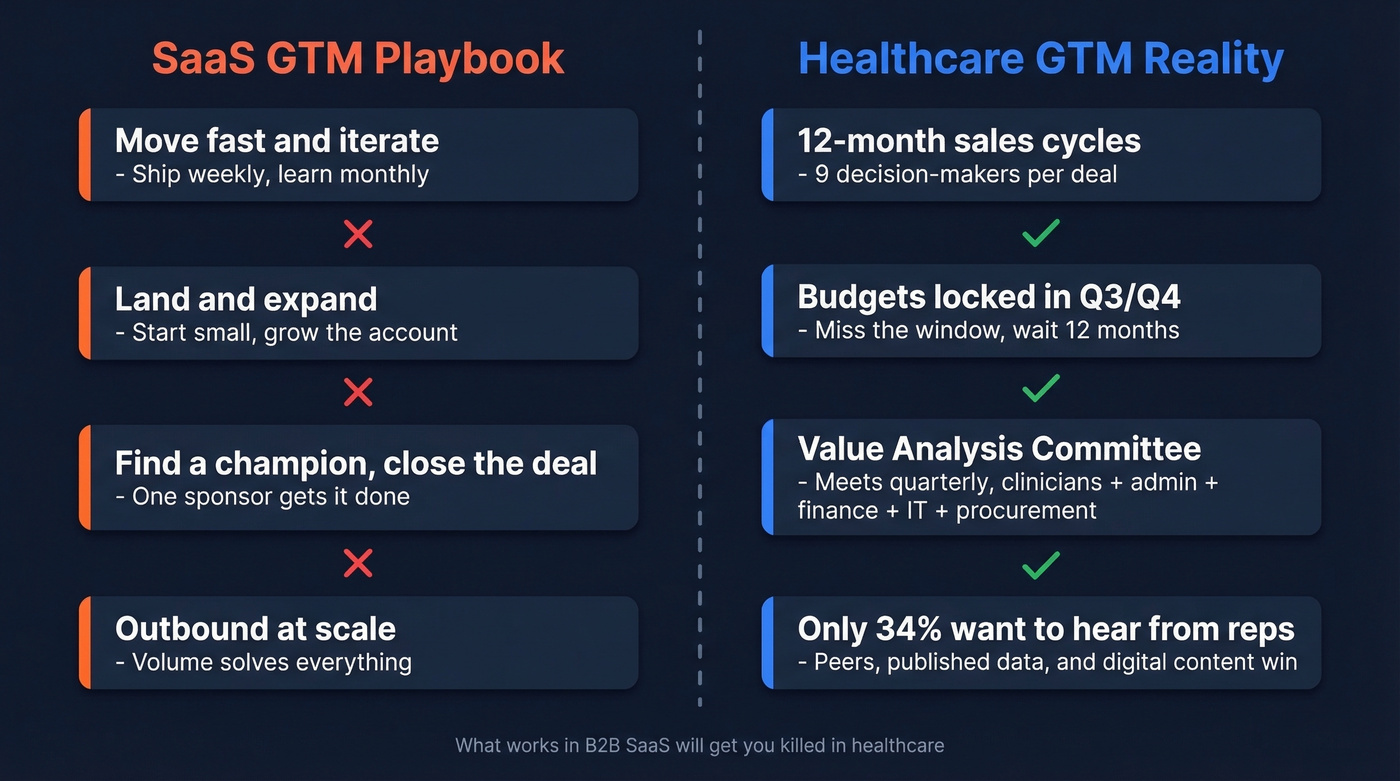
"Move fast and iterate" - Healthcare deals average roughly 12 months with about 9 decision-makers. Even a $10K clinic software sale can take 60-90 days.
"Land and expand" - Hospital budgets are typically finalized in Q3/Q4 for the following fiscal year. Miss that window and you're waiting 12 months.
"Get the champion, close the deal" - The Value Analysis Committee meets quarterly. Your champion is one voice among clinicians, administrators, finance, IT, and procurement.
"Outbound at scale" - Only 34% of hospital executives prefer receiving product info directly from a rep. The rest want peer evidence, published data, and digital content they can review on their own time.
The Healthcare GTM Framework
Stakeholder Mapping
Your buying committee isn't a single decision-maker. It's a Value Analysis Committee with distinct personas, each evaluating your product through a completely different lens:
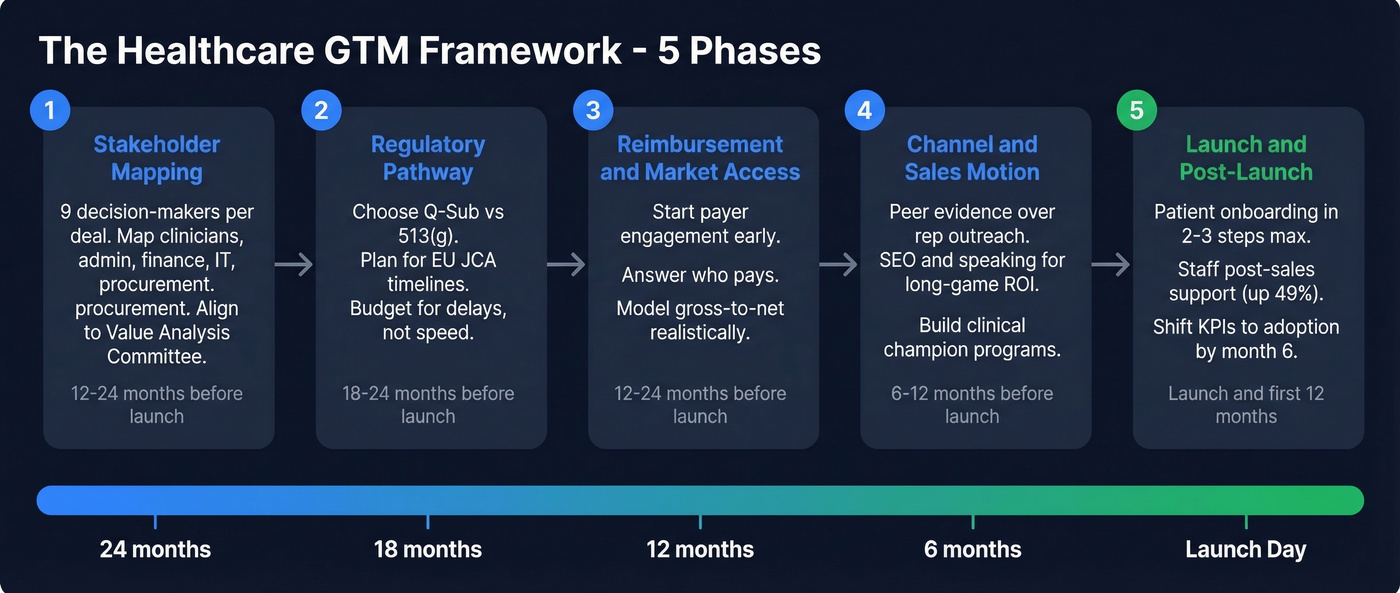
- Clinicians care about outcomes and workflow impact
- Administrators care about operational efficiency
- Finance and procurement care about total cost of ownership and GPO contract alignment
- IT cares about security, HIPAA compliance, and integration burden
Getting on a GPO contract can unlock access to dozens of facilities at once. And with the shift to value-based care, your pitch must center outcomes and total cost of care, not features. If you walk into a Value Analysis Committee meeting leading with product specs, you've already lost the room.
Regulatory Pathway Planning
This is where teams burn months and hundreds of thousands of dollars making the wrong choice early.
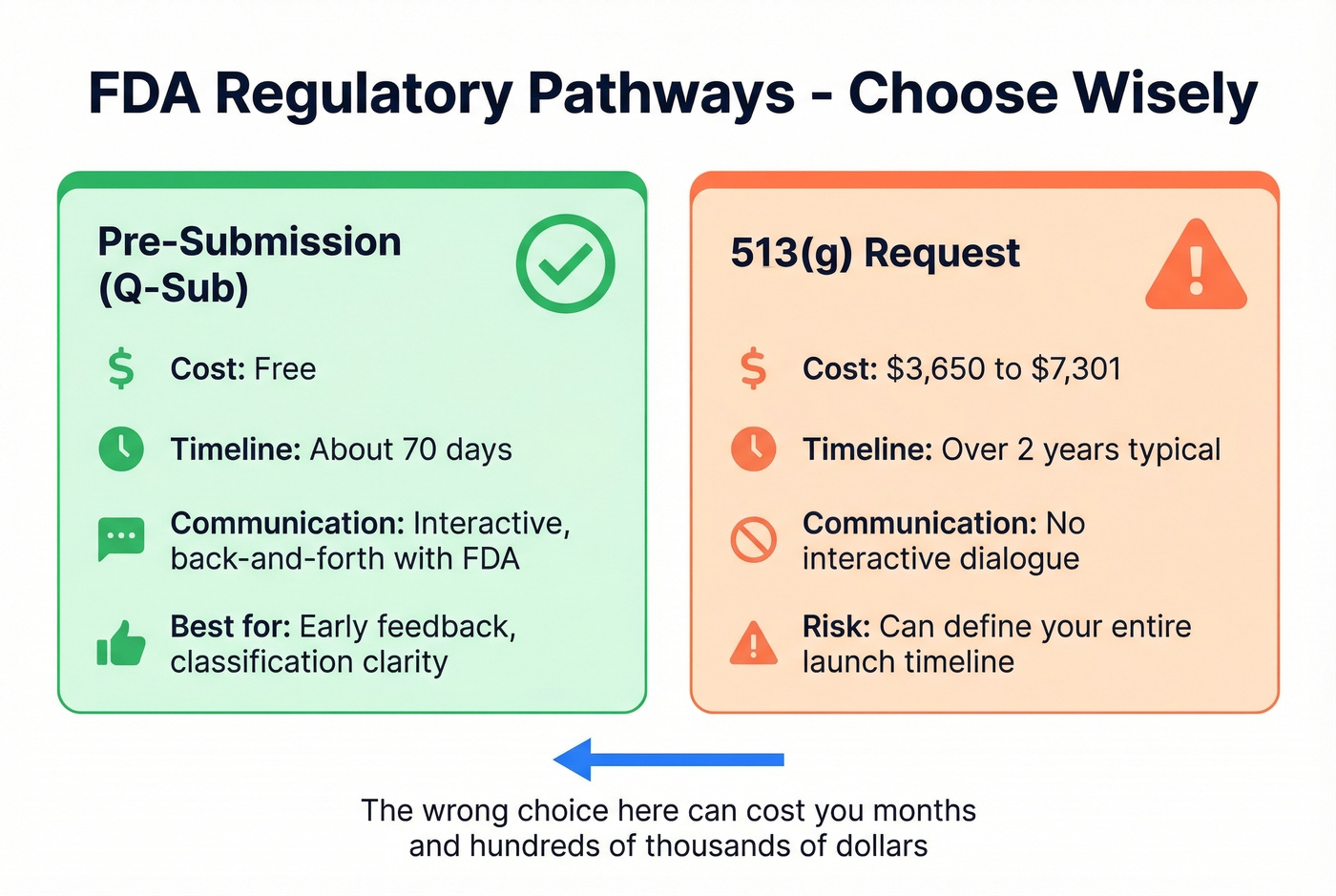
A Pre-Submission (Q-Sub) meeting with FDA is free, interactive, and averages about 70 days for review. A 513(g) request costs $3,650-$7,301 and typically takes over two years with no interactive communication. The difference between those two paths can define your entire launch timeline.
For EU launches, the Joint Clinical Assessment process went live January 12, 2025 for oncology and ATMPs. Predicted 2025 volume was 25 assessments total (17 cancer medicine JCAs and 8 ATMPs); actual was 10. Plan for regulatory timelines to stretch, not compress.
Reimbursement and Market Access
Start payer engagement 12-24 months before launch. This isn't negotiable.
For diagnostics and precision medicine, payers are tightening requirements - expect DEX Z-codes, automated denials, and lab benefit managers controlling utilization. You need to articulate clinical utility and medical necessity with evidence that satisfies coverage criteria, not just clinical trial endpoints.
For digital health, the first question is simpler and harder: who pays? Payers, employers, providers, or patients? Don't over-index on payer reimbursement. US payers often treat digital therapeutics as programmatic spend at steep discounts. We've seen teams build entire GTM plans around payer contracts that ultimately paid 40% of what they modeled.
Channel and Sales Motion
Rep-driven sales alone won't cut it. Your launch needs peer-reviewed evidence, digital content, webinars, and clinical champion programs working in parallel.
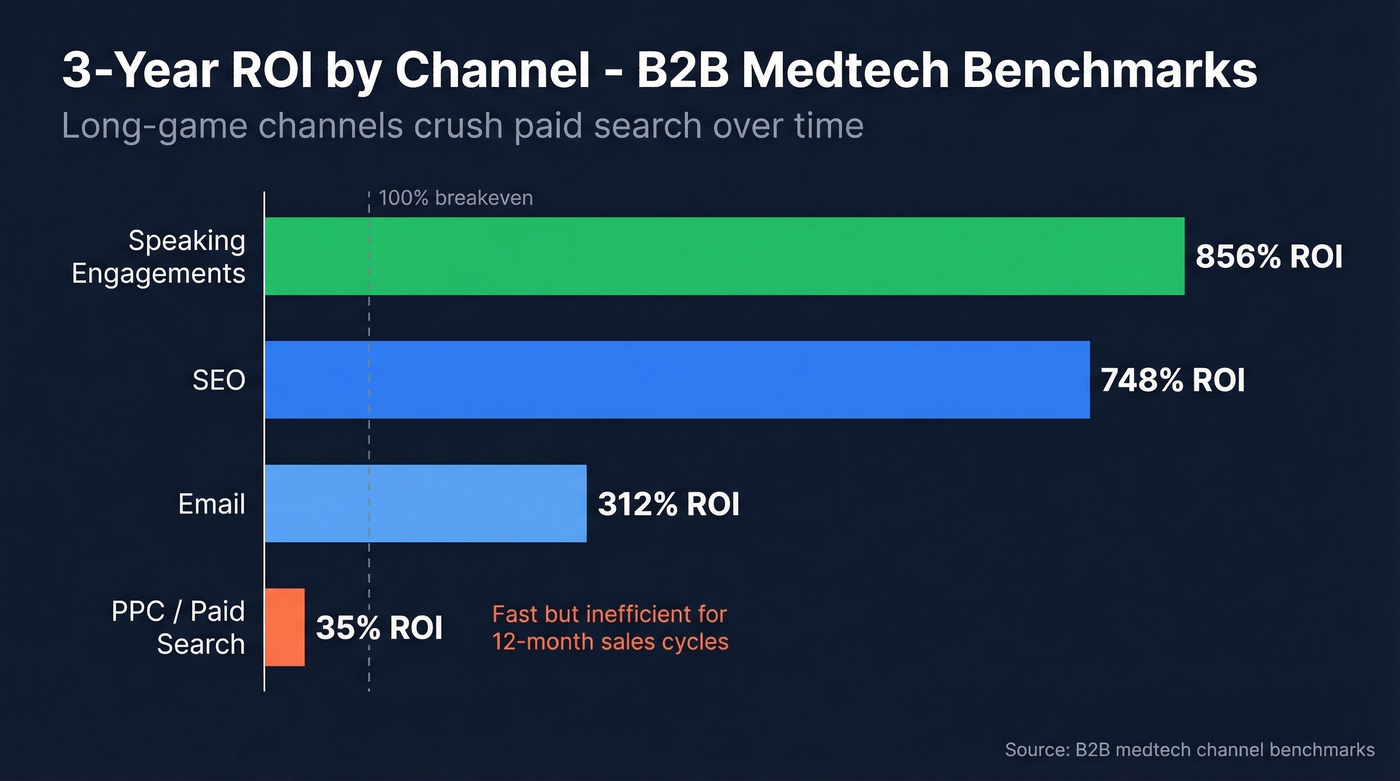
In B2B medtech channel benchmarks, SEO and speaking engagements are the long-game winners on 3-year ROI (SEO: 748%; speaking engagements: 856%), while PPC is fast but far less efficient over time (35% ROI). Email sits in the middle at 312% ROI. Build your channel mix accordingly, and don't let anyone tell you paid search is the primary growth lever for a 12-month sales cycle.
Lead generation roles are the #1 demand gen investment category for digital health executives right now.
Launch Execution and Post-Launch
Patient onboarding should be 2-3 steps maximum - landing page, QR code, app store. Every additional step bleeds activation rates, especially with older patients or low digital literacy populations.
Post-sales support headcount investments are up 49%, so staff accordingly. Compliance infrastructure - Sunshine Act reporting, DSCSA, gross-to-net modeling - isn't an afterthought. These are audit triggers that can derail a launch quarter. And within 6 months of launch, shift your KPIs from awareness metrics like CPL and MQLs to adoption and retention metrics. The teams that keep measuring top-of-funnel at month nine are the ones wondering why their year-one revenue missed by half.

Healthcare buying committees average 9 stakeholders - clinicians, administrators, finance, IT, procurement. Bad contact data doesn't just bounce emails, it burns 12-month sales cycles. Prospeo's 300M+ profiles with 98% email accuracy and 125M+ verified mobile numbers let you reach every member of the Value Analysis Committee with data refreshed every 7 days, not 6 weeks.
Stop losing years to outdated hospital contact data.
GTM by Segment
| Dimension | Pharma | Medtech | Digital Health |
|---|---|---|---|
| Sales cycle | 12-24 months | 6-18 months | 3-12 months |
| Primary buyer | Payers + HCPs | VAC committee | Multiple (see below) |
| Reimbursement | CMS/payer coverage | Hospital capex/opex | "Who pays?" framework |
| Key GTM risk | Access + formulary | KOL overreliance | No single buyer |
Here's the thing: don't over-rely on KOL endorsement as your primary GTM lever. Early adopter physicians aren't representative of the broader market. Build direct insight loops with end users - patients and frontline clinicians - the way consumer goods companies do. Skip this approach if your entire commercial strategy depends on a handful of key opinion leaders saying nice things at conferences.
Benchmarks That Matter
| Metric | Healthcare Avg | Top Performer Target |
|---|---|---|
| B2B CPL (overall) | $377 | $130-$400 (varies by segment) |
| Conversion rate | 6.8% | 10%+ |
| B2B sales cycle | 6-12 months | 3-6 mo (digital health) to 12 mo (pharma) |
| Lead response time | 47 hours | Under 2 hours |
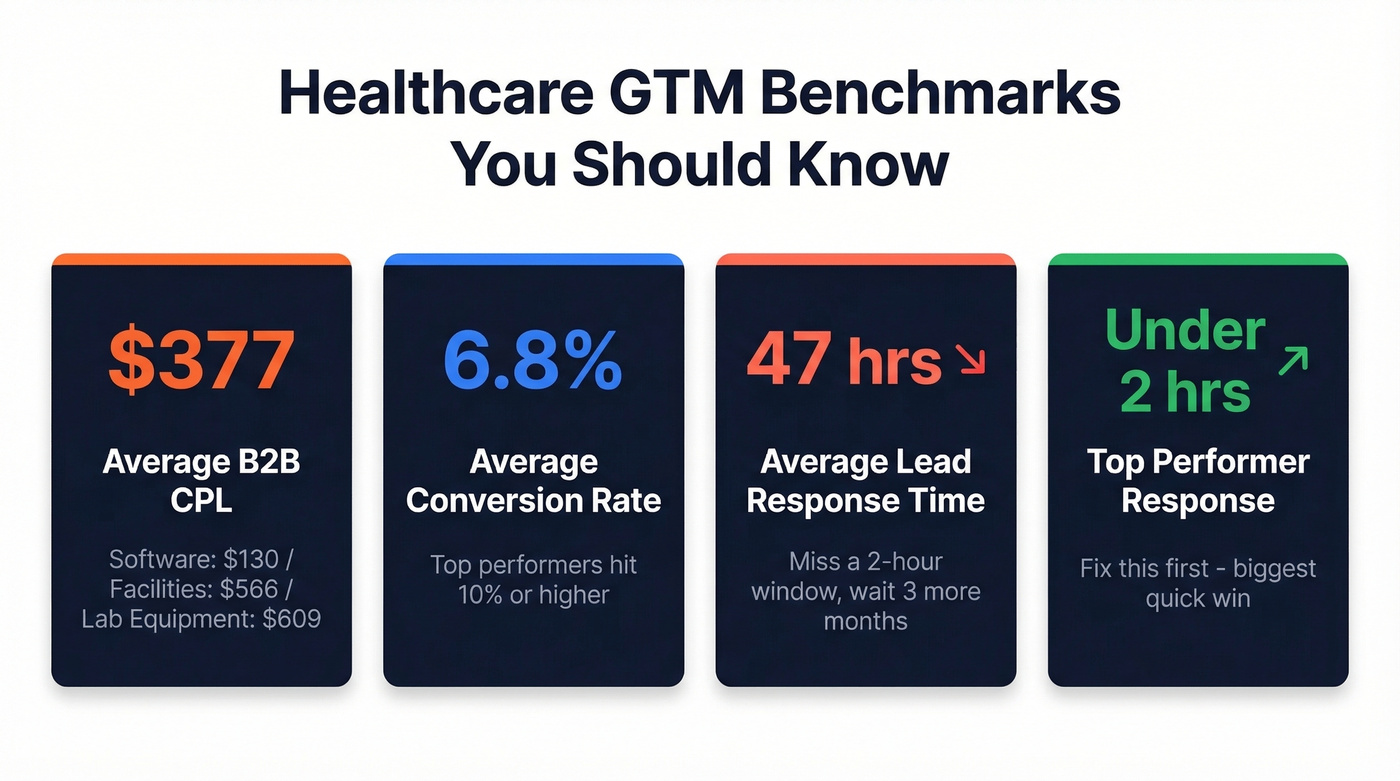
Segment CPL ranges: healthcare software sits around $130, medical facilities around $566, and medical/lab equipment around $609.
That 47-hour average lead response time is brutal. In a market where buying windows are narrow and committee meetings are quarterly, responding in two days instead of two hours means waiting another three months. If you take one thing from this section, fix your response time first.
Building Your Prospect List
The biggest risk in healthcare GTM isn't competition or product-market fit. It's bad data.
You're selling into a committee of nine with a 12-month cycle. If your contact data is wrong, you don't just lose a deal - you lose a year. Healthcare roles turn over fast, generic databases go stale within weeks, and the people you need to reach - clinical directors, VP of supply chain, CISO, CFO - aren't easy to find with accurate contact information.
Prospeo's B2B database covers 300M+ professional profiles with 143M+ verified emails at 98% accuracy and a 7-day data refresh cycle versus the 6-week industry average. The 30+ search filters include buyer intent signals powered by Bombora across 15,000 topics, so you can identify which health systems are actively researching solutions in your category before you spend a single outbound credit. Pair that with 125M+ verified mobile numbers at a 30% pickup rate, and your reps have a real shot at reaching the CFO or VP of IT who'll never respond to a cold email.
Before you push any list into your CRM, run it through data enrichment and basic lead enrichment so titles, departments, and locations are usable for routing.
Then, operationalize outreach with sales prospecting techniques and a tight sales follow-up system so quarterly committee calendars don't kill momentum.
Your GTM timeline is already 12-24 months. Don't waste it outbounding into dead-end contacts. Prospeo's 30+ search filters - including department headcount, job changes, and technographics - let you pinpoint the exact clinical champions, procurement leads, and C-suite buyers inside health systems. At $0.01 per verified email, you'll spend less on data than a single failed hospital meeting costs in travel.
Reach the right 9 people before your competitor reaches the wrong 90.
FAQ
How long does a healthcare GTM launch typically take?
12-24 months from strategy to first revenue is standard. A 510(k) device with existing reimbursement codes moves faster (6-9 months to first PO); a novel diagnostic requiring new coverage determinations sits at the longer end.
What's the biggest mistake in a go-to-market strategy for healthcare?
Treating reimbursement as an afterthought. Payer engagement should start 12-24 months pre-launch. Teams that wait until post-approval lose at least one full budget cycle and often miss their year-one revenue targets by 40% or more.
How do I find verified contacts for healthcare buying committees?
Use a B2B data platform with healthcare-specific filters and a weekly data refresh cycle. Roles like clinical directors and supply chain VPs change seats frequently, so stale data from monthly or quarterly refresh providers will burn your outbound budget fast.