

What Reddit Actually Says About Go-to-Market Strategy
You're three weeks from launch, your deck has 47 slides about "market positioning," and you still don't know how you're getting your first 50 customers. That's the vibe in go-to-market strategy threads across r/startups, r/sales, r/ycombinator, and r/ProductMarketing. The top-voted post on r/sales literally asks: "Are GTM strategies always BS?"
Reddit's right - most of them are. Not because strategy is useless, but because most "strategies" are channel lists dressed up in a slide deck.
What GTM Actually Means
A go-to-market strategy isn't a marketing plan. A GTM strategy answers a harder question: how does this product reach the people who'll pay for it, through what motion, at what price, and in what order?
The Ansoff Matrix is a quick gut-check. Selling an existing product to existing customers? You need a marketing plan. Entering a new market or launching something new? You need a real GTM strategy. People ask the basic question constantly - like this r/ProductMarketing thread: "maybe this has been asked... what is a GTM strategy?" The cleanest definition we've found: GTM is the sequence of bets you make about who buys first, what they buy, how you reach them, and what has to be true for the motion to scale.
GTM Motions Reddit Recommends
| GTM Motion | Best For | Example | Key Risk |
|---|---|---|---|
| Product-led | Self-serve <$100/mo | Atlassian, Slack | Slow monetization |
| Sales-led | Enterprise, complex | Salesforce | High CAC, long cycles |
| Outbound-led | B2B with clear ICP | Ramp | Data quality, domain burn |
| Community-led | Dev tools, prosumer | HubSpot (early) | Hard to scale |
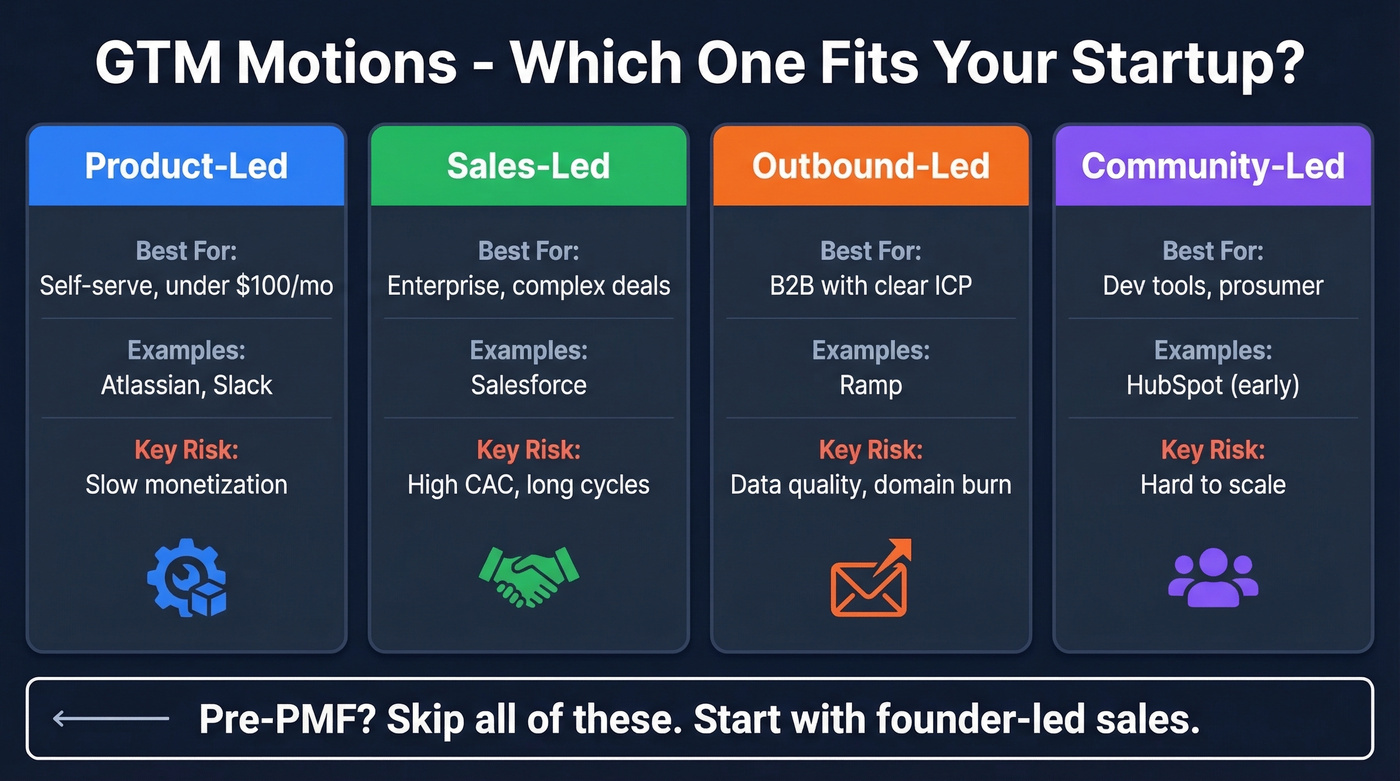
Product-led works when the product sells itself. Atlassian spends 47% of revenue on R&D versus just 16% on sales and marketing - a ratio that only holds if the product drives adoption bottom-up.
Sales-led is the default for enterprise, but it's expensive. Average sales rep tenure sits around 18 months, which means constant retraining. If your deal size can't absorb that churn cost, this motion bleeds you dry.
Outbound-led is the favorite for B2B startups because it's fast, measurable, and doesn't require a brand. Community-led is powerful but slow - the right play for dev tools where trust matters more than speed.
Here's the thing: if you're pre-PMF, your GTM strategy is three words - founder-led sales. Every other motion assumes you already know who buys and why. We've watched dozens of teams skip this step and burn through six figures learning what ten founder conversations would have revealed for free. An r/ycombinator poster put it perfectly: "Our SaaS is almost ready but I'm worried about GTM" - and the answer every time is to sell it yourself first.

Reddit's right - outbound GTM collapses without verified data. Prospeo refreshes 300M+ profiles every 7 days (not 6 weeks like competitors), so your sequences hit real inboxes. Meritt tripled pipeline from $100K to $300K/week after switching.
Stop rewriting sequences when the real problem is stale data.
The Numbers Behind GTM in 2026
The economics of customer acquisition have gotten brutal. [B2B SaaS CAC averaged $1,200](https://firstpagesage.com/reports/b2b-saas-customer-acquisition-cost-2024-report/) as of recent benchmarks - up 222% over eight years. The median company spends $2.00 to acquire $1 of new ARR. Fourth-quartile companies? $2.82 per dollar. That's not a business model, that's a bonfire.
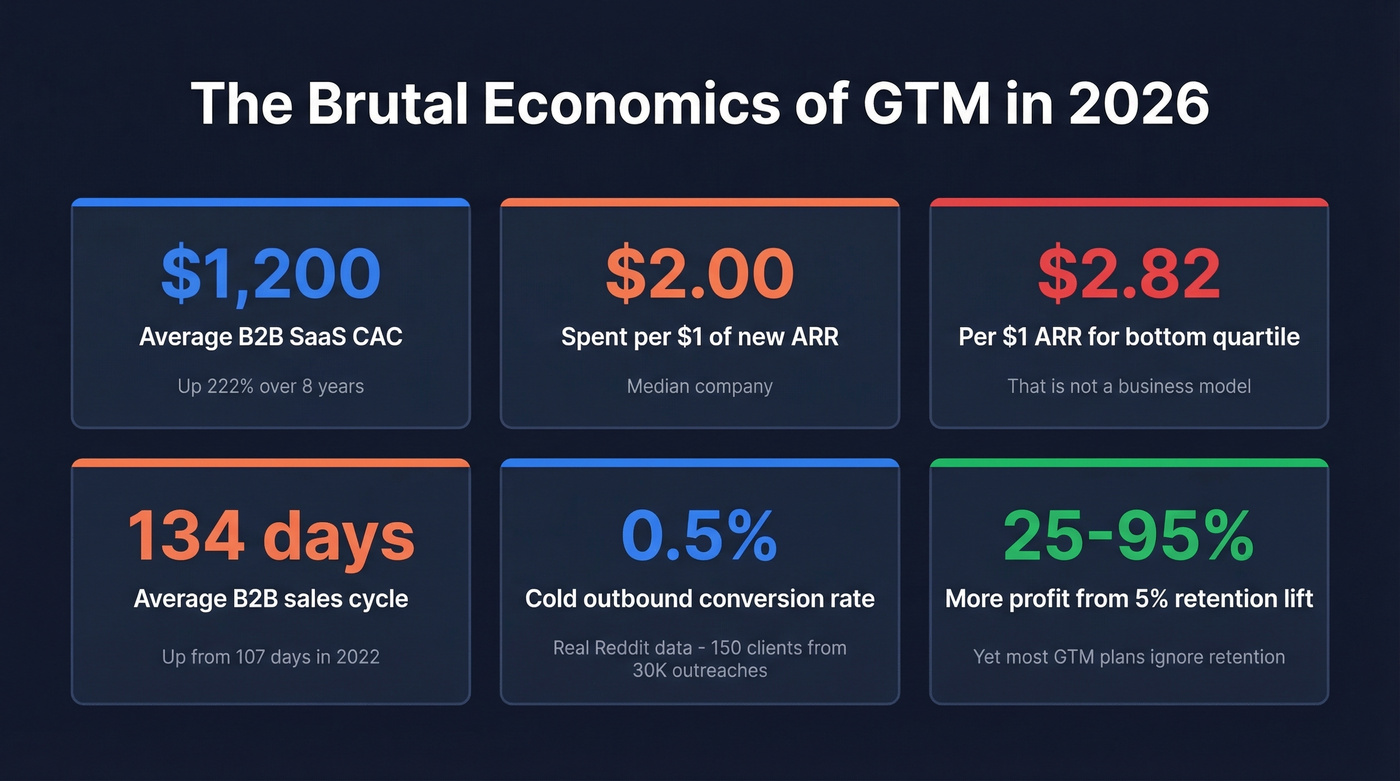
Let's break down the outbound math with a real example. One r/sales poster reported 150 clients from 30,000 outreaches over roughly four months, each on ~£6,500/year contracts with three-year terms. That's a 0.5% conversion rate and about £975,000/year in annualized contract value - roughly £2.925M in total contract value across three years. The catch? It only works with verified contact data. Bad emails bounce, burned domains kill deliverability for months, and the whole motion collapses. If you're troubleshooting bounces, start with email bounce rate benchmarks and fixes.
Sales cycles compound the problem. The average B2B cycle now runs [134 days, up from 107](https://salesperformance.com.au/saas-sales-trends-2025/) in early 2022. Yet a 5% improvement in retention drives 25-95% more profit. Most GTM plans on Reddit focus exclusively on acquisition and ignore expansion entirely - a massive blind spot. If you want a tighter definition of CAC (and what to include), see cost to acquire customer.
Outbound GTM at Scale
Ramp hit $1B ARR in September 2025 with 130+ SDRs generating 75% of future SQLs through outbound. Their system runs 200 experiments per quarter with a two-day MVP rule: if you can't ship it in 48 hours, cut scope until you can. Their average SDR books 3-4x as many meetings as the next closest competitor.
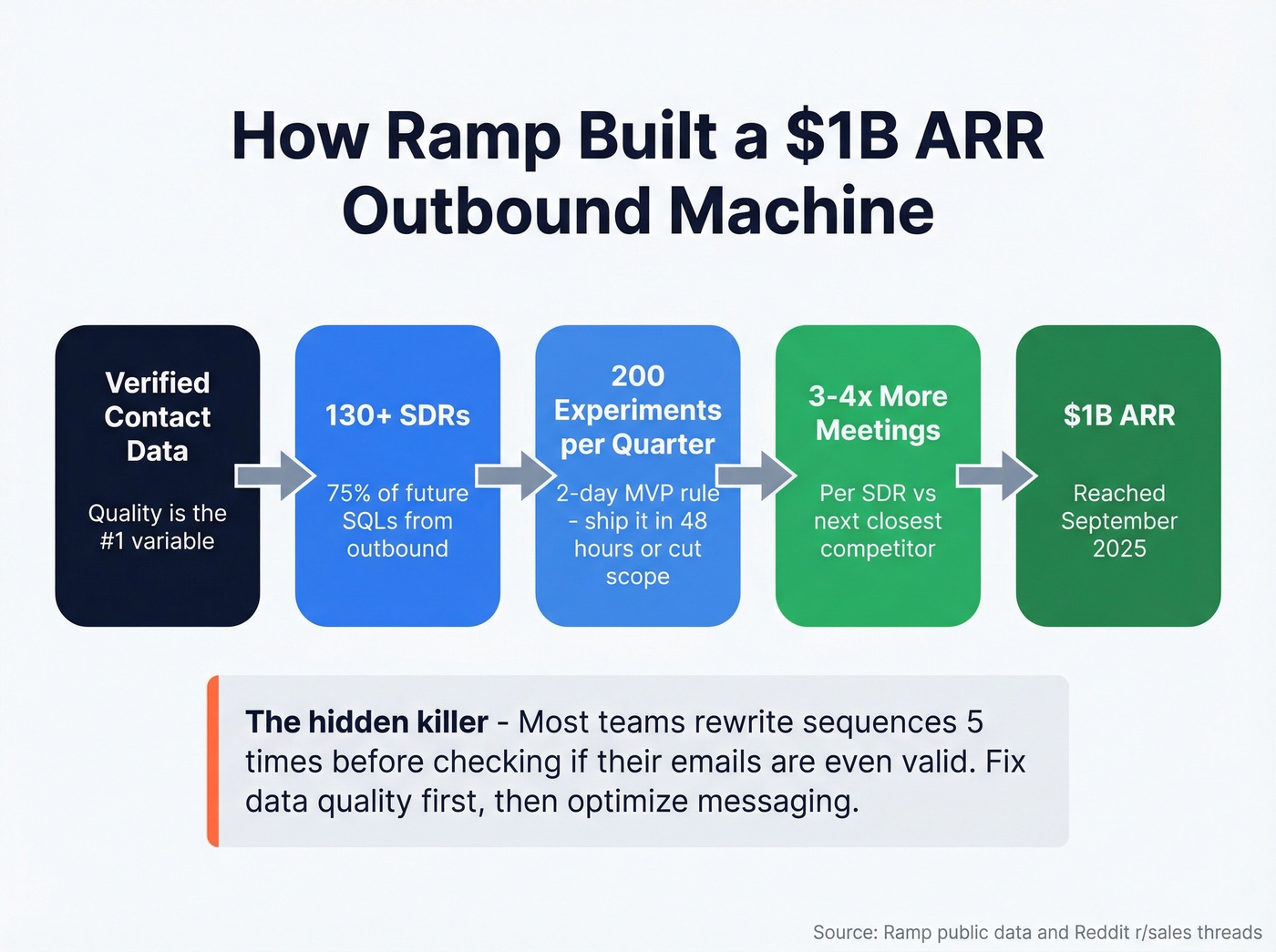
Why does Ramp's system work? They obsess over data quality. In our experience, that's the single variable that separates outbound teams that scale from those that stall. Most teams run experiments on messaging and timing but feed those experiments with stale contact data and wonder why nothing converts. I've seen teams rewrite sequences five times before anyone thinks to check whether the emails they're sending to are even valid. If you're building the motion, a solid starting point is a B2B cold email sequence you can iterate on.

For teams running outbound at volume, Prospeo's 7-day data refresh cycle and 98% email accuracy directly address this. Meritt went from a 35% bounce rate to under 4% after switching, and their pipeline tripled from $100K to $300K per week. If you're evaluating vendors, compare options across data enrichment services and best B2B company data providers.
GTM Mistakes That Sink Startups
Some of these show up in every Reddit thread. Others we've learned the hard way.
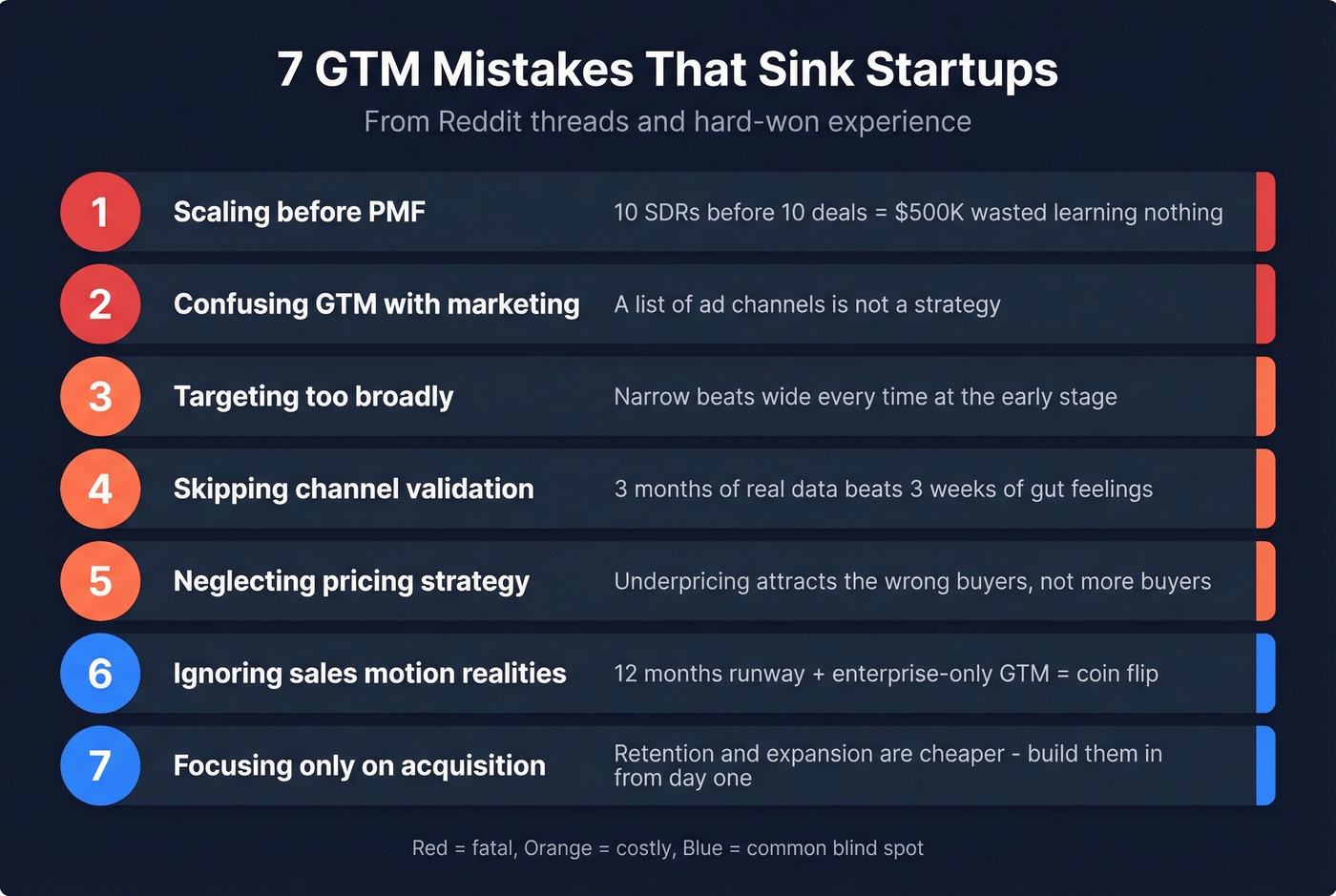
Confusing GTM with marketing. GTM includes pricing, sales motion, and channel strategy - marketing is one piece of it. If your "GTM plan" is a list of ad channels, you don't have one. If you're still defining your market size, use an addressable market framework.
Targeting too broadly. Pick a beachhead, dominate it, then expand. The consensus on r/startups is overwhelmingly clear on this: narrow beats wide every time at the early stage. A practical way to do this is an ideal customer profile with scoring.
Skipping channel validation. Test two channels for 90 days before committing budget. Three months of real data beats three weeks of gut feelings.
Neglecting pricing strategy. Underpricing attracts the wrong buyers, not more buyers. If you're afraid to charge what your product is worth, that's a positioning problem, not a pricing one.
Ignoring sales motion realities. Enterprise means procurement, compliance, and six-month eval cycles. If your runway is 12 months, enterprise-only GTM is a coin flip. If you're going upmarket, align expectations with enterprise B2B sales realities.
Focusing only on acquisition. Retention and expansion are cheaper. Build them into your plan from day one, not as an afterthought when churn starts hurting.
Scaling before PMF. Hiring ten SDRs before you've closed ten deals yourself burns $500K learning nothing. Skip this if you haven't personally sold to at least a dozen customers - no amount of headcount fixes a product nobody wants.
The outbound math only works at 98% email accuracy. At 79%, you're burning domains and budget. Prospeo's free tier gives you 75 verified emails/month - enough to validate your GTM motion before scaling headcount.
Test your first outbound sequence with data that actually connects.
FAQ
What's the best GTM strategy for a startup with no budget?
Founder-led sales with cold outreach. Narrow your ICP to one vertical, one persona, one pain point. Reach out to 50 prospects manually, close a few, and learn what language converts before spending a dollar on anything else. A free CRM like HubSpot covers the tooling side.
How long does a go-to-market strategy take to show results?
Outbound GTM needs 90 days minimum for meaningful signal. Product-led growth takes 6-12 months before self-serve revenue compounds. Measure leading indicators - reply rates, demos booked, pipeline created - not just closed revenue.
What tools do you need for outbound GTM?
Three things: a CRM, a sequencer like Instantly or Smartlead, and verified contact data. That's your entire stack to start. Add intent data and enrichment once you've validated your ICP and messaging.