

Uber's Go-to-Market Strategy: The Two-Game Playbook Nobody Talks About
A RevOps lead once told me that Uber's go-to-market strategy was "just referral codes and free rides." That's like saying Amazon's strategy is "free shipping." Uber operates in 10,500+ cities across 70 countries, serves 131 million monthly active users, and has built one of the most complex market-entry machines in business history - a machine that didn't come from promo codes alone. It came from running two simultaneous games: one to build a marketplace, one to win a political war. Most GTM breakdowns only cover the first.
Ask any founder community about Uber's GTM and you'll hear "subsidies and network effects." That answer covers maybe 40% of the story.
The Two-Games Framework
A Strategic Management Journal study analyzing Uber's entry into four U.S. cities found something most case studies miss: Uber didn't just play the market game. It played a non-market game simultaneously - and the non-market game was often more decisive.
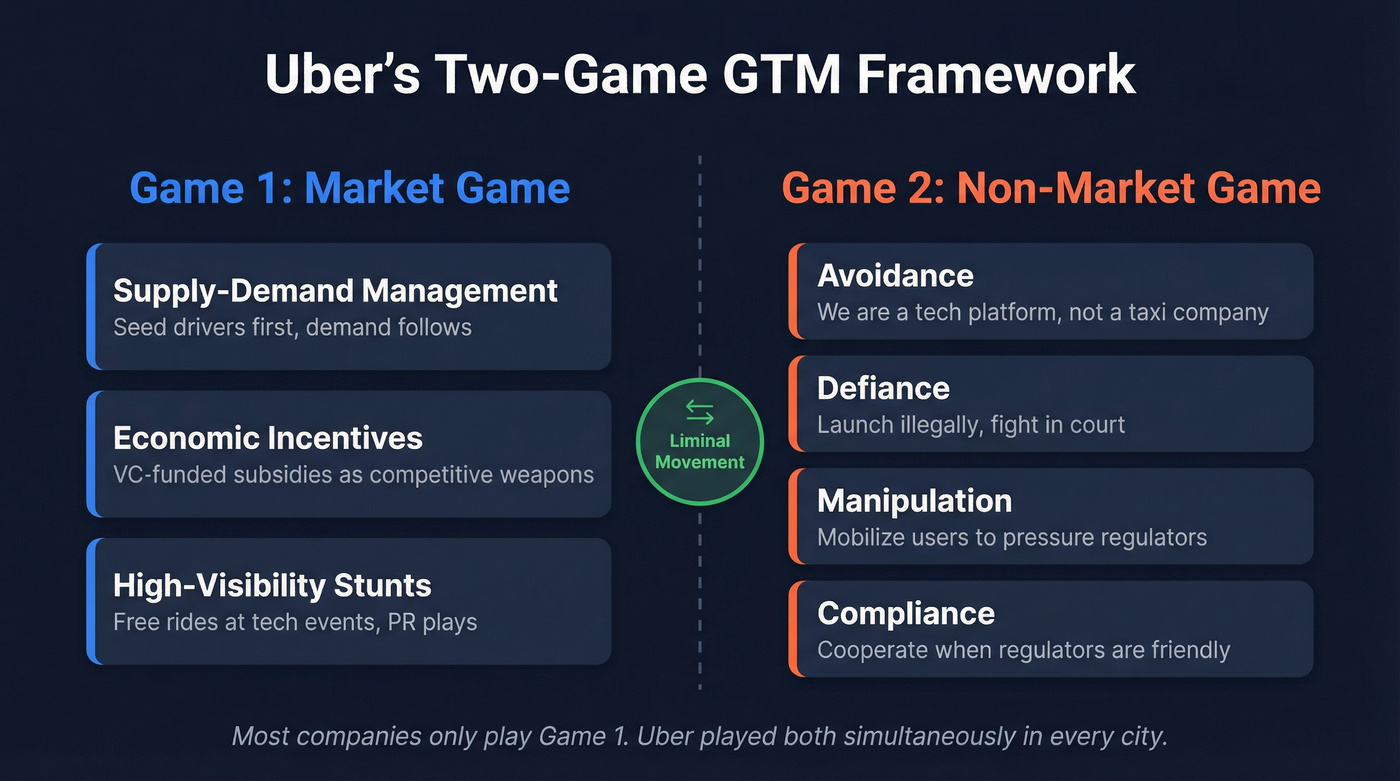
The market game ran on three strategies: supply-demand management, economic incentives, and high-visibility stunts. The non-market game ran on four: avoidance, defiance, manipulation, and compliance. Researchers called Uber's ability to shift between these tactics "liminal movement" - constantly adapting its posture based on which regulators were friendly and which weren't. Most companies treat regulation as a wall. Uber treated it as a variable.
Game 1: Building the Marketplace
Seeding Supply First
Uber understood the chicken-and-egg problem cold. No riders without drivers, no drivers without riders. So they broke the deadlock on the supply side.
Early tactics included $1,000 sign-up bonuses, free phones for drivers, the Xchange leasing program that helped even low-credit-score drivers get vehicles, and targeting Silicon Valley tech events with free rides. The goal wasn't profitability. It was liquidity. Get enough drivers on the road that wait times reliably drop, and the demand side takes care of itself.
Subsidizing Demand
Once supply existed, Uber flooded the demand side with VC-funded fare subsidies, referral programs, and first-ride-free offers. This wasn't a marketing tactic - it was a red ocean strategy where venture capital functioned as a competitive weapon. The reinforcing loop crushed competitors: VC money led to lower prices, which attracted more riders, which attracted more drivers, which strengthened network effects, which attracted more VC money.
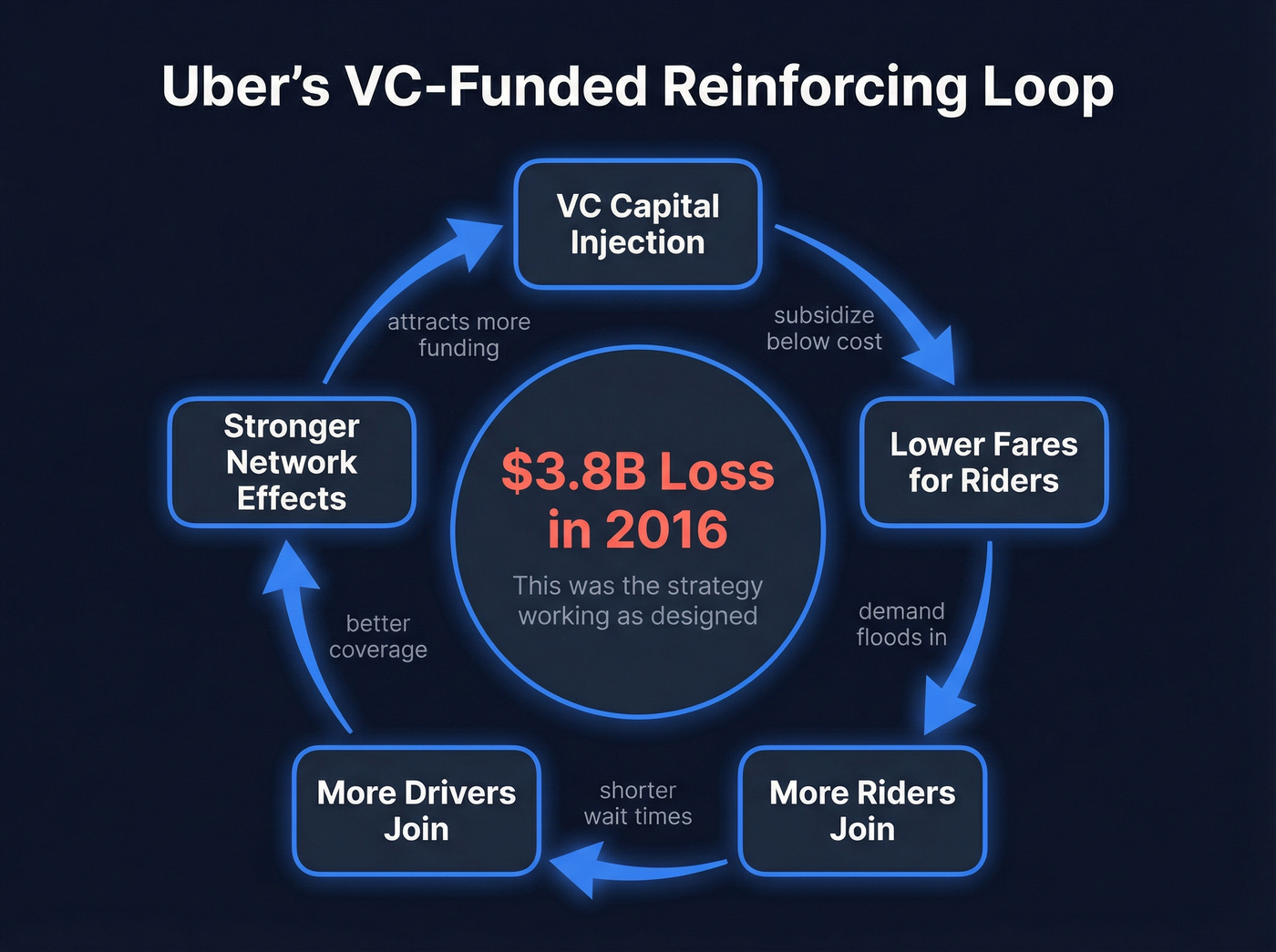
Uber's $3.8B loss in 2016 wasn't a failure. It was the strategy working as designed.
The City Launch Playbook
Uber didn't do one national launch. Every city was its own GTM campaign with a repeatable sequence: enter without permission, frame the service as "transportation technology" rather than a taxi company, seed driver supply with bonuses, subsidize rider fares, then use that rider base as political leverage when regulators pushed back. They even built a tool called Greyball that identified enforcement officials and served them a fake version of the app to avoid sting operations.
Each city had different regulations, different incumbents, different political dynamics. The playbook was consistent; the execution was hyper-local.

Uber's city launch playbook worked because they flooded supply before chasing demand. Your GTM needs the same discipline - pipeline first, everything else second. Prospeo gives you 300M+ profiles with 98% email accuracy and 30+ filters to target by intent, technographics, and headcount growth.
Launch your GTM on data that actually connects you to buyers.
Game 2: Winning the Political War
Operation Rolling Thunder
Washington, D.C., 2012. The city council proposed new rules that would've crippled Uber's model - accessibility requirements, a price floor, the works. Uber's response was a campaign called "Operation Rolling Thunder." In 24 hours, Uber users sent 50,000 emails and 37,000 tweets opposing the regulations. The next day, key provisions were removed.
The mantra, per former Uber lobbyist Mark MacGann: "Don't ask for permission, just launch, hustle."
The Four Regulatory Plays
Uber deployed four distinct approaches depending on the city:
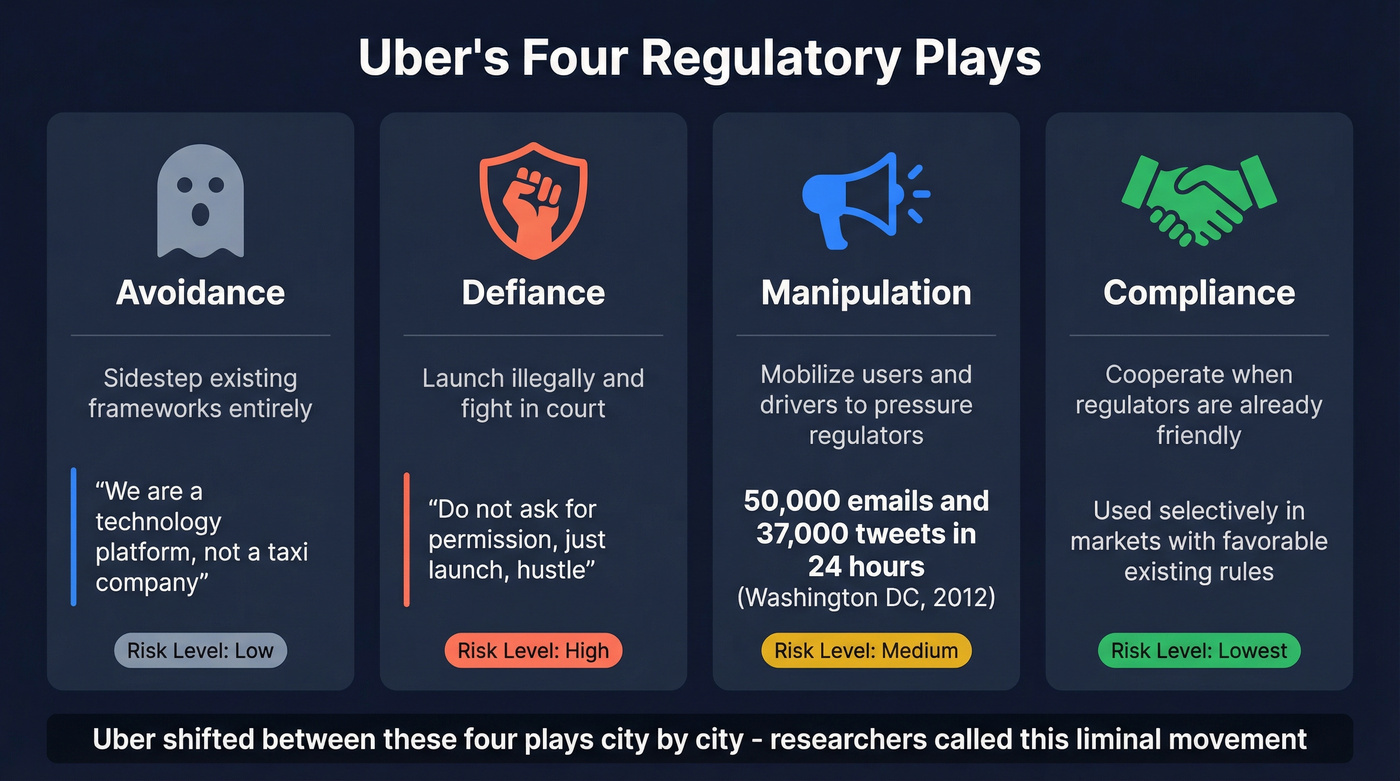
- Avoidance - "We're a technology platform, not a taxi company," sidestepping existing frameworks entirely
- Defiance - Launching illegally and fighting in court
- Manipulation - Mobilizing users, drivers, and sympathetic stakeholders to pressure regulators
- Compliance - Cooperating when regulators were already friendly
By 2016, Uber had spent $1.36M on federal lobbying alone and had nearly as many lobbyists as Amazon, Microsoft, and Walmart combined. That's not a marketing budget. That's a political operation.
The Uber Files
"We're just fucking illegal."
That internal message from Uber's head of global comms captures the posture better than any case study. The leaked Uber Files revealed the full scale: 1,850+ stakeholders targeted across 29 countries, 100+ meetings with public officials, and a "kill switch" used in at least six countries to cut server access during government raids.
Here's the thing: we've seen B2B companies treat compliance as an afterthought and pay for it later. Uber's story is the extreme version. The backlash, the leadership crisis, the regulatory crackdowns - all direct consequences of treating defiance as a default. The GTM lesson isn't "break laws." It's that regulatory strategy is a first-class GTM variable, and ignoring it is just as dangerous as over-indexing on it.
Portfolio Discipline: The Uber Eats Rule
If Uber Eats can't reach #1 or #2 market position within 18 months, exit the market. No exceptions. CEO Dara Khosrowshahi killed the "let's try everywhere" instinct and forced capital allocation toward winnable fights.
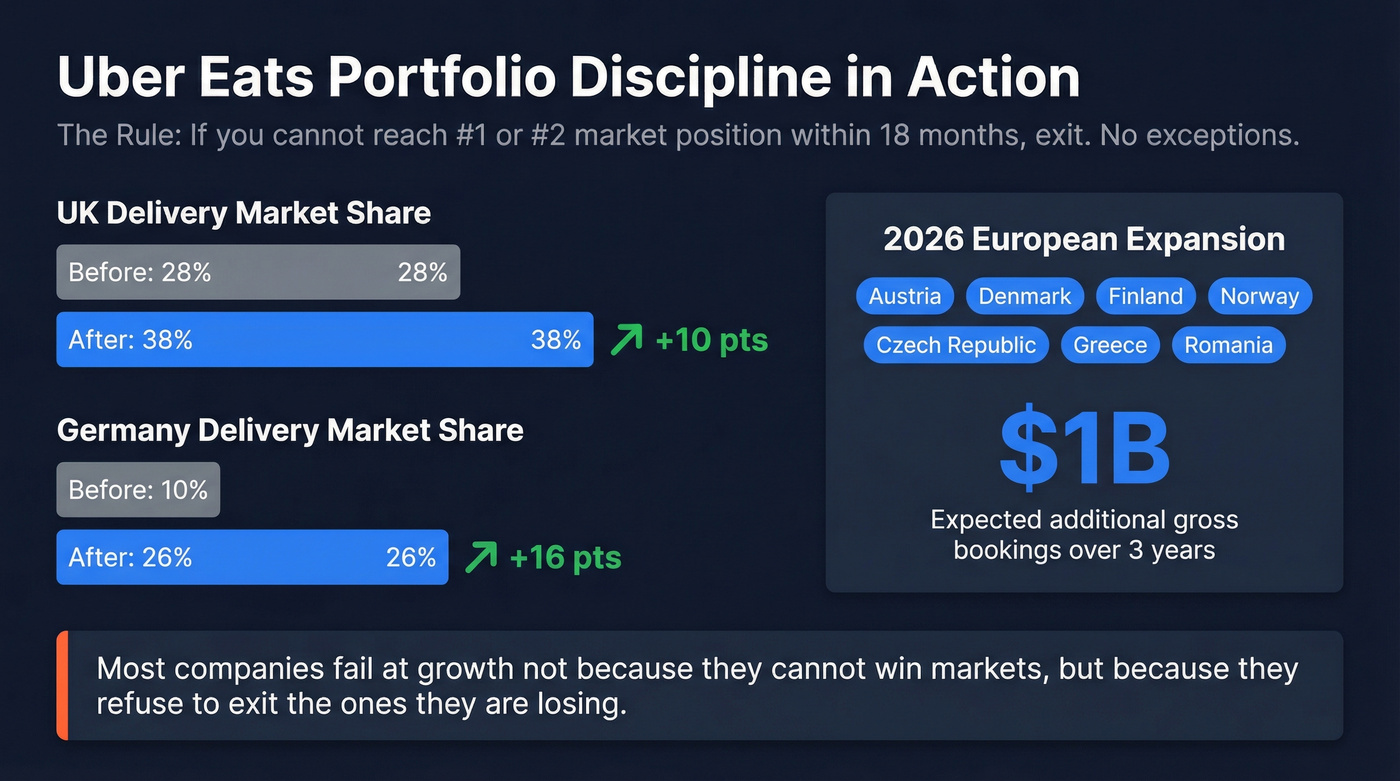
The results speak. In 2026, Uber is expanding delivery into seven new European markets - Austria, Denmark, Finland, Norway, Czech Republic, Greece, and Romania - and expects $1B in additional gross bookings over three years. UK delivery share climbed from 28% to 38%, Germany from 10% to 26%. Portfolio discipline plus aggressive investment in winnable markets is a compounding machine.
Most B2B companies fail at growth not because they can't win markets, but because they refuse to exit the ones they're losing. The #1-or-#2 rule sounds obvious. Almost nobody actually enforces it.
What Uber's GTM Teaches Your Launch
You're not Uber. You don't have $25B in VC funding or a political operation spanning 29 countries. But the structural principles from this go-to-market strategy translate directly.
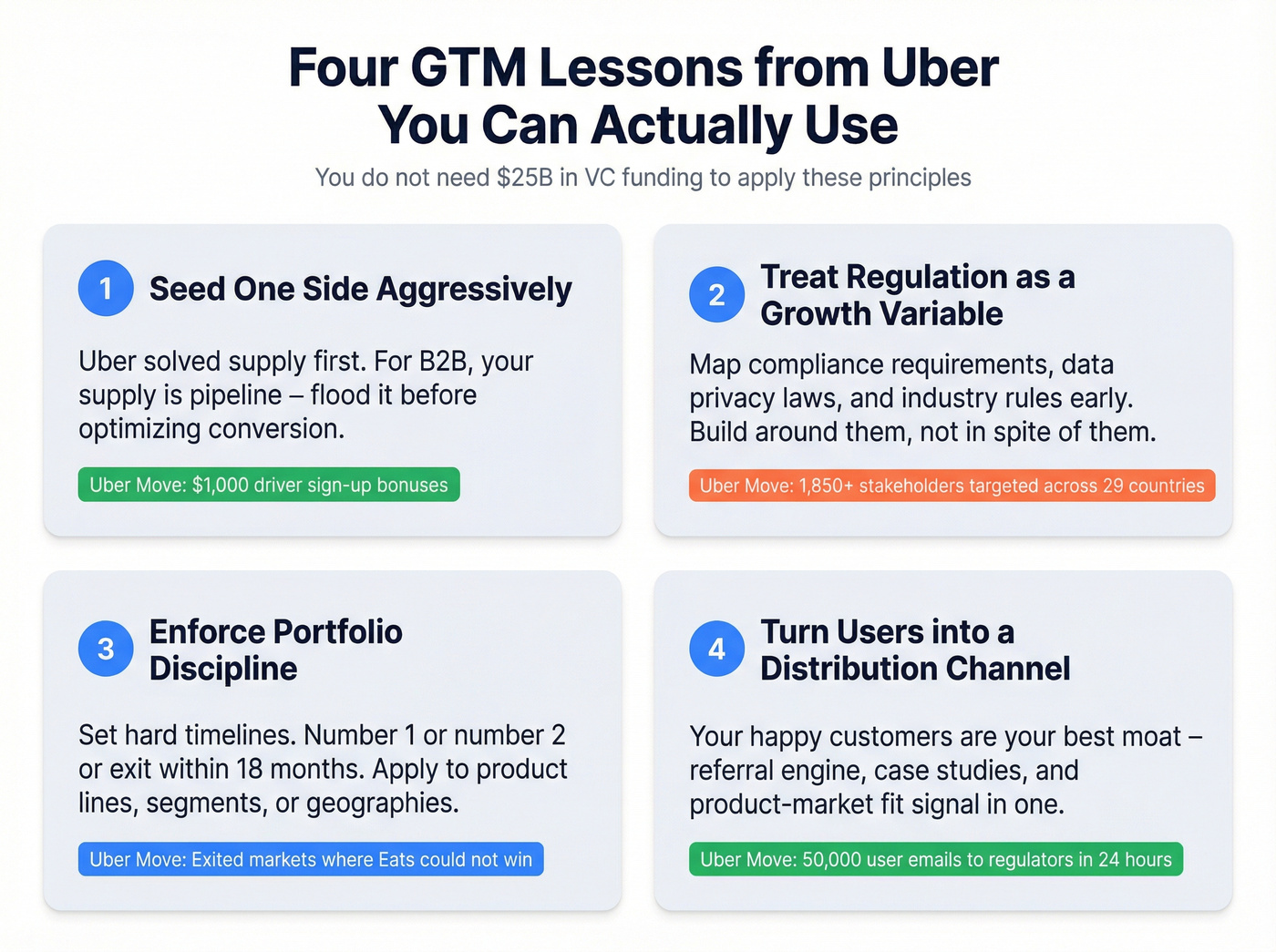
Seed one side of your marketplace aggressively. Uber solved supply first. For B2B, your "supply" is pipeline - flood it before worrying about conversion optimization. That means accurate contact data at scale. Prospeo delivers 98% email accuracy on a 7-day refresh cycle, so your outbound sequences actually land instead of bouncing into oblivion. If you want the mechanics, start with a B2B GTM strategy and then map it into a concrete go-to-market plan.
Treat regulation as a growth variable. Whether it's compliance requirements, data privacy laws, or industry-specific rules, map them early and build your strategy around them, not in spite of them. This is also where go-to-market alignment matters: legal, ops, and sales can't be an afterthought.
Set portfolio discipline with hard timelines. "#1 or #2 or exit within 18 months" is a rule you can adapt to product lines, market segments, or geographic expansion. We've applied this thinking to our own market prioritization and it changed how we allocate resources entirely. If you need a structure, use a go-to-market strategy template and tie it to go-to-market objectives.
Turn your user base into a distribution channel. Uber's riders became its political army. Your happy customers are your best competitive moat - referral engine, case study pipeline, and product-market fit signal rolled into one. In B2B, this often pairs well with account-based marketing tactics once you know your Ideal Customer Profile (ICP).
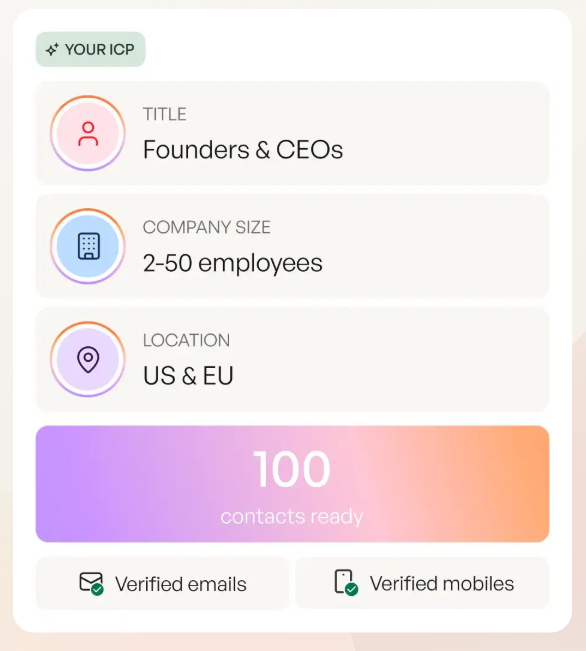
Uber lost $3.8B in a single year subsidizing bad-fit markets before enforcing portfolio discipline. Don't burn budget on bad data. Prospeo's 7-day refresh cycle and 5-step verification mean every contact you reach is current and real - 98% accuracy at $0.01 per email.
Stop subsidizing bounced emails. Start reaching real decision-makers.
FAQ
What is Uber's go-to-market strategy?
Uber runs a two-game GTM: build a two-sided marketplace through subsidies and supply seeding, while simultaneously winning regulatory legitimacy through lobbying, user mobilization, and strategic defiance - executed city by city across 10,500+ markets in 70 countries.
How did Uber enter new cities?
Launch without permission, frame the service as technology, seed driver supply with bonuses and leasing, subsidize rider fares with VC capital, then mobilize riders as political leverage against regulators. Each city ran as its own hyper-local campaign.
What can startups learn from Uber's GTM?
Seed supply before worrying about balance, localize your launch, treat regulation as a variable, and enforce hard portfolio discipline rules. For outbound-led GTM specifically, tools like Prospeo let lean teams flood the pipeline the way Uber flooded driver supply - without burning budget on bad data.
Why did Uber lose $3.8 billion in 2016?
The loss was deliberate, not accidental. Uber used VC capital to subsidize fares below cost, creating a reinforcing loop: cheaper rides attracted more users, which attracted more drivers, which improved the network - making it nearly impossible for competitors to match unit economics at scale.