

How to Build a Go-to-Market Plan That Survives Contact With Reality
The CEO announced the launch date at the all-hands. Eight weeks out. Product's still in beta, pricing hasn't been tested, and sales doesn't know the talk track. You've seen this movie before.
Most go-to-market plans don't fail because the strategy was wrong. They fail because the plan was a 30-page deck nobody executed.
Only 9% of 2,300 companies in a Bain study averaged annual revenue and profit growth of at least 5.5% (while earning their cost of capital) over a decade. The difference wasn't "having a strategy." It was having an integrated go-to-market system that people could actually run - one tight enough to fit on a few pages, specific enough that every team knew what to do Monday morning.
The Whole Plan in Nine Steps
Here's the entire go-to-market plan, each step in one sentence:
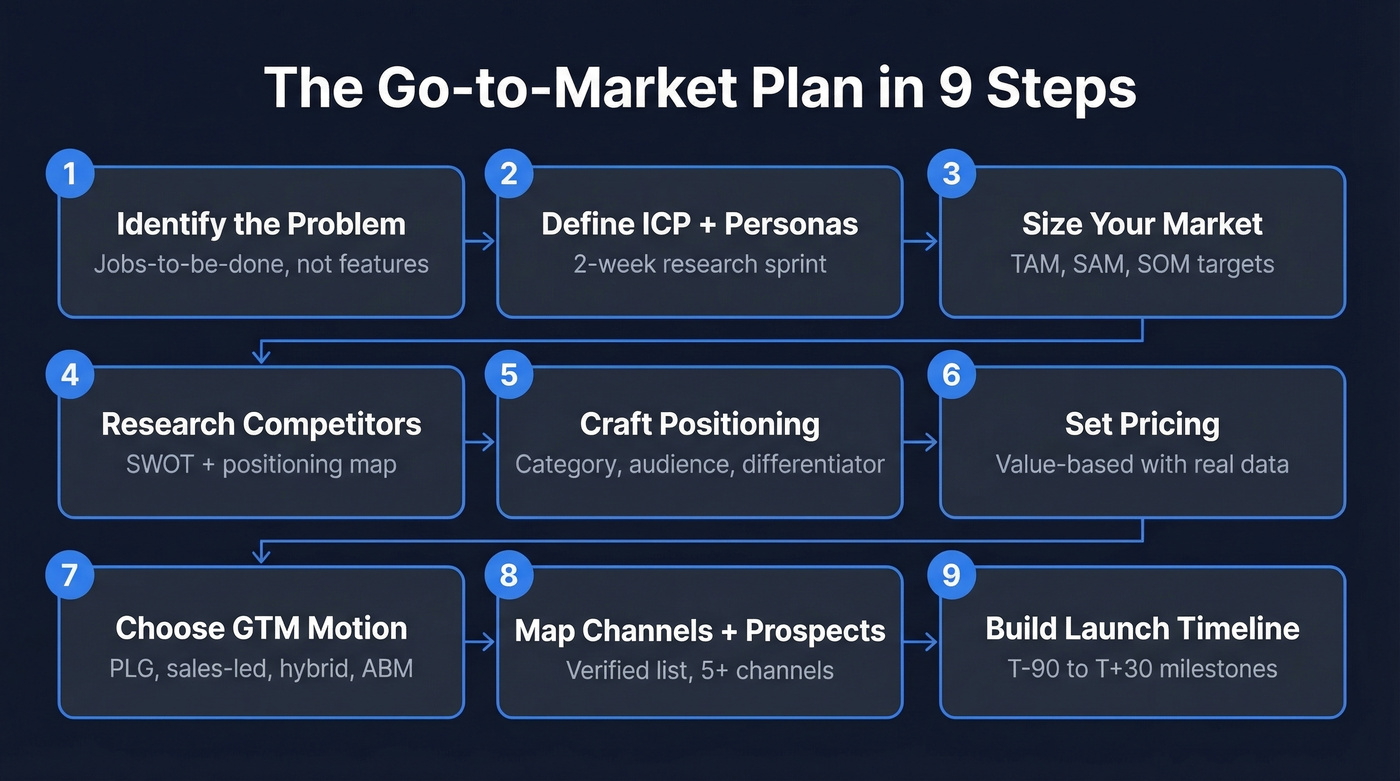
- Identify the problem you solve, not the features you built.
- Define your ICP and buyer personas with time-boxed research.
- Size your market - TAM, SAM, SOM - so targets aren't fiction.
- Research competitors beyond their homepage.
- Craft positioning and messaging your sales team can actually use.
- Set pricing with real willingness-to-pay data.
- Choose your GTM motion: PLG, sales-led, ABM, or hybrid.
- Map channels and build a verified prospect list.
- Build a launch timeline from T-90 to T+30.
Benchmarks worth bookmarking: CAC:LTV ratio of 3:1-5:1, median win rate of 24% (top quartile hits 32%), pipeline coverage at 4.2x for top performers vs. 2.5x median. And the contrarian take worth internalizing: the best GTM plans fit on two to three pages. Everything else is a supporting document.
What Is a Go-to-Market Plan?
A go-to-market plan is the operational document that turns strategy into execution. It answers who you're targeting, what you're saying, where you're saying it, when milestones happen, and who owns each piece. It's not a vision statement - it's a project plan with KPIs, owners, and deadlines.
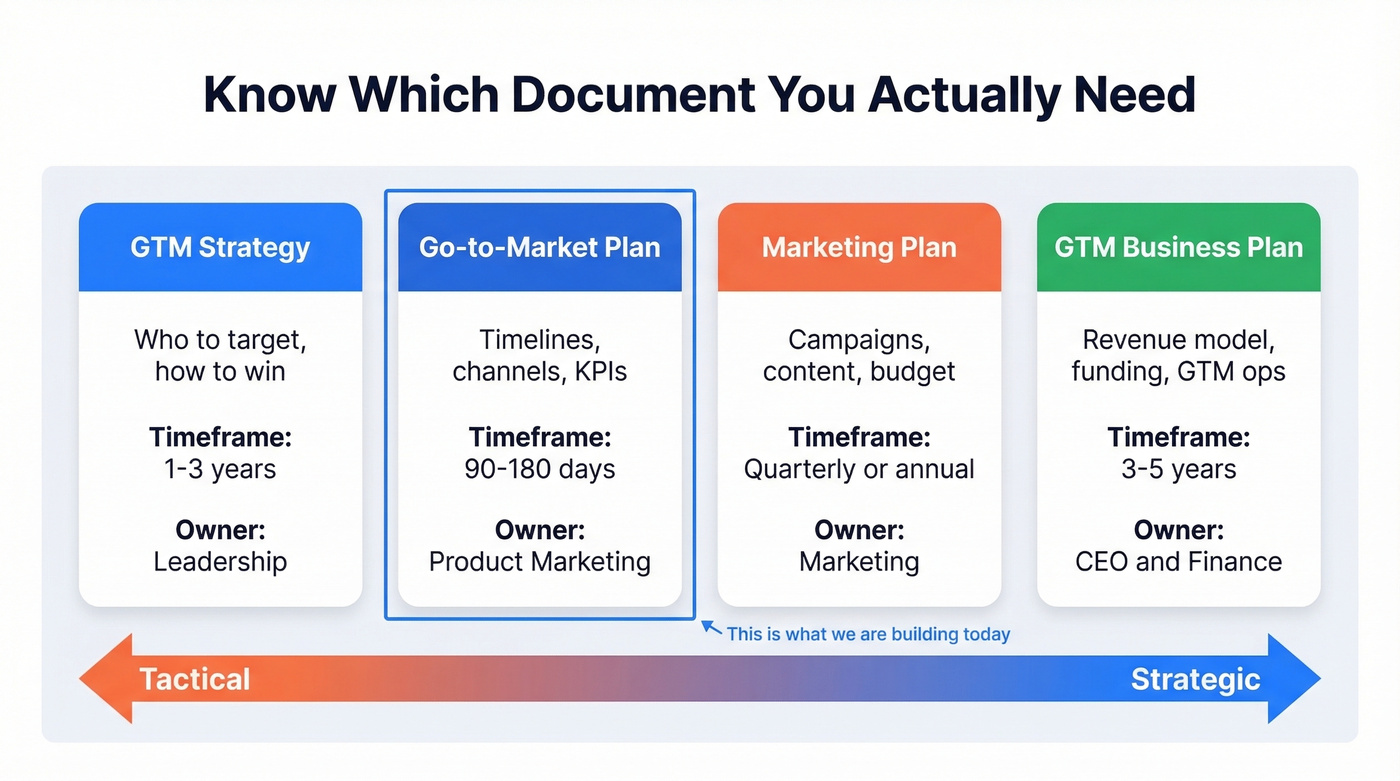
The confusion usually starts with terminology:
| Document | What It Covers | Timeframe | Owner |
|---|---|---|---|
| GTM Strategy | Who to target, how to win | 1-3 years | Leadership |
| Go-to-Market Plan | Timelines, channels, KPIs | 90-180 days | Product Marketing |
| Marketing Plan | Campaigns, content, budget | Quarterly/annual | Marketing |
| Go-to-Market Business Plan | Revenue model, funding, GTM ops | 3-5 years | CEO/Finance |
A marketing-focused GTM plan zeroes in on the demand-gen and campaign layer, while the broader plan coordinates sales, product, CS, and marketing together. The plan matters more than the strategy because 80%+ of mid-market SaaS buyers finalize decisions within six months, often bypassing early vendor contact entirely. Your window to reach them with the right message is shorter than you think.
When You Actually Need One
Not every product update needs a full GTM plan. You need one when the stakes are high enough that winging it will cost you a quarter.
- New product launch. New product, new audience, new messaging - you need a coordinated product go-to-market plan.
- New market entry. Expanding into EMEA, moving upmarket from SMB to mid-market, or entering a new vertical. The ICP shifts, the channels shift, the competitive set shifts.
- Repositioning or rebrand. If you're changing how the market perceives you, every customer-facing team needs to move in sync.
- Pricing model change. Adobe's shift from one-time Creative Suite purchases to subscription-based Creative Cloud wasn't just a pricing decision - it was a full GTM motion that required new messaging, new sales plays, and new retention metrics.
If none of these apply, you probably just need a campaign brief.
How to Build a Go-to-Market Plan: 9 Steps
1. Identify the Problem You Solve
Start with the job your customer is hiring your product to do - not the features you built. This is the Jobs-to-Be-Done framework, and it's the single most important filter for everything that follows.
A cybersecurity company that leads with "AI-powered threat detection with 99.9% uptime" is talking about itself. One that leads with "stop your SOC team from drowning in false positives so they can focus on real threats" is talking about the buyer's problem. Every piece of messaging, every channel decision, every pricing tier should trace back to this problem statement.
2. Define Your ICP and Buyer Personas
Your ideal customer profile isn't a demographic exercise - it's a targeting decision that determines where you spend money and where you don't. Start with firmographics like industry, headcount, revenue, and tech stack, then layer in behavioral signals. Who's actively hiring for the role your product supports? Who just raised funding? Who's showing intent on topics you solve?
The challenge is speed. 49% of GTM teams can't collect consumer research fast enough, which means they either skip it or launch with stale assumptions. The fix: time-box your research sprint to two weeks. Interview 8-12 customers, pull win/loss data, and validate with intent signals. You won't have perfect data, but you'll have enough to avoid building for the wrong buyer.
If you need a starting point, use an ICP template and scoring rubric to keep targeting decisions consistent across teams.
3. Size Your Market (TAM / SAM / SOM)
TAM is the total addressable market - everyone who could theoretically buy. SAM is the serviceable addressable market - the slice you can actually reach with your current product and channels. SOM is the serviceable obtainable market - what you can realistically capture in the next 12-18 months given your resources.
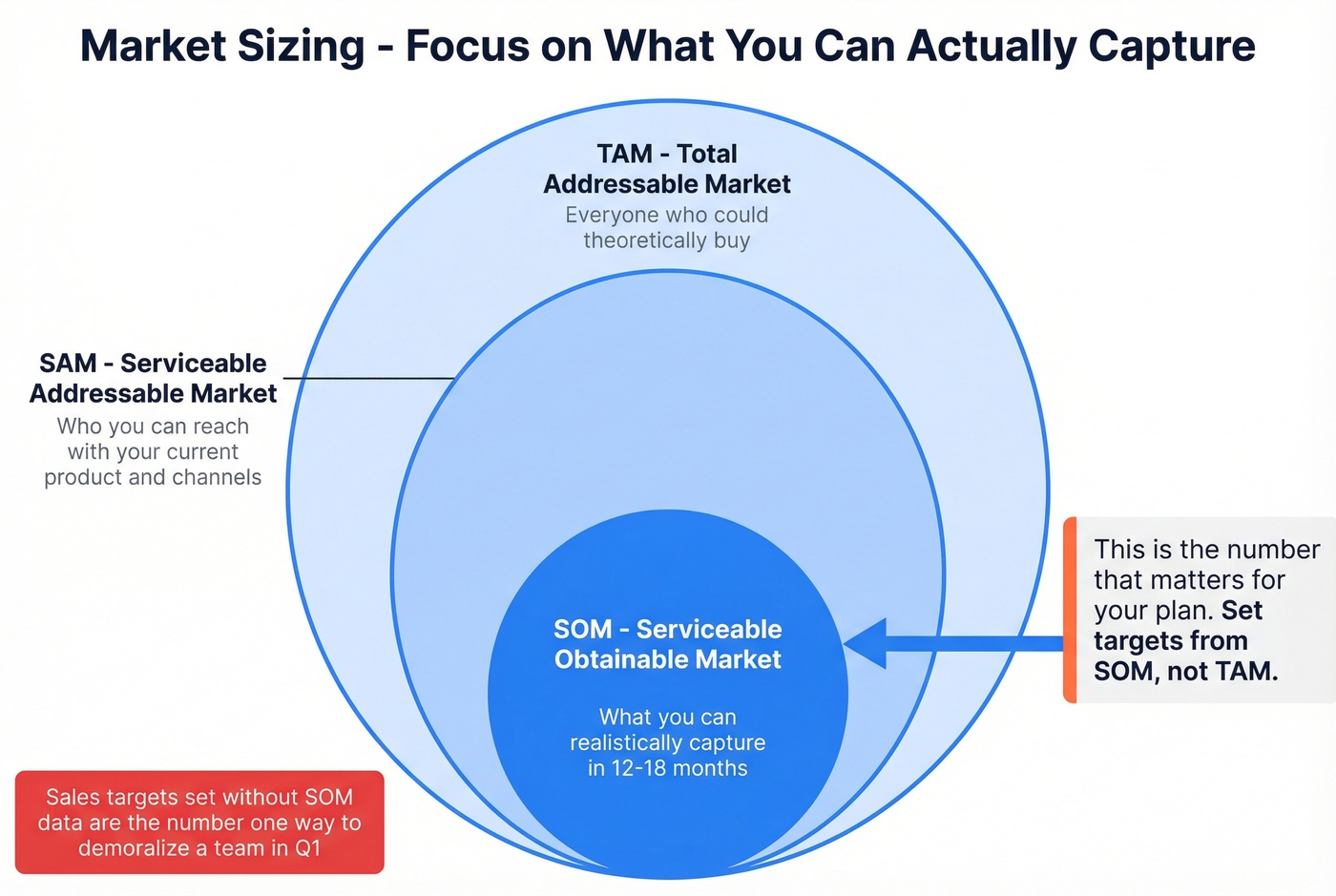
SOM is the number that matters for your plan. The consensus on r/sales and r/startups is brutal on this point: sales targets set without SOM data are the #1 way to demoralize a team in Q1. If your SOM says you can capture 200 accounts this year, don't set a target for 500.
If you want a deeper breakdown, see our guide to TAM, SAM, and SOM.
4. Research Your Competitors
Run a SWOT analysis on your top three to five competitors, then build a competitive positioning map that plots them on the two dimensions your buyers care about most - usually price vs. capability, or ease-of-use vs. depth. The goal isn't to know everything about them. It's to find the gaps they've left open.
One tactic worth stealing from SaaS companies that punch above their weight: competitor conquesting. Build dedicated landing pages for "[Competitor] alternatives" and "[Competitor] vs. [You]" searches. These capture buyers who are already in-market and actively comparing.
To systematize this, build a lightweight competitive intelligence workflow you can refresh quarterly.
5. Craft Your Positioning and Messaging
This is the hardest step, and it's the one most teams rush through. Positioning isn't a tagline. It's the strategic decision about what category you own, who you're for, and why you're different. Messaging is how you express that positioning to different personas at different stages.
Here's the thing: the operational failure here is well-documented. 67% of customer-facing teams get left out of launches, and 76% of sales teams are unaware of what's coming on the product roadmap. You can craft perfect positioning in a conference room, but if sales and CS aren't trained on it before launch day, it doesn't exist.
If you're tightening your narrative, a practical B2B brand positioning framework helps keep messaging consistent across channels.
Look at how Oatly entered the US market. They didn't position as "plant-based milk alternative" - they positioned as the anti-dairy brand for people who already knew dairy was a problem. Every touchpoint, from packaging to barista partnerships, reinforced that single positioning decision. Whether you're developing a plan for a new category or repositioning an existing product, that level of messaging discipline is what separates launches that stick from launches that fizzle.
6. Set Your Pricing
Even in a small sample of 60 software companies, half had never run a pricing study - and larger surveys confirm the pattern. A McKinsey benchmark shows a 1% improvement in pricing can increase profits by up to 11%. Pricing is the single decision with the biggest profit impact in your go-to-market plan, and most teams treat it as an afterthought.
Three methods worth knowing:
| Method | What It Does | Best For |
|---|---|---|
| Van Westendorp | Finds acceptable price range via 4 questions | Early-stage, quick reads |
| Conjoint Analysis | Tests price-feature tradeoffs | Complex products, tiers |
| Gabor-Granger | Measures demand at specific price points | Subscription optimization |
Value-based pricing - setting price based on the outcome you deliver, not your costs - is the right default for B2B SaaS. Cost-plus pricing leaves money on the table. Tiered pricing lets you capture different willingness-to-pay segments without discounting.
Run a Van Westendorp survey with at least 200-300 respondents before you lock pricing. That gives you a directional read in two weeks. For statistical precision, aim for 1,000+. Either way, it costs less than one bad quarter of underpriced deals.
7. Choose Your GTM Motion
Product-led growth works when your ACV is under $50K, your product has a natural self-serve entry point, and users can experience value before talking to sales. Sales-led works when deals are $100K+ and require multi-stakeholder buy-in, custom implementation, or procurement cycles. Hybrid uses PLG for adoption and sales for expansion. ABM is the right motion when you're targeting a defined list of enterprise accounts where personalized, multi-threaded outreach justifies the cost per acquisition.
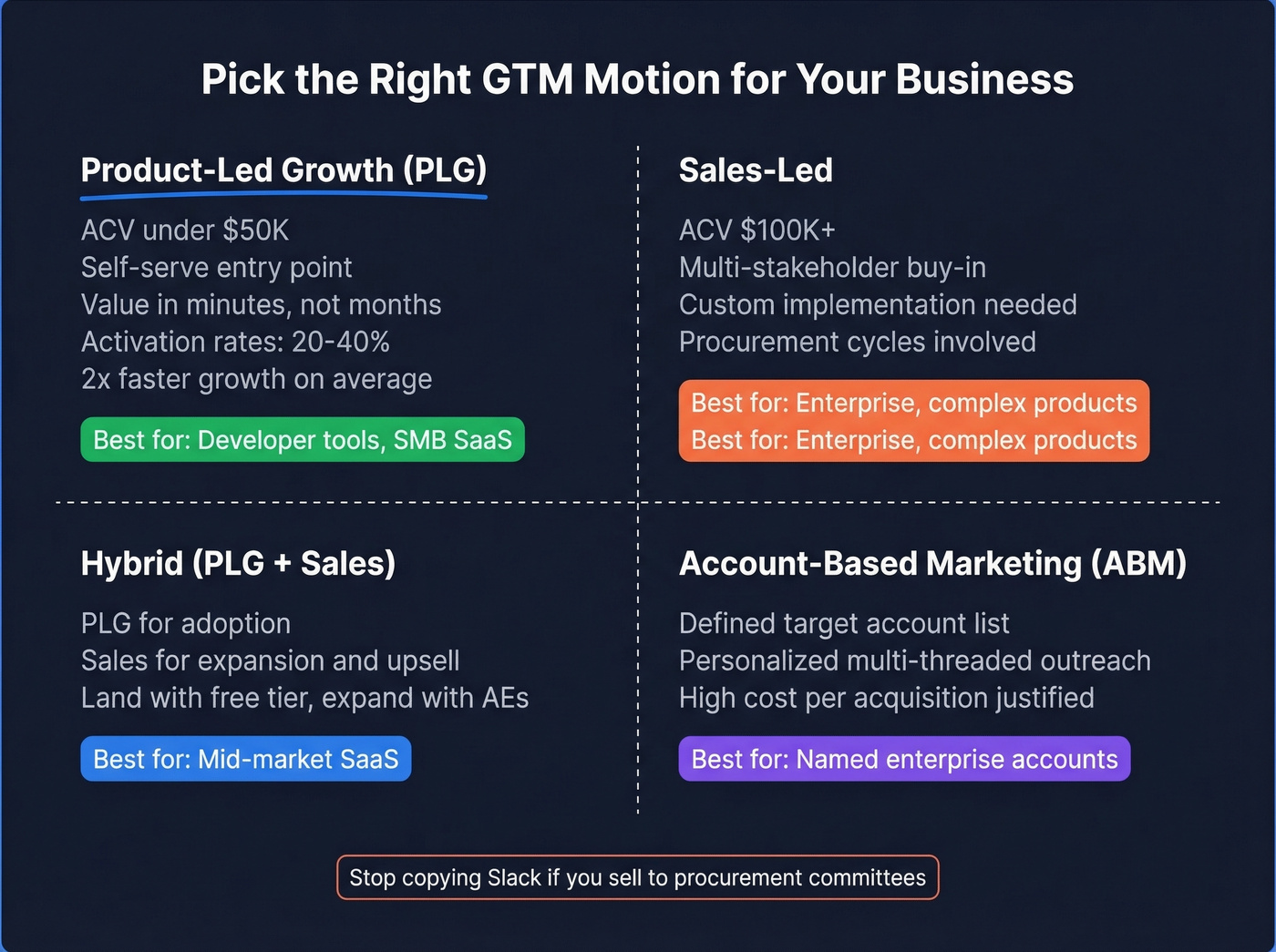
PLG companies grow 2x faster on average, with activation rates running 20-40%. But stop copying Slack's playbook if you're selling to procurement committees. PLG requires a product that delivers value in minutes, not months. If your onboarding takes a solutions engineer and a three-week implementation, you're sales-led. Own it.
The GTM motion you choose shapes every downstream decision in your plan, from channel mix to hiring to how you measure success.
If you're closing deals under $15K, you probably don't need ZoomInfo-level data infrastructure or a 12-person sales team. A lean PLG motion with targeted outbound will outperform an enterprise GTM stack every time.
If you're building outbound alongside PLG, use proven sales prospecting techniques to keep volume from turning into noise.
8. Map Channels and Build Your Prospect List
Successful B2B SaaS firms run an average of five core channels plus roughly 5.5 experimental channels. The best teams are always testing new channels while doubling down on what works. Your GTM marketing plan should name both: the proven channels you'll invest in from day one and the experiments you'll run in the first 90 days.
But this is exactly where most plans stall. You've defined your ICP, nailed your messaging, picked your channels - and then your first outbound campaign bounces at 35% because the prospect list is garbage. Data quality is the step that turns your ICP definition into actual conversations, and almost nobody plans for it.
We've watched this play out dozens of times. Once you've defined your ICP filters - industry, headcount, tech stack, buyer intent, job changes, funding signals - use a B2B data platform like Prospeo to pull a verified prospect list. With 98% verified email accuracy and records refreshed every 7 days, your first outbound sequence actually lands instead of torching your domain reputation.
If you're comparing vendors, start with a shortlist of sales prospecting databases and validate coverage against your ICP.

9. Build Your Launch Timeline
A go-to-market plan without a timeline is a wish list. This framework keeps teams honest:
| Milestone | Timing | Owner |
|---|---|---|
| ICP + positioning locked | T-90 | Product Marketing |
| Messaging framework approved | T-60 | Product Marketing |
| Creative assets locked | T-45 | Creative/Design |
| Sales enablement complete | T-45 | Sales Enablement |
| CS/support team trained on product | T-30 | Customer Success |
| Beta cohort recruited | T-30 | Product + CS |
| Media plan approved | T-30 | Demand Gen |
| Launch | T-0 | Cross-functional |
| Post-launch report | T+30 | Product Marketing |
The operational cadence that keeps this from drifting: read data daily, reallocate budgets weekly, refresh creatives every 10-14 days. The teams that hit targets treat the plan as a living document with weekly check-ins, not a one-time artifact.
If you want a rep-ready execution layer, adapt this into a 30-60-90 day plan for sales.

Step 2 says layer intent signals and hiring data onto your ICP. Prospeo's database gives you 30+ filters - buyer intent across 15,000 topics, headcount growth, technographics, job changes, and funding - so your GTM plan targets accounts that are actually in-market, not just in your TAM.
Stop launching into the void. Build your prospect list on data refreshed every 7 days.
Worked Example: B2B SaaS Launch
Let's make this concrete. Imagine you're launching a compliance automation tool for mid-market fintech companies with 100-500 employees. Here's how four of the nine steps play out:
Problem: Compliance officers spend 15+ hours per week manually tracking regulatory changes across jurisdictions. Your product automates monitoring and flags required actions.
ICP: Mid-market fintechs in the US and UK, 100-500 employees, Series B+, currently using spreadsheets or legacy GRC tools. Buyer is the Head of Compliance; economic buyer is the CFO.
GTM motion: Sales-led with a free compliance audit as the entry point. ACV target is $60K, so pure PLG won't close deals - but the free audit creates a product-led wedge.
Channels: Ads targeting compliance job titles at fintechs, a "[Legacy GRC Tool] alternatives" SEO page, and outbound sequences to 300 verified contacts filtered by fintech vertical, recent compliance hires, and buyer intent signals.
That's a two-page plan. Everything else - the competitive analysis, the pricing research, the persona interviews - lives in supporting docs. This is what B2B GTM planning looks like when you strip away the bloat.
GTM Benchmarks: What Good Looks Like
You can't manage what you don't measure, but you also can't measure what you haven't benchmarked. Here's what good looks like for B2B SaaS in 2026:
| Metric | Median | Top Quartile |
|---|---|---|
| CAC:LTV Ratio | 3:1 | 5:1 |
| Win Rate | 24% | 32% |
| Pipeline Coverage | 2.5x | 4.2x |
| CAC Payback | 18-24 months | 12-18 months |
| NRR | 100-105% | 110%+ |
| Sales Cycle | ~67 days | Varies by ACV |
The CAC payback gap between PLG and sales-led is significant. PLG companies with strong activation can recover acquisition costs in under 90 days. Sales-led motions with $100K+ ACVs and 6-month cycles naturally take longer - 12-18 months is healthy for that segment.
CAC formula from HBS: CAC = (Sales Costs + Marketing Costs) / Number of Customers Acquired. Simple, but the number of teams that can't calculate this cleanly is staggering - usually because sales and marketing costs aren't tracked against specific acquisition cohorts.
If you want to pressure-test your funnel, use these funnel metrics as your baseline dashboard.
For your KPI dashboard defaults, start with CTR 1.5%, trial-to-paid conversion 12%, CAC payback of 6 months or less, and week-8 retention at 65%. These aren't aspirational - they're the minimum thresholds that indicate your GTM motion is working. If you're below these after 90 days, something structural needs to change.
Why Most GTM Plans Die
We've seen five failure modes kill go-to-market plans repeatedly, and they're almost never about strategy.
Misaligned market understanding. Teams build for a buyer that doesn't exist. The cybersecurity startup that builds enterprise-grade tooling for SMBs without validating that SMBs have the budget or technical capacity to use it. This is an ICP problem disguised as a product problem.
Cross-functional breakdown. 76% of sales teams are unaware of the product roadmap. 67% say customer-facing teams get left out of launches. The plan exists in a Google Doc that product marketing wrote and nobody else read. The fix is a RACI or DACI matrix that leadership actually enforces - not one that lives in a slide deck.
If you're trying to operationalize this, treat it like sales execution: clear owners, clear handoffs, and a weekly cadence.
The "Frankenstein GTM." This one comes straight from r/ProductMarketing: leadership bypasses the RACI, channel owners refuse to adjust existing campaigns, pricing teams create bundles without competitive input, and sales targets get set without SOM data. The result is a plan that no single person recognizes as theirs.
No iteration loop. Teams that treat launch day as the finish line instead of the starting line consistently underperform. Aligned GTM teams are 2x more likely to hit revenue targets, and alignment requires ongoing coordination, not a one-time kickoff. 14% of failed launches skipped structured planning entirely.
Bad data at the execution layer. Your first outbound campaign bounces at 35% because the prospect list is six months old. Your reps waste hours chasing disconnected numbers. This is the failure mode that's easiest to fix - and the most common reason a solid plan produces mediocre results. The industry average for data refresh is six weeks, which means most teams are prospecting with stale records by default.
If bounce rates are killing your outbound, start with email bounce rate benchmarks and fixes before you scale volume.
Let's be honest: most of these failures trace back to what Bain calls the "fiefdoms" pattern - functions optimizing for their own metrics instead of the shared GTM outcome. The plan doesn't die because it was wrong. It dies because nobody owned the whole thing.
Step 8 says map channels and build a verified prospect list. Bad data kills GTM execution - 35% bounce rates destroy domain reputation and pipeline in the same quarter. Prospeo delivers 98% email accuracy and 125M+ verified mobiles so your launch actually reaches real buyers.
Your GTM plan deserves a list that won't bounce. Get one for $0.01 per email.
Go-to-Market Plan Template
Stop building 30-page GTM plans nobody reads. Whether you're creating one for the first time or refining an existing plan, this structure works:
- Overview - Problem, solution, target outcome (one paragraph)
- Personas - ICP definition + 2-3 buyer personas with JTBD
- Positioning - Category, differentiator, proof points
- Channels & Budget - Core channels, experimental channels, spend allocation
- Timeline - T-90 to T+30 milestones with owners
- KPI Dashboard - 6-8 metrics with targets and measurement cadence
- Risks - Top 3-5 risks with mitigation plans
- Checklist - Pre-launch readiness gates (messaging locked, sales trained, creative approved)
Skip the Notion template if your team already lives in Google Docs or Confluence - the format matters less than the habit of updating it weekly. If you need something more structured, Smartsheet's GTM templates include week-by-week planning columns, auto-tallying sales goals vs. actuals, and built-in ROI calculations. Pick the one that matches your team's complexity, then strip out everything you won't actually update.
What's Changed in GTM for 2026
The biggest shift isn't AI itself - it's what AI enables operationally. 70% of companies report moderate to full AI adoption in GTM workflows, and the AI marketing market is projected to hit $107.5B by 2028. But the teams winning aren't the ones with the fanciest AI tools. They're the ones using AI to shorten the time between spotting a buying signal and acting on it.
Three trends reshaping how teams build a go-to-market plan right now:
RevOps as the GTM orchestrator. The old model of marketing handing MQLs to sales is dead. The new model centralizes funnel transitions, automates handoffs, and enforces shared KPIs across acquisition, expansion, and retention.
If you're formalizing the function, a RevOps manager playbook helps clarify ownership and operating cadence.
Metrics are shifting. MQLs are giving way to PQL velocity, ARR progression, and NRR health. Retention is now a GTM motion - expansion revenue and customer success are part of the plan, not an afterthought.
Experimentation is the operating system. The HBS framework - hypothesis, test, prioritize, run - applies to channels, messaging, and pricing assumptions. The teams that run more experiments per quarter learn faster and allocate budget more efficiently. That's the real competitive advantage in 2026: speed of learning, not size of budget.
FAQ
What's the difference between a GTM plan and a GTM strategy?
A GTM strategy defines the high-level approach - target segments, competitive positioning, and win conditions over 1-3 years. A go-to-market plan is the operational document with timelines, owners, budgets, and KPIs that turns that strategy into execution over 90-180 days. Strategy is the "what and why"; the plan is the "who, when, and how much."
How long should a go-to-market plan be?
Two to three pages covering ICP, positioning, channels, timeline, KPIs, and a RACI. Supporting documents - competitive analysis, pricing research, persona interviews - live separately. If your plan needs a meeting to explain the plan, it's too long.
Who owns the go-to-market plan?
Product marketing owns the document, but RevOps increasingly orchestrates cross-functional execution. Ownership means nothing without a RACI that leadership actually respects - assign a single DRI with authority to enforce deadlines across teams.
What KPIs should a GTM plan track?
Start with CAC, CAC:LTV ratio (aim for 3:1-5:1), pipeline coverage (4.2x top quartile), win rate, CAC payback period, and NRR (110%+ for SaaS). Layer in channel-specific metrics like CTR, trial-to-paid conversion, and week-8 retention to diagnose where the funnel breaks.
How do I build a prospect list for my GTM launch?
Define ICP filters - industry, headcount, tech stack, funding stage, buyer intent - then pull verified contacts from a B2B data platform. Pair with intent data to prioritize accounts actively researching your category, and you'll spend your first outbound sprint talking to people who are already in-market instead of cold-calling a stale spreadsheet.