

Go-to-Market Alignment: The Operating System Your Revenue Team Is Missing
It's Monday morning. Your SDRs pull a list of 200 "marketing-qualified" leads, load them into a sequence, and 68 emails bounce before lunch. Meanwhile, the marketing team is celebrating a record month for MQLs - leads that sales calls garbage. There's a black hole between MQL and closed-won where nobody knows what happened, and attribution is a mess.
Here's the thing: this isn't a people problem. Go-to-market alignment is an architecture problem, and it's fixable.
The Short Version
GTM alignment is an engineering challenge, not a meetings challenge. Start by diagnosing your handoff effectiveness - if fewer than 35% of marketing-engaged prospects get contacted by sales, your handoff is broken. Then build three things:
- Shared ICP documentation that every team actually executes against
- Lead-stage SLAs with owners, timelines, and consequences
- A clean data foundation - because SLAs mean nothing when a third of your emails bounce
What GTM Alignment Actually Is
Most people think go-to-market alignment means getting sales and marketing in a room together more often. It doesn't. The B2B Playbook frames it as commercial architecture - the structural design of how your revenue teams share goals, data, signals, and handoffs. Think of it as an operating system, not a meeting cadence.
The core insight is simple and uncomfortable: most organizations don't really have clarity around their ICP. They give lip service to it, but they don't execute against it. When your ICP is vague, everything downstream - targeting, scoring, messaging, handoffs - drifts. Marketing optimizes for volume. Sales cherry-picks. Customer Success inherits accounts that never should've closed.
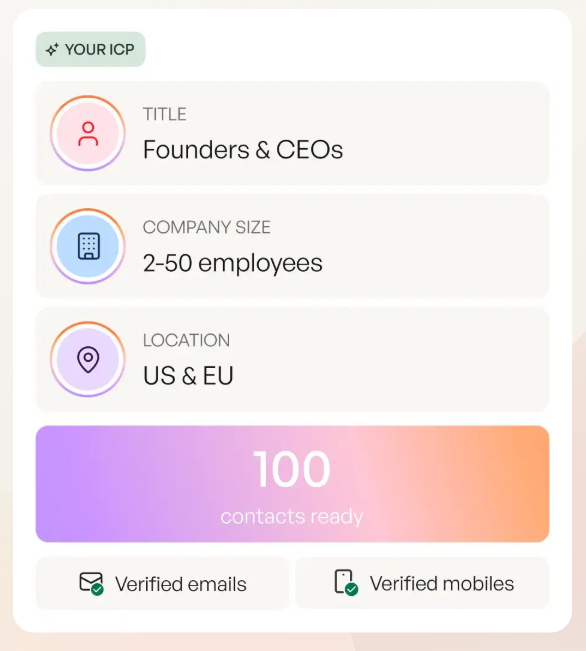
Real GTM strategy means every revenue function operates from the same ICP definition, tracks shared metrics, follows documented handoff protocols, and feeds insights back into the system. It's plumbing, not culture.
The Real Cost of Misalignment
The numbers aren't abstract. A Gartner survey found that 84% of marketing leaders report high "collaboration drag" - too many meetings, too much feedback from too many people, and unclear decision-making authority. Organizations with high collaboration drag are 37% less likely to hit revenue goals. The talent cost is brutal too: employees in high-drag environments are 15x more likely to feel burned out and 9x more likely to plan to leave within a year.
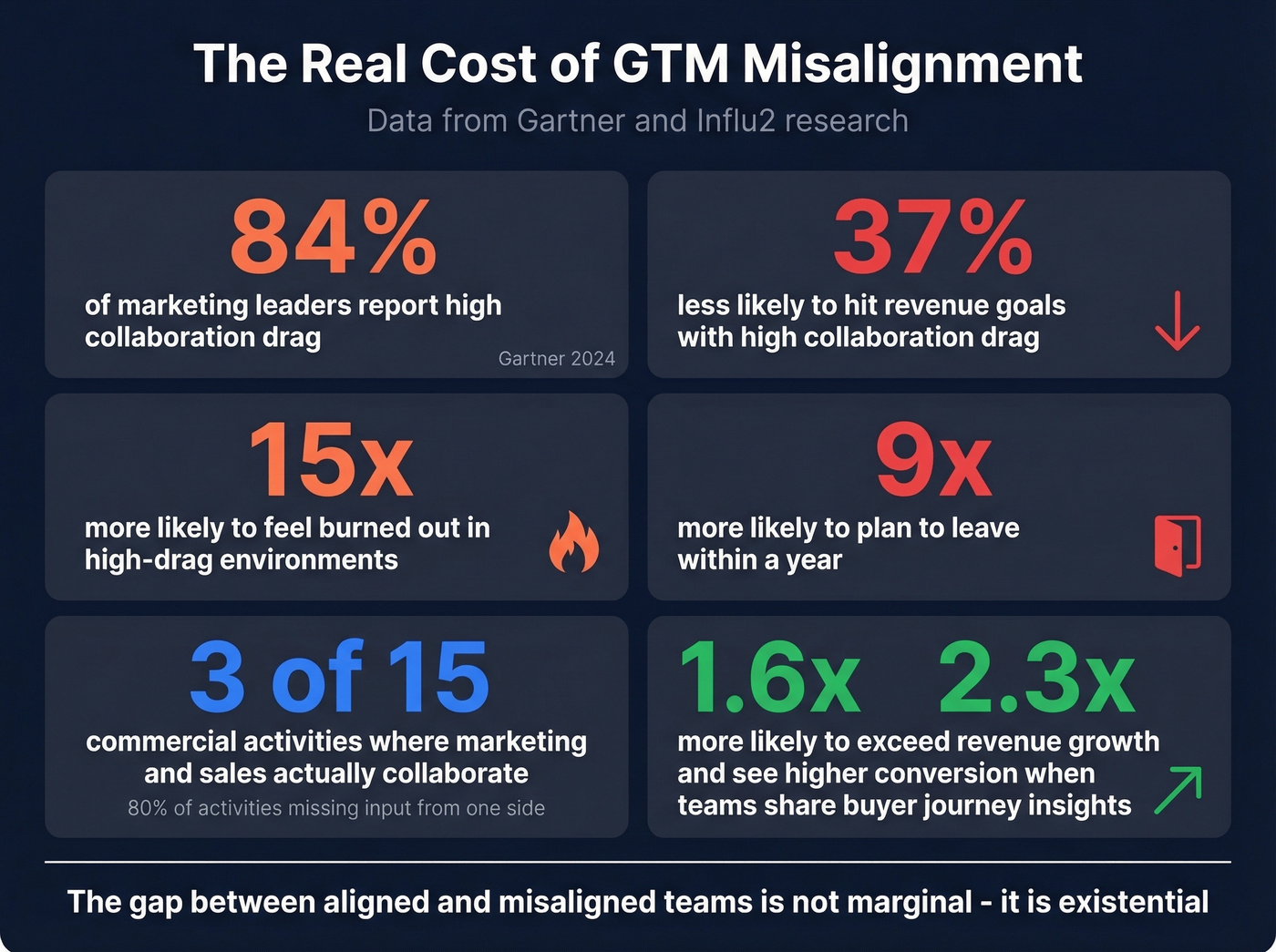
Here's the structural reality: marketing and sales collaborate on only 3 of 15 commercial activities. That means 80% of key commercial activities are missing contributions from one side or the other. Commercial teams that do share buyer journey insights are 1.6x more likely to exceed revenue growth expectations and 2.3x more likely to see higher conversion rates. The gap between aligned and misaligned teams isn't marginal - it's existential.
If any of these sound familiar, your revenue team coordination is broken:
- Conflicting messaging - marketing promises one thing, sales pitches another
- KPIs at odds - marketing rewarded for MQL volume, sales for closed revenue
- Data silos - teams disagree on basic facts because they're looking at different dashboards
- Handoff friction - leads sit untouched for days, or get worked without context
These aren't personality conflicts. They're system failures.
Diagnose Your Alignment
Before you build anything, figure out where you actually stand. Influ2 studied 105 companies and found three distinct alignment tiers based on handoff effectiveness and audience overlap:
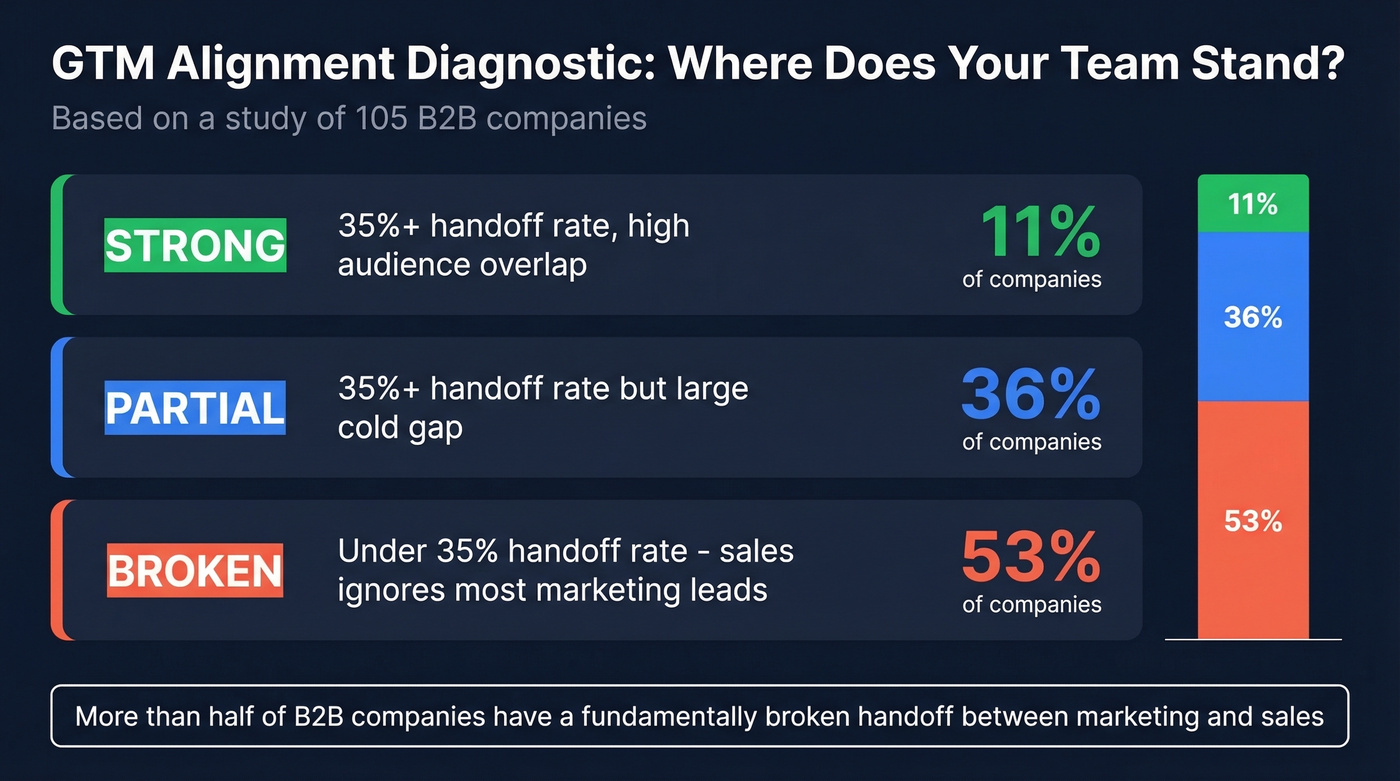
| Tier | Criteria | % of Companies |
|---|---|---|
| Strong | 35%+ handoff rate, high overlap | 11% |
| Partial | 35%+ handoff, large cold gap | 36% |
| Broken | <35% handoff rate | 53% |
More than half of companies have a broken handoff. Sales follows up with fewer than 35% of the prospects marketing has already engaged. That's not a minor inefficiency - that's burning budget on one side and starving pipeline on the other.
Score yourself honestly against the table above, then keep reading.

Your SLAs mean nothing when a third of your emails bounce. Prospeo's 5-step verification delivers 98% email accuracy on 300M+ profiles - refreshed every 7 days, not every 6 weeks. One team tripled pipeline from $100K to $300K/week after switching. GTM alignment starts with data your sales team actually trusts.
Stop building alignment frameworks on a broken data foundation.
The GTM Alignment Framework
Six concrete steps. Each one builds on the last.
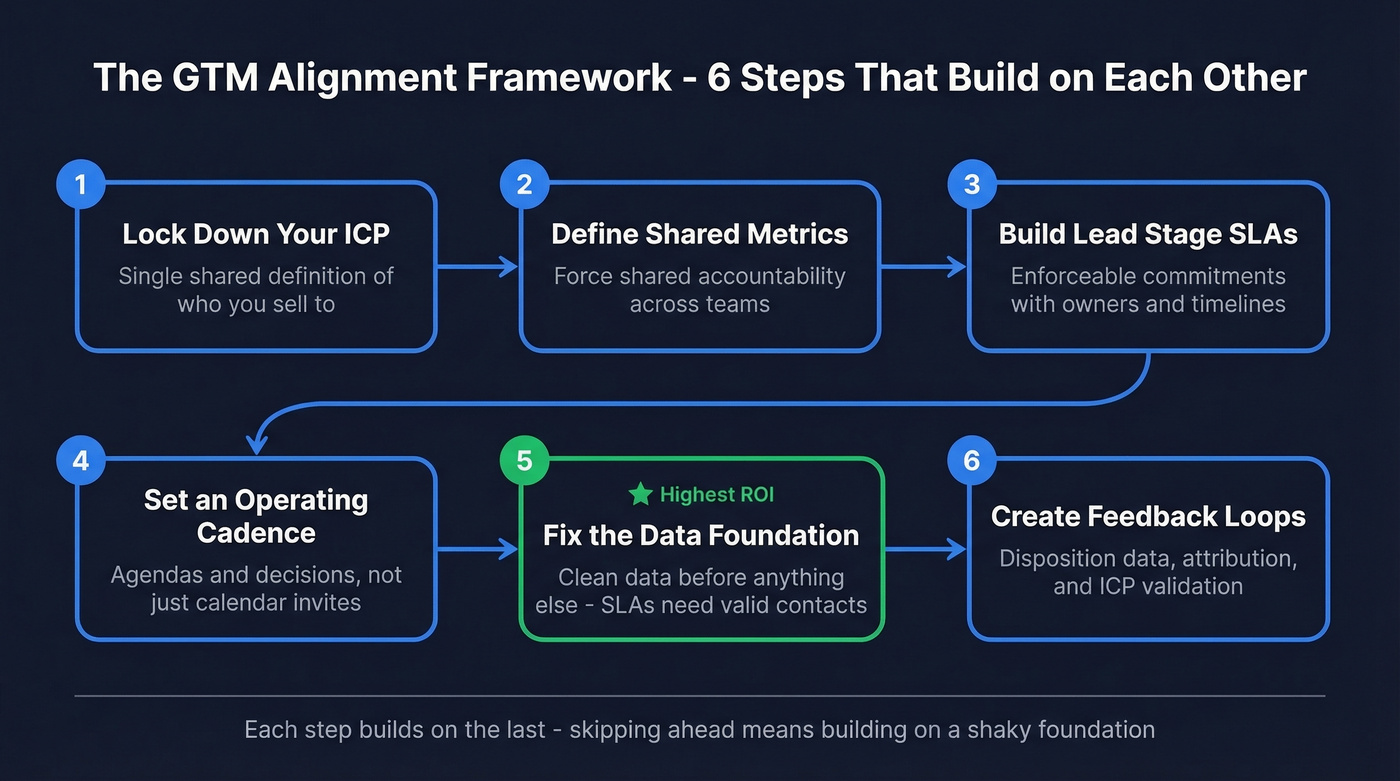
1. Lock Down Your ICP
Your ICP is the boundary within which you build pipeline and win. If marketing is targeting Series A fintech companies and sales is cold-calling enterprise banks, no amount of weekly syncs will fix the disconnect. Aligning sales and marketing starts here - with a single, shared definition of who you're selling to.
Document your ICP in a revenue handbook that every revenue hire reads in their first week. Include firmographics, technographics, buying triggers, and disqualification criteria. Be honest about what isn't intent - a click isn't intent, downloading a PDF isn't intent. We've watched teams waste entire quarters chasing "engaged" leads that never had buying authority or budget.
If your average deal size is under $15K, you probably don't need a complex scoring model at all. A simple fit/no-fit filter based on 4-5 firmographic criteria will outperform a 50-variable lead score that nobody trusts.
2. Define Shared Metrics
Stop letting marketing celebrate MQL volume while sales complains about lead quality. Shared metrics force shared accountability. Here are starter benchmarks worth calibrating against:
| Stage | Target Range |
|---|---|
| Lead to MQL | 20-30% |
| MQL to SQL | 40-60% |
| SQL to Opportunity | 50-70% |
| Lead response time | <24 hrs |
| SLA compliance | >90% |
If your MQL-to-SQL rate is below 40%, the problem is almost certainly ICP definition or scoring criteria - not sales effort.
3. Build Lead Stage SLAs
SLAs turn vague expectations into enforceable commitments. They're the backbone of GTM execution:
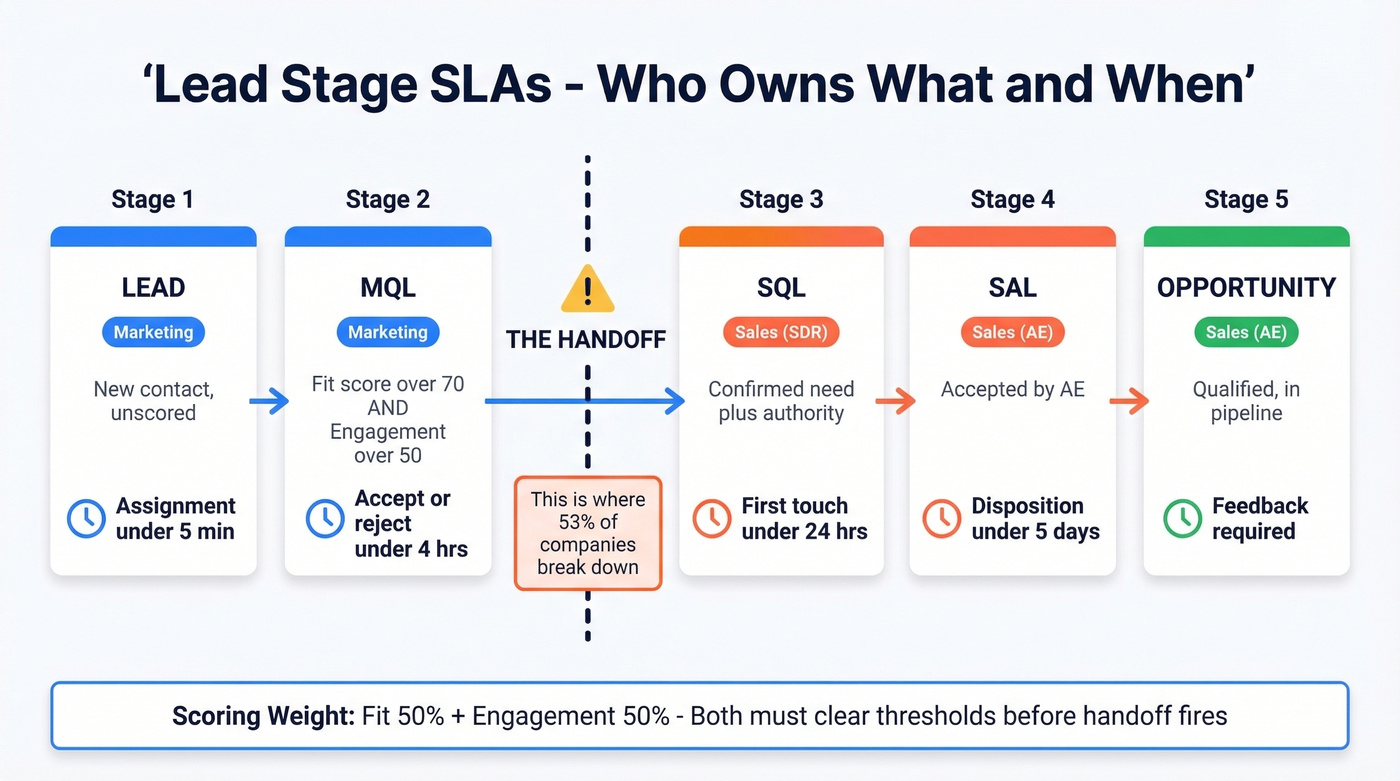
| Stage | Owner | Definition | SLA Timing |
|---|---|---|---|
| Lead | Marketing | New contact, unscored | Assignment <5 min |
| MQL | Marketing | Fit >70 AND Engagement >50 | Accept/reject <4 hrs |
| SQL | Sales (SDR) | Confirmed need + authority | First touch <24 hrs |
| SAL | Sales (AE) | Accepted by AE | Disposition <5 days |
| Opportunity | Sales (AE) | Qualified, in pipeline | Feedback required |
Weight Fit at 50% and Engagement at 50%. A prospect who matches your ICP perfectly but hasn't engaged is a target, not a lead. A prospect who's clicked everything but doesn't match your ICP is noise. Both scores need to clear their thresholds before the handoff fires.
4. Set an Operating Cadence
Calendar invites aren't alignment. Agendas are.
The minimum cadence: weekly lead reviews covering disposition data and SLA compliance; bi-weekly campaign reviews to decide what to kill and what to scale; monthly revenue reviews for pipeline attribution and forecast accuracy; and quarterly strategy sessions to validate ICP and prioritize motions. Content committees play a role too - they keep messaging consistent across every touchpoint rather than letting it drift between teams. Each meeting needs a standing agenda, a single owner, and a decision log. If a meeting doesn't produce decisions, cancel it.
5. Fix the Data Foundation
Nobody talks about this in alignment playbooks, but it's the single highest-ROI fix for most companies: clean the data layer before you do anything else. SLAs mean nothing when 35% of your emails bounce. SDRs won't trust marketing-sourced leads if every third contact is invalid. The trust erosion is real and it's fast.
Snyk had 50 AEs prospecting 4-6 hours per week with a 35-40% bounce rate. After deploying Prospeo's verification layer, bounces dropped under 5%, AE-sourced pipeline jumped 180%, and the team generated 200+ new opportunities per month. Meritt saw a similar shift - bounce rate from 35% to under 4%, pipeline tripled from $100K to $300K per week.
When your data layer delivers contacts that actually connect, SLAs and handoffs start working because reps trust the leads they're receiving. A 7-day data refresh cycle - versus the 6-week industry average - means the contacts flowing through your handoff process stay current rather than decaying between enrichment runs. If you're seeing persistent bounces, start with email bounce rate fundamentals and an email deliverability audit before you touch routing logic.
6. Create Feedback Loops
Your weekly lead review should surface disposition data: why did sales reject these MQLs? Your monthly revenue review should track pipeline attribution: which campaigns actually generated qualified pipeline, not just form fills? Quarterly, validate your ICP against closed-won data.
Edison Partners calls this "priority motions" - pick 2-3 motions that matter most right now and ignore the rest. In our experience, trying to optimize everything simultaneously is how alignment initiatives die. Companies that try to align all 15 commercial activities at once end up aligning on none of them.
Beyond Sales and Marketing
Real go-to-market alignment extends past the sales-marketing boundary. One Reddit thread captured this perfectly: a solo PMM supporting 6 products across multiple verticals described being treated as a "tactical task rabbit" - executing on requests from 8 PMs while the CPO actively blocked strategic input. That's a structural failure where Product and Marketing have no shared operating model.
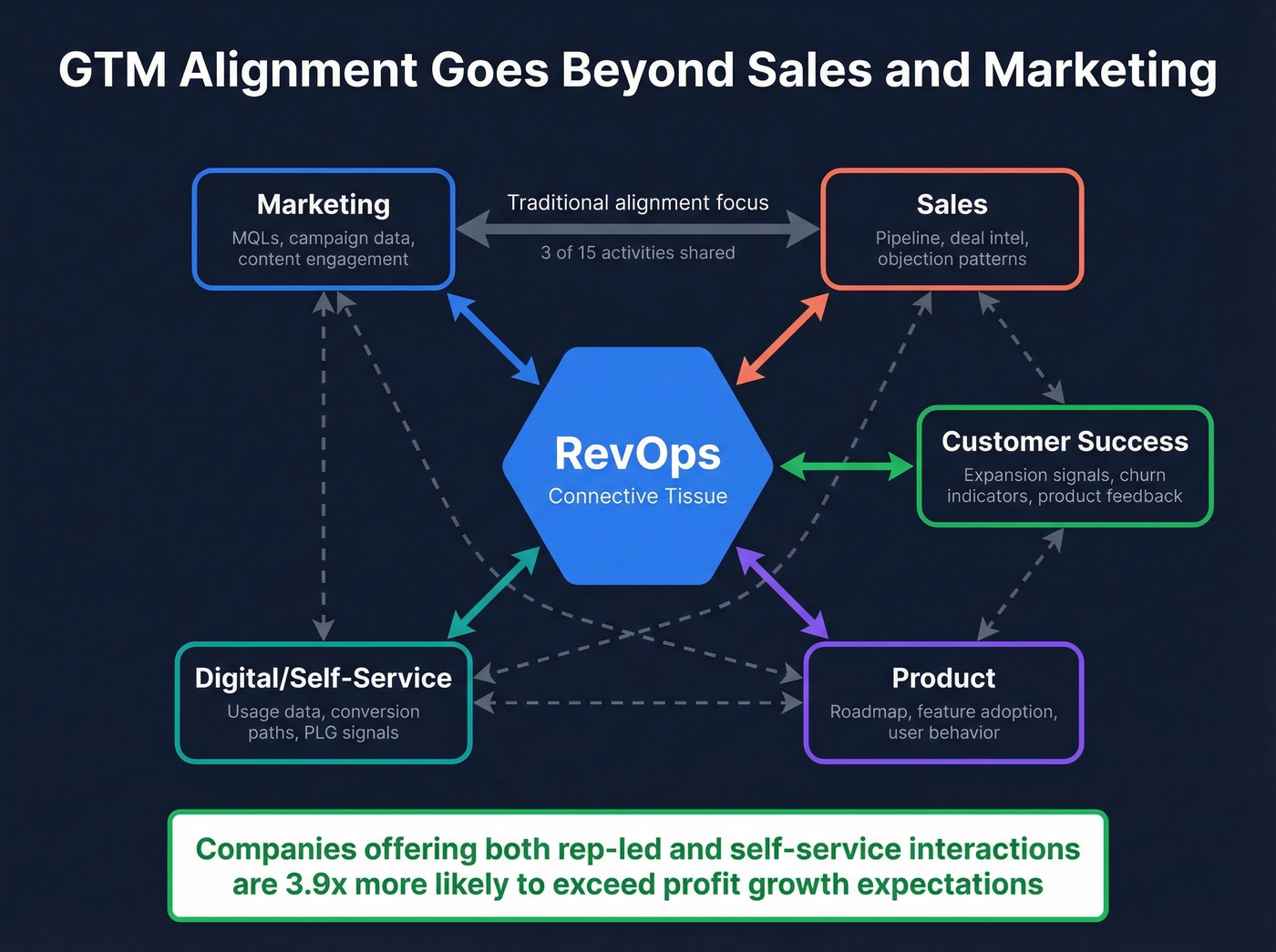
Customer Success is the other blind spot. CS teams sit on a goldmine of expansion signals, churn indicators, and product feedback, but in most organizations that data never flows back to Marketing or Product in a structured way. Organizations offering both rep-led and self-service interactions are 3.9x more likely to exceed profit growth expectations, which means alignment has to extend to digital channels too.
RevOps is the connective tissue. Without a dedicated function owning the data model, process design, and reporting infrastructure, alignment depends on individual relationships that break every time someone leaves. A common refrain on r/sales: "We got aligned for one quarter, then the RevOps lead quit and everything fell apart." That's why RevOps needs a seat at the table, not just a Slack channel.
The Technology Stack
A typical mid-sized company runs 150+ software tools. Most of them don't talk to each other in any meaningful way. "Integrates with Salesforce" often means a fragile connector that syncs a handful of fields, not shared workflows with unified reporting.
If your team is under 20 reps, skip revenue intelligence tools entirely. They're overhead you can't afford yet. Focus your budget on CRM, data quality, and one engagement tool.
For teams ready to build a full GTM enablement stack, here's a reference architecture:
| Layer | Purpose | Example Tools |
|---|---|---|
| CRM | Source of truth | Salesforce (~$25-$300+/user/mo), HubSpot (free tier available) |
| Data & Enrichment | Verified contacts + signals | Prospeo (~$0.01/email, free tier), ZoomInfo ($15-40K/yr), Clay |
| Sales Engagement | Outbound execution | Outreach (~$100-$200+/user/mo), Salesloft (~$100-$200+/user/mo) |
| Revenue Intelligence | Pipeline visibility | Gong (~$100-$200+/user/mo), Clari (~$30-$100K+/yr) |
| Enablement | Content + training | Highspot (~$50-$150+/user/mo), Seismic (~$50-$150+/user/mo) |
| Customer Success | Retention + expansion | Gainsight (~$30-$150K+/yr), Totango ($20K+/yr) |
| Intent Data | In-market signals | Demandbase ($30-$100K+/yr), Bombora |
The principle isn't "buy more tools." It's ensure every layer feeds clean, consistent data into a shared CRM. If your enrichment layer is polluting Salesforce with bad emails and stale titles, no amount of revenue intelligence will compensate. If you're evaluating options, start with a shortlist of data enrichment services and sales prospecting databases that fit your ICP.
You just scored yourself on handoff effectiveness. Now ask: how many of those handoffs fail because contact data is wrong? Prospeo gives your revenue team 30+ ICP filters - buyer intent, technographics, headcount growth, funding - so marketing and sales execute against the same targets with verified emails and direct dials.
Align your GTM teams around contacts that actually connect.
Pitfalls That Kill Alignment
Three anti-patterns destroy alignment initiatives faster than anything else.
Compensation misalignment. Marketing gets rewarded for MQL volume. Sales gets rewarded for closed revenue. Nobody owns the middle of the funnel. If you only fix one thing from this entire article, fix comp. Until comp plans share at least one metric - pipeline generated, conversion rate, or revenue influenced - alignment is a suggestion, not a system.
AI amplifying dysfunction. If your teams can't agree on ICP, AI just generates more noise faster. We've watched teams deploy AI-powered SDR tools on top of broken processes and wonder why response rates cratered. Fix the foundation before you automate. If you're going to automate follow-ups, use proven sales follow-up templates and measure follow-up email reply rate before scaling volume.
Trying to align on everything. The Edison Partners "priority motions" concept is the contrarian take that actually works: pick 2-3 motions that matter this quarter and ruthlessly ignore the rest. Let's be honest - most alignment initiatives fail not because they lack ambition, but because they spread too thin.
FAQ
What's the difference between GTM alignment and RevOps?
RevOps is the operational function - systems, data, processes - that enables alignment. GTM alignment is the outcome: shared goals, coordinated execution, clean handoffs. You need RevOps to sustain alignment at scale, but RevOps without a clear framework just produces well-organized silos.
How do you measure go-to-market alignment?
Track handoff effectiveness (35%+ of marketing-engaged leads contacted by sales), SLA compliance above 90%, and lead-to-opportunity conversion rates. Only 11% of companies show strong alignment on these measures based on Influ2's 105-company study.
What's a realistic timeline?
Expect 60-90 days for foundational elements - ICP documentation, lead stage SLAs, shared dashboards. Behavioral change takes two full quarters. Start with one priority motion, not a company-wide overhaul.
Does GTM enablement require new tools?
Usually not. The gap is typically data quality and process, not software. If your bounce rate exceeds 10%, fix the data layer first - a verification tool that delivers 98% email accuracy can drop bounces under 5% and rebuild rep trust in marketing-sourced leads before you add anything else.
How does AI affect GTM alignment?
AI accelerates whatever you already have. Solid alignment architecture plus AI means dramatically faster execution - better scoring, faster routing, smarter sequencing. Broken alignment plus AI means more noise, faster. Foundation first, automation second.