

How to Run a Go-to-Market Strategy Workshop That Produces Pipeline
Last quarter's launch flopped. Marketing built campaigns around features sales couldn't pitch. Sales targeted accounts product hadn't built for. Someone suggested a go-to-market strategy workshop - good instinct, but most workshops produce a deck that collects dust, not pipeline. One PMM on Reddit described the typical outcome: a "Frankenstein plan" stitched together from competing opinions with no governance.
A productive GTM workshop needs four things: pre-work data, the right people (cross-functional, max 12), a time-blocked agenda with facilitated exercises, and a post-workshop activation meeting within a few days. Skip any one and you'll produce alignment theater, not pipeline.
What a GTM Workshop Should Actually Produce
Walk out of the room with these artifacts or you wasted the day:
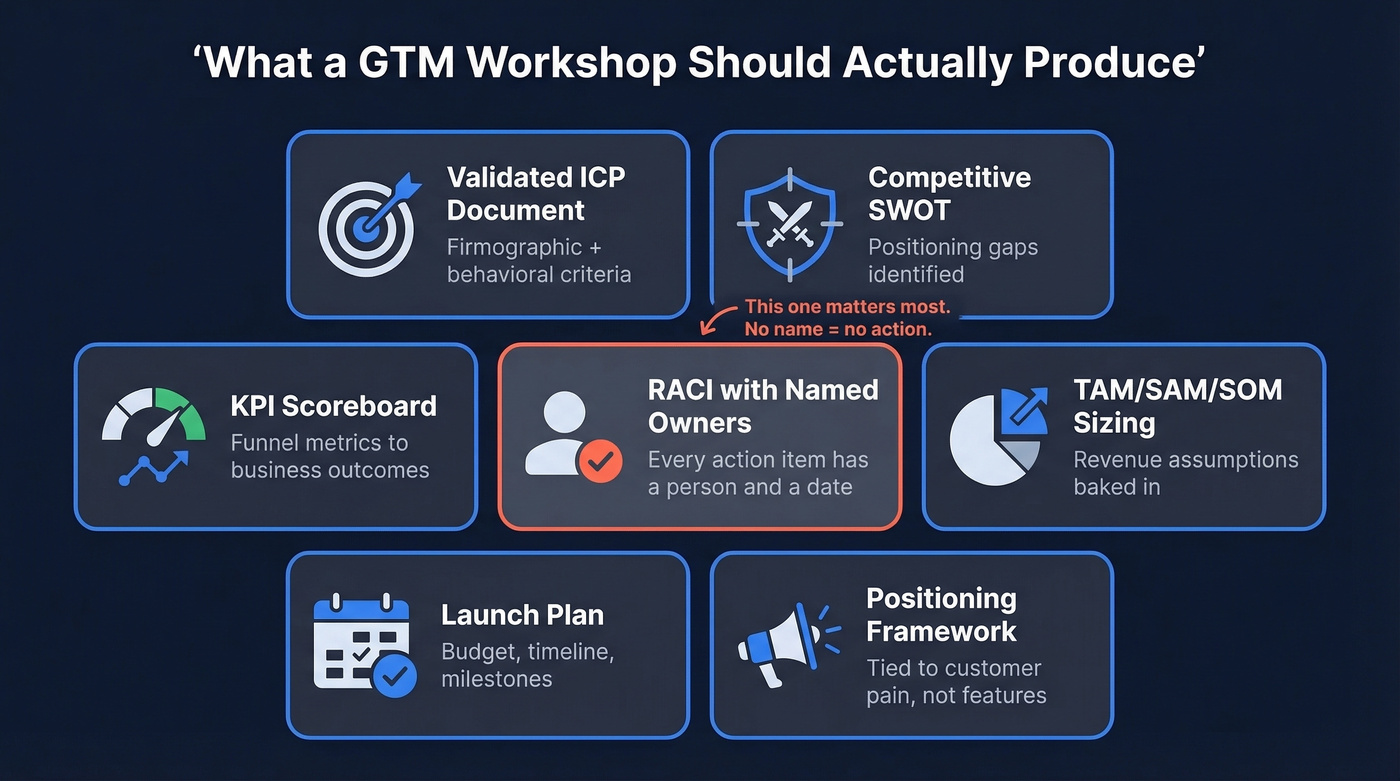
- A validated ICP document with firmographic and behavioral criteria (use an Ideal Customer Profile Template to standardize inputs)
- A competitive SWOT covering positioning gaps
- TAM/SAM/SOM sizing with revenue assumptions
- A positioning framework tied to customer pain, not product features
- A launch plan with budget and timeline
- A KPI scoreboard connecting funnel metrics to business outcomes
- A RACI with named owners for every action item
That last one matters most. If nobody's name is next to an action, it won't happen.
Pre-Work That Prevents Failure
The 15-30 hours of prep beforehand determine whether the workshop produces anything useful. Four prerequisites need to be ready before anyone walks in:
- TAM analysis - market size, segments, growth rates (align on definitions of addressable market early)
- ICP definitions - even rough drafts give the group something to react to
- Market research - buyer pain points, buying behavior, channel preferences
- Competitive research - positioning maps, pricing intel, win/loss patterns (build a lightweight competitive intelligence strategy so updates don’t die after the workshop)
Run 1:1 discovery meetings with every attendee beforehand. This surfaces hidden disagreements early so you're not blindsided in the room. Bring B2B SaaS benchmarks as inputs: 22% win rates, 67-day sales cycles, CAC:LTV targets of 3:1-5:1, and NRR of 110%+. These give the room a shared baseline instead of competing gut feelings, and they prevent the loudest voice from anchoring every number to their own experience.
Who Should Be in the Room
| Role | Why They're There |
|---|---|
| CEO / C-suite | Sets vision, breaks ties |
| Sales leadership + 1-2 reps | Frontline buyer intel |
| Marketing leadership | Positioning, channels, budget |
| Product leadership | Roadmap, feasibility |
| Customer Success | Retention signals, churn drivers (bring recent churn analysis and renewal notes) |
| RevOps / Ops | Data, systems, process |
Cap it at 8-12 people. More than that and you get groupthink, loud voices dominating, and shallow forced alignment - the exact failure modes practitioners complain about on r/strategy. One thread had a facilitator put it bluntly: "Above 12, you're running a town hall, not a workshop."
The 1-Day Agenda
| Time | Block | Exercise | Output |
|---|---|---|---|
| 9:00-10:30 | Objectives & KPIs | Waterfall: company -> dept goals | Aligned KPI grid |
| 10:45-12:45 | ICP & Market Alignment | Review pre-work, debate segments | Validated ICP doc |
| 1:30-2:30 | Competitive Positioning | SWOT + positioning canvas | Differentiation map |
| 2:30-3:30 | Value Prop & Messaging | Value Proposition Canvas | Draft messaging framework |
| 3:45-4:45 | Prioritization & Planning | Impact/Effort Matrix | Ranked initiative list |
| 4:45-5:30 | Owners & Next Steps | RACI assignment | Named owners, 30-day plan |
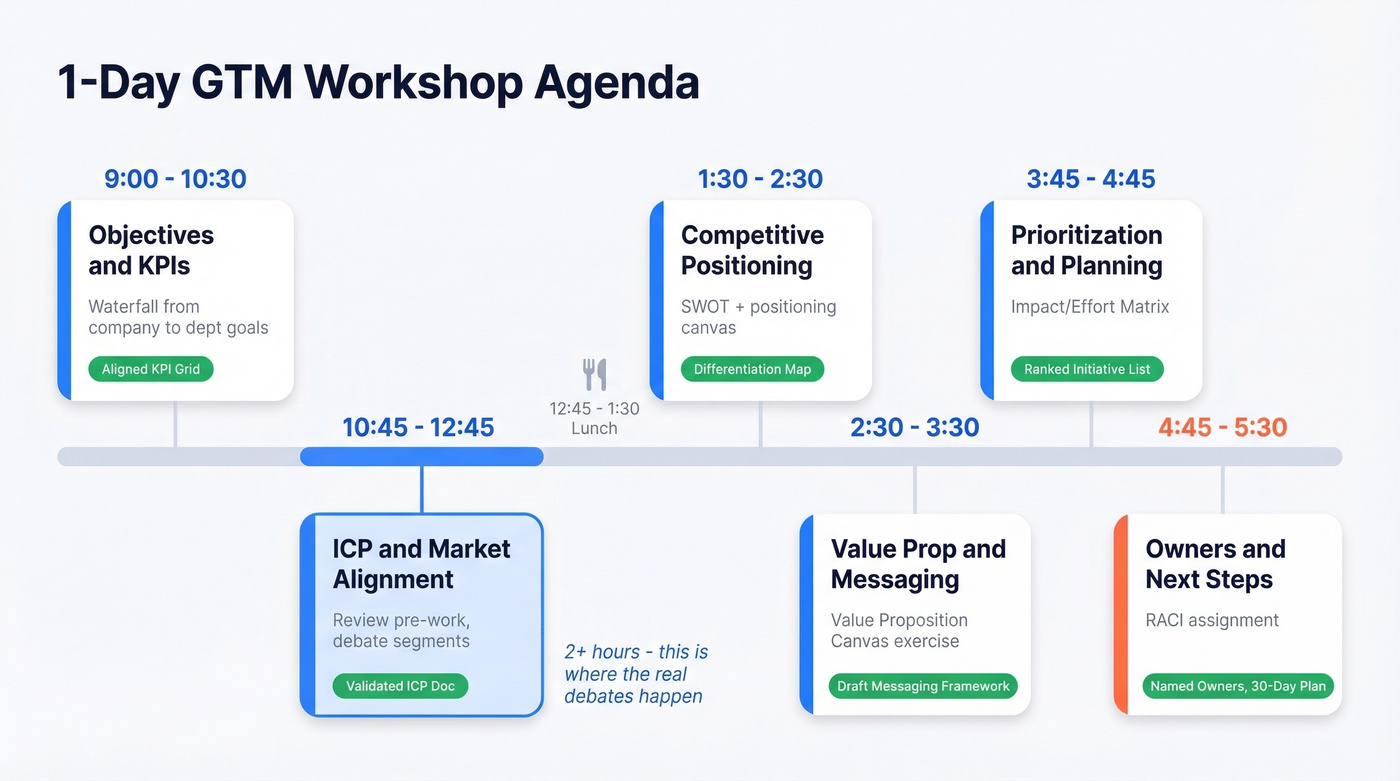
Use a waterfall approach for the first 90 minutes - start with corporate objectives, cascade to departmental objectives, then align KPIs. Spend 2+ hours on ICP and market alignment. In our experience, this is where the real debates happen, and rushing it guarantees misalignment downstream.
Exercises Worth Running
Value Proposition Canvas - Map customer jobs, pains, and gains on one side. Map your product's pain relievers and gain creators on the other. Split into two groups, run it for 20 minutes, then compare outputs. The gaps between groups reveal where your messaging is inconsistent. We've seen this exercise generate the most heated - and productive - debates of any workshop block.
Impact/Effort Matrix - Here's how to run it in 15 minutes: draw a 2x2 on the board, have each person write initiatives on sticky notes, plot them collectively, resource Quick Wins immediately, assign Big Bets a dedicated owner, and kill Time Wasters publicly so nobody resurrects them later.
Customer Journey Mapping - Walk through the buyer's path from problem awareness to closed deal. Mark every touchpoint where your team interacts with the prospect and identify the handoff gaps between marketing, sales, and CS. This exercise exposes the moments where deals die silently - the "we thought sales was following up" black holes that nobody owns until you draw them on a whiteboard.

Your workshop validated the ICP and sized the TAM. Now you need verified contact data to reach those accounts. Prospeo's 300M+ profiles with 30+ filters - buyer intent, technographics, headcount growth, funding - let you build lists that match your workshop segments exactly. 98% email accuracy means your launch outreach lands, not bounces.
Turn your GTM workshop output into pipeline the same week.
DIY vs. Hiring a Facilitator
| DIY | External Facilitator | |
|---|---|---|
| Cost | $0 + 15-30 hrs prep | ~$5K-$20K/day |
| Best for | First workshop, tight budget | Political minefields, multi-BU |
| Risk | Bias, scope creep | Consultant doesn't know your market |
| Our pick | Start here | When you've outgrown DIY |
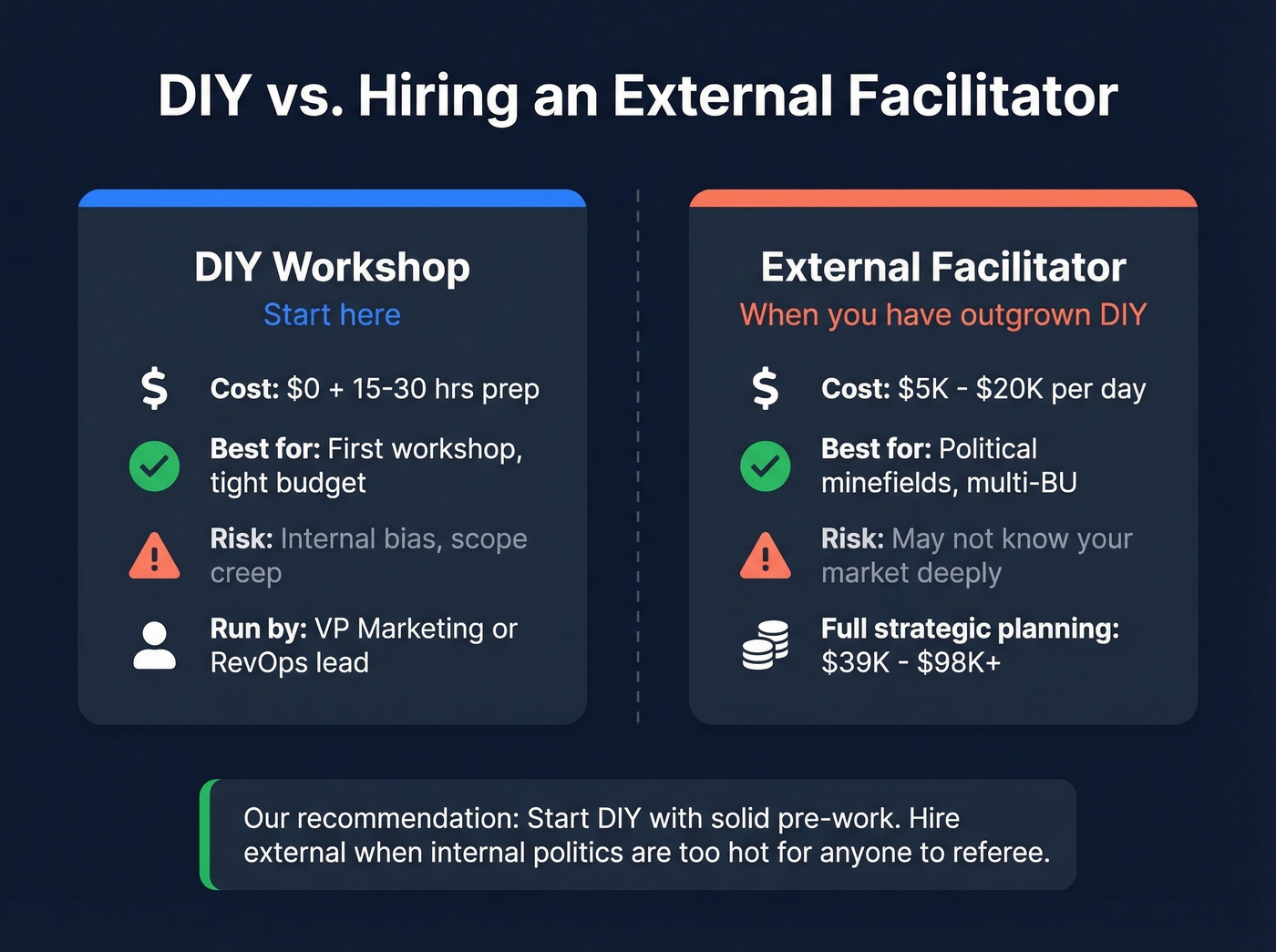
You don't need a $20K facilitator for your first GTM planning session. A strong VP of Marketing or RevOps leader with the right agenda and pre-work can run it well. Hire external help when internal politics are too hot for anyone to referee, or for multi-department alignment projects ($13K-$33K range). For full strategic planning plus implementation, expect $39K-$98K+.
Tools for Remote Sessions
A GTM strategy that lives in slides is already dead. Miro's GTM Strategy Blueprint includes 14 guided boards - ICP, competitive analysis, positioning, customer journey mapping, a live KPI tracker - available on all Miro paid plans at no additional cost. For something lighter, their 1-page GTM Canvas works as a quick-start artifact. Mural offers built-in facilitation prompts, real-time sticky notes, and task assignment boards that keep remote sessions from drifting into chaos.
Skip Mural if your team is already deep in the Miro ecosystem. The switching cost isn't worth it for one workshop.
After the Workshop: GTM as Operating System
The workshop produced the strategy. Now you need execution.
Hold an activation meeting within 48 hours - not two weeks, not "next sprint." Review every action item, confirm owners, and set a 30/60/90-day cadence. As Highspot frames it, modern GTM isn't a one-time initiative. It's an operating system with a shared scoreboard, weekly cadence, and real accountability.
Here's the thing most teams miss: the workshop defined your ICP criteria - industry, company size, job titles, tech stack, growth signals. That's useless if nobody builds the prospect list that week. Tools like Prospeo let you filter by those exact firmographic and technographic criteria across 300M+ profiles, export verified emails at 98% accuracy, and start outbound before the strategy deck gets stale. When your brand-new GTM positioning is on the line, bounce rates under 4% aren't a nice-to-have - they're table stakes (see email bounce rate benchmarks and causes).
The 30/60/90-day activation plan from your workshop dies if reps can't reach decision-makers. Prospeo delivers 125M+ verified mobile numbers with a 30% pickup rate and emails at $0.01 each - refreshed every 7 days, not 6 weeks. Your GTM strategy deserves data that keeps up with it.
Stop letting stale data sabotage a strategy your whole team aligned on.
Five Mistakes That Kill Workshops
We've watched teams make every one of these.
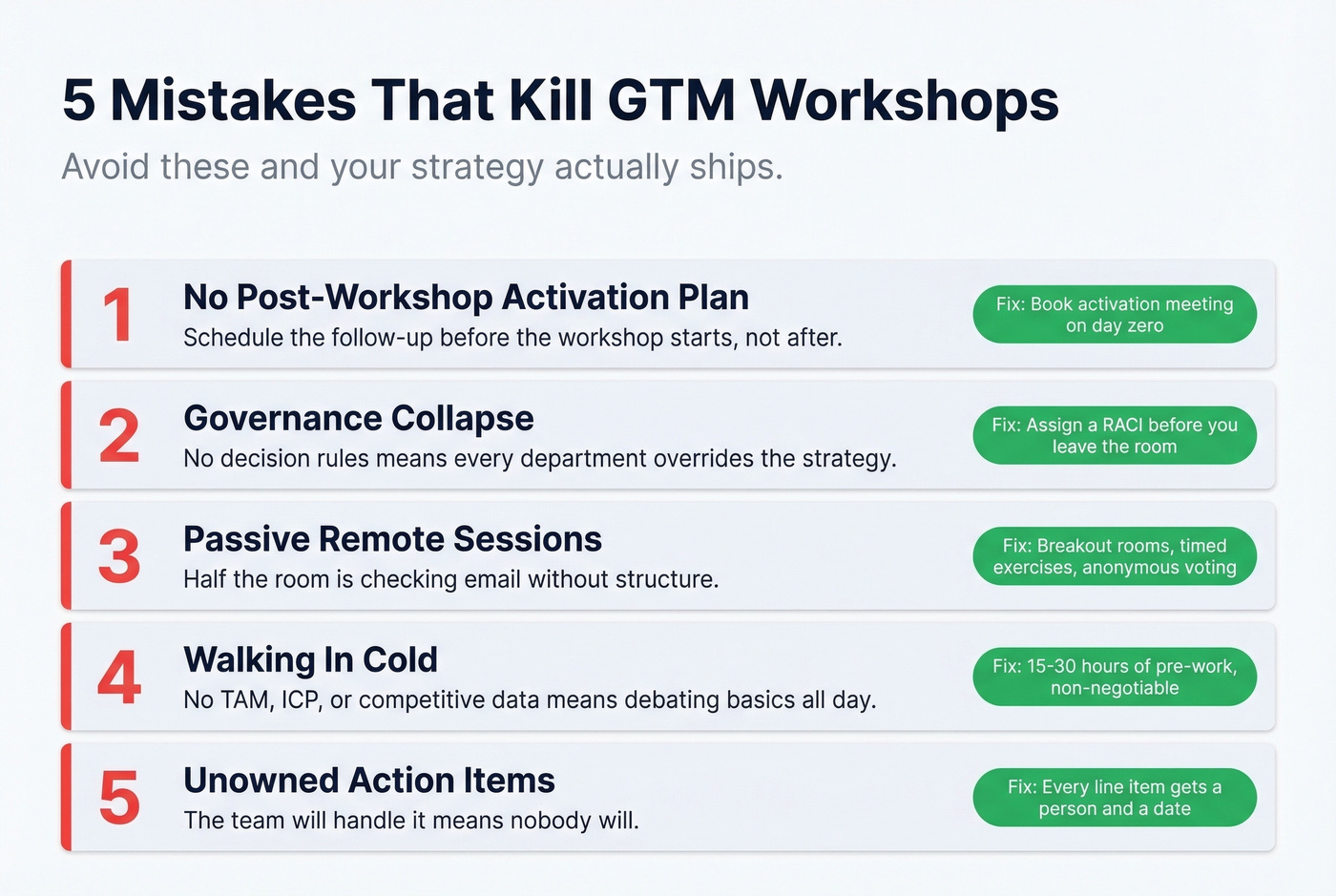
No post-workshop activation plan. Schedule the follow-up before the workshop even starts. If you wait until after, competing priorities will swallow it.
Governance collapse. Without decision rules and a RACI, every department overrides the strategy with their own priorities. That's how you get the Frankenstein plan.
Passive remote sessions. Without breakout rooms, timed exercises, and anonymous voting, half the room is checking email. Let's be honest - they're checking email anyway, but structure at least makes it harder.
Walking in cold. No TAM, ICP, or competitive data means you'll spend the entire day debating basics instead of making decisions. The pre-work isn't optional.
Unowned action items. "The team will handle it" means nobody will. Every line item needs a person and a date.
FAQ
How long should a GTM workshop be?
One focused 8-hour day works for most single-product teams. Budget two days for complex multi-product or multi-business-unit launches where separate ICP debates are needed. Momentum matters more than duration - a tight one-day session beats a sprawling two-day retreat every time.
Who should facilitate a go-to-market strategy workshop?
An internal leader (VP Marketing or RevOps) with thorough pre-work can run it effectively. Hire an external facilitator (~$5K-$20K/day) when internal politics are too heated for anyone in the room to stay neutral, or when you're aligning three or more departments that don't normally collaborate.
How do you turn workshop outputs into pipeline?
Hold an activation meeting within 48 hours, assign every action item a named owner with a deadline, and build a verified prospect list matching your newly defined ICP that same week. The ICP criteria your workshop produced - industry, headcount, tech stack, growth signals - translate directly into search filters on platforms like Prospeo, so outbound starts before alignment fades.