

GTM Models: Choose the Right Go-to-Market Motion for Your Business
A Gartner survey found that over half of leaders report fewer than 75% of their enterprise strategies actually succeed - and misaligned go-to-market is a common reason. You've probably read five articles about GTM models that all say "it depends." This one doesn't. We're replacing that non-answer with numbers, benchmarks, and a decision framework you can use this week.
Here's the thing: most companies don't have a GTM strategy problem. They have a model problem - they picked a motion that doesn't match their price point, and no amount of execution fixes that.
What Is a GTM Model?
A GTM model is the motion type your company uses to acquire and expand revenue - product-led, sales-led, channel-led, and so on. It's not a strategy on its own, and it's not a marketing plan.
Think of it this way: the model is the engine, the strategy is the vehicle. GTM model = motion type (how you sell). GTM strategy = the full plan built around that model, covering ICP, channels, pricing, and metrics. Marketing strategy = one input into the GTM plan. Most teams confuse the two, pick a model that doesn't match their economics, and then blame execution when growth stalls.
The 7 Go-to-Market Models
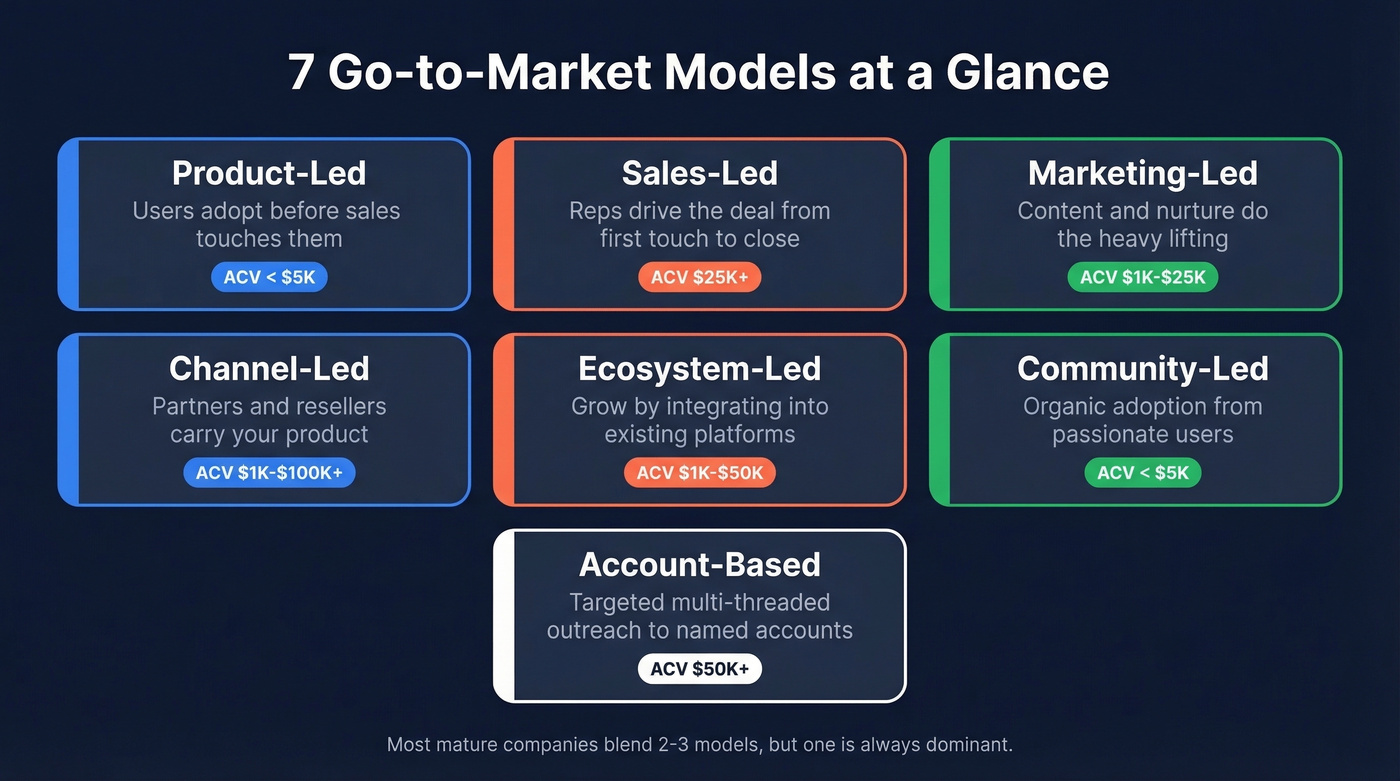
Every company runs some version of these seven motions. Most mature companies blend two or three, but one is always dominant.
Product-Led Growth
Slack didn't need an army of SDRs. Users invited teammates, teams invited departments, and departments brought in procurement. That's PLG: users adopt the product before sales gets involved. 39% of 474 Series A startups now enable some form of PLG, and in DevTools that number hits 50%.
The key risk is straightforward: if your product can't deliver an "aha moment" in under 30 minutes, PLG becomes a leaky funnel. We've watched teams pour money into onboarding flows that never convert because the core product simply requires too much setup to show value quickly. PLG rewards products that are immediately useful, not products that are eventually powerful.
Sales-Led
Reps drive the buying process from first touch to close. This is Salesforce's motion - high-touch, consultative, built for complex deals with multiple stakeholders. Best for ACV above $25K where buyers need education. The risk is cost: CAC payback often lands around 18 months and S&M expenses eat margin fast.
Marketing-Led
What if your buyer reads six blog posts, downloads a whitepaper, and watches a webinar before ever talking to a rep? That's HubSpot's world. Inbound content and nurture sequences do the heavy lifting. Works best when your buyer researches extensively before buying, but you're investing 6-12 months before the pipeline compounds.
Channel-Led
Partners, resellers, or distributors carry your product to market. Oatly's retail distribution is a channel-led play. Best when you can't economically reach every buyer directly. The risk is that your brand experience lives in someone else's hands, and partner enablement requires dedicated headcount and ongoing investment that most teams underestimate.
Ecosystem-Led
You grow by integrating into a platform where buyers already live - think Salesforce AppExchange. Best for products that extend an existing workflow rather than replace it. The risk: platform dependency. If the marketplace changes its rules, your distribution channel shifts overnight.
Community-Led
Skip this model unless your product is genuinely loved. Notion built a massive template-sharing community that became a major acquisition engine, but communities can't be manufactured. When they work, organic adoption drives awareness and trust before any product pitch. When they don't, you've spent a year building a Slack workspace with 200 lurkers.
Account-Based
The most expensive motion per account - and the highest-ceiling one. Highly targeted, multi-threaded outreach to a defined list of accounts where marketing and sales coordinate on personalized messaging. If your ICP targeting is off, you burn budget fast. If it's right, deal sizes justify the investment many times over.
| Model | Best For | Example | Key Risk | Typical ACV |
|---|---|---|---|---|
| Product-Led | Fast time-to-value | Slack, Zoom | Leaky funnel | < $5K |
| Sales-Led | Complex deals | Salesforce | High CAC | $25K+ |
| Marketing-Led | Research-heavy buyers | HubSpot | Slow ramp | $1K-$25K |
| Channel-Led | Broad distribution | Oatly | Partner brand control | $1K-$100K+ |
| Ecosystem-Led | Platform-native tools | AppExchange apps | Platform dependency | $1K-$50K |
| Community-Led | Passionate user base | Notion | Can't be forced | < $5K |
| Account-Based | Enterprise targeting | Enterprise B2B | Expensive per acct | $50K+ |
Which Model Fits Your Price Point?
Your go-to-market model is mostly an economic decision. ChartMogul's analysis of 2,500 SaaS companies makes this painfully clear - layer sales onto a sub-$25 ASP product and you'll watch growth flatline.
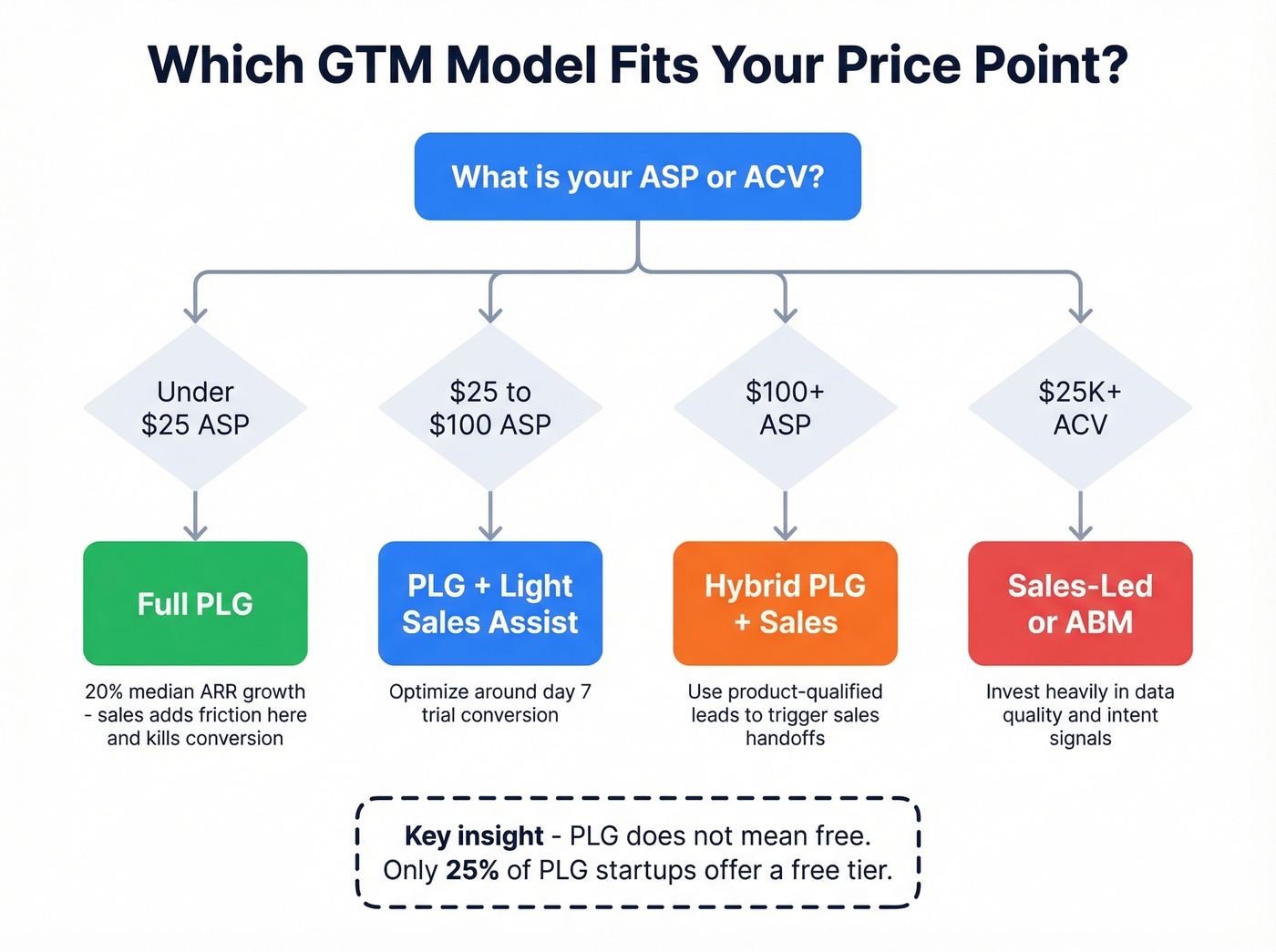
| ASP / ACV Range | Recommended Model | Why | Expected Growth |
|---|---|---|---|
| < $25 ASP | Full PLG | Sales adds friction; correlated with 0% median new business ARR growth at this price point | 20% median ARR growth |
| $25-$100 ASP | PLG + light sales-assist | Complexity rising, trial still works | 15-25% with day-7 optimization |
| $100+ ASP | Hybrid PLG + sales | Buyers need help, trial still works | Layer sales on usage signals |
| $25K+ ACV | Sales-led or ABM | Long cycles, multi-stakeholder | Invest in data quality + intent |
Below $25 ASP, companies that stay full PLG see 20% median new business ARR growth. Companies at the same price point that layer sales too early? Zero percent. Sales adds friction that kills conversion at low price points.
Starting around $100 ASP, the dynamic flips. Buyers need help navigating complexity, and a well-timed sales touch on a product-qualified lead converts dramatically better than self-serve alone. Even in hybrid, one model must be dominant. If you can't name yours, you've got a misalignment problem.
A common debate among operators: does PLG mean free? The Extruct dataset says no. Of 474 Series A startups studied, 39% enable PLG but only 25% offer a free tier. PLG means letting users start without talking to sales - not giving the product away.

Whether you run PLG, sales-led, or ABM, every GTM model breaks down when reps reach the wrong people. Prospeo's 300M+ profiles with 98% email accuracy and 125M+ verified mobiles mean your motion connects to real buyers - not bounced inboxes.
Fix your GTM data before you blame your GTM model.
GTM Benchmarks That Matter
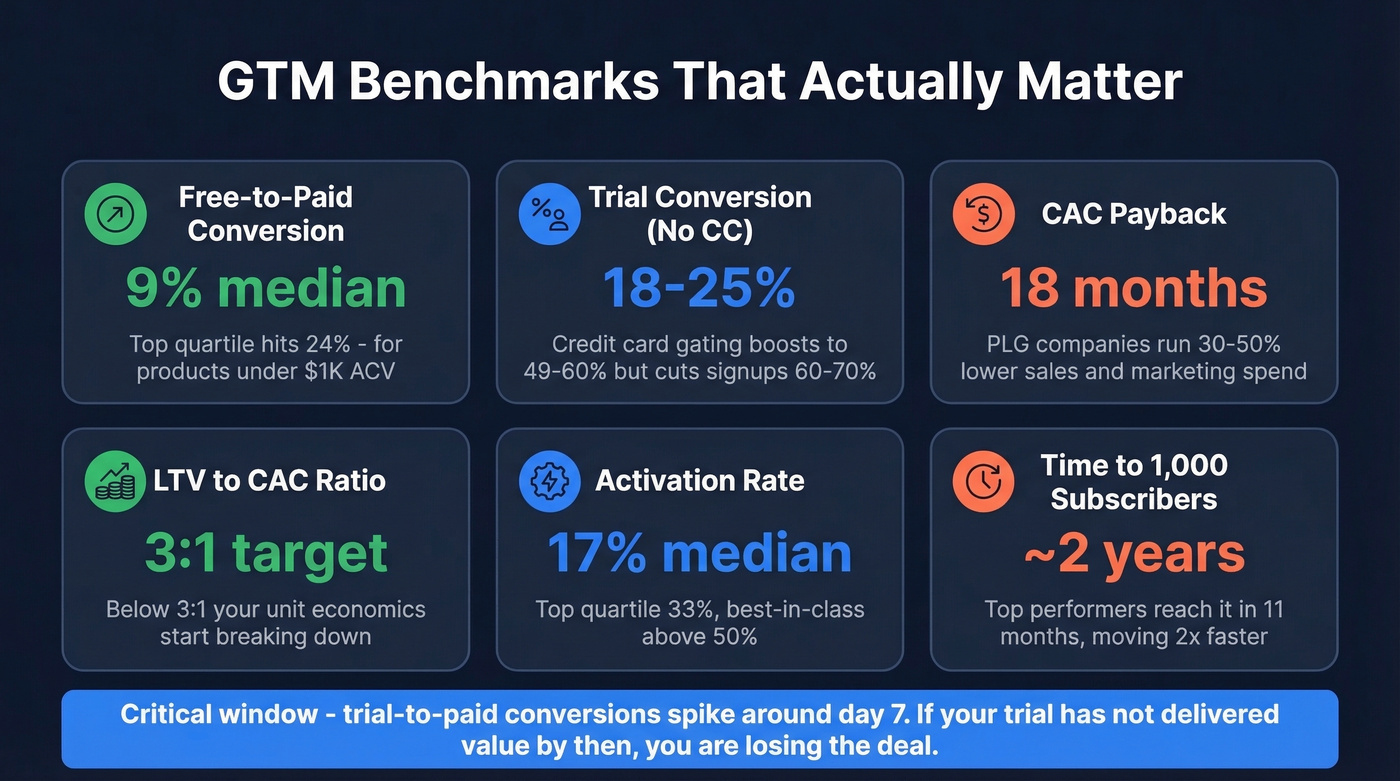
We've seen teams obsess over vanity metrics while ignoring the numbers that actually predict go-to-market health. These are the ones worth tracking:
| Metric | Median | Top Quartile | Notes |
|---|---|---|---|
| Free-to-paid conversion | 9% | 24% | For < $1K ACV products |
| Trial conversion (no CC) | 18-25% | - | CC gating cuts signups 60-70% |
| Trial conversion (CC req.) | 49-60% | - | Higher conversion, smaller funnel |
| CAC payback | 18 months | - | PLG runs 30-50% lower S&M |
| LTV:CAC ratio | 3:1 target | - | Below 3:1, unit economics break |
| Activation rate | 17% | 33% | Best-in-class hits 50%+ |
| Time to 1,000 subscribers | ~2 years | 11 months | Top performers move 2x faster |
The number that matters most: trial-to-paid conversions spike around day 7 for both PLG and sales-led companies. If your trial doesn't deliver value by day 7, you're losing the window. Credit card gating is a double-edged sword - it boosts conversion rates to 49-60% but reduces signups by 60-70%. The right choice depends on whether you're optimizing for volume or qualification.
Why Go-to-Market Motions Fail
Most GTM failures aren't strategy problems. They're validation and alignment problems.
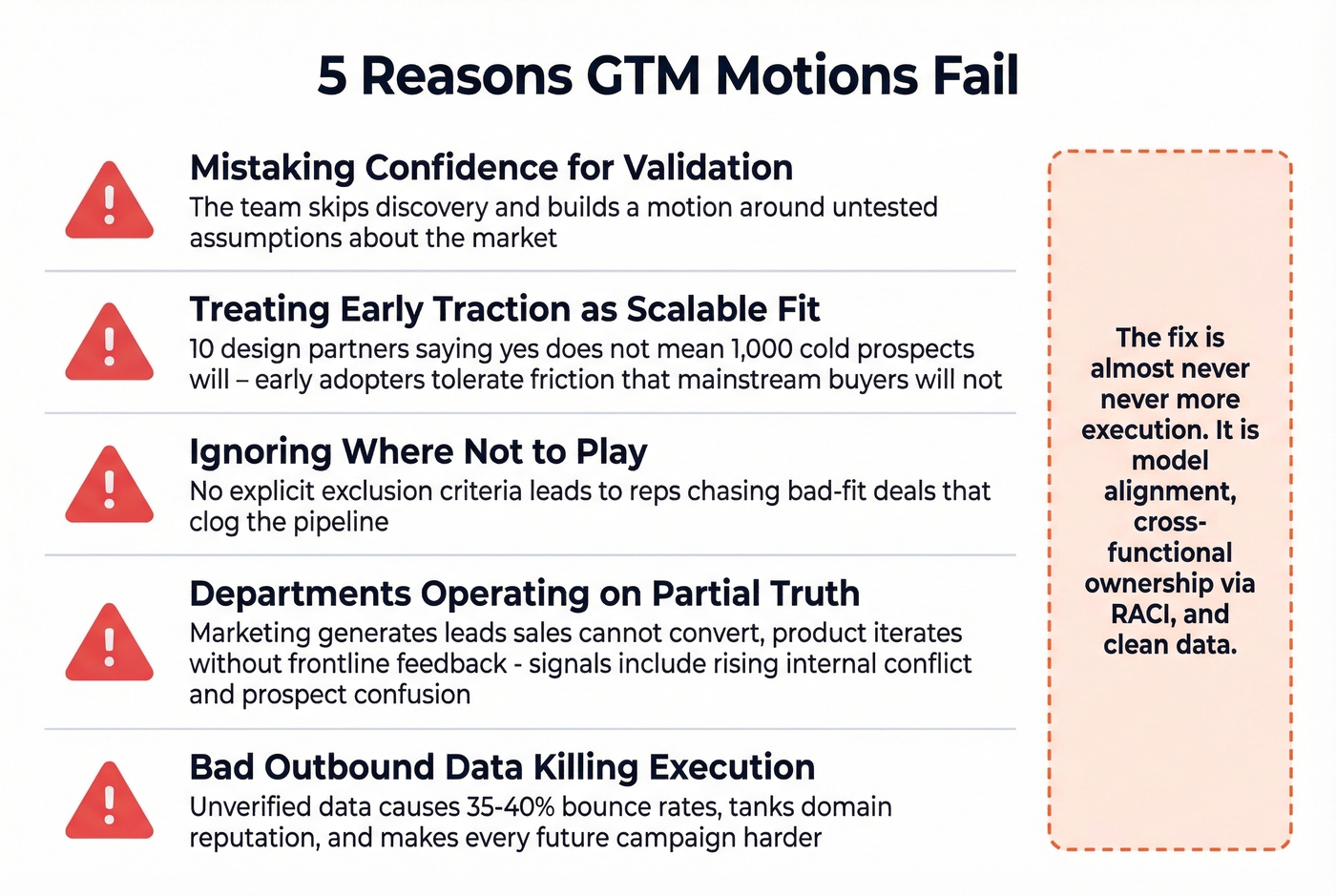
Mistaking confidence for validation. The founding team "knows" the market, skips discovery, and builds a motion around assumptions never tested with actual buyers. We've watched this play out at multiple startups - the team ships a sales-led motion because the CEO came from enterprise sales, not because the product's ACV justified it.
Treating early traction as scalable fit. Ten design partners saying yes doesn't mean 1,000 cold prospects will. Early adopters tolerate friction that mainstream buyers won't.
Ignoring "where not to play." Every GTM plan defines a target market. Almost none define the markets they're explicitly avoiding, which leads to reps chasing bad-fit deals that clog the pipeline. The r/sales consensus on when to hire the first AE almost always maps back to ACV and model choice - if your deal size doesn't justify a dedicated closer, you're hiring too early.
Departments operating on partial truth. Marketing generates leads that sales can't convert. Product iterates without frontline feedback. Two clear signals: increasing internal conflict between commercial functions, and prospect confusion from conflicting engagement experiences. A RACI model for GTM ownership fixes most of this.
Bad outbound data killing execution. This one's frustrating because it's so fixable. We've seen teams running outbound on unverified data hit 35-40% bounce rates - that's not a strategy problem, it's a data problem that tanks your domain reputation and makes every subsequent campaign harder. (If you're seeing this, start with email bounce rate benchmarks and fixes.)
How to Go Hybrid Without Chaos
Almost every company above $100 ASP eventually goes hybrid. The question isn't whether - it's when and how.
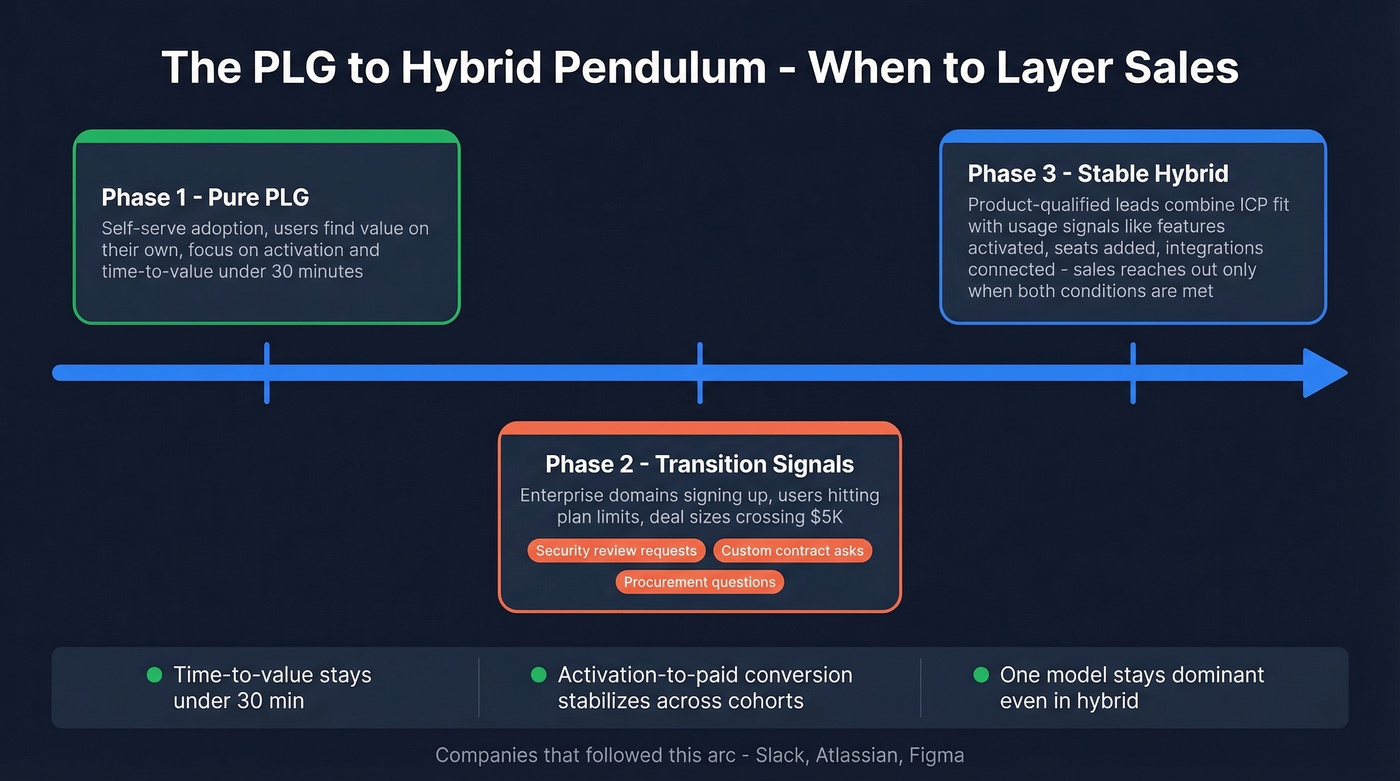
Research describes a "pendulum" pattern: companies swing between human-led onboarding to learn and increase LTV and self-serve to scale, then settle into a stable hybrid. Slack, Atlassian, and Figma all followed this arc - PLG-first, then layered sales to go upmarket.
Three timing signals tell you it's time to add sales:
- Enterprise domain signups start appearing with security review requests and procurement questions.
- Users hit plan limits and ask about custom contracts.
- Deal sizes cross roughly $5K, where buyers expect a human conversation.
The operational key is defining product-qualified leads by combining ICP fit with product usage signals like features activated, seats added, and integrations connected. When both conditions are met, sales reaches out. Not before. You know the hybrid motion is working when median time-to-value stays under 30 minutes and activation-to-paid conversion stabilizes across cohorts.
The GTM Execution Stack
Choosing a model is maybe 30% of the work. Operationalizing it is the other 70%.
Let's break this into three execution layers that matter regardless of model. First, ICP definition with firmographic, technographic, and behavioral filters - not just "Series B SaaS companies" but specific headcount ranges, tech stacks, and hiring patterns that predict buying intent. Second, intent signals to prioritize in-market buyers so reps aren't cold-calling companies that aren't evaluating solutions. Third, verified contact data as the layer that connects strategy to actual conversations. In 2026, AI-driven lead routing and automated enrichment workflows are table stakes for any team running hybrid or sales-led motions.
Successful go-to-market programs share a common trait: they treat data quality as infrastructure, not an afterthought. Every model depends on reaching the right people with accurate information. If your outbound motion runs on a database with a 6-week refresh cycle, you're pitching people who changed jobs last month. Prospeo refreshes data every 7 days, delivers 98% email accuracy, and tracks 15,000 intent topics via Bombora - so your sales-led or ABM motion targets in-market buyers with verified contact data. (If you're evaluating vendors, start with data enrichment services and sales prospecting databases.)
Running ABM or sales-led at $25K+ ACV? Your CAC payback depends on reaching the right stakeholders fast. Prospeo layers intent data across 15,000 topics with 30+ filters - so your reps target in-market accounts, not cold lists refreshed six weeks ago.
Teams using Prospeo book 26% more meetings than ZoomInfo users.
FAQ
What's the difference between a GTM model and a GTM strategy?
A GTM model is the motion type - product-led, sales-led, channel-led, account-based. A strategy is the full plan built around that motion: ICP, channels, pricing, messaging, and metrics. The model is one input into the strategy, not the strategy itself.
Can you run multiple GTM models at once?
Yes, and most companies above $100 ASP do. But one model must be dominant. If you can't name which motion drives the majority of your revenue, you've got a misalignment problem that shows up as internal conflict and buyer confusion. Structure distinct programs for each segment - say, PLG for SMB and sales-led for enterprise - to prevent resource conflicts.
What tools do you need to execute a go-to-market model?
At minimum: a CRM, a verified contact data platform, and an outreach tool. For outbound-heavy motions, add a sequencing tool like Outreach or Lemlist for a functional execution stack. Prospeo's free tier gives you 75 verified emails per month - enough to start testing your motion before committing budget.