

GTM Strategy and Operations: What It Actually Takes to Build the Function
Leadership spends months on GTM strategy and operations planning - workshopping positioning, debating ICP definitions, building slide decks - and then nothing changes for the reps working deals. Up to 70% of B2B sales reps missed quota last year. The strategy wasn't the problem. The lack of operational muscle to execute it was.
Here's the short version: GTM strategy is the blueprint (ICP, positioning, motions, pricing). GTM operations is the engine (execution, measurement, orchestration). You need both. Don't start with a funnel diagram. Start with a weekly operating meeting, a single source of truth for accounts, and clean data.
Strategy vs. Operations
Most teams conflate these, and that's where dysfunction starts.
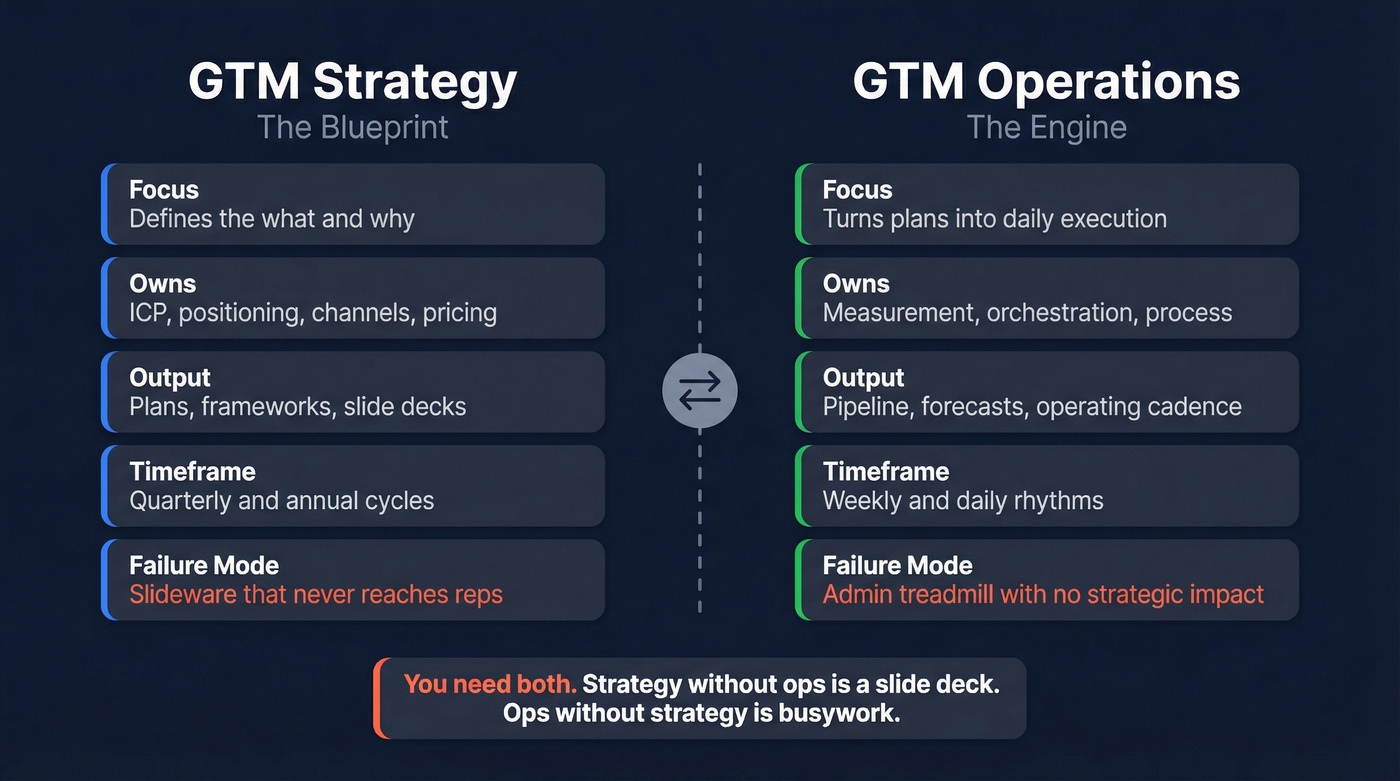
| GTM Strategy | GTM Operations | |
|---|---|---|
| Focus | Blueprint | Engine |
| Owns | ICP, positioning, channels | Execution, measurement |
| Output | Plans, frameworks | Pipeline, forecasts, cadence |
| Timeframe | Quarterly / annual | Weekly / daily |
| Failure mode | Slideware | Admin treadmill |
The average software company runs 10.5 simultaneous go-to-market efforts - five core channels plus experimental initiatives. Without an operations layer enforcing discipline, that's not a strategy. It's chaos with a Notion doc.
What GTM Operations Actually Does
We've seen teams hire a "GTM Ops lead" and then struggle to define the job. It breaks into four areas:
| Responsibility | What it means | Where teams fail first |
|---|---|---|
| Target Setting & Forecasting | Historical win rates + rep capacity = quotas | Targets disconnected from pipeline reality |
| Pipeline & Revenue Ops | CRM hygiene, velocity tracking, funnel reporting | Garbage CRM, fiction forecasts |
| Cross-Team Enablement | Unified dashboards, single source of truth, process docs | Sales, marketing, CS on different data |
| Strategic Projects | Comp design, territory planning, ABM launches, PLG motions | High-leverage work that nobody owns |
One role worth watching: the GTM Engineer - part admin, part developer, part process architect. Someone who builds Clay workflows, scripts integrations, and owns outcomes like "meetings booked" rather than "built a dashboard." The shift from RevOps to GTM Engineering reflects a broader trend: ops teams measured on revenue impact, not task completion. If you're hiring for this role in 2026, look for someone who can write a Python script before lunch and run a pipeline review after it.
KPIs Worth Tracking
Track five metrics, not fifty.
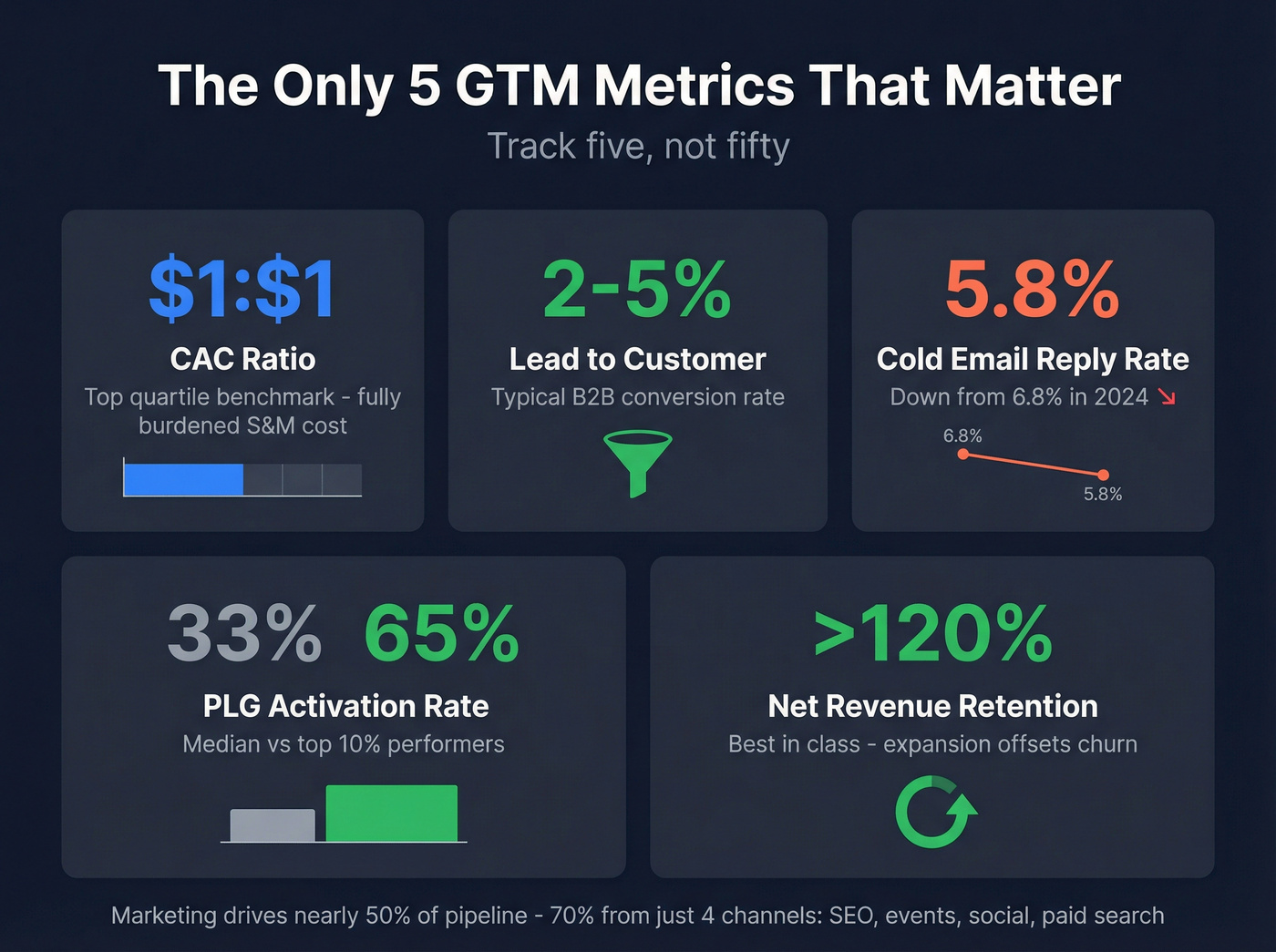
| Metric | Benchmark | Context |
|---|---|---|
| CAC ratio | $1:$1 (top quartile) | Fully burdened S&M cost |
| Lead-to-customer | 2-5% | Typical B2B conversion |
| Cold email reply rate | 5.8% avg | Down from 6.8% in 2024 |
| PLG activation | 33% avg / 65% top | Top 10% vs. median |
| Net revenue retention | >120% best-in-class | Expansion offsets churn |
Marketing contributes nearly 50% of pipeline across most B2B companies, with 70% coming from just four channels: SEO, events, social, and paid search. If your ops team isn't measuring marketing's pipeline contribution alongside sales activity, you're flying half-blind.
That cold email decline deserves attention. Reply rates dropped a full point year-over-year, but the story is more nuanced than "outbound is dead." Timeline-based hooks still pull ~10% reply rates versus 4.39% for problem-based hooks. Better targeting and sharper copy beat more volume every time - and better targeting starts with data that isn't six weeks stale.

You just read that cold email reply rates dropped a full point - and that better targeting beats more volume every time. Prospeo's 7-day data refresh cycle means your reps never prospect with stale records. 98% email accuracy. 30+ filters including buyer intent and job changes. The operational foundation your GTM strategy actually needs.
Stop feeding your GTM engine six-week-old data.
A 4-Phase Roadmap
Phase 1 - Foundation (0-30 days). Run a data audit. Fix lead routing. Establish one weekly operating meeting with sales, marketing, and CS leadership covering pipeline review, metric check, and blocker resolution. In our experience, this single meeting is the highest-ROI change a team can make. The quick win isn't a dashboard. It's everyone looking at the same numbers in the same room.
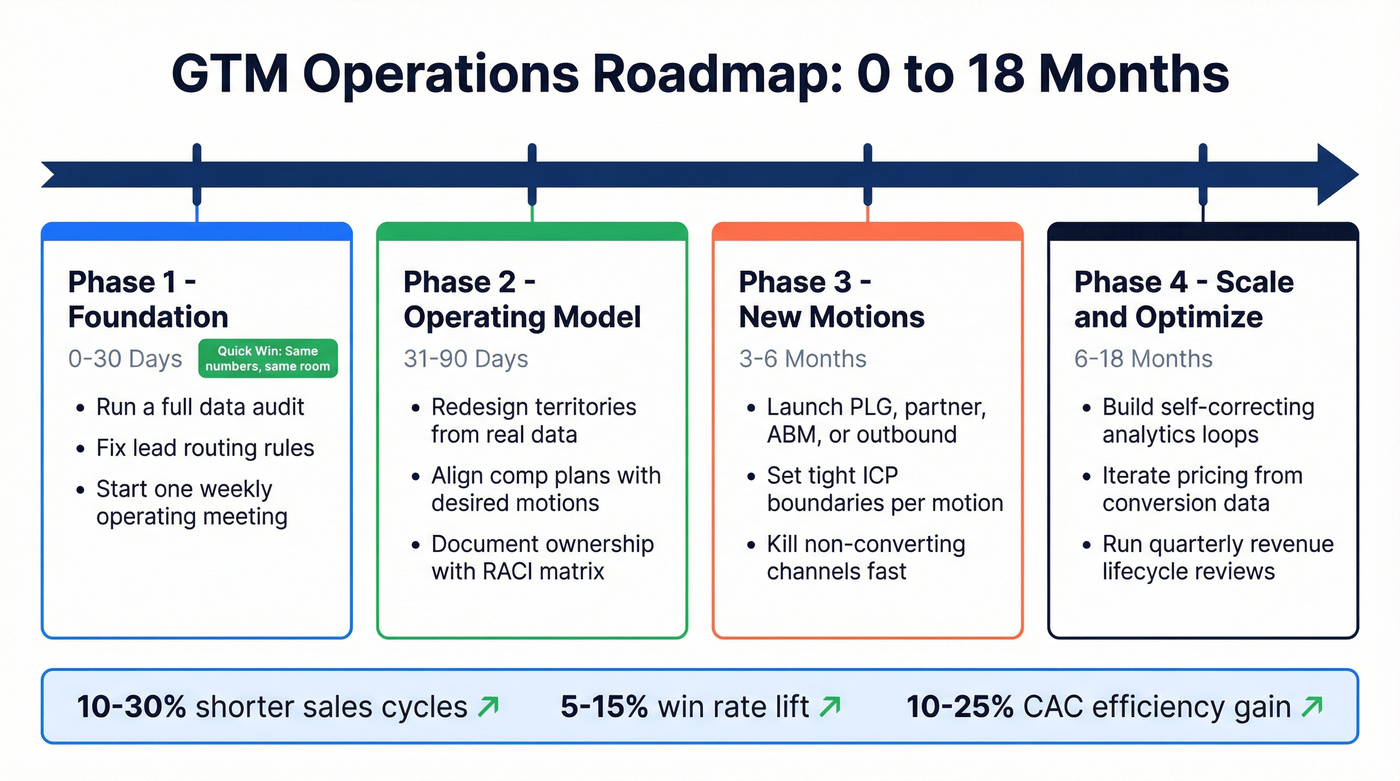
Phase 2 - Operating Model (31-90 days). Redesign territories from actual data. Align comp plans with the motions you want reps running. Document ownership with a RACI matrix before launching new motions, and stand up cross-functional experiments with clear kill criteria. Skip this phase and you'll spend six months untangling misaligned incentives.
Phase 3 - New Motions (3-6 months). Launch PLG, partner, ABM, or outbound motions with tight ICP boundaries. Kill non-converting motions fast. Most teams let underperforming channels linger for quarters because nobody owns the shutdown decision.
Phase 4 - Scale & Optimize (6-18 months). Build self-correcting analytics loops. Iterate pricing using conversion and retention data. Run quarterly reviews of the full revenue lifecycle to catch drift before it compounds.
When done well, teams typically see 10-30% sales cycle reduction, 5-15% win-rate lift, and 10-25% CAC efficiency improvement. Those aren't overnight numbers - they're the result of sustained discipline across all four phases.
The Tech Stack That Actually Matters
The typical mid-sized company runs 150+ software tools. Most don't talk to each other. "Integrates with Salesforce" on a vendor's website doesn't mean the integration actually works - that's the integration illusion that kills ops teams.
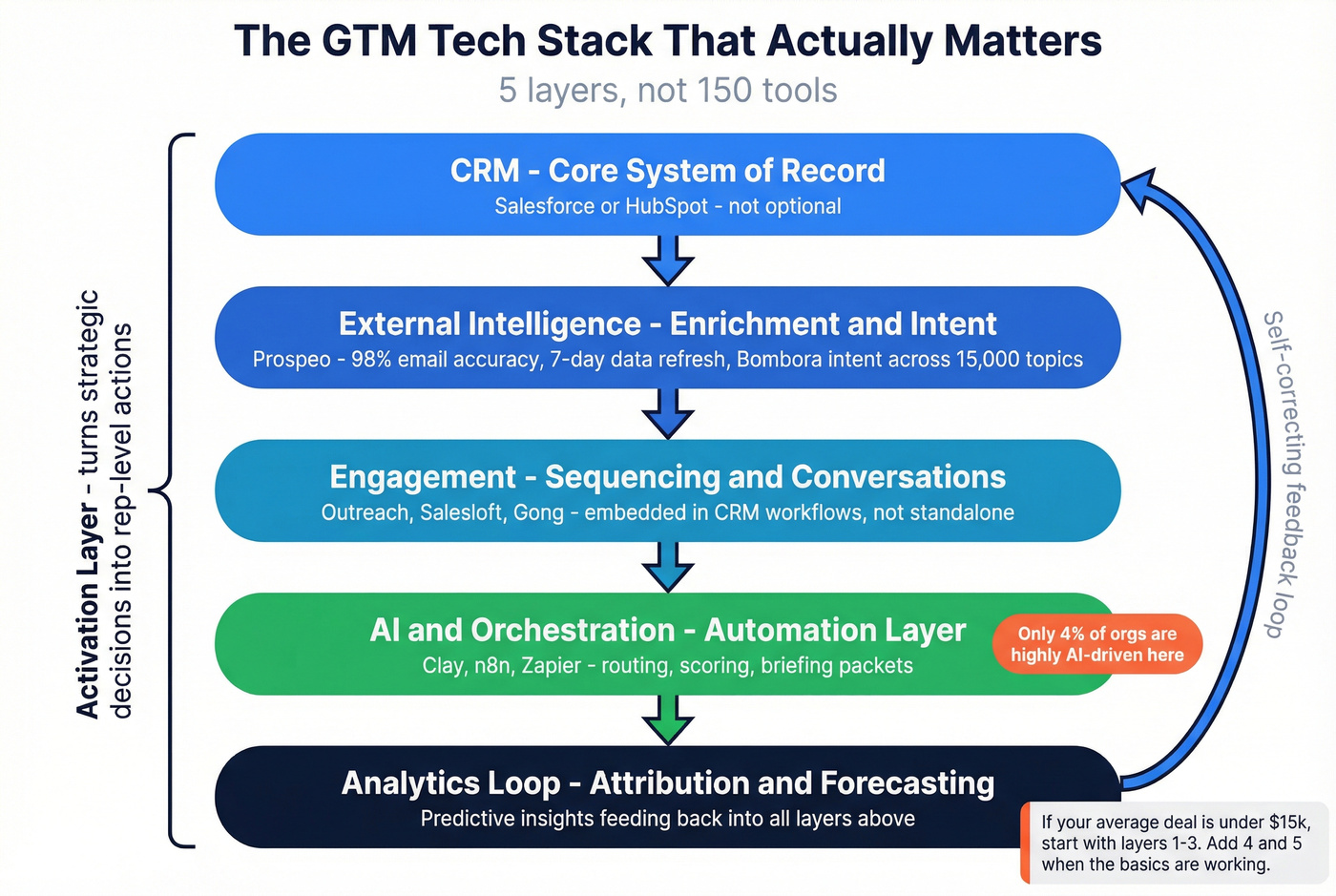
Think of your tech stack as the activation layer that turns strategic decisions into rep-level actions. Five layers matter:
CRM. Salesforce or HubSpot as your core system. Not optional. (If you're evaluating options, start with a few examples of a CRM to map requirements.)
External Intelligence. Your enrichment and intent layer. Prospeo handles this with 98% email accuracy, a 7-day data refresh cycle versus the six-week industry average, and a 92% API match rate for enrichment workflows. Layer in Bombora-powered intent data tracking 15,000 topics to catch accounts while they're actively researching.
Engagement. Outreach, Salesloft, or similar for sequencing. Gong for conversation intelligence. These need to be embedded into CRM workflows, not running as standalone tools.
AI & Orchestration. Clay, n8n, or Zapier for automating routing, scoring, and briefing packets. We're early here - only about 4% of orgs are "highly AI-driven" in go-to-market ops, though 87% have adopted AI in demand gen. The gap between adoption and maturity is enormous.
Analytics Loop. Attribution, forecasting, and predictive insights feeding back into Phases 1-4.
Let's be honest about something: if your average deal size is under $15k, you probably don't need a six-figure intent data platform. Start with clean contact data and a solid engagement tool. Add intent when you've exhausted the basics.

Mistakes That Kill Execution
Strategy as slideware. If the people building your go-to-market strategy don't talk to leads, the strategy is theater. There's a brutal thread on r/sales that nails this dynamic: months of GTM work that turns into superficial messaging changes built by people who've never run a discovery call.
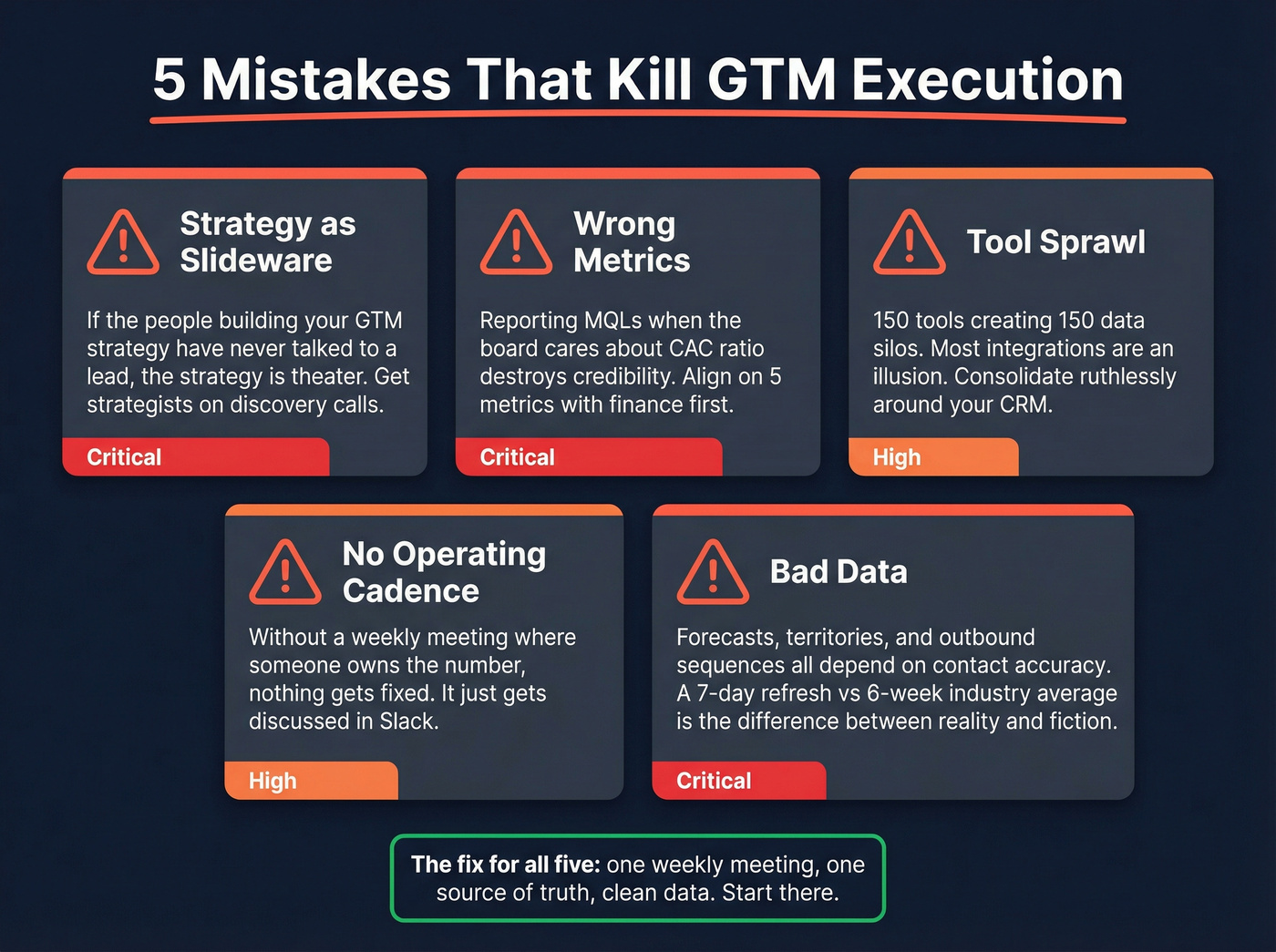
Wrong metrics. Reporting MQLs when the board cares about CAC ratio is a credibility killer. Align on five metrics with finance before building a single dashboard.
Tool sprawl. 150 tools generating 150 data silos. Consolidate ruthlessly. We've seen teams waste months on tool evaluations when their CRM data was the real bottleneck all along.
No operating cadence. Without a weekly meeting where someone owns the number, nothing gets fixed. It just gets discussed.
Bad data. This is the biggest ops mistake, and it's the one nobody wants to talk about because fixing it isn't glamorous. Your forecasts, territory models, and outbound sequences all depend on contact accuracy. A 7-day refresh cycle versus the 6-week industry average is the difference between pipeline metrics that reflect reality and ones that are fiction by the time you act on them. (If you're rebuilding your data layer, start with data enrichment and a short list of data enrichment services.)
Your tech stack's external intelligence layer is the difference between strategy and execution. Prospeo delivers 98% verified emails at $0.01 each, a 92% API match rate for CRM enrichment, and Bombora-powered intent data across 15,000 topics - all with native integrations to Salesforce, HubSpot, Clay, and your sequencing tools.
Activate your GTM operations with data that actually connects reps to buyers.
FAQ
What's the difference between GTM Ops and RevOps?
GTM Ops focuses on go-to-market execution - launching motions, aligning sales/marketing/CS, and measuring pipeline velocity. RevOps is broader, covering the full revenue lifecycle including post-sale renewal and expansion. The trend in 2026 is toward GTM Engineering, which adds technical execution to the traditional ops role.
When should we hire our first GTM Ops person?
Most companies need dedicated GTM Ops past 10-15 reps or $3-5M ARR. The first hire should be a generalist who owns CRM hygiene, forecasting, and cross-team process. At Series B-C, split into systems, insights, and enablement specialists.
What tools does a GTM Ops team need on day one?
Start with three layers: a CRM (Salesforce or HubSpot), a data quality platform for verified contacts and enrichment, and an engagement tool like Outreach or Salesloft. Intent data, AI orchestration, and advanced analytics are Phase 2 decisions once your operating model is running.