

How to Build a GTM Team That Actually Works in 2026
You're a founder wearing every hat - outbound, content, paid, partnerships - and every template you find assumes you already have a 10-person team. That paralysis between "do everything" and "do nothing well" kills more GTM motions than bad product ever will.
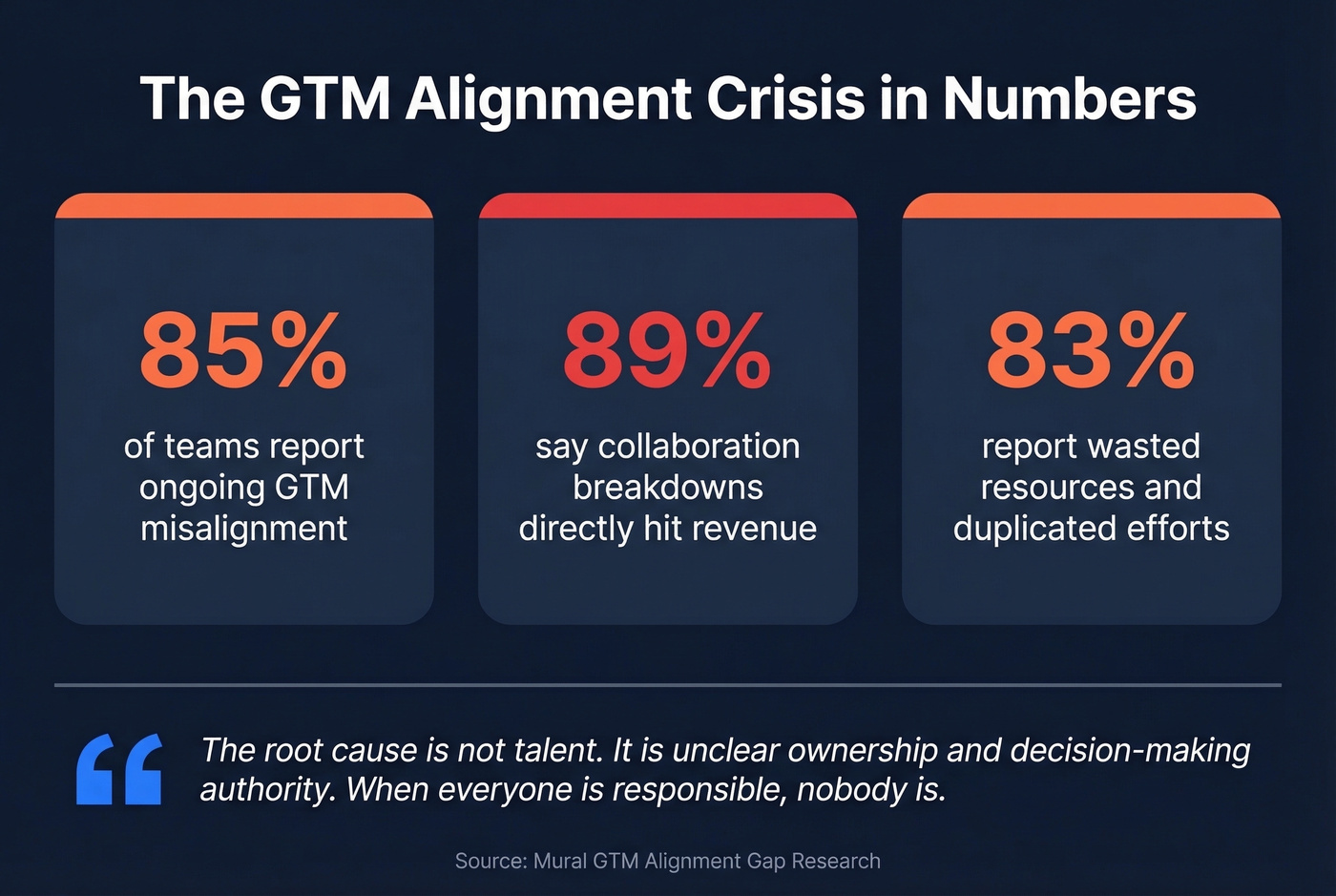
Here's the thing: 85% of teams report ongoing misalignment while simultaneously saying they're confident in their strategy. That gap between confidence and reality is where pipeline goes to die. What follows is the smallest GTM team that can ship a launch without chaos - and how to run it week to week.
What You Need (Quick Version)
A go-to-market team isn't a department. It's a cross-functional group spanning product, marketing, sales, RevOps, and customer success. Most teams fail not because they lack talent, but because nobody owns the plan. Start with clear ownership, add RevOps earlier than you think, and don't hire ahead of your stage.
What "GTM" Actually Means
Half the battle is defining what "GTM" means inside your company - launch, pipeline, or expansion - because teams use the term differently. A persistent misconception, especially across Reddit threads in r/sales and r/startups, is that a go-to-market team is just "sales plus marketing with a fancier name."
It's not.
A GTM team is the cross-functional group responsible for bringing a product to market and generating revenue from it. That includes product management, product marketing, sales, customer success, RevOps, and enablement. Marketing generates demand. Sales closes deals. The go-to-market team orchestrates how all of those functions move in the same direction at the same time, which is especially critical in B2B where longer sales cycles and multiple stakeholders make alignment non-negotiable. Without that orchestration layer, you've got talented people rowing in different directions.
Misalignment isn't a culture problem. It's a decision-rights problem.
Why Most Go-to-Market Teams Are Broken
The numbers are brutal. 85% of teams report ongoing GTM misalignment, and 89% say those collaboration breakdowns directly hit revenue. Another 83% report wasted resources, duplicated efforts, and constant fire drills.
We've seen this play out firsthand. One PMM described a launch where leadership set pricing and sales targets without market research, product wasn't ready, professional services support wasn't defined, and marketing rejected the launch plan because they'd already committed the same ICP to a different campaign. The result was a "Frankenstein plan" where RACI existed on paper but got bypassed at every senior level.
The root cause isn't talent. It's unclear ownership and decision-making authority. When everyone's responsible, nobody is.
Core GTM Team Roles
The modern go-to-market org has expanded well beyond the classic marketing-and-sales duo. Here's how the role map looks in 2026:
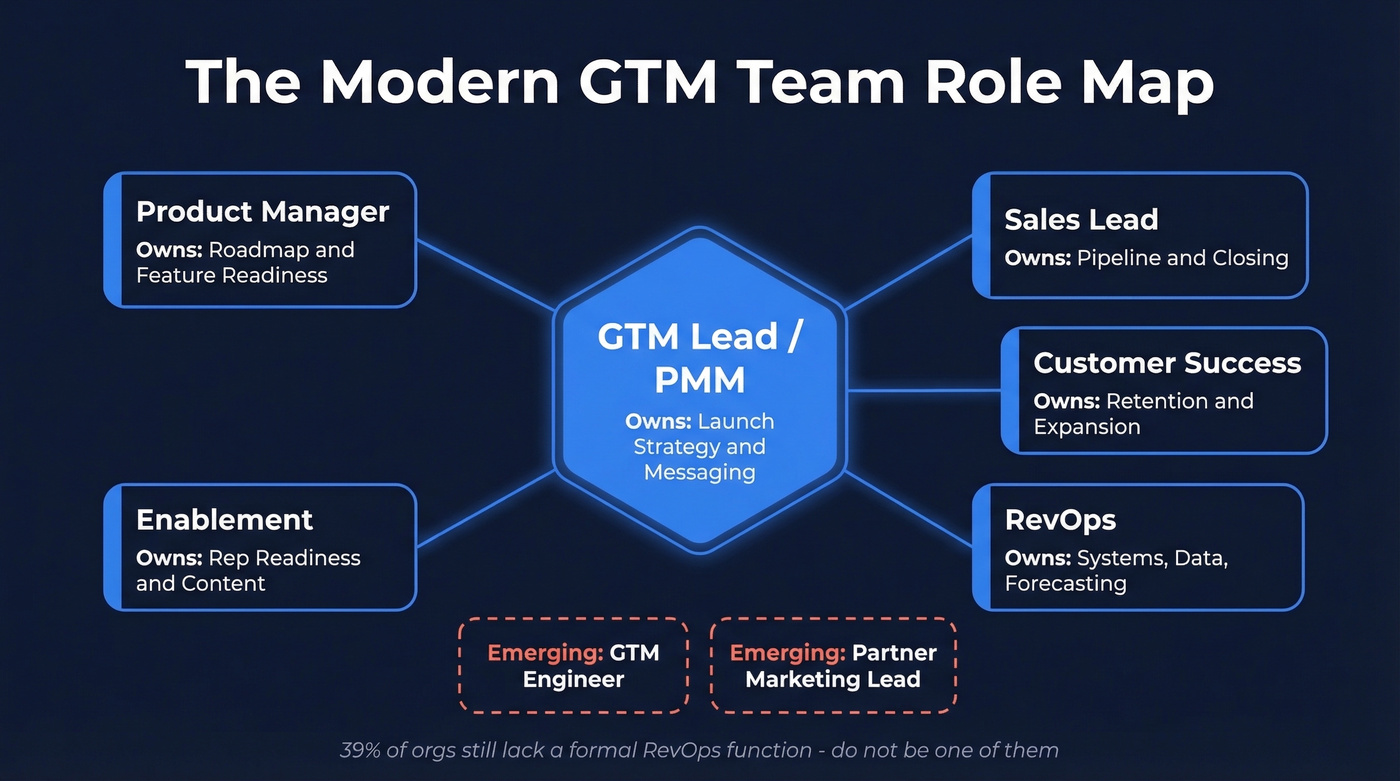
| Role | Owns | Reports To |
|---|---|---|
| GTM Lead / PMM | Launch strategy, messaging | CMO or CPO |
| Product Manager | Roadmap, feature readiness | CPO |
| Sales Lead | Pipeline, closing | CRO or VP Sales |
| Customer Success | Retention, expansion | CRO or CCO |
| RevOps | Systems, data, forecasting | CRO or CFO |
| Enablement | Rep readiness, content | CRO or CMO |
Two emerging roles worth watching: GTM engineers (the technical glue between tools and workflows) and partner marketing leads, which are critical if channel is part of your motion.
The CRO role is expanding fast - accountability now stretches from opportunity generation through closure. Where RevOps reports (CRO vs. CFO) usually depends on whether the company treats ops as a revenue accelerator or a cost center. We've watched companies stall for quarters because that reporting line was never decided.
The biggest gap? 39% of organizations still don't have a formal RevOps function. That's a problem, because RevOps is the connective tissue that keeps data, tools, and processes aligned across every customer-facing team. Without it, you're flying blind on pipeline accuracy and forecasting.
RACI-lite for your first launch:
| Workstream | Owner (Decides) | Approver |
|---|---|---|
| Launch messaging | PMM | CMO |
| Pricing | Product / Finance | CEO |
| Enablement materials | Enablement / PMM | Sales Lead |
| Systems & data | RevOps | CRO |
| Launch timeline | GTM Lead | CRO / CMO |
In our experience, the fastest way to kill a launch is splitting pricing ownership across three execs. One owner per workstream - not one owner for everything, since that creates bottlenecks, but every major deliverable needs a single person who can say yes or no.
Size Your GTM Team by Stage
Don't hire ahead of your stage. We've seen teams burn through runway building a 10-person go-to-market org before they've validated their ICP.
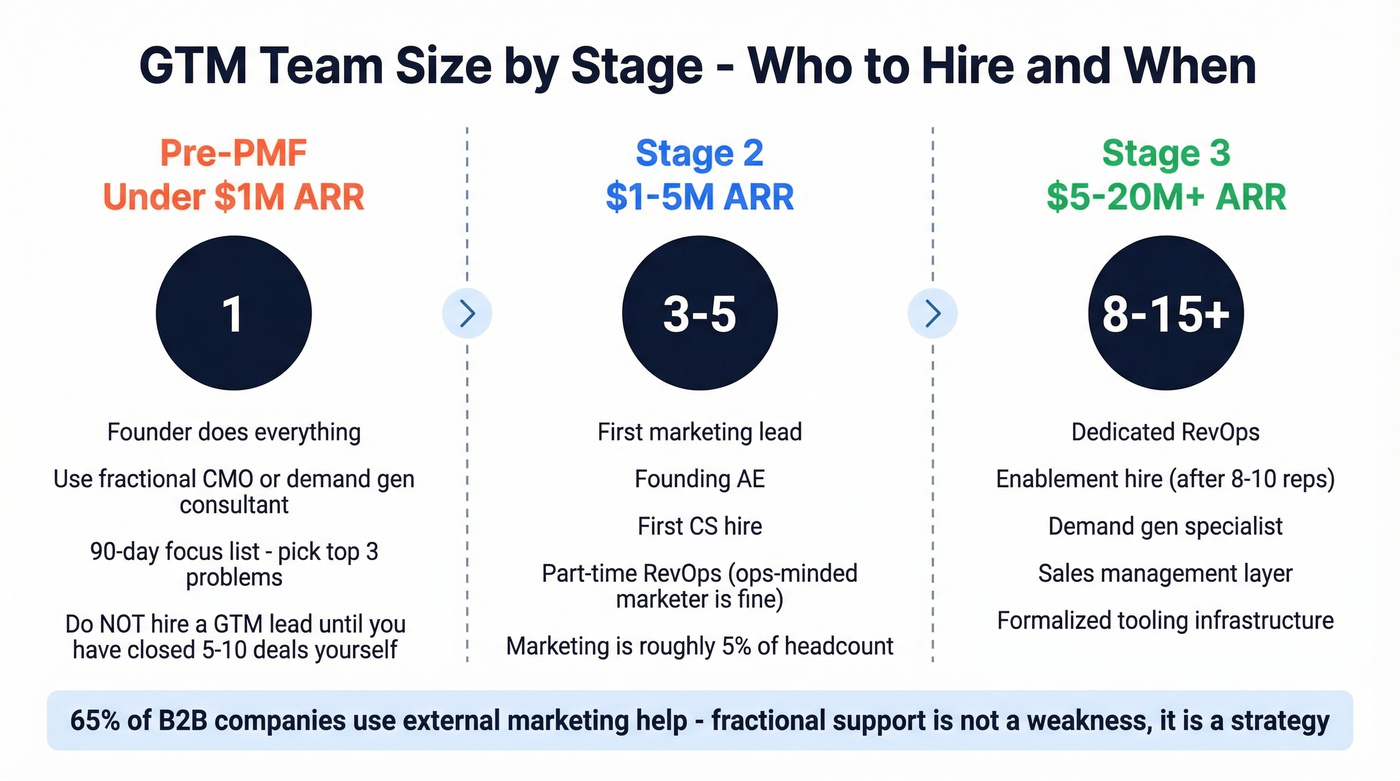
Pre-PMF (under $1M ARR): The founder is the team. Period. This is where "team of one" paralysis hits hardest - you're torn between outbound, content, paid, and partnerships, and every playbook assumes you have specialists. The fix isn't hiring; it's a 90-day focus list. Pick your top three problems and ignore everything else. Supplement with fractional support - 65% of B2B companies use some form of external marketing help, and a fractional CMO or demand gen consultant costs a fraction of a bad full-time hire. I've watched "GTM lead" hires fail when the founder hasn't closed 5-10 real deals yet. Don't hand off the sales motion until your ICP is sharp and repeatable.
$1-5M ARR: First marketing lead, founding AE, first CS hire, and part-time RevOps (even if it's an ops-minded marketer wearing two hats). The average B2B startup marketing team runs 2-5 people, and marketing typically represents about 5% of total headcount. Small enough to stay agile, large enough to cover the critical functions.
$5-20M+ ARR: Dedicated RevOps, enablement, demand gen, expanded sales team with management layer. This is where you invest in tooling infrastructure and formalized processes. AI is helping smaller teams operate like much bigger ones, but it doesn't replace clear ownership. Skip a dedicated enablement hire until you have at least 8-10 reps - before that, the sales lead or PMM can handle it with a shared content library.

You just read that 75% of RevOps pros cite data inconsistency as their top frustration. Prospeo solves that with a 7-day data refresh cycle, 98% email accuracy, and 30+ search filters - including buyer intent, technographics, and headcount growth - so your GTM team operates on data that's actually current.
Give your GTM team the data foundation that doesn't break mid-launch.
Why RevOps Can't Wait
Nearly 60% of organizations with RevOps adopted it in the last three years. That's not a trend - it's a correction. 72% now view RevOps as a strategic revenue driver, and for good reason: 75% of RevOps professionals cite data inconsistency as their top frustration, and 82% say their tools don't integrate well.
RevOps covers systems, analytics, enablement, and strategy. The teams that get this right early build a foundation where pipeline reporting is honest and forecasting is reliable. A 7-day refresh cycle on your contact database - versus the 6-week industry average - keeps CRM accounts current, reduces bounced sequences, and stops your forecast from being built on dead data.
Minimum viable RevOps checklist:
- Single source of truth for pipeline (one CRM, enforced)
- Standardized lead/account scoring across marketing and sales
- Automated enrichment on inbound leads (no manual Googling)
- Weekly data hygiene pass: deduplication, bounce removal, contact refresh
- Shared dashboard covering pipeline coverage, forecast accuracy, and conversion rates
If your average deal size is under $10k and your headcount is under 15, you probably don't need a full-time RevOps hire yet. But you absolutely need someone - even part-time - owning these five things.
Signals That Drive GTM Action
Your competitors are broadcasting signals every week. The best go-to-market teams build playbooks around them instead of waiting for inbound.
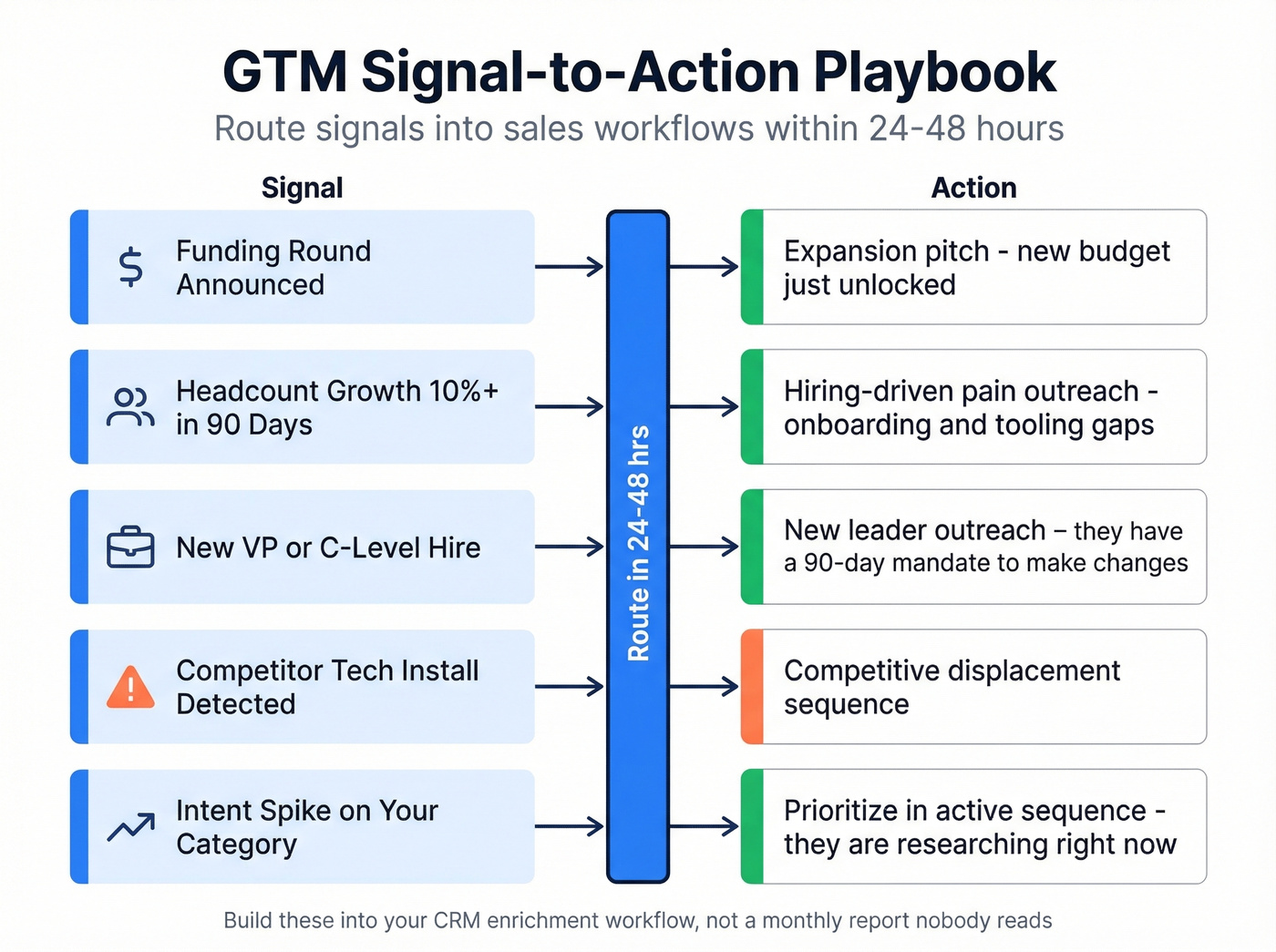
| Signal | Action |
|---|---|
| Funding round announced | Expansion pitch - new budget unlocked |
| Headcount growth (10%+ in 90 days) | Hiring-driven pain outreach (onboarding, tooling) |
| New VP/C-level hire | New leader outreach - 90-day mandate to make changes |
| Competitor tech install detected | Competitive displacement sequence |
| Intent spike on your category topic | Prioritize in sequence - they're actively researching |
These signals are available through intent data providers, CRM enrichment tools, and job board monitoring. The key is routing them into your sales team's workflow within 24-48 hours - not surfacing them in a monthly report nobody reads.
Plan Quarterly, Not Annually
Most plans approved in Q4 are irrelevant by Q2. Headcount changes, pipeline mix shifts, segments over- or under-perform, macro conditions move. Recent benchmarks show the average software company runs 10.5 simultaneous GTM efforts - five core channels plus five-and-a-half experimental initiatives. That's too much motion to steer with an annual plan.
Switch to a quarterly cadence with 90-day project lists. Your quarterly plan should start by naming your stage - problem-market fit, product-market fit, or platform-market fit - so you don't copy a scale playbook too early. Each quarter, name your top three problems, align shared metrics to revenue outcomes, and kill what isn't working.
One data point worth noting: outbound reply rates have declined steadily, and recent tests show timeline-based hooks ("your contract renews in Q3") outperform generic problem hooks by 2-3x. Data quality and relevance matter more now than volume ever did.
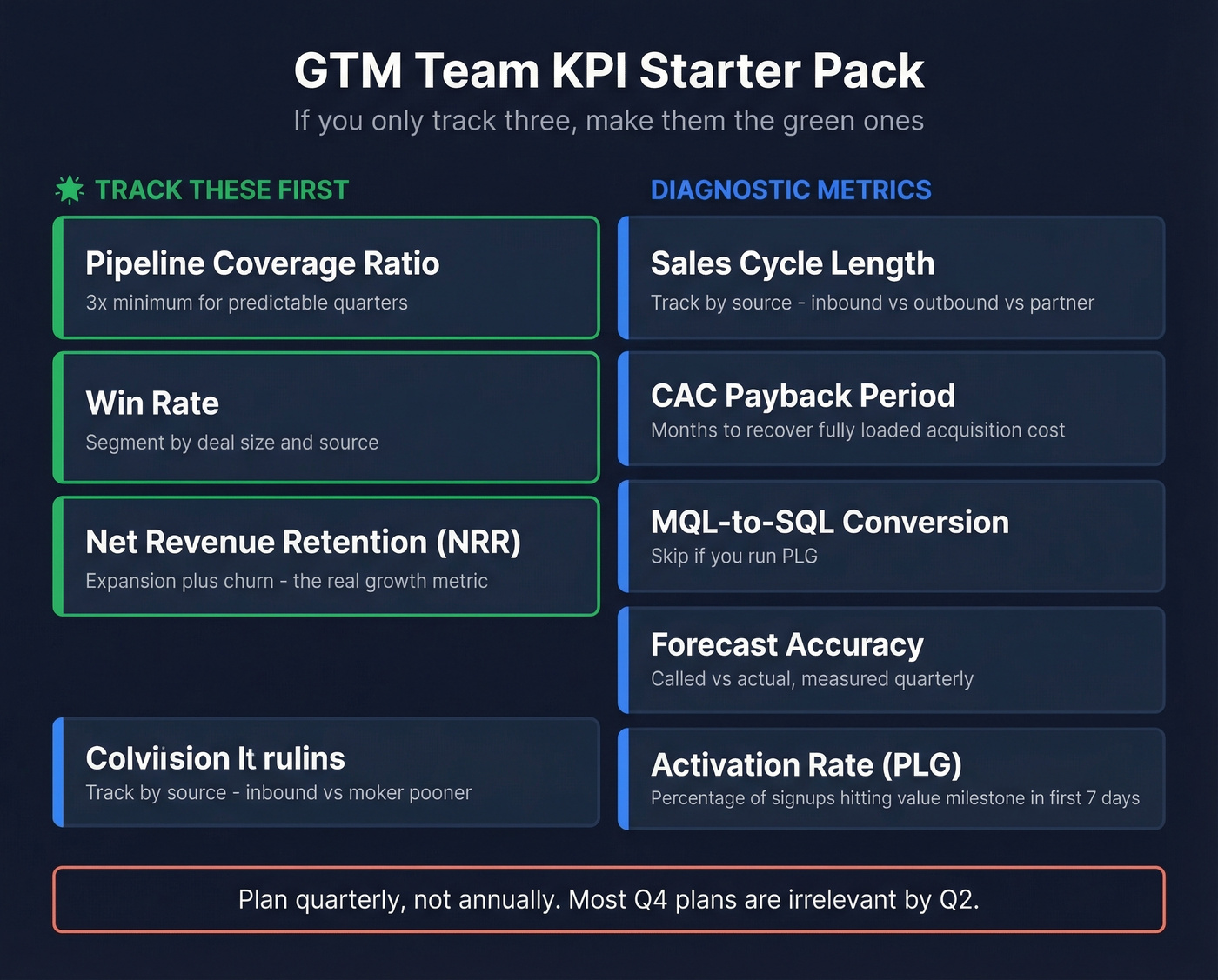
KPI starter pack for your go-to-market team:
- Pipeline coverage ratio - 3x minimum for predictable quarters
- Win rate by segment and deal size
- Sales cycle length tracked by source: inbound vs. outbound vs. partner
- CAC payback period in months to recover fully loaded acquisition cost
- MQL-to-SQL conversion if you run an MQL model; skip if PLG
- Net revenue retention - expansion plus churn; the real growth metric
- Forecast accuracy - called vs. actual, measured quarterly
- Activation rate for PLG: percentage of signups hitting value milestone in first 7 days
If you're only tracking three, make them pipeline coverage, win rate, and NRR. Everything else is diagnostic.
The Tool Stack You Actually Need
You don't need 15 tools. You need the right six, and they need to talk to each other. Don't buy an enterprise enablement platform under $5M ARR - you'll spend more time configuring it than using it.
CRM is the foundation. HubSpot works well under $5M ARR with its free CRM and paid plans from ~$20/month up to ~$800/month+ depending on seats and hubs. Salesforce makes sense once you need enterprise-grade customization at ~$25-$300/user/month. The best CRM is the one your reps actually update.
Communication needs a shared space that isn't email. Slack's free tier handles small teams; paid plans start around ~$8-$9/user/month. Set up a dedicated #gtm-war-room channel for launch coordination.
B2B data is where most teams get it wrong - and where bad data silently destroys outbound. RevOps teams report 75% data inconsistency as their top frustration, which means your sequences are bouncing, your forecasts are built on stale contacts, and your reps waste hours on dead leads. Prospeo addresses this with 300M+ professional profiles at 98% email accuracy on a 7-day refresh cycle. You can build targeted launch lists using 30+ filters - buyer intent, technographics, job changes, funding signals - then push directly into Salesforce, HubSpot, Clay, Instantly, Smartlead, Lemlist, or Zapier/Make. Free tier gives you 75 emails plus 100 Chrome extension credits per month; paid plans run roughly $0.01/email with no contracts.

Enablement should match your stage. Notion or Google Drive work fine under $5M ARR - just maintain a single "sales content" folder with battle cards, one-pagers, and objection docs. Highspot typically runs ~$30-$60/seat/month on annual contracts, and Seismic is enterprise-priced at ~$25-$50/seat/month+. These make more sense once you have 15+ reps and need analytics on content usage.
Project management keeps launches from falling apart. Asana (free for small teams, ~$11-$25/user/month paid) or Linear (free tier, ~$8/user/month paid) handle most workflows. Wrike is worth considering for complex multi-team launches with its built-in Gantt views.
Scaling from founder-led sales to a real GTM org? The last thing you need is bad data burning your domain and killing rep confidence. Prospeo delivers 143M+ verified emails at $0.01 each with 98% accuracy - so your AEs spend time closing, not bouncing. Teams using Prospeo book 26% more meetings than ZoomInfo users.
Stop hiring ahead of your data. Fix the foundation first.
90-Day Operating Rhythm
The teams that win don't just plan quarterly - they run a tight weekly-monthly-quarterly loop.
Weekly (30 min, every Monday):
- Sync on pipeline movement, blockers, and this week's priorities
- Review signal-triggered sequences (new funding, job changes, intent spikes)
- Flag messaging or positioning issues surfaced by reps
Monthly (60 min, first week):
- Pipeline review: coverage ratio, conversion by stage, stuck deals
- Content and enablement gap analysis: what are reps asking for?
- Channel performance: which of your 10+ efforts are earning their keep?
Quarterly (half-day):
- Name your stage: problem-market fit, PMF, or platform-market fit
- Identify top 3 problems for the next 90 days
- Build a one-page plan: 3 problems, 3 owners, 3 metrics, kill list
- Review and prune: cut the bottom 2-3 efforts that aren't performing
The "kill list" is the most important artifact. Let's be honest - with 10+ simultaneous initiatives running, the discipline to stop doing things matters more than the creativity to start new ones.
FAQ
What's the difference between a GTM team and a marketing team?
A marketing team owns demand generation and brand. A go-to-market team is cross-functional - product, sales, marketing, RevOps, and customer success all working toward a shared revenue goal. Marketing is one function within the broader group, not a synonym for it.
When should a startup hire its first GTM lead?
Once you've closed enough deals to validate your ICP and sales motion - typically around $1M ARR. Before that, the founder owns go-to-market. Hiring too early means you're scaling a motion you haven't proven yet.
What tools does a go-to-market team need for outbound?
At minimum: a CRM, a communication platform, a project management tool, and a B2B data platform with verified contacts. The data layer matters most - bounced emails and stale contacts tank domain reputation faster than any other mistake.
How big should a GTM team be at Series A?
Most Series A companies ($1-5M ARR) run with 4-7 people in go-to-market roles: a marketing lead, 1-2 AEs, a CS hire, and part-time RevOps. Resist the urge to hire a full enablement team or enterprise tooling at this stage. Keep it lean, keep ownership clear, and add roles only when you can point to a specific bottleneck the hire would solve.