

High Performance Sales Is a Systems Problem, Not a People Problem
84% of sales reps missed quota last year. Sixty-seven percent don't expect to hit it this year either. When the majority of your team is underperforming, the problem isn't your people - it's your operating system.
Building a high performance sales org in 2026 means fixing the machine, not swapping out the parts.
The Short Version
- Fix your system before blaming reps. LSA Global's organizational alignment research shows culture drives roughly 40% of the performance gap between top and underperforming teams.
- Invest in coaching infrastructure, not training events. Sellers with strong coaches see 53% higher win rates.
- Start with data quality. Bad contacts waste the hours your reps should spend selling - and they only spend about a third of their time selling as it is.
What "High Performance" Actually Means
There's a popular thread on r/sales arguing that 80-85% of sales performance is driven by external factors: economy, market timing, territory, product-market fit. The poster isn't wrong. Individual heroism doesn't scale, and blaming reps for systemic failures is gaslighting with a quota attached.
This isn't about hiring closers. It's a system outcome - measured by quota attainment, win rates, and pipeline velocity across the entire team. When a Korn Ferry survey of 282 sales leaders across 32 countries consistently shows the same levers separating top teams from everyone else, that's not coincidence. It's how the org is wired.

84% of reps missed quota, and bad contact data is eating the hours they should spend selling. Prospeo delivers 98% email accuracy on a 7-day refresh cycle - so every dial and every send reaches a real person. Snyk's 50 AEs cut bounce rates from 35% to under 5% and grew AE-sourced pipeline 180%.
Stop fixing people problems that are actually data problems.
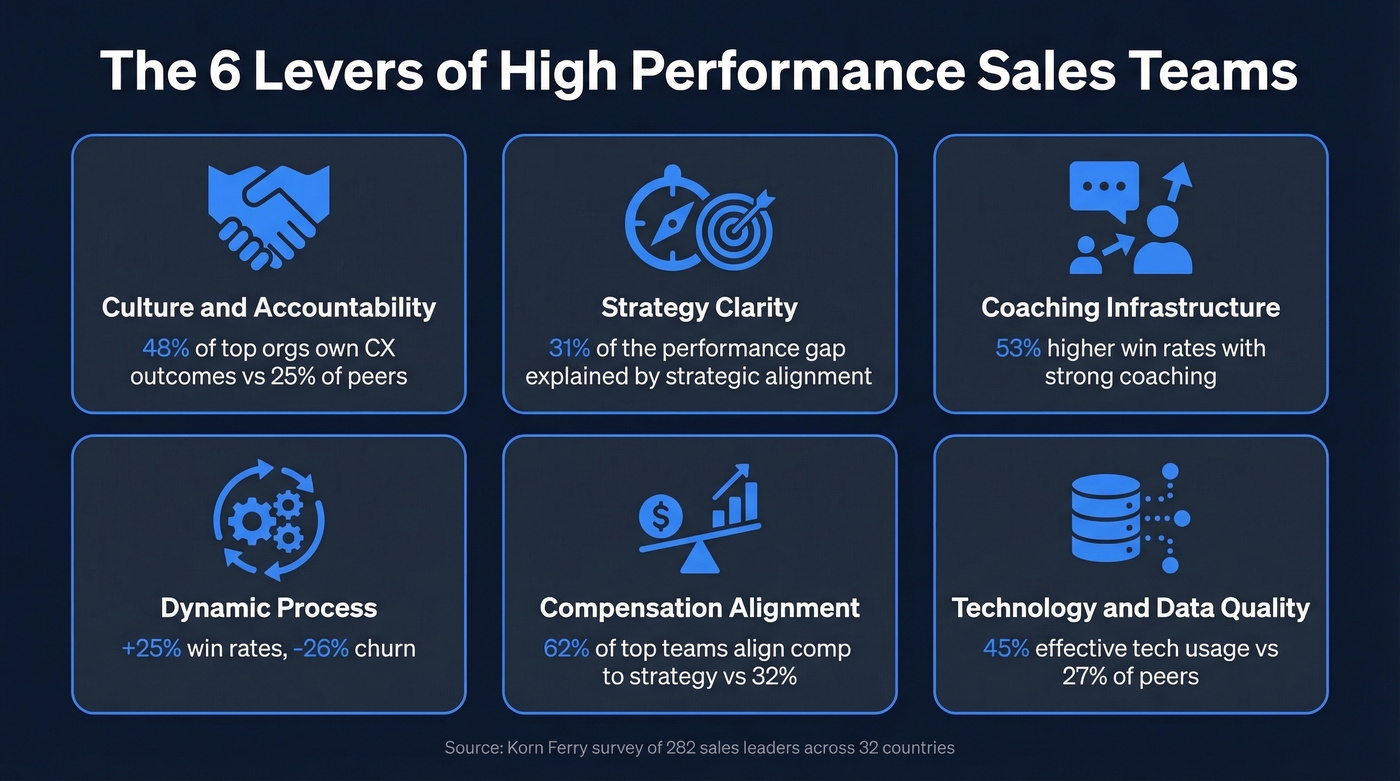
Six Levers That Separate Top Teams
Culture and Accountability
48% of top-performing orgs hold teams accountable for customer experience, versus just 25% of peers. Culture isn't a poster on the wall - it's whether your team owns outcomes or deflects them.
Underperformers tolerate "busy" as a proxy for productive. High activity with no outcomes becomes the norm, and nobody addresses it because the dashboards look full. That kind of complacency is silent - it doesn't show up in a single metric, but it erodes win rates quarter after quarter until someone finally asks why the number keeps slipping.
Here's a stat that makes this concrete: sellers who achieve "trusted partner" status with buyers see 48% higher quota attainment and 25% higher win rates compared to those stuck as "approved vendors." Culture is what gets your reps to that level.
Strategy Clarity
Strategic clarity explains 31% of the gap between top-tier and struggling teams. Solution selling adoption runs 60% at best-in-class orgs versus 48% at peers, and the ability to articulate solution-to-needs fit jumps to 63% versus 38%.
Underperformers hand reps a territory and a target with no playbook. Reps default to whatever worked at their last company - and that inconsistency in execution is exactly what drags team-wide numbers down.
Coaching Infrastructure
This is the lever we've seen make the biggest difference in the shortest time.
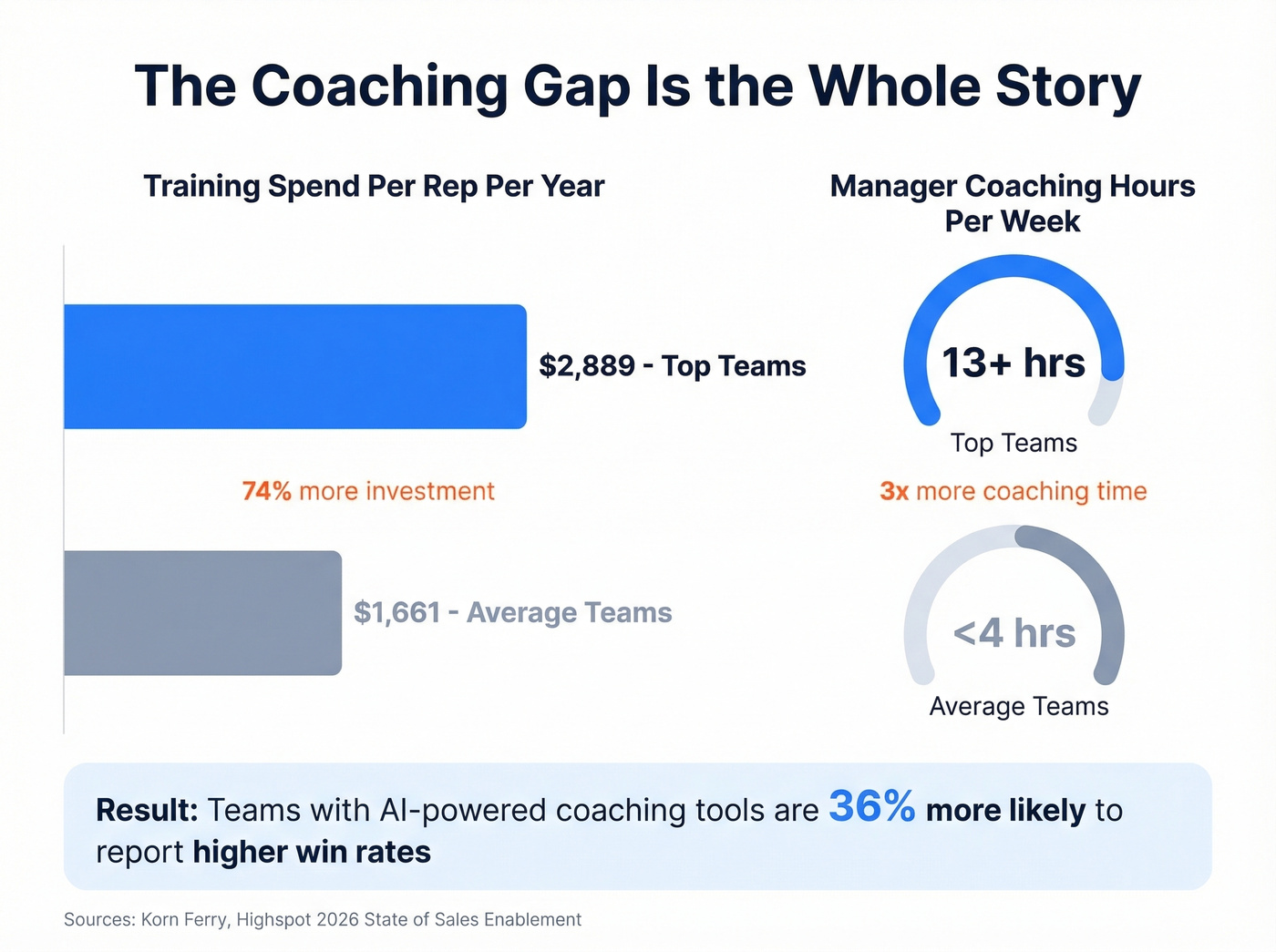
Top teams spend $2,889 per seller per year on training - nearly double the $1,661 average - and supplement it with dynamic manager-led coaching. Highspot's 2026 study of 350 GTM pros found managers spend 13 hours per week coaching. Compare that to the typical org where managers spend less than 10% of their time on it. That gap is the whole story.
AI is accelerating this: teams using AI-powered coaching tools are 36% more likely to report higher win rates. The Challenger group's PAUSE framework - Prepare, Affirm, Understand, Specify, Embed - gives managers a repeatable structure whether they're coaching live or reviewing AI-flagged call moments. Top-performing reps aren't born. They're coached.
Dynamic Process
Orgs with dynamic sales processes see +25% win rates, +11% quota attainment, and -26% customer churn. Combine a dynamic methodology with CRM usage and you get 4x more wins than CRM-only orgs.
Top teams update their process nearly 4x more often than peers. If your process is laminated, it's already dead.
Compensation Alignment
62% of top teams align comp to strategy versus 32% of peers. And 49% of reps at high-performing orgs perceive their comp as fair, compared to just 30% elsewhere.
A useful rule of thumb from SaaStr: a rep's OTE should be roughly 4x their annual quota minimum - so a $120K OTE means you need at least $480K in closed revenue to justify the seat. If reps can't calculate their own commission, the plan is working against you.
Technology and Data Quality
45% of high-performing teams effectively use their sales tech, versus 27% of peers. The trend is consolidation - orgs are running 2 fewer tools on average than last year, and 90% of orgs are using AI for GTM or plan to start. Those with well-integrated stacks are 42% more likely to increase sales productivity.
None of that tech matters if your contact data is garbage. Reps spend only a third of their time selling. Bad emails, dead phone numbers, and stale records eat the rest.
This is where we've seen Prospeo make a measurable difference - 98% email accuracy, a 7-day data refresh cycle versus the 6-week industry average, and 125M+ verified mobile numbers. Snyk's 50-person AE team cut bounce rates from 35-40% to under 5% after switching, and AE-sourced pipeline jumped 180%.
If you're evaluating vendors, start with data enrichment and sales prospecting databases before you add more automation.

What Kills High Performance Sales
Let's be honest about the patterns we see over and over:
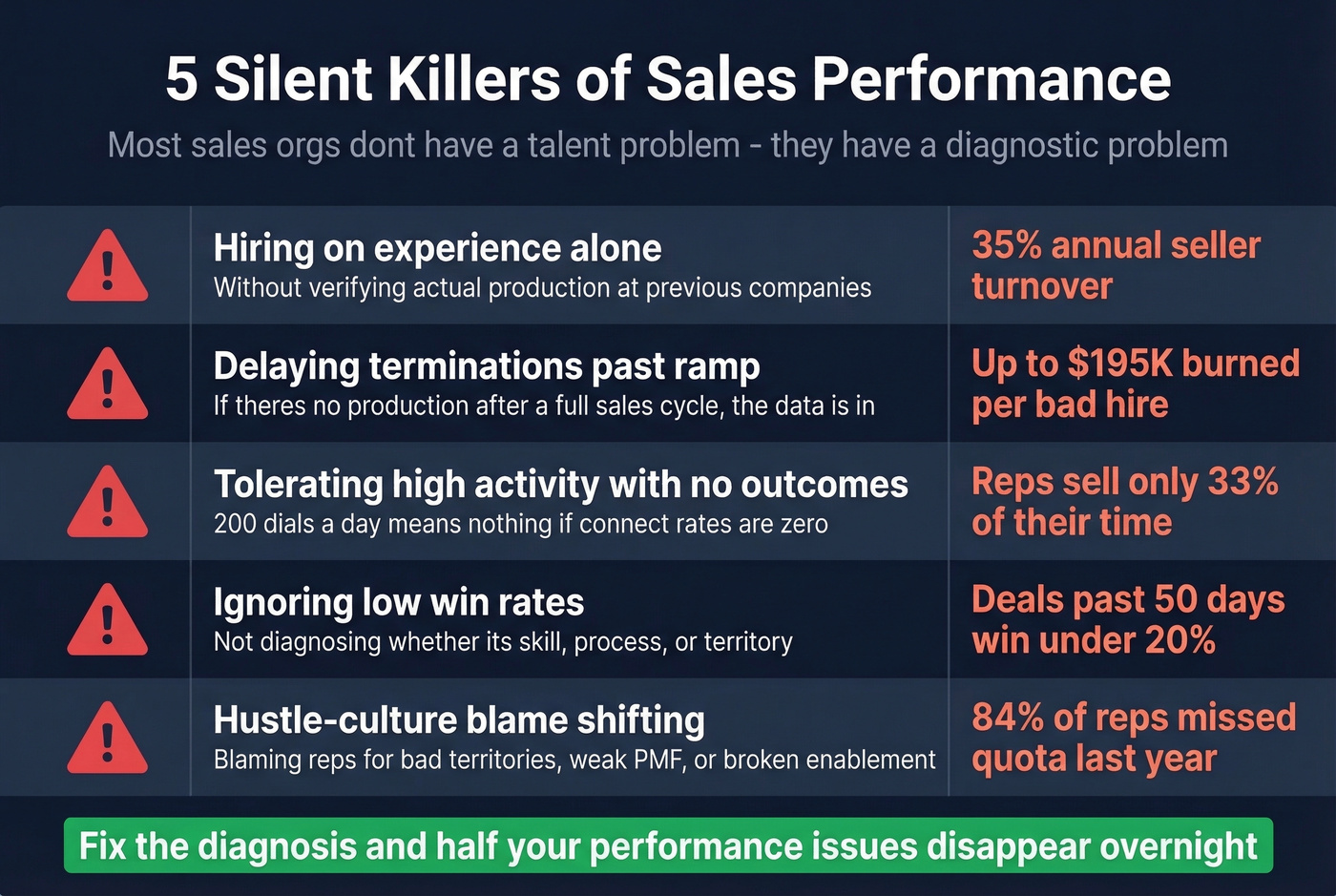
- Hiring on experience alone without verifying actual production at previous companies
- Delaying terminations past ramp - if there's no production after a full sales cycle, the data is in. HubSpot reports 35% annual seller turnover, and Gallup pegs replacement cost at 0.5-2x salary. On a $130K base, that's up to $195K burned per bad hire.
- Tolerating high activity with no outcomes - 200 dials a day means nothing if connect rates are zero
- Allowing low win rates to persist without diagnosing whether it's skill, process, or territory
- Hustle-culture blame-shifting - attributing systemic failure to individual effort when the real problems are bad territories, weak PMF, or broken enablement
Here's our take: most sales orgs don't have a talent problem. They have a diagnostic problem. They can't tell whether a rep is failing because of skill, territory, data quality, or a comp plan that incentivizes the wrong behavior. Fix the diagnosis and half your "performance issues" disappear overnight.
This is also why sales performance management and sales process optimization matter more than motivational speeches.
Benchmarks You Should Track in 2026
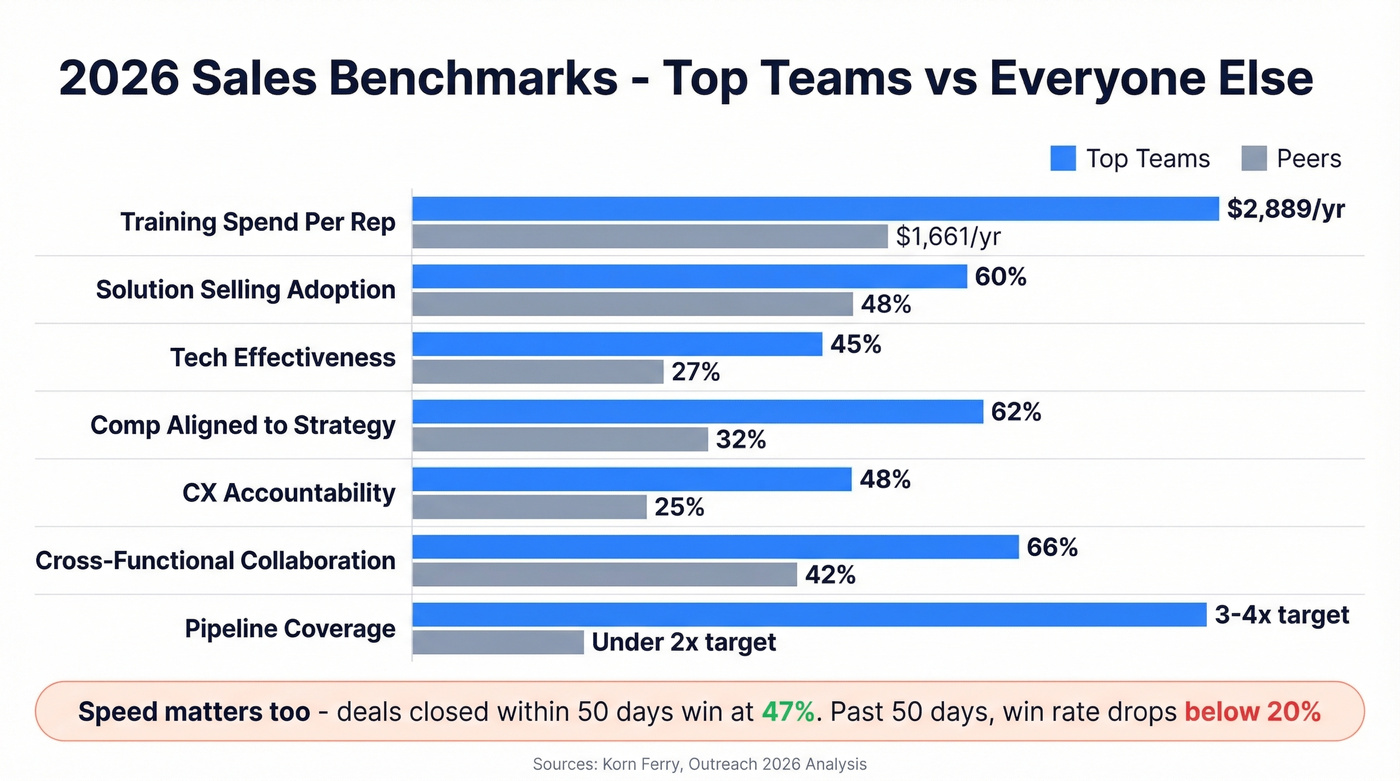
Here's where top teams land versus everyone else, consolidated from the research:
| Metric | Top Teams | Peers |
|---|---|---|
| Training spend/rep | $2,889/yr | $1,661/yr |
| Solution selling adoption | 60% | 48% |
| Tech effectiveness | 45% | 27% |
| Comp aligned to strategy | 62% | 32% |
| CX accountability | 48% | 25% |
| Cross-functional collaboration | 66% | 42% |
| Pipeline coverage | 3-4x target | <2x target |
On deal velocity: Outreach's analysis found deals closed within 50 days win at a 47% rate. Drag past 50 days and the win rate drops below 20%. Speed isn't just efficiency - it's a leading indicator of deal health.
Skip the benchmarks table if your team is pre-revenue or under five reps. At that stage, the only metric that matters is whether you're generating enough pipeline to learn what works.
If you need a baseline, start with sales pipeline benchmarks and funnel metrics before you overhaul the org.
High performance sales teams consolidate tools and demand data that works. Prospeo gives you 300M+ verified profiles, 125M+ mobile numbers with a 30% pickup rate, and intent data across 15,000 topics - all at $0.01 per email. No contracts, no sales calls, no stale records.
Build the system your reps actually deserve.
FAQ
What's the biggest driver of sales team performance?
Culture and accountability. LSA Global's research shows culture drives roughly 40% of the performance gap between top and bottom teams. 48% of top orgs hold teams accountable for CX versus 25% of peers - and that gap compounds across every other metric.
How much should we spend on sales training per rep?
Top teams spend $2,889 per seller per year - nearly double the $1,661 average. Pair that budget with manager-led coaching at 13+ hours per week for 53% higher win rates versus training-only approaches.
How does data quality affect sales performance?
Bad contact data wastes the limited hours reps have for actual selling. Teams using verified, frequently refreshed data have cut bounce rates from 35-40% to under 5% and grown pipeline by 180%.
What's a good pipeline coverage ratio?
High-performing teams maintain 3-4x pipeline coverage against their quota target. Below 2x, you're relying on nearly every deal closing - which means one slipped deal craters the quarter.