

How Long Should an Email Be? The Answer, by Email Type
Every guide on email length cites the same Boomerang study from 2016. That data covered 40 million emails - impressive, but about a decade old. Inboxes have changed. Gong's analysis of 28M+ cold emails found the average rep sends 344 cold emails to land a single meeting, which means every wasted word in your message is multiplied across hundreds of sends. If you're wondering how long an email should be, you need numbers that reflect how people actually read email in 2026 - not 2016.
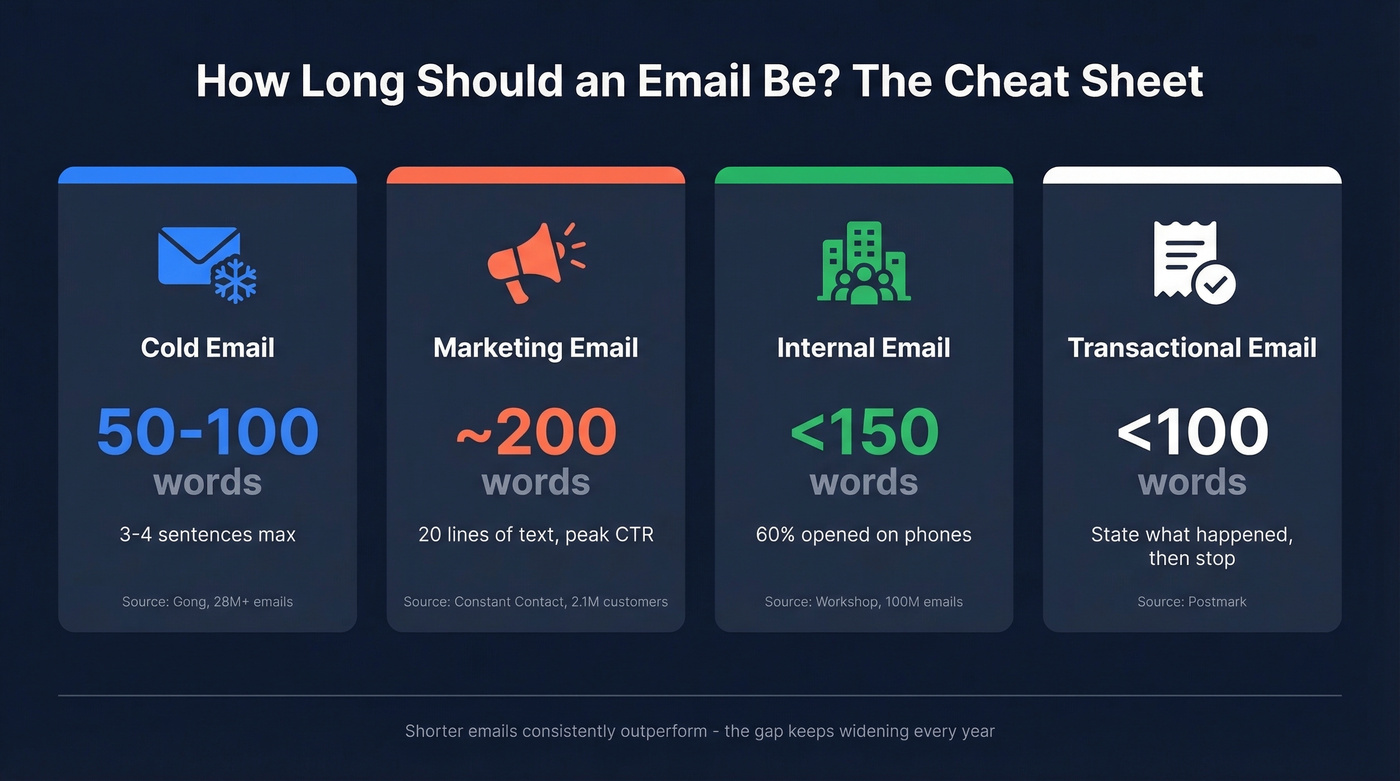
Ideal Email Length: The Cheat Sheet
| Email Type | Word Count | Data Source | Key Stat |
|---|---|---|---|
| Cold email | 50-100 words | Gong, 28M emails | 3-4 sentences = most replies |
| Marketing | ~200 words | Constant Contact, 2.1M customers | ~200 words = peak CTR |
| Internal | Under 150 words | Workshop, 100M emails | 60% opened on phones |
| Transactional | Under ~100 words | Postmark | Subject under 50 chars, body functional |
What the Data Actually Says About Optimal Email Length
The Boomerang study found a response-rate sweet spot between 50 and 125 words - peaking at 51% for 75-100 words. It also found emails with moderate positivity or negativity got 10-15% more responses than completely neutral ones, while too much emotion performed about the same as neutral. That's the old baseline everyone quotes. It's not wrong, but it's incomplete.
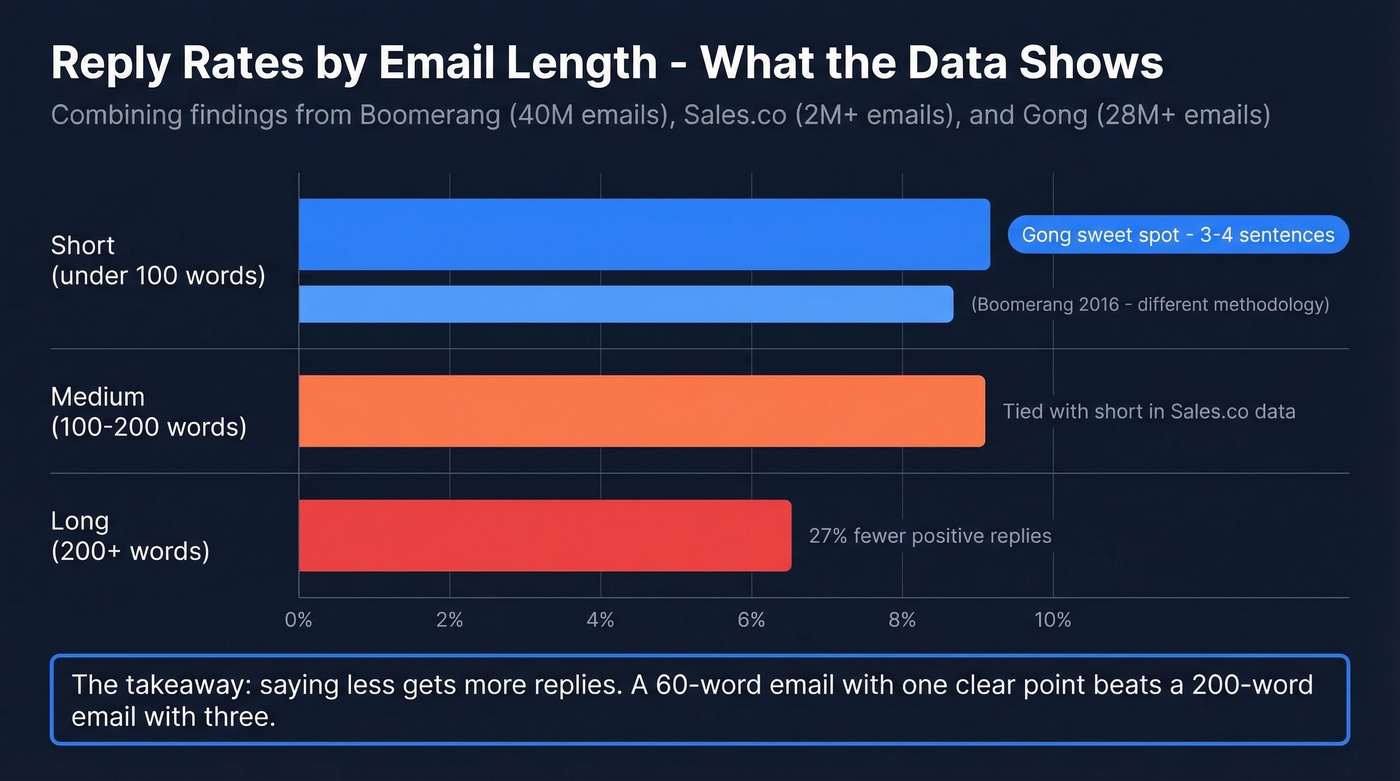
Sales.co's dataset of 2M+ cold emails from 2024-2026 tells a sharper story: ultra-short and medium-length emails tied at roughly 8.8% positive reply rate, while long emails dropped to 6.42%. Gong's analysis narrows it further - 100 words or fewer, ideally 3-4 sentences, delivers the highest reply rates. We've watched this trend accelerate for years, and the gap keeps widening. The average email word count in most inboxes still hovers well above this, which means most senders are leaving replies on the table.
Here's the thing: most people agonize over word count when their real problem is saying too much. A 60-word email that makes one clear point will always beat a 200-word email that makes three.

You just learned that 50-100 words gets the most replies. But Gong's data also shows reps send 344 cold emails per meeting booked - so every bounced email wastes your best copy. Prospeo's 5-step verification delivers 98% email accuracy at $0.01/address, so your perfectly crafted 60-word emails actually reach real inboxes.
Stop perfecting emails that never get delivered.
Length by Email Type
Cold Emails: 50-100 Words
Gong's 3-4 sentence benchmark is the floor. One practitioner on r/Entrepreneur cut emails from 141 words to 56 and watched reply rates jump from 3% to 6%. Pitching in a cold email reduces replies by up to 57%.
The best-performing cold emails on r/copywriting consistently land around 40-60 words with a soft CTA like "Worth a conversation?" The debate around short vs. long is effectively settled for cold outreach. Short wins. Skip this format only if you're writing a warm follow-up where context is already established and the recipient expects detail.
If you need a structure that stays short, borrow from these follow-up templates and keep the ask simple.
Marketing Emails: ~200 Words
Constant Contact's study of 2.1 million customers found that roughly 20 lines of text - about 200 words - hit peak click-through rates. That's the ideal length for most promotional sends. Go beyond that and you're better off linking to a landing page.
If your email is purely a teaser for content, 50 words and a strong CTA will outperform a mini-article crammed into the inbox.
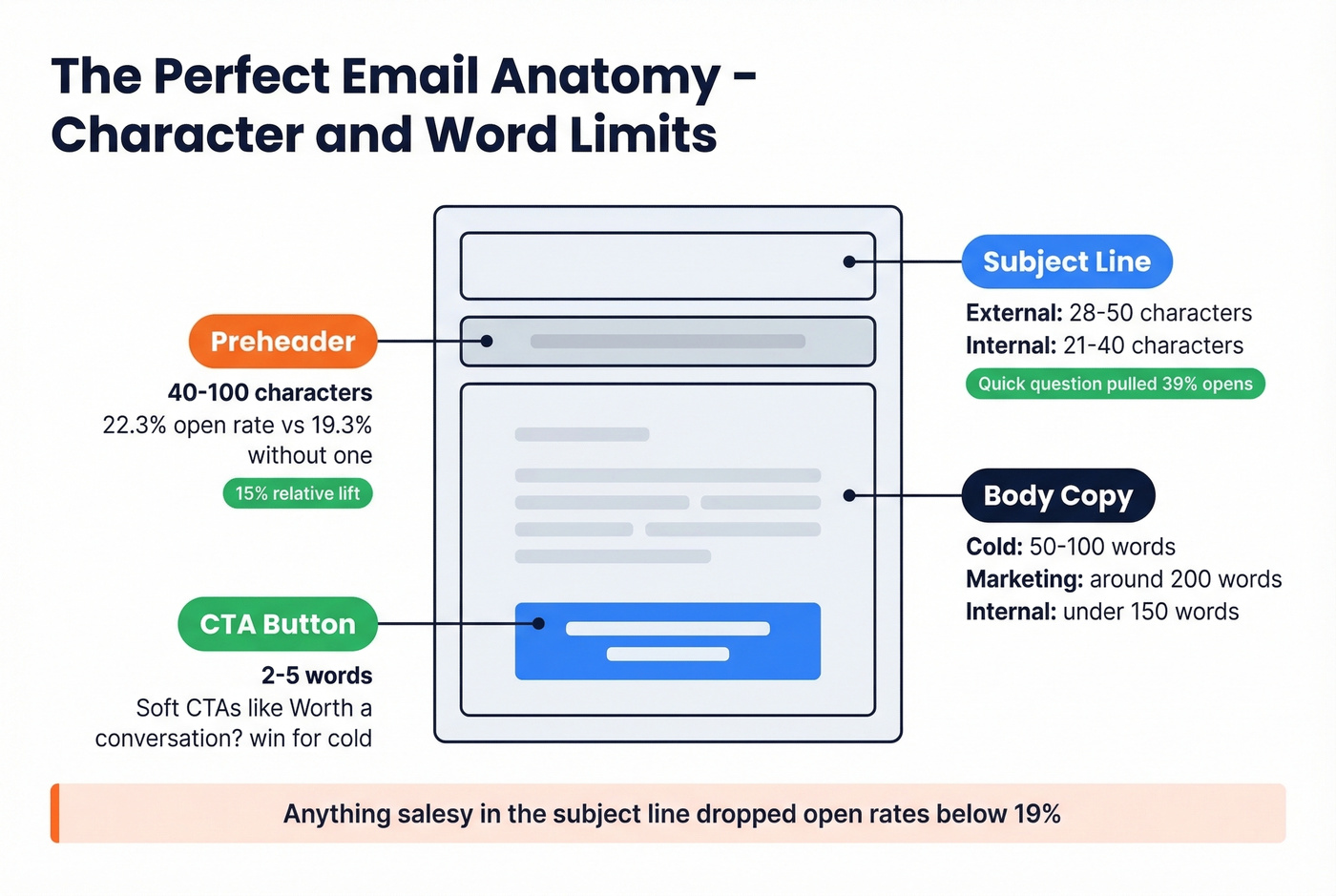
Don't overlook preheaders. Emails with custom preheader text hit a 22.3% open rate vs. 19.3% without one - a 15% relative lift from a single line most marketers leave blank. If you want to test this properly, run an A/B test on preview text.
Internal Emails: Under 150 Words
Workshop analyzed 100 million internal emails and found 60% are opened on phones. That alone should kill the three-paragraph all-hands update.
One benchmark puts the average time spent reading an email at 11.1 seconds. If your internal message can't be scanned in that window, it won't be read. Subject lines work best at 21-40 characters, and emails sent after 5 PM see a 17% drop in open rates. For team updates that exceed 150 words, move the detail to a doc and link to it.
For more subject ideas, pull from these email subject line examples and adapt them for internal tone.
Transactional Emails: Keep It Functional
Order confirmations, password resets, shipping notifications - not the place for brand storytelling. Postmark's guidance is straightforward: subject lines under 50 characters, overflow details in the preheader, and never send from a noreply@ address. State what happened, what the user needs to do, and stop. Often that's under 100 words.
If you're adding any promotional blocks, sanity-check them against basic email deliverability rules first.
Subject Line and Preheader Best Practices
- External subject lines: 28-50 characters.
- Internal subject lines: 21-40 characters.
- Preheaders: 40-100 characters.
- CTA buttons: 2-5 words.
- Tone: "Quick question" pulled 39% opens in one test. Anything salesy dropped below 19%.
If you're writing outbound, these prospecting email subject lines tend to outperform generic hooks.
Length Doesn't Matter If Your Emails Bounce
You can nail the perfect 60-word email, but if it bounces, none of this matters.
That same r/Entrepreneur operator who cut emails to 56 words also reported an 11% bounce rate before switching to verified lists - after cleaning up the data, bounces dropped under 2%. We've seen this pattern repeatedly across our own campaigns and customer data: bad contact info tanks your sender reputation, which pushes even good emails into spam. One of our customers, Stack Optimize, maintains 94%+ deliverability and under 3% bounce rates across all their clients by verifying every address before sending.
Before you stress over email copy length, verify your list. Prospeo runs every address through a 5-step verification process with catch-all handling and spam-trap removal, delivering 98% email accuracy. The free tier gives you 75 verifications per month - enough to test whether your list is the real problem.

Cutting your cold emails to 56 words doubles reply rates - but only if your list is clean. One agency using Prospeo maintains under 3% bounce rates across every client campaign. With 143M+ verified emails and a 7-day data refresh cycle, your short, sharp outreach hits real buyers, not dead inboxes.
Nail the copy length. We'll nail the deliverability.
FAQ
How many words should a cold email be?
Aim for 50-100 words - three to four sentences - based on Gong's analysis of 28M+ cold emails. Under 60 words performs even better. One practitioner doubled reply rates by cutting from 141 words to 56. Lead with relevance, close with a soft CTA, and cut everything else.
Does email length affect deliverability?
Not directly - spam filters don't penalize longer messages. But bloated contact lists full of invalid addresses destroy your sender reputation, which routes everything to spam. Verify contacts before hitting send.
What's the ideal subject line length?
For external emails, 28-50 characters. For internal emails, the sweet spot is tighter: 21-40 characters. Shorter subject lines outperform on mobile, where 60%+ of emails are opened.
Should marketing emails be longer than cold emails?
Yes. Marketing emails peak around 200 words - roughly 20 lines of text - according to Constant Contact's study of 2.1M customers. Cold outreach should stay at 50-100 words. The difference is context: subscribers opted in and expect more detail, while cold prospects haven't and won't read it.