

How Long Should You Wait Before Sending a Follow-Up Email?
You sent a cold email to a VP on Monday. It's Thursday. No reply. Your cursor hovers over the "send" button on a follow-up, and you're second-guessing everything.
Knowing how long to wait for a follow-up email isn't a gut call - timing has real data behind it, and most people get it wrong.
The Quick Answer
For most professional emails, 2-5 business days before your first follow-up is the right window:
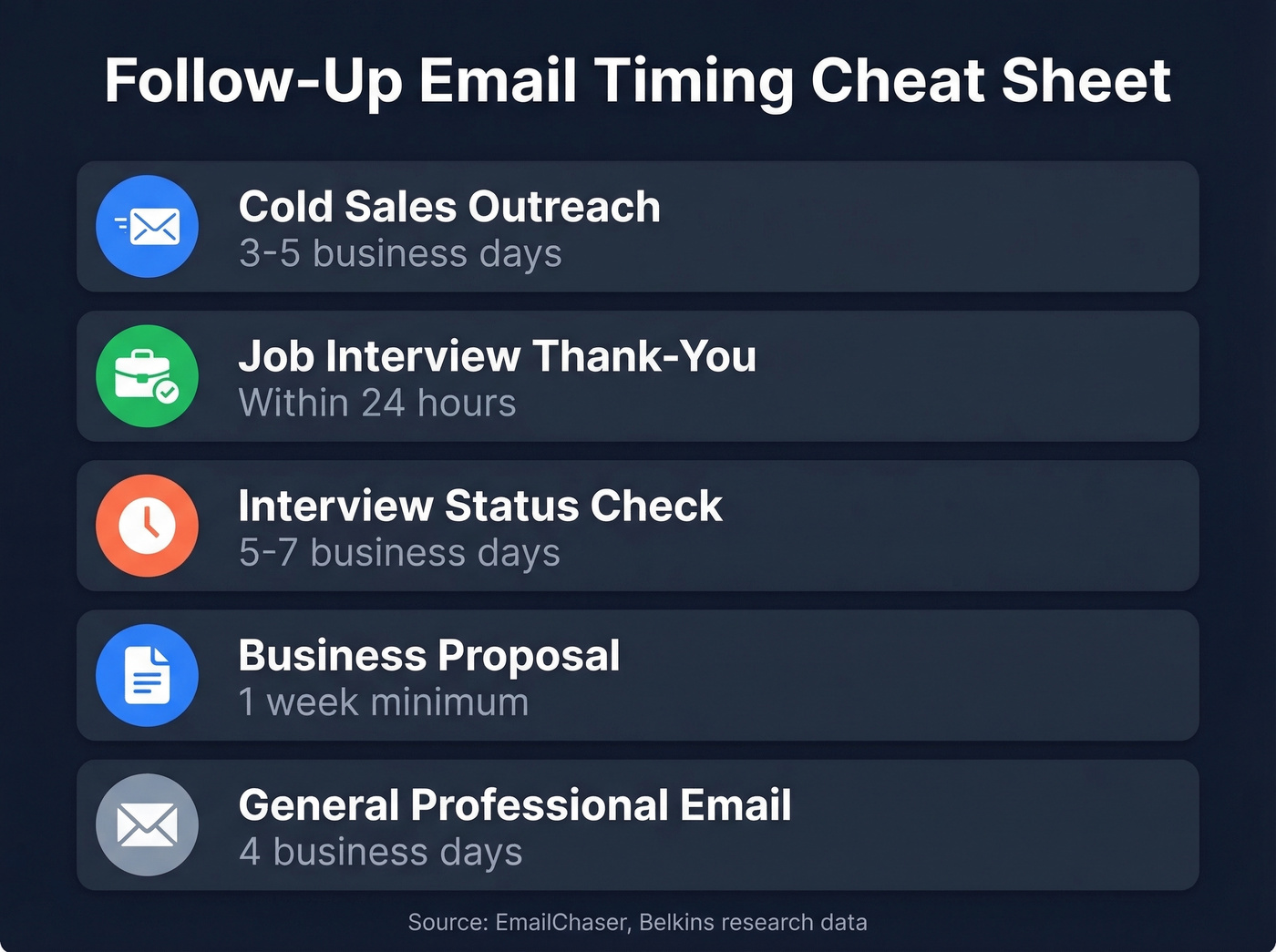
- Cold sales outreach: 3-5 business days
- Job interview thank-you: within 24 hours
- Job interview status check: 5-7 business days
- Business proposal: 1 week
- General professional email: 4 business days
The "3-5 days" default works, but a follow-up to a C-suite exec requires different spacing than a nudge to a recruiter who said "end of week." A hiring manager and a sales prospect operate on completely different timelines, and treating them the same is how you end up in spam folders or ghosted.
Timing by Scenario
| Scenario | First Follow-Up | Spacing After | When to Stop |
|---|---|---|---|
| Cold outreach | 3-5 biz days | 4-7 days | After 2-3 follow-ups |
| Job application | 7-10 biz days | 7 days | After 2 contacts |
| Post-interview | 24-48h (thank-you) | 5-7 days (status) | After 3rd contact |
| Business proposal | 1 week | 1-2 weeks | After 2 follow-ups |
| General professional | 4 biz days | 4-7 days | After 2 follow-ups |
Cold Sales Outreach
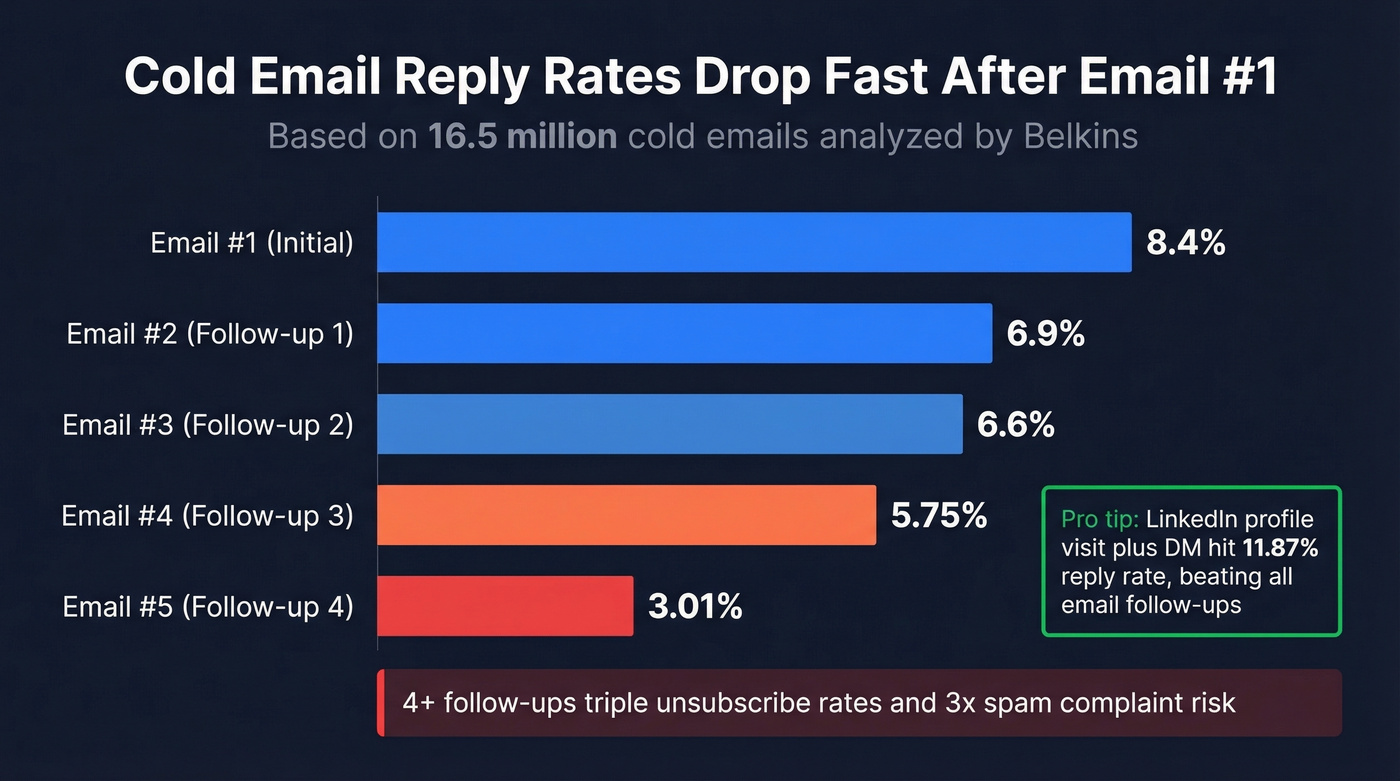
A Belkins study of 16.5 million cold emails found the highest reply rate - 8.4% - comes from the initial email. For founder-led outreach, reply rates hold steady through the first couple of follow-ups (around 6.6-6.9%), then slide to 5.75% on the third email and crater to 3.01% by the fourth. Sending four or more follow-ups triples unsubscribe rates and more than triples spam complaint risk.
So how many days before follow-up email #2? For high-level executives like CEOs and COOs, EmailChaser recommends spacing follow-ups by a couple of weeks rather than 4-7 days. CEOs don't want to hear from you every Tuesday. Adjust timing around holidays and fiscal year-end too - response rates crater during these windows.
One data point worth stealing: that same Belkins study found that a profile visit plus direct message combo on professional networks hit an 11.87% reply rate, outperforming email follow-ups entirely. If email isn't working after two or three attempts, switch channels before sending follow-up #4.
If you need copy that doesn't sound like a bump, steal from these follow-up templates and adapt them to your offer.
Job Interviews & Applications
Send your thank-you email within 24 hours of the interview. For a status check, wait 5-7 business days. If the recruiter said "we'll decide by Friday," follow up the following Monday or Tuesday - not Friday afternoon. That one-day buffer shows patience without letting you slip off their radar.
Here's the thing: 94% of HR managers actually appreciate a follow-up after an interview, so you're not being pushy. Silence after three total contacts, though, is your answer.
Proposals & Professional Emails
For business proposals, one week is the minimum - the recipient likely needs to loop in stakeholders. For general professional emails, four business days is the sweet spot. Getting the spacing right prevents you from appearing either desperate or disinterested.
If you're building a multi-touch cadence, treat it like sequence management instead of one-off nudges.

Perfecting your follow-up cadence means nothing if 17% of your emails never reach the inbox. Prospeo verifies contacts with 98% accuracy on a 7-day refresh cycle, so every follow-up lands where it should - not in a bounce log.
Fix your deliverability before you fix your timing.
Best Day and Time to Follow Up
Send-time data varies by email type. For cold outreach, a Siege Media analysis of 85,000+ personalized emails found Monday between 6-9am PST delivers the best open, click, and reply rates. Monday open rates hit just over 20%, with reply rates at 2.8%.
If you want a deeper breakdown by timezone and audience, see our guide on the best time to send cold emails.
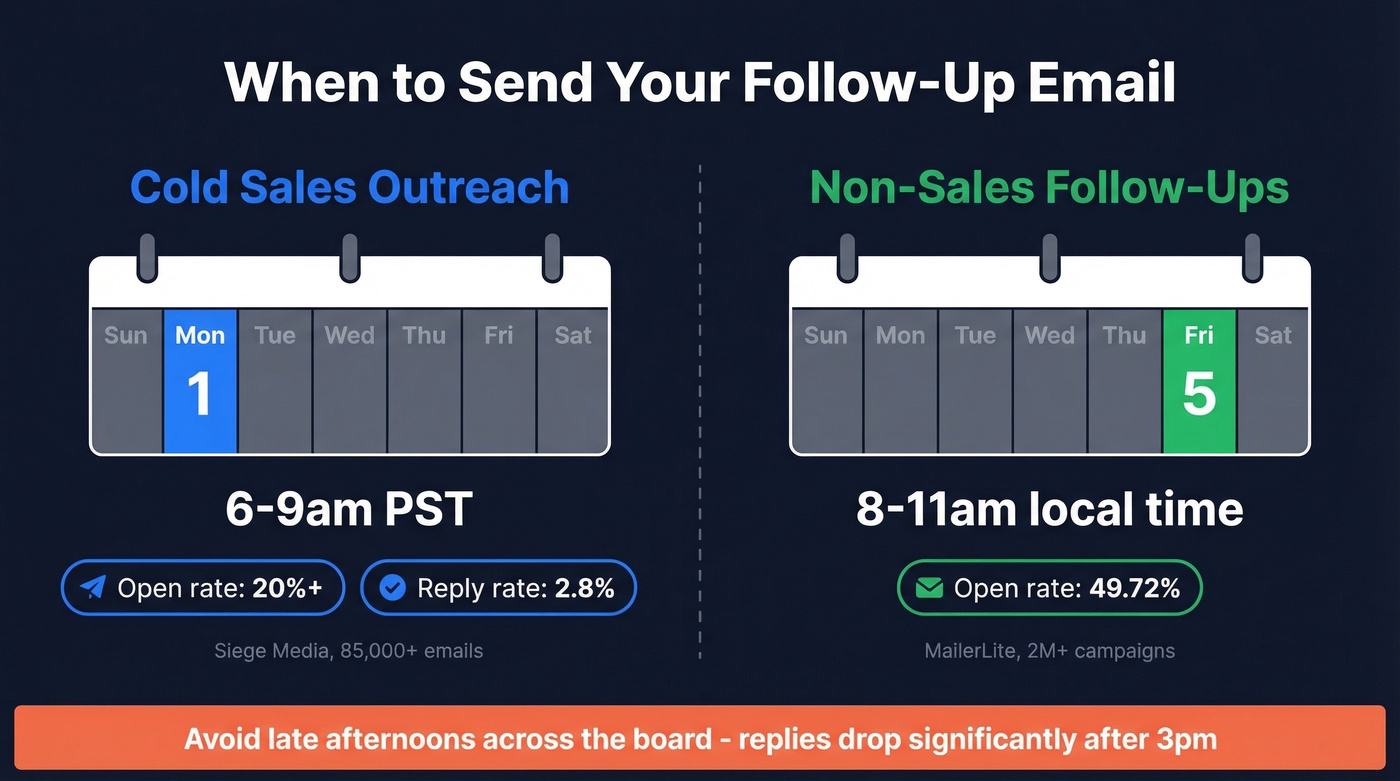
For non-sales follow-ups, the picture flips. MailerLite's analysis of over two million campaigns found Friday has the highest open rate at 49.72%, with opens peaking between 8-11am local time.
In practice: schedule cold outreach for Monday morning and non-sales follow-ups for Friday morning. Avoid late afternoons across the board.
Mistakes That Kill Replies
"Just checking in" adds zero value. Every follow-up should introduce a new angle - a relevant case study, a different value prop, a question that reframes the conversation. We've tested this across dozens of campaigns, and the difference between a generic bump and a value-add follow-up is night and day.
If you keep defaulting to that phrase, use this guide on how to say just checking in professionally instead.
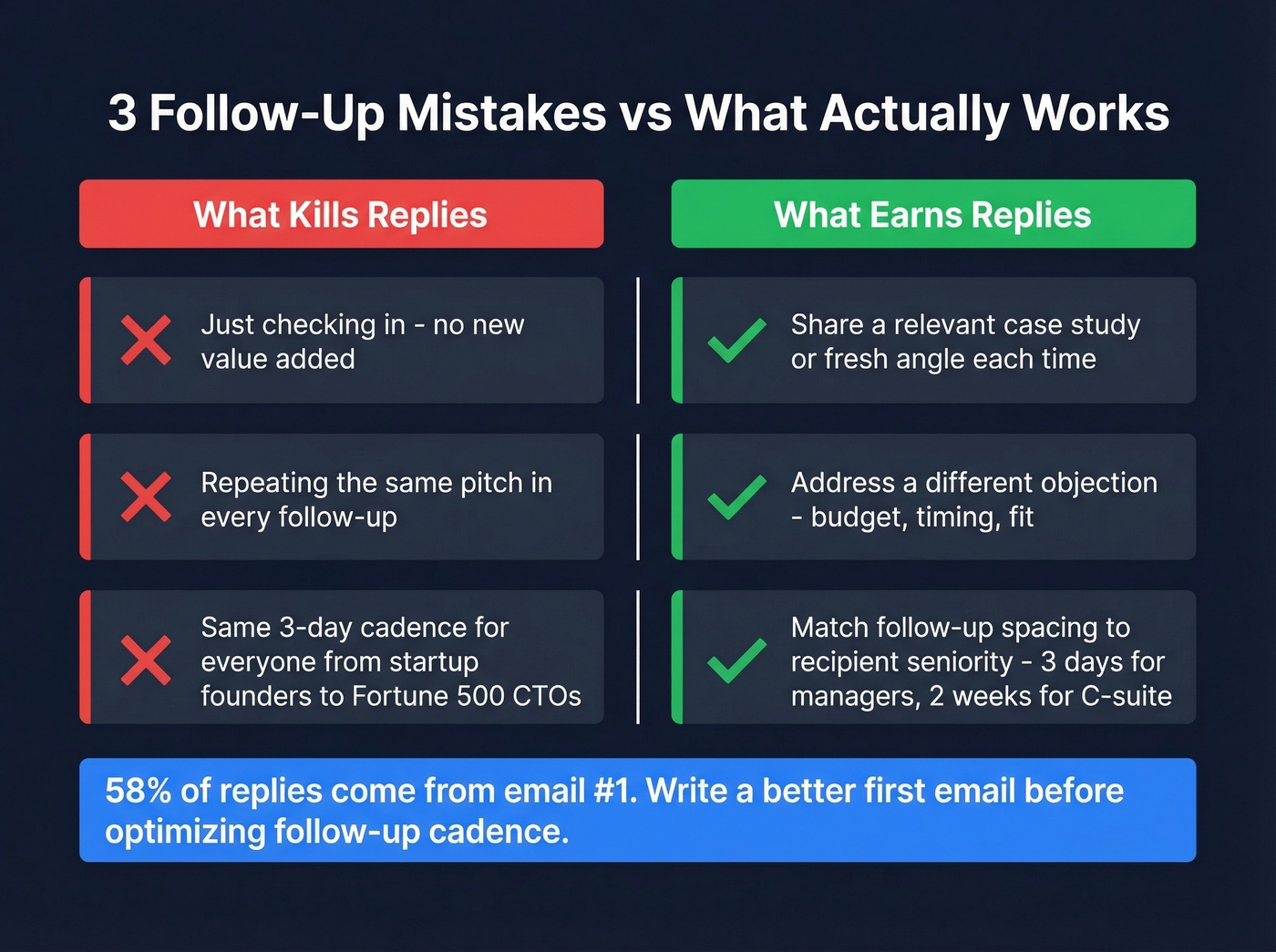
Not addressing a different objection each time. Your prospect didn't reply for a reason. Budget, timing, fit - who knows. Each follow-up should preemptively tackle a different potential objection rather than restating the original pitch.
Wrong cadence for the audience. Emailing a Series A founder every three days is fine. Emailing a Fortune 500 CTO on the same schedule will get you flagged. Matching your follow-up interval to the recipient's seniority is the difference between persistence and spam. The consensus on r/sales is pretty clear on this: if you're blasting C-suite prospects on the same cadence as mid-market managers, you're doing it wrong.
Let's be honest - stop obsessing over follow-up cadence and start writing better first emails. 58% of replies come from email #1. If your initial email isn't landing, a fourth follow-up won't save it.
If you're struggling with the opener, start with proven cold email subject lines and tighten your email copywriting.
Before You Follow Up, Confirm It Arrived
Maybe they didn't ignore you. Maybe they never saw it.
About 17% of cold emails never reach the inbox - they bounce or get caught by spam filtering. If you're following up on an email that bounced, you're not persistent. You're invisible. And every bounce chips away at your sender reputation, making future emails less likely to land.
Before stressing about how long to wait for a follow-up email, verify your contact data. In our experience, running outreach lists through Prospeo before sending catches dead addresses fast - it returns verification results in minutes with 98% accuracy on a 7-day refresh cycle, so you're not wasting follow-ups on contacts who'll never see them.
If you want the full technical checklist, start with our email deliverability guide and monitor your email bounce rate.

If your first email didn't get a reply, the problem might not be timing - it might be a dead address. Prospeo's 5-step verification catches invalid emails before you send, protecting your sender reputation across every follow-up in your sequence. At ~$0.01 per email, it costs less than one wasted follow-up.
Stop following up on emails that never arrived.
FAQ
How many follow-ups should I send before giving up?
Two to three for cold outreach. Four or more triples unsubscribe rates and more than triples spam complaint risk. For job applications, three total contacts is the ceiling. Skip the fourth follow-up entirely if you haven't gotten any signal - an open, a click, anything - by that point.
Is it rude to follow up after no response?
No. 42% of replies come from follow-ups, not the initial email. Stick to the 3-5 business day window, and add new value each time. A "just bumping this" message wastes everyone's time; a follow-up with a fresh angle earns a response.
What if my emails aren't getting any replies at all?
Check deliverability first - 17% of cold emails never reach the inbox due to bounces and spam filtering. Verify your list before optimizing cadence. No follow-up strategy fixes an email that was never delivered.