

How Many Buyer Personas Should a Business Have?
A RevOps Manager lead we know inherited a CRM with nine buyer personas. Nine. Three of them were nearly identical - "Marketing Manager," "Senior Marketing Manager," and "Head of Marketing" - each with its own messaging doc, its own content calendar, and its own pipeline stage. The team was spread so thin that none of the personas got good outreach. If you're wondering how many buyer personas your business actually needs, this is the cautionary tale.
The Short Answer: 3-5 for Most Teams
Most businesses need 3-5 buyer personas. That's the range where you're specific enough to personalize messaging but not so fragmented that your team can't execute. A commonly cited benchmark is that 71% of companies exceeding revenue and lead goals have documented personas - but the keyword is documented, not dozens.
The exact number depends on three things: your business type, your stage, and your team's capacity to actually use the personas you create.
- B2B SaaS or services: 2-4 personas, mapped to buying roles
- B2C / ecommerce: 3-6 personas, mapped to purchase contexts or lifecycle stages
- Early-stage: Start with 1-2. Validate before expanding.
If you're running more than 5-7 personas, you need real governance. And for most teams, it's smarter to operationalize no more than 2-3 at a time than to maintain a bloated persona library that never gets used.
ICP vs. Segment vs. Persona
These three terms get used interchangeably, and that's where persona sprawl starts.
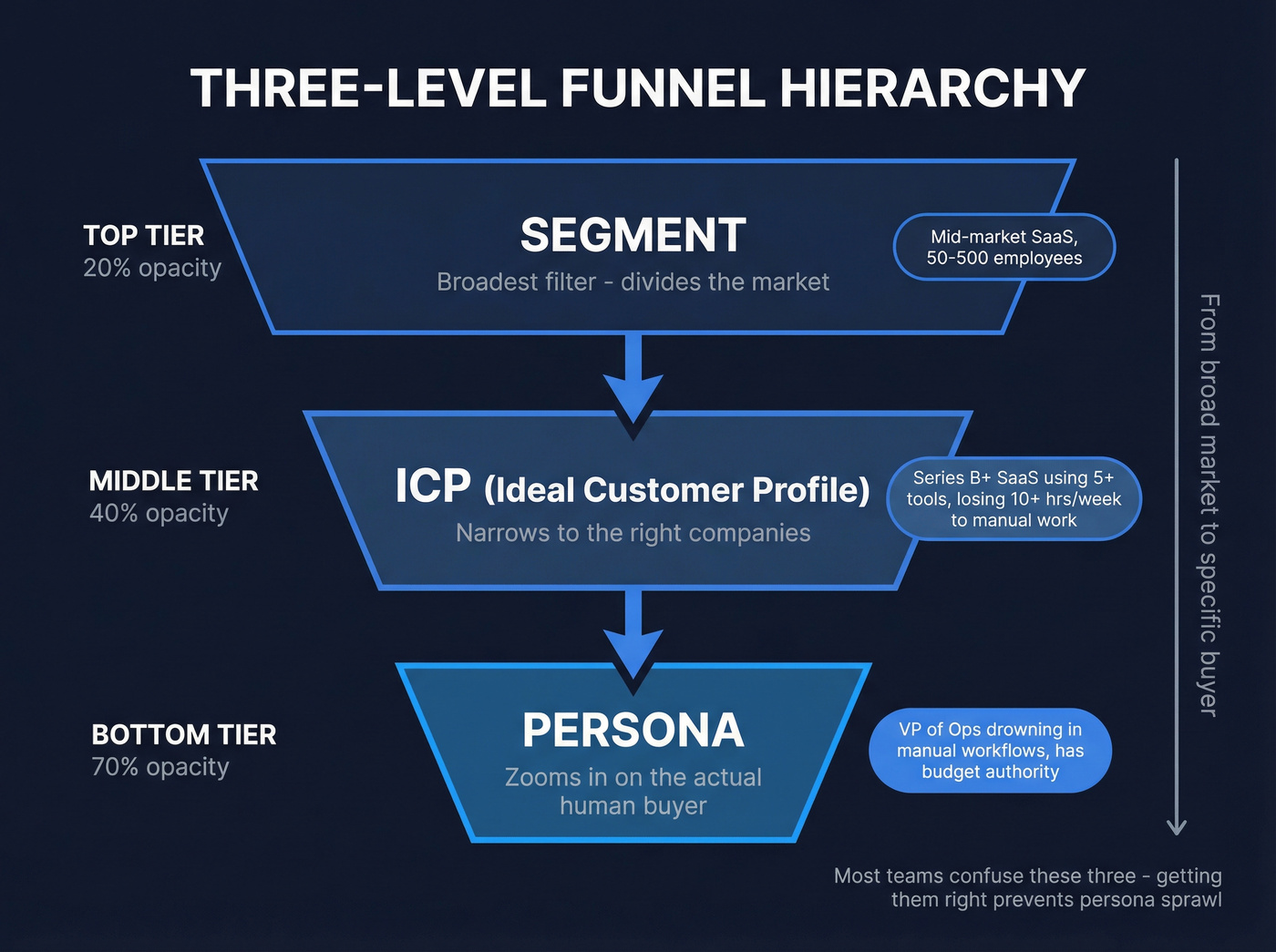
| Term | What It Defines | Example |
|---|---|---|
| Segment | A market group | Mid-market SaaS, 50-500 emp. |
| ICP | The ideal company | Series B+ SaaS using 5+ tools |
| Persona | The individual buyer | VP of Ops losing 10 hrs/week |
HubSpot frames it well: "Personas tell you who you're speaking to. ICPs tell you which companies are worth speaking to in the first place." Segmentation sits above both - it's how you divide the broader market before narrowing to ICPs and personas.
To make this concrete: imagine a company whose ICP targets fast-growing businesses with 50-500 employees using 5+ disconnected software tools that lose 10+ hours weekly to manual data entry. That's the company. The persona is the VP of Operations inside that company who's drowning in manual workflows and has budget authority to fix it. The segment is "mid-market SaaS" - the broadest filter.
Think of it as a funnel. Segmentation is the widest filter. ICP narrows to the right companies. Personas zoom in on the humans who'll actually take your call.
Recommended Count by Business Type
The right number isn't universal. It shifts based on what you sell, who buys it, and how mature your go-to-market is.
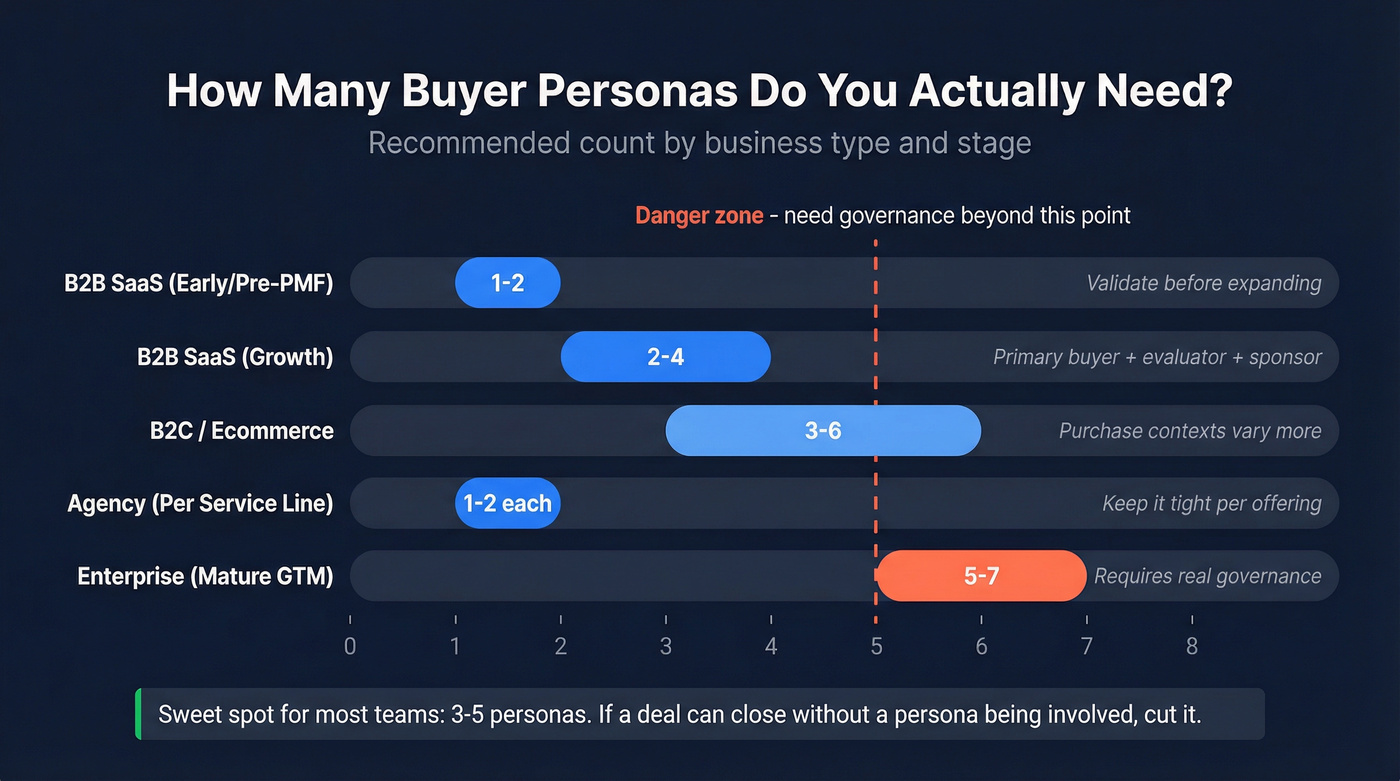
| Business Type | Stage | Recommended Personas |
|---|---|---|
| B2B SaaS | Early (pre-PMF) | 1-2 |
| B2B SaaS | Growth | 2-4 |
| B2C / Ecommerce | Established | 3-6 |
| Agency | Per service line | 1-2 each |
| Enterprise | Mature GTM | 5-7 (with governance) |
Early-stage companies should resist the urge to build a full persona library. One pattern we see repeatedly: founders define five candidate personas before they've closed 20 deals, then wonder why their messaging feels generic. A better approach - and one common in cold email scaling communities on Reddit - is to test outbound against multiple candidates and let response data tell you which 1-2 are real buyers. Head of Growth, CTO, Ecommerce Director - run them all, then double down on whoever replies.
Growth-stage B2B companies typically land at 2-4. That's enough to cover the primary buyer, a technical evaluator, and an executive sponsor without spreading content too thin. As one SEO practitioner noted: "Usually, 2-4 are enough. More than that spreads content too thin."
For B2C, the number goes higher because purchase contexts vary more. A DTC skincare brand might have separate personas for the ingredient-obsessed researcher, the gift buyer, and the subscription loyalist - each needing different messaging and different funnel entry points.
Here's a useful gut check: if a deal can close without a particular persona ever being involved, that persona doesn't belong in your core set. Cut it or demote it to a secondary reference.
The B2B Buying Committee Problem
This is where persona math gets tricky. Gartner finds that typical tech purchases involve 14-23 stakeholders with overlapping and evolving roles. One widely cited benchmark is 8.2 stakeholders on average, and enterprise deals can involve 33 influencers.
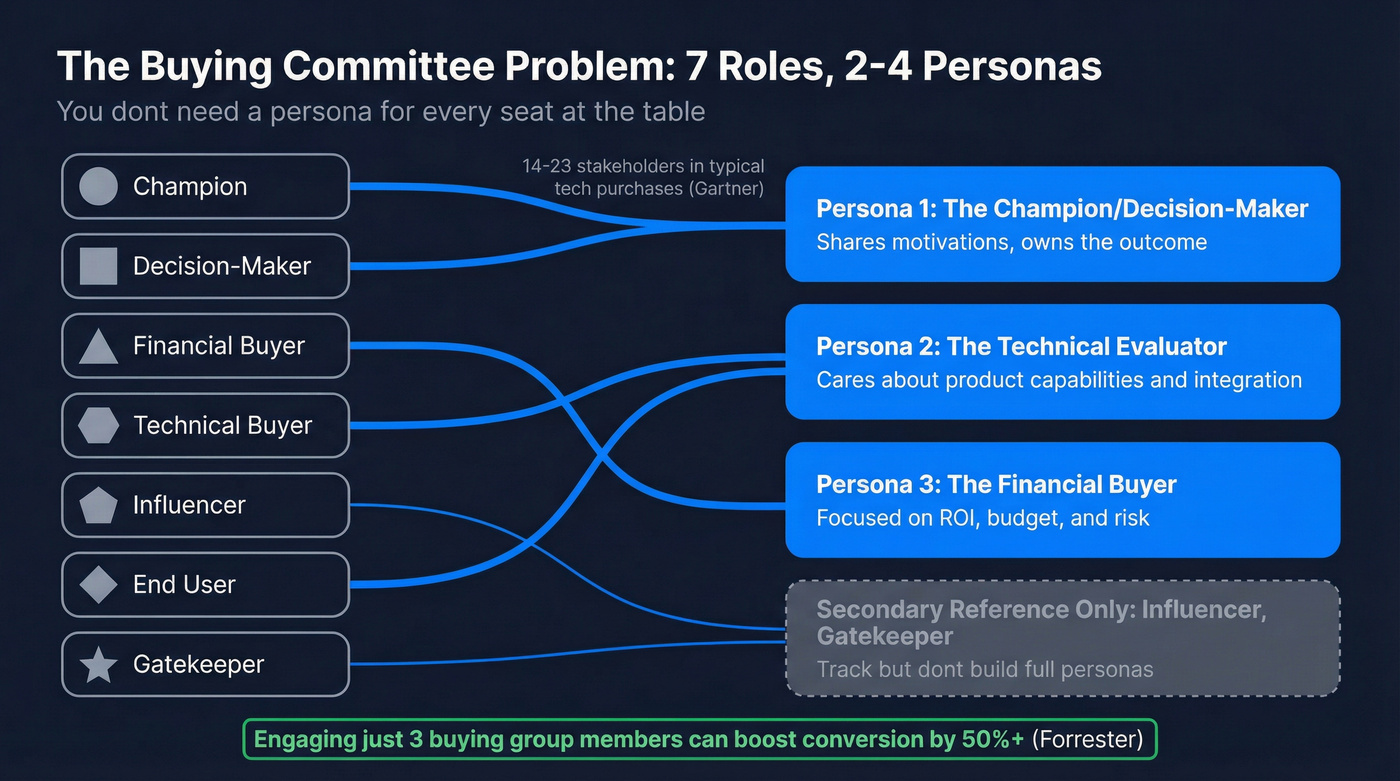
You don't need 23 personas. You need 2-4 that map to the roles that actually move deals forward.
A common buying committee breaks into seven roles: Champion, Decision-Maker, Financial Buyer, Technical Buyer, Influencer, End User, and Gatekeeper. Most of these can be collapsed. The Champion and Decision-Maker often share motivations. The Technical Buyer and End User care about the same product capabilities from different angles. Gartner's guidance goes further: map personas to buying situations - the specific contexts in which purchases happen - rather than just org-chart roles, and layer in jobs-to-be-done thinking so each persona reflects what the buyer is trying to accomplish, not just their title.
Forrester found that engaging just three buying group members can boost conversion rates by 50%+. That's your target. Not a persona for every seat at the table, but enough to multi-thread into the accounts that matter.
Let's be honest: most teams over-invest in persona creation and under-invest in persona activation. A beautifully designed persona slide deck is worthless if you can't find and reach the actual humans who match it. The bottleneck isn't strategy - it's execution.


You don't need 23 personas - you need 2-4 that move deals forward. Prospeo's B2B database lets you filter 300M+ profiles by job title, department, buyer intent, and company size so you can actually reach the humans behind each persona. 98% email accuracy means your outreach lands.
Stop designing persona decks. Start filling pipelines with real buyers.
How to Validate Your Persona Count
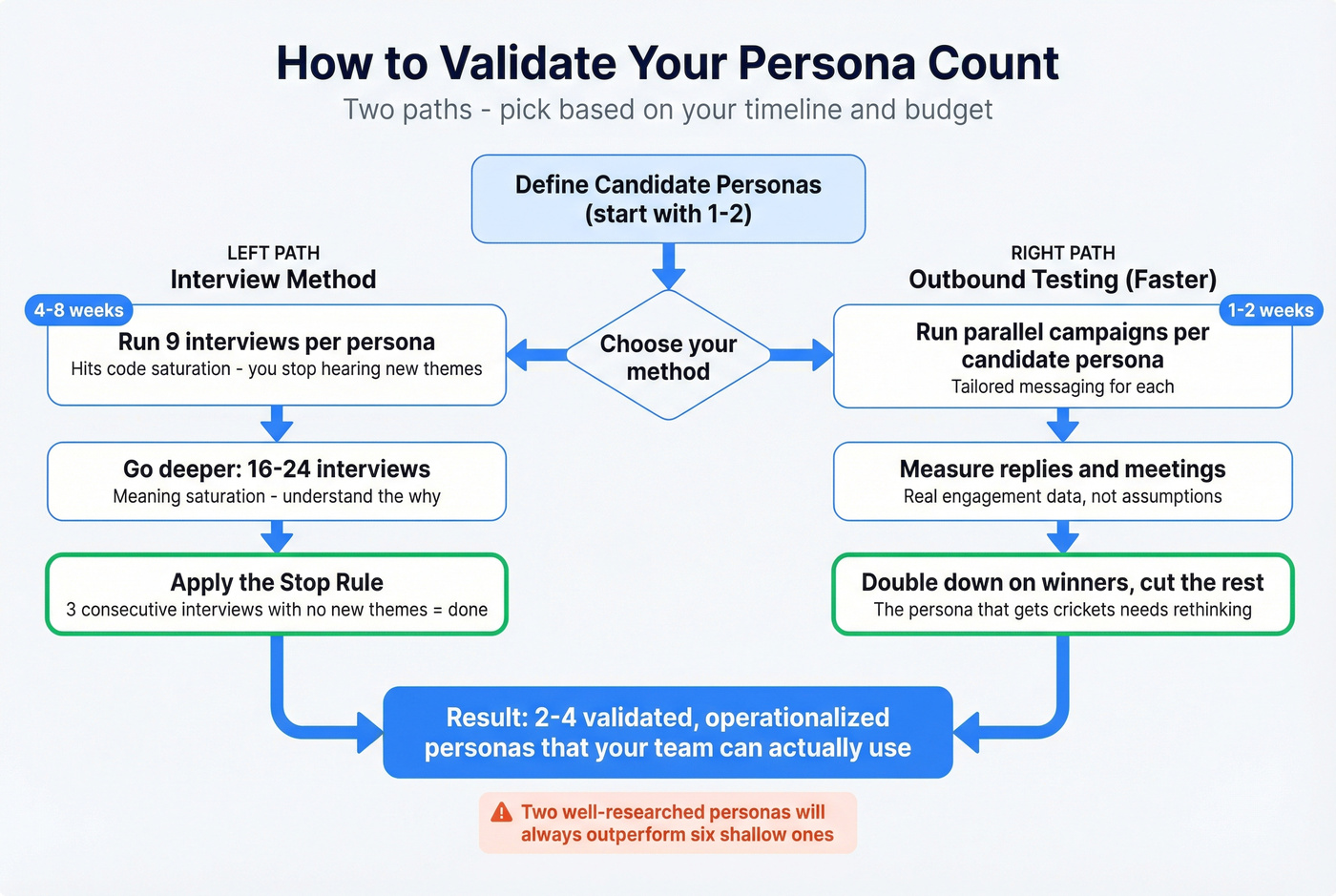
Personas built on assumptions are just fiction with a template. Here's how to validate yours with real data.
Interview Benchmarks
Research by Hennink & Kaiser found that code saturation - the point where you stop hearing new themes - hits around 9 interviews. But meaning saturation, where you deeply understand the why behind those themes, requires 16-24 interviews. The practical guideline from dscout: aim for 20 interviews per segment, then add roughly five interviews for each additional persona, vertical, or region you're exploring.
The Stop Rule
A PLOS One study proposed a measurable framework for assessing saturation: track your Base Size, Run Length, and New Information Threshold. When three consecutive interviews produce no new themes, you've hit saturation. This beats the common approach of "we did 10 interviews and called it done."
Outbound Testing as Faster Validation
If 20 interviews per persona sounds like a lot - it is - outbound testing can compress the timeline dramatically. Run parallel campaigns targeting each candidate persona with tailored messaging. The persona that generates replies and meetings is real. The one that gets crickets needs rethinking or cutting.
Your persona count should match your team's content and outreach capacity. Two well-researched, deeply operationalized personas will outperform six shallow ones every time.
Mistakes That Inflate Your Persona Count
Persona sprawl. Creating too many personas is a rookie mistake. If you're new to this, start with one. Seriously. Get it right before you add a second.
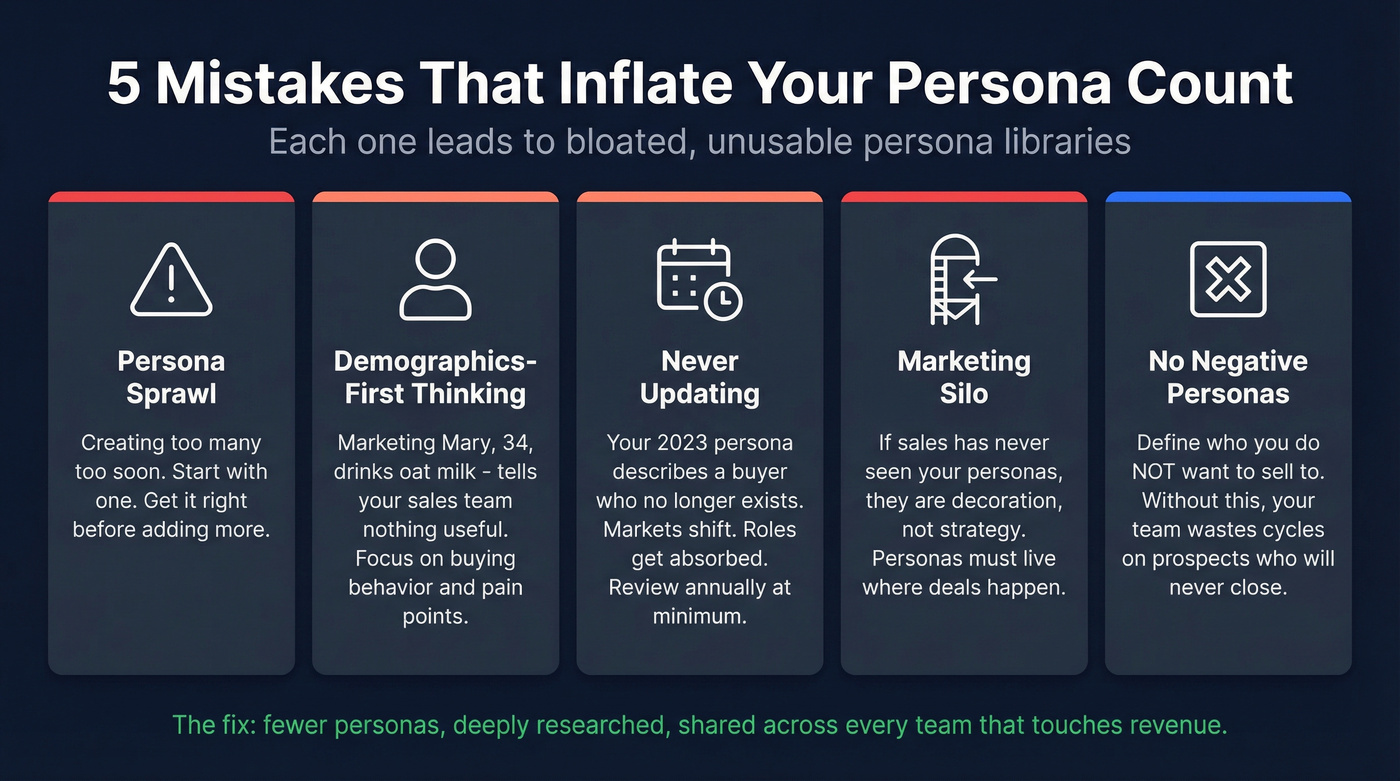
Demographics-first thinking. Building "Marketing Mary, 34, lives in Austin, drinks oat milk" doesn't help your sales team. Personas should be defined by buying behavior, pain points, and decision criteria - not lifestyle details.
Never updating. A persona you built in 2023 doesn't reflect how buyers behave in 2026. Markets shift. Roles evolve. Budgets tighten. We've seen teams running outbound against personas that described a buyer who no longer exists at most target companies because the role got absorbed into RevOps.
Marketing silo. If your personas live in a marketing slide deck and sales has never seen them, they're not personas - they're decoration.
Forgetting negative personas. Defining who you don't want to sell to is just as important. Without a negative persona, your team wastes cycles on prospects who'll never close or churn within 90 days. Skip this step at your own peril.
When to Update Your Personas
The minimum cadence is annual. But 46% of organizations update their personas within 1-4 years, and 28% run quarterly refreshes. The right frequency depends on how fast your market moves.
Triggers that should prompt an immediate review:
- M&A activity, yours or your customers'
- New product launches or market expansion
- Regulatory changes affecting buyer behavior
- Competitive shifts that change how prospects evaluate solutions
- Significant changes in win/loss patterns
If your close rates drop and nobody can explain why, stale personas are a likely culprit.
Turn Personas Into Pipeline
Most persona guides stop at "now go create campaigns." That's like handing someone a recipe and forgetting to mention the grocery store.
The execution gap - going from defined personas to actual conversations with real people who match them - is where most teams stall. Whether you segmented by job title or by context, like the credit card company that found three JTBD-based segments (people living well, business travelers, small business owners), the next step is building contact lists that match each persona. That means filtering by role, seniority, company size, intent signals, and the dozen other attributes that separate a good-fit prospect from noise.
Prospeo makes this step fast. Filter 300M+ profiles by job title, department, buyer intent, technographics, and 30+ other criteria, then export verified emails and direct dials straight to your sequencer.
If you want a repeatable system for list building, see building contact lists and lead enrichment workflows.
Once you have lists, your next bottleneck is usually messaging and sequencing. Use sales prospecting techniques and a B2B cold email sequence to operationalize each persona, then track lead generation metrics to decide which personas deserve more investment.
Validating personas requires reaching real buyers, not guessing from a spreadsheet. Prospeo gives you 30+ filters - intent data across 15,000 topics, technographics, headcount growth, job changes - to test which personas actually convert. At $0.01 per email, running validation campaigns costs less than one stakeholder interview.
Let response data tell you which personas are real. Start testing today.
FAQ
Can a business have just one buyer persona?
Yes - and it's the right move for early-stage companies or single-product businesses. Start with one, validate it with 20 interviews, and expand only when data shows a distinct second buyer with different needs and messaging requirements. One deeply understood persona beats five guesses.
What's a negative buyer persona?
A negative persona defines who you don't want to sell to - prospects who drain resources, churn fast, or never convert. Creating one prevents your team from wasting outreach on poor-fit leads and keeps your persona count focused on buyers who actually generate revenue.
How many buyer personas is too many?
More than you can operationalize. For most teams, that ceiling is 5-7. If each persona doesn't have dedicated messaging, content, and outreach sequences your team actively runs, it's dead weight. The test: can your team name every persona and explain how they sell to each one? If not, consolidate.