

How Many Follow-Up Emails Is Too Many? What 2026 Data Says
It's Thursday afternoon. No reply. You're hovering over "send" on follow-up number four, wondering if this is the one that gets you blocked.
If you're asking how many follow-up emails is too many, here's the honest answer: for cold outreach, 3-5 total emails is the sweet spot. Beyond that, you're burning goodwill and risking your domain. But the right number shifts depending on context - and whether those emails reach real inboxes at all.
Quick Reference by Context
| Context | Max Follow-Ups | Spacing |
|---|---|---|
| Cold outreach | 3-5 total | 3-4 days apart |
| Warm sales (post-demo) | 5-7 touchpoints | 2-3 days, then widen |
| Job interview | 1-2 max | Tied to stated timeline |
| Dormant re-engagement | 1 email | Every 2-3 months |
What 2026 Data Actually Shows
Two 2026 datasets - one from billions of cold email interactions, one from 2M+ emails - tell the same story. Instantly's benchmark report puts the average reply rate at 3.43%, with 58% of all replies coming from the first email. Follow-ups contribute the remaining 42%. That's meaningful, but each additional email delivers progressively less.
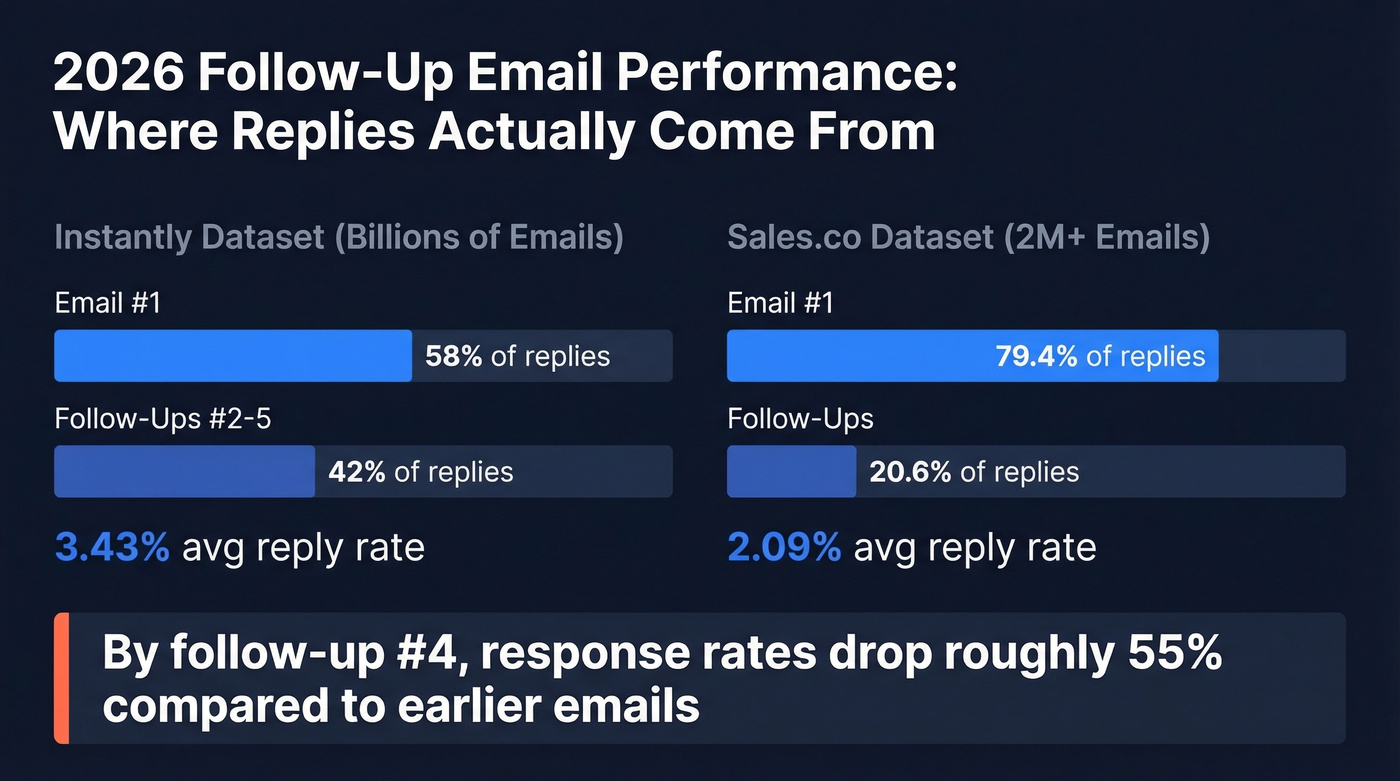
Sales.co's analysis across 100+ industries landed at a 2.09% reply rate, with only 14.1% of those replies positive. Out of every 1,000 contacts emailed, around 6-7 actually expressed interest. Follow-ups generated just 20.6% of total replies in their dataset, compared to 79.4% from the initial outreach. The math is sobering.
By follow-up #4, response rates drop roughly 55% compared to earlier emails. The same benchmark data recommends 4-7 total touchpoints, though we've found 3-5 is the practical ceiling for most teams. Beyond that, each email earns diminishing returns unless it introduces genuinely new value.
Send-time optimization gets a lot of attention, but the 2026 datasets point to a simpler reality: content and targeting drive outcomes more than micro-tweaks to timing. Instantly's dataset shows Tuesday-Wednesday as the peak. Sales.co found Monday had the highest overall reply rate, while Thursday produced the highest positive reply rate. Pick a consistent window and move on.
How to Maximize Replies Per Follow-Up
Cold Outreach Cadence
The cadence that works for most teams: Day 1 (initial email), Day 4 (first follow-up, new angle), Day 8 (social proof or case study), Day 14 (different pain point), Day 28 (breakup email). Five total touches over four weeks.
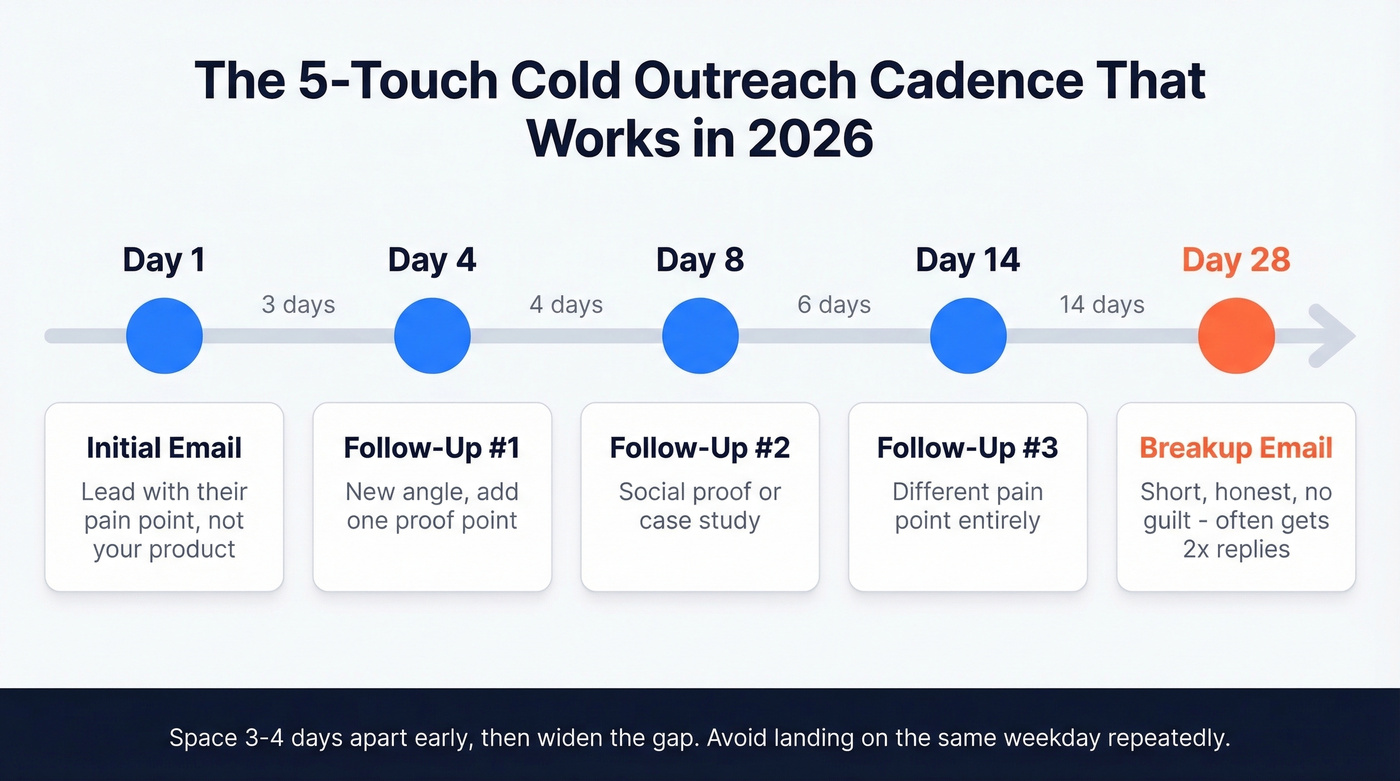
Space them 3-4 days apart early on, then widen the gap. Avoid a 7-day interval so emails don't always land on the same day of the week - that pattern looks automated and prospects notice. Each email needs to earn its existence with new information, not just "circling back." If you're building a full B2B sequences playbook, this cadence is a solid default.
For most B2B sequences, three to four follow-ups after the initial email is the ceiling before diminishing returns set in hard. If you want plug-and-play copy, start with these follow-up templates.
Warm Sales Deals
Post-demo and post-proposal follow-ups play by different rules entirely. Outreach.io's data shows 90% of buyers respond within two days of their most recent message, and most deals require 5-12 touchpoints before closing. Only 8% of sales reps follow up more than five times, which means persistence alone is a competitive advantage in warm deals. Follow up within 24 hours after a demo, then 2-3 days after a proposal. This is also where sequence management matters more than perfect copy.
Job Interview Follow-Ups
Cap it at 1-2 emails. Period. Send a thank-you within 24 hours, then one follow-up tied to whatever timeline they gave you. If they said "we'll decide by Friday," follow up the following Monday. After that, silence is your answer.
Dormant Lead Re-Engagement
For contacts who went cold months ago, one email every 2-3 months is the ceiling. Trigger it with something relevant - a new product launch, an industry shift, content that maps to their original interest. Anything more frequent than that and you're just annoying someone who already decided not to reply.

Follow-up #4 means nothing if emails #1-3 bounced. Bad addresses trigger spam filters, tank your domain reputation, and make every subsequent follow-up invisible. Prospeo's 5-step verification delivers 98% email accuracy - so your carefully spaced cadence actually reaches real inboxes.
Fix your list before you fix your sequence.
The #1 Follow-Up Mistake
Every follow-up guide says "add value." Almost nobody does it.
The default move is what GMass calls "bumping" - replying to your own thread with "just checking in" or "wanted to bump this to the top of your inbox." It's lazy. Prospects can smell it instantly, and it gives them zero reason to respond. If you need alternatives, here are better ways to say just checking in professionally.
Value-add follow-ups look like this: sharing a case study relevant to their industry, reframing around a different pain point, or dropping a specific stat that makes your pitch concrete. "Companies in your space are seeing 40% shorter sales cycles after switching to [approach]" beats "just following up on my last email" every single time. Each follow-up should feel like a new reason to reply, not a reminder that you exist. For a deeper framework, use this guide on how to add value in sales.
When Too Many Follow-Ups Becomes Self-Sabotage
There's a line where persistence crosses into damage, and it's measured in deliverability metrics, not feelings.
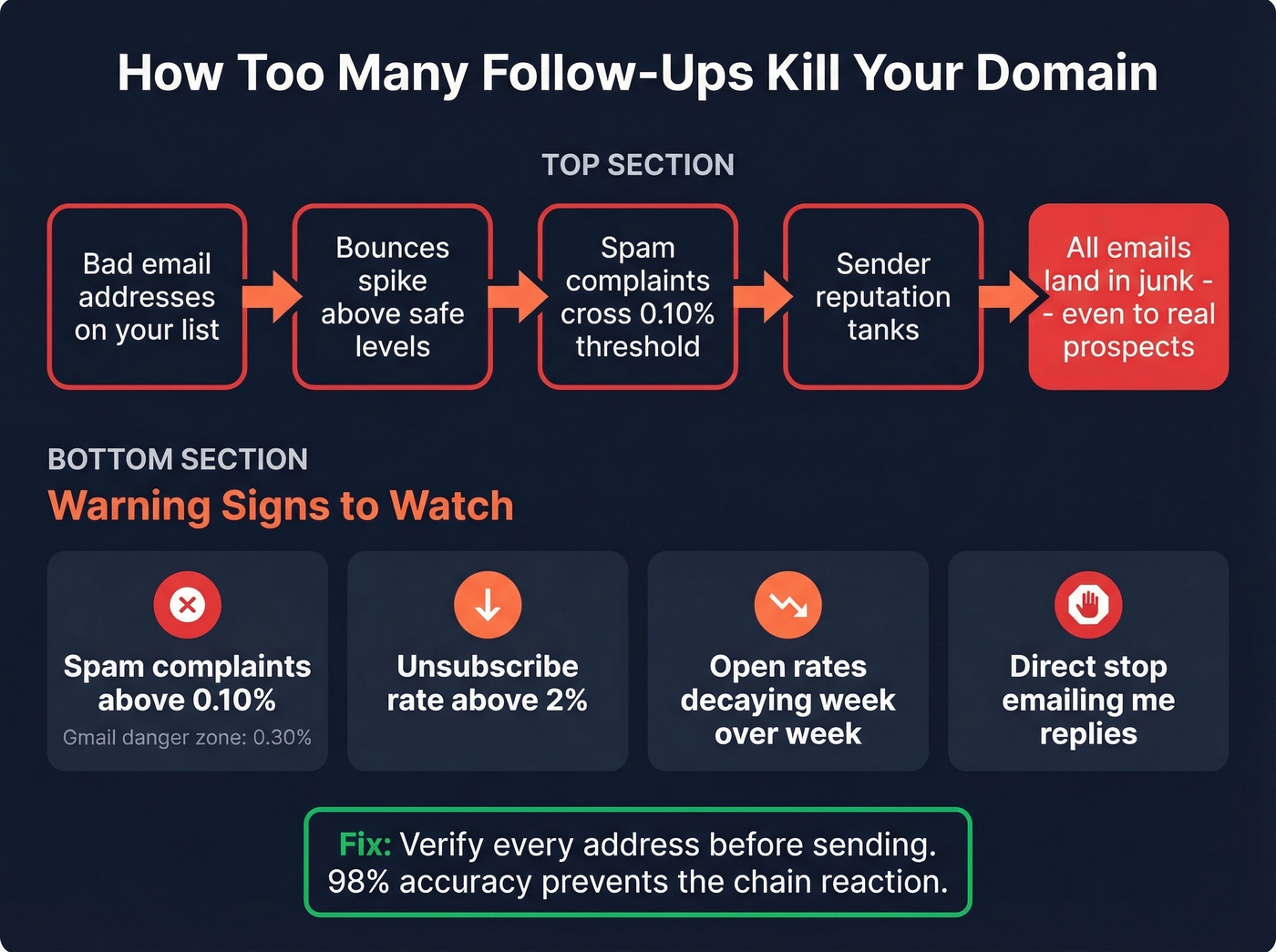
Gmail's spam complaint threshold sits at 0.10%. Cross 0.30% and you're in the danger zone. That's just 3 spam reports per 1,000 emails. Even one complaint per 1,000 can start eroding your sender reputation. If you're troubleshooting, start with an email deliverability guide and then work through how to improve sender reputation.
Watch for these warning signs: unsubscribe rates climbing above 2%, direct "stop emailing me" replies, open rates decaying week over week, and spam complaints in Google Postmaster Tools. Excessive follow-ups are the fastest way to trigger all of these at once.
Here's the chain that kills domains: bad addresses cause bounces, bounces and complaints trigger spam filters, filters tank your reputation, and suddenly even your legitimate follow-ups to real prospects land in junk. We've seen teams run clean five-email sequences and still get crushed because their list quality was terrible - too many dead addresses means bounces, filtering, and a reputation spiral that's hard to reverse. The number of emails in your sequence matters far less than whether those emails reach a real inbox. (If you're diagnosing list issues, this email bounce rate breakdown helps.)

The 2026 data is clear: 3-5 emails is your ceiling. That means every send has to count. Prospeo gives you verified emails refreshed every 7 days - not the 6-week-old data that causes the bounces, spam complaints, and domain damage that kill sequences before follow-up #2.
Send fewer emails to better contacts at ~$0.01 each.
When to Stop Following Up
The hardest part of follow-up strategy isn't knowing when to send - it's knowing when to quit. A thread on r/Recruitment includes an anecdote about someone sending 20 follow-up emails and still getting hired, which is proof that the "right" number depends heavily on context. But for most of us, that story is the exception, not the playbook.
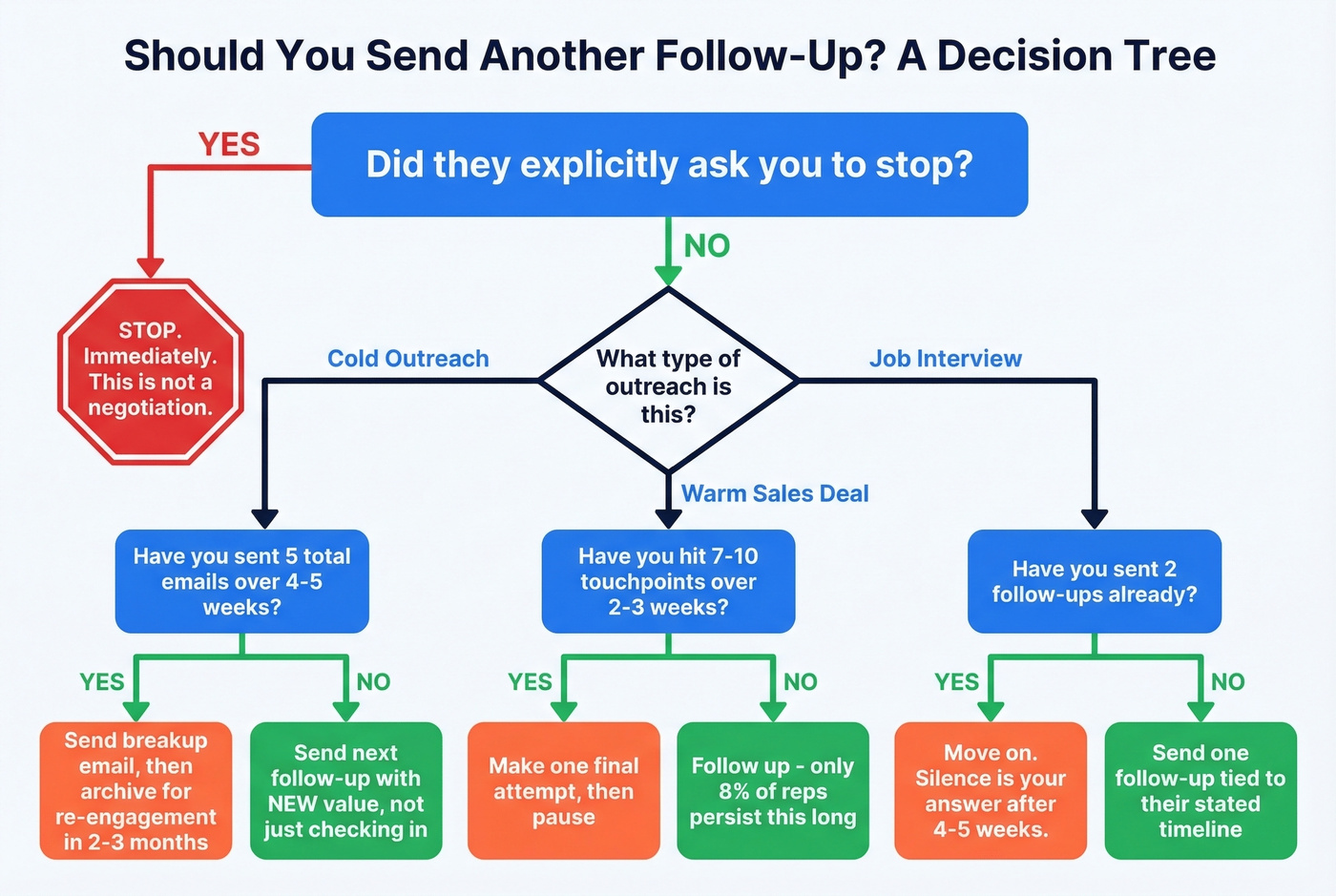
Stop immediately if someone explicitly asks you to stop. This isn't a negotiation.
Apply the commitment test. Serious prospects schedule the next meeting. If they keep saying "let's reconnect sometime" but won't put a date on the calendar, that's your signal they aren't buying.
For cold outreach, send your breakup email after 4-5 weeks of silence across your full sequence. Five total messages is the practical limit before you risk domain damage. For warm deals, make a final attempt after 7-10 touchpoints over 2-3 weeks. For job seekers, if you haven't heard back 4-5 weeks after your last interview, it's time to move on. (If you want a timing cheat sheet, see when should I follow up on an email.)
Opens without replies after 2-3 follow-ups signal low priority, not hidden interest. Send one final value-add email, then archive the contact for re-engagement later.
Sample Cold Outreach Sequence
Here's a proven five-email framework that we've adapted from testing across dozens of campaigns:
- Day 0 - Initial outreach. Lead with their pain point, not your product. Subject line references their company or role specifically. (If you need ideas, borrow from these cold email subject line examples.)
- Day 3 - Quick follow-up. Reply to your own thread. Add one new proof point. Keep it under 75 words.
- Day 7 - New angle. Address a different pain point or use case. This is where you earn the reply you didn't get on emails one and two.
- Day 14 - Social proof. Share a relevant result from a similar company. "Your competitor [X] cut their [metric] by 30%" works if it's true.
- Day 28 - Breakup email. Short, honest, no guilt. "Looks like the timing isn't right - feel free to reach out if things change." In our experience, breakup emails outperform every other email in a sequence, sometimes by 2x.
Skip the breakup email if you're in a warm deal with active engagement - that's a cold outreach tactic that reads as passive-aggressive when someone's already talking to you.
This five-touch sequence is enough to be persistent without crossing into nuisance territory. Let's be honest: most teams don't need a more complicated cadence than this in 2026.
FAQ
Is 3 follow-ups too many?
No. For cold outreach, 3-5 total emails is the 2026 sweet spot. Three follow-ups after an initial email sits comfortably within that range. For job interviews, cap at two total. Three is rarely excessive in a sales setting.
How long should I wait between follow-ups?
Start at 3-4 business days for the first two touches, then widen to 5-7 days for later messages. Following up the same day or next day signals desperation and tanks reply rates.
Should I change the subject line each time?
Keep the same thread for follow-ups two and three - replying in-thread preserves context. Change the subject only for a breakup email or a completely new angle that warrants a fresh thread.
What's a good free tool for verifying emails before a sequence?
Prospeo's free tier includes 75 email credits per month with full 5-step verification - enough to validate a small campaign list. Hunter offers 25 free searches monthly but doesn't include the same catch-all and spam-trap filtering, which matters most for protecting deliverability.