

How Many Sales Reps Do I Need? The Formula Most Teams Get Wrong
84% of sales reps missed quota last year. 87% of sales leaders have no set method for determining quotas. So when someone asks "how many sales reps do I need to hit $5M?" and divides $5M by $500K to get ten, the answer is wrong - and wrong in a direction that costs you the year.
The naive calculation ignores ramp time, attrition, and the fact that reps spend just 28% of their time actually selling. Let's fix that.
The Quick Answer
Revenue target divided by quota gives you a number that's often 40-60% too low. The real formula:
Effective Capacity = (AEs x Quota) x Attainment x Ramp Factor x Retention Factor
Each multiplier reduces your theoretical capacity. Plug in the benchmarks below and you'll have a defensible headcount number in 10 minutes - one your CFO will actually believe.
Sales Capacity Formula Explained
Start Simple
Capacity = Reps x Quota x Attainment
Five reps carrying a $200K quota at 80% attainment gives you $800K, not the $1M you'd get by ignoring attainment. Most leaders skip this step entirely. This is the capacity approach - other models exist (territory-based, workload-based, dynamic hybrid), but capacity planning is the most defensible for headcount decisions.
Layer In Ramp and Attrition
The full capacity formula accounts for every variable that chips away at your theoretical number:
Effective Capacity = (AEs x Quota) x Attainment x Ramp Factor x Retention Factor
Attainment for enterprise SaaS averages 70-80%. Use 0.75 as your default unless you've got strong historical data. For context, 91% of organizations missed quota expectations in 2024, so if anything, 0.75 is generous.
Ramp factor is where most plans fall apart. Average SaaS ramp time has climbed to 5.7 months - up 32% from 4.3 months in 2020. For new hires, use 0.6x as a simplified ramp multiplier. They won't produce at full capacity for two quarters.
Retention factor captures the reality that people leave. The formula: 1 - (attrition rate x 0.5). At 15% annual attrition with a 6-month backfill delay, that's 0.925. Sounds small. It compounds with everything else, and that compounding is what kills your forecast.
Successful B2B sales teams typically operate at a capacity utilization rate between 65% and 75%. Budget accordingly.
Worked Example
Target: $5M in new bookings. Quota: $500K per AE.
The naive math assumes all 10 reps produce at full quota: $5M / $500K = 10 AEs. Done, right?
Reality: only 8 are ramped, and 2 are new hires who'll produce at 0.6x during ramp. Attrition is 15%.
- Ramped capacity: 8 x $500K = $4M
- New hire capacity: 2 x $500K x 0.6 = $600K
- Total raw capacity: $4.6M
- Apply attainment (x 0.75): $3.45M
- Apply retention (x 0.925): $3.19M
You're $1.8M short. To hit $5M, you need roughly 14 AEs - not 10. That's a 40% gap the naive formula misses completely. We've watched this exact scenario blow up Q4 forecasts more times than we can count.
2026 Benchmarks for Your Model
Revenue Per Rep by Stage
| Company Stage | Revenue/Rep |
|---|---|
| Seed | $250-400K |
| Series A | $400-600K |
| Series B | $600-800K |
| Series C+ | $800K-$1.2M |
Revenue Per Rep by ACV
| ACV Tier | Revenue/Rep |
|---|---|
| <$10K | $300-500K |
| $10-50K | $500-750K |
| $50-150K | $750K-$1M |
| >$150K | $1-2M+ |
These benchmarks come from a study of 312 B2B SaaS companies and 2,400+ reps. If your plan assumes every rep produces $1M and you're a Series A company, you're building on sand.
Ramp Time by Segment
| Segment | Ramp Time | Key Risk |
|---|---|---|
| SMB | 1-3 months | Low risk per hire |
| Mid-Market | 4-6 months | Moderate dead zone |
| Enterprise | 9-12 months | Major capacity gap |
| SDR | ~3.2 months | High early turnover |
Here's the thing: 20% of new sales hires leave within 90 days. The total cost to ramp a new rep runs roughly 3x their base salary when you factor in recruiting and training. That means a single bad hire at $120K base costs you close to $360K in real dollars before you even start backfilling.
If you want to reduce that risk, start with a tight 30-60-90 day plan and a clear sales process optimization cadence.

Your capacity model says you need 14 AEs, not 10. But hiring 4 more reps at $250K+ fully loaded cost isn't the only lever. Reps spend just 28% of their time selling - Prospeo's 98% email accuracy and 125M+ verified mobile numbers (30% pickup rate) eliminate hours of wasted prospecting so each rep produces more.
Make every rep on your headcount plan count. Start free today.
SDRs, Managers, and Total Headcount
SDR-to-AE Ratios
Data from 939 companies shows clear patterns by deal size:
| Segment | SDR:AE Ratio | Sales Cycle |
|---|---|---|
| SMB (<$30K ACV) | 1:2 | 20-30 days |
| Mid-Market ($30-100K) | 1:2.5 | 30-45 days |
| Enterprise (>$100K) | 1:3 to 1:4 | 60-90 days |
Inbound-heavy teams can stretch to 1:3 or 1:4. Outbound-heavy teams need 1:1.5 to 1:2 due to higher prospecting volume. AE-led prospecting delivers 3-4x higher conversion rates than the traditional SDR-to-AE handoff - Salesloft restructured to an AE-led model in 2025, and more companies are following.
That doesn't mean SDRs are dead. Their role is shifting toward enablement and research. And don't just count reps - count accounts per rep. Growth often requires reducing account loads even as quotas stay flat.
If you're building outbound coverage, pair ratios with a repeatable lead generation workflow and modern SDR tools.
Manager Span of Control
Target spans by segment: SMB 8-12 reps, Mid-Market 7-10, Enterprise 6-8. Reducing span from 12 to 9 increases the percentage of reps at 100%+ attainment by 6 points and cuts ramp time by about half a month. Managers aren't overhead - they're a capacity multiplier when the ratio is right. Even a 40-member sales team can underperform a lean 20-person org if manager spans are too wide and coaching suffers.
Common Mistakes That Blow Up Your Plan
Using blended attrition rates. Sales reps churn far more than engineers. The consensus on r/financial is blunt: some years it's 5%, other years 25%. In our experience, teams that use company-wide attrition rates are always blindsided when Q3 hits. Use sales-specific numbers.
Over-assigning quotas to compensate. 58% of organizations pad quotas by 20-30% to "ensure" the team hits plan. This demoralizes reps and inflates your capacity model with numbers nobody believes.
Confusing the fuel tank with the fuel. A practitioner on r/FPandA nailed this: quota is the tank, opportunities are the fuel. A bigger tank without more pipeline doesn't help.
Hiring one rep instead of two. For your first sales hires, always hire in pairs. With one rep, you can't tell if a miss is the person, the process, or the market.
Look - if your average deal size is under $10K, you probably don't need to obsess over sales team sizing at all. Hire one SDR, give them great data, and see what happens. The capacity model matters most when each hire represents $154K+ in OTE and $250K-$300K+ in fully loaded cost.
Before You Hire - Fix What You Have
Sometimes the real answer to "how many sales reps do I need?" isn't "more." It's "make the ones you have more productive."
Sellers using AI tools are 3.7x more likely to meet quota. AI-assisted workflows unlock roughly 15% more revenue capacity per seller - applied to a 25-rep team carrying $1.2M quotas, that's $4.5M in additional capacity without a single new hire.
GreyScout doubled their sales team from 2 to 5 reps, but what actually moved the needle was fixing their data infrastructure with Prospeo. Rep ramp time dropped from 8-10 weeks to 4 weeks. Pipeline jumped 140%. Bounce rates fell from 38% to under 4%. At roughly $0.01 per verified email versus the $250K-$300K+ fully loaded cost of a new AE, the ROI math isn't close.
Reps spend 28% of their time selling. Fix the other 72% before you add headcount.
If you're trying to increase output without adding seats, focus on data enrichment, reducing email bounce rate, and tightening pipeline health.
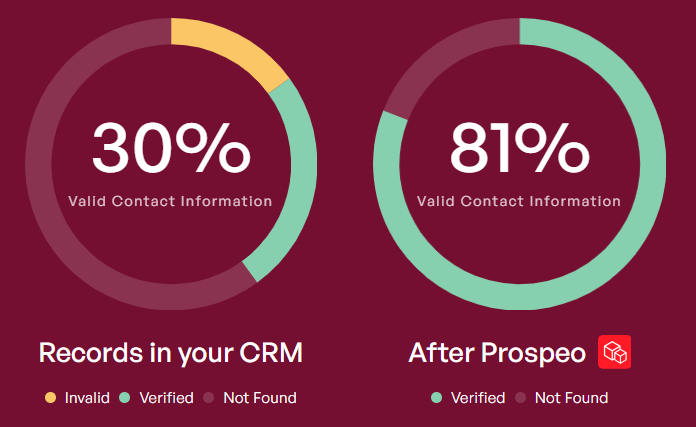
Bad data inflates your headcount model. When bounce rates hit 35%, reps burn hours chasing dead contacts instead of closing deals - and your capacity formula breaks. Prospeo refreshes 300M+ profiles every 7 days, not every 6 weeks. Teams using Prospeo book 26% more meetings than ZoomInfo users at $0.01 per email.
Stop hiring reps to compensate for bad data. Fix the data first.
FAQ
How many reps does a startup need before hiring a VP Sales?
Two to three ramped reps producing repeatable revenue. The VP Sales role is about scaling what works, not figuring out product-market fit. If your founders haven't closed the first 20-40 customers themselves, it's too early.
Should I hire more reps or improve efficiency first?
If attainment is below 60% and ramp exceeds 6 months, fix process and tooling first. GreyScout cut ramp time in half with better contact data before scaling from 2 to 5 reps - pipeline jumped 140% as a result. Skip the hiring spree until your current team is actually productive.
How do I account for seasonal cycles in headcount planning?
Plan hires 6-9 months before you need full capacity. For Q1 revenue targets, post roles in Q2-Q3 of the prior year. Enterprise ramp can take 9-12 months, so waiting until Q4 to hire for a January push means you won't see full productivity until the following fall.