

How to Ask for a Follow-Up Without Sounding Desperate
You sent a proposal three days ago. Radio silence. Now you're drafting and deleting the same email for the fourth time, wondering if following up makes you look needy.
It doesn't. With only 8.5% of sales outreach emails getting any response at all, your message probably got buried - not ignored. Knowing how to ask for a follow-up is the difference between deals that close and deals that die in someone's inbox. Following up isn't nagging. It's doing your job.
Three Rules for Every Follow-Up
- Add a reason to reply every time. New information, a deadline, a specific question. Never send a message that's just "checking in." (If you need alternatives, see checking in.)
- Follow up sooner than you think. Two to three days, not two weeks. (More timing guidance: follow up sooner.)
- Switch channels if email fails. Call, walk over, send a message. (If calling is part of your motion, build a repeatable cold calling system.)
When to Send Your Follow-Up
Start sooner, space out gradually, and know when to stop.
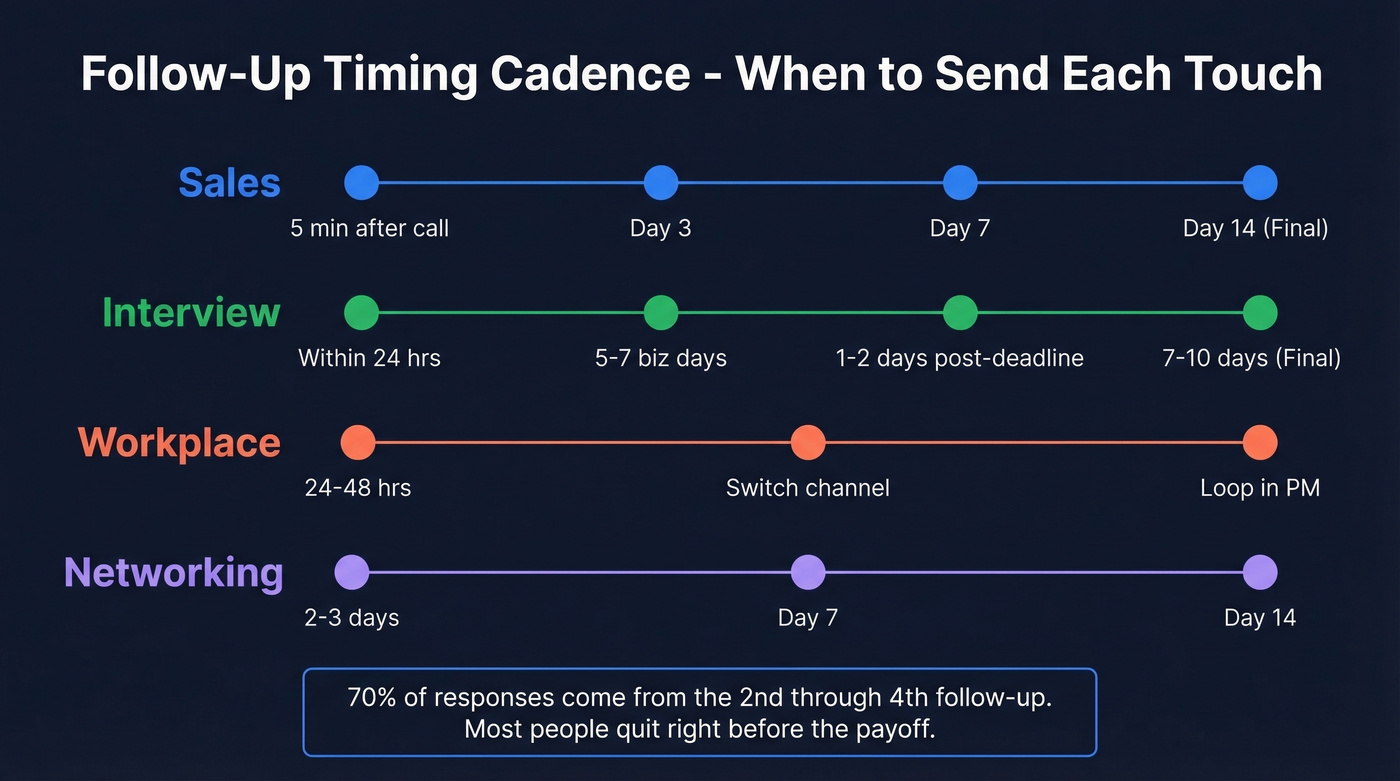
| Context | Touch 1 | Touch 2 | Touch 3 | Final |
|---|---|---|---|---|
| Sales | 5 min after call | Day 3 | Day 7 | Day 14 |
| Interview | Within 24 hrs | 5-7 biz days | 1-2 days post-deadline | 7-10 days |
| Workplace | 24-48 hrs | Switch channel | Loop in PM | - |
| Networking | 2-3 days | Day 7 | Day 14 | - |
Here's the thing most people get wrong: they send one follow-up, hear nothing, and assume they're being annoying. But 70% of responses come from the 2nd through 4th follow-up, which means most people quit right before the payoff. A MailerLite analysis of 12 billion emails found open rates hold steady in the low-to-mid 30% range from monthly to twice-weekly sends, only dropping meaningfully at daily frequency. Following up a few times won't annoy people. Emailing every day will.
Follow-Up Templates That Work
If you're wondering how to politely ask for a response in email, the key is combining a clear reason to reply with a low-pressure tone. We've tested dozens of variations across our own outreach - these four formats consistently pull replies. (For more options, compare these follow-up templates.)
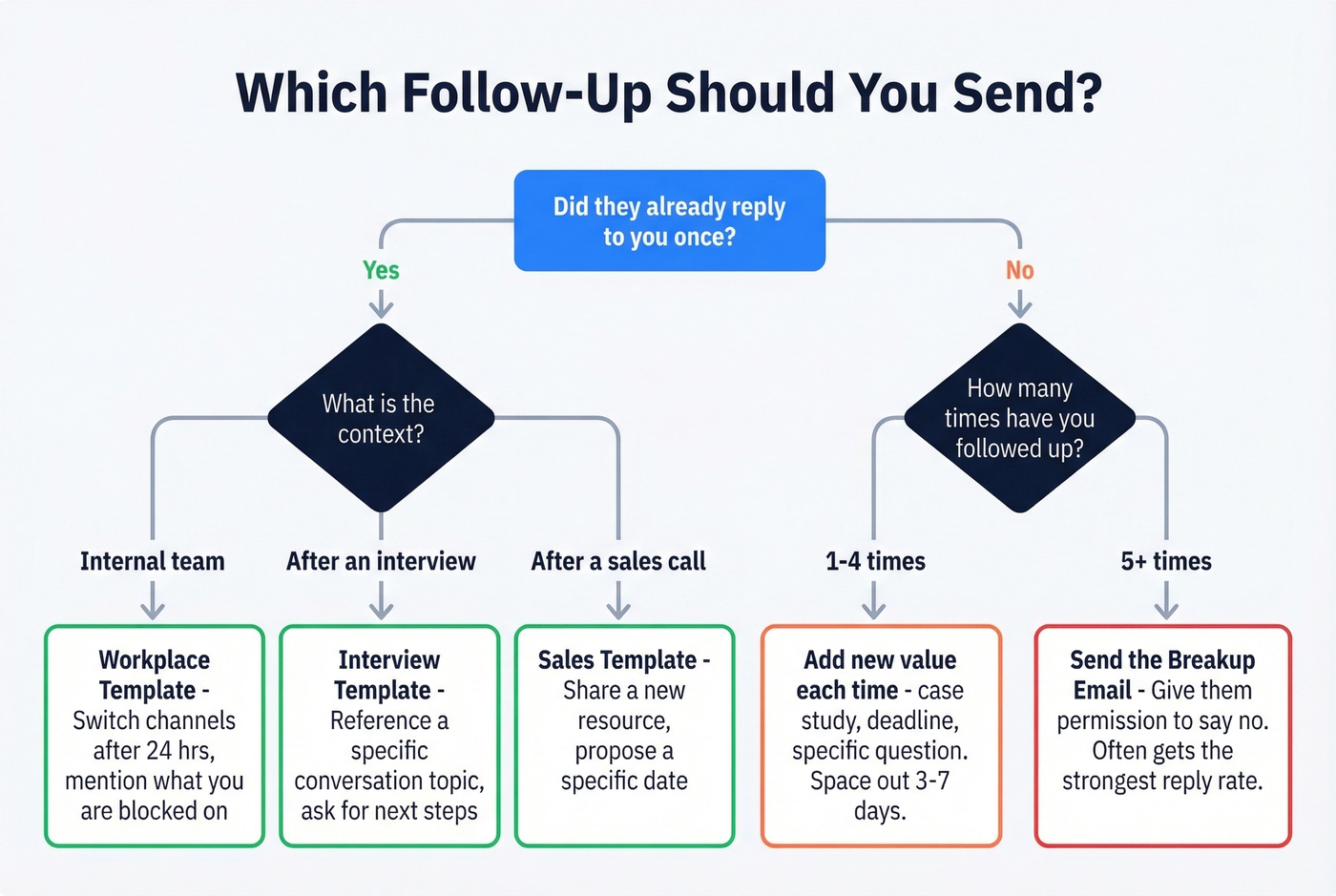
Sales Follow-Up
Gong's analysis of hundreds of thousands of sales emails found several angles that consistently outperform generic check-ins, including loss aversion and the tactical apology.
Subject: Quick question about [project/proposal]
Hi [Name], I'm trying to finalize my schedule for next week and wanted to see if [date] works for a quick call. I also realized I didn't share [specific resource/case study] - it's relevant to what you mentioned about [pain point].
If the timing's off, just let me know and I'll circle back when it makes sense.
Keep it between 50 and 125 words - that's the sweet spot for response rates. The "finalize my schedule" framing, borrowed from a r/sales thread, works because it implies a deadline without manufacturing one. (If you're building a full outbound motion, pair this with a B2B cold email sequence.)
Interview Follow-Up
Keep thank-you emails under 200 words and status checks under 150. Hiring managers skim these, so front-load the value.
Subject: Following up on [Role] - [Your Name]
Hi [Name], I wanted to check in on the [Role] position. Our conversation about [specific topic] reinforced my interest - especially [one concrete reason you're a fit].
I'm happy to provide any additional information. What's the best next step?
One Reddit poster reported getting a job offer 20 minutes after sending a follow-up. Anecdotal? Sure. But it's a reminder that the follow-up itself can be the nudge that tips a decision.
Workplace Follow-Up
Internal follow-ups play by different rules. You're not selling - you're unblocking work. If 24 hours pass without a reply, skip the second email and switch channels. Walk over, call, or send an IM.
Hey [Name], I sent over [deliverable/question] yesterday - wanted to check if you had a chance to look at it. I'm blocked on [next step] until I hear back, so any ETA helps.
If you're still stuck, loop in your PM or manager. Frame it as a prioritization question, not a complaint.
Networking Follow-Up
The goal here isn't to close anything - it's to stay memorable. Reference a specific moment from your conversation and offer something useful before asking for anything.
Hi [Name], great meeting you at [event]. Your point about [specific topic] stuck with me - I actually came across [article/resource] that's relevant. Would love to continue the conversation over coffee sometime.
The Breakup Email
After 5-7 touches in sales (or 3 in an interview process), send a permission-to-close message:
Subject: Should I close this out?
Hi [Name], I've reached out a few times and haven't heard back - totally understand if the timing isn't right. I'll close this out on my end, but if things change, I'm easy to find.
Breakup emails often pull the strongest reply rates in a sequence. People respond when they feel the window closing. (To improve outcomes across touches, track your follow-up email reply rate.)

You just spent 20 minutes crafting the perfect follow-up. If it bounces, none of that matters. Prospeo verifies emails at 98% accuracy with a 5-step process that catches spam traps, honeypots, and catch-all domains - so every follow-up actually lands.
Stop following up with dead inboxes. Verify first.
Phrases That Kill Your Follow-Up
Every one of these signals the same thing: "I have nothing new to say."
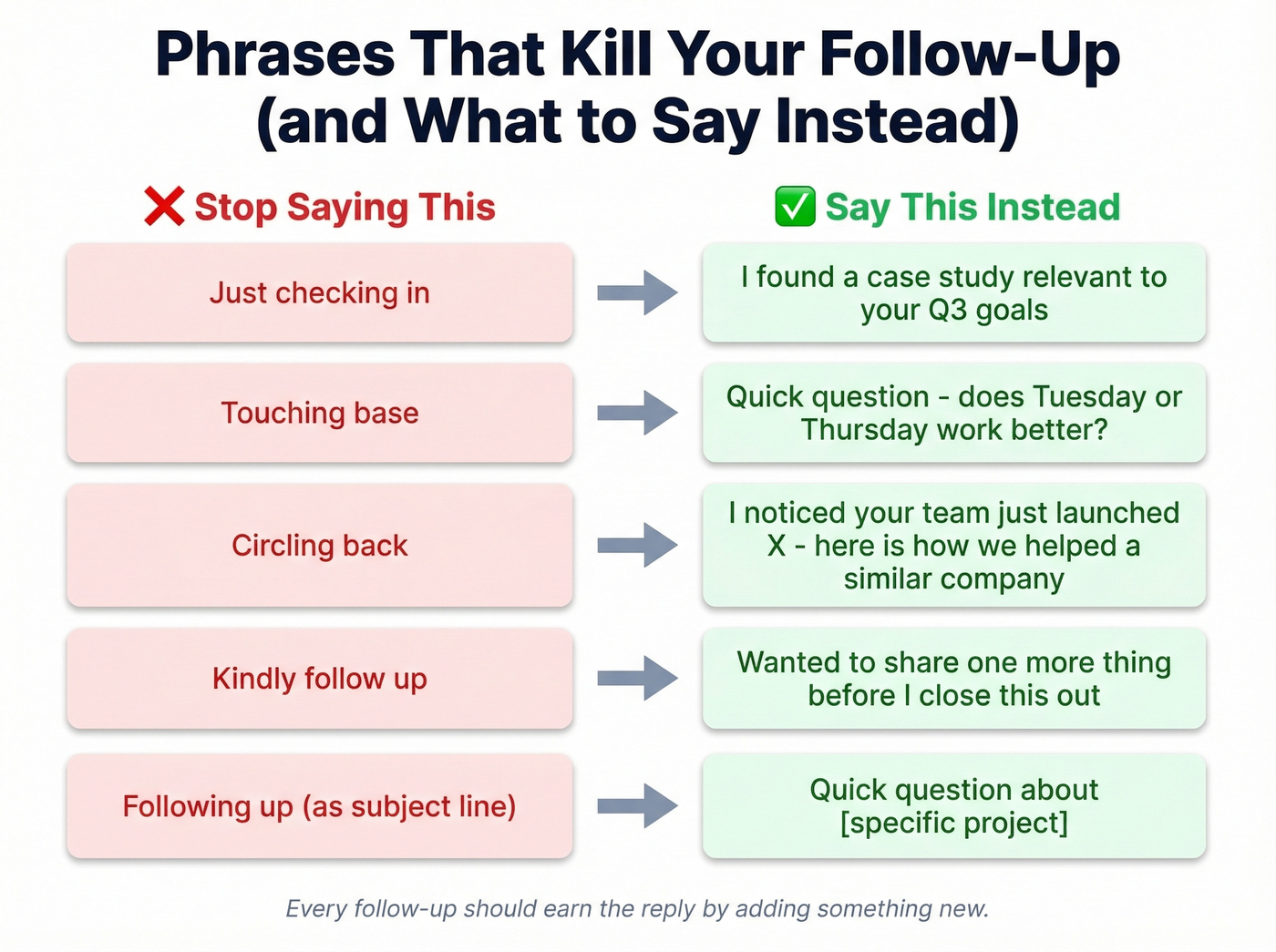
- "Just checking in" - the most ignored phrase in professional email. It gives the recipient zero reason to reply.
- "Touching base" / "Circling back" - corporate filler that screams autopilot. Replace with a specific question or new information.
- "Kindly follow up" - on r/etiquette, "kindly" was flagged as passive-aggressive, especially in client-facing contexts. Drop it entirely.
- "Following up" as a subject line - it signals obligation, not value. Use a specific question or reference instead. (If you need ideas, pull from these subject line examples.)
Let's be honest: if your follow-up email could be replaced by the words "please respond," you haven't written a follow-up. You've written a guilt trip. Every touch needs to earn the reply by adding something new.
When to Pick Up the Phone
82% of buyers accept meetings from sellers who reach out by phone, and 57% of C-level and VP buyers actually prefer it. A phone call communicates urgency without the passive-aggressive energy of a fifth email sitting in someone's inbox.
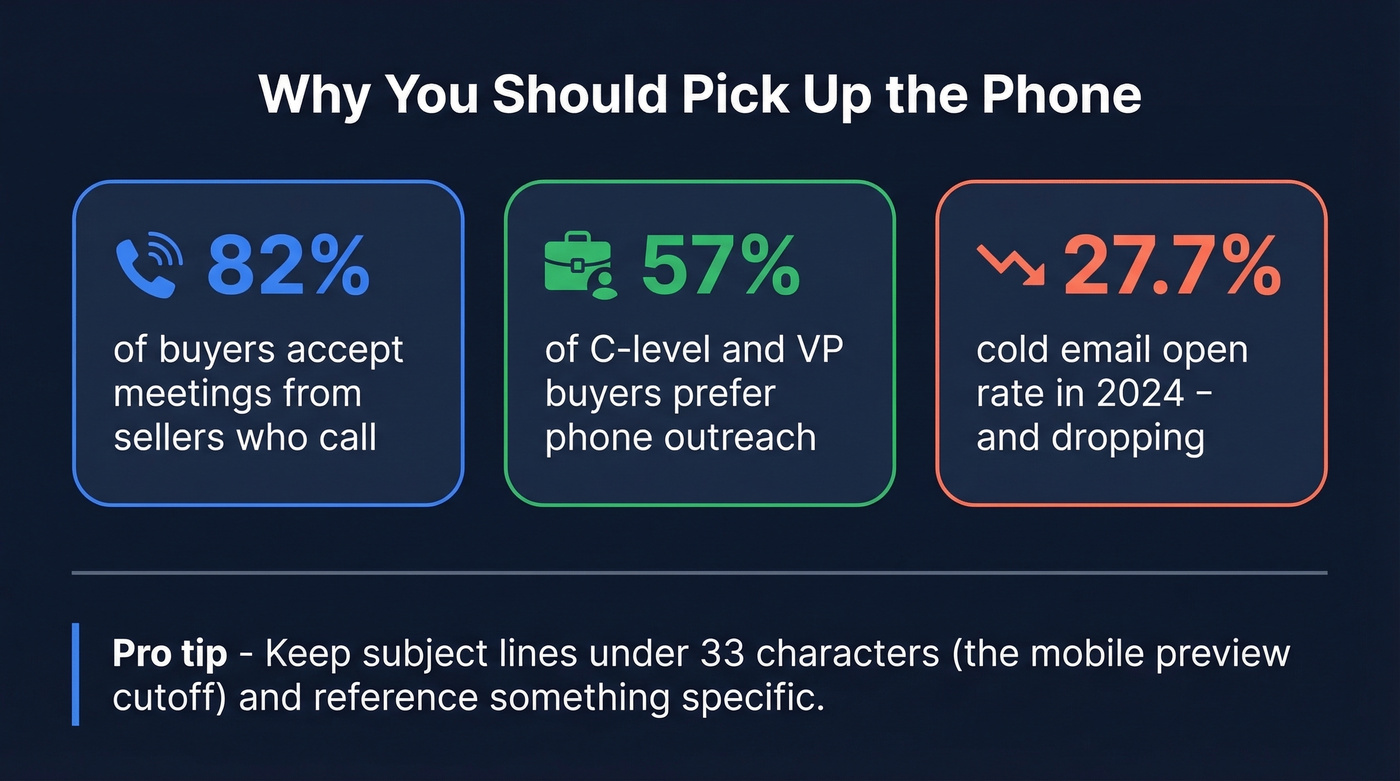
If you're sticking with email, nail the subject line. Keep it under 33 characters - that's the mobile preview cutoff - and reference something specific. Cold email open rates fell to 27.7% by 2024, so generic subject lines are a death sentence. I once watched a rep triple his reply rate just by swapping "Following up" for "Quick question about your Q3 rollout" - same email body, completely different results. (For more deliverability-safe sending practices, see bulk email without getting blacklisted.)
Verify Before You Follow Up
The number one reason follow-ups fail isn't bad wording - it's emailing the wrong address. A perfectly crafted message that bounces accomplishes nothing except damaging your sender reputation. We've seen teams burn through entire sequences only to discover half their list was stale.
Before you launch any follow-up cadence, verify the email is actually deliverable. Prospeo handles this with 98% email accuracy and a 7-day data refresh cycle, so you're not sending to addresses that went dead months ago. The free tier gives you 75 email verifications per month - enough to confirm your contacts before any outreach cadence. (If you're troubleshooting bounces, start with email bounce rate and then work on sender reputation.)
Skip this step if you're only following up with people who've already replied to you. But for cold or semi-warm outreach? Verification isn't optional.

The best follow-up sequence in the world fails if you're emailing the wrong person. Prospeo gives you 143M+ verified emails refreshed every 7 days - not stale data from six weeks ago. At $0.01 per email, fixing your contact list costs less than the deal you're about to lose.
Get verified emails before your next follow-up goes out.
FAQ
How many follow-ups is too many?
For sales, stop after 5-7 touches spread across channels. For interviews, three is the limit. For workplace requests, switch to a phone call after one unanswered email. 70% of responses come from the 2nd through 4th message - persistence pays, but daily emails don't.
How do you politely ask for a response without being pushy?
Give the recipient a specific, low-effort action - a yes/no question, a date to confirm, or a simple "let me know either way." Pairing a concrete ask with a genuine reason like a deadline, a new resource, or a scheduling constraint makes it easy to reply without feeling pressured.
What's the best subject line for a follow-up email?
Keep it under 33 characters so it displays fully on mobile. Reference something specific - a date, a deliverable, a question. "Quick question about [project]" outperforms "Following up" every time because it promises value instead of obligation.
How do I make sure my follow-up actually reaches someone?
Verify the email address before sending. Bounced messages waste your time and hurt your sender reputation - once that reputation drops, even valid emails land in spam. Tools like Prospeo verify emails in real time with 98% accuracy so you know in seconds whether an address is deliverable.