

How to Ask for a Meeting and Actually Get a Yes
You sent 20 meeting requests last week. Two replies came back - one was "not right now" and the other bounced. That's not a template problem. It's a process problem: wrong email address, too many words, zero follow-up. Learning how to ask for a meeting effectively means fixing those three things, and a mediocre request sent to a verified address outperforms a "perfect" one sent to a dead inbox every single time.
Why 83% of Meeting Requests Get Ignored
83% of meeting request emails never get a response. Not "get rejected" - they never get a response at all. They vanish alongside 50+ unread messages already sitting in your recipient's inbox, according to Ignition's research on follow-up behavior.
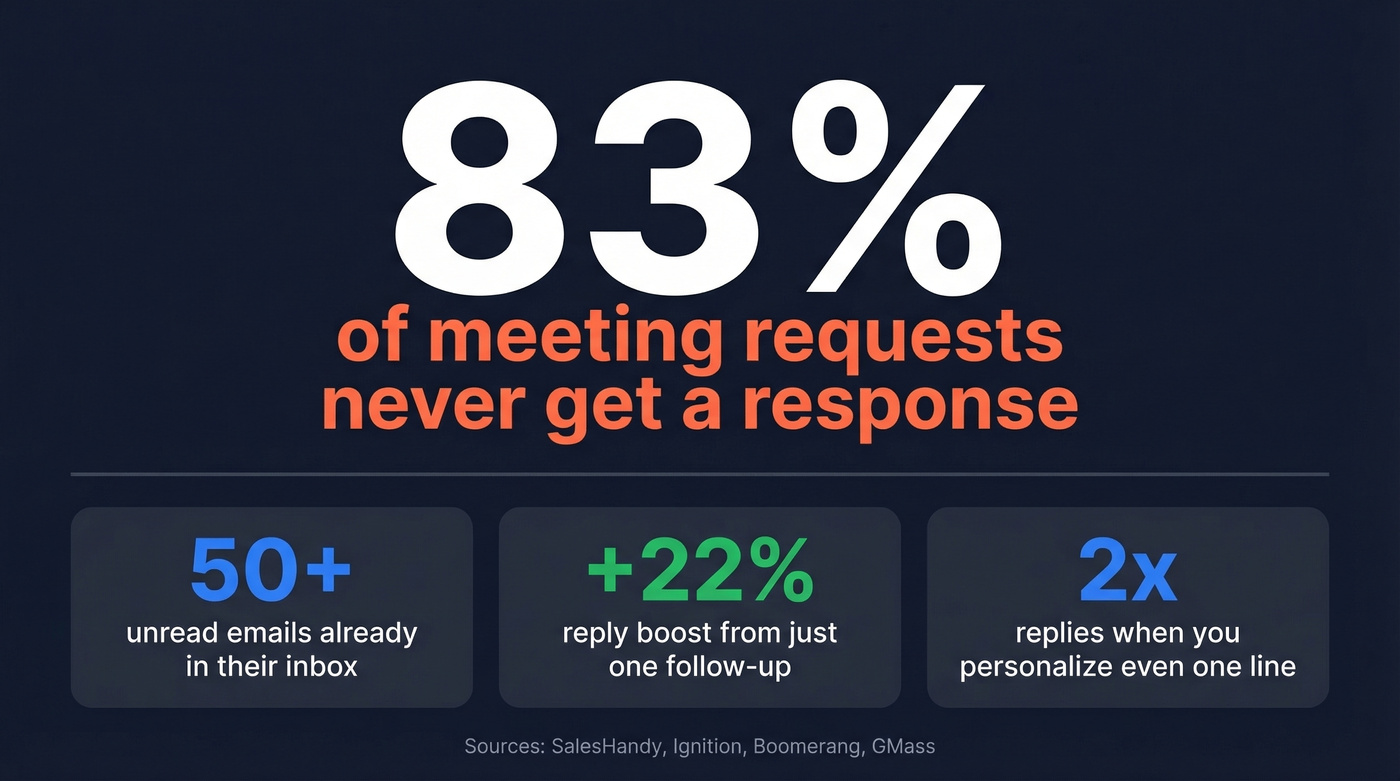
Your meeting request isn't competing with other meeting requests. It's competing with Slack notifications, internal threads, newsletters, and that one vendor who won't stop following up about a webinar.
But volume isn't the whole story. Your recipient is decision-fatigued. Every meeting request is another decision to make, and the default answer to any decision is "later." Your job is to make saying yes easier than saying maybe. The people who consistently book meetings aren't better writers - they're more systematic about three things: keeping emails short, following up relentlessly, and making sure the email actually reaches the inbox.
The Short Version
If you're pressed for time, here's the entire strategy:
- Keep it 50-125 words, written simply. Emails at a 3rd-grade reading level get 36% more replies than those written at a college level. Short sentences. Plain words.
- Propose 2-3 specific times and ask for 15 minutes. Make it easy to say yes or no. Don't make the recipient do scheduling work.
- Always follow up. A single follow-up boosts response rate by 22%. Most people skip this entirely. (If you need copy, steal from these sales follow-up templates.)
The Science Behind Emails That Get Replies
Boomerang analyzed over 40 million emails to figure out what actually drives responses. Three findings matter most for meeting requests.
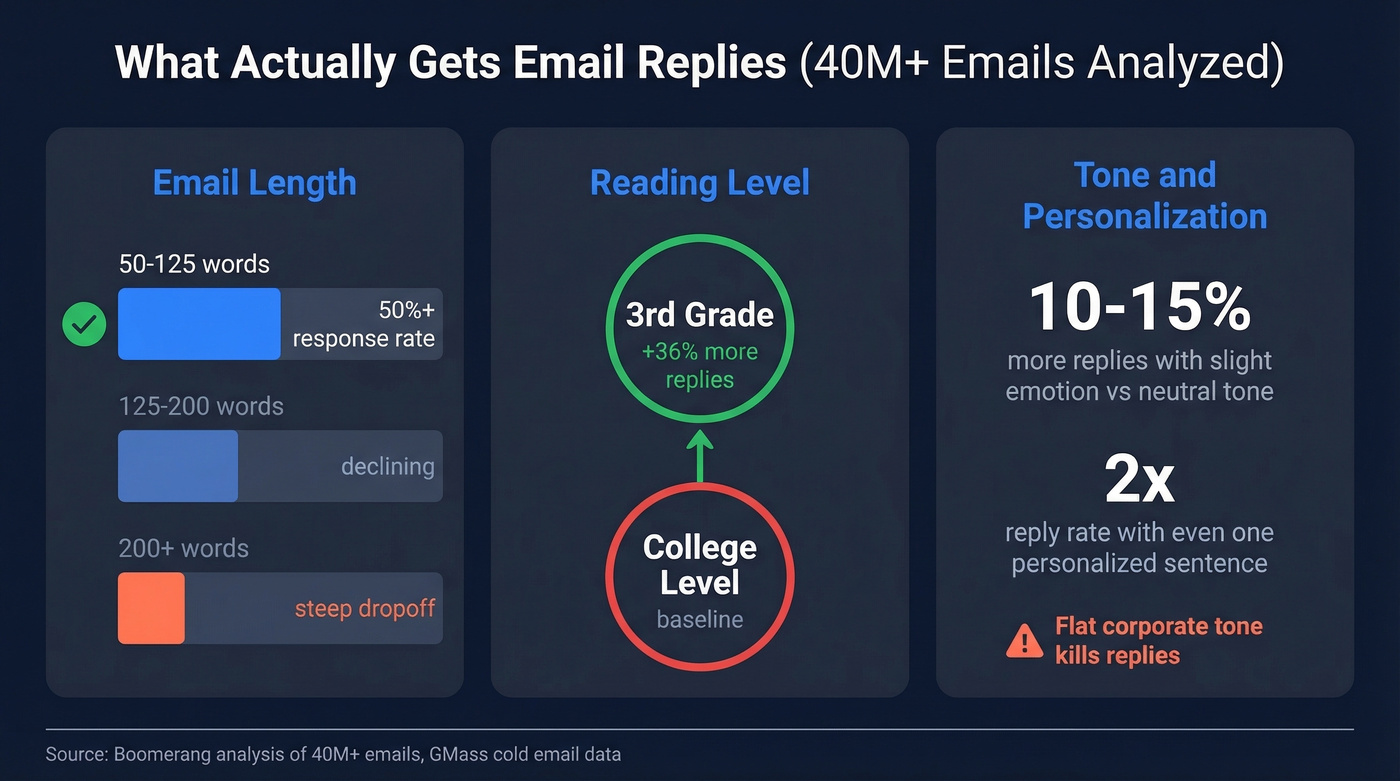
Length: The sweet spot is 50-125 words. Response rates in that range sit above 50%. Go longer and you're asking someone to invest time before they've agreed to invest time - that's backwards.
Reading level: Emails written at a 3rd-grade reading level outperformed college-level writing by 36%. This isn't about dumbing things down. It's about respecting your reader's attention. Short words, short sentences, one idea per paragraph.
Tone: Slightly positive or slightly negative emails got 10-15% more responses than neutral ones. A little enthusiasm ("excited to share") or a little urgency ("running out of time on this") outperforms the flat corporate tone most people default to. Personalized cold emails get more than twice the replies of generic ones - even a single personalized sentence referencing their company, a recent post, or a mutual connection doubles your odds. (For a deeper playbook, see personalized outreach.)
Subject lines follow the same principles. Keep them short, specific, and relevant. "Quick question about [their initiative]" beats "Meeting Request" every time. If you want options, pull from these email subject line examples.
Step-by-Step Meeting Request Framework
Here's the thing: most frameworks overcomplicate this. We've boiled it down to seven steps that work whether you're emailing your VP or a stranger.
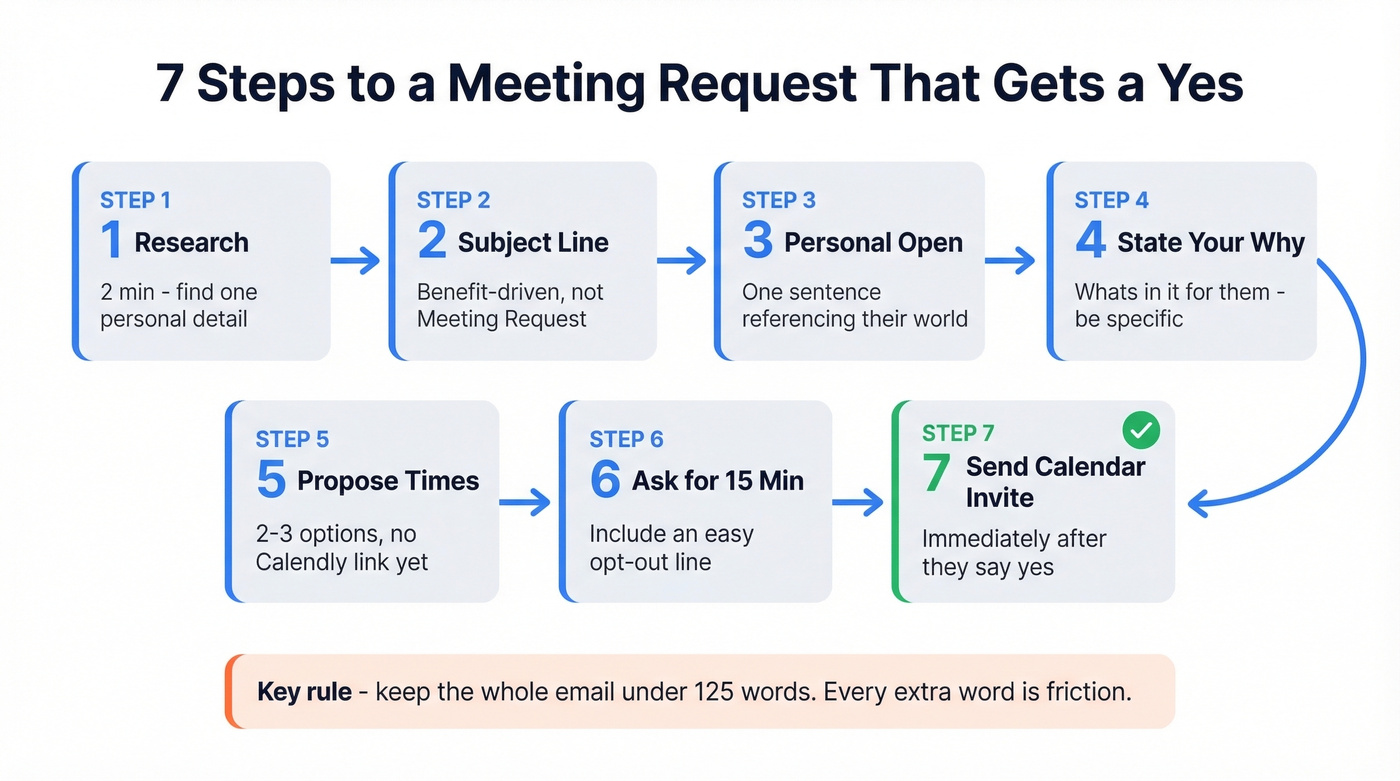
1. Research the person. Spend 2 minutes. Find one thing you can reference - a recent hire, a product launch, a post they wrote. That's your personalization hook.
2. Write a benefit-driven subject line. Not "Meeting Request." Try "15 min on [specific topic they care about]" or "Quick question re: [their initiative]."
3. Open with a personalized sentence. Reference the thing you found. One sentence. Don't overdo it.
4. State your purpose clearly. Why should they meet with you? What's in it for them? Specificity breeds believability - "I'd like to share how three companies in [their industry] reduced churn by 20%" beats "I'd love to discuss how we can help." Always. (If you need a tighter value prop, start with these sample elevator pitches.)
5. Propose 2-3 specific times. "Would Tuesday at 2pm or Thursday at 10am work?" Don't send a Calendly link in the first email. A common complaint on r/sales is that it feels presumptuous before someone has agreed to meet.
6. Ask for 15 minutes and include an opt-out. "If this isn't relevant, no worries at all" gives them permission to say no - which paradoxically makes them more likely to say yes.
7. Once they say yes, send a calendar invite immediately. Include a one-line agenda, the meeting link, and any prep materials.
Here's a meeting request example that hits all seven points in under 100 words:
Subject: 15 min on [specific topic]
Hi [Name],
Saw [personalized detail - their post, company news, mutual connection]. Congrats on that.
I work with [type of company] on [specific outcome]. Thought it'd be worth a quick conversation to see if [specific benefit] applies to [their company].
Would [Day] at [Time] or [Day] at [Time] work for a 15-minute call? If the timing's off, happy to adjust - and if this isn't relevant, no worries at all.
[Your name]
Templates for Every Scenario
Your Boss or Colleague
Internal meetings are low-stakes, but vague requests still get deprioritized. Lead with the agenda so they know it's worth their time.
Subject: 15 min - [project name] decision needed
Hi [Name],
I need your input on [specific decision] for [project]. I've got a recommendation ready - just need 15 minutes to walk through it and get your sign-off.
Does [Day] at [Time] or [Day] at [Time] work? Happy to come to your office or jump on a call.
A Prospect or Potential Client
Value first. The prospect doesn't care about your product - they care about their problem.
Subject: [Their company] + [specific outcome]
Hi [Name],
[One personalized sentence - reference their company, industry, or a challenge you've seen in their space.]
We helped [similar company] [specific result - e.g., "cut onboarding time by 40%"]. I think there's a fit worth exploring.
Would a 15-minute call on [Day] or [Day] make sense? If this isn't a priority right now, totally understand - just say the word.
A Busy Executive or VIP
The Forbes networking guide nails the distinction here. Wrong approach: vague background plus aggressive scheduling. Right approach: common ground in one sentence, a credible and specific reason, and exactly 15 minutes.
Subject: [Mutual connection / shared interest] - quick question
Hi [Name],
[One sentence establishing common ground - same conference, mutual contact, their published work.] Your perspective on [specific topic] stood out to me.
I'm working on [one sentence of context]. Would you have 15 minutes for a call this month? I'll keep it tight and come prepared. If the timing doesn't work, no pressure at all.
Skip this template if you don't have genuine common ground. Faking a connection with a VIP backfires fast.
Pro tip: If they decline the meeting, offer to send a 2-minute summary by email instead. You still get your message across, and you've shown you respect their time.
Requesting a Meeting With a Stranger
"I'd love to pick your brain" is the fastest way to get ignored. It signals you haven't done your homework and you're asking for free consulting. Engaging with someone's content before reaching out - commenting on a post, sharing their article - pushes success rates from ~15% to 40-50%.
Subject: Your [article/talk/post] on [topic] - one question
Hi [Name],
I came across your [specific content] on [topic] and it shifted how I'm thinking about [specific angle]. Really appreciated [specific detail].
I'm exploring [related area] and would love to ask you one or two focused questions. Would a 20-minute call work sometime in the next couple weeks? Happy to work around your schedule - and if it's not a good time, I completely understand.

83% of meeting requests get ignored - but bounced emails never even get the chance to be ignored. Every template above is useless if it lands in a dead inbox. Prospeo gives you 98% verified emails with a 7-day refresh cycle, so your carefully crafted meeting request actually reaches the person you wrote it for.
Fix the inbox problem first. Emails start at $0.01 each.
Cold Outreach: Booking Meetings at Scale
Templates matter for one-off requests. But if you're trying to book 50+ meetings a month, you need a system. (Start with these sales prospecting techniques.)
What Response Rates to Expect
The average cold email response rate lands between 1-5%. Practitioners on r/coldemail report 2-4% for well-targeted campaigns, and 7-10% is possible with tight targeting and strong copy. Realistic expectation for a solid campaign: 2-5%. Plan your funnel math around that.
The Funnel Math
Consistent meeting booking looks like this:
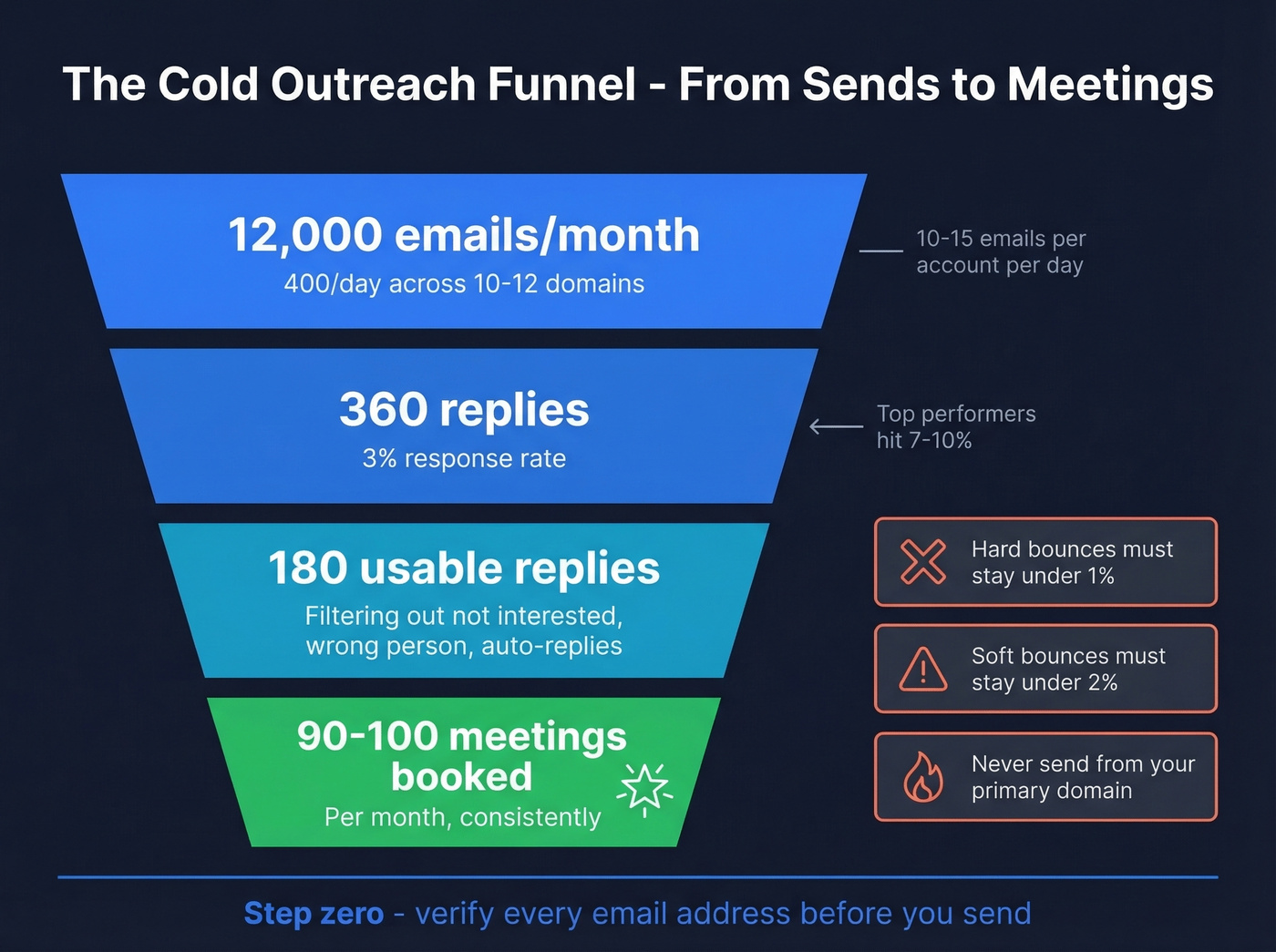
400 emails/day -> ~12,000/month -> 360 replies at 3% -> ~180 usable replies -> ~90-100 booked meetings/month
To send 400/day, you need roughly 10-12 domains with 2-3 accounts each, sending 10-15 emails per account per day. Never send cold outreach from your primary business domain. Set up separate domains, warm them for at least 14-21 days, and keep warmup running even after you start sending. This is infrastructure, not magic. (To stay safe, track your email velocity.)
Deliverability Is the Prerequisite
None of this works if your emails bounce. An analysis of 81,966 cold emails found that healthy campaigns keep soft bounces under 2% and hard bounces under 1%. Go above those thresholds and your domain reputation tanks, which means even your good emails start landing in spam.
The chain works like this: bad email address, bounce, domain damage, fewer meetings. Every meeting request you send to an invalid address doesn't just fail - it makes your next request less likely to arrive. We've watched teams go from 35% bounce rates to under 4% just by switching their data source. Before you optimize a single word of copy, verify your list. Prospeo's 98% email accuracy and 7-day refresh cycle means the addresses you pull today are current - not stale data from six weeks ago. (If you want the full breakdown, read our email deliverability guide.)
You just spent 2 minutes researching a prospect and writing a personalized 100-word meeting request. Don't waste that effort on a bad email address. Prospeo's 300M+ database with 30+ filters lets you find the right decision-maker and their verified contact info - so every meeting request you send has a real shot at a reply.
Stop sending perfect emails to wrong addresses. Start booking meetings.
Go Multi-Channel
Email isn't enough on its own. B2B buyers now use 10+ channels to interact with suppliers, up from five in 2016. If you're only emailing, you're leaving meetings on the table.
Social outreach works particularly well as a complement. A well-crafted InMail sees 18-25% reply rates compared to 1-5% for cold email. The key is engaging with someone's content first - like or comment on a post, then send the message.
For phone, keep the same principles. Ask for exactly 15 minutes. Frame it so they can answer yes or no. Give them an exit: "Worth a 15-minute call this week, or should I follow up by email instead?" Most people respect the brevity. The best-performing outreach sequences in 2026 layer all three: email first, social engagement second, phone as the third touch. (If you're building the phone layer, use a cold calling system.)
The Follow-Up That Books the Meeting
This is the single highest-ROI change most people can make. 70% of sales emails need a follow-up to get a response. Without follow-up, you're looking at a ~16% email response rate. Add just one follow-up and that jumps to 27%.
About 60% of replies come after the first follow-up. The data is unambiguous.
Wait 2-5 days after your initial email. For a full cold sequence, plan 4-7 emails spread over 14-21 days. After that, switch channels or move on. (If you're unsure on timing, see when should i follow up on an email.)
Here's a follow-up template that works:
Subject: Re: [original subject]
Hi [Name],
Just circling back on this - I know inboxes get buried. Still happy to share how [specific benefit] applies to [their company].
Would [new Day] at [Time] work for 15 minutes? If the timing's wrong or this isn't relevant, just let me know either way.
Keep it shorter than the original. Don't re-pitch. Make it easy to respond.
Mistakes That Kill Your Meeting Request
Sending a Calendly link in the first email. Propose times first. Send the scheduling link after they've agreed to meet.
"I'd love to pick your brain." Vague, overused, and signals you haven't prepared. Replace with a specific question or topic.
Writing at a college reading level. The Boomerang data is clear - that costs you 36% of your responses. Use short words. Short sentences. Get to the point.
No follow-up. You're giving away 22% of potential responses. One follow-up. That's all it takes.
Sending to unverified email addresses. Every bounce damages your sender reputation. Verify every email before you hit send - a single bad batch can tank deliverability for weeks. (Benchmarks and fixes: email bounce rate.)
Let's Be Honest: Most People Don't Need Better Templates
Here's what I've learned watching hundreds of outbound campaigns: the teams that book the most meetings aren't writing the best emails. They're sending decent emails to verified addresses, following up three times, and doing it across multiple channels. If your average deal size is modest, you don't need a 500-word masterpiece - you need a 75-word email that actually lands in someone's inbox. Obsess over data quality and follow-up cadence. The copy is the easy part.
FAQ
How do you politely ask for a meeting?
Open with a clear reason, propose 2-3 specific times, and keep it under 125 words. Ask for 15 minutes and include an easy opt-out like "if this isn't relevant, no worries." Specificity plus brevity is what makes a request feel respectful rather than demanding.
How many follow-ups should you send?
Plan 4-7 emails over 14-21 days. The first follow-up is the most impactful, boosting response rates by 22%. After 4-5 touches with no reply, switch to social outreach or phone rather than sending another email to someone who's clearly not engaging there.
What's the best day and time to send a meeting request?
Tuesday through Thursday mornings is the general consensus, but timing matters less than most people think. Follow-up consistency and email deliverability have a far bigger impact on your booking rate than sending at 9:07am versus 10:15am. Test with your audience and optimize from there.
How do you request a meeting with someone you've never met?
Engage with their content on social media before reaching out - this alone pushes success rates from ~15% to 40-50%. When you email, reference something specific they've published and ask one focused question. For verified contact details, tools like Prospeo ensure your outreach actually reaches the right inbox instead of bouncing into the void.