

How to Ask for a Meeting via Email - What Massive Datasets Reveal
You've written what feels like a perfectly reasonable meeting request email. Clear subject line, polite ask, a link to your calendar. Then - nothing. No reply. No meeting. Just silence.
The average cold email reply rate across 16.5M emails is 5.8%, and most teams hover in the 1-5% range. Whether you're a founder chasing a partnership, an AE booking demos, or a freelancer pitching a client, those odds feel brutal. But the emails that do get replies follow a surprisingly consistent pattern - and learning how to ask for a meeting via email starts with understanding the data behind what actually works.
Three Rules That Actually Matter
We've studied multiple large-scale datasets covering tens of millions of emails. Three patterns show up every time:
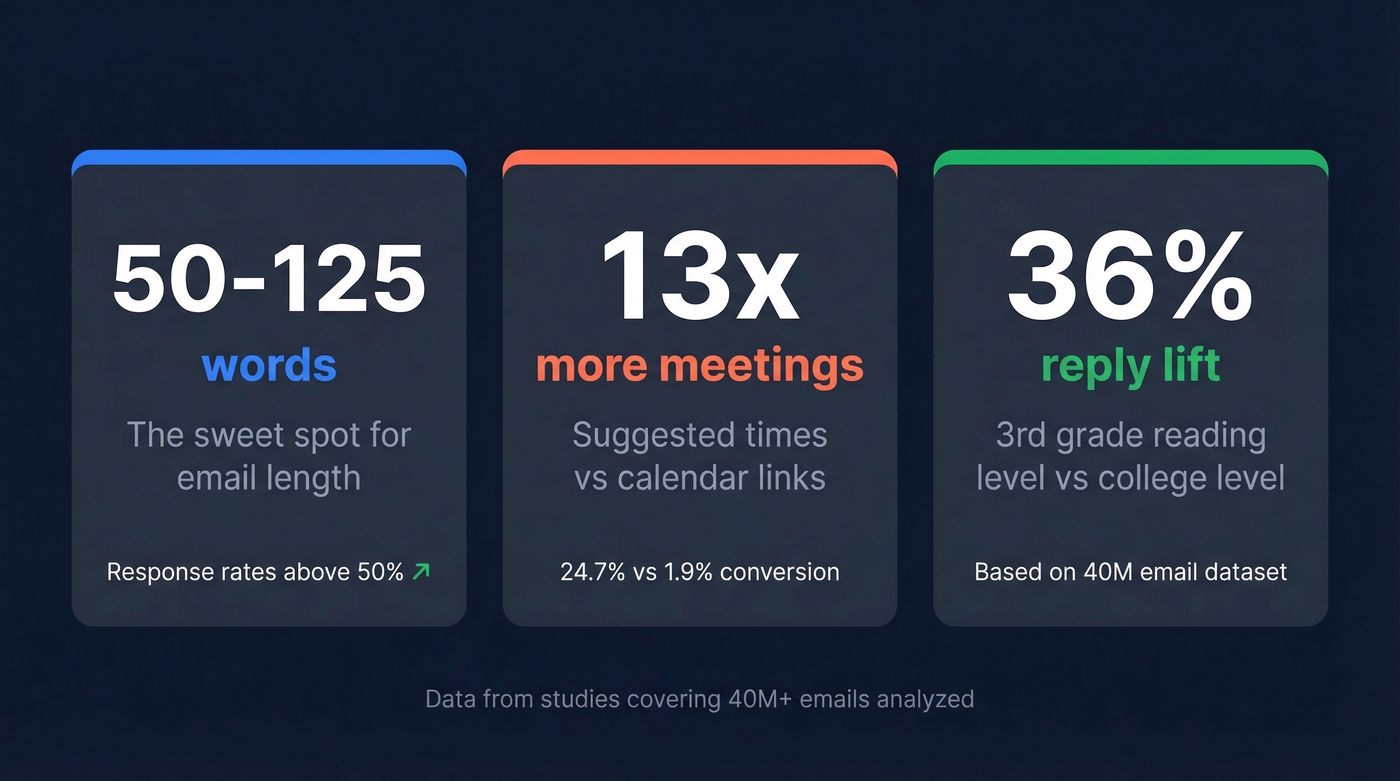
- Keep it under 100 words. The 50-125 word sweet spot produces response rates above 50%. Past 125 words, replies drop fast.
- Suggest two specific times - never a calendar link on first touch. A Chili Piper A/B test found suggested times booked 13x more meetings than a calendar link.
- Write at a 3rd-grade reading level. That's not dumbing it down - it's clarity. A 40M-email dataset showed a 36% response lift over college-level writing.
Why Most Meeting Requests Fail
The average cold email gets ignored not because the offer is bad, but because the email itself creates friction. Too long, too vague, too much about the sender. GMass puts the typical response range at 1-5%, and that's across teams with dedicated outbound operations. If you're writing meeting requests between other tasks, your baseline is probably lower.
Here's the thing: the emails that break through share a few traits. They're short. They're specific. And they make the next step effortless - the recipient shouldn't need to do any work beyond saying "yes" or "how about Thursday instead?" Asking for a meeting in email is less about eloquence and more about removing every possible point of friction.
The 5-Part Framework for Meeting Request Emails
Every high-performing meeting request email we've seen follows the same skeleton. Five parts, each one sentence or less.
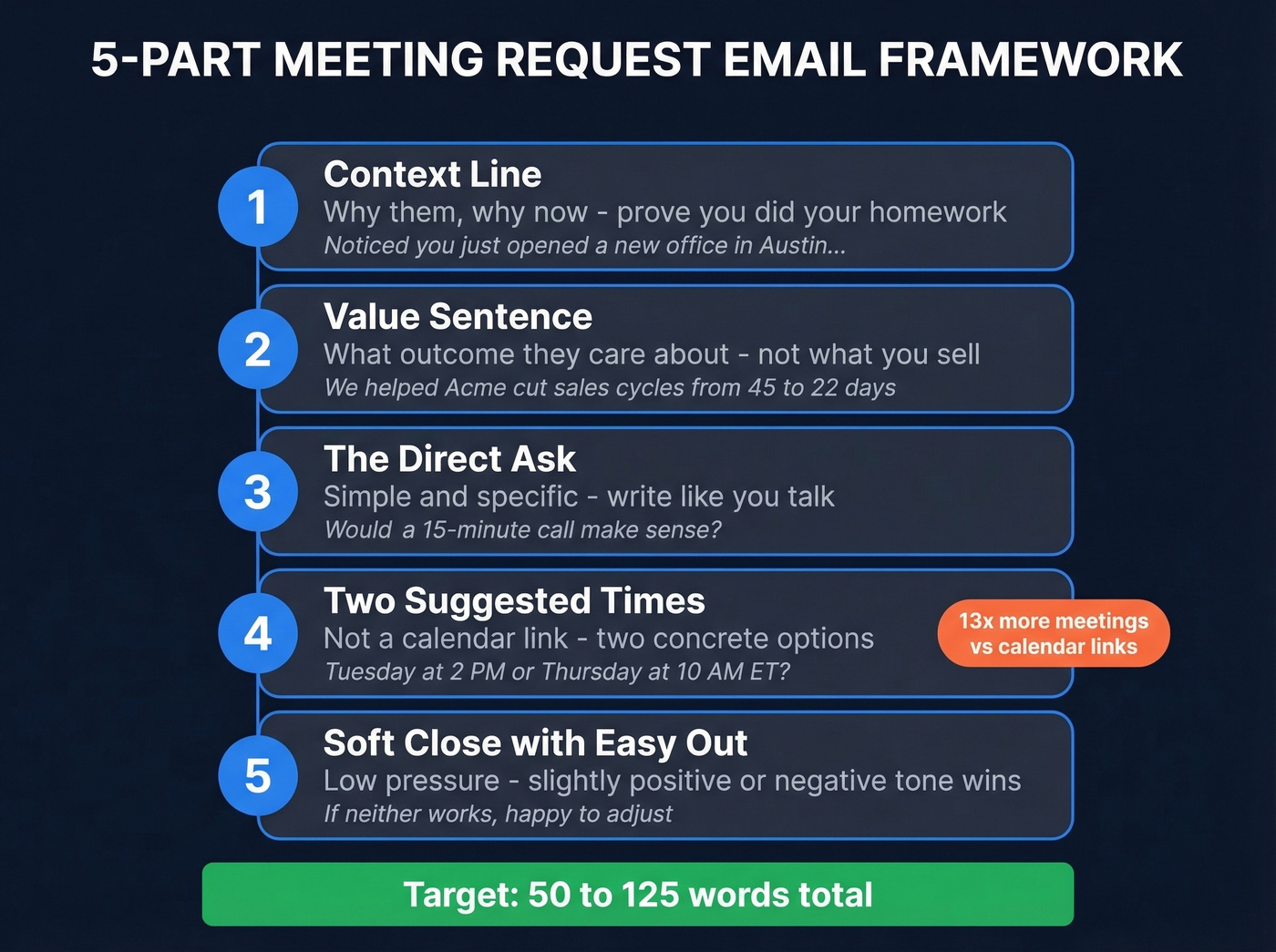
1. One line of context. Why are you emailing this specific person right now? A trigger event, a mutual connection, something you noticed about their company. This isn't a compliment - it's proof you did 30 seconds of homework.
2. One sentence of value. What's in it for them? Not what your product does - what outcome they'd care about. "We helped [similar company] shorten their sales cycle from 45 days to 22" beats "We offer sales acceleration services" every single time.
3. The ask. Direct and specific. "Would a 15-minute call make sense?" works. "I'd love to explore potential synergies" doesn't. That 36% response lift from simple language is real - write like you talk.
4. Two suggested times. Not a Calendly link. Not "let me know when works." Two concrete options: "Tuesday at 2 PM or Thursday at 10 AM ET?" This eliminates decision fatigue and signals you respect their time.
5. A soft close with an easy opt-out. Something like: "If neither works, happy to adjust - or just let me know if this isn't a priority right now." Slightly positive or slightly negative emotional tone outperforms neutral by 10-15%. A low-pressure close hits that sweet spot.
The whole thing should land between 50 and 125 words.
Subject Lines That Get Opened
An analysis of 85M+ cold emails revealed patterns that hold up consistently. Short subject lines - one to four words - produce higher open rates. "Quick question" outperforms "Quick question about your Q3 pipeline strategy and how we might help." All lowercase wins too, except for proper nouns. It reads like a real email from a colleague, not a marketing blast.
If you want more options to test, pull from a swipe file of subject lines and keep them in the 1-4 word range.
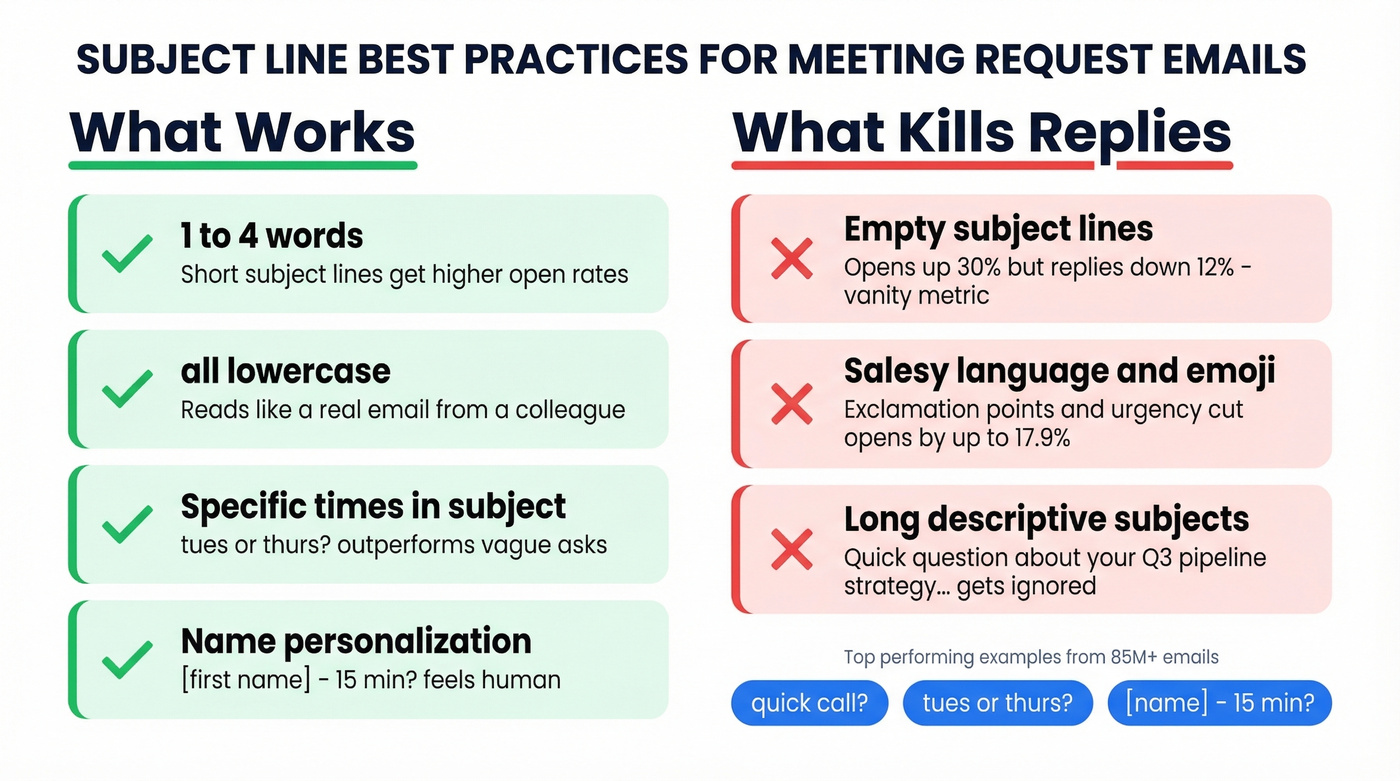
One trap to avoid: empty subject lines boost opens by ~30% but tank reply rates by 12%. Opens without replies are vanity metrics.
Salesy language - exclamation points, "limited time" urgency, emoji - can reduce open rates by up to 17.9%. Good subject lines for meeting requests: "quick call?" / "tues or thurs?" / "[first name] - 15 min?"
The Calendar Link Trap
Chili Piper ran an A/B test - 50 emails with a calendar link, 50 with suggested times. The calendar link converted at 1.9%. Suggested times booked 13x more meetings.
If you're building a full outbound motion, this fits cleanly into a B2B cold email sequence where the link only appears after interest.
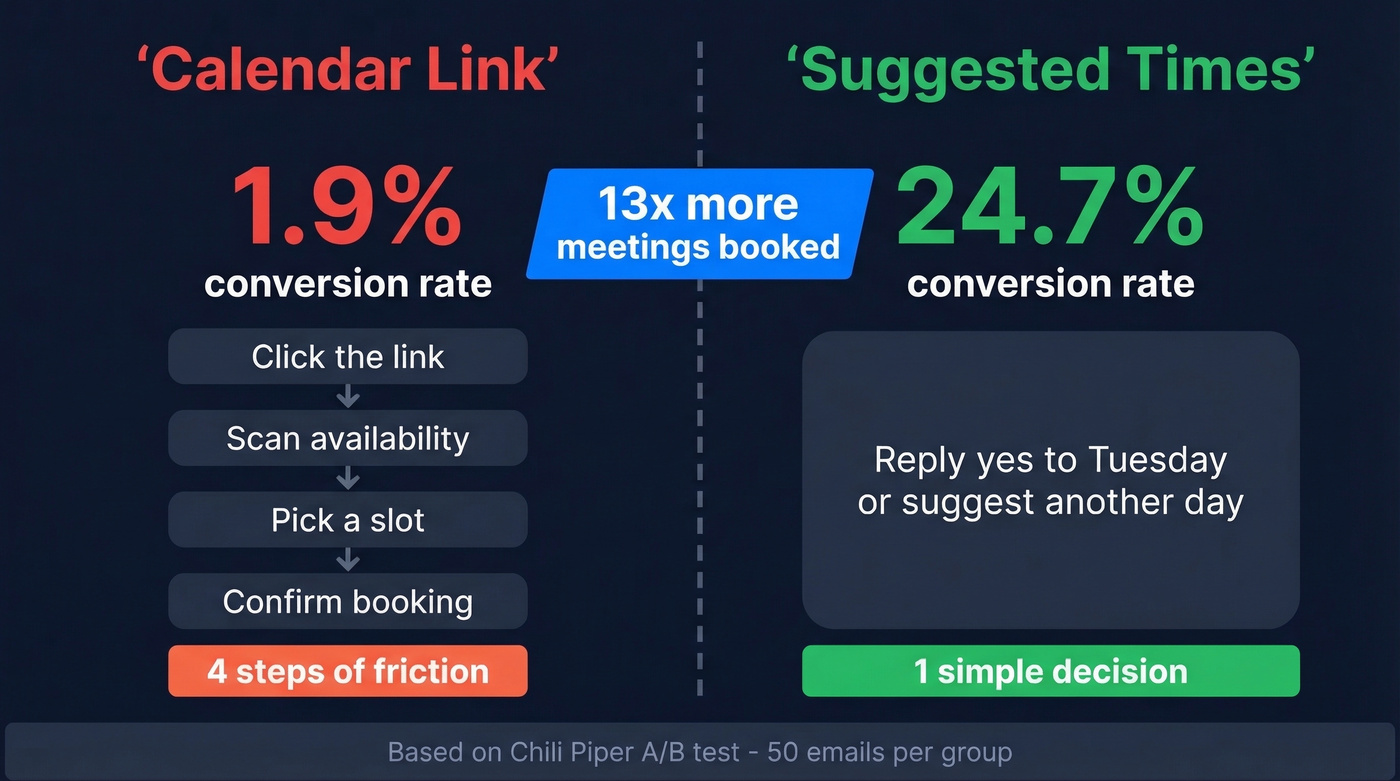
Why? A calendar link asks the recipient to click through, scan your availability, pick a slot, and confirm. That's four steps. Two suggested times require one decision: "yes to Tuesday" or "how about Wednesday instead?" Save the scheduling link for after they've said yes.

You just learned that suggested times book 13x more meetings than calendar links. But none of that matters if your email never arrives. Prospeo's Email Finder delivers 98% verified addresses on a 7-day refresh cycle - so your carefully crafted meeting request actually reaches the inbox.
Stop perfecting emails that bounce. Start with verified data.
When to Hit Send
Timing won't save a bad email, but it gives a good one an edge.
| Day | Reply Rate |
|---|---|
| Thursday | 6.87% |
| Tuesday | Often highest opens |
| Monday | 5.29% |
| Saturday | Worst performer |
Tuesday and Thursday are your safest bets. A Mailshake compilation pulling from HubSpot, Campaign Monitor, and Moosend - covering 100B+ emails combined - consistently points to Tuesday as a top day for opens and clicks.
For a deeper breakdown (including time zones and follow-up timing), see our best time to send cold emails playbook.
For time of day, aim for 8-11 AM in the recipient's time zone. Late afternoon works as a secondary window. There's also an unexpected peak at 8-11 PM with a 6.52% reply rate - likely executives clearing inboxes before bed. If you're targeting C-suite, evening sends are worth testing.
Verify Before You Send
None of the above matters if your email bounces.
Emailing 1-2 contacts per company produces a 7.8% reply rate, while blasting 10+ contacts at the same company drops you to 3.8%. Precision beats volume - but precision requires verified data.
If you're troubleshooting bounces and what they do to your domain, start with email bounce rate benchmarks and fixes.

Prospeo's Email Finder handles this well. Enter a name and company domain, get a verified address back - 98% accuracy on a 7-day refresh cycle, so you're never emailing stale data. One customer, Meritt, saw their bounce rate drop from 35% to under 4% after switching. The free tier gives you 75 verified emails per month to test the workflow.
If you're comparing approaches (finder vs verifier vs enrichment), our guide to data enrichment services can help you pick the right workflow.
One more deliverability tip: disable open-tracking pixels. Emails without tracking produce ~3% higher response rates. Tracking pixels are a known spam trigger, and that lift compounds across hundreds of sends. If you want the technical why, see email tracking pixels and how they impact deliverability.
Email Templates That Book Meetings
Each template follows the 5-part framework and stays under 100 words. Swap the brackets for your details.
Cold Outreach to a Prospect
Subject: quick call?
Hi [First Name],
Noticed [Company] just [trigger event - opened a new office, raised a round, posted 3 SDR roles]. When that happens, [specific problem] usually follows.
We helped [similar company] [specific result] in [timeframe]. Worth a 15-minute call to see if it applies?
How's Tuesday at 2 PM or Thursday at 10 AM ET?
Either way, no pressure - happy to share the case study if you'd rather read first.
Warm Introduction
Subject: [mutual connection] suggested we talk
Hi [First Name],
[Mutual connection] mentioned you're working on [challenge]. We just wrapped a similar project with [company] - cut their [metric] by [result].
Would 15 minutes be useful? I'm open Wednesday at 11 AM or Friday at 3 PM ET.
If the timing's off, just say so - happy to circle back later.
Executive / C-Suite Request
Subject: [company name] + [your company]
[First Name],
[One-line observation about their business - a public metric, a strategic move, a market shift]. That usually creates pressure on [specific function].
We've helped [2-3 peer companies] navigate this. 15 minutes to compare notes?
Thursday at 9 AM or Monday at 4 PM ET work on your end?
If not the right time, understood.
Internal Meeting Request
Subject: sync on [project/topic]?
Hey [First Name],
I've been digging into [topic] and think there's overlap with what your team's building. A quick alignment call could save us both from duplicating work.
Does Tuesday at 1 PM or Wednesday at 3 PM work?
If you'd rather async it, I can send a Loom instead.
Post-Event Follow-Up
Subject: good meeting you at [event]
Hi [First Name],
Great chatting at [event] about [specific topic]. You mentioned [their challenge] - we actually just published data on that.
Worth 15 minutes to walk through it? I'm free Thursday at 11 AM or Friday at 2 PM ET.
If the timing doesn't work, I'll send the report over regardless.
The Breakup Email
Subject: closing the loop
Hi [First Name],
I've reached out a few times about [topic] - I'll assume the timing isn't right.
If [problem] becomes a priority down the road, I'm easy to find. Deleting you from my follow-up list now.
All the best with [specific initiative].
The Follow-Up Cadence
44% of salespeople give up after one follow-up. That's a mistake. A single follow-up boosts replies by 65.8% based on an analysis of 12M emails. But by the fifth email, reply rates drop 55%. The sweet spot is 4-5 total emails:
If you want plug-and-play copy for each touch, use these sales follow-up templates and adapt them to your offer.
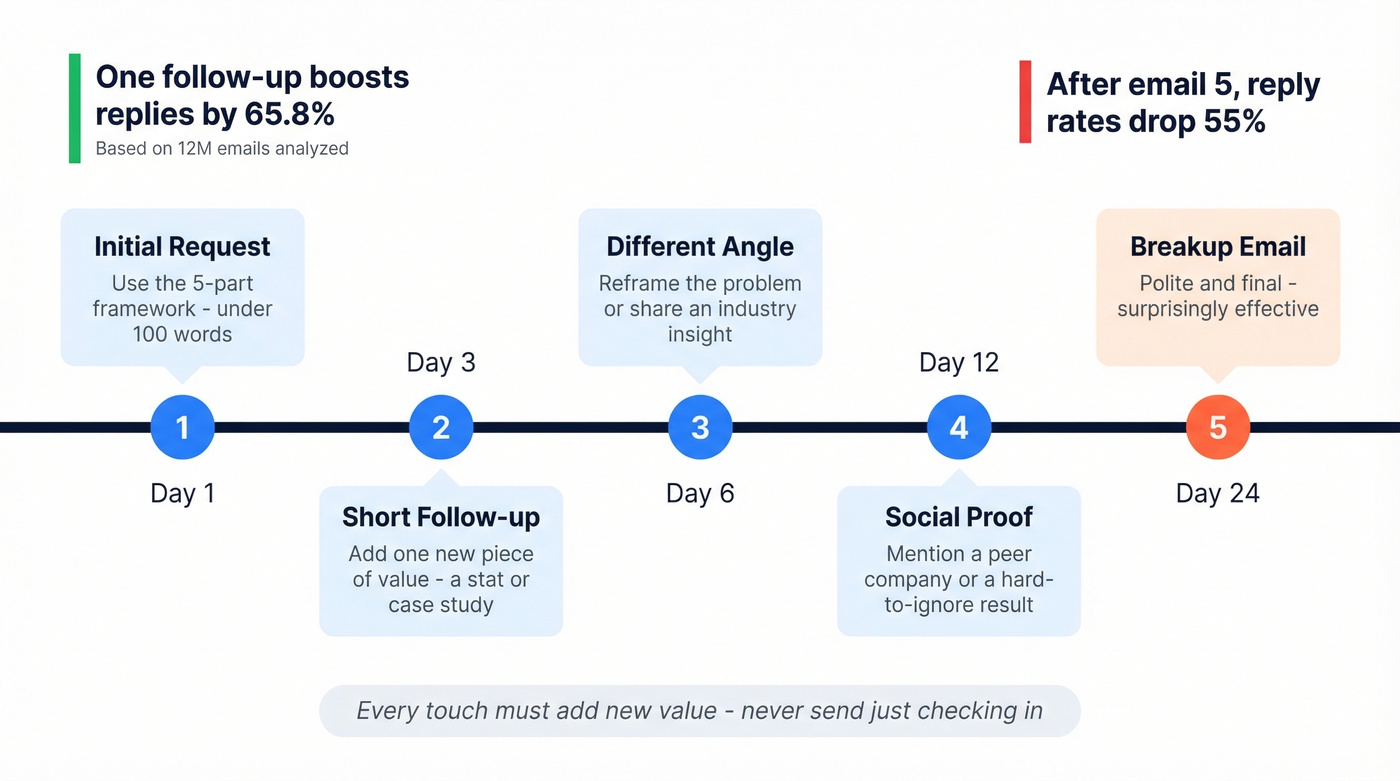
- Day 1: Initial meeting request using the 5-part framework
- Day 3: Short follow-up - add one new piece of value like a relevant stat or case study
- Day 6: Different angle - reframe the problem or share an industry insight
- Day 12: Social proof - mention a peer company or a result that's hard to ignore
- Day 24: Breakup email - polite, final, and surprisingly effective
Let's be honest about follow-ups: if your email is over 150 words, delete it and start over. No exceptions. And "just checking in" is the worst follow-up line in sales - ask anyone on r/sales and they'll tell you the same thing. Every touch should give the recipient a reason to care that they didn't have before. A new data point, a relevant article, a competitor insight. If you can't add value, don't send the email.
Meeting Request Scorecard
Before you hit send, grade your email against this checklist:
- Under 100 words?
- Subject line 1-4 words, lowercase?
- Opens with context - why them, why now?
- One clear sentence of value for the recipient?
- Direct ask - not buried or hedged?
- Two specific times suggested, no calendar link?
- Written at a 3rd-grade reading level?
- Soft close with an easy opt-out?
- Email address verified before sending?
- Open-tracking pixel disabled?
If you can check all ten, you're ahead of most outbound emails. The gap between five checkmarks and ten is often the difference between low single-digit reply rates and high single-digit performance. We use this scorecard on our own outreach - it takes 30 seconds and catches the mistakes that cost you replies.
If you want to go deeper on the mechanics of getting replies (beyond meeting requests), see emails that get responses.
Meritt dropped their bounce rate from 35% to under 4% and tripled their pipeline to $300K/week. When every meeting request lands in a real inbox, the 5-part framework you just learned actually works. Prospeo gives you 75 free verified emails per month to prove it.
Book more meetings by emailing people who actually exist.
FAQ
How long should a meeting request email be?
Between 50 and 125 words. An analysis of 40M+ emails found this range produces response rates above 50%. Once you cross 200 words, replies drop steadily. Count your words before sending - most people write 2x longer than they think.
Should I suggest specific times or use a calendar link?
Suggest specific times. Chili Piper's A/B test showed suggested times booked 13x more meetings than a calendar link. Two concrete options require one simple decision instead of four steps through a scheduling tool.
What's the best day to send a meeting request email?
Thursday pulls the highest reply rate at 6.87%, while Tuesday consistently tops open-rate charts across multiple large-scale studies covering 100B+ emails. Avoid weekends entirely - Saturday is the worst performer by a wide margin.
How do I request a meeting without a warm introduction?
Lead with a trigger event or specific observation about the recipient's company - it replaces the trust a mutual connection would provide. Follow the 5-part framework, stay under 100 words, and suggest two concrete times. Cold emails that open with relevant context outperform generic intros by a wide margin.
How do I make sure my meeting request actually reaches the inbox?
Verify every email address before sending. Skip this step and you're gambling with your domain reputation - one customer we work with was bouncing 35% of their emails before they started verifying, and that kind of bounce rate can land your entire domain on blocklists. Disabling open-tracking pixels also helps, since they're a known spam trigger that reduces response rates by roughly 3%.