

How to Ask for a Meeting with a Client (Templates + Data)
Your biggest client hasn't responded to your last two emails. The QBR is in three weeks, and you're staring at a blank compose window wondering if "just checking in" will finally be the subject line that works. It won't. Figuring out how to ask for a meeting with a client shouldn't feel this painful - you already have the relationship. The problem is mechanics: wrong length, wrong timing, or wrong contact.
The Quick Checklist
Before you scroll to the templates:
- State the purpose in the first sentence - no warm-up fluff.
- Propose 2-3 specific times with day, time, and timezone.
- Include the meeting mode - Zoom, phone, or in-person.
- Keep it under 125 words. Emails in the 50-125 word range hit response rates above 50%.
- One clear CTA. "Pick a time" or "confirm Thursday works" - not both.
If your company uses a scheduling tool like Calendly, a booking link can replace the time options. But proposing specific times signals more effort and makes it easier for the client to say yes.
That's it. Everything below is the evidence and the templates.
What 16.5 Million Emails Reveal About Reply Rates
Belkins analyzed 16.5 million cold emails across 93 business domains covering all of 2024. The average cold email reply rate came in at 5.8%, down from 6.8% the year before. Client emails perform significantly higher since you're not a stranger, but the mechanics that drive replies are identical.
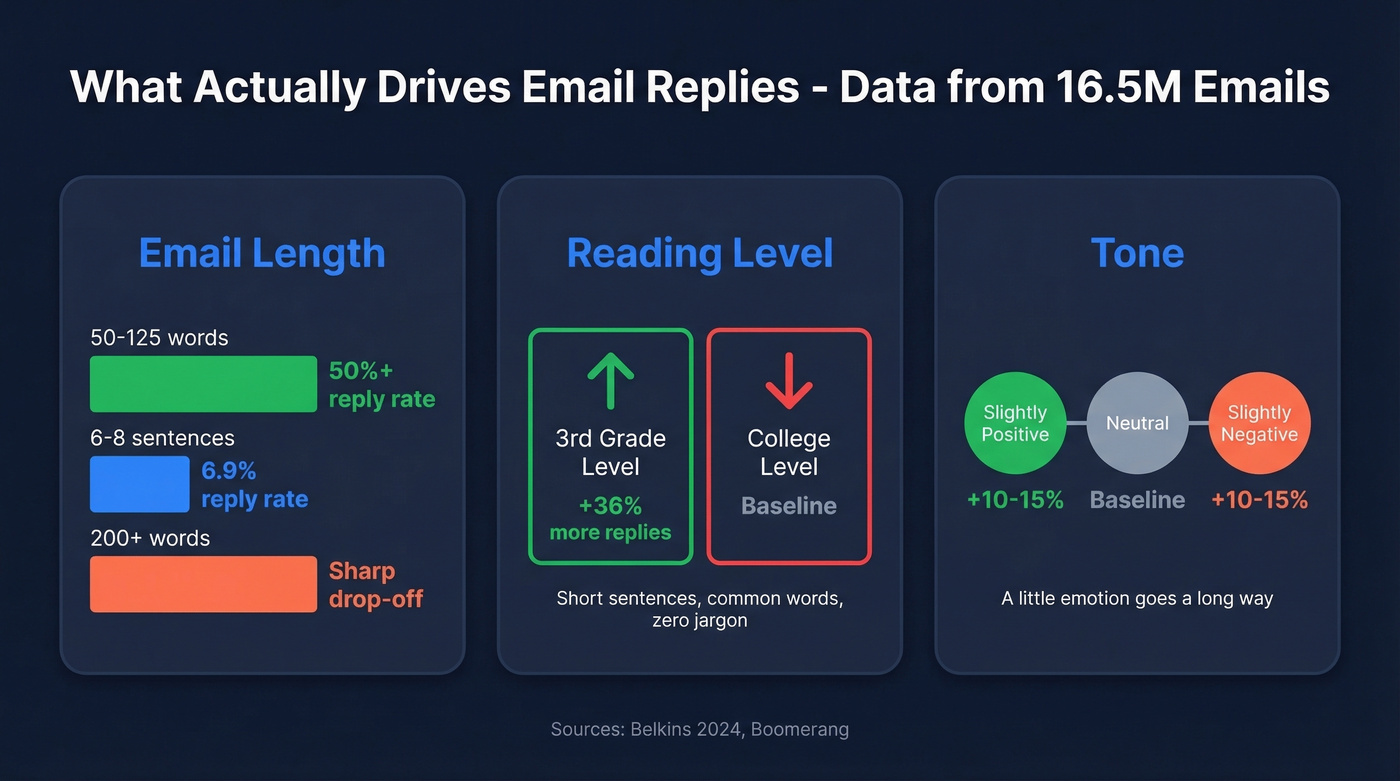
The biggest lever is length. Emails between 6-8 sentences and under 200 words hit a 6.9% reply rate. Boomerang's research narrows it further: 50-125 words is the sweet spot, with response rates above 50%.
Reading level matters more than most people expect. Emails written at a 3rd-grade reading level produced a 36% lift over college-level writing. That doesn't mean dumbing it down - it means short sentences, common words, and zero jargon. One more thing: tone. Slightly positive or slightly negative emails get 10-15% more responses than completely neutral ones. "Excited to share Q2 results" beats "Sending Q2 results." A little emotion goes a long way.

Subject Lines That Get Opened
Quick caveat: Apple Mail Privacy Protection auto-loads tracking pixels for a large share of recipients, which means open rates are inflated and unreliable. Optimize your subject lines for replies, not opens.
The heuristic that works: 6-9 words, concrete, and time-bound. Here are examples grouped by scenario:
QBR / Business Review
- "Q3 review - 30 min this Thursday?"
- "[Company] QBR: three times that work"
Kickoff / Onboarding
- "Kickoff call - picking a time"
- "Getting started: quick sync this week?"
Renewal / Contract
- "Renewal conversation before [date]"
- "[Company] contract - 15 min to align"
Check-In
- "Quick check-in - how's [project]?"
- "Catching up: 15 min this week?"
Escalation (No Response)
- "Still want to connect - new times"
- "Trying once more: [topic] sync"
New AM Introduction
- "Your new point of contact at [company]"
- "Taking over [client name]'s account"
Notice the pattern: most effective subject lines name a specific time frame or duration. Vague subjects like "Let's connect" or "Touching base" get buried. If you want more options, pull from these subject lines and adapt them to your client context.
6 Client Meeting Request Templates
Every template below follows the same structure: reason, clear ask, 2-3 time options, meeting mode, expected duration. All stay under 125 words.
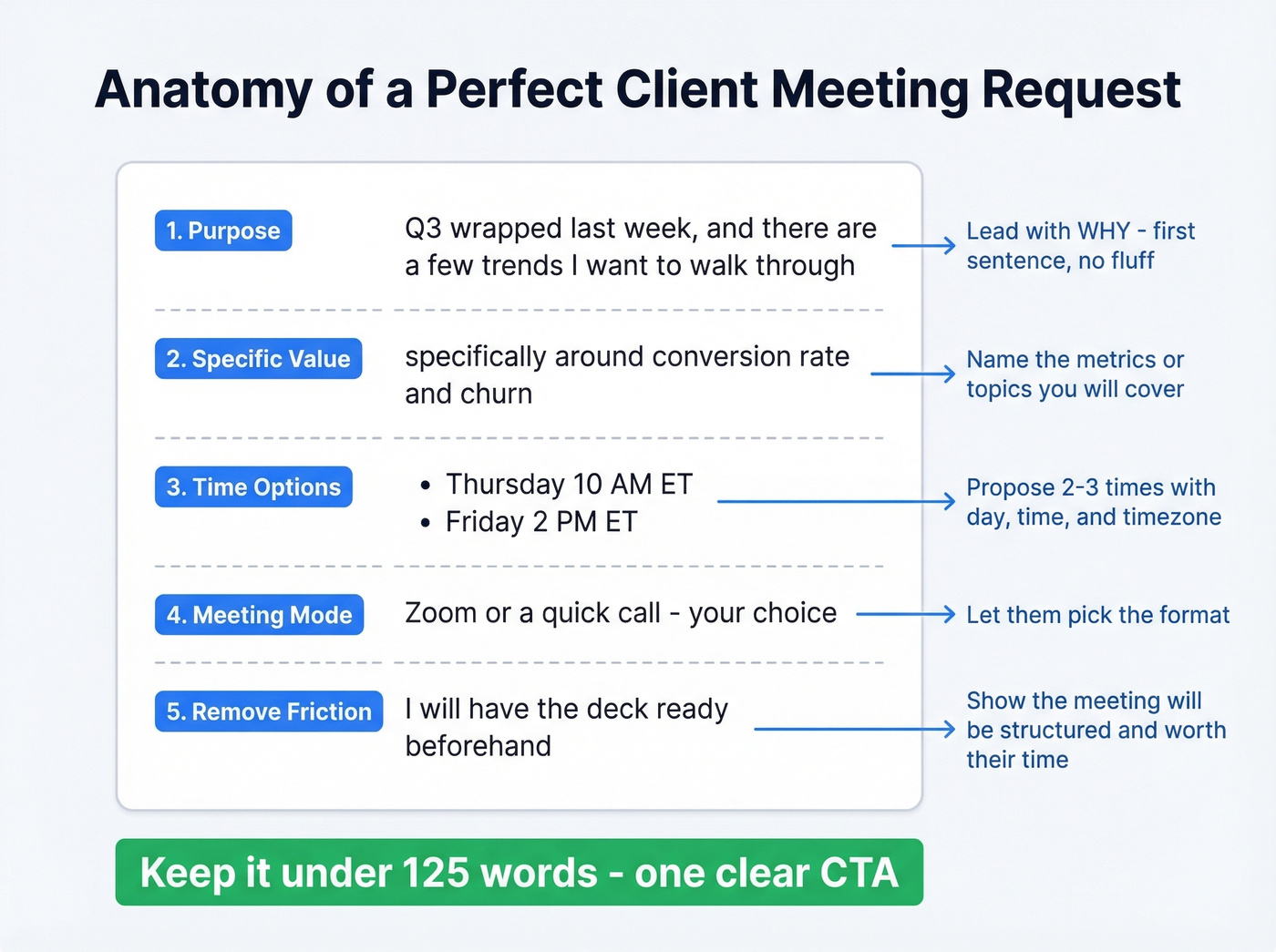
Quarterly Business Review
Hi [Name],
Q3 wrapped last week, and there are a few trends in your account I'd like to walk through - specifically around [metric] and [metric].
Could we grab 30 minutes this week? I'm open:
- Thursday 10 AM ET
- Friday 2 PM ET
Happy to do Zoom or a quick call - whichever's easier. I'll have the deck ready beforehand.
Best, [Your name]
Why this works: It leads with a specific reason, names the metrics you'll cover, and gives the client a reason to show up beyond obligation. The "deck ready beforehand" line removes friction - they know the meeting will be structured. If you're building a more formal review, use these QBR questions to shape the agenda.
New Account Kickoff
Hi [Name],
Excited to get things moving. I'd like to schedule a kickoff call to align on goals, timeline, and who's involved on both sides.
Would any of these work for a 45-minute Zoom?
- Tuesday 11 AM ET
- Wednesday 3 PM ET
- Thursday 10 AM ET
I'll send an agenda ahead of time.
Looking forward to it, [Your name]
Renewal or Contract Discussion
Hi [Name],
Your renewal is coming up on [date], and I want to make sure we have time to talk through what's working, what isn't, and any adjustments for next year.
Can we block 30 minutes before [date]? A couple options:
- [Day] at [time]
- [Day] at [time]
Zoom or phone - your call.
Thanks, [Your name]
If you're tracking retention, tie the conversation to your renewal goals and the levers you can actually move.
New Account Manager Introduction
This one's trickier than it looks. You're asking someone who didn't choose you to invest time in you. The key is to name-drop the previous AM and show you've done your homework.
Hi [Name],
I'm [Your name], taking over as your account manager from [Previous AM]. [Previous AM] spoke highly of the work you're doing with [project/product].
I'd love to introduce myself and hear what's top of mind for your team. Would 20 minutes work this week?
- [Day] at [time]
- [Day] at [time]
Happy to jump on Zoom or a call.
Best, [Your name]
Escalation (Unresponsive Client)
Hi [Name],
I've sent a couple of notes about [topic] and know things get buried. Totally understand.
I want to make sure [specific issue or deliverable] doesn't stall. Could we do a quick 15-minute call this week? I'm flexible on timing - just reply with what works and I'll send the invite.
If email isn't the best way to reach you, let me know and I'll try another channel.
Thanks, [Your name]
Common mistake: Don't apologize for following up. "Sorry to bother you again" signals low status and makes the client less likely to respond, not more. You have a legitimate business reason to connect - own it. The goal is requesting a meeting without being pushy, not requesting one without conviction. If you need more variations, borrow a few lines from these follow-up templates.
Casual Check-In
Hi [Name],
It's been a few weeks since we last connected. Wanted to check in on [project/feature/initiative] and see if anything's come up on your end.
No formal agenda - just a 15-minute catch-up. Would [Day] at [time] work? Zoom or phone, either way.
Talk soon, [Your name]

The perfect meeting request still bounces if you're emailing a dead address. Prospeo's 98% verified emails and 7-day refresh cycle mean your carefully crafted ask actually lands in your client's inbox - not a bounce-back folder.
Stop crafting the perfect email for the wrong address.
Requesting a Meeting via Chat or SMS
The same principles apply when you're reaching out via Slack, Teams, or SMS. If anything, brevity matters even more - messages over two or three sentences feel like walls of text in a chat window. Lead with the reason, propose one or two times, and make it easy to reply with a single word. Skip the greeting line entirely; in a messaging context, "Hi [Name]" followed by a paragraph reads stiff. Just get to the point. If you're doing this as part of a broader sales communication motion, keep the same structure across channels.
Best Days and Times to Send
Thursday is the best day to send a meeting request. Thursday emails hit a 6.87% reply rate versus Monday's 5.29% - that's a 30% difference. Pipedrive's analysis also points to Tuesday, Wednesday, and Thursday as the strongest days. For a deeper breakdown, see the data on the best time to send outreach.
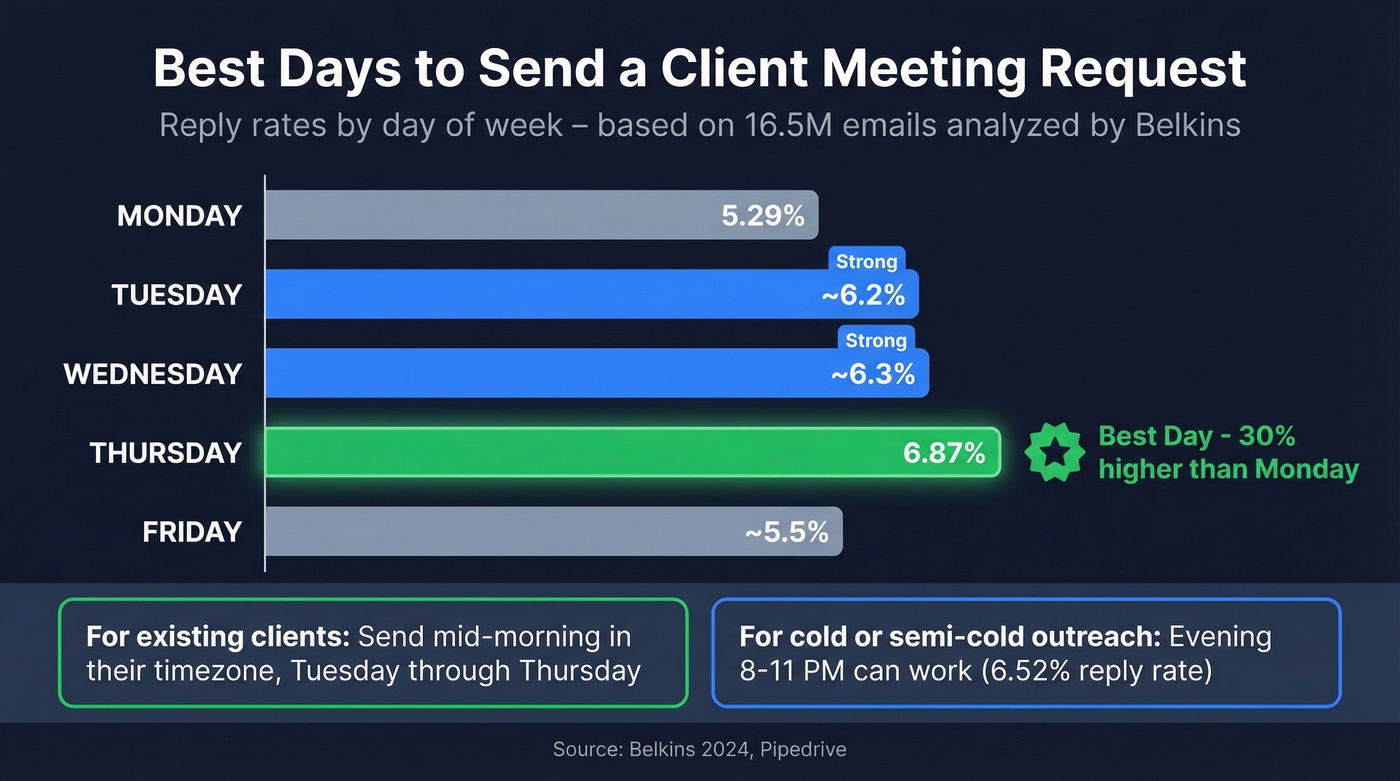
For existing clients, send during their business hours - mid-morning in their timezone is the safe bet. The evening peak (8-11 PM at 6.52% reply rate) works better for cold or semi-cold outreach where you're trying to catch someone outside the inbox avalanche. For a client who knows you, mid-morning Tuesday through Thursday is the move.
The Follow-Up Cadence That Works
Here's the thing: most reps either follow up too aggressively or not at all. We've seen account managers burn client relationships by sending five follow-ups in two weeks, and we've seen others send one email and give up after 48 hours. For client meeting requests, keep it to the initial email plus two follow-ups.
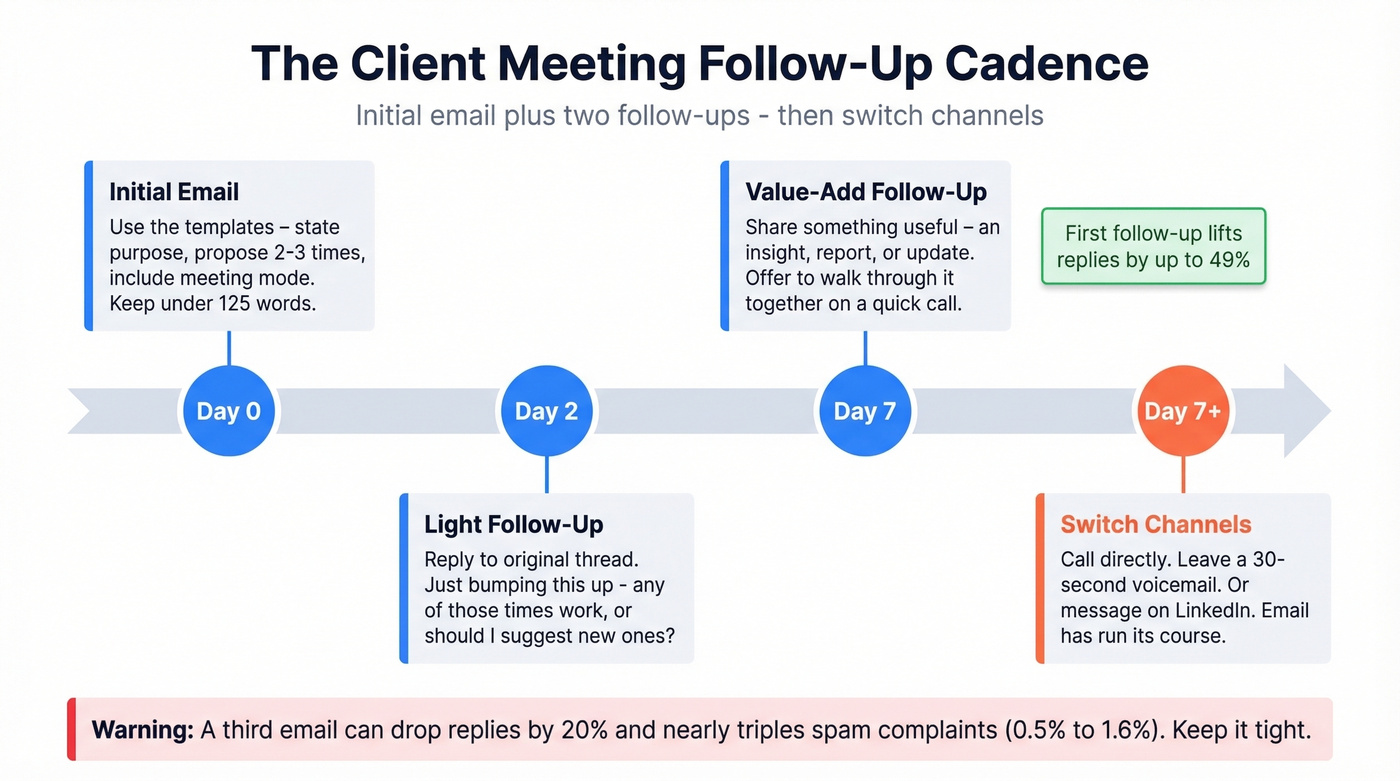
Day 0: Initial email using the templates above.
Day 2: Light follow-up. Reply to your original thread: "Hi [Name] - just bumping this up. Any of those times work, or should I suggest new ones?"
Day 7: Value-add follow-up. Add something useful: "Wanted to share [insight/report/update] - would love to walk through it together. Open to a quick call this week?"
After Day 7: Switch channels. Call them directly. Leave a 30-second voicemail referencing your email. Or send a short message on a professional platform. Email has run its course.
A first follow-up can lift replies by up to 49%. But adding a third email can drop replies by up to 20%, and spam complaints nearly triple - from 0.5% on email one to 1.6% by email four. Keep it tight.
Before follow-up #3, verify the email is still active. A tool like Prospeo catches bounces before they hurt your sender reputation - 98% email accuracy means you'll know immediately if an address has gone stale. If bounces are a recurring issue, fix the root cause with this email deliverability checklist.
When Your Client Contact Has Changed
Look, most account managers miss this entirely: you don't need a better template - you need to make sure you're emailing the right person.
The #1 silent killer of client meeting requests isn't bad copy. It's a dead inbox. Your point of contact left the company four months ago, changed roles, or their email is sitting in a dormant account nobody checks. Your CRM still says the VP of Marketing is Sarah, but Sarah's been at a different company since March. We ran into this exact scenario with a client last year - three perfectly crafted follow-ups, zero replies, and the contact had been gone for six weeks.
If your meeting request bounced or got zero response after three attempts, the problem is almost never your writing. It's your data. Before you rewrite that template for the third time, check whether the person on the other end still exists at that company. Prospeo's Chrome extension pulls verified contact data from any company website in one click - find the new stakeholder, get a verified email, and send your meeting request to someone who'll actually read it. If you're doing this at scale, consider adding a lightweight data enrichment step to keep contacts current.
Unresponsive client? The email you have on file might be outdated. Prospeo enriches your CRM contacts with 50+ data points - including verified direct dials and current emails - so your escalation message reaches a real human, not a defunct inbox.
Get direct dials and fresh emails for every client in your book.
FAQ
How long should a meeting request email be?
Keep it between 50 and 125 words. Boomerang's research shows this range produces response rates above 50%. A 16.5 million-email study confirms that 6-8 sentences and under 200 words hit the highest reply rates for any outreach.
How many follow-ups should I send?
Two follow-ups maximum - three emails total. Adding a third email can drop reply rates by up to 20%, and spam complaints nearly triple by email four. After your second follow-up, switch to phone or another channel entirely.
What's the best day to send a meeting request?
Thursday wins at a 6.87% reply rate versus Monday's 5.29%. For existing clients, send midweek during their business hours - mid-morning in their timezone consistently lands best across multiple studies.
What if my meeting request email bounces?
Your contact likely changed roles or left the company. Use an email finder tool to get the current stakeholder's verified address before resending. With 98% accuracy and a 7-day data refresh cycle, you'll confirm you're reaching the right person.
How do I request a meeting without being pushy?
Lead with value - explain what the client will get out of the conversation, not just what you need. Propose specific times but make it clear they can suggest alternatives. Keep follow-ups to two, and always give them an easy out like "If now isn't the right time, happy to revisit next month." Confidence and courtesy aren't opposites; the best requests are direct and respectful at the same time.