

How to Ask for Referrals (Without Making It Weird)
Your best client just told you they love working with you. You said thanks, talked about the weather, and hung up. That was a referral you left on the table.
83% of satisfied customers are willing to refer, but only 29% actually do - because nobody asks. In B2B, 84% of sales begin with a referral. The gap between "willing" and "doing" is entirely on you, and learning how to ask for referrals consistently is the single highest-leverage skill most reps never develop.
The Short Version
Three rules cover 80% of referral best practices:
- Say "Who do you know that...?" - never "Do you know anyone?" The first prompts recall. The second invites a no.
- Make the intro happen. A name without an introduction is just a cold lead with extra steps.
- Verify the contact info before you reach out. A bounced email kills referral momentum dead.
That's the framework. Everything below is the how.
Why Referrals Outperform Every Other Channel
Referrals aren't a "nice to have." They're the highest-ROI channel most teams underinvest in. Referred customers carry a 25% higher lifetime value than customers acquired through other channels, referral programs deliver 4x higher ROI than digital advertising, and companies running them see a 24% reduction in customer acquisition costs.
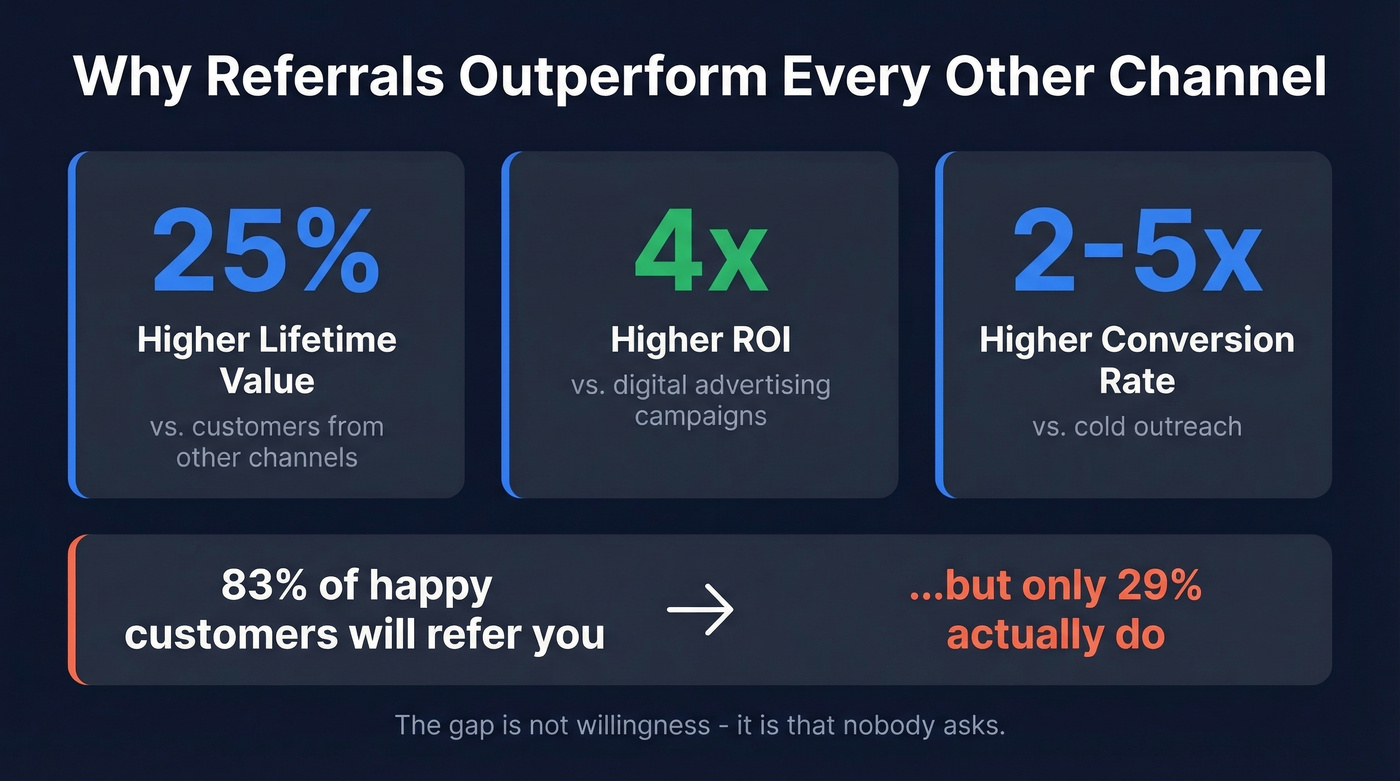
The conversion gap is massive too. Referrals typically convert 2-5x higher than cold outreach. When someone you trust says "talk to this person," you talk to them. No amount of ad spend replicates that trust transfer.
The Psychology Behind the Ask
Most referral advice boils down to "just ask!" That's not helpful. The how matters more than the whether.
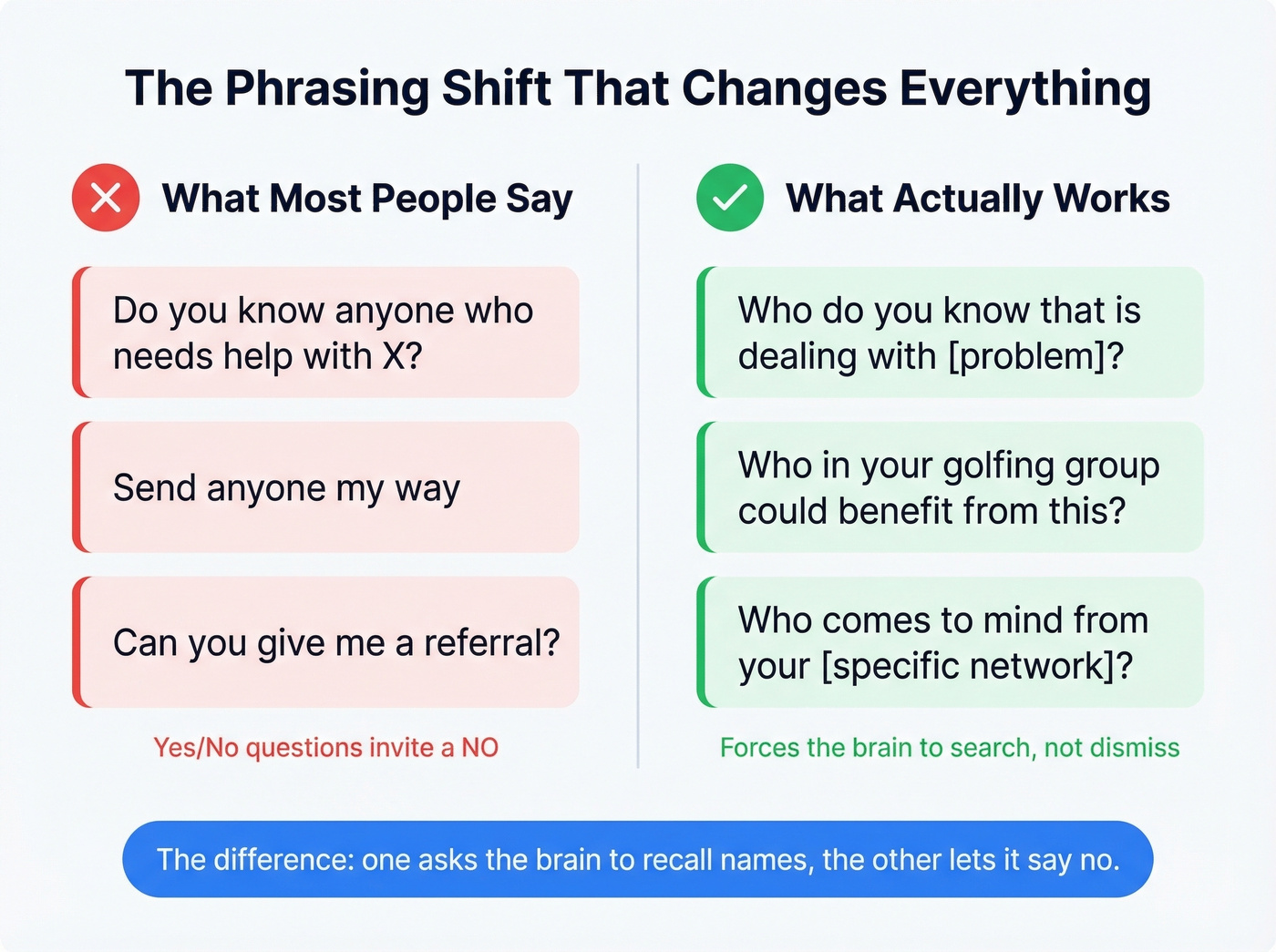
The phrasing shift that changes everything. "Do you know anyone who needs help with X?" is a yes/no question. Humans default to no. "Not right now, but if I think of anyone I'll let you know" - you've heard that a hundred times. The consensus on r/Entrepreneur matches what sales psychology has taught for years: switch to "Who do you know that...?" It forces the brain to search rather than dismiss.
Trust transfer is the real mechanism. A referral works because the referrer's credibility transfers to you. When your client says "you should talk to my rep," they're lending their reputation. That's why getting permission from both parties matters - it preserves trust on both sides. Skip this step and you're just name-dropping, which erodes the very thing that makes referrals powerful. This connects to what Kitces calls the pro-social loop: when you frame the referral as helping someone the referrer cares about - not as helping you - the referrer becomes a connector (high status) rather than a lead source (low status). That single distinction separates a referral that feels generous from one that feels transactional.
The Inner Circle Strategy. Sandler's approach gets specific about where to point the referrer's brain. Instead of asking them to think of "anyone," tie the ask to a real group they belong to. "I'm wondering if any of your golfing buddies could benefit from what we do. Who comes to mind?" This narrows the search space and makes the referrer feel like they're helping a friend, not doing you a favor.
Step-by-Step Referral Process
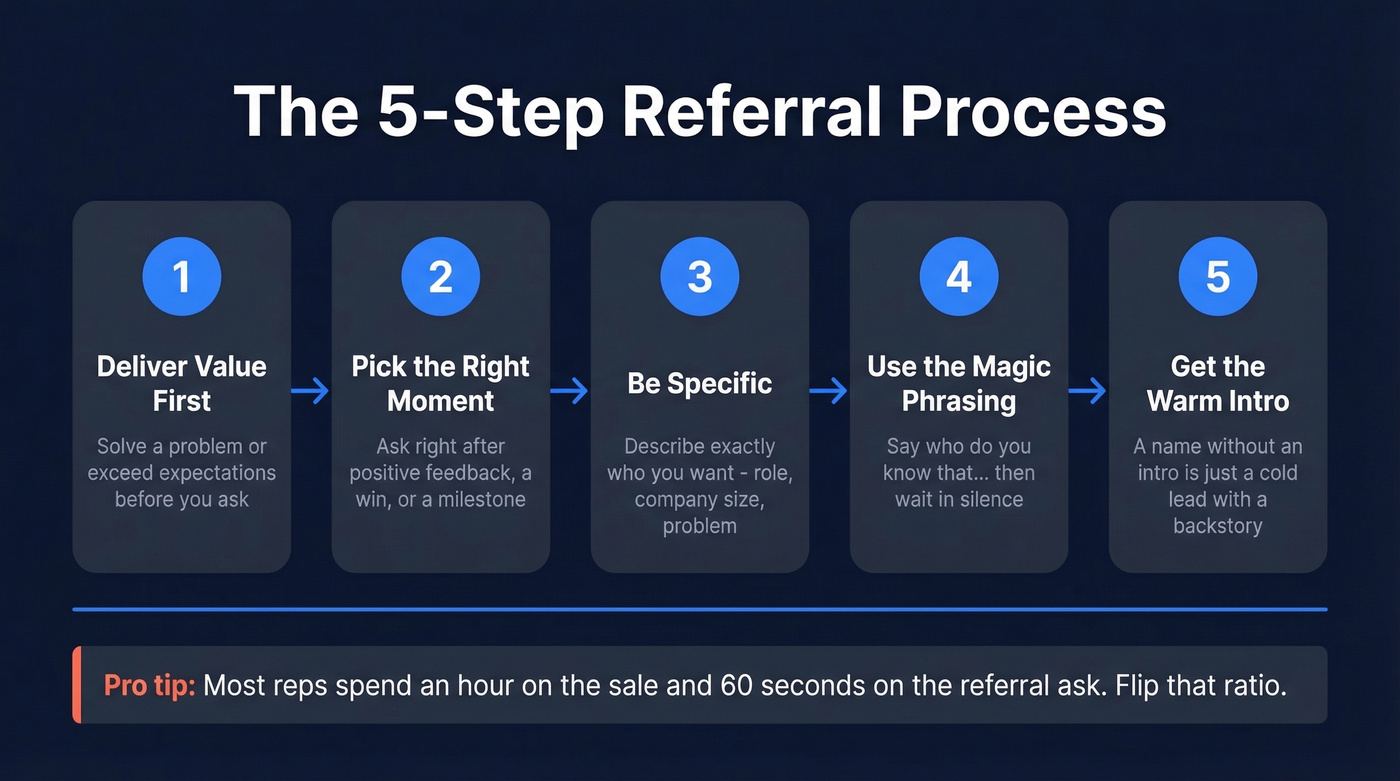
Step 1: Deliver Value First
This sounds obvious, but it's the step people skip. You can't withdraw from a relationship bank you haven't deposited into. Deliver a result, solve a problem, or exceed an expectation. Then you've earned the right to ask. (If you need a framework, start with how to add value in sales.)
Step 2: Pick the Right Moment
The best time to ask is right after a success moment - positive feedback, a completed project, a resolved support ticket, an NPS promoter response. Most reps spend hours on a sale and then invest 60-180 seconds on the referral ask. That ratio is backwards.
Step 3: Be Specific About Who You Want
"Send anyone my way" is lazy and forgettable. Describe the person you're looking for: "We work best with VP-level ops leaders at mid-market SaaS companies going through a growth phase." The more specific you are, the easier it is for your client to think of someone real. If you don't have yours nailed down, use an ideal customer profile template.
Step 4: Use the "Who Do You Know" Phrasing
Not "Do you know anyone?" Not "If you think of someone." Say: "Who do you know that's dealing with [specific problem]?" Then wait. Silence is your friend here - let them think.
Step 5: Make the Introduction Happen
A name without an intro is just a cold lead with a backstory. The gold standard: your client calls the referral during the meeting and hands you the phone. That's not always realistic, but push for at least a warm email introduction - ask your client to loop you both in with a quick note. Don't just take the name and run. (If you want a clean follow-up, use an email after introduction template.)

A referral without verified contact info is just a name on a napkin. Prospeo gives you 98% accurate emails and verified mobile numbers for any referral - so you reach out before the warm intro goes cold.
Turn every referral into a real conversation, not a bounced email.
7 Referral Scripts You Can Copy
Here are seven scripts organized by channel. Copy them, tweak the brackets, and send.
| # | Channel | Context | When to Use |
|---|---|---|---|
| 1 | Post-project thank-you | After delivering results | |
| 2 | Milestone celebration | Company/client milestone | |
| 3 | B2B routing request | Unknown decision-maker | |
| 4 | Phone | Inner Circle script | During a live conversation |
| 5 | Phone | Post-feedback live ask | After positive feedback |
| 6 | DM | Industry-specific ask | Warm professional contact |
| 7 | DM | Follow-up nudge | After initial ask goes cold |
Email Templates
1. Post-Project Thank-You + Ask
Subject: Thanks - and a quick question
Hi [Name],
Really glad we could [specific result - e.g., "cut your onboarding time by 40%"]. It's been great working together.
Quick question: who do you know that's dealing with [specific problem you solve]? I'd love an intro if someone comes to mind - happy to make it easy on your end.
Thanks again, [Your name]
2. Milestone Celebration + Ask
Subject: Congrats on [milestone] - quick favor
Hi [Name],
Saw [company] just hit [milestone]. That's huge - congrats to the whole team.
Since things are going well: who in your network is facing [problem]? I'd love to help someone the way we've worked together. A quick intro email is all it takes.
[Your name]
3. B2B "Who Handles [Topic]?" Routing Template
Subject: Who handles [topic] at [Company]?
Hi [Name],
I'm reaching out because [one-sentence reason tied to their company]. Are you the right person to talk to about [topic], or could you point me to whoever handles it?
Appreciate the help either way.
[Your name]
Subject lines matter - 35% of recipients decide to open based on the subject line alone. Keep yours specific and curiosity-driven. "Quick question" outperforms "Referral request" every time. (For more options, swipe these email subject line examples.)
Phone / In-Person Scripts
4. Sandler Inner Circle Script
"You mentioned you're in [industry group / hobby group / alumni network]. I'm wondering - who in that circle is dealing with [specific problem]? Anyone come to mind?"
Then ask why they thought of that person. Ask permission to use your client's name. Ideally, have them make the call right there.
5. Post-Positive-Feedback Live Ask
When a client says something like "You guys have been great" - don't just say thanks. Say:
"That means a lot. We're trying to work with more companies like yours. Who do you know that's dealing with [problem]? If you're comfortable making a quick intro, I'll take it from there."
DM Templates
6. Industry-Specific Referral Request
Hi [Name], I've been working with a few [industry] companies on [specific outcome]. Who in your network is in a similar space and might benefit from a conversation? Happy to keep it low-key - just an intro.
7. Follow-Up After Initial Ask Goes Unanswered
Hi [Name], circling back on my earlier message - totally understand if the timing wasn't right. If anyone in [industry/role] comes to mind who's dealing with [problem], I'd appreciate the connection. No pressure either way.
The rulebook across all seven: personalize the greeting, be specific about what you're asking for, highlight the mutual benefit, keep it concise, and express genuine gratitude.
Referral Mistakes That Kill the Ask
We've watched teams leave thousands of dollars in pipeline on the table because of these mistakes. In our experience, #5 is the biggest killer.
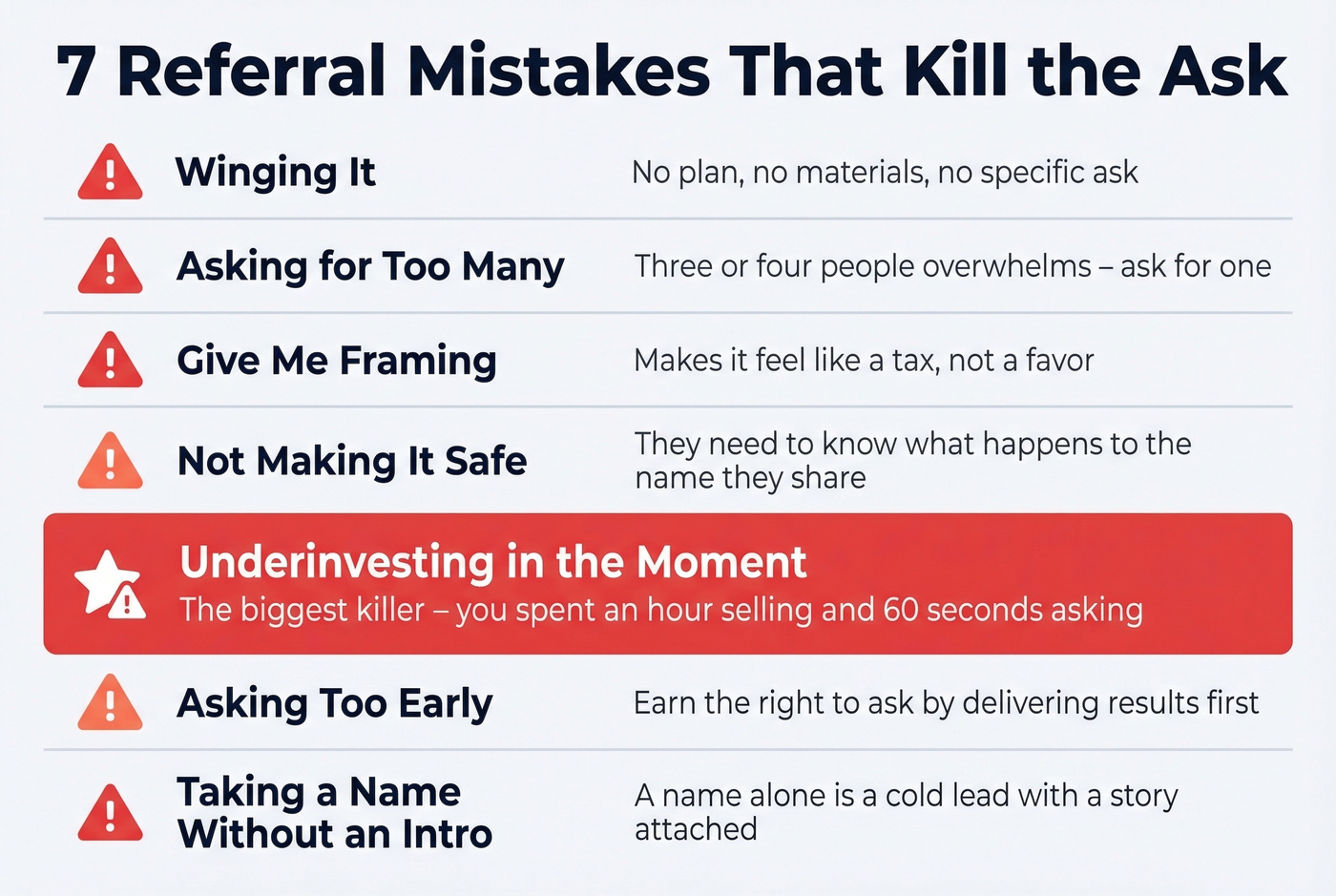
1. Winging it. No plan, no materials, no specific ask. You wouldn't walk into a sales meeting unprepared - don't wing the referral ask either.
2. Asking for too many at once. "Can you think of three or four people?" overwhelms the referrer. Ask for one. You can always come back.
3. "Give me" framing. "Can you give me a referral?" makes it feel like a tax. Reframe it as helping someone they care about.
4. Not making it feel safe. If the referrer doesn't know what'll happen to the name they give you, they won't give it. Explain your process: "I'll send a friendly email mentioning you. No hard sell."
5. Underinvesting in the moment. You spent an hour on the sale and 60 seconds on the referral ask. That ratio is backwards.
6. Asking too early. Requesting a referral before you've delivered value is like asking someone to co-sign a loan on the first date. Earn it first.
7. Taking a name without getting an intro. On Reddit, sales reps and job seekers alike report the same frustration: the connection accepts, you ask for the referral, and the conversation just dies. A name alone is a cold lead with a story attached. Push for the warm introduction - that's where the trust transfer lives.
From Referral Name to First Meeting
Here's the thing nobody covers. You got a name. Now what?
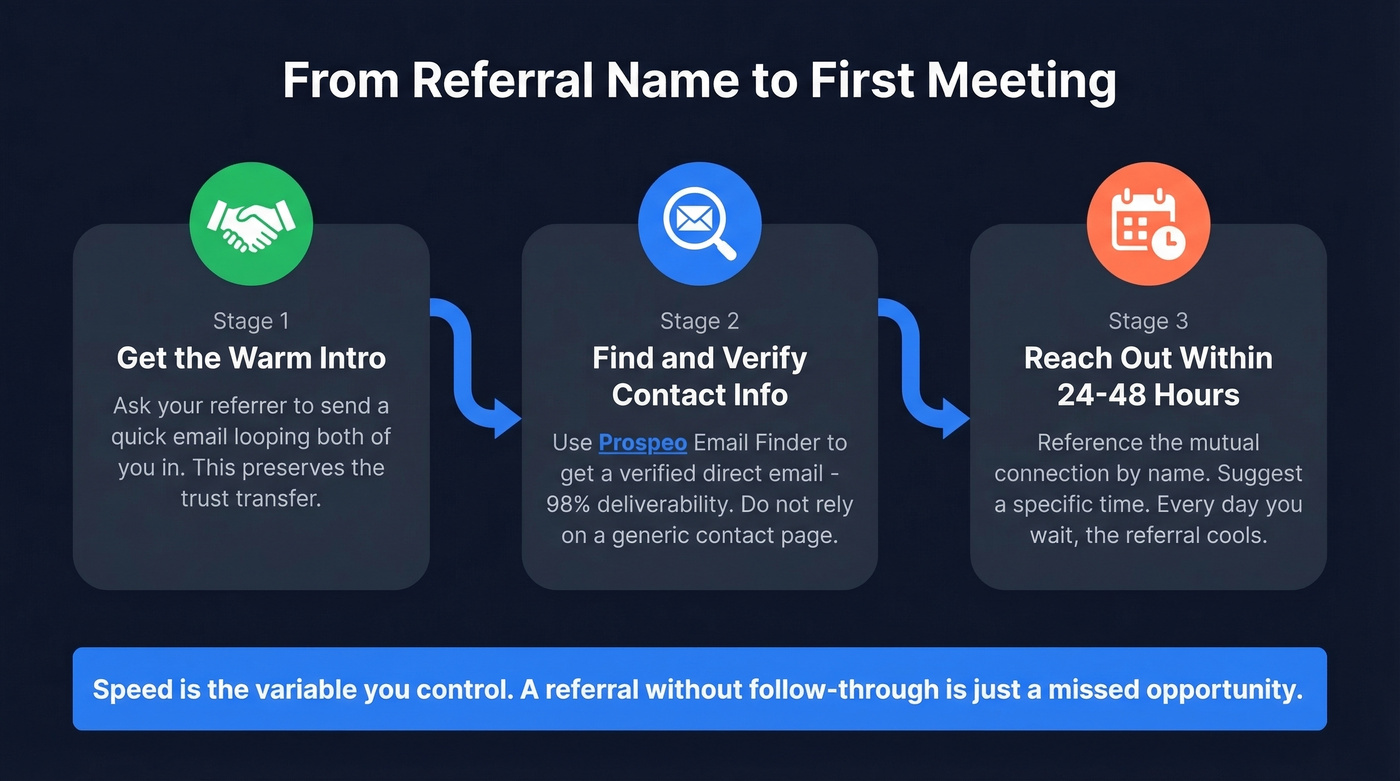
We've seen this scenario play out dozens of times: someone gets a referral, Googles the person, finds a generic info@ email on the company website, sends a cold-sounding message, and hears nothing. The warm intro went cold because the follow-through was sloppy.
Get the referrer to make the intro. Ask them to send a quick email looping both of you in. This preserves the trust transfer and gives you permission to follow up.
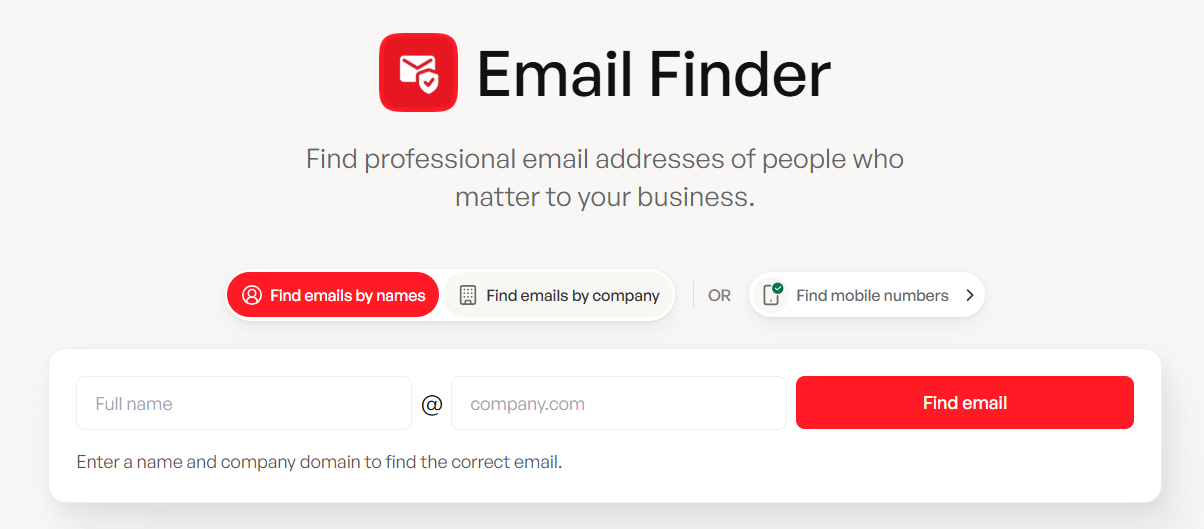
Find and verify the contact's direct email. Don't rely on a company's "Contact Us" page. Prospeo's Email Finder pulls from 300M+ professional profiles and runs a 5-step verification process - 98% of the emails it returns are deliverable. The free tier gives you 75 emails plus 100 Chrome extension credits per month, more than enough to act on every referral you receive. If you want a broader workflow, start with name to email.
Send warm outreach within 24-48 hours. Reference the mutual connection by name, keep it short, and suggest a specific next step. "Sarah mentioned you're scaling your outbound team - I'd love to share what's worked for companies in your space. Would Thursday at 2pm work for a quick call?" Every day you wait, the referral cools. Speed is the variable you control. If you need a nudge sequence, use these sales follow-up templates.
You just got a name and a company. Now what? Prospeo's Chrome extension lets you pull verified emails, direct dials, and 40+ data points for any referred contact in one click - no more Googling or guessing.
Stop letting referral momentum die in your inbox.
Building a Consistent Referral Habit
Here's a hot take: you don't need a referral program. You need a referral habit.
If your average deal size is under $50k, a fancy referral portal with tiered incentives is overkill. Just ask. Every time. No exceptions. Start by making the ask part of every successful engagement and build the muscle before you build the infrastructure. Most teams skip straight to designing incentive tiers and referral portals when they haven't even asked their last ten happy clients for a single name.
Once referrals start flowing consistently, then systematize. Two-sided incentives work best - roughly 65% of referrers prefer programs where both sides benefit. Podium offers $500 to both parties. Speechify gives $60 in savings to each side. The referred friend needs a reason to engage, not just the referrer. Recognize power referrers with escalating perks, and make the sharing process take 30 seconds or less. If it requires more than a quick message or a link click, you'll lose people.
The companies that generate the most introductions aren't the ones with the fanciest programs. They're the ones where every rep asks, every time.
FAQ
When's the best time to ask for a referral?
Right after a success moment - positive feedback, project completion, or a resolved support ticket. 83% of satisfied customers are willing to refer, but only 29% do. The bottleneck isn't timing. It's never asking at all.
How do you ask without sounding desperate?
Be specific and frame it as a compliment. "You clearly know your industry - who do you know that's dealing with [problem]?" makes the referrer feel valued, not used. The key: make the other person feel like a connector, not a lead source.
What if the referrer gives you a name but no contact info?
Use a verification tool like Prospeo to find their direct email - it returns 98% deliverable addresses from 300M+ profiles. A name without contact info stalls the referral; verify the data and reach out within 48 hours.
Should you offer an incentive for referrals?
For B2B sales under six figures, genuine gratitude and reciprocity outperform cash incentives. For consumer or high-volume programs, two-sided incentives where both parties benefit outperform one-sided rewards by a wide margin - roughly 65% of referrers prefer this structure. Skip this if your deal sizes are small and your relationships are strong; a sincere thank-you and a Starbucks gift card go further than you'd think.