

How to Build a Martech Stack That Doesn't Waste Half Your Budget
The average marketing team uses 49% of its martech stack's capabilities. Roughly half the features you're paying for go untouched. Martech eats nearly 22% of total marketing budgets, yet only 15% of organizations can demonstrate positive ROI from that spend.
If you're figuring out how to build a martech stack, the problem isn't the tools. It's how stacks get assembled - and the complexity tax that accumulates every time someone adds "just one more tool."
Here's the thing: the martech landscape has ballooned from roughly 3,500 solutions in 2016 to more than 11,000 products today, and the market itself hit $131B in 2023 with projections north of $215B by 2027. McKinsey found that 65% of B2C organizations self-identify as merely "developing" or "operational" in their martech maturity. Most teams aren't behind because they picked the wrong tools. They're behind because nobody planned the stack as a system.
Core Components of a Marketing Technology Stack
Most teams need 8-15 tools across eight core categories. Everything else is a nice-to-have until you've got clear ownership, clean data, and workflows that actually get used.
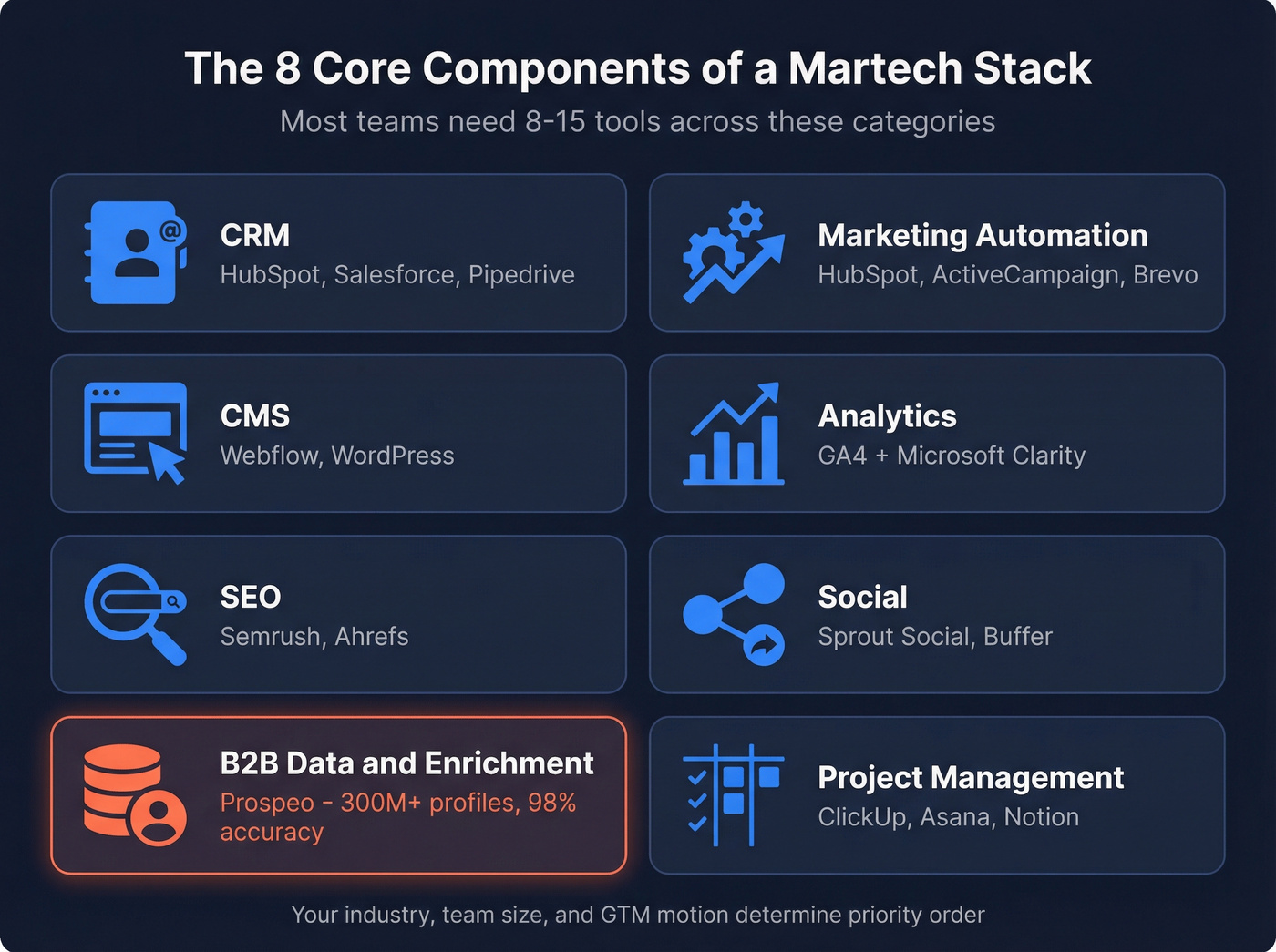
- CRM - HubSpot (free + paid tiers), Salesforce (from ~$25/user/mo), or Pipedrive (from ~$14/user/mo). If you need a quick refresher on what counts as a CRM, see CRM.
- Marketing automation - HubSpot, ActiveCampaign (from ~$15/mo), or Brevo (free + paid tiers)
- CMS - Webflow (from ~$14/mo), WordPress (free), or your CRM's built-in pages
- Analytics - GA4 + Microsoft Clarity, which offers free heatmaps
- SEO - Semrush (from ~$130/mo) or Ahrefs (from ~$99/mo)
- Social - Sprout Social (paid plans), Buffer (from ~$6/mo/channel), or native scheduling
- B2B data and enrichment - Prospeo, with 300M+ professional profiles and 98% email accuracy on a 7-day refresh cycle. If you're comparing vendors, start with data enrichment.
- Project management - ClickUp (free + paid tiers), Asana (free + paid tiers), or Notion (free + paid tiers)
Your industry, team size, and go-to-market motion determine which categories get reinforced first. If you're building outbound alongside the stack, these lead generation trends help prioritize what to instrument.
Real-World Stack Examples
10-Person Agency
A seven-figure agency owner on r/DigitalMarketing shared their full stack after years of iteration. It spans 15+ tools across PM, CRM, SEO, design, and hosting - but the interesting part is what they chose to avoid.
They chain Calendly into Zapier into Mailchimp into HubSpot to dodge HubSpot's pricing cliff. HubSpot Marketing Hub jumps from ~$50/mo on Starter to ~$800/mo on Professional, and this team decided automation wasn't worth a 16x price increase. ClickUp won their PM slot after 80+ hours of research. That level of deliberation is what separates a functional stack from a Frankenstack.
3-Person SaaS Startup
A lean SaaS team runs a completely different setup: HubSpot for CRM and email, Webflow for their site, Instantly for outbound, Intercom for in-app messaging, Figma and Canva for design, Calendly for scheduling, and Slack plus Google Meet for comms. Total tool count stays tight.
For contact data and email verification, a tool like Prospeo feeds verified contacts into Instantly or HubSpot sequences without the overhead of an annual enterprise data contract. If you're building outbound sequences, use a simple sequence management checklist so the stack doesn't sprawl. Company type shapes tool selection far more than "best of" lists do.
Recommended Tools by Company Size
| Category | Startup (1-5 people) | SMB (6-50) | Mid-Market (51-500) |
|---|---|---|---|
| CRM | HubSpot Free | HubSpot Starter | Salesforce (from ~$75/user/mo) |
| Marketing Automation | Brevo Free | ActiveCampaign (from ~$15/mo) | HubSpot Pro (~$800/mo) |
| CMS | Webflow (from ~$14/mo) | WordPress + hosting | Webflow or headless CMS |
| Analytics | GA4 + Clarity (free) | GA4 + Clarity (free) | GA4 + Amplitude (free + paid) |
| SEO | Ahrefs (from ~$99/mo) | Semrush (from ~$130/mo) | Semrush (higher tiers) |
| Social | Buffer (from ~$6/mo/channel) | Sprout Social | Sprout Social (higher tiers) |
| B2B Data | Prospeo | Prospeo | Prospeo or ZoomInfo ($15K+/yr) |
| Project Management | Notion (free) | ClickUp (paid tiers) | Asana Business |
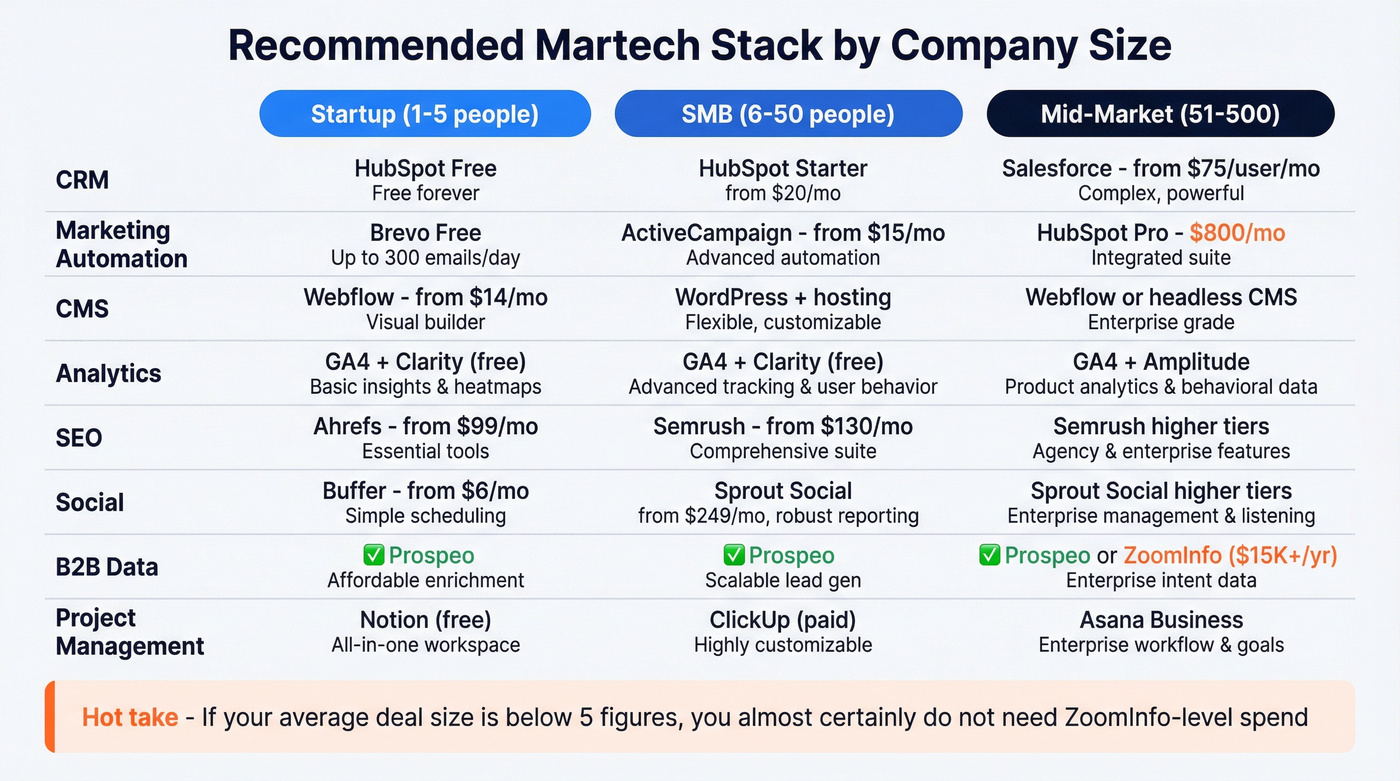
Hot take: If your average deal size sits below five figures, you almost certainly don't need ZoomInfo-level spend. A $15K+ annual contract makes little sense when self-serve tools deliver equal or better accuracy at a fraction of the cost. Save the budget for content and distribution. (If you're pressure-testing data vendors, compare options in B2B company data.)

Half your martech budget is wasted if your data layer feeds bad contacts into every downstream tool. Prospeo gives you 300M+ profiles with 98% email accuracy, refreshed every 7 days - not 6 weeks. Native integrations with HubSpot, Salesforce, Instantly, and Lemlist mean it slots into your stack without Zapier duct tape.
Start at $0.01 per email. No contracts, no sales calls.
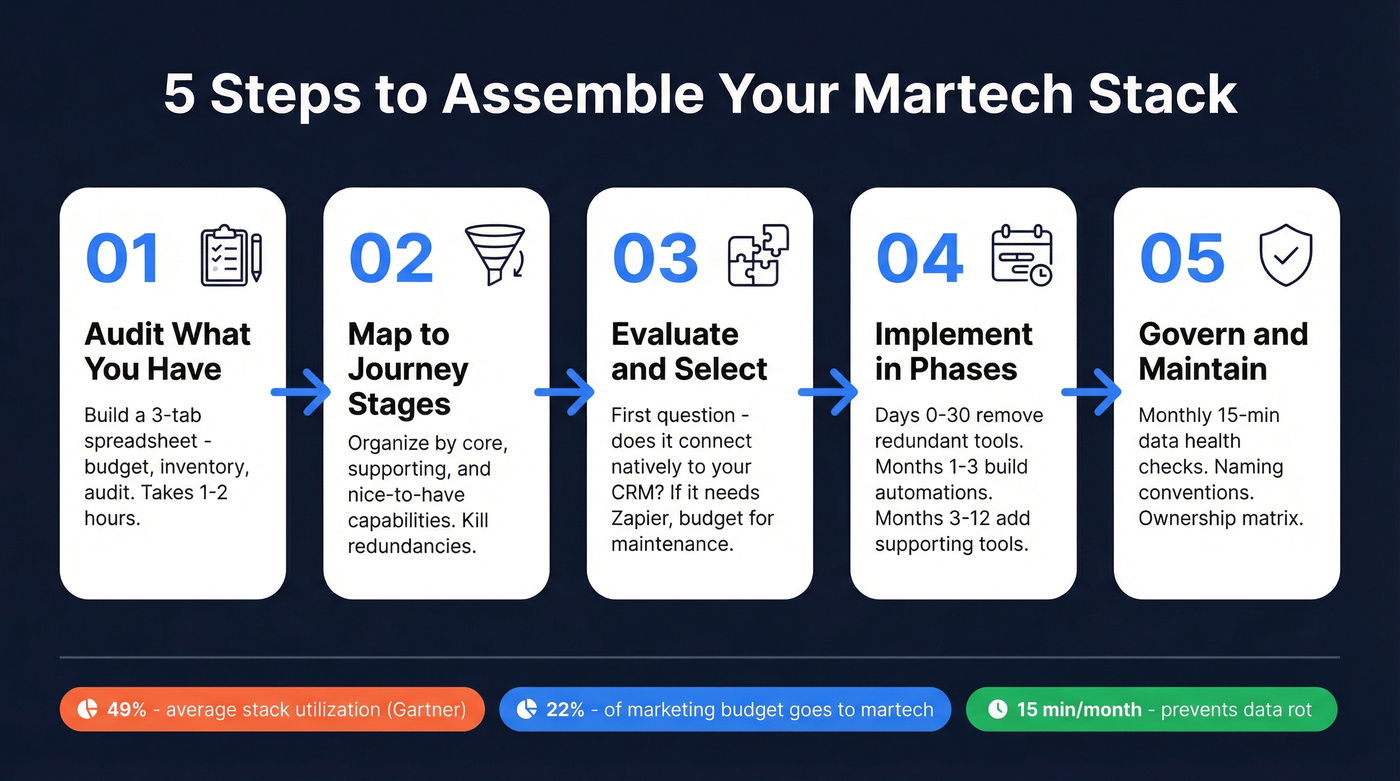
5 Steps to Assemble Your Stack
Step 1: Audit What You Already Have
Start with a three-tab spreadsheet: budget, inventory, and audit. This takes 1-2 hours if you have access to billing records.
Marketers allocate 20-25% of their marketing budget to martech - if you're above that and can't explain why, you've found your first problem. We've run this exercise with our own tools and found two overlapping subscriptions we'd been paying for over a year. Embarrassing, but common.
Step 2: Map Capabilities to Journey Stages
Don't organize tools by vendor name. Organize them by what they do across the customer journey: core capabilities that drive revenue, supporting capabilities that improve efficiency, and nice-to-haves that are useful but not critical. If you need a clean way to define stages and handoffs, borrow a lead generation workflow view and map tools onto it.
This framework, borrowed from House of Martech's audit methodology, exposes redundancies fast. Two tools doing the same job at the same journey stage means one should go.
Step 3: Evaluate and Select Tools
Poor integration kills more marketing technology stacks than bad tool selection.
When evaluating a new tool, the first question isn't "what features does it have?" It's "does it connect natively to my CRM and my sequencer?" If the answer requires Zapier or another iPaaS, budget time for setup and ongoing maintenance. In our experience, the tools that claim "native integration with everything" are the ones that break first.
For any workflow that requires custom logic, evaluate whether an iPaaS like Zapier or Make can handle it before building a custom integration. And watch for pricing cliffs - a tool that costs $50/mo today might cost $800/mo the moment you need its next tier.
Step 4: Implement in Phases
Don't rip and replace everything at once. We've seen teams try that and lose months of pipeline data in the process. The learning curve is steep enough without compounding it by swapping every tool simultaneously.
- 0-30 days: Remove redundant tools, consolidate logins, fix broken integrations
- 1-3 months: Implement automation workflows, connect data flows between core tools, train the team
- 3-12 months: Add supporting tools, build reporting dashboards, establish governance cadence
Step 5: Govern and Maintain
A stack without governance decays fast.
Build a lightweight data responsibility matrix that answers four questions: who enters data, who verifies it, who uses it, and who fixes it when it breaks. Establish campaign naming conventions like Region_CampaignType_Date so reporting doesn't require archaeology. Then run a monthly 15-minute data health check - look for missing fields, duplicates, and tracking inconsistencies. Fifteen minutes a month prevents the kind of data rot that makes your entire stack unreliable. If you're doing any outbound at scale, pair governance with an email deliverability guide so bad data doesn't turn into domain damage.
Stack Architecture Trends for 2026
The old mental model of "systems of record" and "systems of engagement" is breaking down. Scott Brinker's updated framework splits the stack into systems of truth - your CRM, MDM, data warehouse where governance lives - and systems of context, the dynamic, AI-driven experiences that pull from those truth sources. The practical implication: your warehouse matters more than your front-end tools.
The warehouse-first pattern, where your CDP queries the warehouse directly and activates via reverse ETL, cuts cloud costs by roughly 40% and reduces time-to-segment from weeks to hours.
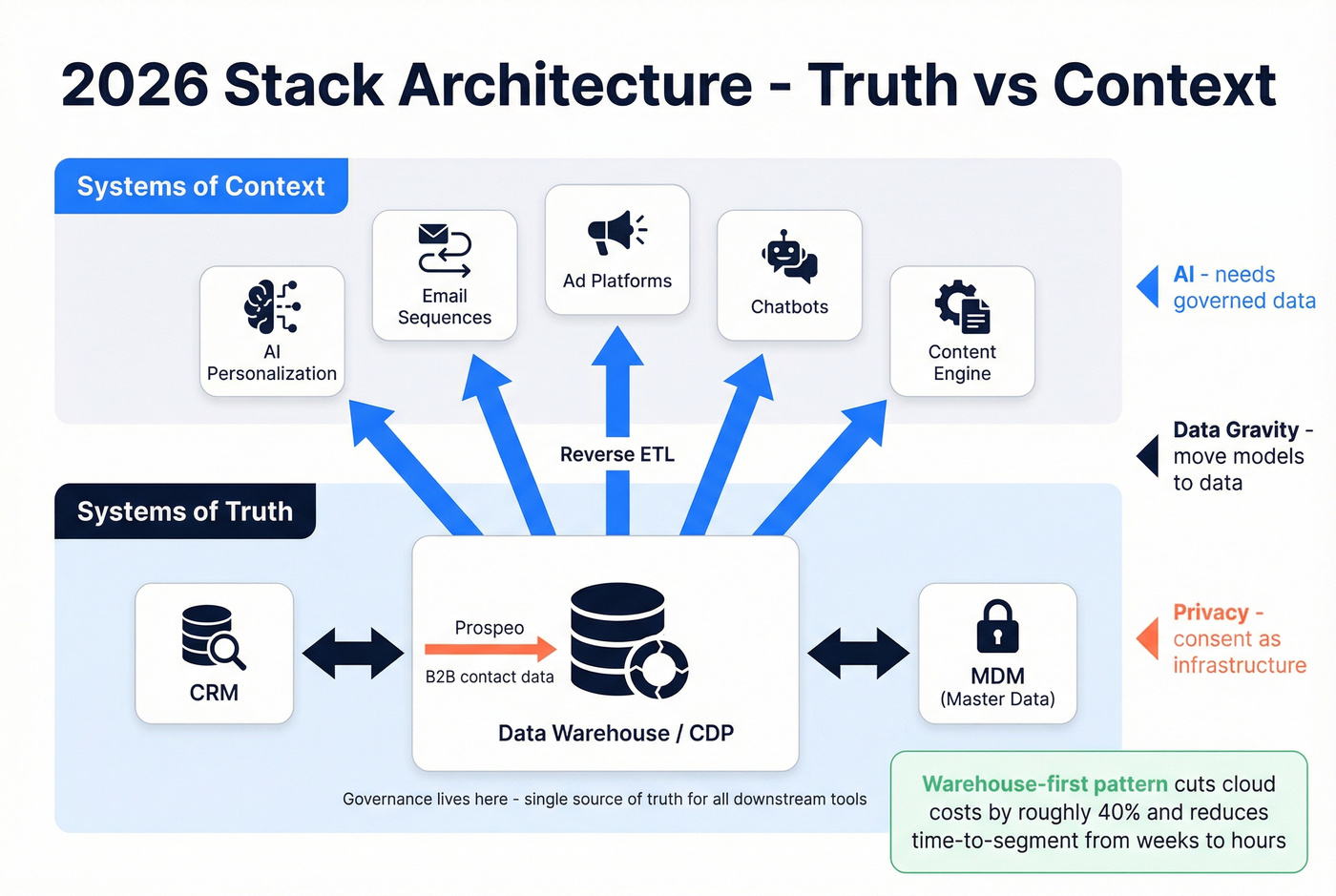
Three forces are reshaping stack architecture right now. AI needs governed data to function well. Data gravity demands you move models to the data rather than the other way around. And privacy regulations - which we'll cover next - are turning consent management into an infrastructure requirement. For teams assembling a B2B marketing technology stack today, invest in the data layer first and treat front-end tools as replaceable. Stack modernization is a human change project: overinvest in enablement and culture, not just procurement. If you're tying marketing and sales systems together, a simple RevOps ownership model prevents tool sprawl.
You don't need a $15K/year data contract to get enterprise-grade B2B data. Prospeo delivers 98% email accuracy and 125M+ verified mobiles on a self-serve, credit-based model - so your stack stays lean and your budget goes to content and distribution, not bloated vendor contracts.
Teams using Prospeo book 35% more meetings than Apollo users.
Privacy as a Stack Decision
Roughly 20 US states now have comprehensive privacy statutes in effect, and enforcement is getting teeth - coordinated AG sweeps in late 2025 targeted sites that claimed to honor Global Privacy Control while still firing retargeting pixels. Privacy isn't a legal checkbox anymore. It's an architecture decision.
Without proper consent management, expect 30-40% analytics data loss as browsers and users block tracking. GA4 Consent Mode v2 helps by modeling conversions from cookieless pings, and server-side GTM scrubs PII before forwarding data to third parties.
For teams processing EU data, remember that GDPR requires opt-in consent - the opposite of the US opt-out default. Tag consent metadata at capture with source, purpose, and expiration so it travels cleanly across your CDP, CRM, and automation tools.
Common Mistakes to Avoid
Ignoring pricing cliffs. HubSpot's jump from $50/mo to $800/mo is the most famous, but almost every platform has a tier where costs spike disproportionately. Map your growth trajectory against pricing tiers before you commit. If you're building outbound, this is also where sales prospecting techniques can keep you focused on what actually moves pipeline (instead of buying more tools).
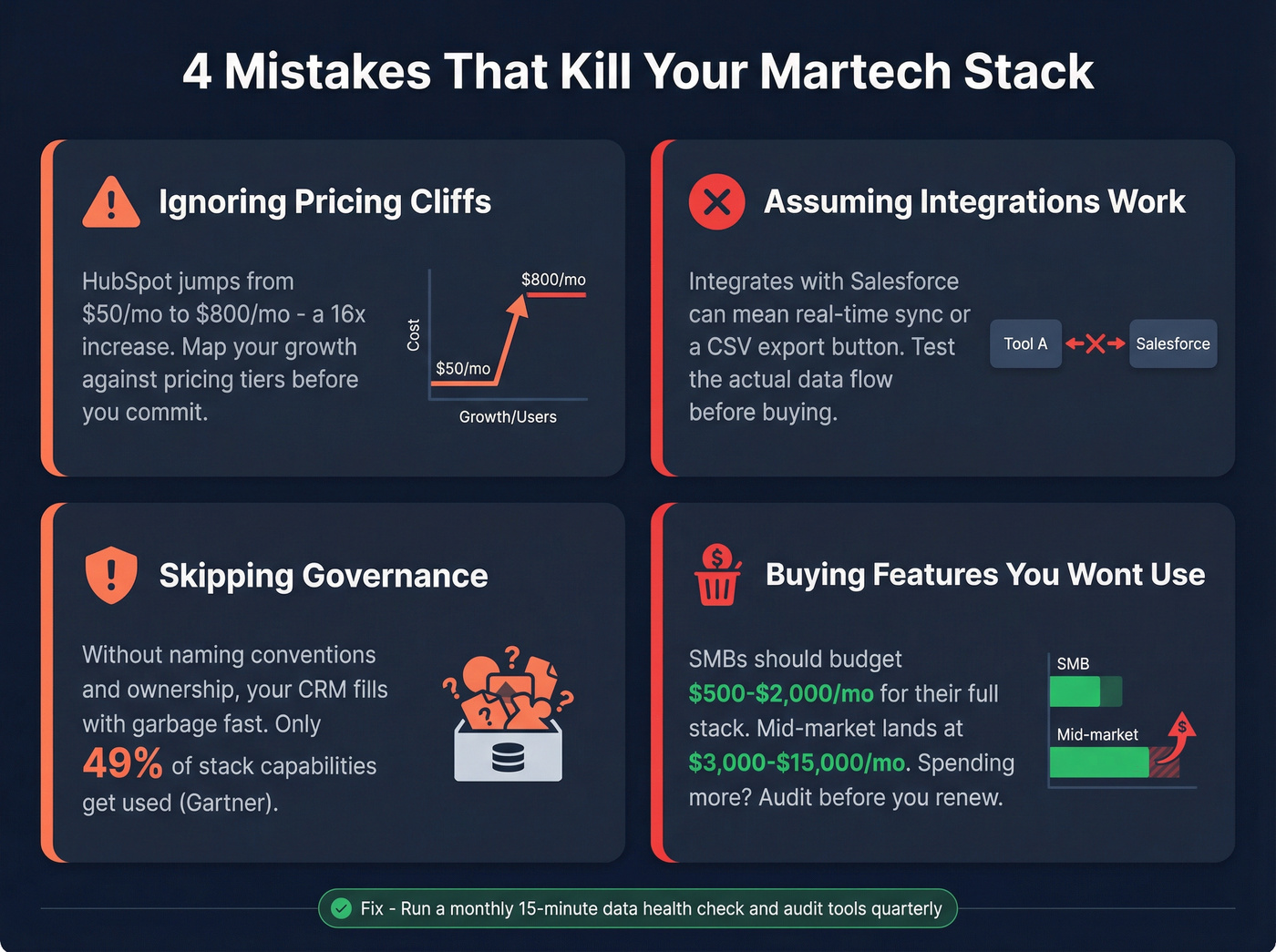
Assuming native integrations work. "Integrates with Salesforce" can mean anything from a real-time bidirectional sync to a CSV export button. Test the actual data flow before buying.
Skipping governance entirely. Without naming conventions, ownership, and health checks, your CRM fills with garbage surprisingly fast. That 49% utilization stat from Gartner? Governance is a big reason.
Buying for features you won't use. Let's be honest: most teams need a minority of what enterprise platforms offer. SMBs should budget $500-$2,000/mo for their full stack. Mid-market teams typically land at $3,000-$15,000/mo. If you're spending more, audit before you renew.
FAQ
How many tools should be in a martech stack?
Most SMB and mid-market teams run 8-15 tools effectively. Gartner's data shows teams use only 49% of their stack's capabilities, so more tools rarely means better results - it usually means more integration headaches and wasted budget.
How much does a martech stack cost?
SMBs typically spend $500-$2,000/mo, mid-market teams $3,000-$15,000/mo, and enterprises $15,000-$100,000+/mo. Always map your 12-month growth against each tool's pricing tiers to avoid surprise jumps.
What's the most important tool in a martech stack?
CRM is the operational backbone, but data quality is the foundation underneath it. A CRM full of bad emails and stale contacts breaks every downstream workflow - which is why data enrichment belongs in your core stack from day one, not as an afterthought.
How often should I audit my martech stack?
Run a full audit annually and a lightweight 15-minute data health check monthly. Re-evaluate immediately after any major team restructure, strategy pivot, or budget change. The monthly cadence catches problems before they compound into expensive messes.