

How to Close an Elevator Pitch: The Last 5 Seconds That Actually Matter
You just delivered a solid 25-second pitch. Clear problem, compelling solution, confident delivery. Then... silence. You smile, they smile, and the conversation drifts into "Well, nice meeting you."
That's not a bad pitch. That's a bad close.
Here's the reframe most people miss: your pitch's purpose isn't what you want to say - it's what you want your audience to do as a result. An Inc. article highlights extreme brevity examples, like Google allegedly convincing an early investor with 12 words and Warby Parker telling its origin story in about 100. Brevity isn't the hard part. Knowing what to ask for at the end - that's the hard part.
And there's a psychological reason the close matters more than any other part. People disproportionately remember the last thing you said; psychologists call this the recency effect. A mediocre pitch with a sharp close outperforms a brilliant pitch that fizzles out. So let's make the last five seconds of yours work.
What You Need (Quick Version)
Three closing approaches, one line each:
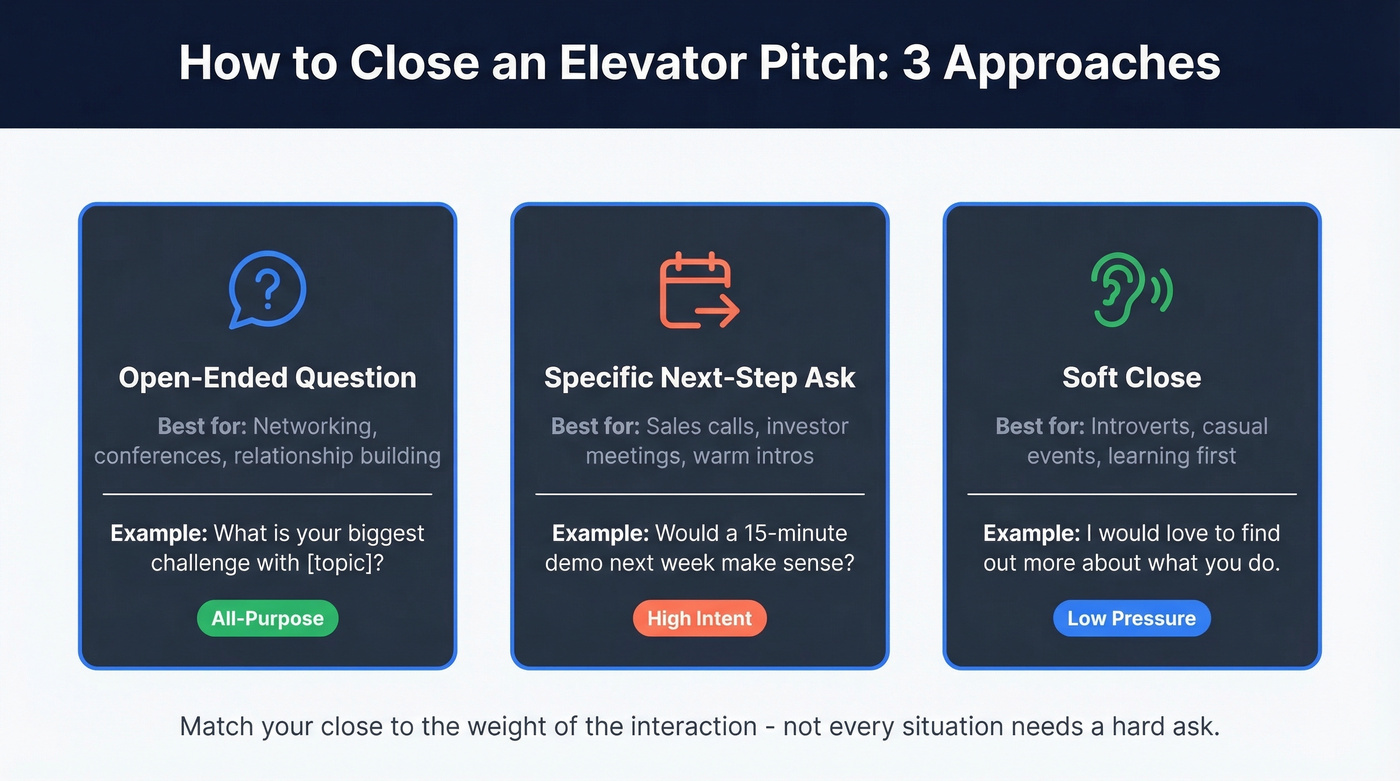
- Open-ended question - best all-purpose close for networking and sales. Keeps the conversation alive instead of killing it.
- Specific next-step ask - best when you know exactly what you want: a meeting, a demo, a coffee.
- Soft close - best for introverts or low-pressure settings where listening beats pitching.
If your pitch leads to outbound sales, make sure your follow-up actually lands. Bad contact data kills deals even after a great close - especially if you don’t have a solid lead generation workflow behind it.
Three Ways to End Your Pitch
The Open-Ended Question
Use this if you're at a networking event, conference, or any situation where the goal is starting a relationship, not closing a deal.
Skip this if you already have clear buy-in and just need to book the next step. An open-ended question can feel like stalling when the other person's already interested.
Salesforce's pitch guide makes this point bluntly: phrases like "Have a great day" or "Thanks for stopping by" are conversation killers, not closes. They're polite exits disguised as endings. Instead, end with something that requires a real answer.
Examples that work: "What brought you here today?" or "What's your biggest challenge with [topic you just pitched]?" These flip the dynamic - suddenly you're listening, and they're invested. (If you want more ready-to-use scripts, pull from these sample elevator pitches and just swap the close.)
The Specific Next-Step Ask
Use this if you know what you want and the interaction warrants it. A sales conversation, an investor meeting, a warm intro that's clearly going somewhere.
Skip this if you just met someone 30 seconds ago and you're already asking for a 90-minute strategy session. That's the fastest way to get a polite "I'll think about it" that means no.
The key principle from Close.com's pitch framework: don't ask for too much. Match the ask to the weight of the interaction. After a 30-second pitch, a reasonable next step is a 15-minute call or a 30-minute demo - not a full workshop, not a dinner, just a bite-size commitment that's easy to say yes to.
Always leave a business card or share contact info. The best close in the world is useless if they can't find you tomorrow - so treat it like contact management software, not a sticky note.
The Soft Close
Use this if you're an introvert, you're at a casual event, or you genuinely want to learn about the other person before pushing your agenda.
Skip this if you're in a high-stakes pitch with a time limit - investors and hiring managers expect directness.
Patricia Weber's introvert networking approach compresses the pitch to 10-15 seconds and ends with: "I'd love to find out more about what you do." That's not weakness - it's strategy. You've planted your value prop, and now you're giving them the floor. Most people love talking about themselves. Let them.
This pairs well with Forbes' networking advice to set a goal of meeting just 3-5 people per event. When you're not trying to close everyone, each conversation gets more natural, and your soft close sounds genuine instead of rehearsed.
Closing Lines You Can Steal
The part you came for. Fifteen closing lines organized by scenario - pick the one that fits and make it yours.
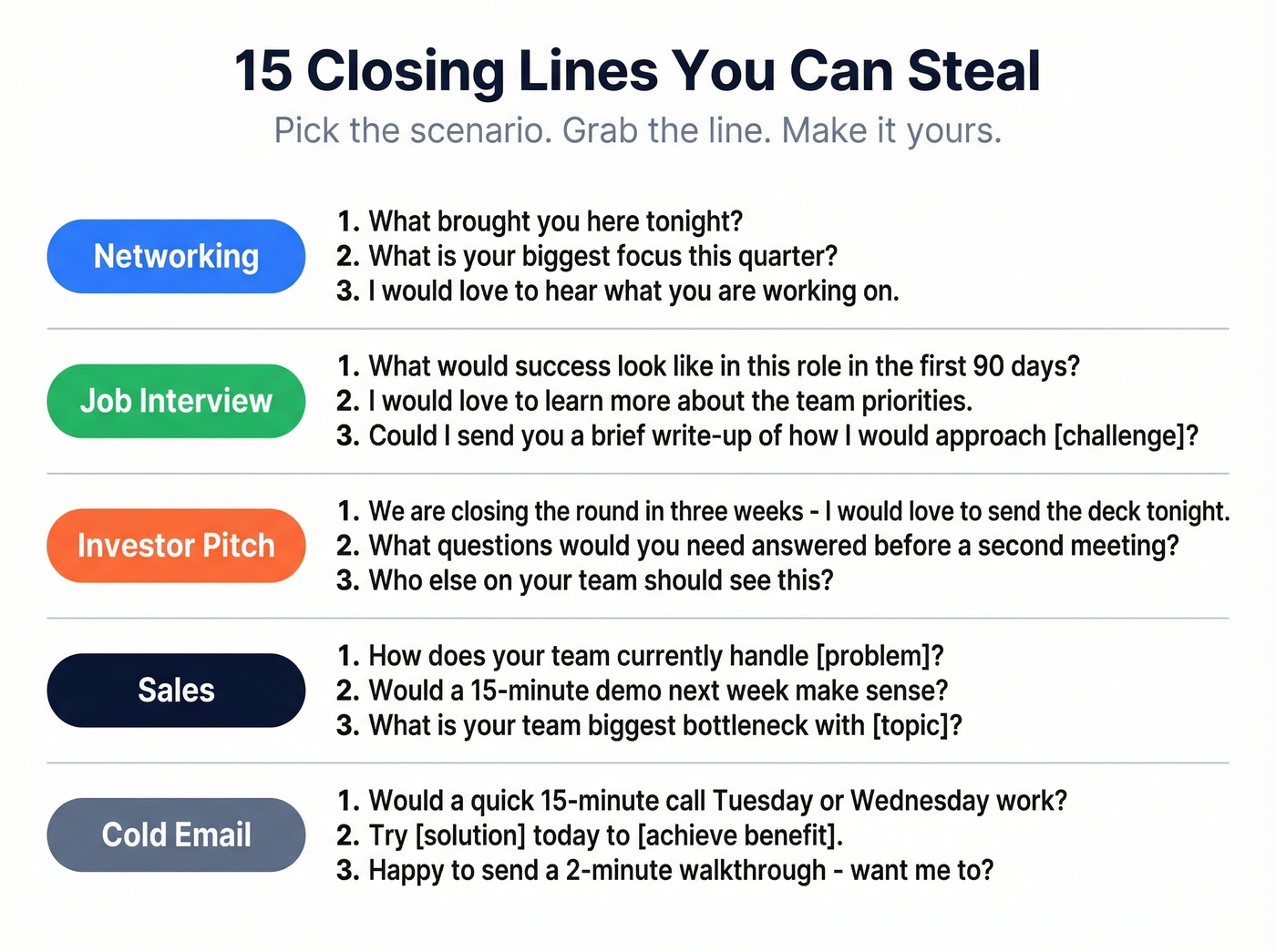
Networking Event
- "What brought you here tonight?"
- "What's your biggest focus this quarter?"
- "I'd love to hear what you're working on."
Job Interview
- "What would success look like in this role in the first 90 days?"
- "I'd love to learn more about the team's priorities."
- "Could I send you a brief write-up of how I'd approach [specific challenge]?" (If you’re interviewing for sales, pair this with a simple 30-60-90 day plan.)
Investor Pitch
- "We're closing the round in three weeks - I'd love to send the deck tonight."
- "What questions would you need answered before a second meeting?"
- "Who else on your team should see this?"
Sales Conversation
- "How does your team currently handle [problem]?"
- "Would a 15-minute demo next week make sense?"
- "What's your team's biggest bottleneck with [topic]?" (For more ways to move the deal forward, see these steps to close a sale.)
Cold Email or Written Pitch
- "Would a quick 15-minute call Tuesday or Wednesday work?"
- "Try [solution] today to [achieve benefit]."
- "Happy to send a 2-minute walkthrough - want me to?" (You’ll get more replies with proven cold email follow-up templates.)

A perfect close means nothing if your follow-up bounces. Prospeo gives you 98% verified emails so your post-pitch message actually reaches the person you just impressed. At $0.01 per email, one landed follow-up pays for itself.
Don't let bad data waste a great pitch close.
Five Closing Mistakes That Kill Your Pitch
1. Ending with a polite nothing. "Thanks for your time!" isn't a close - it's an exit ramp. You just gave the other person permission to forget you.
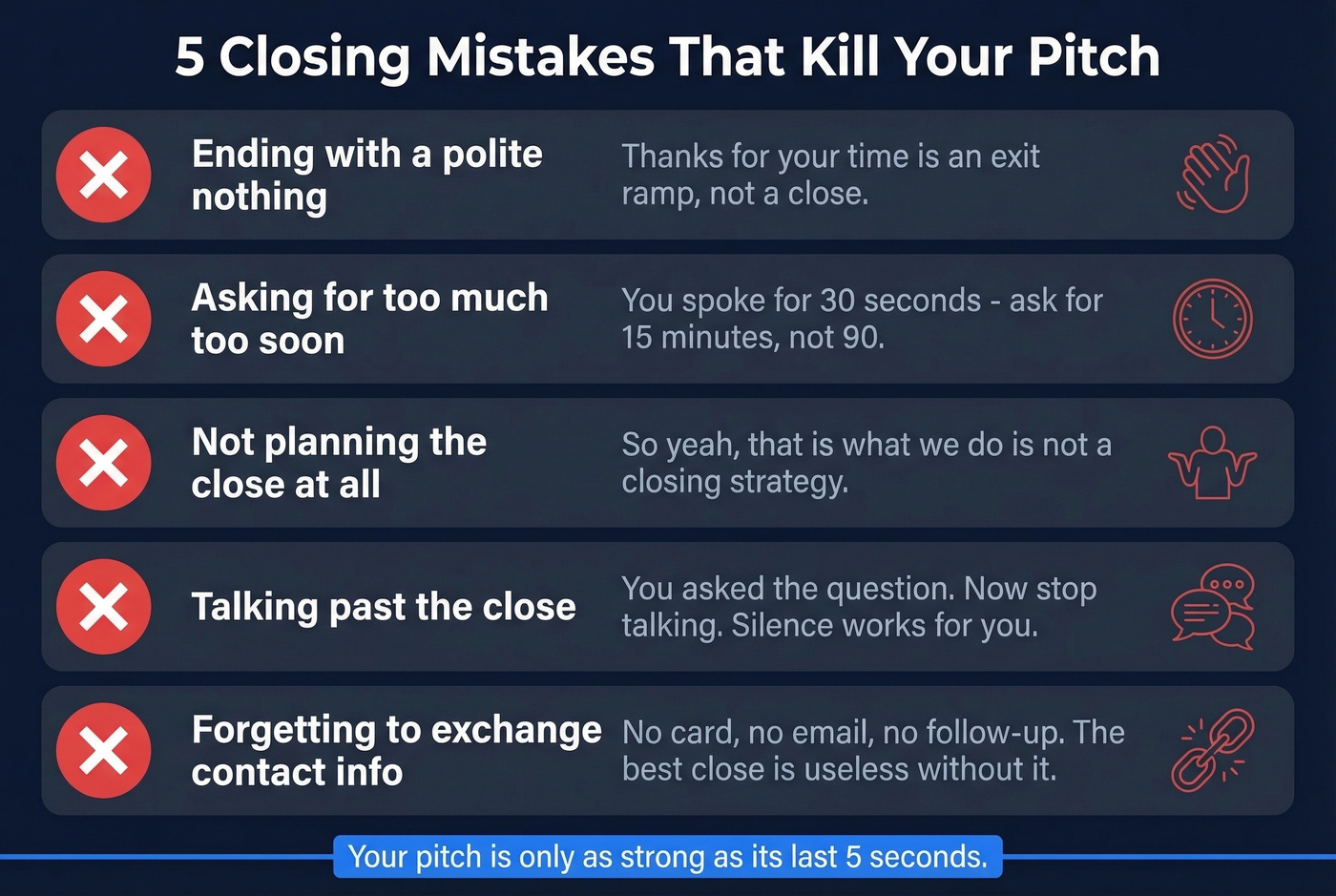
2. Asking for too much too soon. You spoke for 30 seconds. Don't ask for a 90-minute strategy session. A 15-minute call is a reasonable ask. A full-day workshop is not.
3. Not planning the close at all. We've watched dozens of founders nail their pitch and then fumble the ending with "So yeah, that's what we do." A common theme in founder circles is that if your 60-second sales pitch runs even a few seconds over, you've already lost attention - so don't waste the seconds you have by winging the most important part. (If you’re building repeatable outbound, these sales prospecting techniques help you systematize it.)
4. Talking past the close. You asked the question. Now stop talking. Silence feels uncomfortable, but it's working in your favor. The moment you fill the gap with "I mean, only if you want to, no pressure, totally fine either way" - you've undermined your own ask.
5. Forgetting to exchange contact info. No card, no email, no phone number, no way to follow up. If your total pitch is 75-100 words - roughly 30-45 seconds of speaking - your close should be about 15-20 words. One sentence. But that sentence is worthless without a way to continue the conversation.
The 5-Minute Post-Pitch Protocol
The close isn't the end. It's the bridge. This protocol turns a good pitch ending into an actual relationship, and it works best when you're targeting 3-5 meaningful conversations per event rather than trying to pitch everyone in the room.
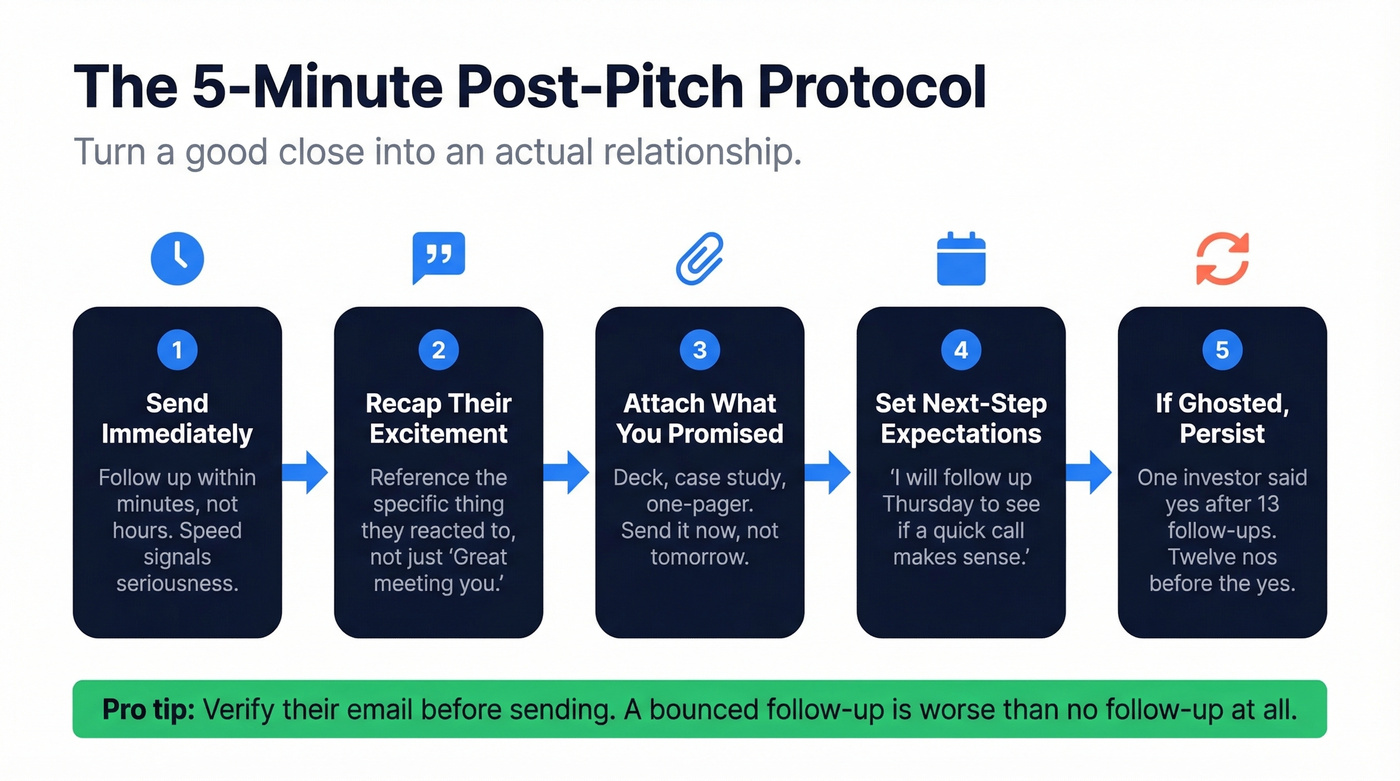
Send a follow-up message within minutes, not hours. HustleFund's Eric Bahn sends follow-ups within minutes of a pitch ending. Speed signals seriousness. While they still remember your face, get into their inbox.
Recap what excited them. Don't just say "Great meeting you." Reference the specific thing they reacted to. "You mentioned your team's struggling with outbound reply rates - here's the one-pager I mentioned."
Attach anything you promised. Deck, case study, link, one-pager. If you said you'd send it, send it now. Not tomorrow. Now.
Set explicit next-step expectations. "I'll follow up Thursday to see if a quick call makes sense." This gives them a timeline and gives you permission to follow up without feeling pushy. Research suggests attention drops sharply after about nine minutes in meetings, so keep follow-up calls and demos tight. (If you want plug-and-play copy, use these sales follow-up templates.)
If ghosted, persist. That same HustleFund investor committed after being pinged 13 times. Twelve follow-ups before the yes. If you're getting silence, try: "I'll stop pinging if timing isn't right - just let me know either way." That line breaks the ghosting pattern more often than you'd expect.
If you met someone at an event and only got a name and company, Prospeo's Email Finder can surface their verified email in seconds - and the Chrome Extension works directly from any company website or professional profile.
Stop Memorizing Your Pitch
Look, most pitch advice is backwards. It tells you to memorize a script and deliver it flawlessly. In our experience, the people who close best aren't the ones with the most polished scripts - they're the ones who know exactly what they're asking for.
Memorize 3-4 closing templates: the open-ended question, the specific ask, the soft close. Let the rest be conversational. Match your closing tone to your pitch style - a stats-heavy pitch earns a direct ask, while a storytelling pitch flows better into an open-ended question. That's how to close an elevator pitch without sounding like a robot reading a teleprompter.
Rehearse your close. Improvise everything else. You'll sound more human, and the close will land harder because it feels like a genuine reaction to the conversation - not a scripted finale.
You nailed the close and exchanged info - now scale it. Prospeo's 300M+ verified contacts and 125M+ direct dials mean you can skip the pitch entirely and reach decision-makers straight in their inbox. Teams book 35% more meetings than Apollo users.
Turn every great close into a pipeline that doesn't depend on chance encounters.
FAQ
Can you close with a statement instead of a question?
Yes - "I'll send you the deck tonight" works perfectly when you already have buy-in. Questions tend to perform better at networking events because they invite dialogue, but statements are stronger when you just need to confirm the next action.
What if they say no or seem uninterested?
Say "Totally understand - if anything changes, here's my card." A graceful exit preserves the relationship better than a forced close. Aim for 3-5 meaningful conversations per event, not a 100% conversion rate.
How do you close a written elevator pitch?
End with one specific, low-friction ask. "Would a 15-minute call next week make sense?" works. "Let me know your thoughts" doesn't - it's too vague to act on. Verify email addresses before sending so your message actually reaches the inbox.
How long should the closing line be?
One sentence - roughly 15-20 words. If your total pitch runs 75-100 words, the close is about 15-20 of those. It's not a second pitch; it's the single action you want them to take next.