

How to Cold Call B2B (Without Wasting 200 Dials a Day)
The B2B dial-to-meeting rate dropped from 4.82% to 2.3% over the past two years. That sounds like cold calling is dying - until you realize the reps still booking meetings didn't get worse. Their data did. Learning how to cold call B2B in 2026 comes down to three things: clean numbers, a tight framework, and knowing which objections actually matter.
You made 47 dials yesterday. Three people picked up. One hung up before you finished your name.
That's fixable, and the fix is more mechanical than you think.
The quick version:
- Fix your data first - 22.5% of your list goes stale every year.
- Use a 35-second opener: Who / Why / What.
- Prepare for exactly four objections.
The B2B Sales Call Math
| Metric | Number | Source |
|---|---|---|
| Calls per appointment | 209 | Bridge Group |
| Connect rate (practitioner benchmark) | ~5% | r/sales |
| Successful call duration | 5:50 | Gong.io |
| Failed call duration | 3:14 | Gong.io |
| Buyers who accept meetings | 82% | RAIN Group |
| Dial-to-meeting (2026) | ~2.3% | Industry avg |
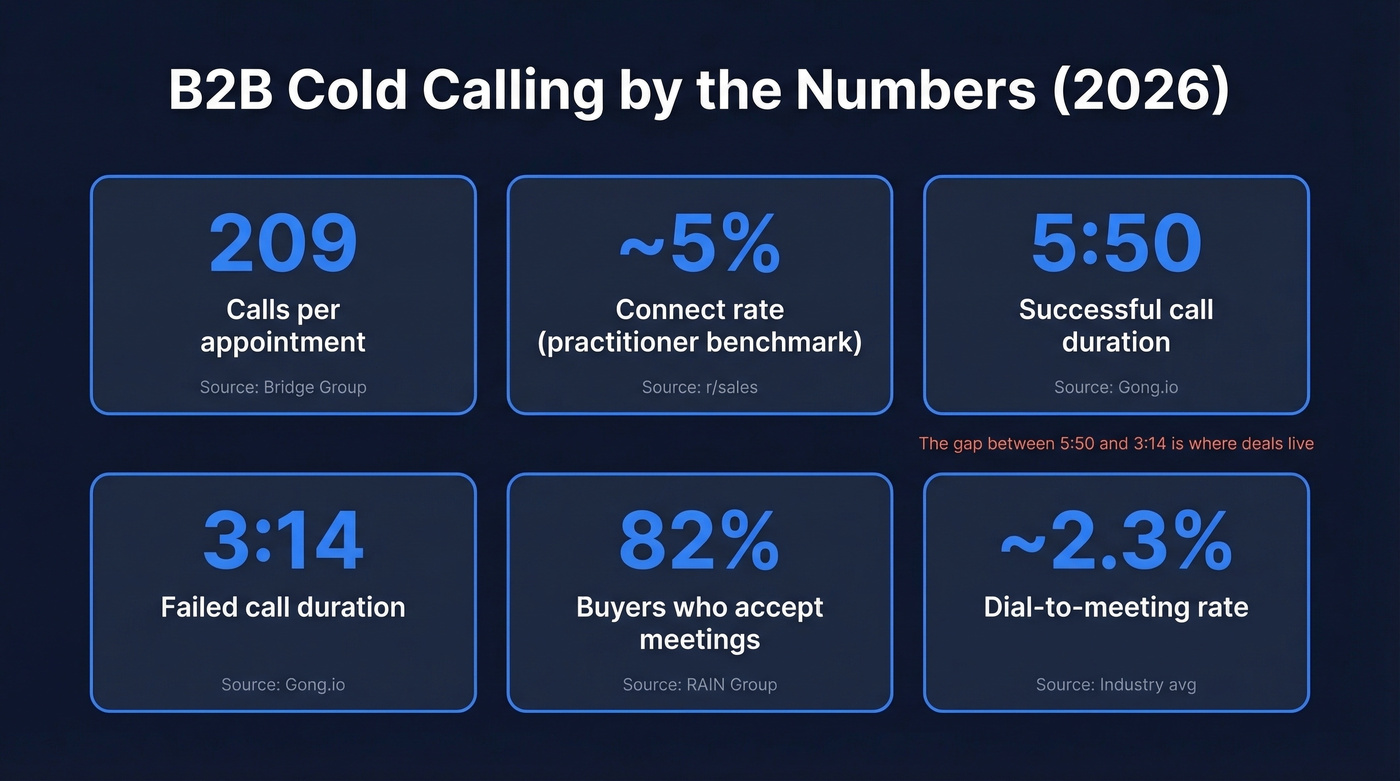
The gap between 5:50 and 3:14 is where deals live. If you're getting cut off before the three-minute mark, your opener or your targeting is off - not your pitch.
Before You Dial: Fix Your Data
B2B contact data decays at 2.1% per month at 2.1% per month. That's nearly a quarter of your list going stale every year. If you're dialing from a list you built six months ago, you're burning a meaningful chunk of your time on wrong numbers and departed employees.
Here's the thing: skip auto-dialers until your data is clean. They just help you waste time faster. If your connect rate is below 3%, don't touch your script - your list is the problem. (If you need a stack, start with a simple cold calling system you can actually run daily.)
Call mobile numbers first. With remote and hybrid work, you'll get a better shot at an answer on a cell than an office desk line. Spend 3-5 minutes per prospect checking for a trigger event, a job change, or a funding round (here’s a practical way to track sales triggers). Best windows: Tuesday through Thursday, 10-11 AM and 2-4 PM local time.
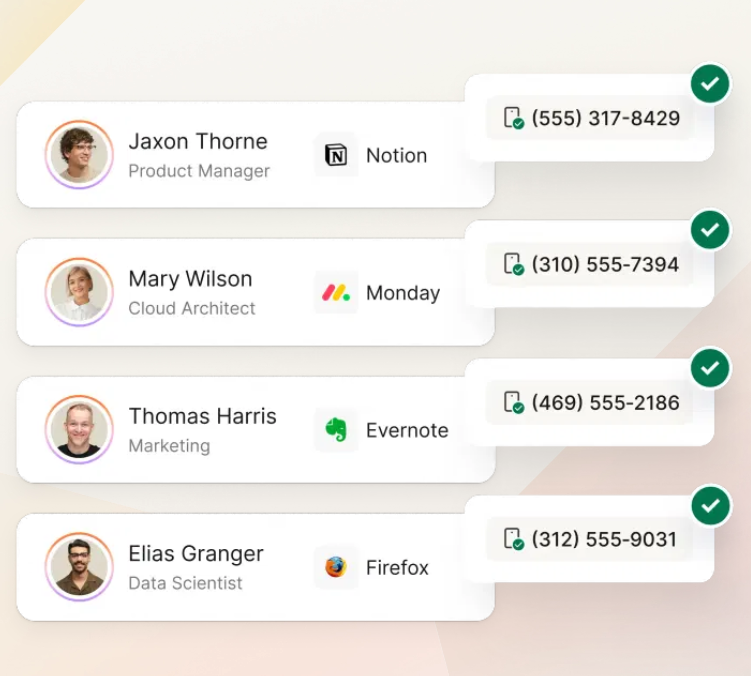
None of that matters if your phone numbers are wrong. When Meritt switched to Prospeo's verified mobiles - pulled from a database of 125M+ numbers refreshed every 7 days - their connect rate tripled, jumping to 20-25%. That's the single highest-leverage change most teams can make before touching their script. (If you’re comparing vendors, see our breakdown of data enrichment services.)
The 35-Second Framework
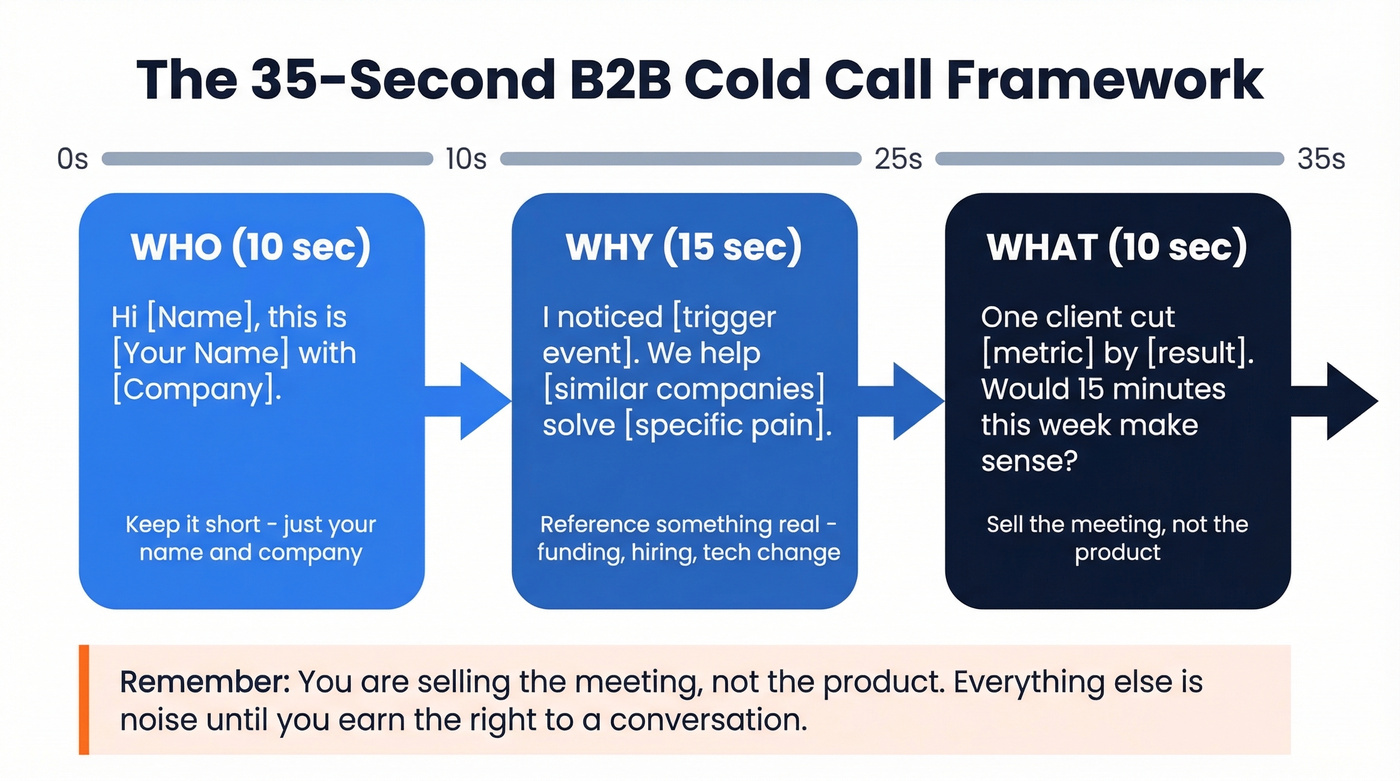
Your opener needs to answer three questions in under 35 seconds: Who are you, Why are you calling, and What do you want. Everything else is noise until you've earned the right to a conversation. Think of this as the skeleton - you can customize the details for each vertical, but the structure stays the same.
"Hi [Name], this is [Your Name] with [Company]. I'm reaching out because we work with [similar role/industry] teams dealing with [specific pain]. One of our customers recently found over $25,000 in missed invoices from 45 customers using our platform. I'd love 15 minutes to see if we can do something similar - does Thursday afternoon work?"
You're not selling the product on the call. You're selling the meeting. (If you want more options, steal a few talk track examples and adapt them.)
Opening Lines That Work
Do this: Ask "How are you?" - Gong's data shows this boosts success rates by about 10%. Explain why you're calling, which drives a 2.1x higher success rate. Mention a mutual connection when possible - it increases your odds by 70%.
Skip this: "Is this a bad time?" kills your chances by 40%.
Three openers worth testing:
- Trigger-event: "I saw [Company] just raised a Series B - congrats. Usually when teams scale that fast, [pain point] becomes a bottleneck. Is that on your radar?"
- Transparency: "I'll be honest, this is a cold call. But I did my homework - mind giving me 30 seconds?" This one works best for SDRs with less than six months of experience. It disarms the prospect and buys you time.
- Referral: "[Mutual contact] mentioned you're the person who owns [area]. They thought it'd be worth connecting." A referral-based opener consistently outperforms generic intros because it borrows trust from someone the prospect already knows.

Meritt tripled their connect rate to 20-25% by switching to Prospeo's verified mobile numbers. With 125M+ direct dials refreshed every 7 days and a 30% pickup rate, you stop burning dials on dead numbers and start reaching real buyers.
Fix your data before you fix your script. Start free with 75 credits.
Sample Script for B2B Calls
Here's a complete outbound script you can adapt. The structure works whether you're selling SaaS, professional services, or pitching local partnerships to brick-and-mortar stores. (For more channels and angles, see these sales prospecting techniques.)
Intro (10 seconds): "Hi [Name], this is [Your Name] with [Company]."
Context (15 seconds): "I noticed [trigger - hiring post, funding round, tech stack change]. We help [similar companies] solve [specific pain]."
Value hook (10 seconds): "One of our clients cut their [metric] by [result] in [timeframe]."
Ask: "Would it make sense to grab 15 minutes this week to see if that's relevant for you?"
Adapt the value hook to match your prospect's world. If you're calling law firms, swap the metric for something like billable-hour recovery or client intake speed - specificity signals that you understand their business. The same principle applies to any vertical: the framework stays constant, but the language should mirror how your prospect talks about their own problems.
Handling the Four Objections
Most objections aren't real objections - they're reflexes. As one r/sales poster put it: "Cold calling isn't dead - you're just bad at it." Your job is to convert reflexes into actual conversations. Having scripts reps can internalize - not read verbatim - makes the difference between a brush-off and a real dialogue. (If this is the part you struggle with most, use a dedicated cold call rejection playbook.)
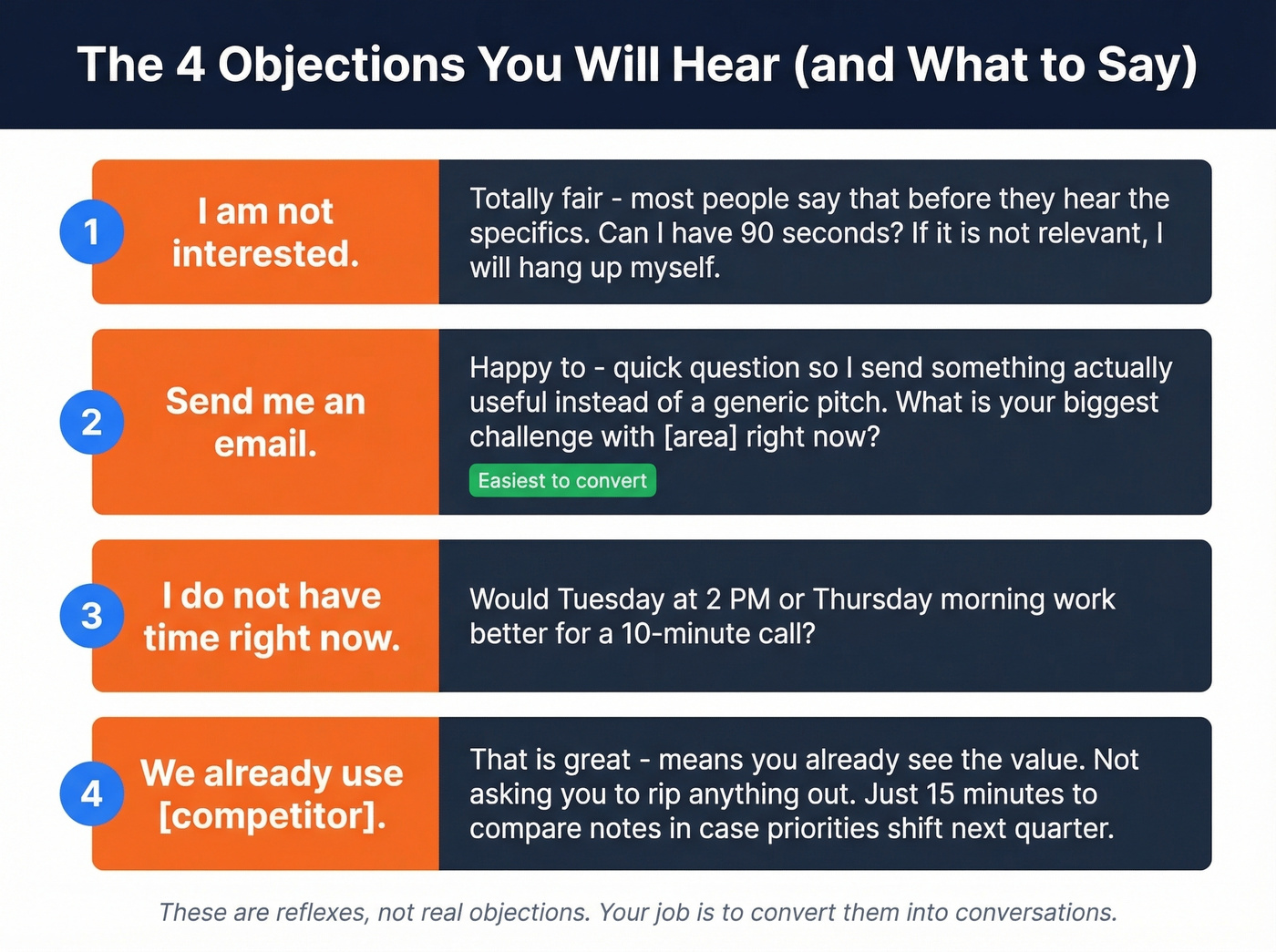
"I'm not interested."
"Totally fair - most people say that before they hear the specifics. Can I have 90 seconds? If it's not relevant, I'll hang up myself."
"Send me an email." In our experience, this is the easiest objection to convert. Don't just agree - ask one qualifying question first so you send something useful instead of a generic pitch. That question alone often opens a two-minute conversation.
"I don't have time right now."
"Would Tuesday at 2 PM or Thursday morning work better for a 10-minute call?"
"We already use [competitor]."
"That's great - means you already see the value. I'm not asking you to rip anything out. Just 15 minutes to compare notes, in case priorities shift next quarter."
Follow-Up That Sticks
Most sales happen after 5-7 touchpoints. Build a 4-6 week cadence mixing calls and emails. Reduce no-shows by sending a strong agenda immediately - not a vague "Intro call" subject line - and get live calendar confirmation on the call. Book meetings within the same week whenever possible. (If you want plug-and-play copy, use these sales follow-up templates.)
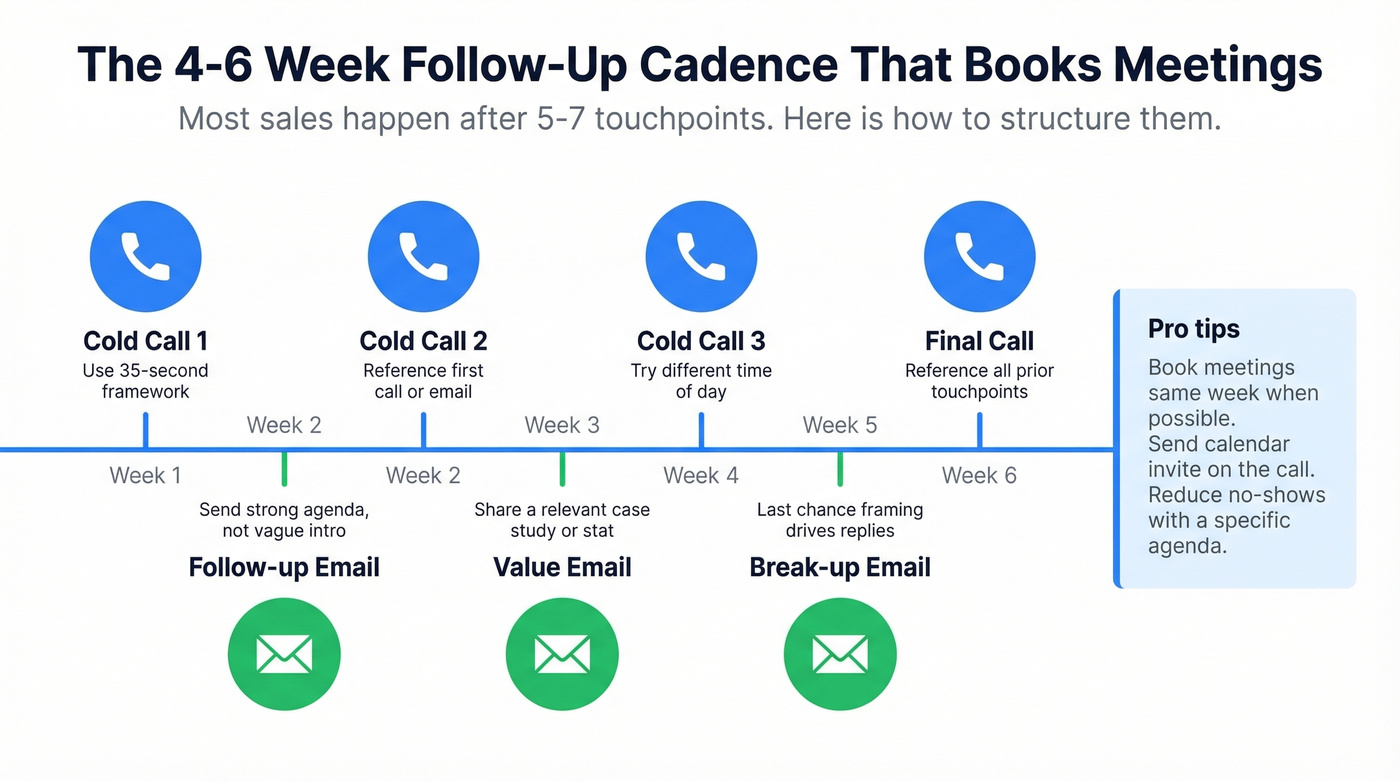
We've found that the reps who treat follow-up as a system rather than an afterthought consistently outperform those who wing it, even when their initial call skills are weaker.
Building Better Sales Scripts
The biggest mistake reps make with scripts in 2026 is treating them as word-for-word monologues. A good script is a decision tree, not a teleprompter.
Write out your opener, your two strongest value hooks, and your objection responses - then practice until you can deliver them conversationally without reading. Record your calls. Listen back. Trim anything that sounds scripted. The reps who book the most meetings sound like they're having a conversation, not performing one. (This is also where a solid sales communication baseline helps.)
Let's be honest: if you can hear someone reading, so can your prospect. And they'll hang up.
Compliance Checklist
TCPA penalties run $500-$1,500 per call. Per violation, not per campaign.
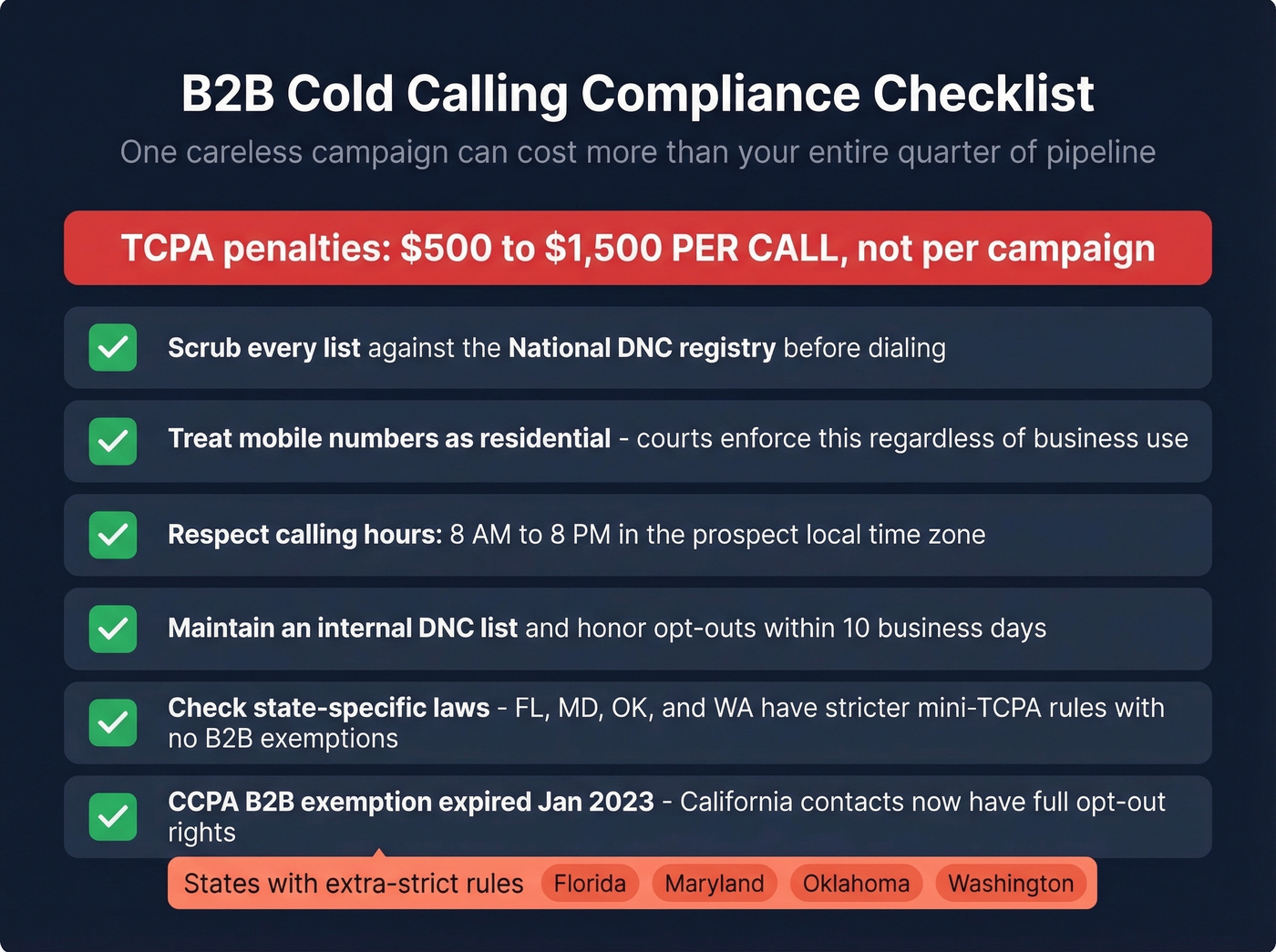
- Scrub every list against the National DNC registry
- Treat mobile numbers as residential - courts treat this as true regardless of business use
- Respect calling hours: 8 AM-8 PM in the prospect's local time zone
- Maintain an internal DNC list and honor opt-outs within 10 business days
- Florida, Maryland, Oklahoma, and Washington have stricter mini-TCPA laws with no B2B exemptions
- The CCPA B2B exemption expired January 2023 - California contacts now have full opt-out rights
Skip this section at your own risk. One careless campaign can cost more than your entire quarter's pipeline is worth.
Your follow-up cadence is only as good as your contact data. Prospeo gives you verified emails at 98% accuracy and direct mobile numbers for $0.01 per lead - so every touchpoint in your 5-7 step sequence actually lands.
Stop dialing wrong numbers. Build a clean list in minutes.
FAQ
How many cold calls should I make per day?
Plan for 150-200+ dials. At a 5% connect rate, that gives you 8-10 live conversations and roughly one booked meeting. Volume isn't negotiable - but only after your list is verified.
Is B2B cold calling still effective in 2026?
Yes. 82% of buyers accept meetings from proactive outreach according to RAIN Group. The dial-to-meeting rate has dropped, but that's a data quality problem, not a channel problem. Teams with verified numbers still see 5%+ connect rates.
What's the fastest way to improve my connect rate?
Fix your phone numbers. Data decays 2.1% per month, so nearly a quarter of your list is dead within a year. Meritt saw their connect rate jump from single digits to 20-25% after switching to weekly-refreshed verified mobiles.
Do I need a different script for every industry?
Not entirely. The 35-second framework - Who, Why, What - works across verticals. What changes is the value hook and the language you use to describe the prospect's pain. Build one core script, then create industry-specific variations for your top three or four target segments.