

How to Cold Call Restaurants (and Actually Book Meetings)
It's Tuesday at 10 AM. You've got 30 restaurants on your list, but all you have is the main number from Google. The hostess answers, says "the owner isn't here," and you're back to square one.
Here's the thing about cold calling restaurants: it's a completely different game than standard B2B outreach. Owners run on 3-5% profit margins. They're fielding 15-20 solicitation calls a week. And the person who picks up the phone is almost never the person who signs checks - every call competes with a lunch rush, a staffing crisis, or a delivery driver who didn't show up. Whether you're selling POS systems, food distribution, marketing services, or kitchen equipment, if you treat this like calling a SaaS company's front desk, you'll burn through your list in a week with nothing to show for it.
Realistic Benchmarks
The average cold call converts to a sale at 2.35% - food and beverage distribution comes in slightly higher at 2.53%. For meetings specifically, expect roughly 40-45 dials per booking. Plan for about 18 dials before you connect with a decision-maker, and 8 attempts to reach the same person.
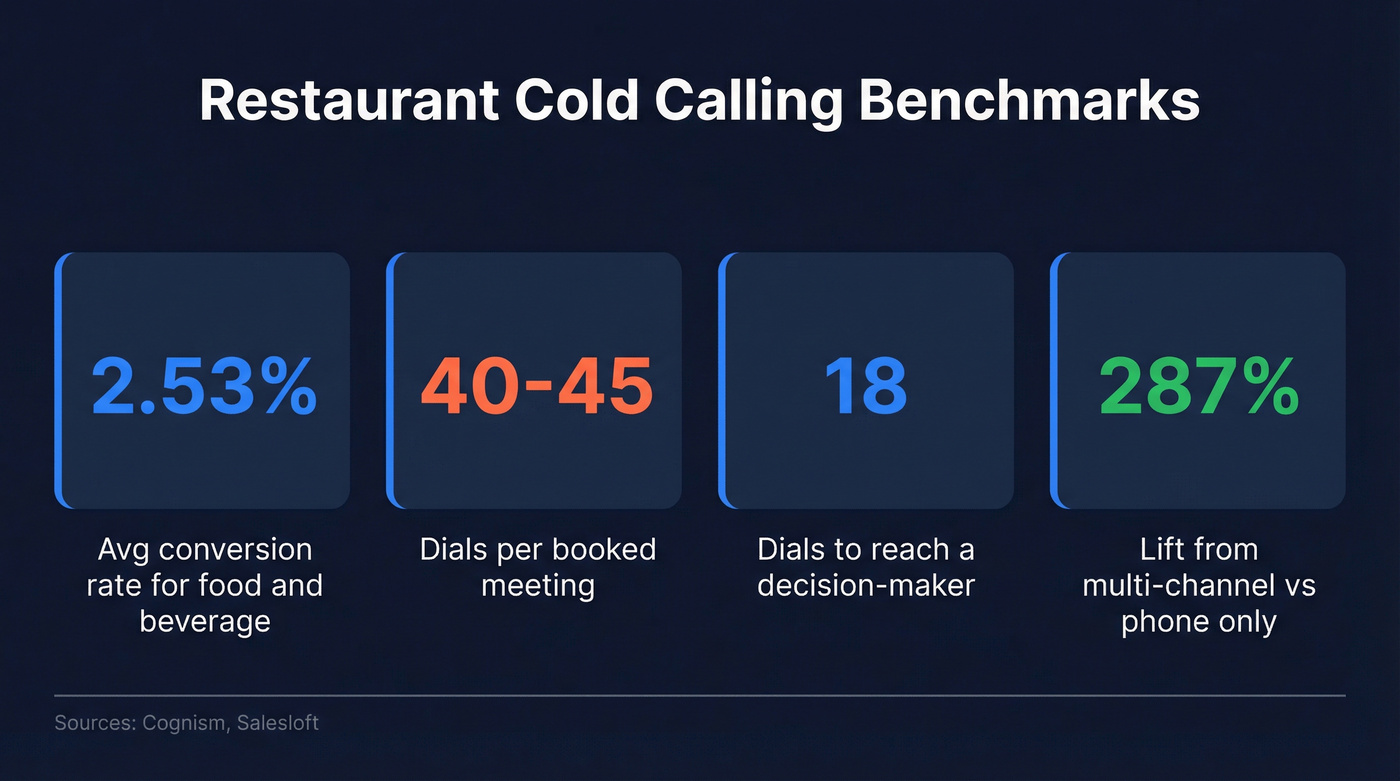
Those numbers aren't exciting. But knowing them keeps you from quitting on day three.
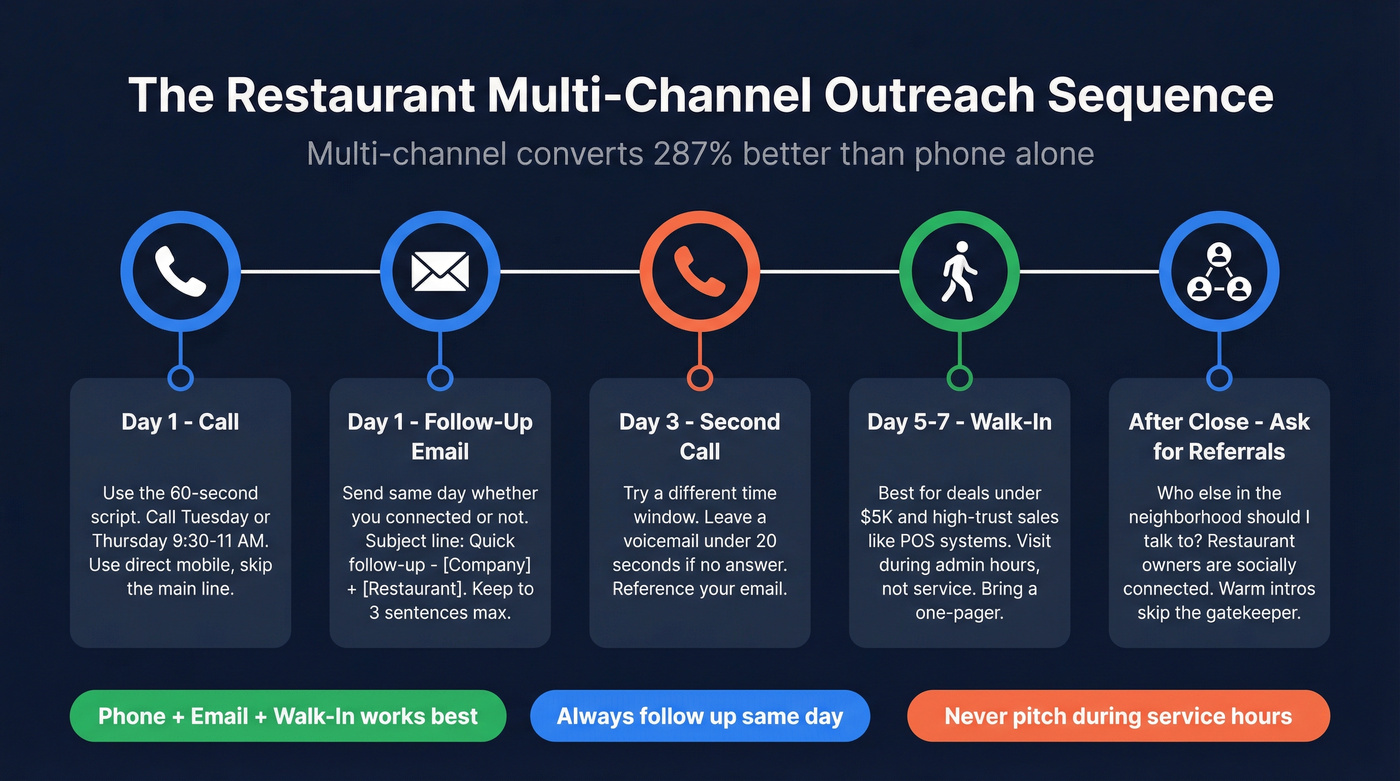
Multi-channel outreach improves conversion by up to 287% compared to phone alone. If you're only dialing, you're leaving most of your results on the table - especially if you don’t have a repeatable cold calling system.
Build Your Prospect List First
Cold calling restaurants without a prospect list is like cooking without ingredients. Before you pick up the phone, you need two things for every restaurant: the owner's name and a direct number. Personalized cold calls - where you reference the owner by name and something specific about their business - convert up to 6x better than generic dials (more on personalized outreach).
Start with Google Business Profile and Yelp to identify the owner or GM. Check the restaurant's website for an "About" page; smaller independents often list the owner by name. The problem is you've got the name but no way to reach them besides the main line.
Skip the main line entirely. Prospeo's Chrome extension pulls verified emails and direct mobile numbers from websites in one click - 125M+ verified mobiles, 98% email accuracy, data refreshed every 7 days. That refresh cycle matters for restaurant prospecting, where ownership changes and closures happen constantly. The free tier gives you 75 emails plus 100 Chrome extension credits per month, enough to build a solid starter list without spending anything. (If you’re building lists at scale, a simple lead generation workflow helps keep data clean.)
When to Call Restaurants
General B2B wisdom says Wednesday and Thursday are prime days. For restaurants, the calculus is completely different.
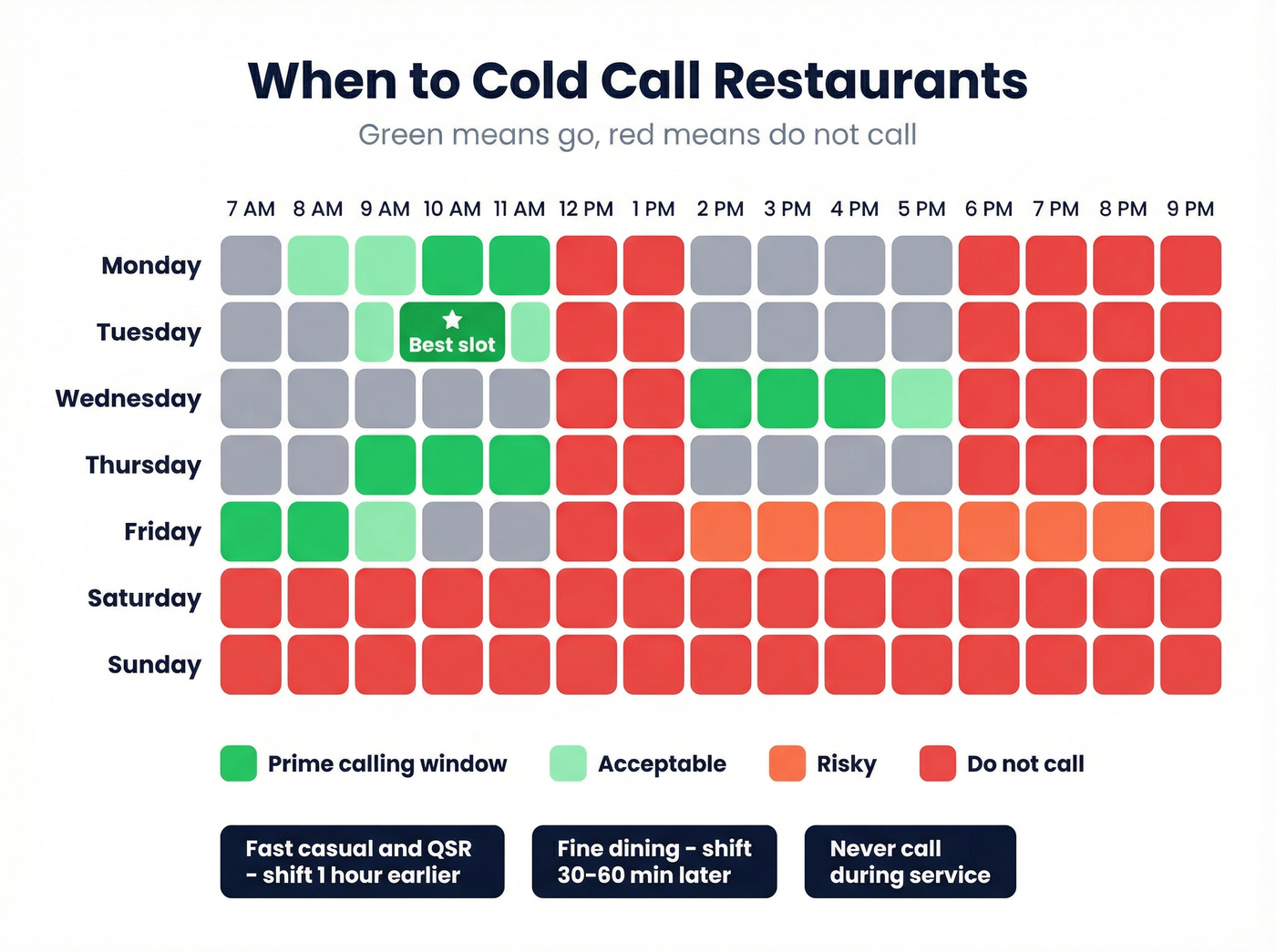
| Day | Window | Why It Works |
|---|---|---|
| Mon | 10-11:30 AM | Post-weekend, before lunch prep |
| Tue | 9:30-11 AM | Quietest morning of the week |
| Wed | 2-4 PM | Between lunch and dinner service |
| Thu | 9-11:30 AM | Owners often handle admin early |
| Fri | Early AM only | Day gets chaotic fast |
| Sat/Sun | Skip | Don't even try |
The pattern is simple: call during admin hours, never during service. Tuesday 9:30-11 AM is the single best slot - it's the window where owners are most likely doing paperwork instead of fighting fires. If you're selling to fast casual or QSR, shift everything earlier since their prep windows start at 7-9 AM. Fine dining is the opposite: push 30-60 minutes later because owners tend to arrive mid-morning. (If you’re pairing calls with email, align timing with the best time to send cold emails.)

You're not losing deals because your script is bad. You're losing them because you're dialing the main line and pitching the hostess. Prospeo gives you restaurant owners' direct mobile numbers and verified emails - 125M+ mobiles, 98% email accuracy, refreshed every 7 days so you're not calling restaurants that closed last month.
Bypass the host stand entirely. Start with the owner's direct number.
The 60-Second Script
Restaurant owners are mid-inventory or mid-crisis. Respect their time and they'll respect yours.
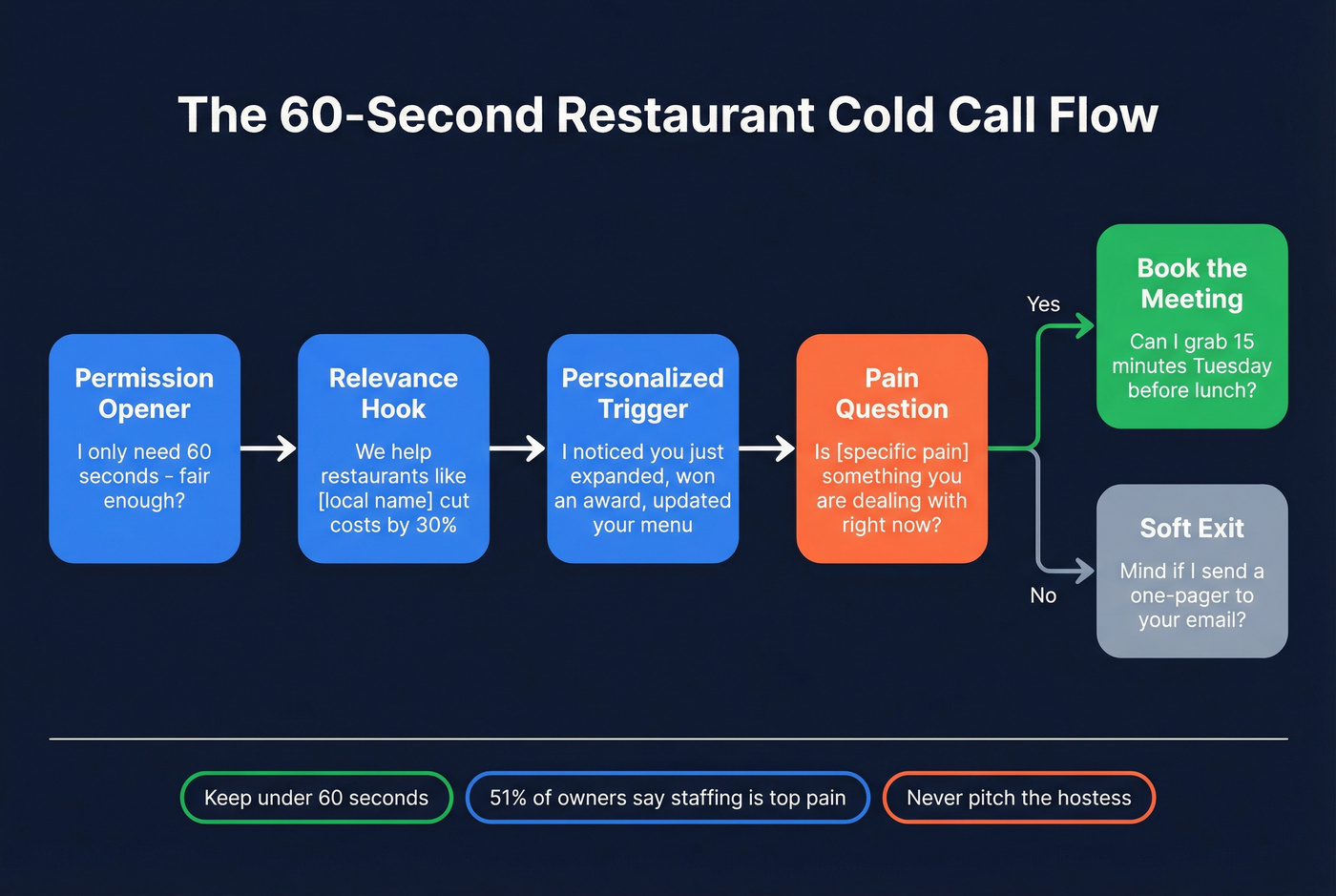
The Opener
"Hi [Owner Name], this is [Your Name] with [Company]. I know you're busy, so I only need 60 seconds - fair enough?
We help restaurants like [similar local restaurant] [cut delivery fees by 30% / reduce staffing costs / increase table turns]. I noticed you just [won a local award / expanded to a second location / updated your menu].
Quick question: is [specific pain point] something you're dealing with right now?
[If yes] Great - can I grab 15 minutes this week, maybe Tuesday before lunch?
[If no] Totally fair. Mind if I send a one-pager to your email in case it becomes relevant?"
The permission-based opener ("I only need 60 seconds") gives the owner an exit. Paradoxically, that makes them more likely to stay on the line. And if you're selling anything staffing-related, lead with that pain - 51% of restaurant operators cite staffing as their top challenge. (If you want more variations, borrow from these talk track examples.)
The Voicemail
"Hey [Owner Name], [Your Name] with [Company]. We help restaurants in [city] [one-sentence benefit]. I'll shoot you a quick email - if it's relevant, just hit reply. My number is [number]."
Keep voicemails under 20 seconds. Anything longer gets deleted mid-message.
Getting Past the Host Stand
The "clever" gatekeeper script is a myth. The consensus on r/sales is that a simple, direct ask works best.
Ask for the person by first name. "Hey, is Mike around?" works 8 out of 10 times. It sounds like you know them.
Call before the restaurant opens. Owners are often there during prep - and the hostess isn't.
Use direct mobile numbers. This bypasses the host stand entirely. It's the single biggest advantage you can give yourself.
Never pitch the person who answers. Don't explain what you're selling to the hostess. Just ask for the owner and be friendly about it. If you’re newer to this, the fundamentals in cold calling for beginners apply - just with tighter timing.
We've seen reps overthink this endlessly. Don't try to be clever, don't use fake urgency ("I'm returning his call"), and for the love of everything, don't call during Friday dinner service.
Handling the 5 Most Common Objections
Drop the pitch. Ask a question instead.
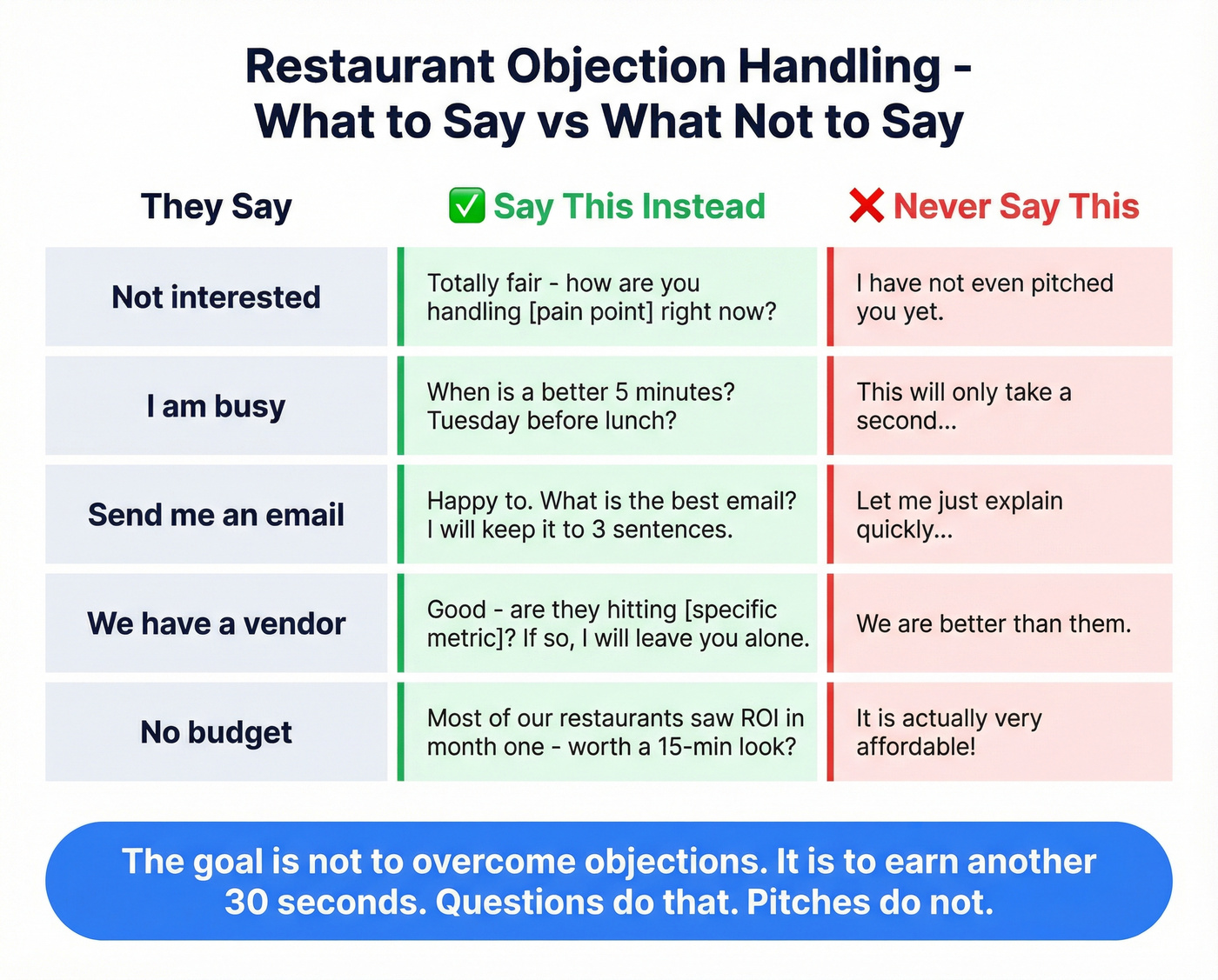
| Objection | Response | Don't Say This |
|---|---|---|
| "Not interested" | "Totally fair - how are you handling [pain point] right now?" | "I haven't even pitched you yet." |
| "I'm busy" | "When's a better 5 minutes? Tuesday before lunch?" | "This'll only take a second..." |
| "Send me an email" | "Happy to. What's the best email? I'll keep it to 3 sentences." | "Let me just explain quickly..." |
| "We have a vendor" | "Good - are they hitting [specific metric]? If so, I'll leave you alone." | "We're better than them." |
| "No budget" | "Most of our restaurants saw ROI in month one - worth a 15-min look?" | "It's actually very affordable!" |
The goal isn't to overcome objections. It's to earn another 30 seconds. Questions do that. Pitches don't. (If you’re getting shut down fast, tighten your approach using these cold call rejection fixes.)
Follow-Up: Email + Walk-In
Send a follow-up email the same day of every call - whether you connected or not.
Subject: Quick follow-up - [Your Company] + [Restaurant Name]
Hi [Name], good chatting earlier. Here's the one thing I mentioned: [single benefit, one sentence]. Happy to show you how [reference restaurant] did it. Worth 15 minutes this week?
For deals under a few thousand dollars, walk-ins will outperform phone calls for restaurants every time. The r/sales community is pretty unanimous on this for high-trust sales like POS systems and equipment. For services, supplies, and marketing, phone plus email is more scalable - but let's be honest, combining all three channels is where the real results come from. If you need plug-and-play copy, keep a few sales follow-up templates ready.
One more thing we've learned from running outbound campaigns: every closed deal should end with one question. "Who else in the neighborhood should I talk to?" Restaurant owners are socially connected. Referrals compound fast, and a warm intro from a fellow owner skips the entire gatekeeper problem.
Knowing how to cold call restaurants is only half the equation - the other half is reaching the right person with verified contact data so you're not wasting dials on dead numbers. (If you’re missing owner details entirely, start with a business owner lookup process.)
Multi-channel outreach converts 287% better than phone alone - but only if you have the owner's real email. Prospeo's Chrome extension pulls verified contact data from any restaurant website in one click. 75 free emails per month, no contracts, no sales calls required.
Build your restaurant prospect list in minutes, not days.
FAQ
How many cold calls to book a restaurant meeting?
Expect 40-45 dials per booked meeting when calling restaurant owners. Adding same-day email follow-up lifts results significantly - multi-channel outreach improves conversion by up to 287% over phone-only approaches.
Should I cold call or walk into restaurants?
For high-trust purchases like POS systems or kitchen equipment, walk-ins outperform calls - especially on deals under $5K. For recurring services and supply contracts, phone paired with email scales better. Best results come from combining both.
What's the best time to cold call a restaurant?
Tuesday and Thursday mornings between 9:30-11 AM are the highest-connect windows. Owners handle admin tasks before lunch prep begins. Avoid calling during service hours (11:30 AM-2 PM, 5-9 PM) and skip weekends entirely.
How do I find a restaurant owner's direct number?
Skip the main line. Prospeo's mobile finder pulls verified mobile numbers from 125M+ records, and the Chrome extension works directly on restaurant websites. The free tier gets you started immediately with 75 emails and 100 extension credits per month.