

How to Design a Sales Funnel That Actually Converts
You built a funnel. You labeled the stages, picked a CRM, maybe even mapped some content to each one. Then 96% of your visitors turned out not ready to buy on their first visit, and the leads that did enter went quiet by stage two.
The problem isn't that funnels don't work. It's that most are designed around internal labels instead of buyer behavior. Knowing how to design a sales funnel means starting with the buyer, not your org chart.
A huge chunk of B2B buying happens before a prospect ever talks to sales - the commonly cited figure is that buyers complete around 70% of their research before engaging a vendor. Your funnel needs to meet them where they already are, not where you wish they were.
One quick distinction before we get into it: a sales funnel tracks the buyer's journey; a pipeline tracks your rep's activities (and the sales activities inside each stage). Design the funnel first, then build the pipeline to match.
Exit Criteria Over Stage Labels
Most funnel guides hand you four or five stage names - Awareness, Interest, Decision, Action - and call it a framework. That's not a framework. That's a label maker.
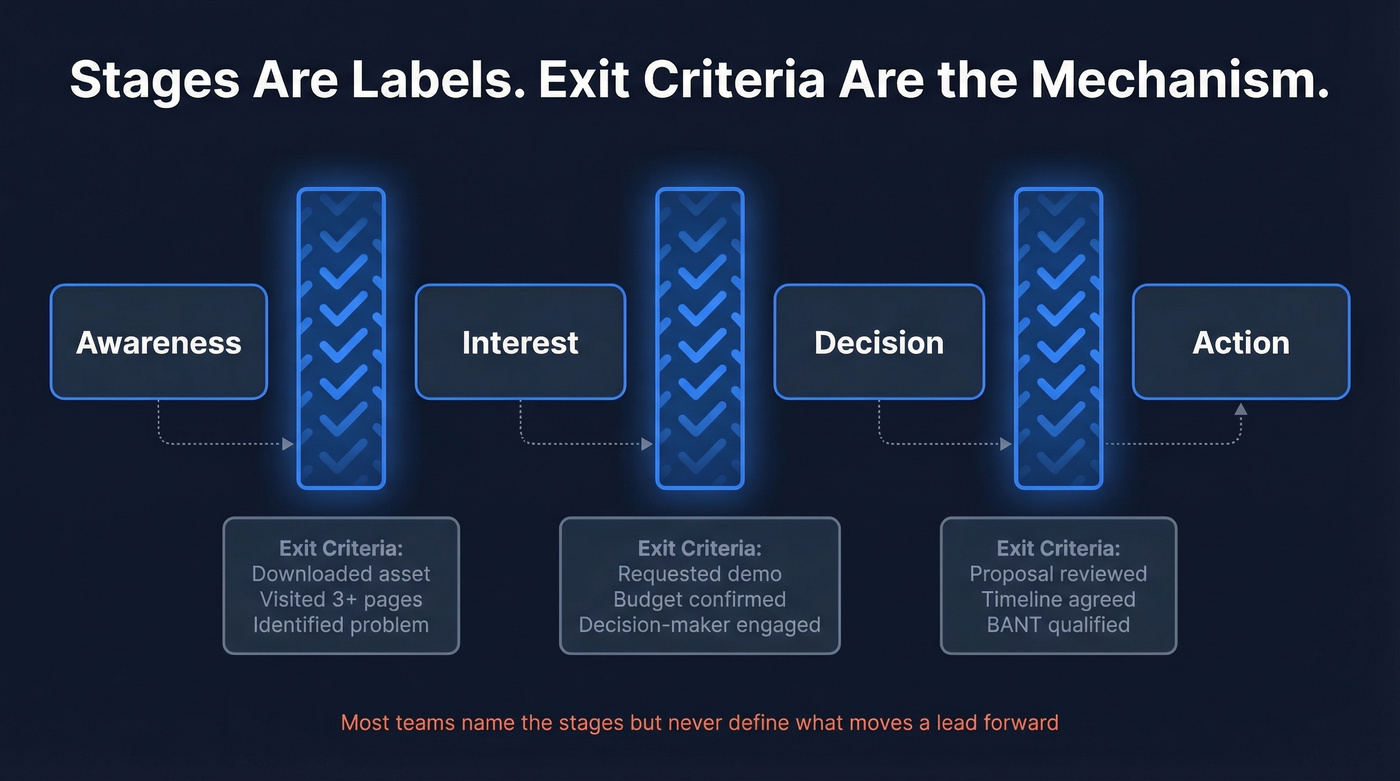
The real engineering happens at the gates between stages. Crazy Egg calls these "milestone events": specific actions that prove a lead has graduated to the next level. BANT (Budget, Authority, Need, Timing) defines what must be true before a lead moves forward. Aaron Ross's Predictable Revenue made the same point years ago - every station has an entry spec and an exit spec, like a manufacturing line.
Stages are labels. Exit criteria are the mechanism. Define the criteria first, then name the stages whatever you want.
5 Steps to Build a Sales Funnel
1. Define Your ICP and Buyer Journey
The biggest mistake we see is building funnels around your org chart instead of the buyer's actual decision process. One agency rebuilt a client's digital journey around real buyer behavior and saw contact form submissions jump 650% year-over-year. That's not a typo. The funnel structure was the bottleneck, not the traffic.
Start by interviewing five to ten recent customers. Ask them what triggered their search, what they compared, what almost made them walk away, and what finally convinced them. Those answers become your stage definitions (use an ideal customer profile template if you need a scoring rubric).
2. Set Stage-Exit Criteria
For each stage, define the milestone that triggers promotion to the next one. A whitepaper download might move someone from Awareness to Interest. A pricing page visit plus a demo request signals "sales-ready" intent.
If you can't answer BANT's four questions about a lead, it isn't qualified - it's just warm. Here's the thing: most teams skip this step entirely, then wonder why their pipeline is full of ghosts who never respond to follow-ups.
3. Map Content to Each Stage
| Stage | Buyer Mindset | Assets |
|---|---|---|
| TOFU | "I have a problem" | Blogs, reports, webinars |
| MOFU | "What are my options?" | Comparisons, ROI calculators, case studies |
| BOFU | "Which vendor?" | Demos, trials, proposals |
| Retain | "Was this worth it?" | Onboarding, upsells, review requests |
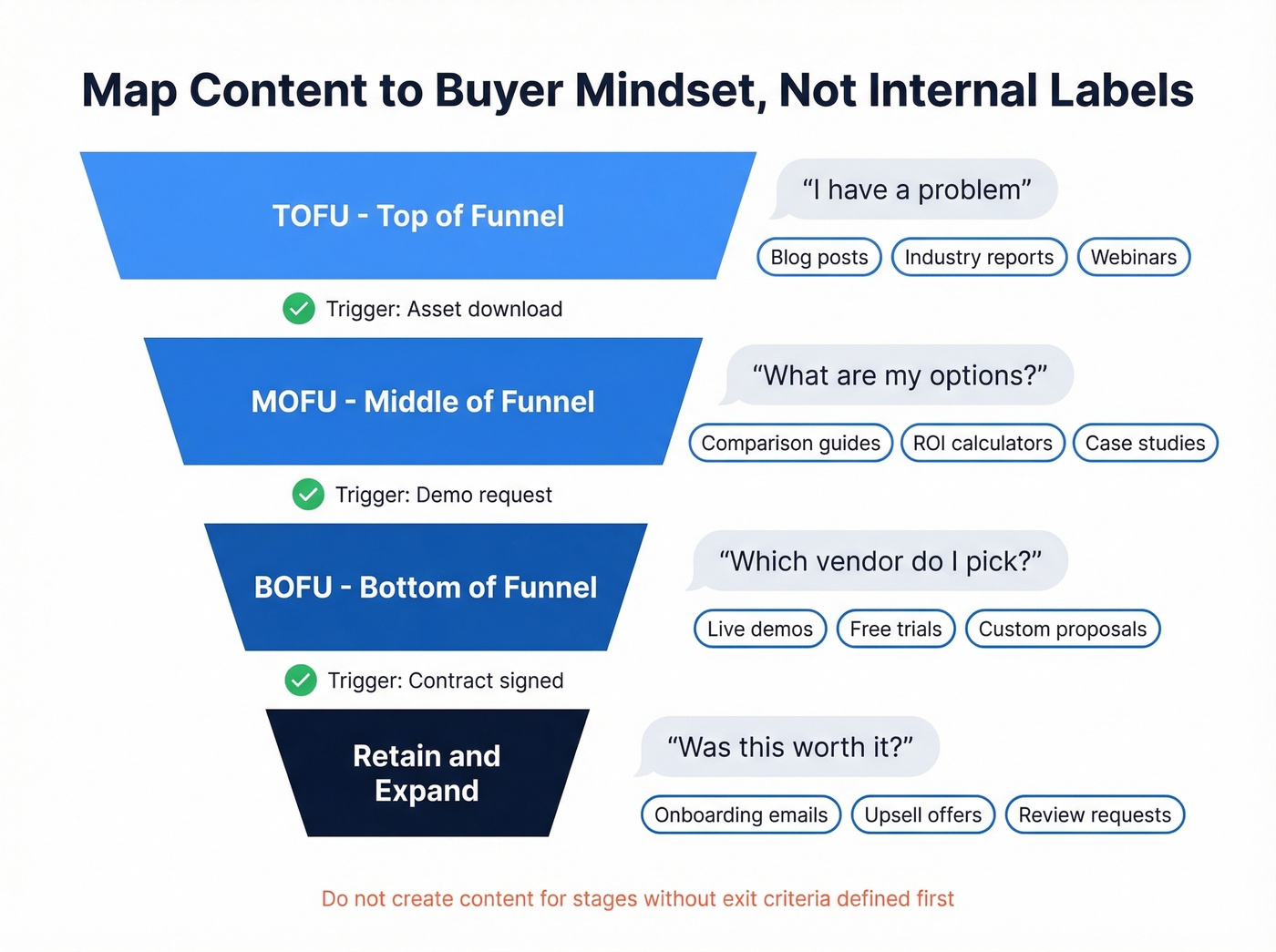
Don't create content for stages you haven't defined exit criteria for. That's how you end up with 47 blog posts and zero pipeline (if you want a tighter structure, start from a B2B sales funnel template).
4. Build Lead Capture and Nurture
Two-step forms - where you capture the email first, then ask for details on the next screen - convert 20-40% better than single-step forms. Small CTA changes matter too: Unbounce documented a 104% lift just by changing button text from "Sign up for free" to "Trial for free."
Cart abandonment averages around 70% across industries, so build a recovery sequence at 1 hour, 2 hours, 24 hours, and 48 hours.
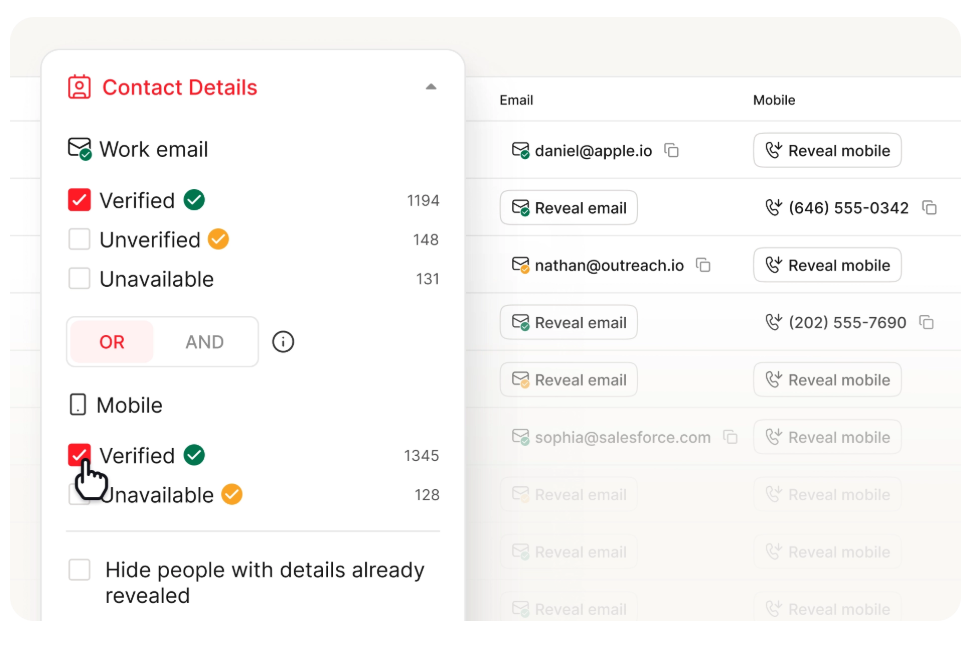
Before you activate any nurture sequence, verify your contact data. If a third of your emails bounce, your funnel isn't broken - your data is. We've seen this pattern repeatedly: teams blame their messaging or offer when the real culprit is stale email addresses that never reach an inbox. Prospeo's 5-step verification on a 7-day refresh cycle keeps bounce rates under 4%, which means your sequences actually land (and if you're diagnosing issues, start with email bounce rate benchmarks and causes).
5. Instrument Measurement
Track pipeline velocity with this formula:
(Opportunities x Win Rate x Avg Deal Size) / Sales Cycle Length
Most B2B conversions involve 5-8 touchpoints, and data-driven attribution is typically 30% more accurate than last-click models. In our experience, teams that set up stage-to-stage tracking from day one optimize 2-3x faster than those who try to retrofit it six months in. The data compounds - every week without measurement is a week of invisible leaks (use a dedicated funnel metrics checklist to avoid blind spots).

A perfectly designed funnel still fails when emails bounce. Prospeo's 5-step verification and 7-day data refresh keep bounce rates under 4% - so your nurture sequences actually reach buyers. At $0.01 per verified email, bad data is no longer an excuse for a leaky funnel.
Stop blaming your funnel when the real problem is stale contact data.
Funnel Benchmarks by Industry
Use these First Page Sage benchmarks as your diagnostic baseline. When a stage falls significantly below these numbers, that's where your funnel is leaking (and if you need more context, compare against broader sales conversion rate benchmarks too).
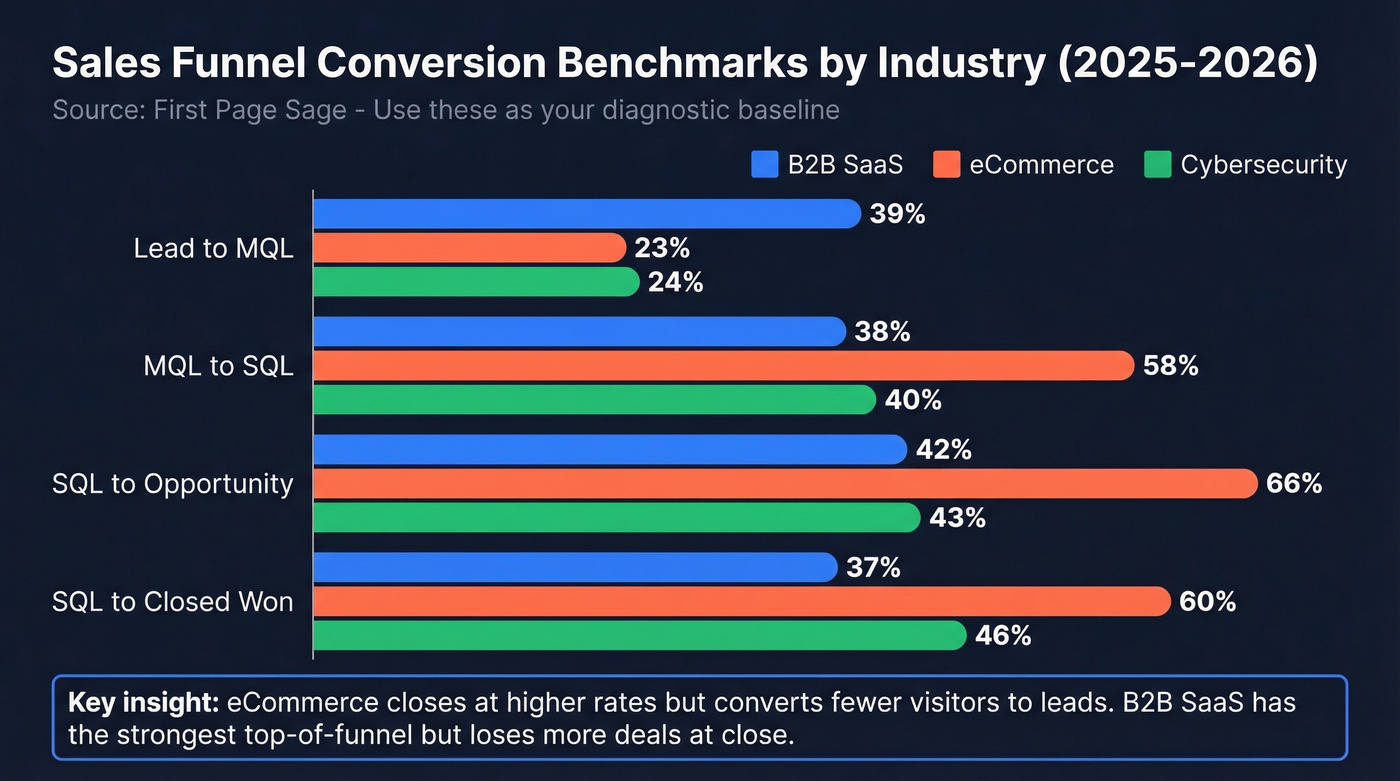
| Industry | Lead-to-MQL | MQL-to-SQL | SQL-to-Opp | SQL-to-Closed |
|---|---|---|---|---|
| B2B SaaS | 39% | 38% | 42% | 37% |
| eCommerce | 23% | 58% | 66% | 60% |
| Cybersecurity | 24% | 40% | 43% | 46% |
| Overall range | 1-5% visitor-to-lead | 3-10% end-to-end | 6.6% median landing page | 15-30% Opp-to-Closed |
A recurring question on r/DigitalMarketing is whether funnels are even still relevant in 2026. They are - but only if designed around behavior, not labels.
A Real Funnel With Real Numbers
One documented case study ran a webinar-based funnel for two months: $6,937 in ad spend generated $27,813 in total revenue. The webinar opt-in page converted at 30%, cost per lead was $4, and roughly 45% of total sales came from the backend nurture sequence - not the initial pitch.
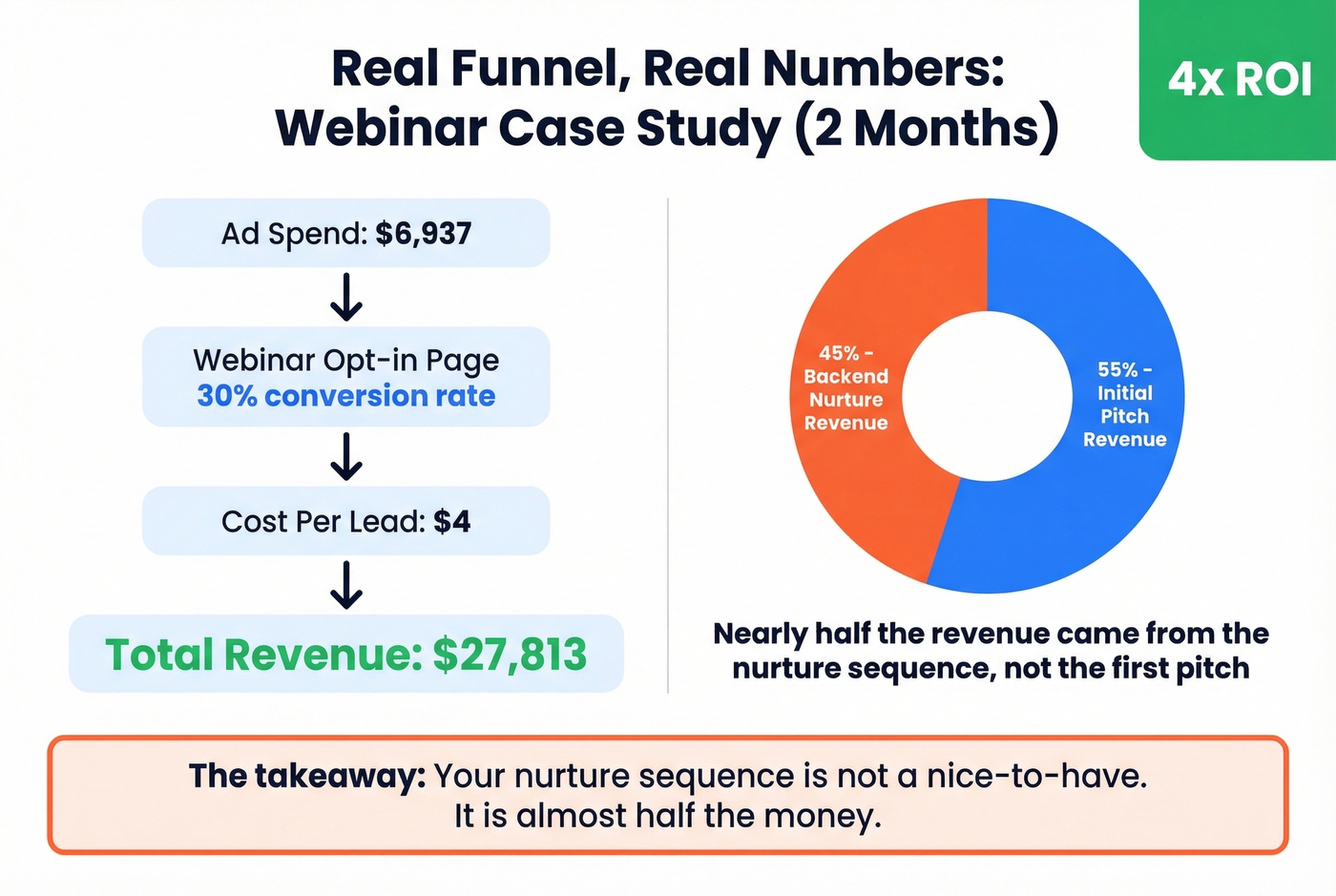
Let's be honest about what that means. The nurture sequence isn't a nice-to-have. It's nearly half the revenue.
If your average deal size is under $5k, you don't need a seven-stage funnel with marketing automation. You need a landing page, a three-email nurture, and a calendar link. Complexity kills small-deal funnels faster than anything else. Skip the elaborate multi-branch workflows until your deal size justifies them (and borrow proven sales follow-up templates so the sequence actually gets replies).
Three Mistakes That Kill Conversions
Building around your org chart. When marketing measures MQLs and sales measures SQLs with different definitions, leads fall through the gap. We've watched teams argue for weeks about what counts as "qualified" while actual buyers go cold. Design around the buyer journey, not your reporting structure (this is one of the most common sales pipeline challenges in practice).
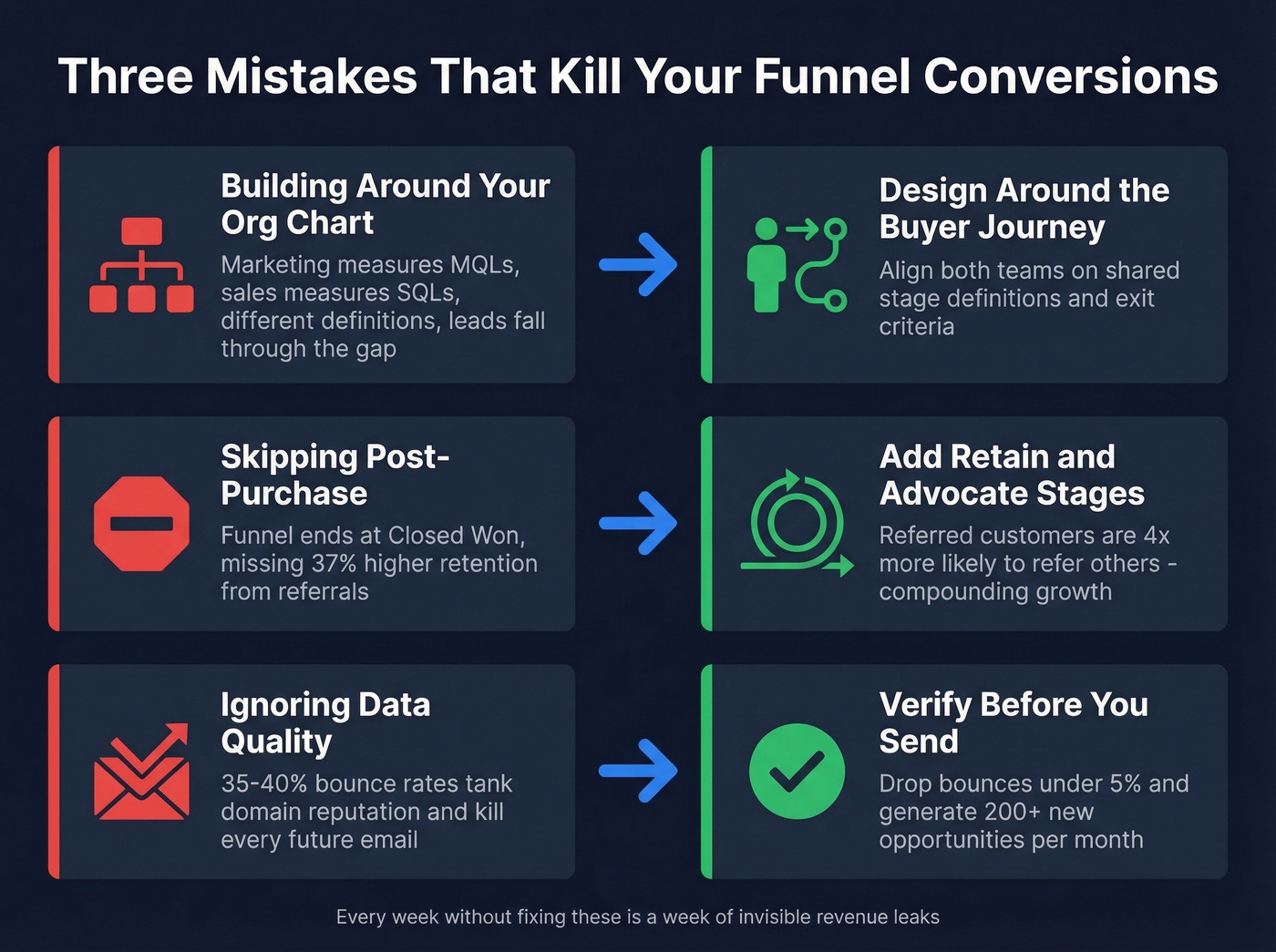
Skipping post-purchase. Referred customers have 37% higher retention rates and are 4x more likely to refer others. If your funnel ends at "Closed Won," you're leaving compounding growth on the table. Add a retention and advocacy stage - what HubSpot calls the "flywheel" model.
Ignoring data quality. Snyk's outbound team was running 35-40% bounce rates. After switching to Prospeo, bounces dropped under 5% and they generated 200+ new opportunities per month. Bad data tanks domain reputation and makes every future email harder to deliver - it's a compounding problem that gets worse the longer you ignore it (see the full email deliverability guide for root-cause fixes).
FAQ
What's the difference between a sales funnel and a sales pipeline?
A sales funnel maps the buyer's journey from awareness to purchase. A pipeline maps your rep's activities - calls, demos, proposals. Design the funnel around buyer behavior first, then align your pipeline stages to match.
How many stages should a sales funnel have?
Most effective B2B funnels use 4-6 stages. Fewer than four and you lose visibility into where leads stall; more than six adds friction without improving conversion. Match stage count to your average deal complexity.
What's a good funnel conversion rate?
For B2B SaaS, expect roughly 39% Lead-to-MQL and 37% SQL-to-Closed based on First Page Sage benchmarks. eCommerce funnels typically see higher close rates (around 60%) but lower top-of-funnel conversion. Anything below 3% end-to-end needs diagnosis.
How do I fix high bounce rates in my nurture sequences?
Start with data quality - verify every email before it enters a sequence. After that, check send frequency and subject-line relevance at each stage. If you're still seeing bounces above 5%, your list source is the problem, not your copy.
You just mapped ICP, exit criteria, and content to every stage. Now you need verified contacts to fill it. Prospeo gives you 300M+ profiles with 30+ filters - buyer intent, technographics, job changes, funding - so the leads entering your TOFU actually match the ICP you defined in step one.
Build the funnel, then fill it with contacts that convert.