

How to Develop a Go-to-Market Strategy That Doesn't Fail
90% of startups fail. 95% of new product launches fail. And of the startups that don't make it, 42% cite "no market need" as the reason - they built something nobody asked for, then wondered why nobody bought it. Knowing how to develop a go-to-market strategy is what keeps you from launching blind.
Here's the quick version: A GTM strategy boils down to a few core decisions - who you're selling to, what you'll say to them, how you'll reach them, what you'll charge, and what it costs to acquire a customer. Plus the KPIs that prove it's working. If you only do one thing, talk to 20-30 customers before you build anything else.
What a GTM Strategy Actually Is
A go-to-market strategy isn't a marketing plan. Marketing plans cover demand gen, brand awareness, and campaign tactics. A GTM strategy sits above all of that - it's the full system for getting a product into the hands of paying customers, from ICP definition through pricing, sales motion, distribution channels, and success metrics. If you're serious about building a GTM plan that holds up under pressure, treat it as an operating system, not a slide deck.
Pick Your GTM Motion First
Before channels, messaging, or pricing - pick your motion. This single decision shapes everything downstream.
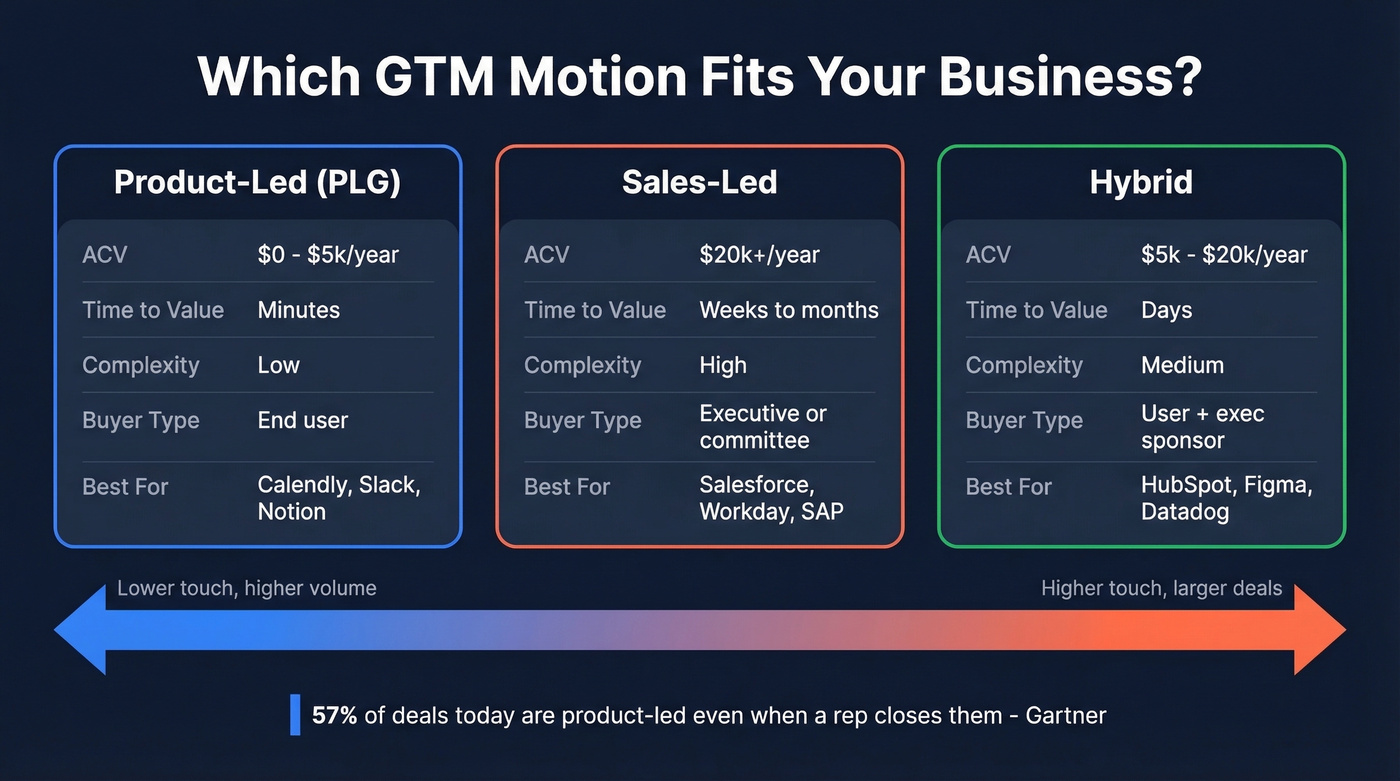
PLG companies grow revenue 30% faster with 50% lower CAC compared to sales-led peers. But PLG only works when time-to-value is measured in minutes, not weeks. Calendly's TTV is about 30 seconds - create a scheduling link, done. If your product requires a 45-minute demo and a security review, that's not PLG territory.
The ACV threshold is the simplest decision rubric. Below $5k/year, PLG is usually the best fit. At $20k+/year, you typically need sales-led. The middle ground is hybrid - and Gartner's data shows that in 57% of deals today, the product itself leads the sales process even when a rep closes it.
| Signal | PLG | Sales-Led | Hybrid |
|---|---|---|---|
| ACV | $0-5k | $20k+ | $5k-20k |
| TTV | Minutes | Weeks/months | Days |
| Complexity | Low | High | Medium |
| Buyer | End user | Executive / committee | User + exec sponsor |
B2B vs B2C: Why Your Approach Changes
Your GTM motion also depends on whether you're selling to businesses or consumers. The mechanics are fundamentally different, and generic GTM advice that ignores this distinction is mostly useless.
| Dimension | B2B | B2C |
|---|---|---|
| Decision-maker | 6-10 person committee | Individual |
| Sales cycle | 6-12 months | Minutes to days |
| Buying driver | ROI / business impact | Emotion / convenience |
| Key channels | Email, ABM, webinars, sales | Social, influencers, SEO |
| Pricing | Negotiable / tiered | Fixed / transparent |
| Messaging focus | Problem -> outcome -> proof | Aspiration -> identity -> urgency |
B2B buying complexity is the reason most generic GTM advice falls flat. You're not convincing one person. You're navigating a committee where the CFO cares about ROI, IT cares about security, and the end user just wants something that doesn't suck.

B2B buying committees have 6-10 decision-makers. You need verified contact data for every one of them. Prospeo's 300M+ profiles with 30+ filters - buyer intent, technographics, job changes, headcount growth - let you turn your ICP definition into a ready-to-contact list in minutes, not weeks.
Stop building GTM strategies on bad data. Start with 98% accuracy.
7 Steps to Build Your GTM Strategy
1. Define Your ICP
"Targeting all mid-market companies" is targeting nobody. Most teams skip ICP rigor and jump straight to channels and copy - and then wonder why nothing converts.
If you need a starting point, use an ICP definition template and scoring rubric before you write a single outbound sequence.
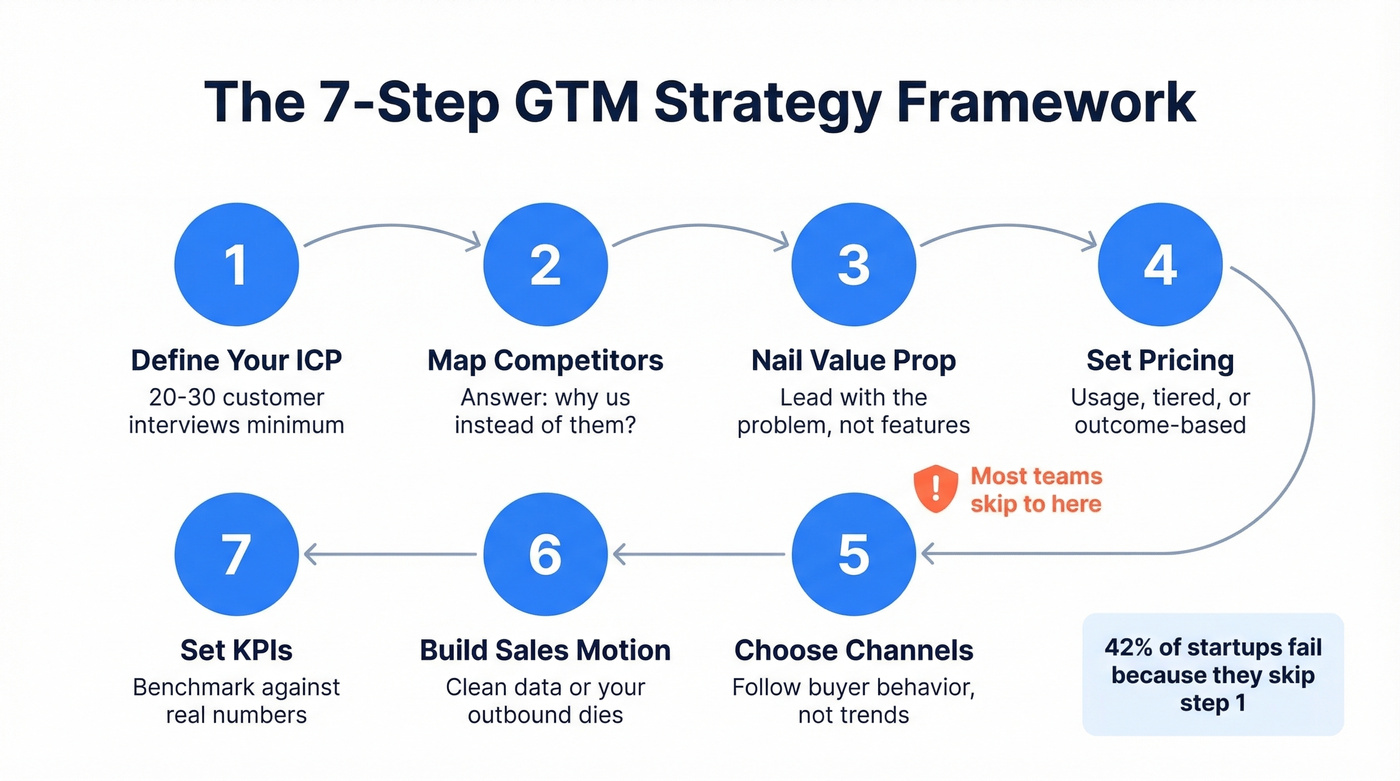
Run 20-30 structured interviews minimum. Ask what they've tried, what failed, and what they'd pay to fix it. We've found that the patterns from those conversations are worth more than any market report you'll ever commission. This research phase is the foundation of any go-to-market strategy that actually reflects reality.
2. Map the Competitive Landscape
According to Crayon's research, only 53% of businesses conduct competitive analysis at least quarterly. The other 47% are flying blind.
You don't need a 50-page report. You need a clear answer to "why us instead of them?" One sentence. If you can't articulate it, your reps definitely can't either, and your prospects will default to whoever they've already heard of. (If you want a system for this, build a lightweight competitive intelligence cadence.)
3. Nail Your Value Proposition
Feature-first positioning is a top failure mode. Nobody cares that you have "AI-powered analytics with real-time dashboards." They care that you cut their reporting time from 4 hours to 15 minutes.
Lead with the problem you solve, not the features you built. The HBS startup framework treats value proposition as a core component of the broader business model - your GTM has to reflect it. This is also where B2B brand positioning stops being theory and starts driving conversion.
4. Set Your Pricing Model
Hybrid pricing models show 105% net revenue retention, and one in three B2B buyers now prefers variable pricing over flat-rate contracts. Your pricing model signals your motion: usage-based fits PLG, tiered seat-based fits sales-led, and outcome-based pricing is where the market's heading.
Here's the thing: if your deal size sits below $10k annually, you probably don't need a sales team at all. Put that headcount budget into product and let the product sell itself.
5. Choose Channels From Buyer Behavior
The B2B Institute's 95-5 rule says 95% of your potential buyers are out-of-market at any given time. Only 5% are actively looking.
Channel strategy starts from how buyers discover and evaluate - not from your budget allocation. For B2B, that typically means outbound email, content that builds trust during the 95% phase, and ABM for high-value accounts. Don't pick channels because they're trendy. Pick them because your buyers are there. If outbound is part of your mix, lean on proven sales prospecting techniques instead of reinventing the wheel.
6. Build Your Sales Motion
This is where strategy meets execution - and where most GTM plans fall apart. Outbound only works when the data underneath it is clean. We've watched teams launch beautiful sequences and immediately get crushed by bounces, which tanks sender reputation fast and takes weeks to recover from.
If you're running cold email, follow a real email deliverability checklist before you scale volume.

Prospeo's database covers 300M+ professional profiles with 30+ search filters - buyer intent, technographics, job changes, headcount growth, funding signals - so you can translate your ICP definition directly into a prospect list. The 98% email accuracy and 7-day data refresh cycle mean you're not burning your domain on stale contacts.
7. Set KPIs With Real Benchmarks
55% of companies don't even know their CAC. Set targets against real benchmarks, not aspirational guesses. (If you need a deeper breakdown, start with funnel metrics and work backward.)
| Metric | Benchmark | Achievable Target |
|---|---|---|
| Web -> Lead | 2.5% | 1.25% (conservative for early-stage) |
| Google Ad CTR | 2.41% | 4%+ (with tight targeting) |
| Email open rate | 15.4% | 21%+ (with personalization) |
| Email CTR | 7.4% | 1-5% for B2B |
| Conversion -> opp | 20% | 22%+ |
| Quote win rate | 35-55% | - |
| Marketing spend | 9.1% of revenue | 2-3% for lean/bootstrapped |
Some targets sit below the benchmark because early-stage companies have less brand equity; others sit above because focused targeting outperforms broad campaigns. Calibrate to your stage, not to a Series D company with a 40-person marketing team.
Do the Funnel Math
Most GTM guides stop at strategy. Let's talk about the math that turns strategy into a plan.
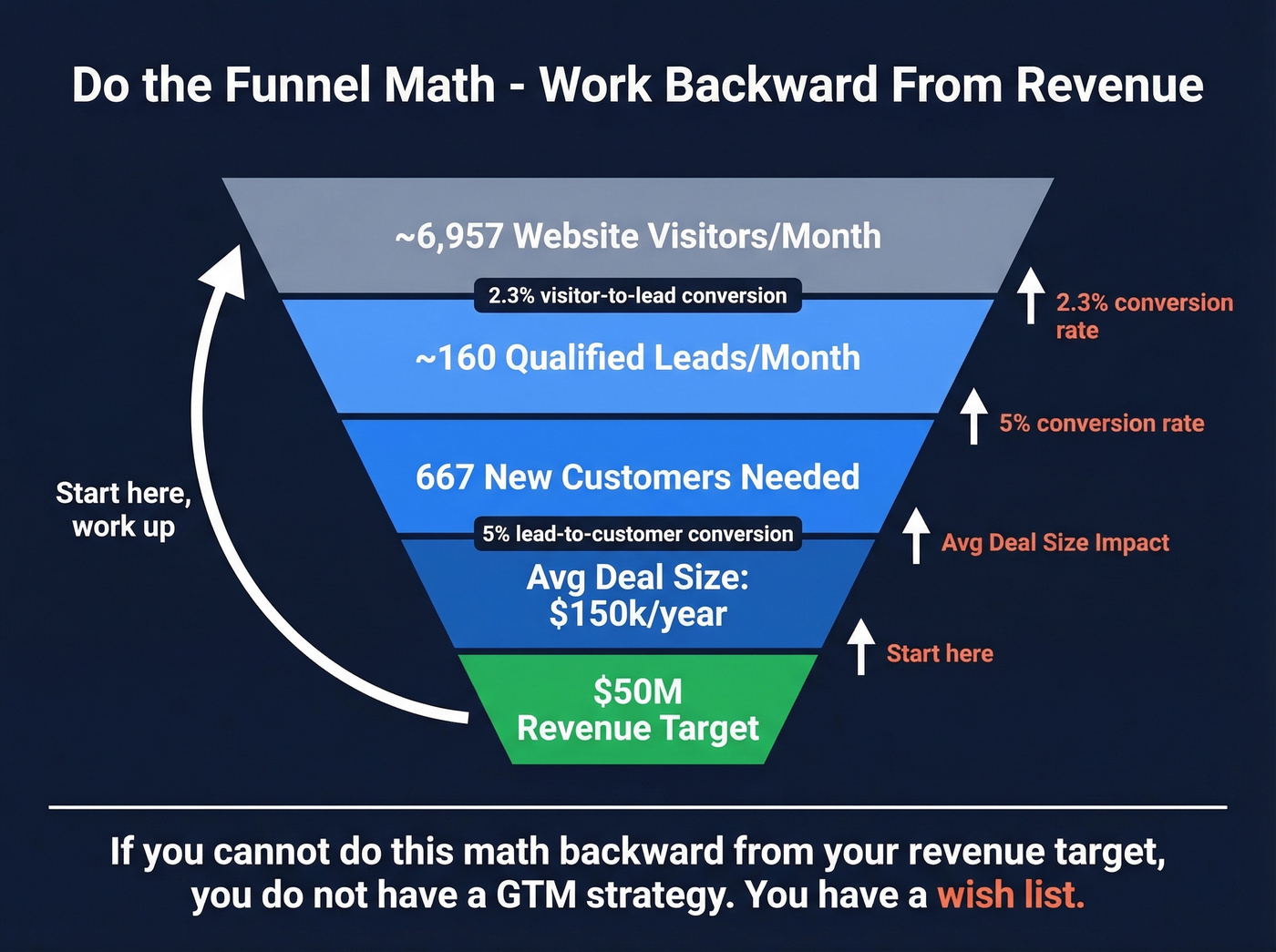
Work backward from a revenue target. Say you need $50M in revenue, your average customer pays $150k/year, and your lead-to-customer conversion rate is 5%. That means you need 667 new customers, or about 160 qualified leads per month. If your visitor-to-lead conversion is 2.3%, you need approximately 6,957 website visitors per month. The math works the same at $2M or $50M - only the numbers change.
If you want to sanity-check your assumptions, compare them to the average B2B lead conversion rate benchmarks.
If you can't do this math backward from your revenue target, you don't have a GTM strategy. You have a wish list. Every channel, every budget line, every hire should trace back to these numbers.
Need a starting framework? Smartsheet offers free GTM templates that map out timelines, ownership, and channel plans - useful scaffolding while you're building your plan from scratch.
5 GTM Mistakes That Kill Launches
These aren't theoretical. Our team has seen every one of them sink a launch.
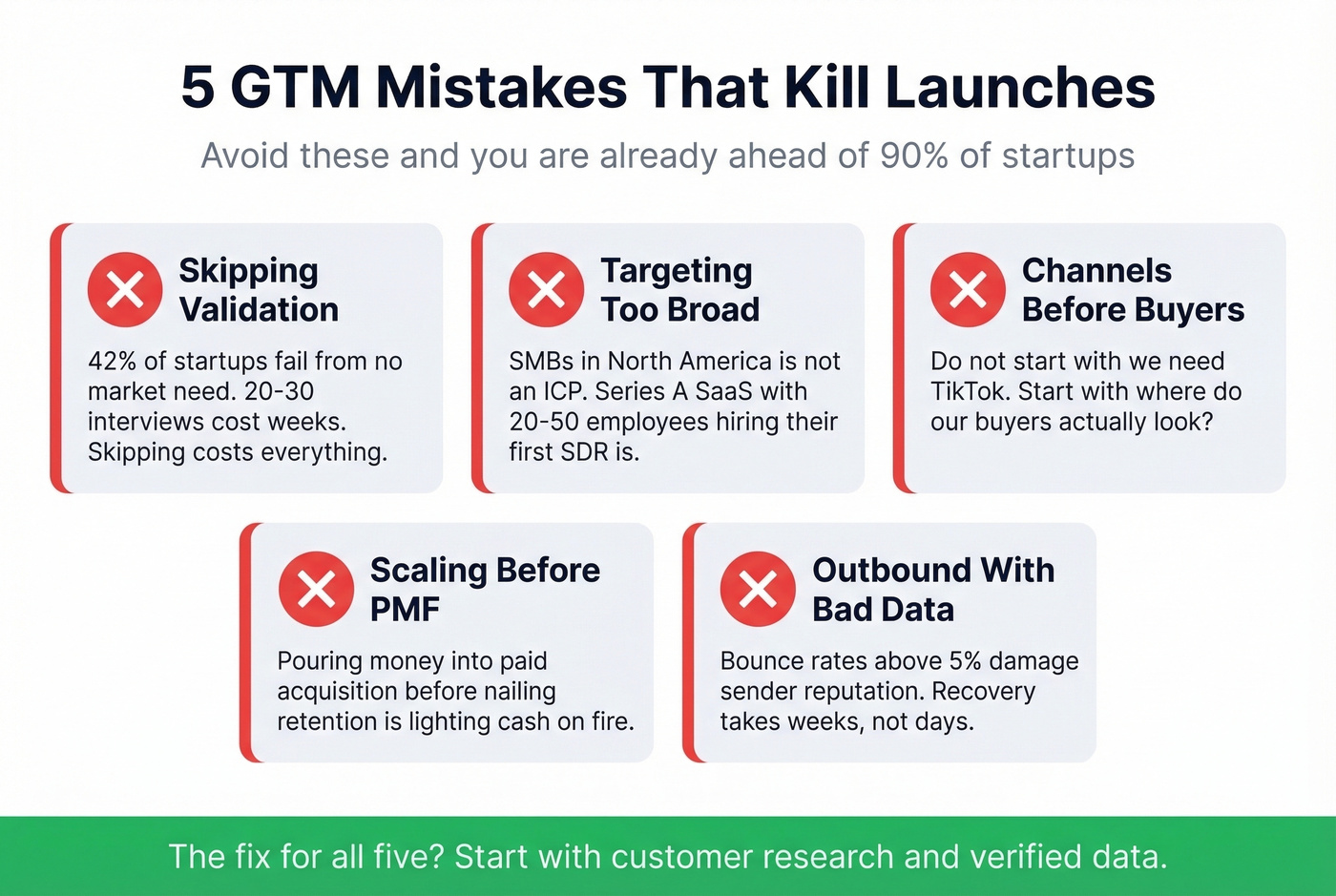
Skipping validation. 42% of startups fail from no market need. Twenty to thirty customer interviews cost you a couple weeks. Skipping them costs you everything.
Targeting too broad. "SMBs in North America" isn't an ICP. "Series A SaaS companies with 20-50 employees hiring their first SDR team" is. The difference between those two statements is the difference between a campaign that converts and one that bleeds money.
Choosing channels before understanding buyers. Don't start with "we need to be on TikTok." Start with "where do our buyers actually discover solutions?" Those are very different questions.
Scaling before product-market fit. Pouring money into paid acquisition before you've nailed retention is lighting cash on fire. Top sellers close deals 3x faster and generate 11x more revenue per day - but only when the product delivers.
Sending outbound with bad data. Bounce rates above 5% damage your sender reputation, and recovery takes weeks. Verify every email before you hit send. Skip this step and you'll spend more time repairing your domain than closing deals. (If you're troubleshooting, start with email bounce rate benchmarks and fixes.)
You just defined your ICP and mapped your channels. Now you need the contacts. Prospeo delivers 98% email accuracy on a 7-day refresh cycle - so your outbound sequences actually land. At $0.01/email, your CAC stays low while your pipeline grows.
Launch your GTM motion with data that won't tank your sender reputation.
FAQ
What's the difference between a GTM strategy and a marketing plan?
A GTM strategy covers the full path to market - ICP definition, pricing, sales motion, distribution channels, and success metrics. A marketing plan is one component within it, focused specifically on demand generation and brand awareness campaigns.
How long does it take to develop a go-to-market strategy?
Two to four weeks of focused work, assuming you've completed 20-30 customer interviews. The ICP validation phase takes the longest - rushing it is the single most common reason GTM plans collapse on contact with reality.
What tools do I need to execute a GTM plan?
At minimum: a CRM (HubSpot or Salesforce), a sequencing tool for outbound, and a verified contact data source to build your prospect list. Layer in analytics and intent data as you scale past initial traction.
Can a first-time founder build an effective GTM strategy?
Yes - start with the 7-step framework above but weight step one heavily. First-time founders tend to over-invest in product and under-invest in market understanding. Talk to 30 potential customers before you write a single line of positioning copy.