How to Do B2B Telemarketing: The Practitioner's Playbook
Your SDR just burned through 80 dials and booked zero meetings. Before you blame the script, check the data. The average cold calling success rate is 2.3%, meaning even a decent rep needs 40-45 dials per meeting. But that number assumes clean data. With stale lists and switchboard numbers, you're not doing telemarketing - you're doing data entry with a headset.
Knowing how to do B2B telemarketing well comes down to three things: reaching the right person, saying the right thing, and doing it at the right time. This playbook covers all three with real benchmarks, tested scripts, compliance guardrails, and the activity math you need to staff and forecast properly.
The Short Version
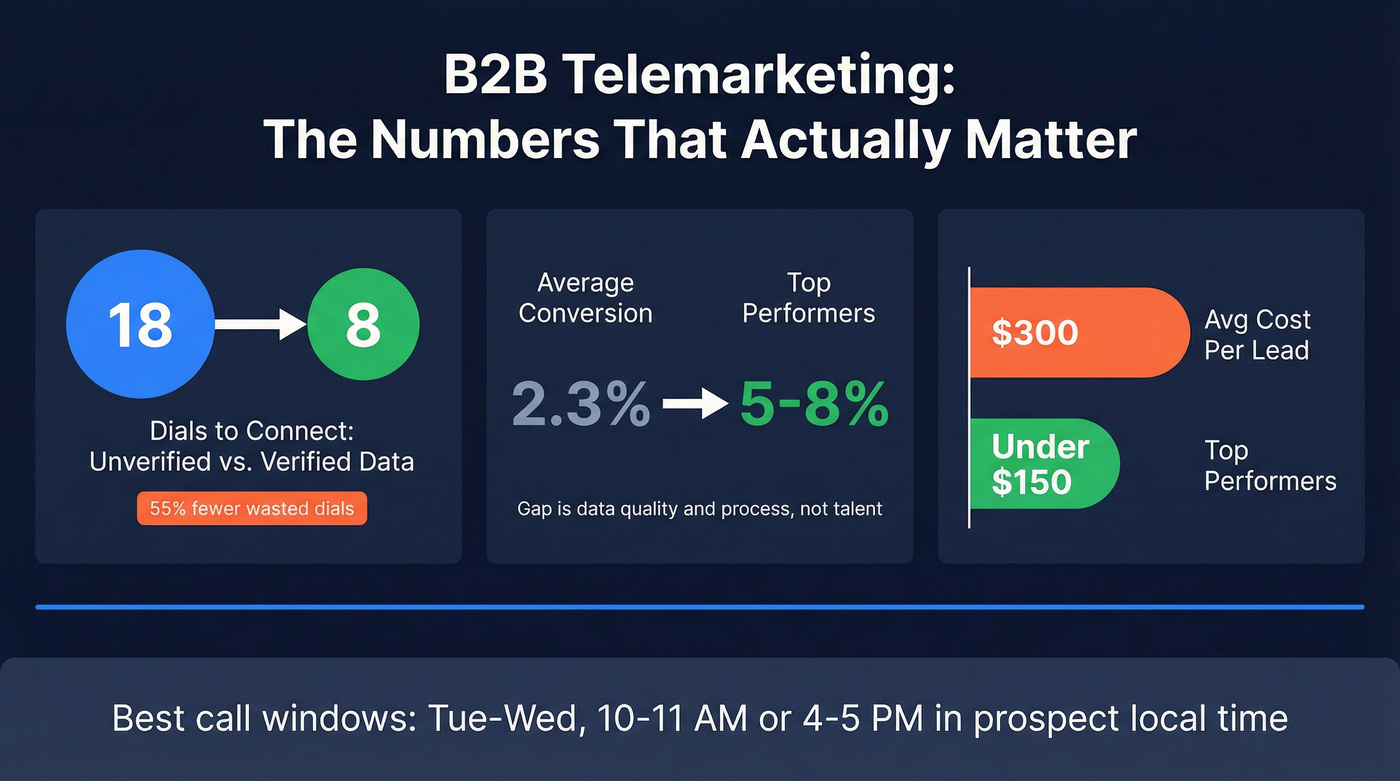
Data quality is the single biggest lever you can pull. Verified direct dials can cut dials-to-connect from 18 down to roughly 8 - that's the difference between an SDR who books meetings and one who burns out. Call Tuesday through Wednesday, 10-11 AM or 4-5 PM in the prospect's local time. Expect around 40-45 dials per meeting at average performance; top teams hit 5-8% conversion by combining clean data, tight scripts, and multi-channel follow-up.
What B2B Telemarketing Actually Is
B2B telemarketing is outbound phone-based outreach to business buyers - typically decision-makers or influencers at target accounts. It covers lead generation calls, qualification conversations, appointment setting, post-event follow-up, and market research. The goal isn't always a sale on the spot. More often, it's booking a meeting, confirming interest, or moving a deal forward.
The confusion starts when people lump B2B and B2C telemarketing together. They're fundamentally different.
| B2B Telemarketing | B2C Telemarketing | |
|---|---|---|
| Audience | Named decision-makers | Mass consumer lists |
| Sales cycle | Weeks to months | Minutes to days |
| Tone | Consultative, peer-level | Scripted, transactional |
| Decision-makers | 3-7 per deal | Usually 1 |
| Campaign types | Lead gen, qualification, ABM | Direct sale, renewals |
B2B calls are shorter, more targeted, and far more dependent on reaching the right person. That last point matters more than anything else in this playbook.
Realistic Benchmarks for 2026
Before you build a campaign, you need to know what realistic performance looks like. Too many teams set quotas based on fantasy math.
| Metric | Average | Top Performers |
|---|---|---|
| Connect rate | 3-10% (avg 5.5%) | 7-10%+ |
| Conversion rate | 2.3% | 5-8% |
| Dials per meeting | 40-45 | 12-20 |
| Cost per lead | $150-$400 (avg $300) | Under $150 |
| Show rate | 60-70% | 80%+ with confirmation |
| Quality convos/day | 4.4 (down 45% since 2014) | 6-8 |
The gap between average and top performers isn't talent. It's data quality and process. On average, it takes 18 dials to connect with a decision-maker. With verified direct dials, that drops to roughly 8. That single variable - reaching the right person on the first try - separates teams that hit quota from teams that churn reps every quarter.
Regional success rates vary more than most teams expect. UK teams see roughly 8% conversion, while the US and continental Europe hover around 6%. If you're running international campaigns, adjust your activity targets accordingly.
Average cold call duration sits at 93 seconds, up from 83 seconds the year prior. Conversations are getting longer, which means prospect engagement is rising when reps actually reach the right person with something relevant. At 93 seconds per conversation and a 5% connect rate, 50 daily dials produce about 3.9 minutes of actual prospect talk time. Every wasted dial on a dead number eats into that window.
In-House vs. Outsourced Teams
This decision shapes everything from cost structure to quality control, so get it right before you build anything.
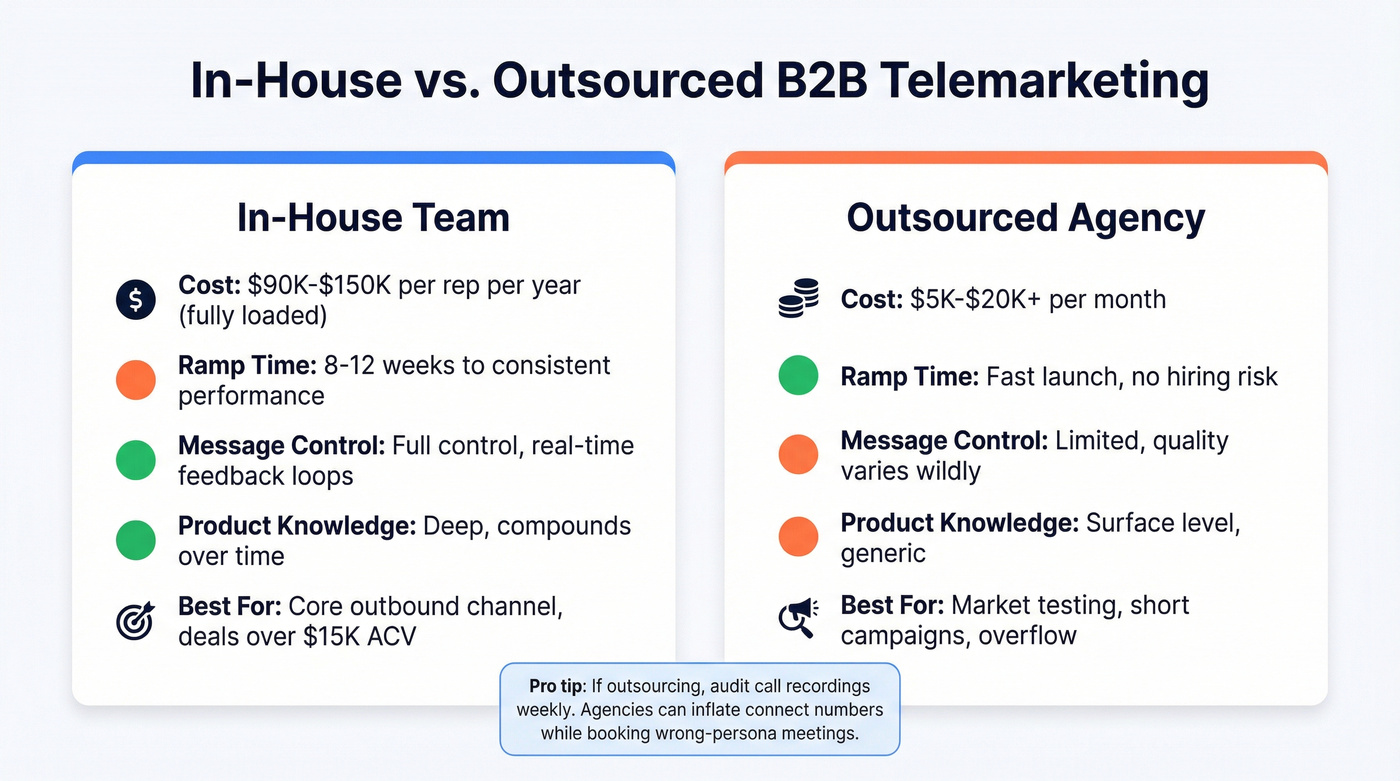
In-house gives you full control over messaging, real-time feedback loops, and deeper product knowledge on every call. A fully loaded SDR typically costs $90K-$150K per year in the US once you factor in salary, variable comp, benefits, tools, and management overhead. The downside: ramp time. New reps usually take 8-12 weeks to hit consistent performance, and you're paying for that learning curve.
Outsourced agencies often charge $5K-$20K+ per month depending on volume, targeting complexity, and whether meetings are guaranteed. You get faster launch times and no hiring risk, but you sacrifice message control. The reps won't know your product the way an internal team does, and quality varies wildly between agencies.
Here's the thing: if your average deal size clears $15K and you're planning to make outbound a core channel, build in-house. The compounding knowledge your reps gain about your market is worth more than the speed of outsourcing. For testing a new market or running a short campaign, outsource - but audit call recordings weekly. We've seen teams get burned by agencies that inflate connect numbers while booking meetings with the wrong persona entirely.

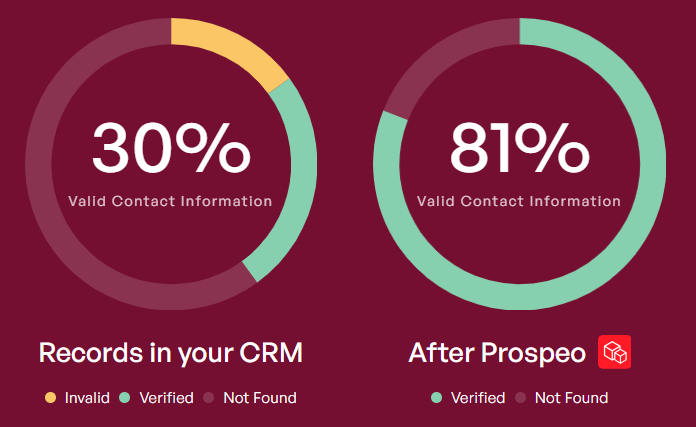
Your article just showed you: 18 dials to connect with unverified data vs. 8 with verified direct dials. Prospeo's Mobile Finder gives you access to 125M+ verified mobile numbers with a 30% pickup rate - refreshed every 7 days so you're never dialing stale numbers.
Stop burning dials on switchboards. Start reaching decision-makers directly.
Step-by-Step B2B Telemarketing Process
Build a Verified List First
Everything starts here. Your ICP definition determines who you call, and your list quality determines whether those calls connect. Get either wrong and nothing downstream matters.
Start with four filters: industry, company size (employee count or revenue), job title or seniority, and tech stack. If you're selling marketing automation, you don't want to call companies already running HubSpot Enterprise - unless your pitch is migration. Technographic data turns a generic list into a targeted one.
List quality is the #1 lever in telemarketing economics. The difference between 18 dials to reach a decision-maker and 8 dials isn't about dialing faster. It's about dialing numbers that actually ring on someone's desk. Prospeo's B2B Database gives you 30+ search filters - buyer intent, technographics, job changes, headcount growth, funding signals - across 300M+ professional profiles with 98% verified email accuracy. The Mobile Finder pulls from 125M+ verified mobile numbers with a 30% pickup rate, and all records refresh on a 7-day cycle. That weekly refresh matters because phone numbers go stale fast: people change roles, companies switch carriers, and a list that was accurate last month can degrade 15-20% within two months.

Before you dial a single number, scrub your list. Remove disconnected numbers, wrong roles, duplicates, and anyone who should be suppressed for DNC or opt-out reasons.
Define Strategy and Targets
Vague goals produce vague results. Tie your targets to the benchmarks above and work backward from revenue.
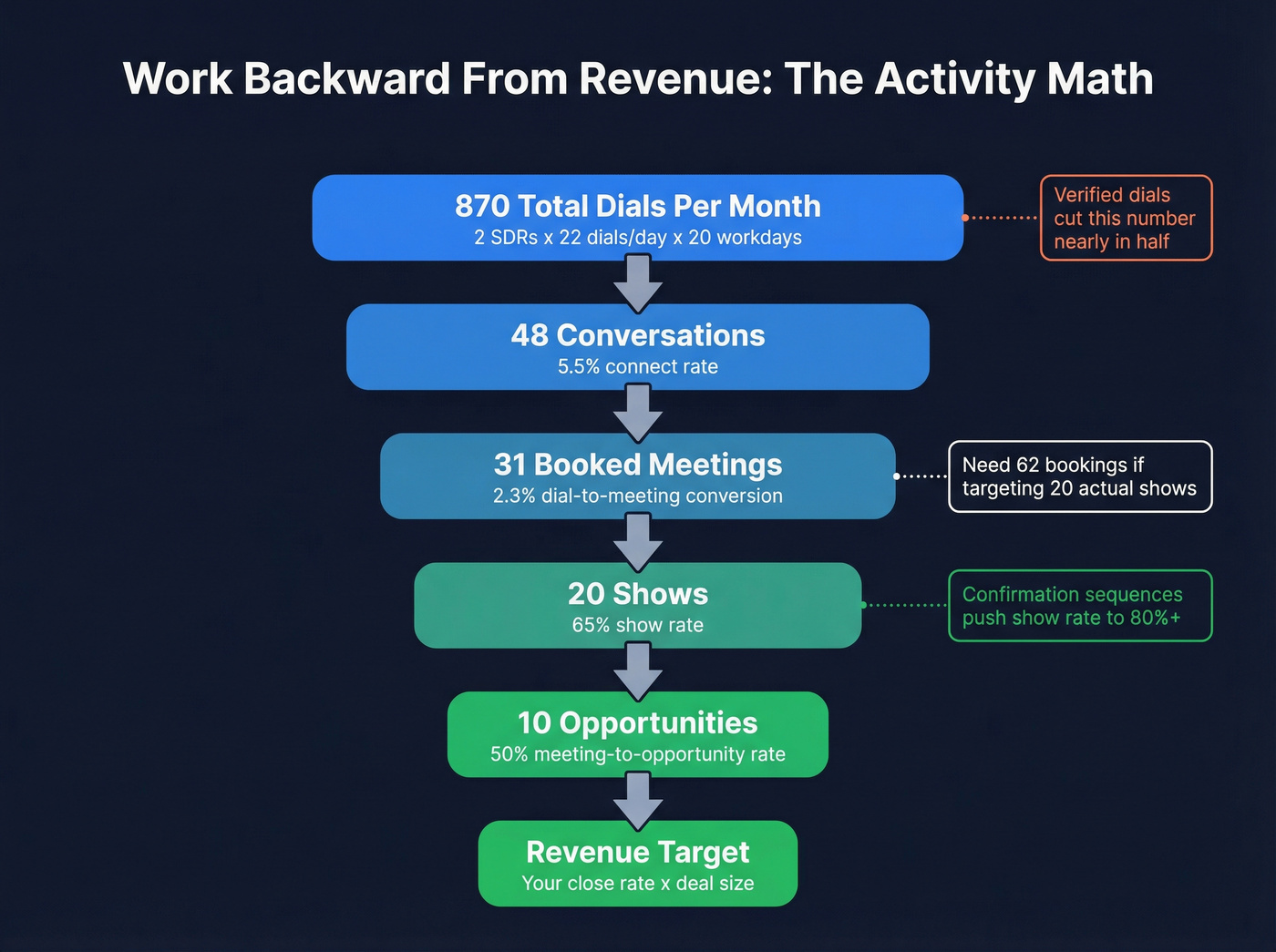
If you need 20 meetings per month and you're performing at the 2.3% dial-to-meeting benchmark, you need about 870 dials per month. Split across two SDRs, that's roughly 435 dials each - about 22 dials per day assuming 20 workdays. Now factor in a 65% show rate: you'll need roughly 31 booked meetings to get 20 actual conversations. If your meeting-to-opportunity rate is 50%, you need 40 shows, which means about 62 booked meetings at a 65% show rate.
Write these numbers on a whiteboard. If your team can't see the math, they can't hit the targets.
Build Your Tech Stack
You need four things. Not twelve. Four.
| Category | What It Does | Price Range |
|---|---|---|
| Data provider | Verified contacts + dials | Prospeo ~$0.01/lead; others ~$5K-$40K+/yr |
| Power dialer | Parallel/auto dialing | $50-$150/user/mo |
| CRM | Pipeline + activity tracking | HubSpot free tier; Salesforce ~$25-$165+/user/mo |
| Call recording | QA + coaching | Often bundled with dialer |
Start with the data layer. The best dialer in the world can't fix wrong numbers. We've seen teams spend months evaluating dialers while their reps dial switchboard numbers from a two-year-old list. We've also watched teams cut their dials-per-meeting in half simply by switching to a provider with weekly data refreshes. Get the data right first, then optimize everything else.
Write Scripts That Sound Human
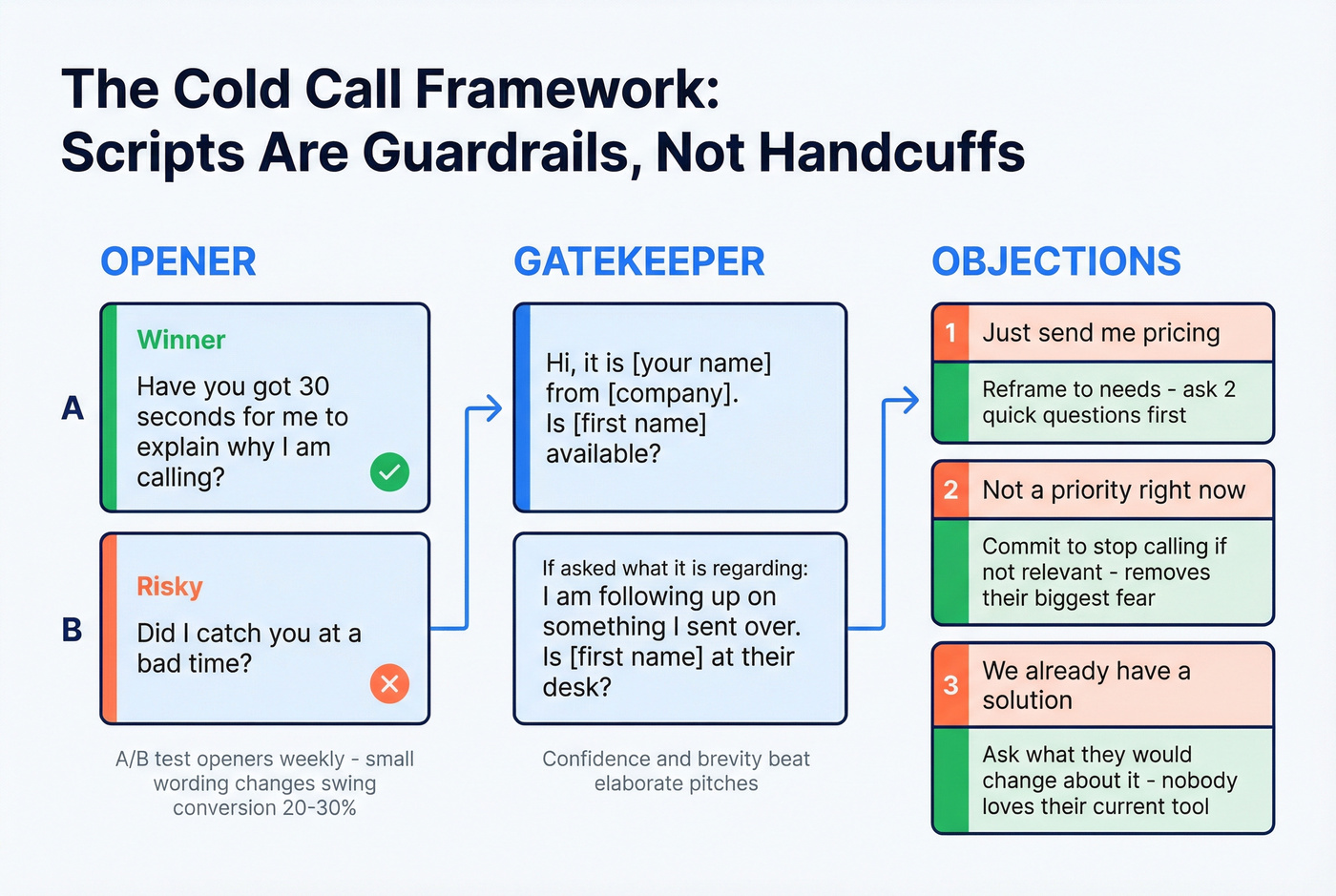
Scripts are guardrails, not handcuffs. If you're reading word-for-word, you've already lost - the prospect can hear it, and they'll hang up. Use these as frameworks: know the structure, then make it your own.
The permission-based opener:
"Hi [first name], it's [your name] from [company]. Have you got 30 seconds for me to explain why I'm calling?"
This works because it respects the prospect's time and gives them a choice. Most people will give you 30 seconds out of curiosity. Once you've got permission, deliver your value prop in two sentences - not a paragraph.
The gatekeeper script:
"Hi, it's [your name] from [company]. Is [first name] available?"
Keep it casual. Don't over-explain. When the gatekeeper asks "What's this regarding?" try: "I'm following up on something I sent over. Is [first name] at their desk?" Gatekeepers respond to confidence and brevity, not elaborate pitches.
The "I don't have time" response:
"Totally understand - you're busy. Can I grab 10 minutes on Thursday at 2 PM? If it's not relevant, I won't call again."
Propose a specific time. "Can I call you back later?" gets a vague "sure" that goes nowhere. A specific day and time gets a real commitment or a real no. Both are better than limbo.
A/B test your openers relentlessly. Run two versions for a week, track connect-to-conversation rates, and kill the loser. Small wording changes - "Have you got 30 seconds?" vs. "Did I catch you at a bad time?" - can swing conversion by 20-30%. The consensus on r/sales is that the "bad time" opener actually invites the prospect to say yes and hang up, while the "30 seconds" version creates curiosity. Most teams never test this, which is why most teams stay average.
Handle Objections Without Flinching
Objections aren't rejection. They're the prospect telling you what they need to hear before they'll engage.
"Just send me pricing." Don't. Pricing without context is a dead end. Instead: "Happy to - but our pricing depends on your team size and what you're trying to solve. Can I ask two quick questions so I send you something relevant instead of a generic sheet?" This reframes the conversation from price to needs.
"It's not a priority right now." Try: "I hear you. Give me two minutes to explain what we do - and if it's genuinely not relevant, I won't call again. Fair?" The commitment to stop calling removes the prospect's biggest fear: that saying "maybe" means endless follow-up.
"We already have a solution for that." This one's actually an opening. "Great - most companies in your space do. Quick question: if you could change one thing about how it works today, what would it be?" Nobody wants to admit they made a bad purchase, but everyone has complaints. Let them vent, and you've got a conversation.
Best Days and Times to Call
Timing isn't everything, but it's a meaningful variable. An analysis of 1.4M+ outbound calls found that Tuesday and Wednesday account for 44% of total demos booked. Friday is the worst day on every metric - skip it if you can.
| Day | Performance |
|---|---|
| Monday | Highest efficiency (1.19% call-to-demo) |
| Tuesday | Best overall; tied for highest positive call rate (4.8%) |
| Wednesday | Strong; best in EMEA markets |
| Thursday | Solid middle performer |
| Friday | Worst across the board |
For time of day, the data points to two windows: 10-11 AM and 4-5 PM local time. Calling between 8-11 AM lifts connection rates by about 15% compared to random times. The worst window? Around 1 PM - lunch kills answer rates everywhere.
Test both morning and late afternoon for your specific market. If you're calling CFOs, early morning before their day fills up tends to work. Sales leaders? Late afternoon when they're wrapping up is often better.
SDR Activity Model - Realistic Math
Let's build a realistic monthly model so you can staff and forecast properly. This assumes roughly 20 workdays per month.
| Stage | Daily | Weekly | Monthly |
|---|---|---|---|
| Dials | 50 | 250 | ~1,000 |
| Connects (5%) | 2.5 | 12.5 | ~50 |
| Meetings booked (2.3%) | ~1.15 | ~5.75 | ~23 |
| Shows (65%) | ~0.75 | ~3.75 | ~15 |
That 23 meetings/month figure is slightly above the 21-meeting benchmark, which means a rep hitting 50 dials per day with average performance should be in the ballpark. But only 30% of reps actually make 50+ dials per day - the rest fall short due to research time, admin work, or bad data forcing redials.
The multi-channel multiplier is real and dramatic. Teams combining calls with email and social touchpoints see 287% better results than single-channel outreach. Your SDRs shouldn't just be dialing - they should be calling into prospects who've already seen an email or engaged with content. Personalized outreach, where the rep references a prospect's recent post, job change, or funding round, consistently outperforms generic calls by wide margins.
Callback reach probability sits around 26.85%, meaning more than a quarter of prospects you leave a voicemail for will call back. That makes voicemail strategy non-optional. Keep voicemails under 30 seconds: state your name and company, give one specific reason to call back, and leave your number twice.
Compliance Rules That Save Your Budget
Look, I know compliance isn't the exciting part. But a bad week of unchecked dialing can cost more than your entire tech stack for the year.
TCPA (US): Penalties run $500-$1,500 per call for violations. You can only dial between 8 AM-9 PM in the prospect's local time. Honor opt-out requests within 10 business days, maintain internal do-not-call lists for at least 4 years, and don't use autodialers to wireless numbers without prior express consent.
GDPR (EU): B2B calls can use legitimate interest as a legal basis, but you need to conduct a Legitimate Interest Assessment. Prospects have the right to object - and you must stop immediately when they do. The ICO's guide to direct marketing is worth bookmarking.
CCPA/CPRA (California): The B2B exemption expired January 1, 2023. B2B calls now fall under full CCPA/CPRA scope, with fines of $2,663 per unintentional violation and $7,988 per intentional violation.
UK PECR: Screen every B2B list against the Corporate Telephone Preference Service before dialing.
The enforcement examples are sobering. Italy fined TIM EUR27.8M for unsolicited calls. The UK's ICO fined Skean GBP100,000 for making 614,342 unsolicited calls to TPS-registered numbers. France hit Futura Internationale with a EUR500,000 penalty for cold calling without consent. These aren't theoretical risks.
Mistakes That Kill Campaigns
Dialing unverified or stale data. If more than 10% of your numbers are disconnected, you're burning SDR hours. Verify every list before it hits the dialer.
Dropping the cadence after two attempts. 93% of conversations happen by the third call attempt. Build cadences of 8-12 touches over 2-3 weeks. Two calls and a shrug isn't a cadence - it's giving up.
Reading scripts word-for-word. We covered this above, but it bears repeating. Internalize the framework, then have a conversation.
No call recording or QA process. You can't coach what you can't hear. Record every call, review a sample weekly, and build a library of "what good sounds like" for new hires.
Ignoring compliance logging. Every opt-out, every DNC request, every consent record needs to be logged and timestamped. One missed suppression can trigger a five-figure fine. Skip this if you enjoy writing checks to regulators.
The math is simple: at 2.3% conversion, every wasted dial on a dead number costs you meetings. Prospeo's B2B Database combines 30+ filters - buyer intent, technographics, job changes, funding - across 300M+ profiles at $0.01/email. Build the list that turns 870 monthly dials into 20 booked meetings.
Build a telemarketing list that actually connects - for a penny per lead.
FAQ
What's a good B2B cold calling success rate?
The average is 2.3%, based on an analysis of 204,000+ calls. Top-performing teams hit 5-8% by combining verified direct dials, strong scripts, and multi-channel cadences. If you're below 2%, your data or your opener needs work before anything else.
How many calls should an SDR make per day?
Most SDRs average 40-50 dials per day, with high performers pushing 50-70 when backed by clean data. Only about 30% of reps consistently hit 50+ daily - the rest lose time to bad numbers, admin tasks, and CRM updates.
Is B2B telemarketing still effective in 2026?
Yes. Multi-channel outbound that includes calls delivers 287% better results than single-channel approaches. The channel isn't dead - bad execution is. Teams with verified data, tight scripts, and disciplined cadences are booking more meetings than ever.
What's the best day and time to cold call?
Tuesday and Wednesday produce the best results, accounting for 44% of demos in a 1.4M-call analysis. For time of day, 10-11 AM and 4-5 PM local time are the strongest windows. Avoid Friday and the 1 PM lunch hour.
How do I get verified phone numbers for outbound calling?
Use a data provider with verified direct dials and a frequent refresh cycle. Prospeo's Mobile Finder covers 125M+ verified numbers with a 30% pickup rate and a 7-day refresh cycle - critical because lists degrade 15-20% within two months. You can export directly to your dialer or CRM with 30+ targeting filters including job title, industry, and buyer intent.