

How to Get Clients for App Development in 2026
You send 200 cold emails. Two replies. One ghosts after the intro call. That's the reality most app development shops face when they first try outbound - and it's not because the work is bad. It's because the approach is broken.
Figuring out how to get clients for app development is the single hardest skill shift a developer makes. Over 376 billion emails hit inboxes daily, and that number keeps climbing. The moment you decide to find your own clients, you stop being a coder and start being a business owner. We've watched dozens of dev shops make this transition, and the ones who survive all run the same basic system. Here's how it works.
The Three-Move Version
Short on time? The entire playbook compressed:
- Pick a niche. "We build apps" loses to "we build investor-ready SaaS MVPs in under 8 weeks" every time.
- Build 3-5 case studies with measurable KPIs. Screenshots aren't proof. Revenue impact is.
- Run a 50-email test with verified contacts. Not 500 spray-and-pray messages - 50 targeted, personalized, deliverable emails.
Everything supports one heuristic: keep acquisition cost low enough that lifetime value hits a 3:1 LTV:CAC ratio. That's the line between a sustainable dev shop and a freelancer on a treadmill.
Pick a Niche and Own It
Generalist positioning kills app development businesses. "We build mobile apps" sounds like everyone else on Clutch. A niche statement - "HIPAA-compliant patient engagement apps for mid-size health systems" - filters out bad-fit leads and lets you charge more.
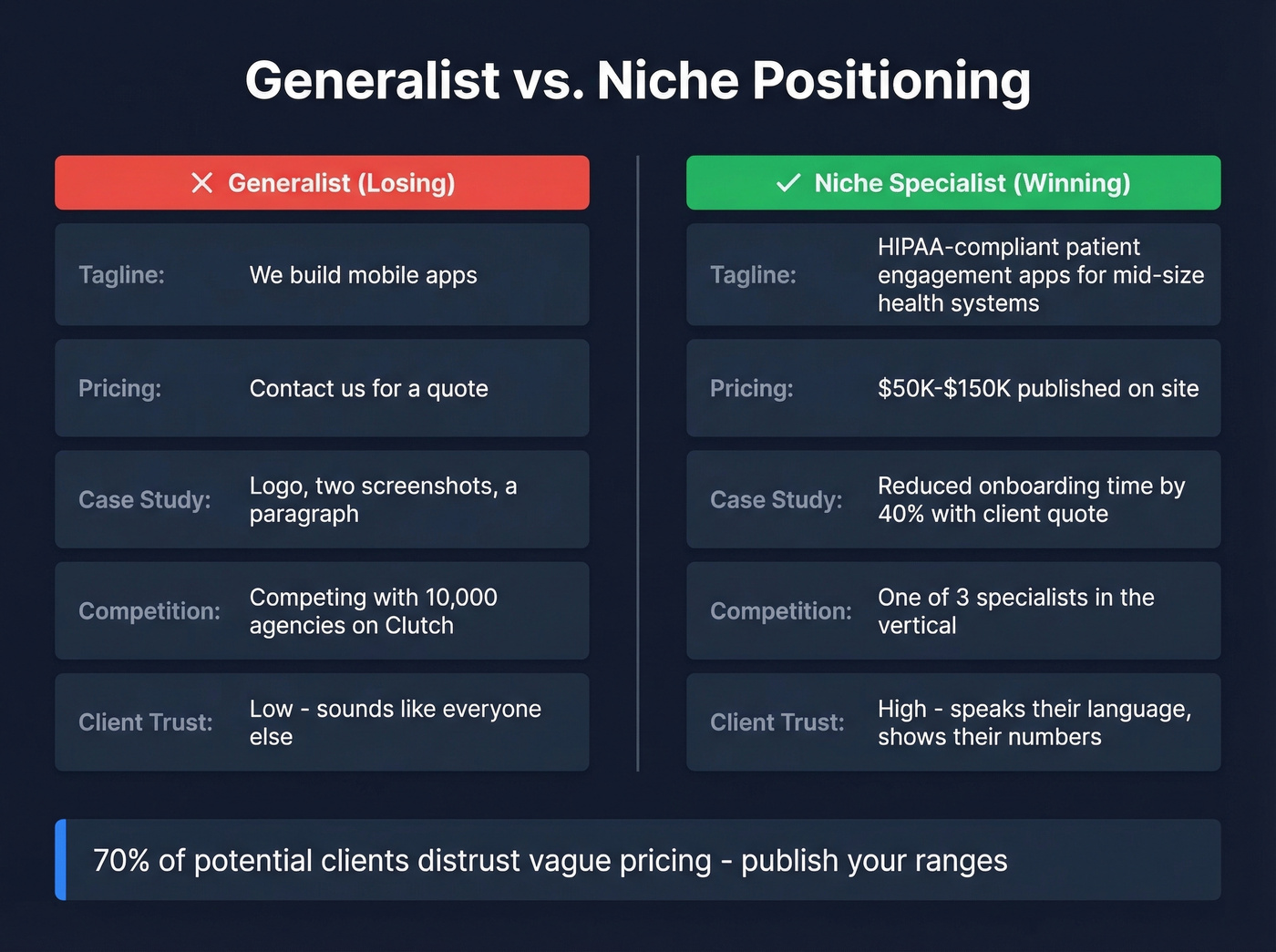
Around 70% of potential clients distrust vague pricing, so publish ranges. As a practical baseline, simple MVPs often land around $15K-$50K, mid-complexity apps with integrations sit at $50K-$150K, and enterprise builds with compliance and multi-platform support push $150K-$500K+. Putting numbers on your site pre-qualifies buyers before they ever book a call. The dev shops that hide pricing aren't being strategic - they're losing leads who assume they can't afford it and never reach out.
Build Proof That Sells
Case studies are your strongest sales asset. But most dev shops do them wrong - a logo, two screenshots, a paragraph about "the challenge." That's not proof.
Lead with the KPI. "Reduced onboarding time by 40%" or "drove 12,000 downloads in 30 days." Include the client's words - a one-sentence testimonial with a name and title beats a paragraph you wrote yourself. Show the before and after. Three to five case studies with tangible, measurable results is enough. You don't need twenty. You need five that make prospects think "I want those numbers."
Win on Freelance Platforms First
Here's the thing about Upwork: it's a launchpad, not a career.
Every decent project attracts 20-50 competing proposals. Win rates sit at 5-12%. Those aren't great odds for long-term business building. But for your first 3-5 testimonials? Unbeatable. Respond early, personalize every pitch, and treat the first few wins as reputation-building - not profit centers. Once you've got case studies, redirect energy toward channels you control. If you're already past this stage and have solid proof of work, skip Upwork entirely and go straight to outbound.

Your cold outreach funnel breaks at the first step if emails bounce. Prospeo verifies addresses at 98% accuracy across 300M+ profiles - so your 50-email test actually reaches 50 decision-makers. The free tier gives you 75 verifications/month to start landing app development clients today.
Fix your deliverability before you write another cold email.
Cold Outreach That Lands Clients
Cold email is where most developers either break through or give up. The math is unforgiving: 17% of cold emails never reach the inbox because the address is wrong. Purchased lists generate 3-4x fewer responses than self-collected contacts. Building your own list isn't optional.
Before you send a single message, verify every address. Prospeo checks emails at 98% accuracy across 300M+ professional profiles, and the free tier covers 75 email verifications per month - enough to test your first campaign without spending a dollar. If you want a deeper checklist, start with an email deliverability guide and then improve sender reputation before you scale volume.

Target companies showing demand signals - new funding, mobile dev job postings, or tech stack changes. Look for companies actively researching app development or digital transformation; that kind of intent signal turns a cold email into a warm one. A simple way to operationalize this is identifying buying signals and building an ideal customer profile you can score leads against. Then send something like this:
Subject: Quick thought on [Company]'s app
Hey [First Name],
Saw [specific trigger - funding round, product launch, mobile dev job posting]. Took 3 minutes to look at your current app - noticed [specific UX or performance issue].
Put together a quick teardown with a few fixes. Want me to send it over? No strings.
Run a sequence of 3-4 emails plus 1-2 social touchpoints over two weeks. If you need structure, use a proven B2B cold email sequence and keep a swipe file of cold email subject line examples. Stay visible without being pushy: engage with something they've published recently, then follow up with a short, relevant note.
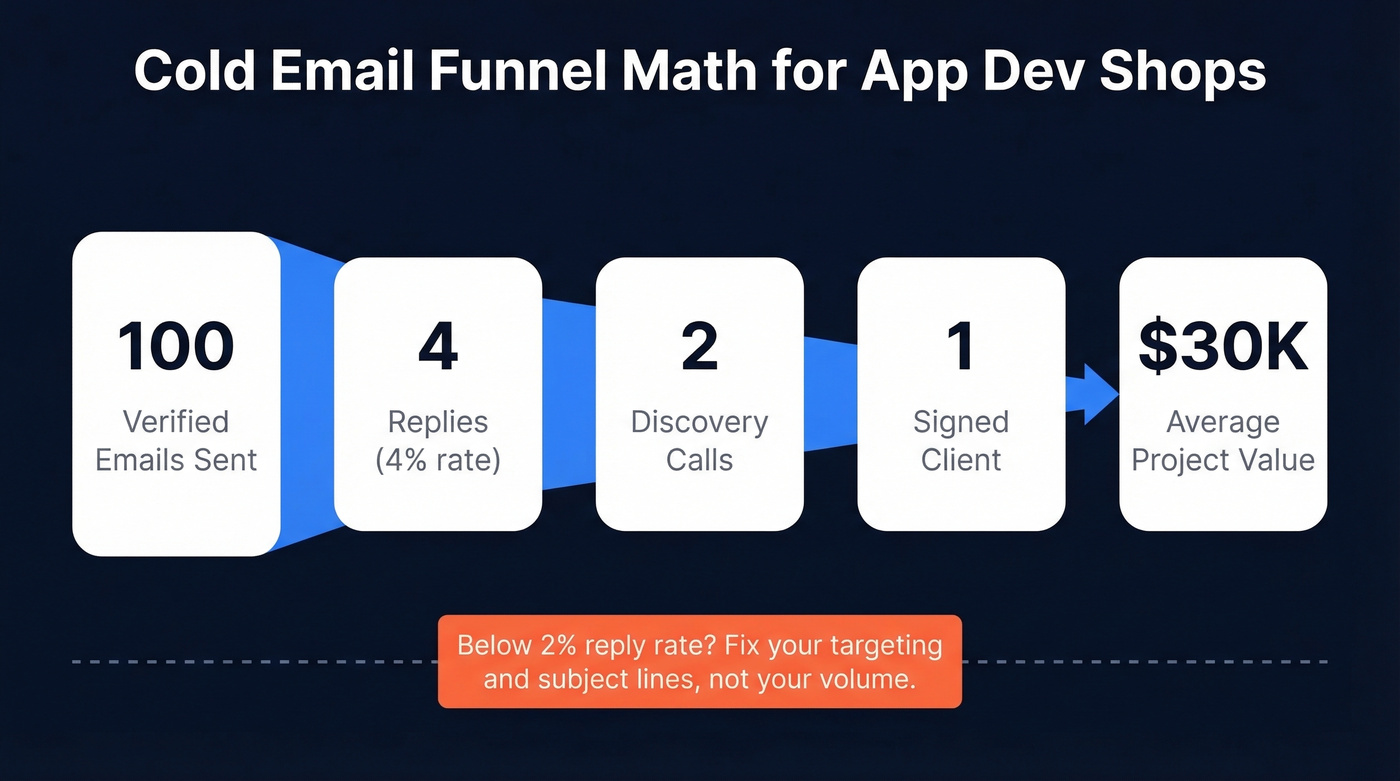
Here's the funnel math: 100 verified emails -> 4 replies -> 2 discovery calls -> 1 client. At a $30K average project, that single client justifies months of outreach effort. A 4% reply rate means you're resonating. If your reply rate sits below 2%, the problem is almost always targeting or subject lines, not volume.
One strong opinion from our team: if your average contract sits below $10K, cold outbound probably isn't worth the effort. Focus on Upwork and referrals until your positioning supports higher-ticket work.
When a prospect replies, send a one-page scoping note within 48 hours - timeline, risks, and a ballpark budget. Speed wins deals in this market.
Use Referrals and Partnerships
Referrals are the cheapest acquisition channel by a wide margin - and the only one where trust is pre-built. Let's look at how channels compare:
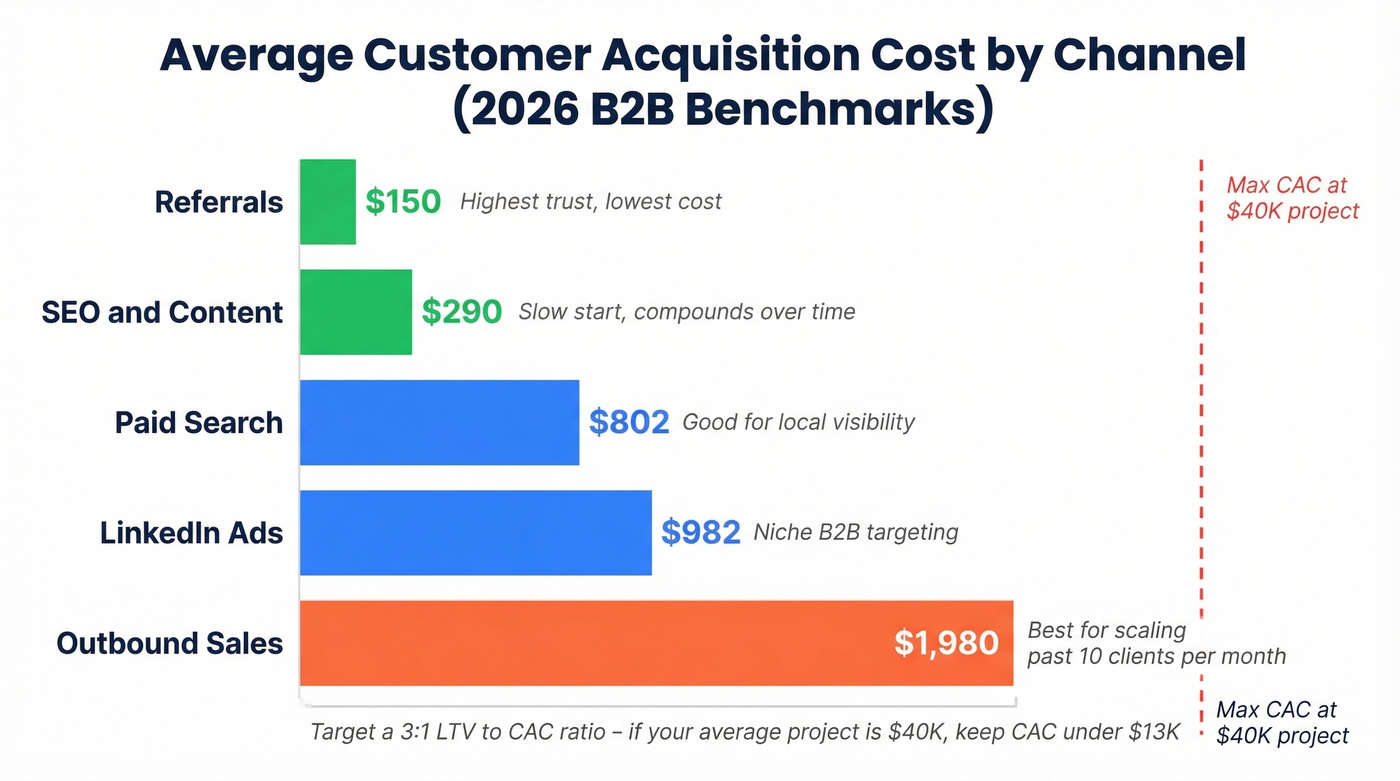
| Channel | Avg. CAC | Best For |
|---|---|---|
| Referrals | $150 | First clients, highest trust |
| SEO / Content | ~$290 | Long-term compounding |
| Paid Search | $802 | Local visibility |
| LinkedIn Ads | $982 | Niche B2B audiences |
| Outbound Sales | $1,980 | Scaling past 10 clients/mo |
Based on 2026 B2B benchmarks from Phoenix Strategy Group. CAC rose 40-60% from 2023 to 2025 and continues trending higher.
The 3:1 LTV:CAC ratio applies here too - if your average project is $40K, keep acquisition cost under $13K regardless of channel. If you want to sanity-check your numbers, map it to cost to acquire customer and track funnel metrics so you know which channel is actually working. Structure a simple referral program: offer a $500-$1,000 fee or a discount on future work. Partner with design agencies and business consultants who serve your niche but don't build apps. We've seen this single move - a warm intro from a design partner - close deals faster than any email sequence.
Build Inbound with Content and SEO
The global application development software market is projected to reach $195.8 billion - demand isn't the problem. Visibility is.
Write content that addresses client challenges, not developer tutorials. "How much does a healthcare app cost in 2026" attracts buyers. "How to implement SwiftUI navigation" attracts other developers. The consensus on r/webdev and r/freelance is that most dev shops blog for the wrong audience entirely - they write for peers instead of prospects. Turn every completed project into a case study blog post. SEO is slow to start but has the lowest CAC of any channel that doesn't depend on your personal network.
Mistakes That Kill Your Pipeline
Taking bad-fit clients for cash. A $5K project from a client who doesn't know what they want will cost you $15K in revisions and reputation damage. Say no.
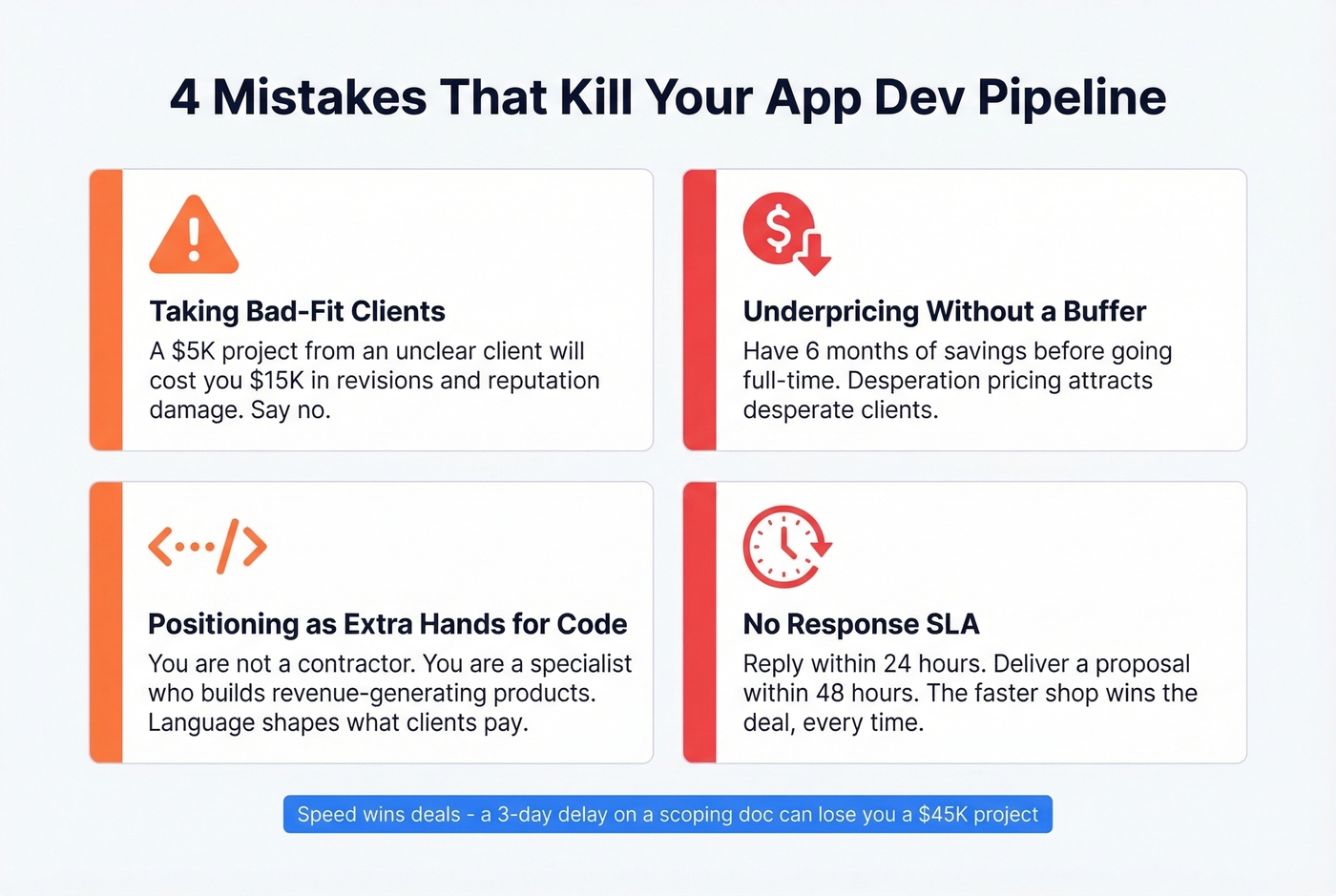
Underpricing without a buffer. Have at least six months of savings before going full-time. Desperation pricing attracts desperate clients, and that cycle is brutal to escape once you're in it.
Positioning as "extra hands for code." You're not a contractor. You're a specialist who builds revenue-generating products. The language you use on your site and in proposals shapes how clients treat you - and what they're willing to pay.
No response SLA. The dev shops that reply within 24 hours and deliver a proposal within 48 hours win more deals than the ones who "get back to you next week." I've personally lost a $45K project because we took three days to send a scoping doc. The client signed with someone faster. Lesson learned.
Finding CTOs and product leaders who actually need app development? Prospeo's 30+ search filters - including funding signals, tech stack data, and buyer intent across 15,000 topics - let you build targeted lists of companies actively researching mobile and software development. At $0.01 per email, your 100-email test costs a dollar.
Build your first prospect list in under ten minutes.
FAQ
How many cold emails to land one app development client?
Plan for 100 verified emails to close one client. At a 4% reply rate, that's 4 replies, typically converting to 2 discovery calls and 1 signed project. The key word is "verified" - unverified lists inflate volume while tanking deliverability.
What does it cost to acquire an app development client?
Referrals average around $150 per client, SEO runs about $290, and outbound sales averages $1,980. Target a 3:1 LTV:CAC ratio - if your average project is $40K, keep acquisition cost under $13K.
Is Upwork worth it for app developers in 2026?
Only as a starting point. Expect 20-50 competing proposals per project and a 5-12% win rate. Use it to collect your first 3-5 testimonials, then shift to outbound and referrals where you control the pipeline.
How do I make sure my cold emails reach the inbox?
Verify every address before sending - catching invalid emails before they bounce protects your sender reputation. Beyond verification, warm up your sending domain for 2-3 weeks and keep daily volume under 30 emails per inbox.
What niche should I pick as an app developer?
Choose an industry where you've already built something - healthcare, fintech, e-commerce, logistics - and pair it with a project type like MVPs, migrations, or API integrations. "HIPAA-compliant patient apps" wins over "mobile development services" every time.