

How to Identify Customer Pain Points in 2026 (and Actually Prioritize Them)
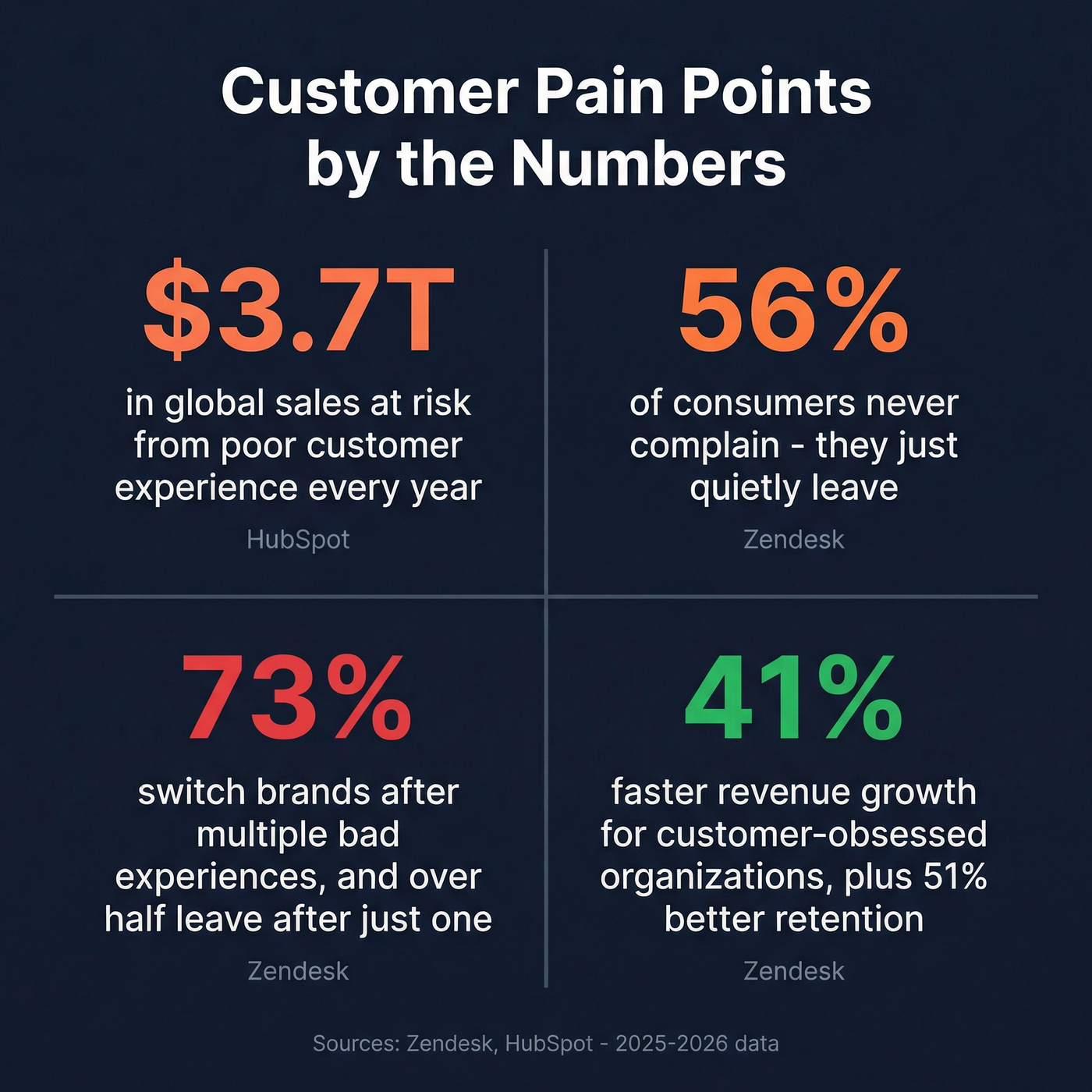
Poor customer experiences put $3.7 trillion in sales at risk globally every year. That's not a typo - trillion with a T. And yet most advice on how to identify customer pain points boils down to "talk to your customers" and "read reviews." As one practitioner on r/sales put it, most scripts and educational material are "way too generic."
Here's the thing: 56% of consumers never complain about a negative experience. They just leave. You can't fix friction you never hear about, which is why passive listening alone fails. Here's a system that works.
Three Levels, Not Four Categories
You've probably seen the classic four-bucket taxonomy: process, financial, support, product. It's fine for a slide deck. But NNGroup's three-level model is more useful because it maps each level to a different research method.
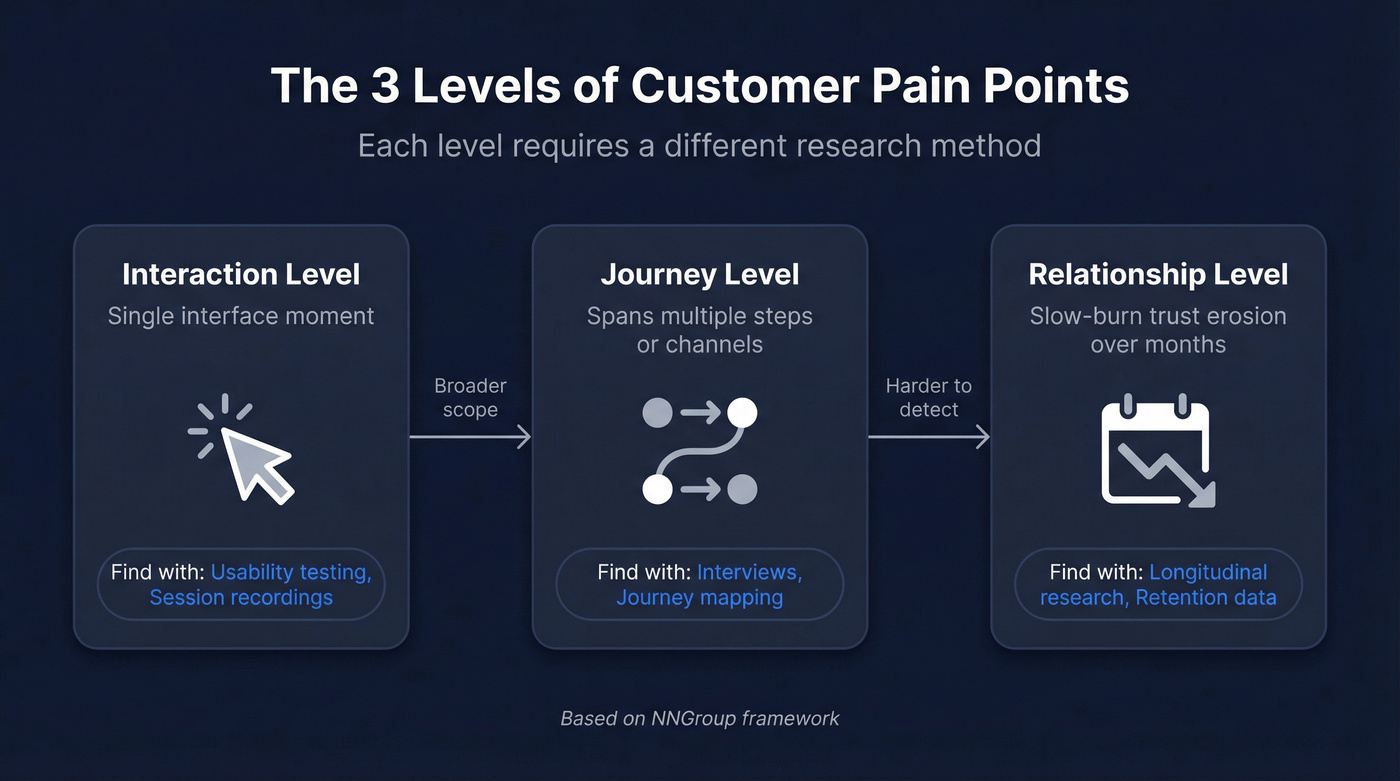
Interaction-level pain points are usability problems in a single interface moment - a confusing checkout flow, a broken filter. You find these through usability testing and session recordings. Journey-level pain points span multiple steps, like a customer re-explaining their issue across three support channels. Interviews and journey mapping surface these. Relationship-level pain points are slow-burn trust erosions over months or years, and they only emerge through longitudinal research and long-term retention data.
The identification method changes at each level. That's the insight most guides miss.
Five Ways to Find Customer Pain Points
The Discovery Interview Spine
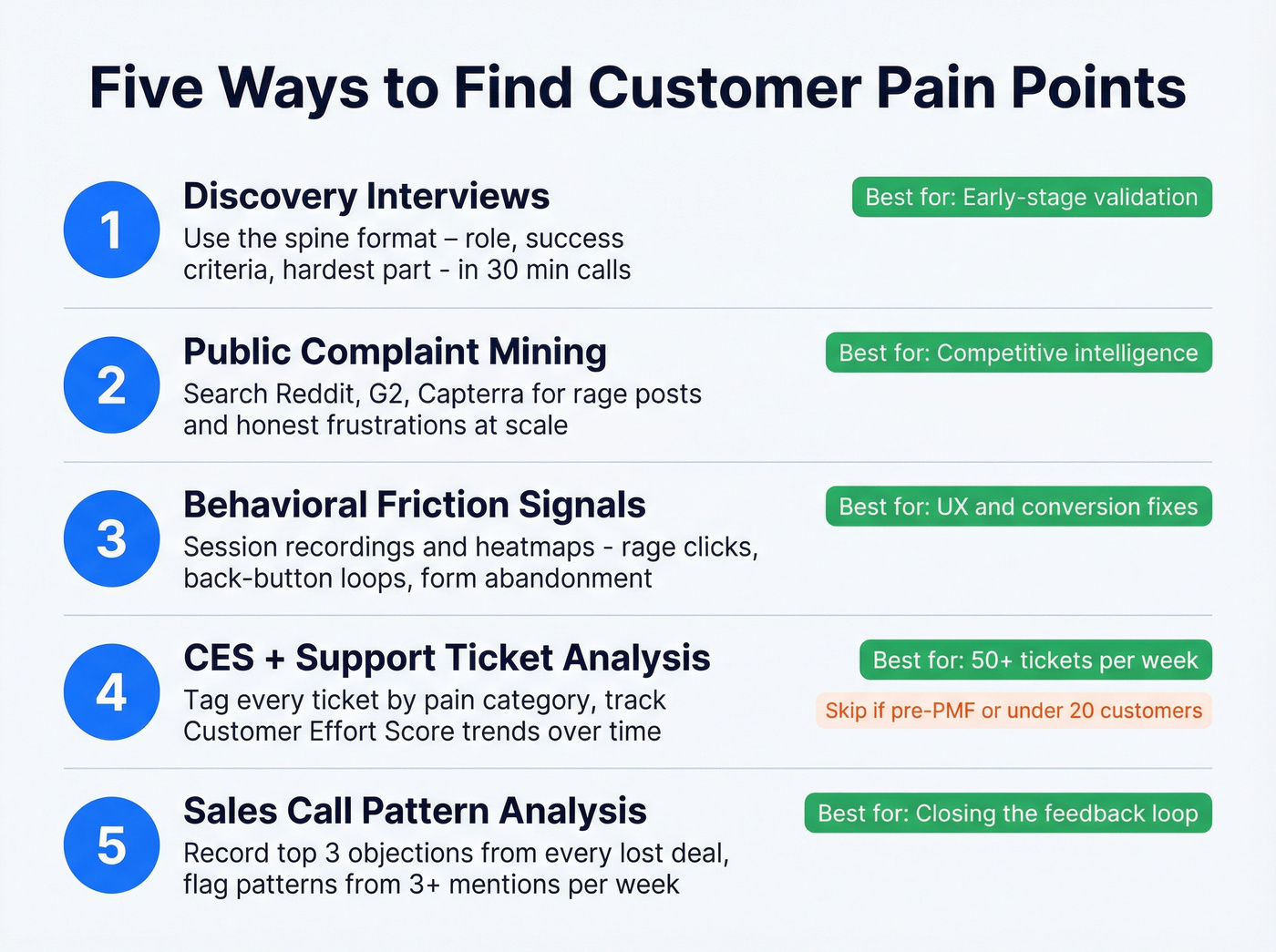
Forget 45-minute unstructured conversations. Use CustomerDevLabs' spine: role, then success criteria, then hardest part. Run it in about 30 minutes using LeanB2B's format: 2 min greetings, 3 min qualification, 20 min open-ended questions, 5 min closing.
When a customer describes their problem, write down their exact words. "I waste two hours every Monday reconciling reports" is messaging gold - don't paraphrase it into corporate-speak. If you want a repeatable structure, borrow a few discovery questions and keep the same spine across segments.
Mine Public Complaints at Scale
People rage-posting on Reddit at 2 AM are more honest than anyone in a scheduled interview. Search Reddit, G2, and Capterra with queries like these:
"hate when" [your category]"wish there was" [your problem space]"frustrated with" [competitor name]
Drop every relevant quote into a spreadsheet with columns for Quote, Source, Date, Sentiment, and Category. Aim for 500+ data points before looking for patterns. Feed these queries into ChatGPT or Claude to categorize and score results faster than manual tagging - the patterns become obvious once you have volume. We've found this approach is one of the fastest paths to uncovering frustrations that interviews alone would miss. (If you want to operationalize this into a repeatable pipeline, map it to a simple competitive intelligence strategy.)
Read Behavioral Friction Signals
Session recordings and heatmaps don't lie. If a user repeats an action twice without completing it, that's a pain point, not interest.
I once watched a team discover their biggest conversion killer wasn't pricing - it was a confusing settings page that made users think the product was broken. Look for rage clicks, repeated back-button usage, and form abandonment. These signals reveal friction customers can't articulate because they've normalized it. Tie the biggest friction points back to funnel metrics so you can quantify impact, not just anecdotes.
CES + Support Ticket Analysis
Use this if you're consistently getting 50+ support tickets per week. Tag every ticket by pain category, then calculate your Customer Effort Score to track trends over time.
Skip this if you're pre-product-market-fit or have fewer than 20 customers. You'll get far more signal from interviews and complaint mining at that stage. If churn is the real symptom, pair this with a basic churn analysis to see which pain points actually drive exits.
Sales Call Pattern Analysis
Your sales team hears objections daily but rarely documents them systematically. Fix that. Record the top 3 objections from every lost deal, track which demo features generate the most questions, and treat any concern mentioned by 3+ prospects in the same week as a pattern worth tagging. This data is sitting in your CRM right now - most teams just never bother to aggregate it. To make it actionable, turn the patterns into sales battle cards your team can actually use.

Your sales team hears objections daily. But are you reaching prospects who already feel the pain? Prospeo tracks 15,000 intent topics so you can target companies actively researching solutions - then reach decision-makers with 98%-accurate emails.
Stop guessing who hurts. Start targeting who's searching.
How to Prioritize What You Found
A list of 40 pain points is useless without a scoring model. Rate each on three dimensions using a 1-5 scale, then multiply:
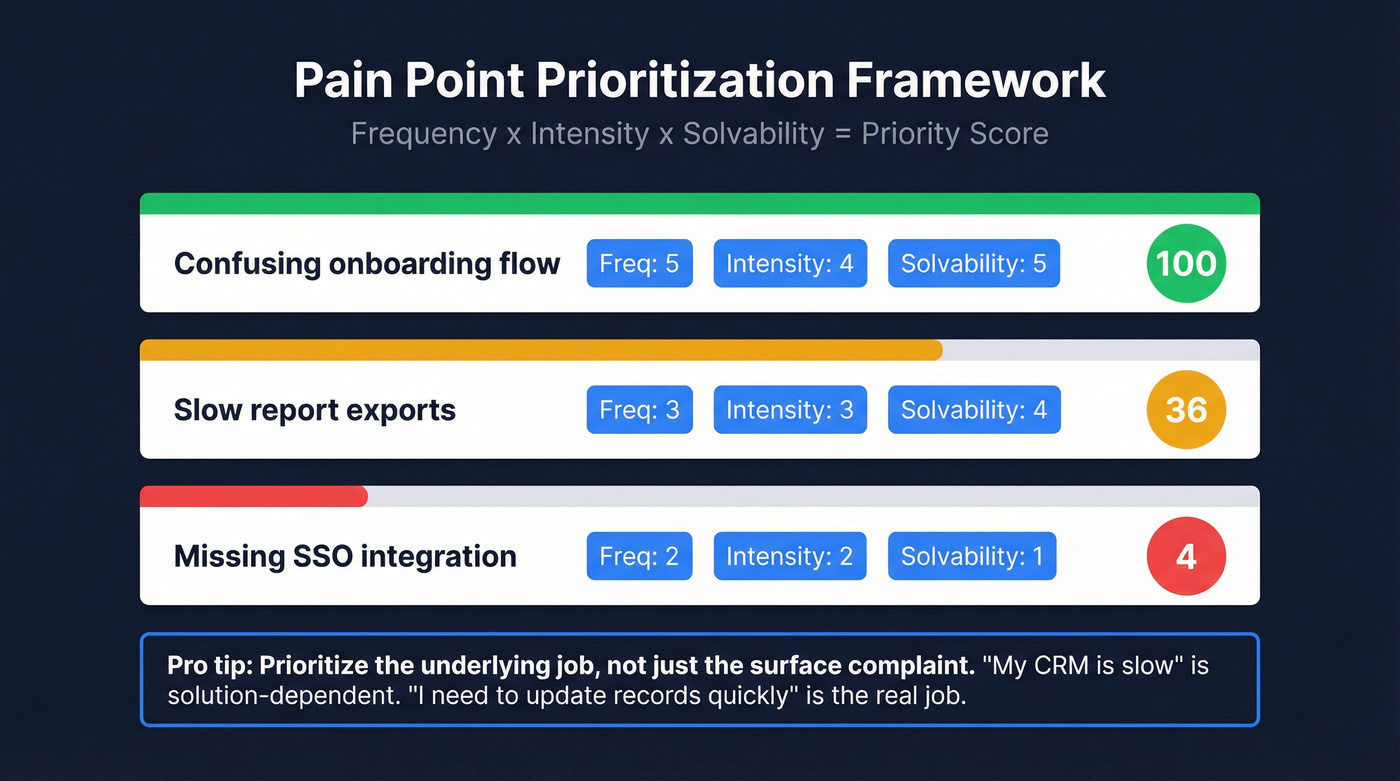
Frequency x Intensity x Solvability = Priority Score
| Pain Point | Freq | Intensity | Solvability | Score |
|---|---|---|---|---|
| Confusing onboarding flow | 5 | 4 | 5 | 100 |
| Slow report exports | 3 | 3 | 4 | 36 |
| Missing SSO integration | 2 | 2 | 1 | 4 |
In our experience, teams that skip scoring chase the loudest complaint rather than the most impactful one. The squeaky wheel gets the grease, and it's rarely the wheel that matters most. If you need a parallel for outbound, this is basically lead scoring applied to customer friction.
One framing from JTBD methodology sharpens this further: pain points are often solution-dependent ("my CRM is slow"), but the underlying job is solution-agnostic ("I need to update records quickly and reliably"). Prioritize the job, not just the surface complaint.
Turn Pain Points Into Outbound Targeting
Let's be honest: learning how to identify customer pain points is the easy part. The hard part is finding people who are experiencing them right now, before a competitor does. Most teams stop at the insight and never close the loop to action.
Prospeo bridges that gap. Its intent data tracks 15,000 topics via Bombora, so you can find companies actively researching solutions to the exact problems you've scored. Layer that with job role, headcount growth, and technographic filters across 30+ dimensions, and you're building lists of people who already feel the pain - with 98% email accuracy so your outreach actually lands. If you're building lists at scale, a structured lead generation workflow helps keep research → targeting → outreach from breaking. The free tier gives you 75 emails per month and 100 Chrome extension credits to test the workflow before committing a dollar.
Identifying pain points is step one. Step two is building a list of people experiencing them right now. Prospeo's 30+ filters - buyer intent, technographics, headcount growth, job changes - let you turn pain point research into targeted outreach at $0.01 per verified email.
Turn customer insights into pipeline before your competitors do.
Key Stats to Remember
- 73% of consumers switch after multiple bad experiences; more than half switch after just one
- 56% never complain - they quietly leave
- Customer-obsessed organizations see 41% faster revenue growth and 51% better retention
- $3.7 trillion in global sales at risk from poor CX annually
FAQ
What are the four main types of customer pain points?
The traditional taxonomy covers process, financial, support, and product pain points. But the three-level model - interaction, journey, relationship - is more actionable because each level maps to a specific research method. Use the four categories for labeling; use the three levels for deciding how to investigate.
How do you find pain points without interviews?
Mine public complaints on Reddit, G2, and Capterra using targeted search queries like "frustrated with" [competitor], then use AI tools to categorize results at scale. Pair that with behavioral analytics - session recordings and heatmaps reveal friction customers can't articulate. Support ticket analysis rounds out the picture without scheduling a single call.
How do you turn pain points into sales outreach?
Score each pain point by frequency, intensity, and solvability, then use intent data to find companies actively searching for solutions. Tools like Prospeo pair Bombora intent signals with verified contact data so you reach decision-makers who already feel the pain - the free tier lets you test the workflow without a contract.