

How to Identify Leads That Actually Convert
Your SDR builds a 200-contact list on Monday. By Wednesday, 40% have bounced, your domain reputation's taken a hit, and the sequences you spent hours writing land in spam. The problem isn't the outreach - it's the list.
If you want to identify leads that actually convert, stop chasing volume and start building precision.
The Full System in Five Steps
Skip any one of these and your pipeline leaks:
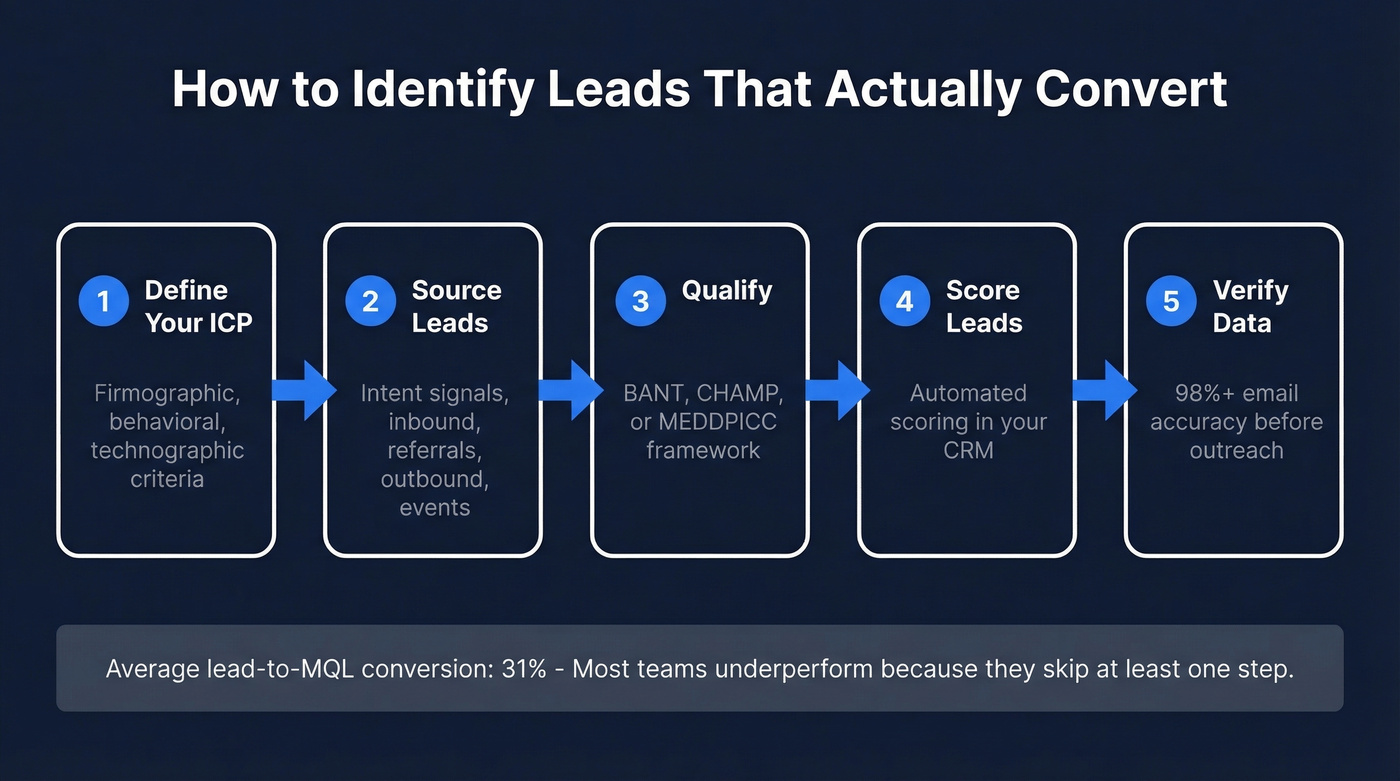
- Define your ICP with firmographic, behavioral, and technographic criteria
- Source leads through intent signals, inbound, referrals, outbound, events, and signal-based triggers
- Qualify using the right framework - BANT for transactional deals, MEDDIC for enterprise
- Score leads in your CRM so reps work the hottest accounts first
- Verify contact data before any outreach touches a prospect's inbox
The average lead-to-MQL conversion rate sits at 31%. Most teams underperform that number because they skip at least one of these steps. Finding quality leads starts with getting every step right - not just the ones that feel easy.
What Counts as a "Lead" in 2026
A lead isn't just someone who filled out a form. That definition died when 67% of customers started preferring self-service over talking to a rep. In 2026, a lead is anyone who matches your ICP and shows behavioral evidence of interest - whether they've raised their hand or not.
Here's how the stages break down: a lead matches your profile or shows interest. A prospect is a lead you've qualified through a framework (BANT, CHAMP, MEDDPICC) with enough clarity to justify sales time. An opportunity is a prospect in an active sales cycle with a defined next step.
Within leads, you've got cold (matches ICP, no engagement), warm (some behavioral signal), and hot (multiple high-intent actions). Your CRM translates these into MQLs and SQLs. The distinction matters because it determines who works the lead and when - stacking multiple intent signals helps reps prioritize the accounts most likely to close.
Define Your ICP First
You can't spot the right leads if you haven't defined what "right" looks like. Your ICP needs three dimensions working together.
Firmographic criteria are the baseline: industry, company revenue, headcount, geography, growth stage. These filter out companies that'll never buy. Behavioral criteria are where it gets interesting: content consumption patterns, pricing page visits, repeat visits to solution pages, webinar attendance. These tell you who's actively researching. Technographic criteria complete the filter: what's in their tech stack, what tools they're hiring for, what integrations they'd need. A company running Salesforce and Outreach but no data provider? That's a signal.
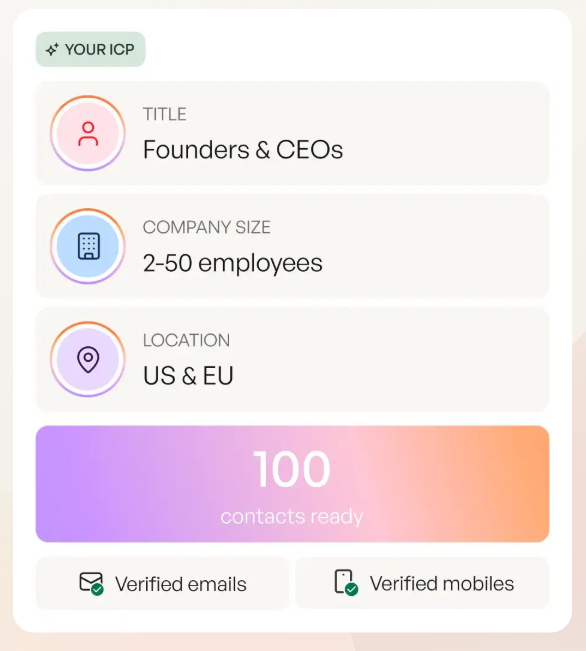
Here's the thing - the average B2B purchase involves 7 stakeholders. Your ICP can't be a single persona. Map multiple buyer roles per account: the economic buyer, the champion, the technical evaluator, the end user. Build your ICP as an account profile with persona layers, not a single job title. Without this foundation, every downstream step in your lead identification process falls apart.
Seven Proven Methods to Find Leads
1. Intent Data and Dark Funnel Signals
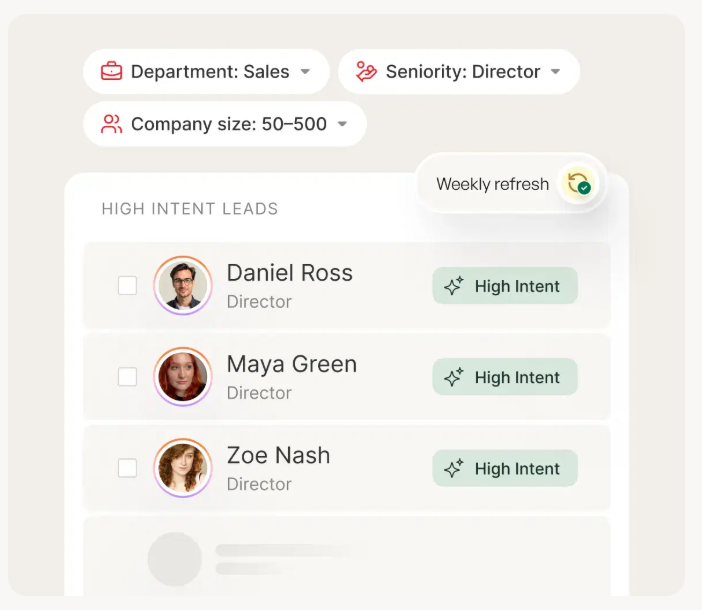
Up to 70% of the buyer journey happens in the dark funnel - buyers researching without filling out forms, shortlisting 2-3 vendors before ever contacting sales. The intent data market is projected to hit $4.5B in 2026 at a 15.9% CAGR, and for good reason: it catches invisible signals that form fills miss entirely. Best for mid-market and enterprise teams with longer sales cycles. Layering first-party and third-party intent data is the fastest path to finding buyers who are already in-market.
If you want a broader breakdown of channels and what they’re best at, see our guide to B2B lead generation channels.
2. Inbound Content and SEO
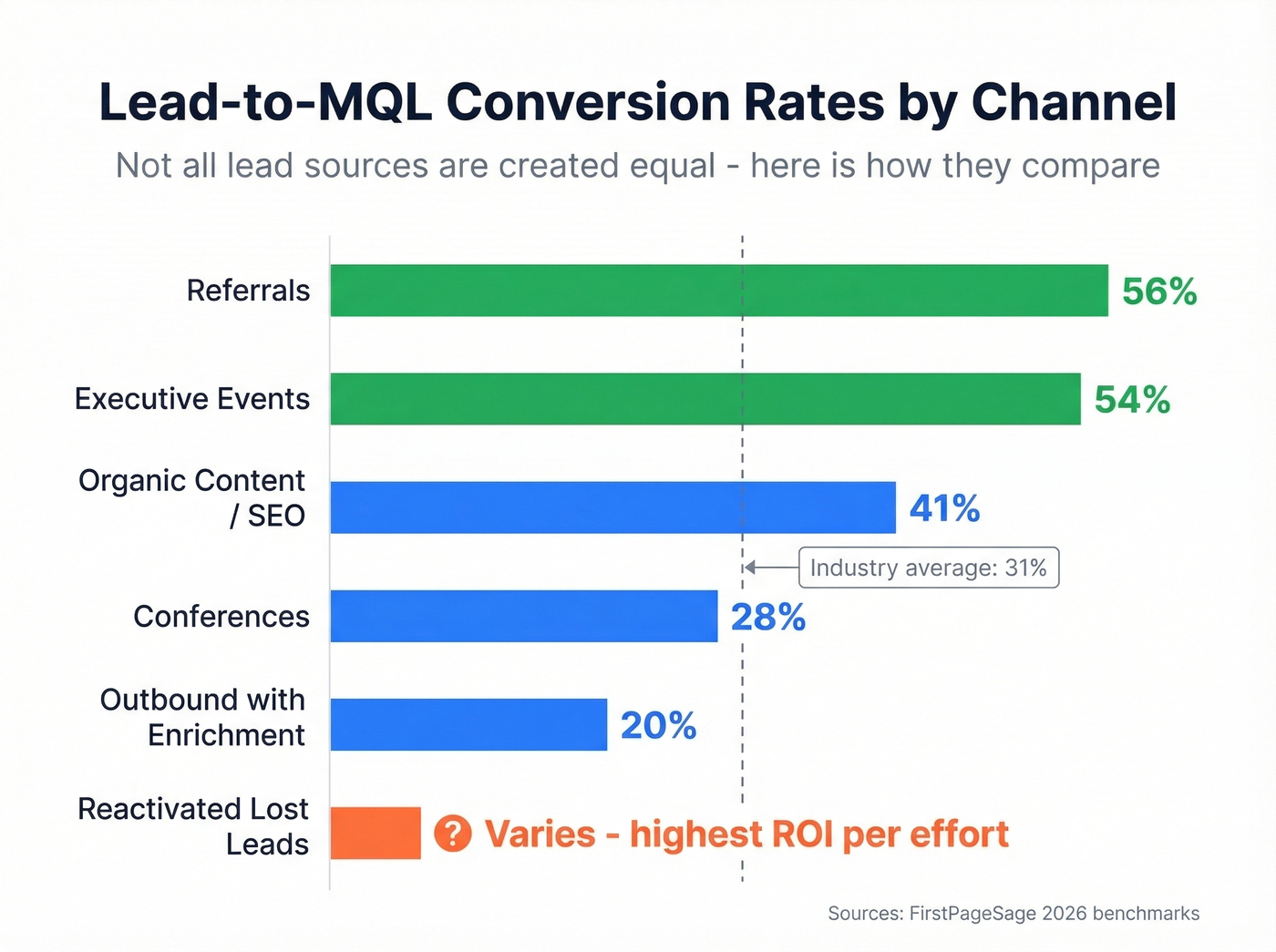
Organic content converts at a 41% lead-to-MQL rate - one of the highest-performing channels. The catch is patience: 6-12 months to build meaningful traffic. But once the flywheel spins, inbound leads arrive pre-educated and cheaper than any paid channel.
If you already have a content engine, double down. If you don't, start now and supplement with outbound while it matures. SEO-driven content is one of the few channels that compounds over time. (If you’re building this motion from scratch, start with a B2B inbound lead generation plan.)
3. Referrals
Referrals convert at 56% lead-to-MQL - the highest of any channel. They're also the hardest to scale.
Most teams treat referrals as an afterthought ("ask happy customers to intro you"), but the teams that win here build structured programs with incentives, tracking, and follow-up cadences. Consider forming reciprocal referral circles with non-competing vendors who sell to the same buyer - a tactic that's gaining traction in SDR communities on Reddit and consistently outperforms cold outreach. If you want to operationalize this, build a real B2B referral program.
4. Outbound Prospecting with Enrichment
This is where most sales teams live, and the quality of your outbound depends entirely on the quality of your data. Tools like Apollo ($49/user/month) and Clay ($134/month for 2,000 enrichment credits) can support enrichment workflows, but the real differentiator is accuracy.
Prospeo's 30+ search filters - including buyer intent, job change signals, and tech stack data - let you build targeted lists that go beyond basic firmographics, with 98% email accuracy that keeps your domain clean. The right filters are what separate a list that converts from one that bounces. For more options, compare B2B lead list tools and lead finder tools.
5. Events
Here's a number that should change how you allocate your events budget: executive events convert at 54% lead-to-MQL, while conferences sit at 28%. That's nearly 2x. If you're selling high-ACV deals where face time matters, skip the 10,000-person expo and host a dinner for 20 VPs. (More tactics in our event lead generation playbook.)
6. Signal-Based Outbound
Job changes, funding rounds, tech installs, headcount growth - these are timing signals that tell you when to reach out, not just who. A VP of Sales who just joined a Series B company with 50 new hires? That's a signal stack.
In our experience, signal-based sequences get 3-4x the reply rate of generic outbound because the context writes the email for you. If you want to systematize this, see how to automate sales signals.
7. Reactivate Lost Leads
Most teams ignore their richest lead source: the prospects who went dark. A deal that stalled six months ago because of budget constraints might be ready now - especially if you're tracking job changes and funding signals. Set a quarterly cadence to review closed-lost opportunities against fresh intent data. It's the highest-ROI prospecting motion nobody talks about.
Use Intent Data to Catch In-Market Buyers
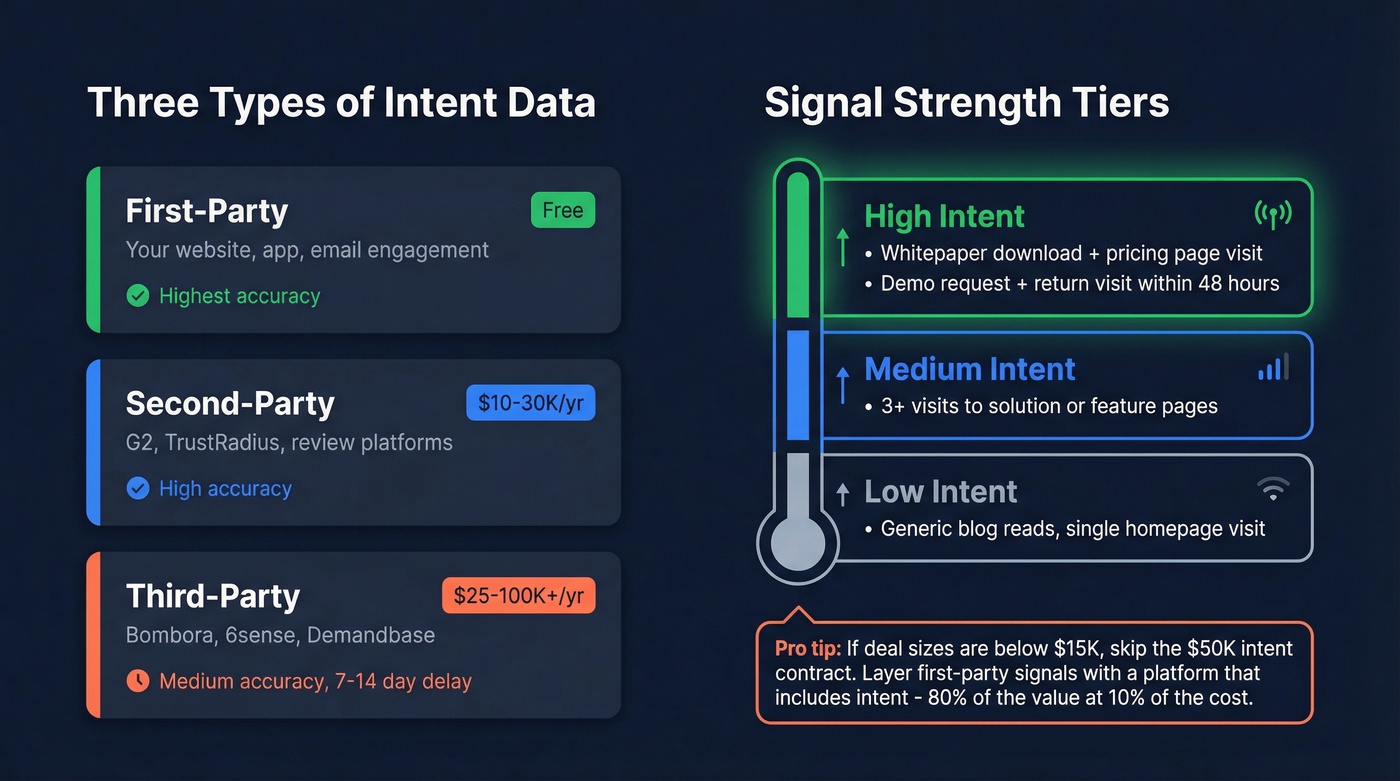
Intent data is the single biggest shift in how teams identify leads. Here's how the three types compare:
| Type | Source Examples | Accuracy | Cost Range | Best For |
|---|---|---|---|---|
| First-party | Your site, app, email | Highest | Free | Scoring existing leads |
| Second-party | G2, TrustRadius | High | $10-30K/yr | Catching competitor eval |
| Third-party | Bombora, 6sense, Demandbase | Medium | $25-100K+/yr | Early-stage signals |
First-party intent is the most accurate and it's free - pricing page visits, whitepaper downloads, email engagement. The problem is reach: you only see people who already found you. Second-party intent from platforms like G2 Buyer Intent catches prospects evaluating your category on review sites, which is gold for competitive displacement plays.
Third-party intent casts the widest net but comes with higher false positives and potential 7-14 day delays. Standalone contracts from major providers run $25K-$100K+/year.
For signal strength, think in tiers. High intent: a whitepaper download combined with a pricing page visit. Medium intent: 3+ visits to solution or feature pages. Low intent: generic blog reads. When a prospect downloads a whitepaper, reference that specific asset in your outreach - not a generic "I noticed you visited our site." The specificity is what converts.
If your deal sizes sit below $15K, you probably don't need a $50K intent data contract. Layer first-party signals with a data platform that includes intent - you'll get 80% of the value at 10% of the cost.

You just read why ICP targeting, intent signals, and data verification all need to work together. Prospeo combines all three: 30+ search filters (intent, technographics, job changes, funding), 15,000 Bombora intent topics, and 98% verified email accuracy - so every lead you identify is real, reachable, and in-market.
Build lists that convert instead of lists that bounce.
Qualify with the Right Framework
Identifying leads is half the battle. Qualifying them is where pipeline quality gets made or broken.
BANT
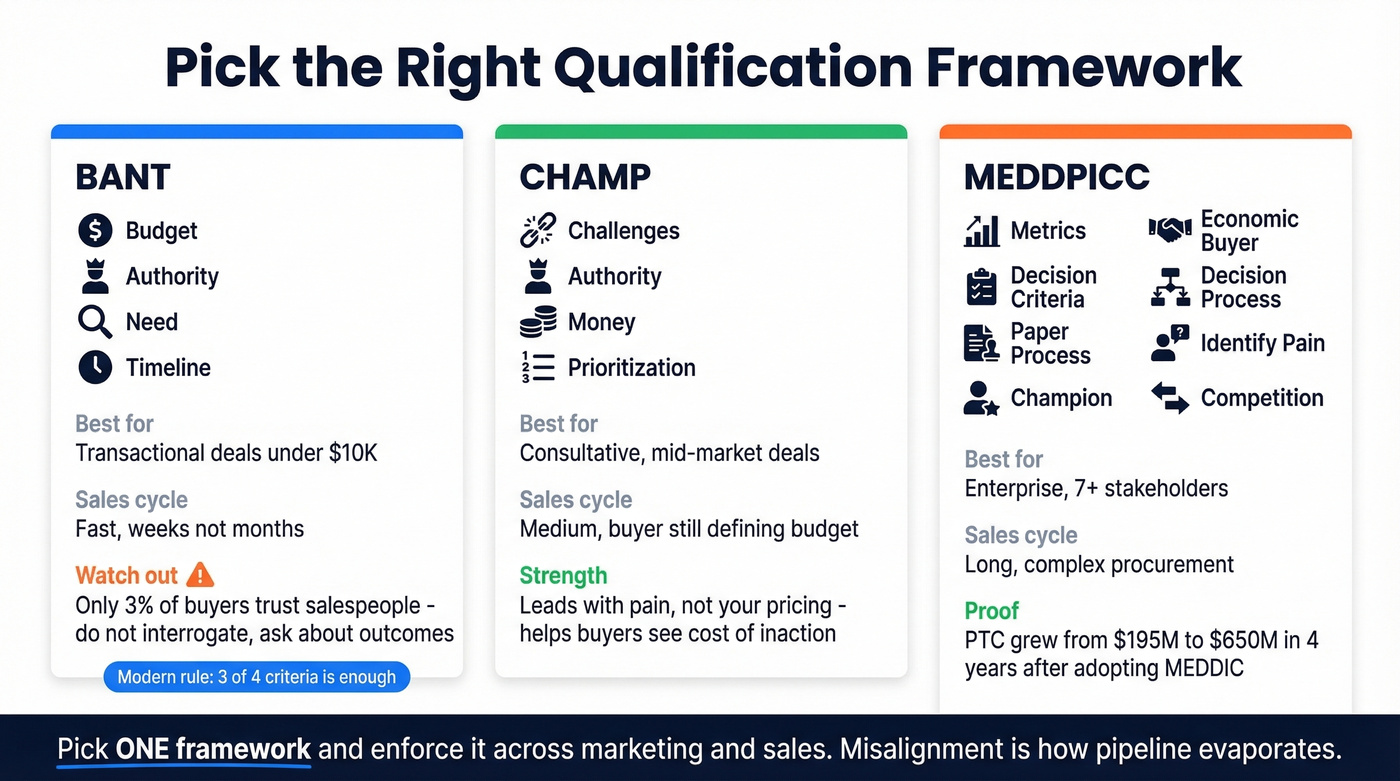
Budget, Authority, Need, Timeline - the classic. The modern "3 of 4" rule says a lead qualifies if it meets at least three criteria. BANT works for transactional deals where the buying process is straightforward, but only 3% of buyers trust salespeople, so running BANT as an interrogation kills deals before they start. Ask about business outcomes, not budget line items.
CHAMP
Challenges, Authority, Money, Prioritization. CHAMP flips the script by leading with the prospect's pain instead of your pricing. Best for consultative selling where the buyer doesn't yet know their budget - they need to understand the cost of inaction before they can assign dollars.
MEDDIC / MEDDPICC
Developed at PTC in the 1990s, MEDDIC is the enterprise qualification standard for a reason. After PTC implemented it, revenue grew from ~$195M to $650M in four years. MEDDPICC adds Paper Process and Competition to handle modern procurement complexity.
| Framework | Best For | When to Use |
|---|---|---|
| BANT | Transactional, sub-$10K | Fast sales cycles |
| CHAMP | Consultative, mid-market | Undefined budgets |
| MEDDPICC | Enterprise, 7+ stakeholders | Complex procurement |
Let's be honest: we've seen organizations where marketing qualifies on BANT, sales qualifies on MEDDIC, and nobody agrees on what "qualified" means. That's how pipeline evaporates. Pick one framework and enforce it across the team.
Score Leads in Your CRM
Lead scoring turns your qualification framework into something automated and measurable. In HubSpot, you've got three score types: Engagement (behavioral signals), Fit (firmographic match), and Combined. You can score Contacts, Companies, and Deals depending on your Hub tier.
If you want a deeper walkthrough of models and point systems, use this guide to lead scoring methods.
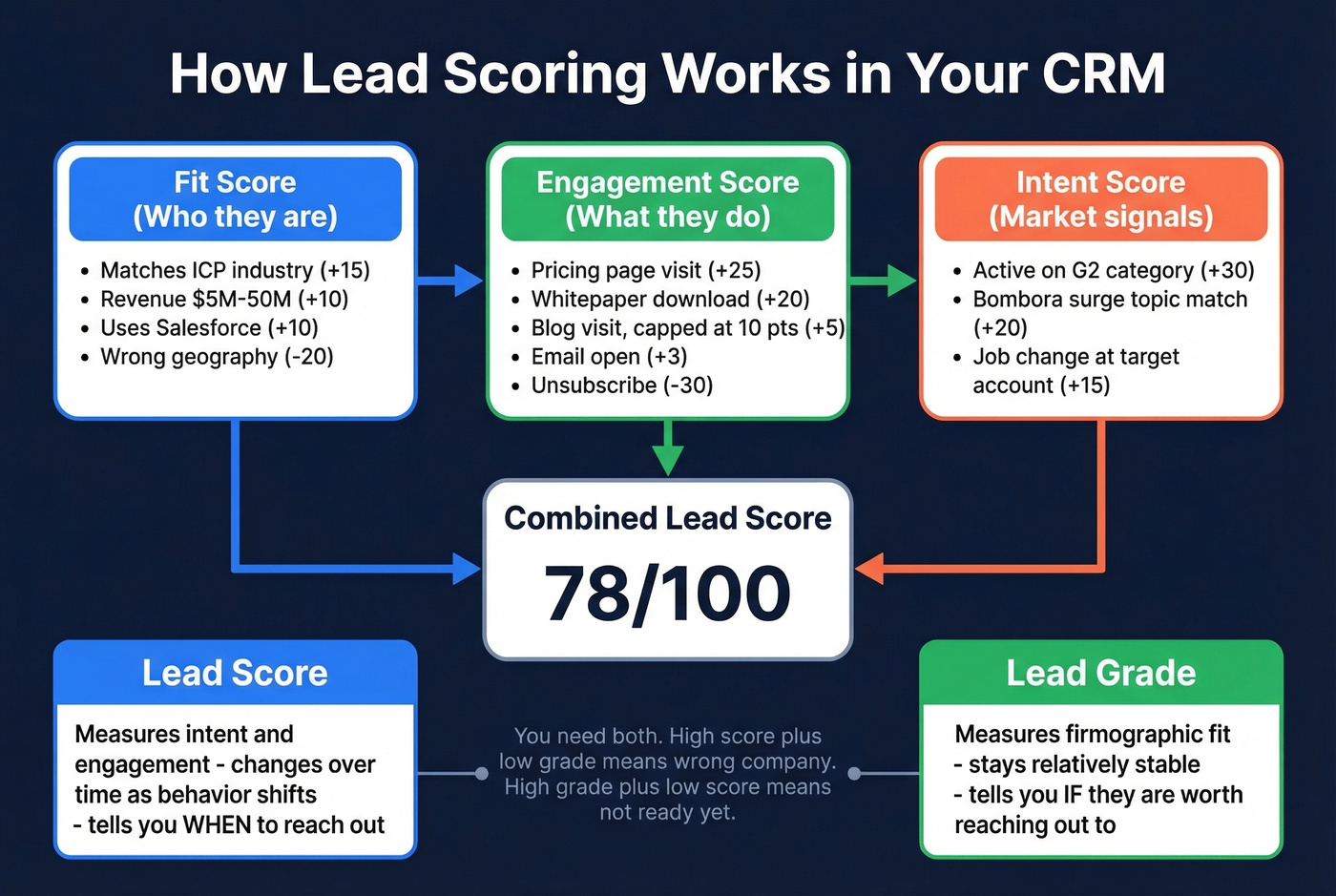
The mechanics work through score groups with overall limits, group limits, and criteria points. For instance, cap awareness-stage blog visits at 10 points but assign 25 points to a pricing page view. Create multiple scores per object for different teams or regions.
The key distinction is lead score versus lead grade. Score measures intent through behavioral engagement. Grade measures fit through firmographic alignment. An A95 is your top prospect - perfect fit, high engagement. A C25 goes to nurture.
Typical teams convert 25-35% of MQLs to SQLs. High-alignment RevOps organizations push 40-50%. If you're below 25%, your scoring model needs recalibration. Salesforce offers similar functionality through Einstein Lead Scoring or custom score fields - the platform matters less than the discipline of actually using scores to route leads.
Verify Leads Before Outreach
This is where most teams blow it. You've identified leads, qualified them, scored them - then you send outreach to stale data and watch your bounce rate climb.
Lead verification isn't optional. It's basic hygiene: validate accuracy, quality, and compliance before bad records ever hit your sequences. If you need a step-by-step process, follow our guide on how to verify an email address.
Your verification checklist before any outreach:
- Email verification - real-time, not just syntax checks
- Phone verification - confirm direct dials are active
- Litigant scrub - check against known TCPA litigants
- Disclosure and consent - proper language with timestamped evidence
We've tested dozens of data providers, and the difference between 98% and 87% email accuracy compounds across thousands of sends. Prospeo's 7-day data refresh cycle - versus the 6-week industry average - keeps your data current between campaigns.
Real results back this up: Snyk's 50 AEs prospecting 4-6 hours per week went from 35-40% bounce rates to under 5%, driving 180% more AE-sourced pipeline. If you're not verifying before outreach, you're burning your domain reputation with every campaign. Once your domain's flagged, even your good emails stop landing.
Benchmarks - What Good Looks Like
Here's where you calibrate expectations. These numbers come from First Page Sage's analysis and Ruler Analytics' 100M+ data point study.
Lead-to-MQL by Channel:
| Channel | Lead-to-MQL Rate |
|---|---|
| Client referrals | 56% |
| Executive events | 54% |
| SEO / organic | 41% |
| Email marketing | 38% |
| PPC | 29% |
| Conferences | 28% |
| Trade shows | 24% |
| Webinars | 19% |
Lead-to-MQL by Industry:
| Industry | Lead-to-MQL Rate |
|---|---|
| B2B SaaS | 39% |
| Cybersecurity | 39% |
| Financial services | 29% |
| Construction | 17% |
The cross-industry average is 31% lead-to-MQL and 2.9% visitor-to-qualified-lead. If you're below those numbers, look at your channel mix first. In our experience, teams that maintain at least three active channels consistently outperform single-channel operations - regardless of which three they pick.
Mistakes That Kill Your Pipeline
Targeting the wrong audience. Your ICP drifts over time as your product evolves. Revisit ICP criteria quarterly with input from both sales and customer success - the deals you're winning today should inform the leads you target tomorrow.
Over-qualifying or under-qualifying. Both are expensive. Under-qualifying floods reps with junk. Over-qualifying starves them. Pick one framework and enforce it consistently.
Over-reliance on one channel. If 70% of your pipeline comes from one source, you're one algorithm change away from a crisis. Referrals plus intent-based outbound plus inbound is a solid minimum.
Ignoring data quality. Bad data doesn't just cause bounces - it erodes domain reputation, wastes rep time, and skews your scoring models. Verify before outreach using tools with weekly refresh cycles, not the 6-week industry standard. The best list in the world is worthless if half the emails are dead. (More on the real cost of bad leads.)
Sales and marketing misalignment on "qualified." If marketing says MQL and sales says "garbage," your funnel has a trust problem. Build a shared scoring model with agreed thresholds, document what score triggers handoff, and review it monthly.
Bad data doesn't just waste rep time - it destroys your domain reputation. Prospeo's 5-step verification and 7-day data refresh cycle mean the leads you identify today are still accurate next week. At $0.01 per email, you get enterprise-grade lead identification without the enterprise contract.
Teams using Prospeo book 35% more meetings than Apollo users.
FAQ
What's the difference between a lead and a prospect?
A lead matches your ICP or shows interest. A prospect is a lead you've qualified through a framework like BANT or MEDDPICC with enough clarity to justify active sales time. The distinction determines who owns the relationship and what resources get allocated.
How many leads should convert to MQLs?
The cross-industry average is 31% lead-to-MQL. Referrals hit 56%, webinars sit at 19%. Optimizing your channel mix matters more than chasing raw volume - three diversified channels consistently outperform single-channel operations.
What's the best lead qualification framework?
BANT works for fast, sub-$10K sales cycles. CHAMP suits consultative mid-market deals with undefined budgets. MEDDPICC is the standard for enterprise procurement with 7+ stakeholders. Pick one and enforce it across your entire revenue team.
How often should lead data be refreshed?
Weekly is ideal for active outbound campaigns; monthly is the bare minimum. The industry average sits around 6 weeks, which means your data's already stale by the time you use it. Aim for weekly refreshes to keep bounce rates under 5%.
Is intent data worth the cost?
First-party intent (site visits, email engagement) is free and the most accurate. Third-party standalone contracts run $25K-$100K+/year. For teams with deal sizes under $20K, a data platform with built-in intent tracking delivers better ROI than a separate contract.