

How to Improve Lead Response Time in 2026 (Playbook)
Your VP of Sales pulls the report. Median first-touch time: 4 hours. Marketing's spending serious money on paid acquisition, and a big chunk of that budget is burning before a rep even picks up the phone.
Workato tested 114 B2B companies by submitting demo request forms - zero called back within 5 minutes. Only one sent a personalized email within 5 minutes. The average personalized email took nearly 12 hours. A separate analysis of 1,000+ companies found the average lead response time is 29+ hours, and 63% of companies never respond at all.
Here's the thing: the 5-minute rule has been gospel for over a decade. Companies are getting worse at it, not better. If you want to improve lead response time, the fix isn't motivation - it's infrastructure.
The Short Version
- Fix your routing. Automated round-robin with availability detection cuts response time by ~73%. Manual assignment is the single biggest bottleneck.
- Enrich inbound leads in real time so routing rules have company size, industry, and seniority to work with - not just a name and email. (More on lead enrichment if you need a framework.)
- Set channel-specific SLAs and measure median, not average. One SLA for all channels is lazy. A live chat lead and an email inquiry don't have the same urgency.
What the Research Says
The canonical study is Oldroyd, McElheran, and Elkington's "The Short Life of Online Sales Leads" (Harvard Business Review, March 2011). The research is commonly summarized as being based on 15,000+ web-generated leads and 100,000+ call attempts.
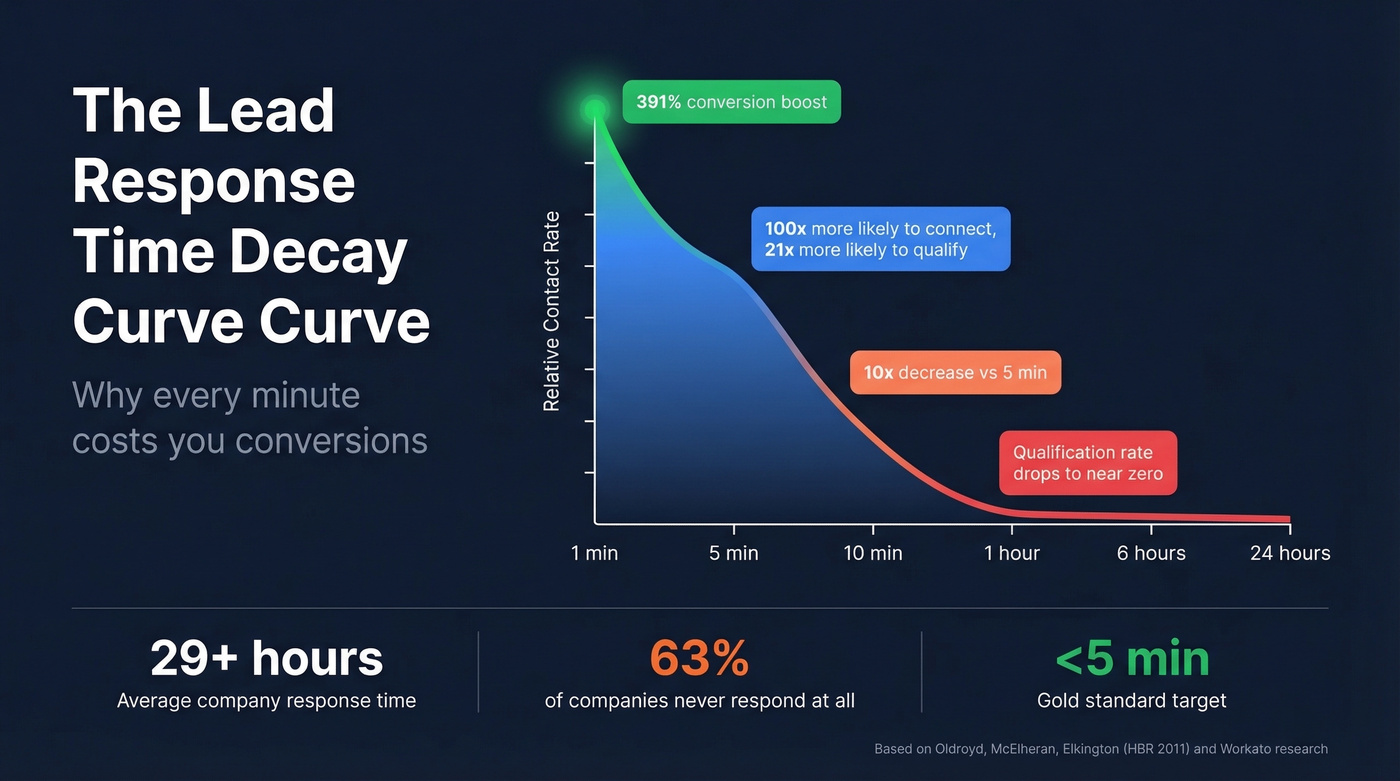
The benchmarks most teams quote: leads contacted within 5 minutes are 100x more likely to connect and 21x more likely to qualify than those contacted after 30 minutes.
The decay curve is brutal. Waiting 10 minutes versus 5 produces a 10x decrease in contact rates. Calling within the first minute boosts conversion by 391%. These aren't marginal gains - they're order-of-magnitude differences that should make any revenue leader uncomfortable with the status quo.
Of the companies that do respond, 20.3% manage it within an hour and 17.2% respond instantly. Fast responders capture disproportionate value while everyone else fights over cold leads.
Most teams don't have a lead quality problem. They have a lead speed problem masquerading as a quality problem. We've watched teams triple conversion rates without changing a single thing about their targeting - just by responding to prospects quickly.
Measuring Response Time Correctly
Your average response time is a lie.
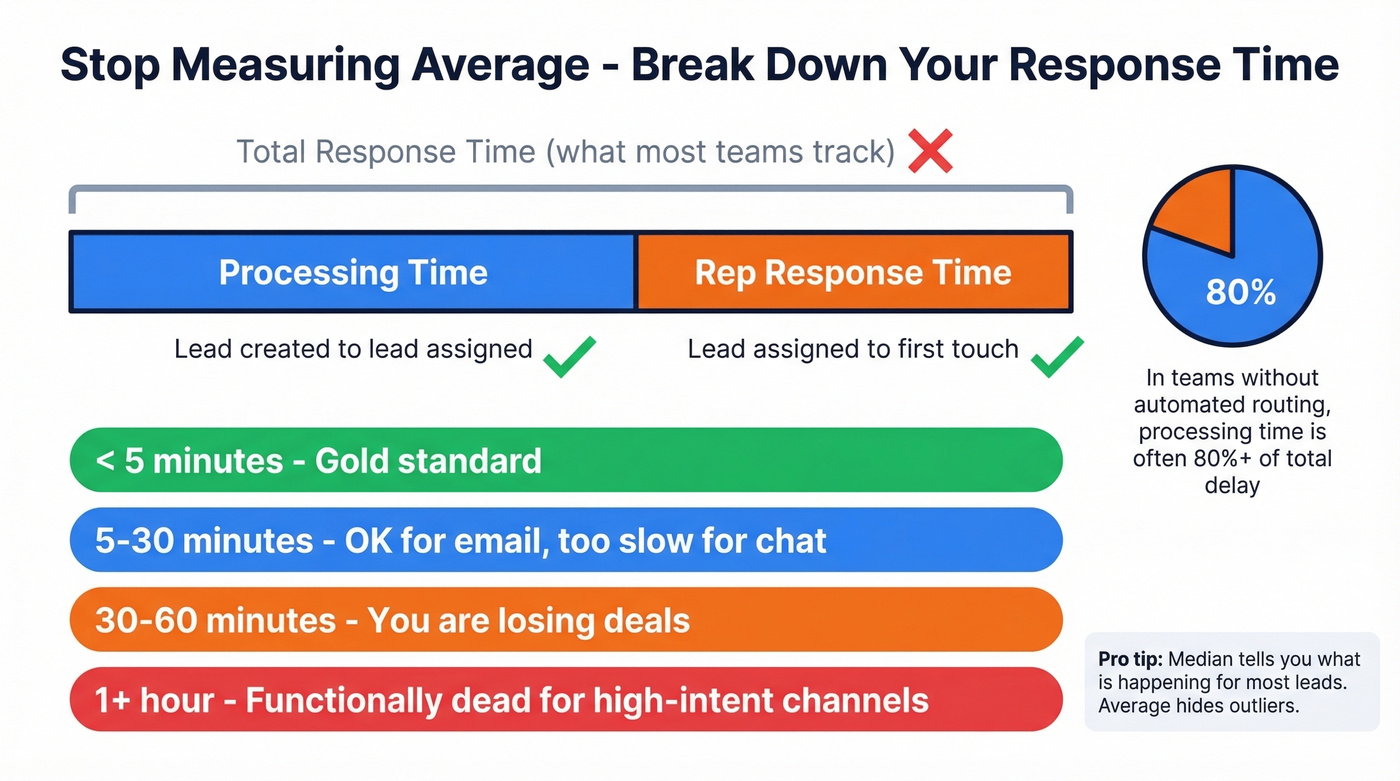
If 9 reps respond in 3 minutes and one rep responds in 6 hours, your average is 39 minutes. Your median is 3 minutes. The median tells you what's actually happening for most leads; the average tells you almost nothing useful. HubSpot users on r/sales regularly ask how to build reports correlating response time to close rate - which tells you most CRMs don't make this easy out of the box.
Break measurement into two components: Processing Time + Rep Response Time. Processing time is the gap between lead creation and assignment. Rep response time is the gap between assignment and first touch. Most teams only track the total, which means they can't diagnose whether the bottleneck is routing or rep behavior. In teams that haven't automated assignment, routing is usually the biggest chunk of the delay - sometimes 80% or more of the total. Proper lead response optimization starts with separating these two metrics so you know exactly where the delay lives.
Track leads in buckets by channel and source:
- < 5 minutes - gold standard
- 5-30 minutes - acceptable for email, too slow for chat or phone
- 30-60 minutes - you're losing deals
- > 1 hour - functionally dead for high-intent channels
Hidden Response Time Killers
Six operational failures kill response time before a rep even sees the lead. We've seen every single one in production CRMs, and they're frustratingly common even at companies that should know better.
No clear ownership. Leads sit in a shared queue because nobody's specifically responsible. Round-robin with forced assignment eliminates this overnight.
Leads created too early or too late. If your form creates a lead record before the prospect finishes a multi-step flow, you're routing incomplete data. If it waits for manual review, you've added hours.
Sales doesn't trust marketing leads. When reps believe inbound leads are low quality, they deprioritize them. This is a data quality problem disguised as a motivation problem - fix enrichment and lead scoring, and rep behavior follows.
No post-assignment activity tracking. Without mandatory activity logging and escalation alerts, you can't tell the difference between "rep called and didn't connect" and "rep never tried." That distinction matters enormously.
Too many lead stages. If your lifecycle has 8 stages between "new" and "contacted," each transition adds latency. Simplify to the minimum viable pipeline (or standardize your lead status setup).
Object confusion in your CRM. Leads and contacts follow different workflows in Salesforce and HubSpot. Conflating them means your automation breaks in ways that are hard to diagnose, and leads fall through the cracks silently.

Slow response time isn't just a rep problem - it's a data problem. When inbound leads arrive with nothing but a name and email, reps waste minutes researching instead of calling. Prospeo's enrichment API returns 50+ data points per contact at a 92% match rate, giving your routing rules the company size, seniority, and intent signals they need to assign leads instantly.
Enrich before you route. Respond in minutes, not hours.
The 5-Minute Response Workflow
This workflow is adapted from MartechDo's automation blueprint and pressure-tested across real RevOps implementations. If you're serious about responding to leads faster, this is the system to build.
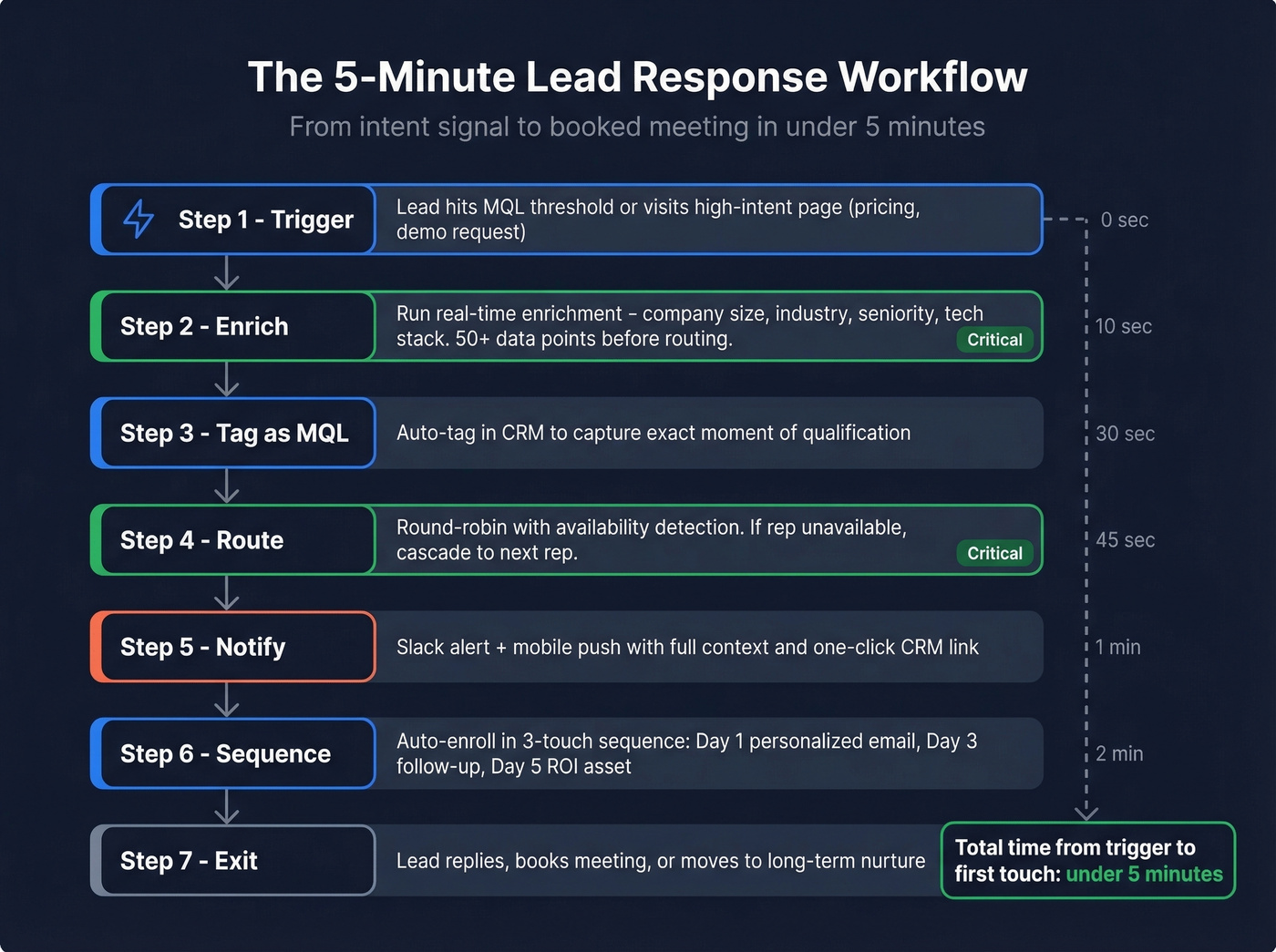
Step 1 - Trigger. Lead score crosses your MQL threshold, or the prospect visits a high-intent page like pricing or demo request. Don't trigger on every form fill - trigger on intent signals (see identifying buying signals for a scoring approach).
Step 2 - Enrich. Before routing, run the lead through real-time enrichment. You need company size, industry, seniority, and tech stack data so your routing rules can actually do their job. Prospeo's enrichment API returns 50+ data points per contact with a 92% match rate, but whatever tool you use, the principle is the same: enrich before you route, not after.
Step 3 - Tag as MQL. Auto-tag in your CRM so reporting captures the moment of qualification, not the moment of first rep activity.
Step 4 - Route. Round-robin with availability detection. If the assigned rep is in a meeting, on PTO, or hasn't responded to the last 3 assignments within SLA, the lead cascades to the next available rep.
Step 5 - Notify. Slack alert and mobile push with full context: what the lead did, company name, enriched data, and a one-click link to the CRM record. Don't make the rep hunt for information.
Step 6 - Sequence. Auto-enroll in a 3-touch sequence over 5 days. Day 1: personalized email. Day 3: feature or pain-point follow-up. Day 5: ROI asset or case study. (If you need copy, start with these sales follow-up templates.)
Step 7 - Exit conditions. Lead replies, books a meeting, or is manually removed. Otherwise, move to long-term nurture after the sequence completes.
8 Tactics to Cut Response Time
1. Automate Round-Robin Routing
Manual lead assignment is the single biggest source of processing time. HubSpot and Salesforce both offer native round-robin - turn it on. For territory-based or capacity-weighted routing, LeanData or Chili Piper handle it. This is the single highest-ROI change you can make today.
2. Set Channel-Specific SLAs
| Channel | Target Response |
|---|---|
| Live Chat | < 1 minute |
| Phone | < 3 minutes |
| SMS | < 3 minutes |
| < 30 minutes | |
| Social Media | < 1 hour |
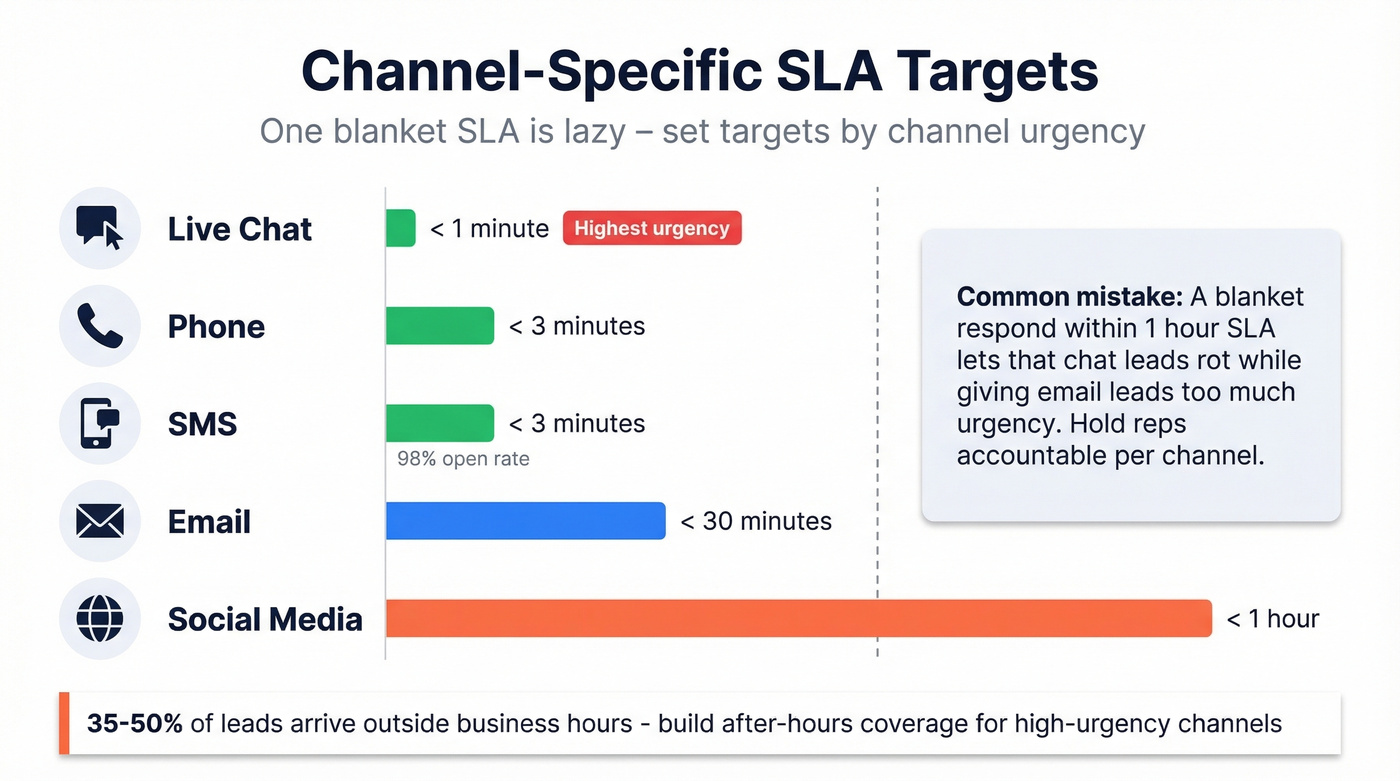
Hold reps accountable to each channel separately. A blanket "respond within 1 hour" SLA lets your chat leads rot while giving email leads too much urgency.
3. Enrich Leads Before Routing
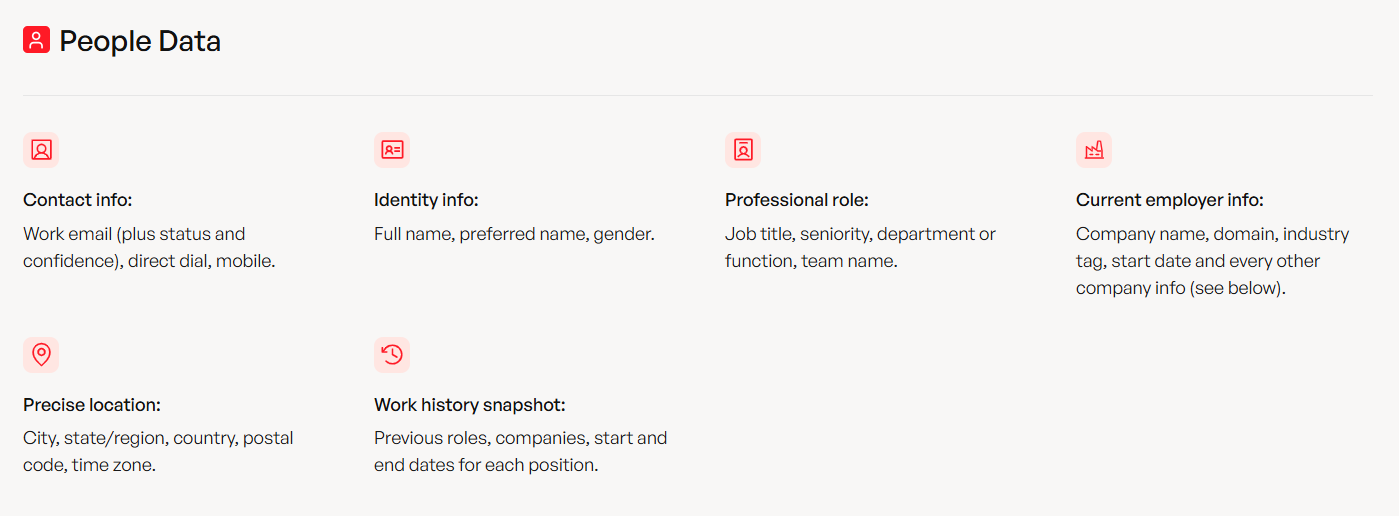
Routing rules are only as good as your data. When an inbound lead arrives with just a name and email, your system can't route by company size, industry, or seniority - every lead gets the same treatment, and your enterprise prospects wait in the same queue as tire-kickers. Real-time enrichment at the point of entry fills those gaps so leads reach the right rep instantly.
4. Push Notifications for High-Intent Leads
Email notifications aren't fast enough. By the time a rep checks their inbox, 15 minutes have passed. Set up Slack alerts and mobile push for pricing page visits, demo requests, and return visits from known accounts. Include the lead's name, company, and what they did so the rep calls with context, not cold.
5. Autoresponders with Self-Booking Links
An autoresponder buys you time and captures intent. 78% of B2B buyers expect a response within an hour - an immediate autoresponder with a self-booking link lets the prospect schedule a meeting before a rep picks up the phone.
Calendly starts free with paid plans from around $10/user/month. Dead simple to set up, but it doesn't qualify leads during booking. Chili Piper typically runs ~$30-50/user/month and handles routing and qualification in the booking flow. Skip Chili Piper if your volume is under 100 leads/month - the platform cost won't justify the ROI at that scale.
6. Deploy Chatbots for Instant Engagement
Drift, Qualified, and similar tools provide 24/7 first-touch engagement. They won't replace a rep conversation, but a chatbot that qualifies intent and books a meeting is infinitely better than a form submission that sits untouched until Monday.
Skip this if your deal sizes are small. The platform cost won't pay for itself.
7. Build After-Hours Coverage
Around 35-50% of inbound leads arrive outside business hours. A prospect fills out your demo form at 6:47 PM Thursday. By Friday at 9 AM, they've booked demos with two competitors. Solutions: chatbot qualification, SMS autoresponders with a 98% open rate, rotating on-call coverage for high-value leads, and time-zone-aware routing for distributed teams (especially for enterprise B2B sales motions).
8. Close the Persistence Gap
Speed matters, but so does persistence. The average team makes only 4.47 follow-up attempts versus a recommended 12. Even worse: 50% of leads are never contacted at all. Build a minimum 6-touch sequence across email, phone, and SMS, and enforce completion through your sequencing tool (see importance of follow-up in sales for the data behind it). A fast first touch followed by silence is barely better than no touch at all.
Benchmarks by Industry
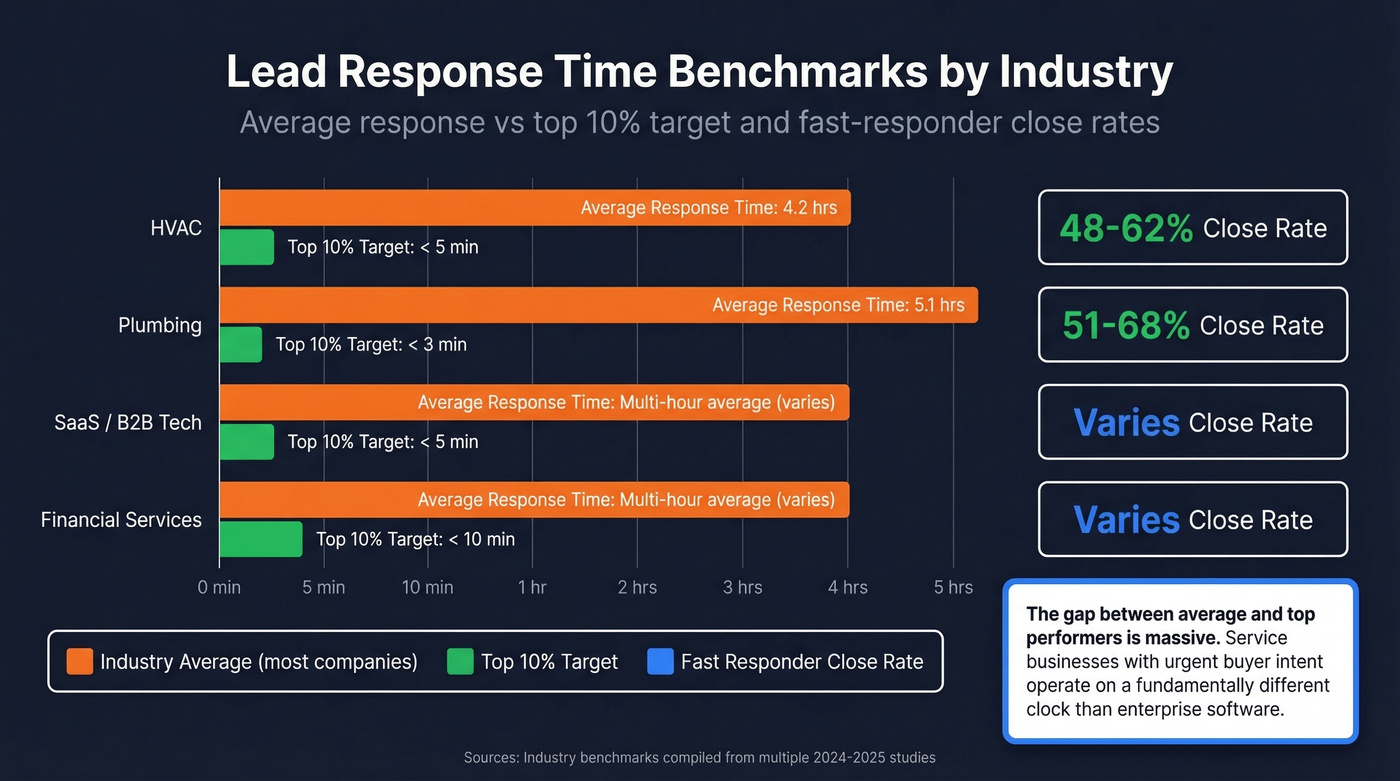
Response time benchmarks vary dramatically by industry. Service businesses with urgent buyer intent operate on a fundamentally different clock than enterprise software sales.
| Industry | Avg Response | Top 10% Target | Close Rate (Fast Responders) |
|---|---|---|---|
| HVAC | 4.2 hrs | < 5 min | 48-62% |
| Plumbing | 5.1 hrs | < 3 min | 51-68% |
| Roofing | 8.7 hrs | < 15 min | 35-45% |
| Financial Advisors | 3.8 hrs | < 10 min | 25-40% |
Look at the HVAC numbers. The gap between average close rates of 12-18% and fast-responder close rates of 48-62% is a 3-4x difference. That's not a marginal improvement - that's the difference between a struggling business and a thriving one. The top 10% aren't doing anything magical. They're just picking up the phone.
Calculate the Revenue Impact
Let's run the math on a real scenario. Say you generate 500 inbound leads per month with an average deal size of $5,000. Currently, 60% of your leads sit in the ">1 hour" bucket with a 2% conversion rate, and 15% land in the "<5 min" bucket with an 8% conversion rate.
Current revenue from those buckets: (300 x 0.02 x $5,000) + (75 x 0.08 x $5,000) = $30,000 + $30,000 = $60,000/month.
Now shift half of the ">1 hour" leads into the "<5 min" bucket through routing automation and enrichment. New math: (150 x 0.02 x $5,000) + (225 x 0.08 x $5,000) = $15,000 + $90,000 = $105,000/month.
That's a $45,000/month revenue lift - $540,000 annually - from an operational fix, not more ad spend. Adjust these inputs for your business, but the shape of the curve holds. And remember: up to 50% of B2B sales go to the vendor that responds first. Every minute you shave off is a minute your competitor doesn't get.
The article above proves it: reps who don't trust lead quality deprioritize follow-up, and response time collapses. Fix that with 98% verified email accuracy and enriched records your team actually wants to call. At $0.01 per email with a 7-day data refresh, Prospeo gives every inbound lead the context reps need to pick up the phone immediately.
Stop losing deals to stale data. Give reps leads worth racing to.
FAQ
What's a good lead response time?
Under 5 minutes. Leads contacted within 5 minutes are 100x more likely to connect and 21x more likely to qualify than those contacted after 30 minutes. For live chat and phone, aim for under 1 minute.
What's the average response time in 2026?
The most recent large-scale benchmark found the average is 29+ hours, and 63% of companies never respond at all. Most companies are nowhere near the 5-minute standard despite a decade of awareness.
How do you measure lead response time?
Subtract lead creation time from first rep response time, then use median instead of average to avoid outlier distortion. Segment by channel and lead source - and split processing time from rep response time to pinpoint bottlenecks.
Does lead data quality affect response time?
Directly. If inbound leads arrive with only a name and email, routing rules can't segment by company size or seniority. Real-time enrichment fills those gaps so leads reach the right rep instantly instead of sitting in a generic queue.
How many follow-up attempts should you make?
At least 6, ideally 12. The average team makes only 4.47 attempts, and 50% of leads are never contacted at all. Build a multi-channel sequence across email, phone, and SMS, then enforce completion through your automation platform.