

How to Improve Sales Revenue: A Diagnostic Playbook for 2026
A RevOps lead we know ran a full-quarter "revenue acceleration" initiative last year. Twelve tactics. Three new tools. A 47-slide deck. Pipeline went up 15%. Revenue went down. The problem wasn't effort - it was diagnosis. They'd optimized pipeline volume when their real leak was win rate, which had cratered because reps were pitching unqualified accounts with bad contact data.
If you're sitting at Q2 with 60% of your annual target still ahead, the instinct is to add more pipeline. That instinct is usually wrong. More than 70% of strategic growth plans fail due to execution breakdown, not a lack of ideas. You don't need 20 strategies. You need to find the 2-3 things that are actually broken and fix them in sequence.
The Quick Version
Most revenue problems trace back to 1-2 broken variables in the pipeline velocity formula:
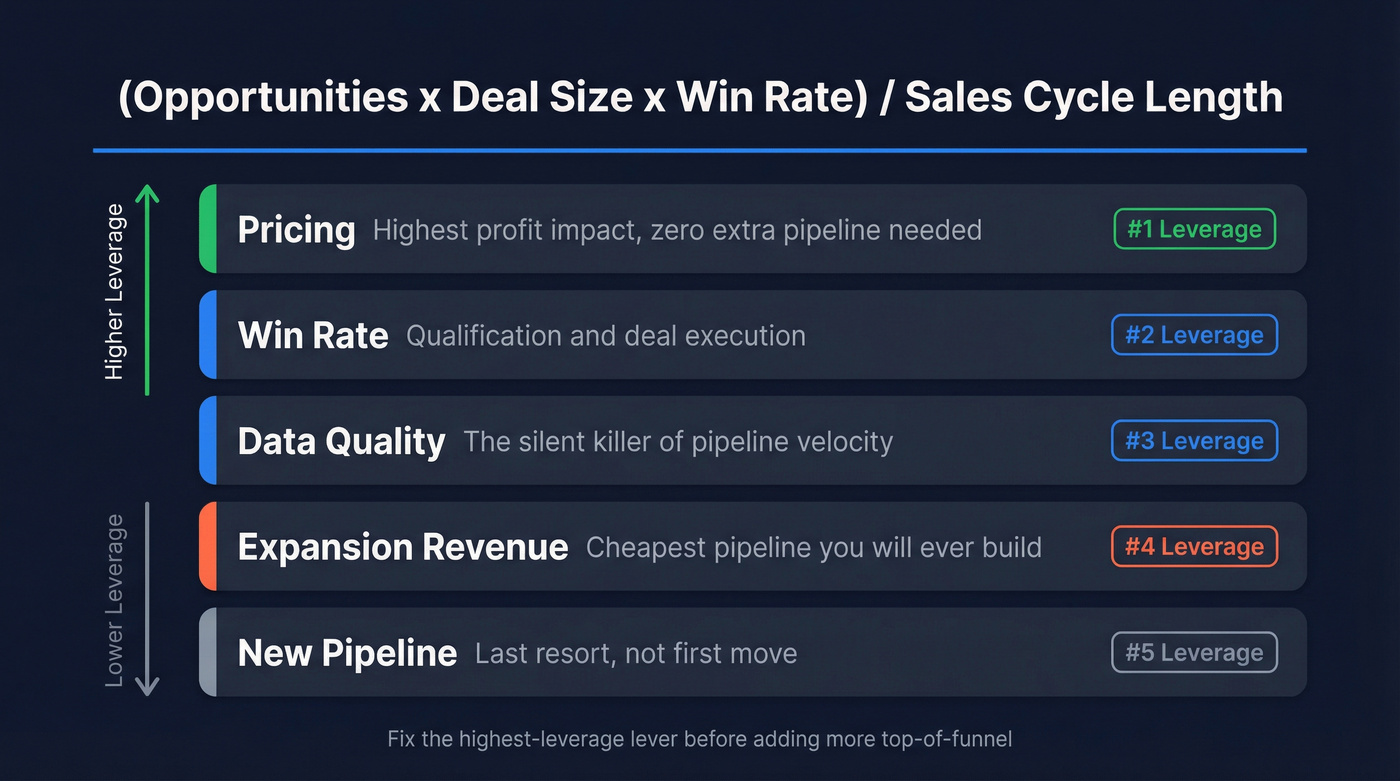
(Opportunities x Deal Size x Win Rate) / Sales Cycle Length
If you don't know which variable is dragging, you'll optimize the wrong thing. Here's the priority stack, ordered by leverage:
- Pricing - highest profit impact, zero additional pipeline required
- Win rate - qualification and deal execution
- Data quality - the silent killer of pipeline velocity
- Expansion revenue - cheapest pipeline you'll ever build
- New pipeline - last, not first
Fix the highest-leverage lever before adding more top-of-funnel. That's the core of any real strategy to increase sales revenue without burning the team out.
Diagnose Before You Prescribe
The pipeline velocity formula isn't just a metric - it's a diagnostic tool.
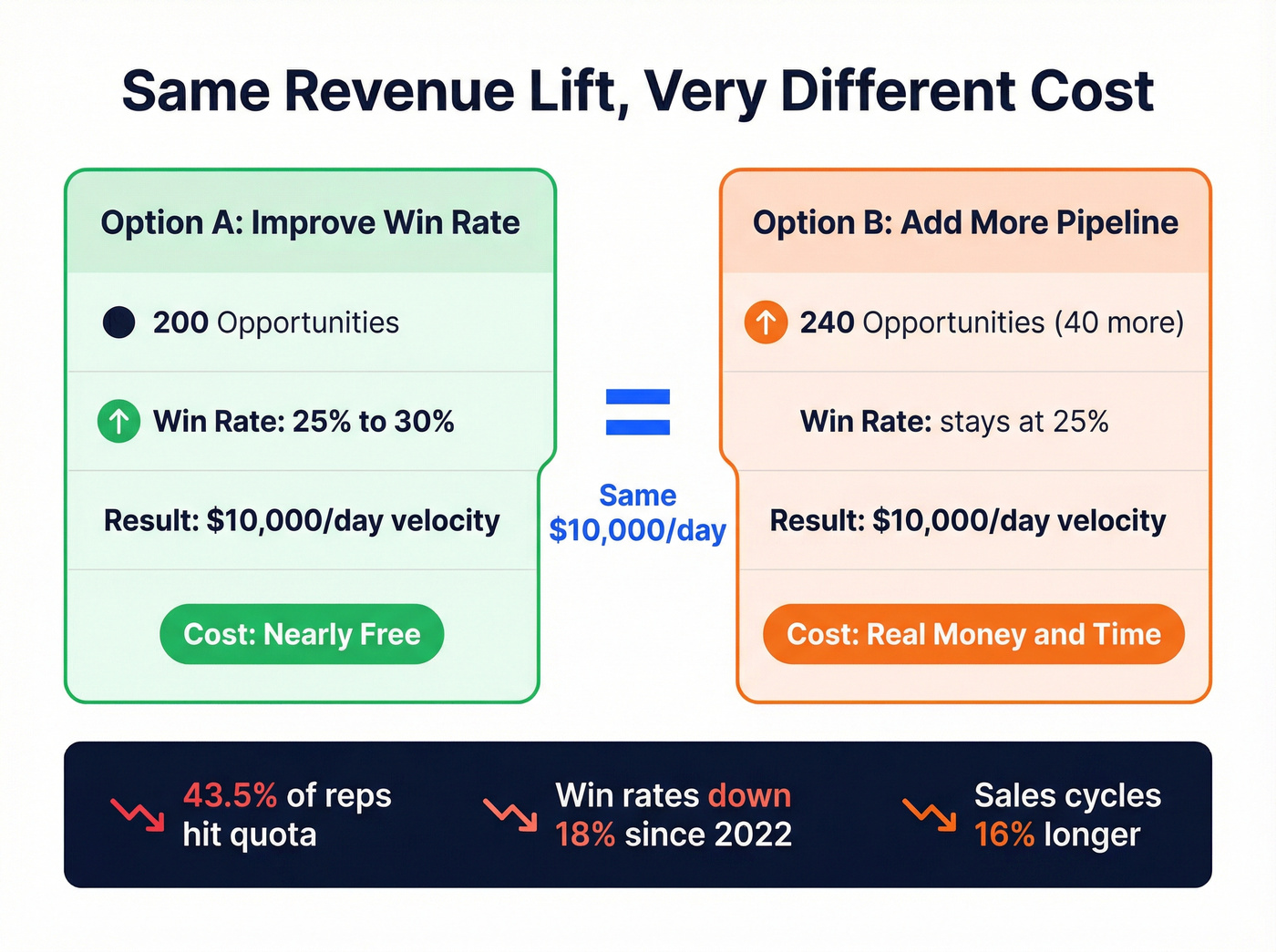
Say your team generates 200 qualified opportunities per quarter, with an average deal size of $15,000, a 25% win rate, and a 90-day sales cycle. Your pipeline velocity is:
(200 x $15,000 x 0.25) / 90 = $8,333/day
Now improve win rate from 25% to 30% - everything else stays flat. Velocity jumps to $10,000/day. That's a 20% revenue lift from a single variable. Compare that to adding 40 more opportunities at the same win rate: you'd get the same $10,000/day, but generating 40 more opps costs real money and time. Win rate improvement is essentially free.
The structural picture is ugly. Only 43.5% of sales professionals hit quota per RepVue's Q1 2024 index. Ebsta and Pavilion's benchmarks show win rates declined 18% versus 2022 and sales cycles grew 16% over the same period. QuotaPath's 2024 Compensation Trends report found 91% of companies failed to achieve 80% or more of their quota targets. Something is broken in most orgs. The question is what.
Quick Diagnostic - answer these honestly:
- Do you know your win rate by deal stage and segment?
- Has your average deal size changed in the last 6 months?
- Can you name the #1 reason deals stall past day 50?
- Is your outbound bounce rate under 5%?
If you answered "no" to two or more, start with the audit in the 90-day plan below.
| Lever | Key Benchmark | Fastest Fix |
|---|---|---|
| Pricing | Data-led teams 10x more likely to exceed growth | Segment-specific increase |
| Win Rate | 47% under 50 days vs 20% beyond | MEDDICC qualification |
| Pipeline Coverage | 3-4x quota = healthy | Clean data + AI prospecting |
| Deal Size | Cross-sell lifts rev up to 30% | Customer maturity model |
| Sales Cycle | 16% longer vs 2022 | Conversation intelligence |

You just saw the math: improving win rate from 25% to 30% delivers the same revenue lift as generating 40 more opportunities - without the cost. But win rate starts with reaching the right people. Prospeo's 98% email accuracy and 7-day data refresh mean your reps pitch qualified buyers, not dead inboxes. Snyk cut bounce rates from 35-40% to under 5% and grew AE-sourced pipeline 180%.
Stop optimizing pipeline volume when your real leak is data quality.
Five Levers That Drive Sales Revenue
Fix Your Pricing First
Here's the thing: pricing is the highest-leverage move most sales leaders ignore. An SBI/Price Intelligently survey of 300+ SaaS operators found that data-led pricing teams are 10x more likely to exceed growth targets, and companies aligning pricing to strategy are 40% more likely to perform far above those targets. Yet 59% of SMBs still rely on "leadership intuition" to set prices. That's gut feel masquerading as strategy.
The widely cited McKinsey estimate holds: a 1% price increase translates to an 11% profit increase for the average company. More leverage than any pipeline program will ever deliver, and it requires zero additional leads.
B2B buyers invest when a solution hits at least two of four criteria: saves time, saves money, is simple to adopt, or adds transparency. Your pricing should map to whichever of these you deliver best. The move in 2026 isn't a broad price hike - it's surgical. Segment your customers by value delivered, identify where you're underpriced relative to outcomes, and raise prices there. Broad increases trigger churn. Targeted increases, backed by usage data and ROI proof, stick.
Accelerate Pipeline Velocity
Speed kills - in a good way. Outreach's benchmarks show deals closed within 50 days have a 47% win rate. Beyond 50 days, that drops to 20%. Every week a deal lingers, your odds of winning it erode.
Pipeline coverage should sit at 3-4x quota. Below that, you're running on fumes. Above 5x, you probably have a qualification problem - too many bad deals clogging the pipe.
AI SDR tools are cutting prospecting time in half. Among teams using them, 40% save 4-7 hours per week, and 45% of high-performing teams now run hybrid human-AI SDR models. LivePerson cut research time from 20 minutes to 2 minutes per prospect and saw a 35% lift in engagement rates. Conversation intelligence users close deals 11 days faster on average.
But none of this matters if your underlying data is garbage. If 30% of your emails bounce, you didn't send 5,000 emails - you sent 3,500. And your reps wasted time on the other 1,500. Snyk's 50-person AE team went from a 35-40% bounce rate to under 5% after switching to Prospeo for verified email data, and AE-sourced pipeline jumped 180%. Cleaner contact data translates directly into revenue without just "doing more outreach." If you need a baseline, start with email bounce rate benchmarks and fixes.
Expand Existing Customers
Upsell and cross-sell work when customers have been live for 6+ months, usage data shows they're bumping against plan limits, and your NPS or health score is green. Upsell conversion rates run 15-30%, with SaaS hovering around 27.6%. Cross-selling strategies can increase revenue up to 30%.
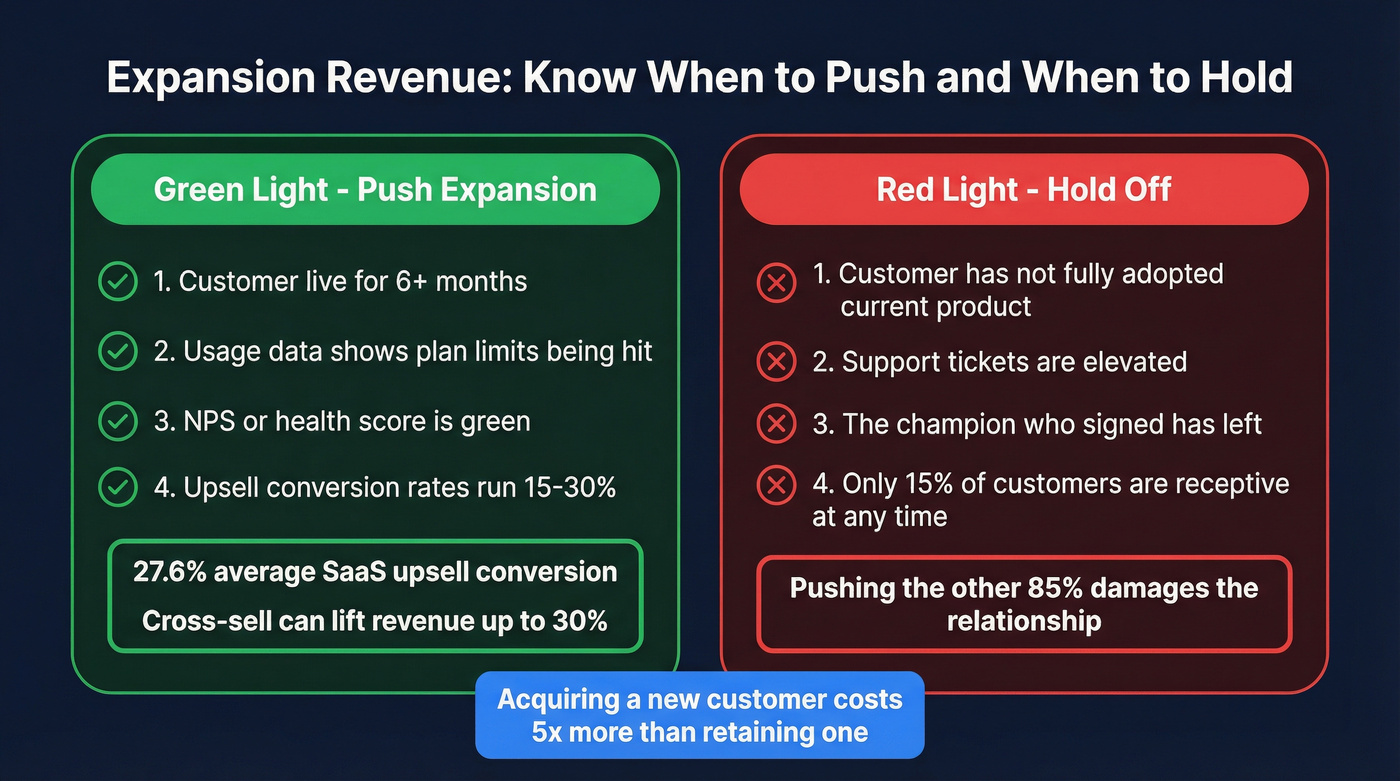
Skip the expansion push when the customer hasn't fully adopted what they bought, support tickets are elevated, or the champion who signed has left. Only about 15% of customers are receptive to cross-selling at any given time. Pushing the other 85% damages the relationship.
The math is simple: acquiring a new customer costs 5x more than retaining an existing one. Build a customer maturity model - segment by adoption stage, health score, and expansion readiness - and let that drive your upsell motion instead of gut feel. If you're formalizing the motion, align on upsell and cross-sell definitions and triggers.
Fix Your Enablement
Only 26% of reps receive weekly coaching. That's a staggering gap, because weekly coaching is associated with 25% higher quota attainment and 30% more deals won. Training ROI runs about $4.53 for every $1 spent - one of the highest-return investments a sales org can make.
The distinction matters: training teaches skills, coaching applies them to live deals. Most orgs over-invest in training (annual SKO, LMS modules nobody finishes) and under-invest in coaching (deal reviews, call listening, pipeline inspection). When enablement is delivered in the flow of work, completion rates hit 90%+. When it's a 45-minute e-learning module, completion craters. The traditional LMS is dead for sales teams. To operationalize this, treat sales execution as a system, not a one-off training event.
Eliminate Revenue Leakage
One poster on r/sales estimated $1M-$4M in revenue lost over 20 years from a single operational failure - a delivery issue in the early 2000s that blacklisted them with a major buyer for decades. B2B buyers have long memories.
Reps spend 70% of their time on non-selling tasks. That means the 30% they do spend selling has to count. Bad prospect data - wrong emails, disconnected numbers, outdated titles - eats directly into that 30%. If your bounce rate is 35%, you're wasting over a third of your outbound effort before a single conversation happens. GreyScout cut their bounce rate from 38% to under 4% and saw pipeline climb 140% once reps stopped chasing dead-end contacts. If you're cleaning lists at scale, consider data enrichment services to keep records current.
Your 90-Day Revenue Plan
We've seen teams identify their weakest variable in under a week using the pipeline velocity formula. The hard part is staying disciplined enough to fix one thing at a time instead of launching twelve initiatives at once.
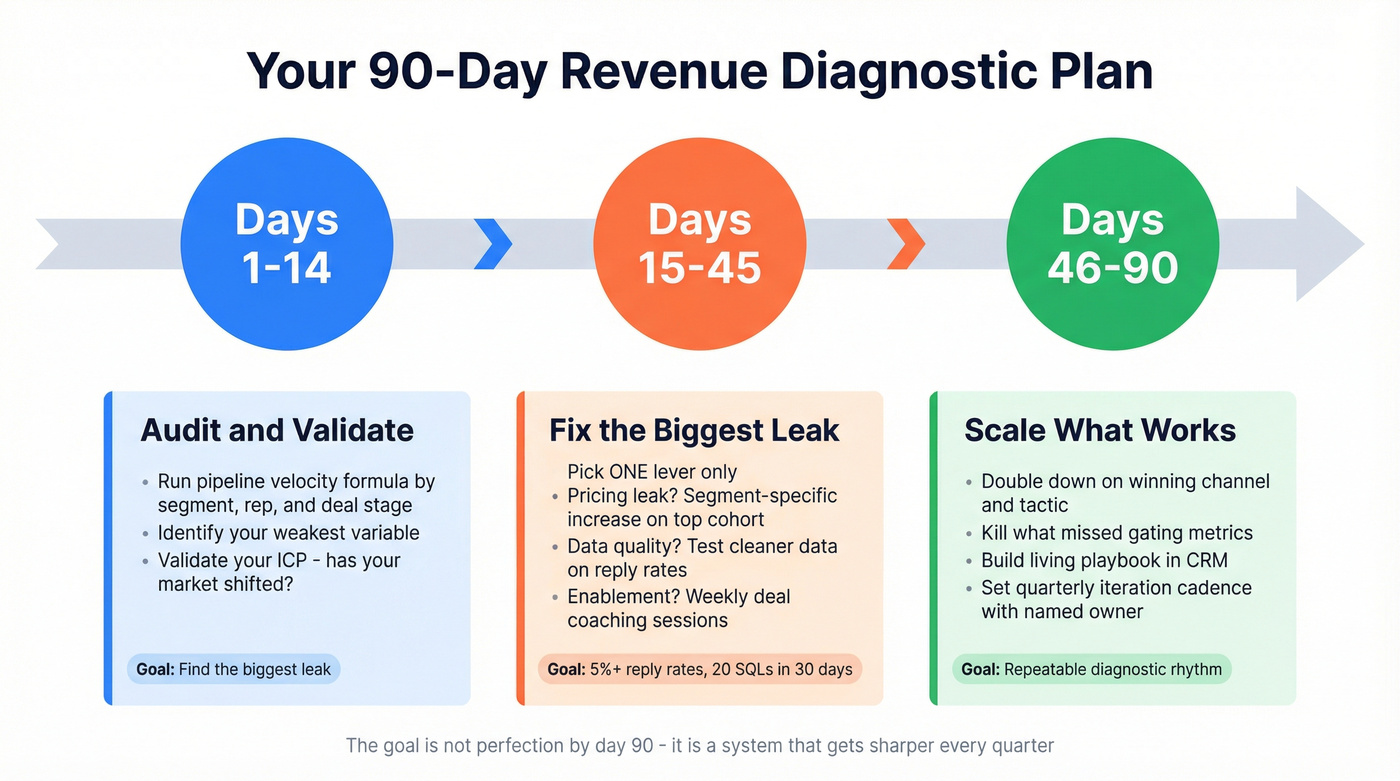
Days 1-14: Audit and Validate
Run the pipeline velocity formula for your team. Break it down by segment, rep, and deal stage. Identify which variable is weakest. Simultaneously, validate your ICP - are you targeting the right accounts, or has your market shifted since you last checked? Use an Ideal Customer Profile scoring rubric so the team qualifies consistently.
Days 15-45: Fix the Biggest Leak
Pick one lever. Just one.
- If pricing is the leak: Run a segment-specific price increase on your highest-value cohort. Test with 20% of renewals before rolling broadly.
- If data quality is the bottleneck: Test whether cleaner data moves your reply rates before committing budget. Aim for outbound reply rates of 5% or higher.
- If enablement is broken: Implement weekly deal coaching sessions and embed micro-learning in your CRM workflow.
Launch a 3-channel pilot (outbound, inbound, partner) with clear gating metrics: 5%+ outbound reply rates and 20 SQLs in the first 30 days. If you need messaging that reliably drives replies, pull from these sales follow-up templates.
Days 46-90: Scale What Works
Double down on the channel and tactic that hit gating metrics. Kill what didn't. Build your sales playbook as a living document embedded in your CRM - not a PDF on SharePoint that nobody opens. Set a quarterly iteration cadence with a named owner in Enablement or RevOps. If you're standardizing the stack, compare sales forecasting solutions before you lock in tooling.
The goal isn't perfection by day 90. It's a repeatable diagnostic rhythm that gets sharper every quarter - one of the few revenue growth strategies that actually compounds over time.
Mistakes That Kill Revenue Growth
Setting quotas without a method. 87% of sales leaders wing it. When quotas are arbitrary, forecasts are fiction and rep trust erodes.
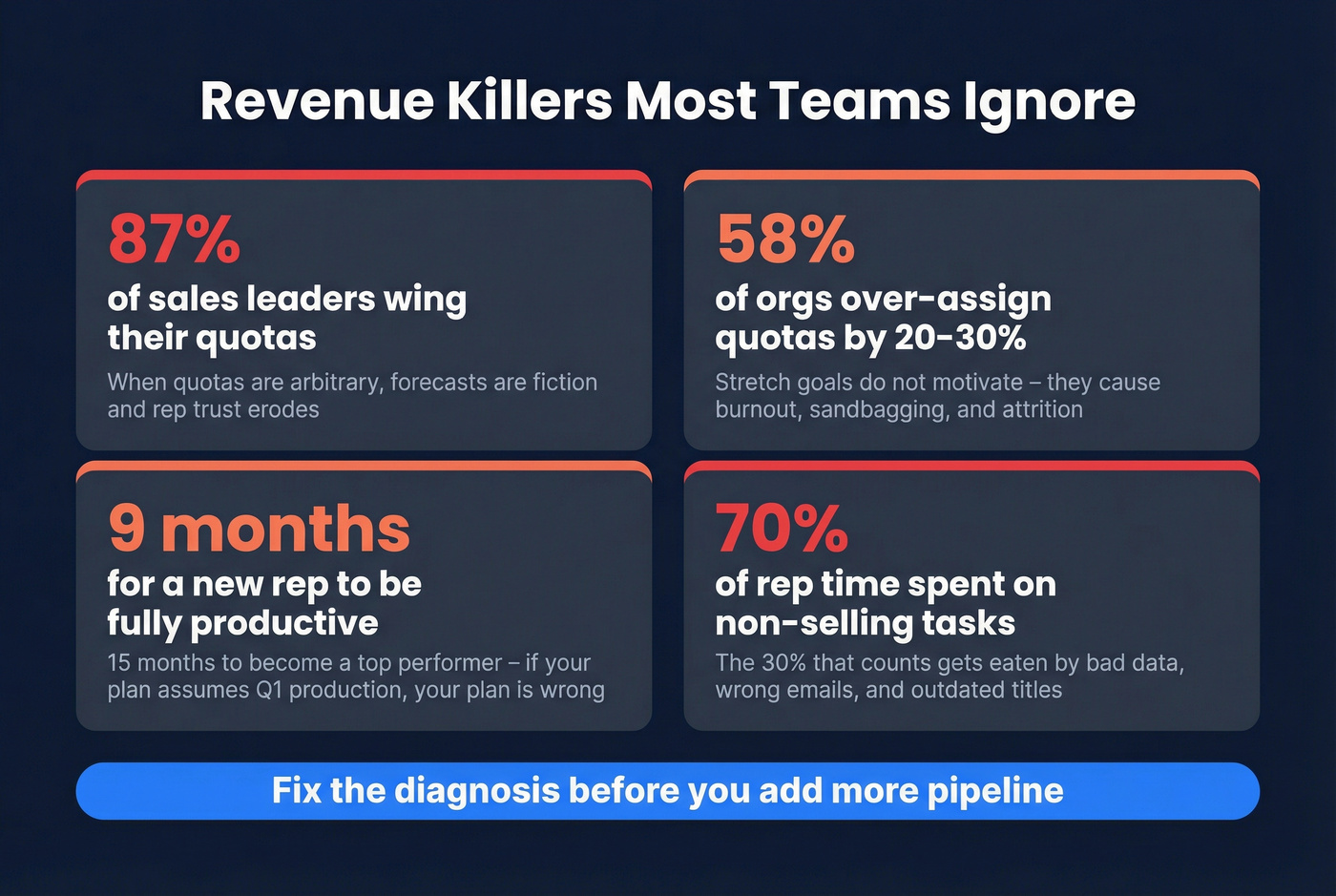
Over-assigning quotas by 20-30%. 58% of orgs do this. The logic is "stretch goals motivate." The reality is burnout, sandbagging, and attrition.
Ignoring ramp time. It takes 9 months for a new rep to be fully productive and 15 months to become a top performer. If your revenue plan assumes new hires produce in Q1, your plan is wrong.
Confusing more pipeline with more revenue. Let's be honest: if your average deal is under $10k, you probably don't need more pipeline - you need better conversion. A team closing 35% of 100 deals beats a team closing 15% of 200 deals, and the first team's reps aren't burned out. If you're troubleshooting conversion, start with sales conversion rate benchmarks.
Leadership doesn't believe the plan. Only 52% of CEOs believe in their own growth plans. If the executive team isn't bought in, execution stalls at the first headwind.
Your pipeline velocity formula is only as strong as its weakest variable. If reps waste hours on bounced emails and wrong numbers, cycle length inflates and win rate craters. Prospeo gives you 300M+ verified profiles at $0.01/email - 90% cheaper than ZoomInfo - so every outreach dollar actually reaches a decision-maker. Teams using Prospeo book 26% more meetings than ZoomInfo users.
Fix the data lever first. Every other revenue fix depends on it.
FAQ
What's the fastest way to improve sales revenue?
Pricing optimization. Data-led pricing teams are 10x more likely to exceed growth targets, and a 1% price increase can translate to an 11% profit lift. It requires zero additional pipeline - just better analysis of where you're underpriced relative to value delivered.
How do you calculate pipeline velocity?
Pipeline velocity = (Opportunities x Average Deal Size x Win Rate) / Average Sales Cycle Length. Track it monthly by segment and rep. If the number isn't growing, diagnose which of the four variables is dragging - that's your highest-leverage fix.
How does bad prospect data hurt revenue?
Bounced emails and wrong numbers waste the 30% of time reps actually spend selling. A 35% bounce rate means over a third of outbound effort produces nothing. Verified data with 98% email accuracy and a weekly refresh cycle turns dead-end outreach into real conversations.
How long does it take to see results from a revenue plan?
With a focused 90-day plan targeting 1-2 levers, teams typically see measurable pipeline and win-rate improvements within 45-60 days. Pricing and data quality fixes tend to show results fastest because they don't require behavior change across the whole team.