

How to Increase Sales Revenue in 2026: 12 Strategies With the Math to Prove It
You just missed the quarter. Again. Not by a catastrophic margin - by 12%, maybe 15% - the kind of miss that feels fixable but keeps happening. The uncomfortable truth is most revenue "plans" are built on vibes instead of math, and the execution gaps compound faster than anyone expects.
Why Most Revenue Targets Get Missed
The data is brutal. Over 80% of businesses missed their sales forecast in at least one quarter over the past two years, and 73% of mid-market businesses failed to meet growth expectations entirely. These aren't strategy failures - they're execution failures. The targets were reasonable. The funnel math was wrong, the data was dirty, or the team was staffed against the wrong motions.
The average CRO lasts just 17 months in the role. That means most revenue organizations are perpetually mid-transition, rebuilding playbooks before the last ones had time to work. Meanwhile, CEOs who nail their go-to-market strategy are 2x more likely to meet or exceed revenue expectations - 74% of them hit their targets. The strategy itself isn't complicated. The plumbing underneath it is where everything breaks.
What You Need (Quick Version)
If you only do three things this quarter:
- Raise prices on new customers by 10-15%. SaaS companies averaged 8-12% YoY increases recently. You're probably underpriced.
- Reverse-engineer your funnel math. Work backward from your revenue target to daily activity numbers. If you can't tell a rep exactly how many calls they need to make on Monday morning, your plan has a hole.
- Clean your prospect data. Reps spend only 30% of their time actually selling. For Meritt, switching to Prospeo dropped bounce rates from 35% to under 4% - that's pipeline you're currently leaving on the table.
These three moves address the fastest revenue levers and require zero new headcount.
The Five Revenue Levers
Every revenue strategy maps to one of five lifecycle stages. Before jumping into tactics, know which lever you're actually pulling.
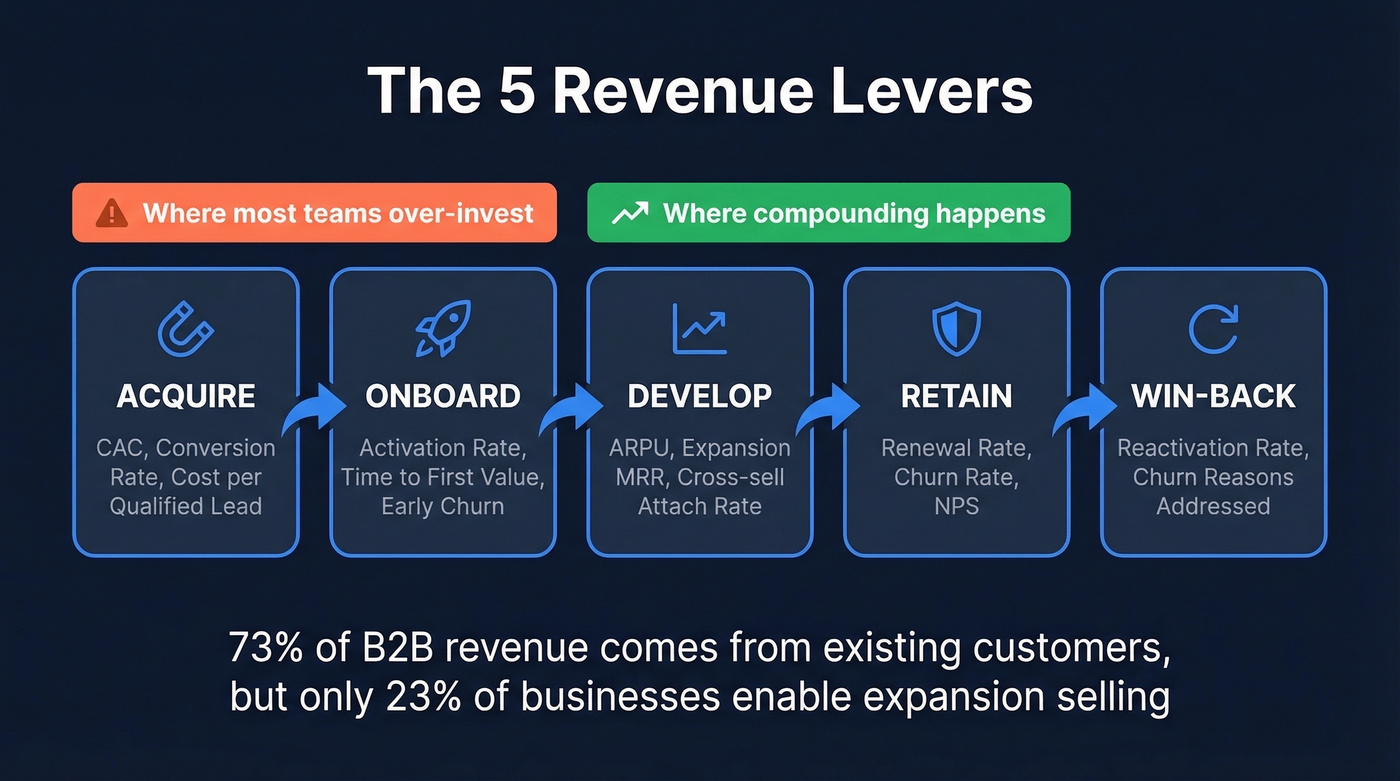
Acquire - CAC, conversion rate, cost per qualified lead. This is where most teams over-invest and where diminishing returns hit fastest.
Onboard - Activation rate, time-to-first-value, early churn. The first 90 days set the trajectory for everything downstream.
Develop - ARPU, expansion MRR, cross-sell attach rate. Most B2B revenue comes from existing customers (73%), yet only about 23% of businesses enable expansion selling. The gap is staggering.
Retain - Renewal rate, churn rate, NPS. A 5% improvement in retention drives 25-95% more profit, making it the highest-leverage metric most teams underweight.
Win-back - Reactivation rate, reasons for churn addressed. The cheapest customer to acquire is the one who already knows your product.
Most teams are over-indexed on Acquire and under-indexed on everything else. If you want to accelerate sales growth, shifting investment toward Develop and Retain is where the compounding happens.

You just did the funnel math. Now ask: what happens when 35% of your emails bounce? Every dead contact burns rep hours, kills domain reputation, and widens the gap to quota. Prospeo's 98% email accuracy and 7-day refresh cycle closed that gap for Snyk - 50 AEs, 180% more pipeline, 200+ new opportunities per month.
Stop reverse-engineering a funnel built on broken data.
12 Strategies That Actually Move Revenue
1. Reverse-Engineer Your Funnel Math
This is the single most valuable exercise a revenue leader can do, and most skip it. A $500K annual quota sounds abstract. Broken into daily activity targets, it becomes a plan.
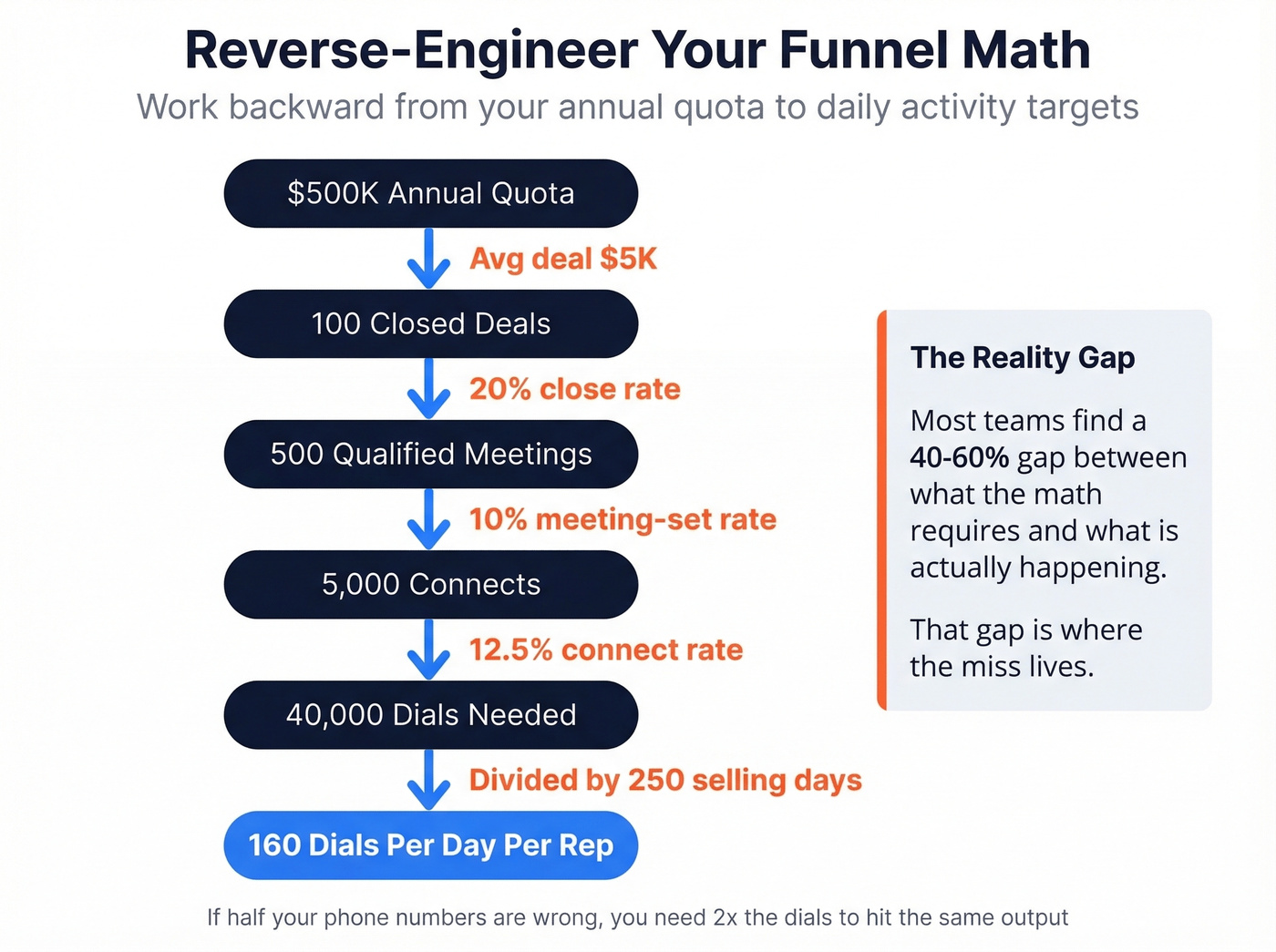
Let's work the math. Say your average deal is $5K. That's 100 closed deals to hit quota. If your close rate on qualified opportunities is 20%, you need 500 qualified meetings. If your meeting-set rate from connects is 10%, you need 5,000 connects. If your connect rate is 12.5%, you need 40,000 dials - roughly 160 per selling day.
A simpler version from Rough Notes: 400 calls -> 50 connects (12.5%) -> 5 meetings (10%) -> 2 closes (20%). That's one rep's monthly cycle. Now multiply across your team and compare to your actual activity data. In our experience, the gap between what the math requires and what's actually happening is usually 40-60%. That gap is almost always where the miss lives.
That connect rate assumption of 12.5% depends entirely on data quality. If half your numbers are wrong, you need twice the dials to hit the same output.
Close.com's free revenue growth calculator lets you plug in your own numbers and export a CSV. Share it with your team. Make the math visible. Most B2B teams need 3-4x pipeline coverage to hit quota reliably - if you're running at 2x, you don't have a closing problem. You have a pipeline problem.
2. Fix Your Prospecting Data
None of that funnel math works if your data is garbage. And for most teams, it is.
Reps spend only 30% of their time actually selling. The rest goes to admin, research, and chasing contacts that don't exist. When your email bounce rate is 35%, you're not just wasting sends. You're wasting the rep time that went into researching those contacts, writing those emails, and building those sequences. At 1,000 sends per week, a 35% bounce rate means 350 dead-end contacts that consumed real hours.
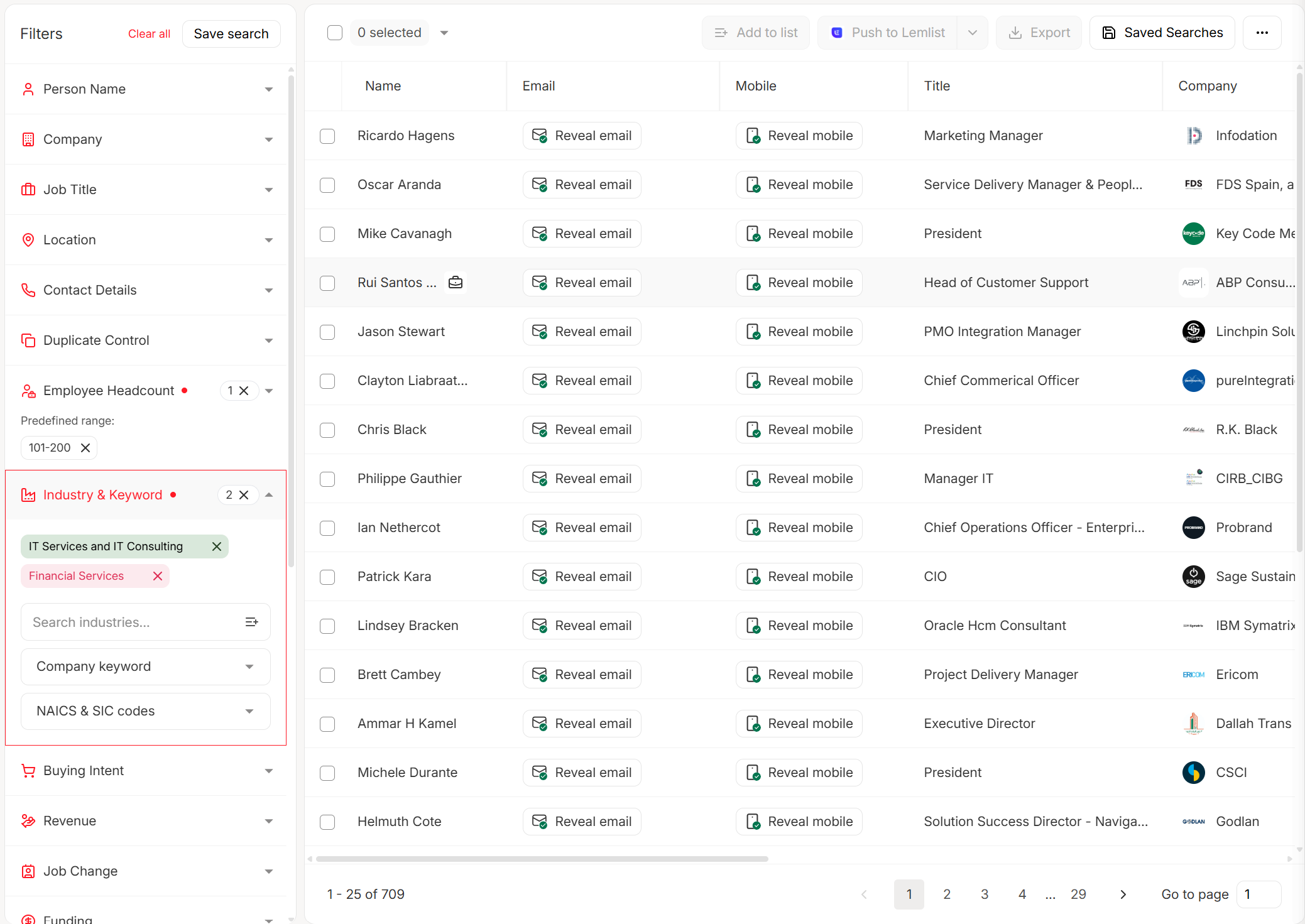
Prospeo addresses this at the source with 98% email accuracy, a 7-day data refresh cycle, and 300M+ professional profiles. The results speak for themselves: Meritt went from a 35% bounce rate to under 4%, and their pipeline tripled from $100K to $300K per week. Snyk's 50 AEs saw AE-sourced pipeline jump 180% after switching, generating 200+ new opportunities per month.
When your bounce rate drops from 35% to under 4%, every other metric in your funnel improves. Connect rates go up. Domain reputation stays clean. Sequences actually reach inboxes. It's the most fixable revenue problem most teams ignore.
3. Raise Your Prices
This is the fastest lever and the one teams are most afraid to pull. They shouldn't be.
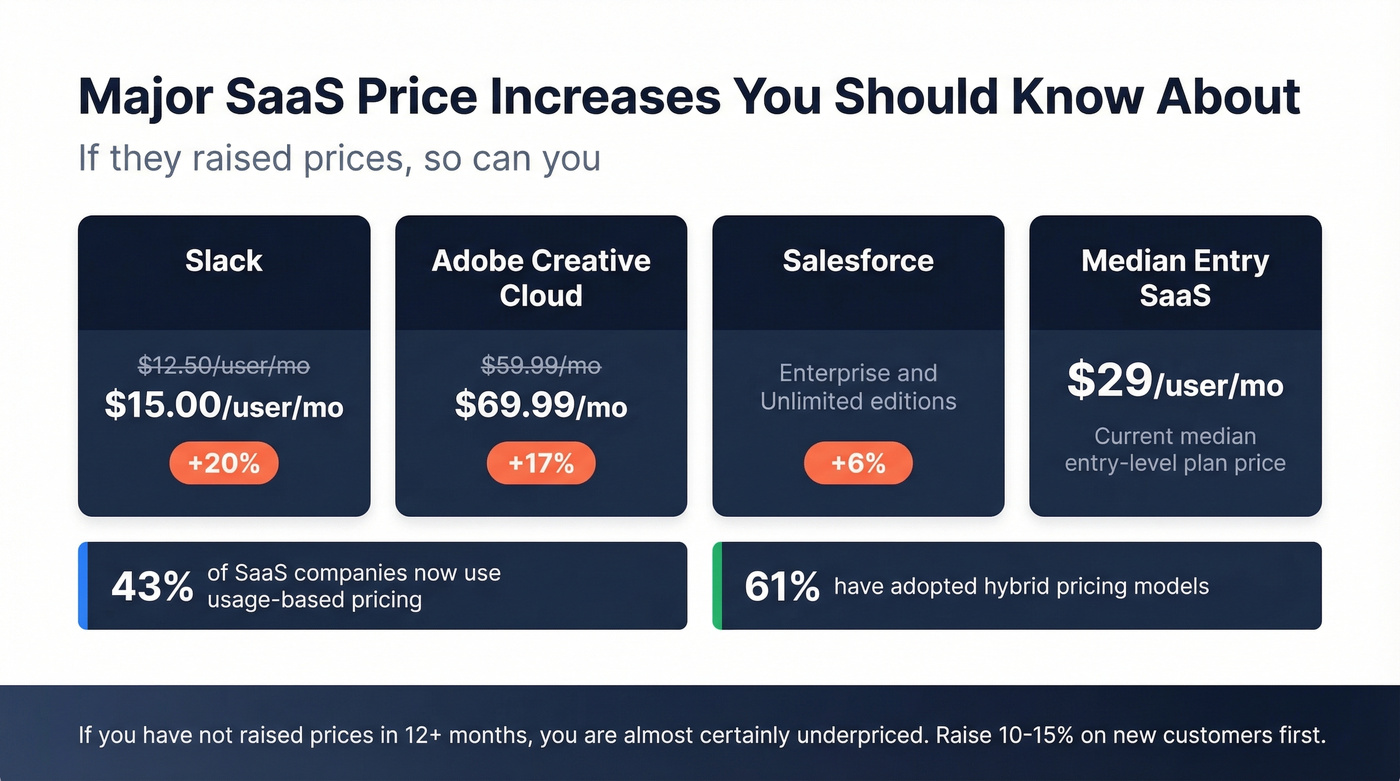
SaaStr documented the specifics: Slack went from $12.50 to $15/user/month (a 20% jump), Adobe pushed Creative Cloud from $59.99 to $69.99/month, and Salesforce tacked on 6% for Enterprise and Unlimited editions. The median entry-level SaaS plan now sits at $29/user/month.
Pricing model innovation is reshaping how companies capture value, too. 43% of SaaS companies now use usage-based pricing, and 61% have adopted hybrid models that blend subscriptions with consumption. If you're still on flat per-seat pricing, you're leaving expansion revenue on the table with every power user.
The playbook: raise on new customers first. Existing customers keep their current rate until renewal, and even then, you phase it in. We've tested this with multiple teams - raising prices on new customers by 10-15% almost never triggers meaningful pushback. If you haven't raised prices in 12+ months, you're almost certainly underpriced.
Here's the thing: if your average contract value is in the low five figures or less, you probably don't need to agonize over pricing strategy. Just raise it 10% on new deals this month. The customers you lose at a 10% higher price were never going to be your best customers anyway.
4. Upsell and Cross-Sell Existing Customers
73% of B2B revenue originates from current customers. Only about 23% of businesses enable their sales teams for expansion conversations. That's an enormous gap - and it's where the easiest money lives.
Here's what actually works: set usage-based triggers that flag when a customer hits 80% of their plan limit, then route that signal to the account owner with a pre-built expansion offer. Train your CS team to run quarterly business reviews that end with a commercial recommendation, not just a satisfaction check. The first 90 days of a customer relationship - onboarding, activation, early value delivery - set the long-term trajectory for expansion revenue. If your CS team treats QBRs as relationship maintenance instead of revenue opportunities, you're sitting on your highest-margin revenue source and doing nothing with it.
One more thing: 76% of software companies launched AI features in the past year, but fewer than 1 in 5 saw more than 10% revenue impact from them. The companies that did monetize AI successfully treated it as an upsell motion with dedicated pricing, not a free feature bundled into existing plans.
5. Staff Renewals Differently
Your AEs handle renewals alongside net-new deals. They deprioritize renewals because commissions favor new logos. Renewal rates slip. Upsell attach rates crater.
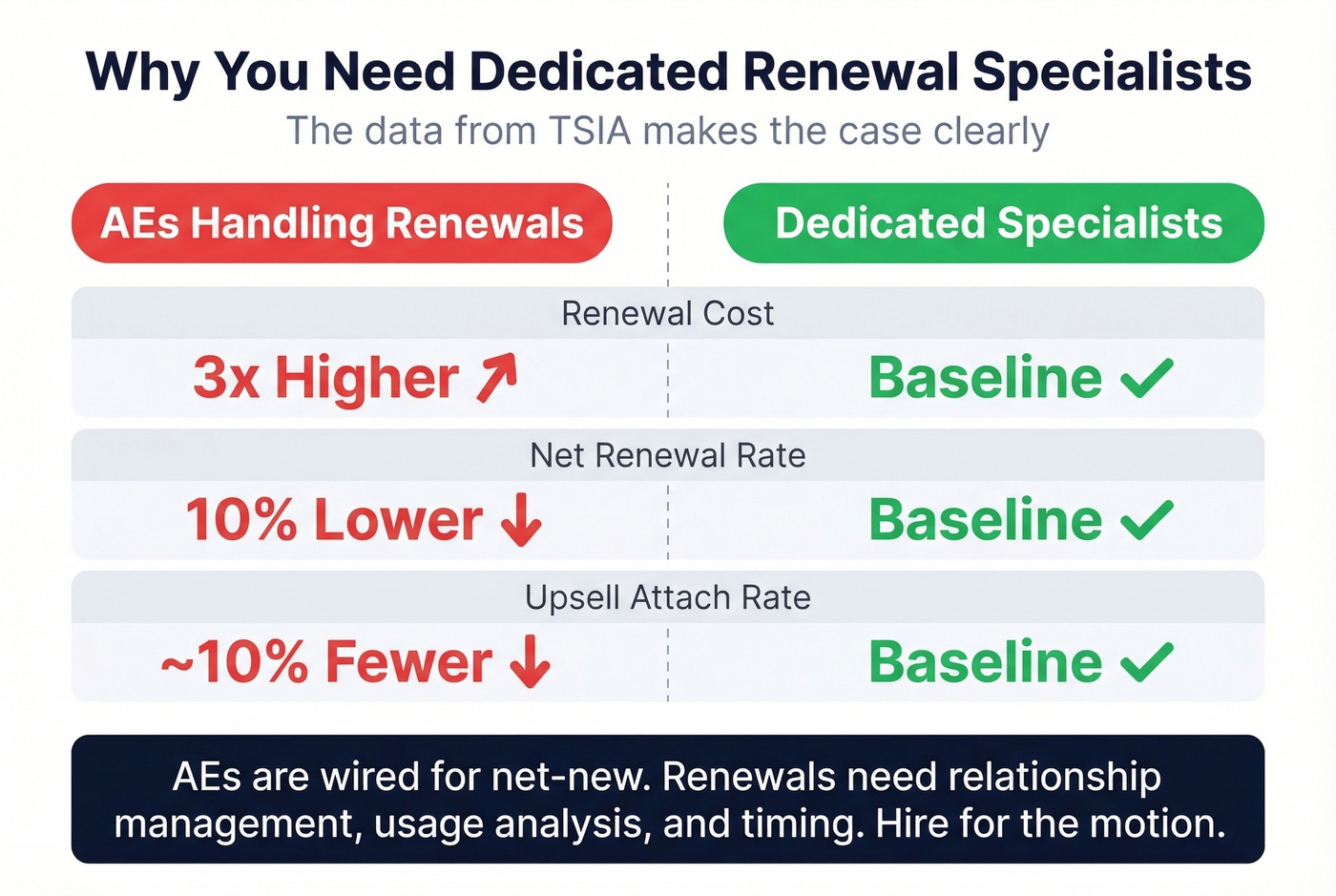
Dedicated renewal specialists change the math. TSIA's data shows the difference is dramatic:
| Metric | AEs Handling Renewals | Dedicated Specialists |
|---|---|---|
| Renewal cost | 3x higher | Baseline |
| Net renewal rate | 10% lower | Baseline |
| Upsell attach | ~10% fewer | Baseline |
AEs are wired for net-new. Renewals require a different skill set - relationship management, usage analysis, timing. Hire for the motion. This is the single easiest org design fix most companies refuse to make.
6. Invest in Retention
Bain's research, published in HBR, found that increasing customer retention rates by just 5% increases profits by 25-95%. Acquiring a new customer costs 5-25x more than retaining an existing one.
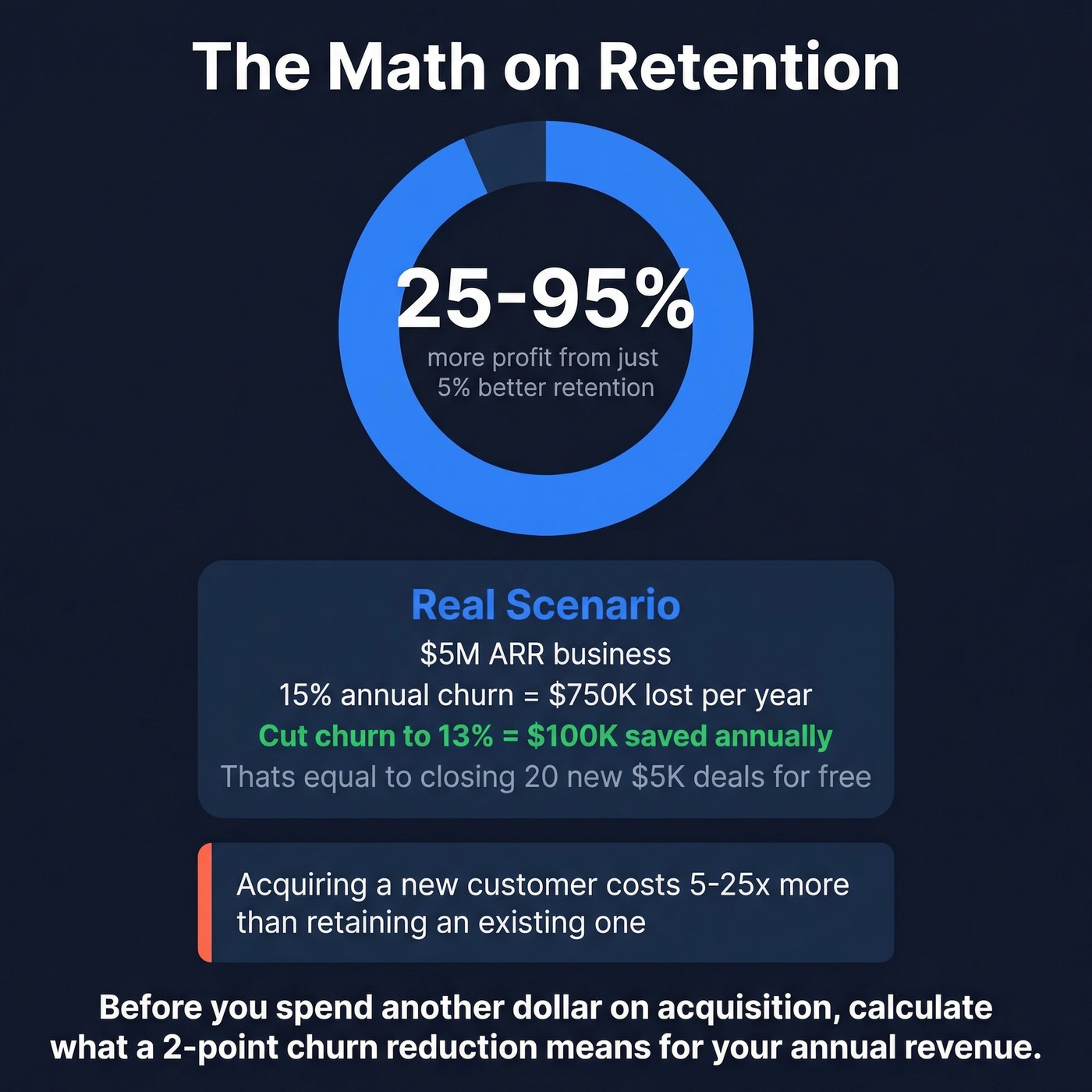
Here's a scenario: you're running a $5M ARR business with 15% annual churn. That's $750K walking out the door every year. Cutting churn to 13% saves $100K annually - the equivalent of closing 20 new $5K deals without spending a dollar on acquisition. Now imagine you redirect even half the budget you'd spend acquiring those 20 deals into retention programs. The math compounds fast.
We've seen teams pour six figures into outbound programs while ignoring a 15% monthly churn rate. That's filling a leaking bucket with a firehose. Before you spend another dollar on acquisition, calculate what a 2-point churn reduction would mean for your annual revenue.
7. Reduce Checkout Friction
Skip this one if you're pure B2B SaaS with no self-serve checkout. For everyone else - especially ecommerce - this is your highest-ROI fix.
The average documented cart abandonment rate is 70.22% across 50 studies. The top reasons: 39% cite extra costs like shipping, tax, and fees; 21% say delivery is too slow; 19% don't trust the site with their card info. The average checkout flow contains 23.48 form elements - the ideal is 12-14. You're asking people to fill out twice as many fields as necessary.
Baymard estimates that better checkout design could recover $260B in lost US and EU ecommerce revenue. Even a 10% improvement in your abandonment rate can meaningfully move quarterly numbers.
8. Sharpen Your Value Proposition
HubSpot's State of Sales report surveyed 1,000 sales professionals and found the top deal-killers: 37% said no product fit, and 35% said poor value for money. That's 72% of lost deals coming down to messaging and positioning.
If your reps can't articulate why your product is worth the price in two sentences, the problem isn't the prospect - it's the pitch. Try this exercise: have every rep write down the single biggest outcome your product delivers, then the single biggest cost of not using it. If you get 10 different answers from 10 reps, your value prop isn't sharp - it's a Rorschach test. Align on one "before and after" statement that every rep can deliver cold, and watch demo-to-close rates climb.
9. Reallocate Leads From Your Worst Reps
This one's uncomfortable but effective.
Your median rep closes at 20%. Your bottom rep closes at 10%. You send both 50 leads per month. The median rep closes 10 deals. The bottom rep closes 5. Reallocating those 50 leads to the median rep - or even splitting them across your top three - produces roughly 20% more revenue from the same lead volume. No new pipeline required.
Ask any B2B sales leader what moved the needle fastest, and the answer is almost always the same: stop distributing leads equally and start distributing them based on conversion data. You don't need to fire anyone tomorrow. But you do need to look at close rates by rep and ask whether your lead distribution is optimized or just egalitarian.
10. Switch to Monthly Quotas
Quarterly quotas create a predictable pattern: slow start, mid-quarter scramble, end-of-quarter heroics. Monthly quotas create urgency and faster feedback loops. Reps know within 30 days whether their approach is working, and managers can course-correct before a quarter is lost.
One SaaS company we tracked saw pipeline velocity increase 15% within two quarters of switching from quarterly to monthly quotas - simply because problems got caught in week three instead of week nine.
11. Align Sales and Marketing on Pipeline Math
Take the funnel math from strategy #1 and share it with marketing. If sales needs 500 qualified meetings to hit target, and marketing is generating 200 MQLs per month with a 10% meeting-set rate, the math doesn't work. That's 20 meetings from marketing against a 500-meeting target.
You need 3-4x pipeline coverage, and both teams need to own their piece of that number. Put the funnel model in a shared dashboard. Update it weekly. Argue about the assumptions, not the blame.
12. Optimize for Mobile Conversion
Mobile conversion rates run 2.8% vs. desktop's 3.2%, and mobile cart abandonment hits 79% compared to 68.1% on desktop. If more than half your traffic is mobile - and it probably is - that gap is costing you real revenue.
Test your checkout flow on a phone. Time it. Count the taps. Then cut half of them.
The Benchmarks You Need
| Metric | Benchmark | Source | If You're Below This |
|---|---|---|---|
| Quota attainment | 43.5% of reps hit quota | RepVue via Everstage | Audit territory design and lead quality before blaming reps |
| Reps on track | 59.9% meeting targets | HubSpot State of Sales | The gap between 43.5% and 59.9% reflects measurement differences - track both |
| Cart abandonment | 70.22% average | Baymard (50 studies) | Above 75%? Audit checkout flow immediately |
| Mobile vs desktop CVR | 2.8% vs 3.2% | Smart Insights | Gap wider than 0.5pp? Mobile UX needs work |
| SaaS price increases | 8-12% YoY | Monetizely | Haven't raised in 12+ months? You're falling behind |
| Pipeline coverage | 3-4x needed | Industry standard | Below 3x? Pipeline problem, not a closing problem |
| Retention -> profit | +5% retention = +25-95% profit | Bain via HBR | Calculate your churn cost before spending on acquisition |
Mistakes That Kill Revenue Growth
Staffing renewals with AEs costs 3x more and produces 10% lower renewal rates. Hire specialists.
Ignoring data quality means every bounced email is a meeting that never happened. This compounds across thousands of sends per month, quietly destroying domain reputation and rep morale in the process. If you need a repeatable process, start with CRM data cleaning.
Setting quarterly quotas when monthly would work delays feedback loops by 60 days. Problems that could be caught in week three become quarter-killers by week ten.
Chasing new logos while neglecting expansion ignores the fact that 73% of B2B revenue comes from existing customers, but only about 23% of teams enable expansion selling. That's a 50-point gap hiding your best revenue. If you want a tighter playbook, use an account management upsell strategy.
Tolerating 3-5% revenue leakage from coordination failures across pricing, billing, forecasting, and compliance quietly drains margin. Most teams don't even measure it.
Meritt tripled pipeline from $100K to $300K per week with the same team - no new hires, no new tools, just data that actually connects. When bounce rates drop from 35% to under 4%, every lever in this article compounds faster. Prospeo gives you 300M+ profiles at $0.01/email so you can scale revenue without scaling costs.
Increase revenue this quarter without increasing headcount.
FAQ
What's the fastest way to increase sales revenue?
Raising prices 10-15% on new customers and fixing prospect data quality are the two fastest levers because they improve revenue per deal and reduce wasted outreach within 30-60 days. If you can only pick one, start with data: dropping bounce rates from 35% to under 4% immediately lifts deliverability and connect rates across your entire funnel.
How do you calculate the pipeline needed to hit a revenue target?
Divide your revenue target by average deal size, then divide by win rate to get required qualified pipeline. A $1M target with a 25% win rate requires $4M in pipeline, and most B2B teams run best at 3-4x coverage to absorb slippage from no-shows, stalled deals, and push-outs.
Does raising prices actually increase revenue?
Yes - when you start with new customers and keep the increase modest (8-15%), it usually lifts revenue without materially hurting win rates. The clean rollout is: new deals first, then phased increases at renewal with clear value-based justification.
Why do most sales teams miss their revenue targets?
Most misses come from execution gaps: wrong funnel assumptions, insufficient pipeline coverage (often under 3x), and dirty data that lowers connect rates and tanks deliverability. Fixing the math, staffing the right motions like renewals, and cleaning lists typically moves results faster than another strategy deck.
The Non-Vibes Plan
If you want a real answer to how to increase sales revenue, it's this: make the math visible, fix the data feeding the funnel, and pull the levers that compound - pricing, expansion, retention - instead of only chasing new logos. Do the three fast moves first, then use the benchmarks above to find the one constraint that's actually causing the miss. If you want to go deeper on the math, use a sales growth calculator and sanity-check your sales pipeline metrics.