

How to Increase Software Sales: A Benchmark-Driven Playbook
Most advice on how to increase software sales reads like it was written in 2019 and lightly repackaged. "Know your ICP." "Nurture your leads." Those aren't strategies - they're prerequisites. The global SaaS market has surpassed $232B, competition for every buyer's attention is brutal, and the playbooks that worked three years ago are producing diminishing returns.
What actually drives measurable pipeline growth is more specific than most people admit. And here's the contrarian take most teams miss: you don't need more leads. You need better data on the leads you already have.
The Short Version
- Match your sales motion to your ACV - PLG under $5K, hybrid $5K-$50K, sales-led $50K+
- Benchmark every funnel stage against industry norms
- Replace volume-based outbound with signal-led selling
- Invest in data quality over data quantity
- Use evidence-based selling, not pressure tactics
Let's break each of these down with real numbers.
Match Your Sales Motion to Your ACV
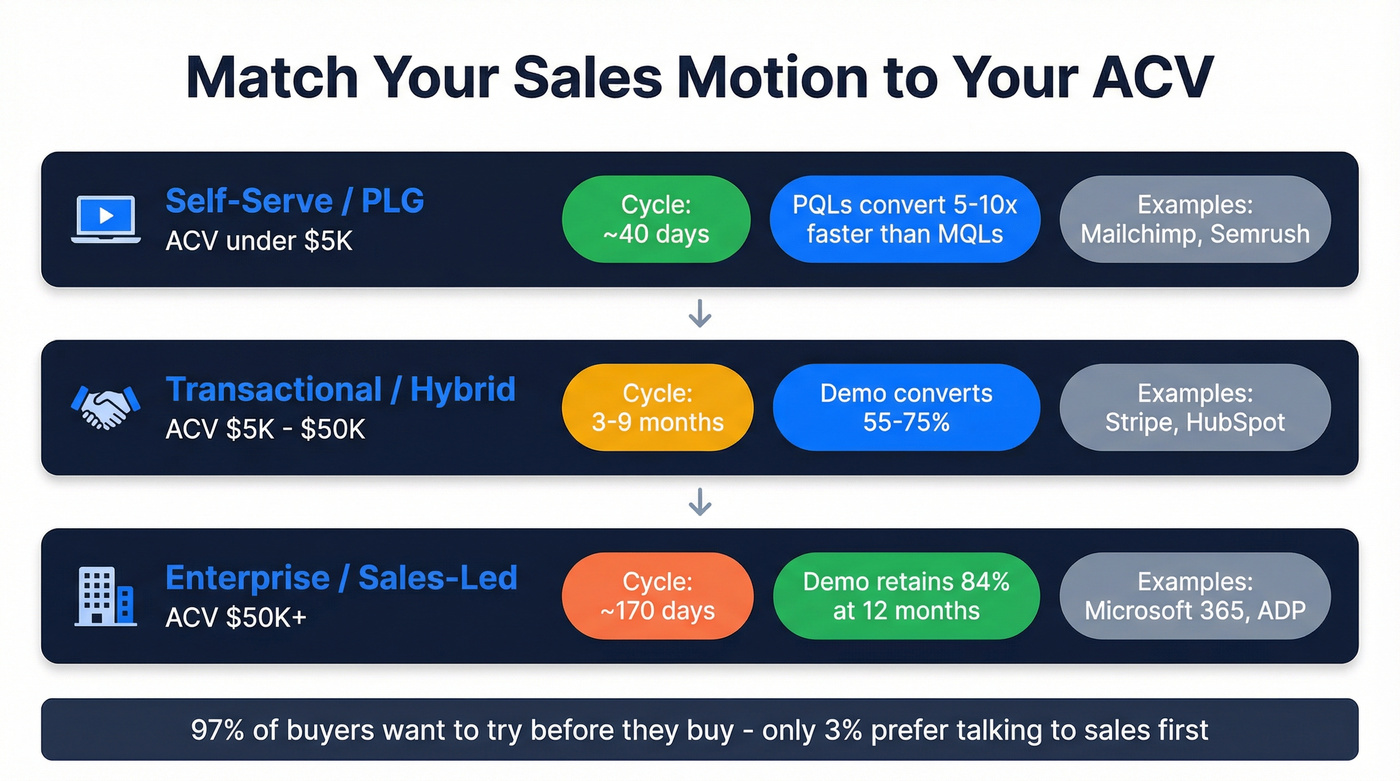
The single biggest strategic mistake in software sales is running the wrong motion for your deal size. A $3K/year product shouldn't require a 45-minute demo with an AE. A $75K enterprise deal shouldn't rely on a self-serve signup flow. We've seen teams burn through entire quarters before realizing the mismatch.
| Sales Motion | ACV Range | Sales Cycle | Examples |
|---|---|---|---|
| Self-serve (PLG) | <$5K | ~40 days | Mailchimp, Semrush |
| Transactional | $5K-$50K | 3-9 months | Stripe, HubSpot |
| Enterprise | $50K+ | ~170 days | Microsoft 365, ADP |
97% of buyers want to try before they buy - only 3% prefer speaking to sales first. That doesn't mean you kill your sales team. It means you let PLG handle self-serve adoption and use reps where they actually add value: expansion, multi-threading, and complex enterprise deals. PQLs convert 5-10x faster than MQLs, making your sales team more efficient, not redundant.
Trial vs. Demo vs. Freemium
Enterprise trials convert at just 10-15%, while demos convert 55-75% for deals above $50K ACV. Opt-in free trials land at 18.2% conversion; opt-out trials hit 48.8%. But demo cohorts retain 84% at 12 months versus 65% for trial cohorts. Don't pick based on philosophy - pick based on the math.
Don't Forget Onboarding
Strong onboarding reduces time-to-value by 60% and increases retention by up to 50%. We've watched teams obsess over top-of-funnel while hemorrhaging revenue from poor activation. If your LTV:CAC ratio is below 3:1, onboarding is almost certainly the leak - every dollar spent reducing churn protects expansion revenue that compounds quarter over quarter, and it's usually cheaper than acquiring a new customer.
Diagnose Your Funnel With Real Numbers
Most software companies can't tell you where their funnel is actually leaking. They know revenue is below target, but they haven't benchmarked each stage against anything concrete.
| Funnel Stage | Healthy Range | Elite |
|---|---|---|
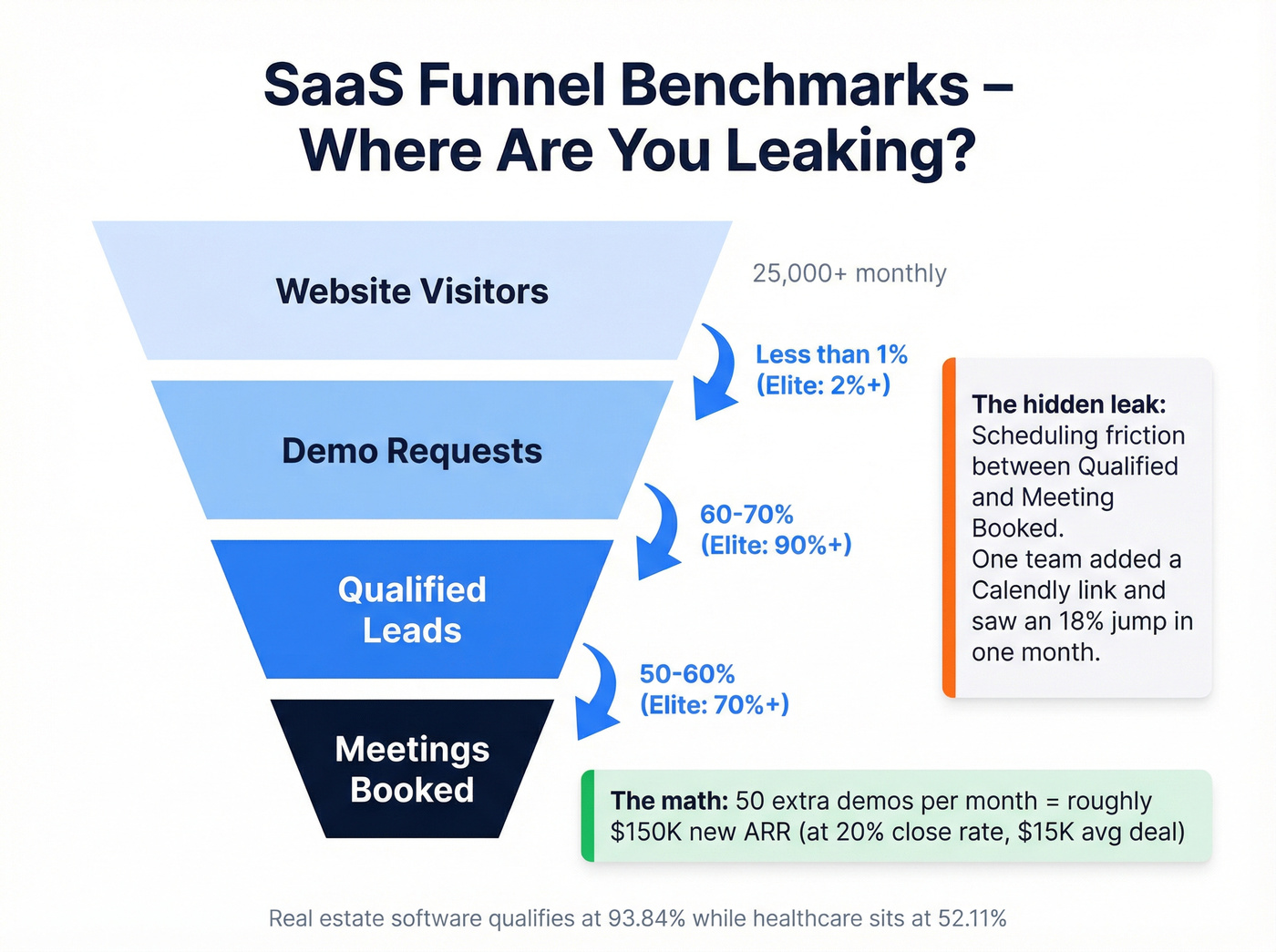
| Visitor -> Demo Request | <1% (at 25K+ visitors) | 2%+ |
| Demo -> Qualified | 60-70% | 90%+ |
| Qualified -> Meeting | 50-60% | 70%+ |
The variance across industries is massive. Real estate software companies qualify at 93.84% while healthcare software sits at 52.11%. If your qualification rate is below 60%, the problem is usually broad targeting or low-intent traffic - not your sales team's pitch.
In our experience, a common funnel leak hides between qualified and meeting-booked. Scheduling friction is a silent killer. One team we spoke with added a Calendly link to their qualification confirmation email and saw meeting-booked rates jump 18% in a single month.
Here's a model that makes the impact concrete: at 25,000 monthly visitors, booking just 50 additional demos per month translates to roughly $150K in new ARR, assuming a 20% close rate and $15K average deal size. That's not a moonshot - it's a rounding error in your funnel math.

You just saw how 50 extra demos per month can add $150K in ARR. But that math only works if your outbound actually reaches real buyers. Prospeo's 300M+ profiles with 98% email accuracy and 30+ filters - intent data, technographics, funding, headcount growth - let you target the exact accounts that match your ACV tier.
Stop guessing. Start selling to buyers who are actually in-market.
Outbound That Actually Works in 2026
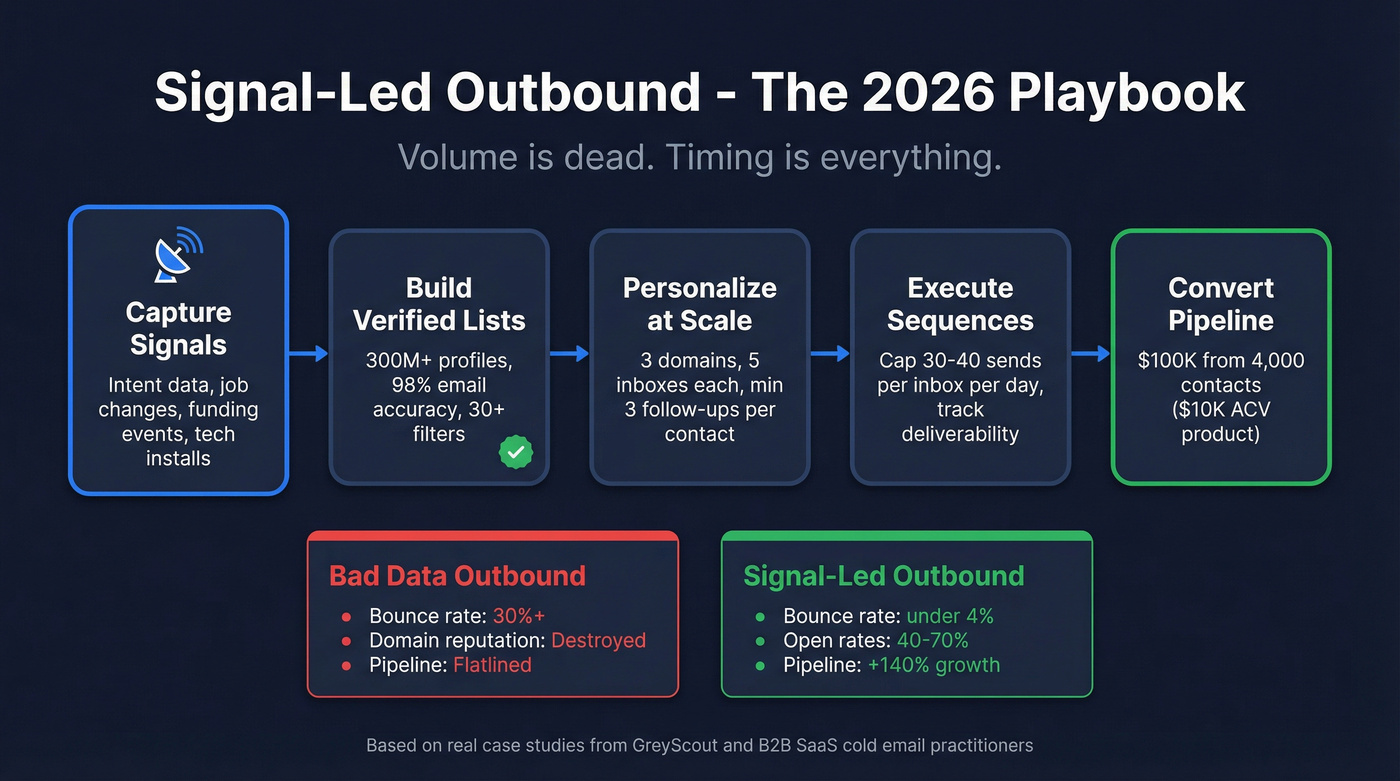
Volume-based outbound is dead. The shift working right now is signal-led selling - using intent data, job changes, funding events, and technographic signals to time outreach to moments when buyers are actually in-market.
One CRM hygiene move that pays for itself immediately: replace "Closed Lost" with "Closed Lost - Nurture." Deals that weren't ready six months ago might be ready now, and you've already done the discovery work.
A case study shared on r/coldemail shows what disciplined cold email looks like: a B2B SaaS team generated $100K from just 4,000 contacts selling a $10K/year product. The setup was 3 domains, 5 inboxes each, extreme personalization, and a minimum of 3 follow-ups per contact. With good deliverability, cold email benchmarks run 40-70% open rates and 1-5% reply rates.
But none of that matters if your data is bad. A 30%+ bounce rate doesn't just waste emails - it burns your sending domain and poisons every subsequent campaign. GreyScout saw their bounce rate drop from 38% to under 4% and pipeline jump 140% after switching to Prospeo's verified database, which runs a 7-day data refresh cycle with 98% email accuracy across 300M+ profiles.
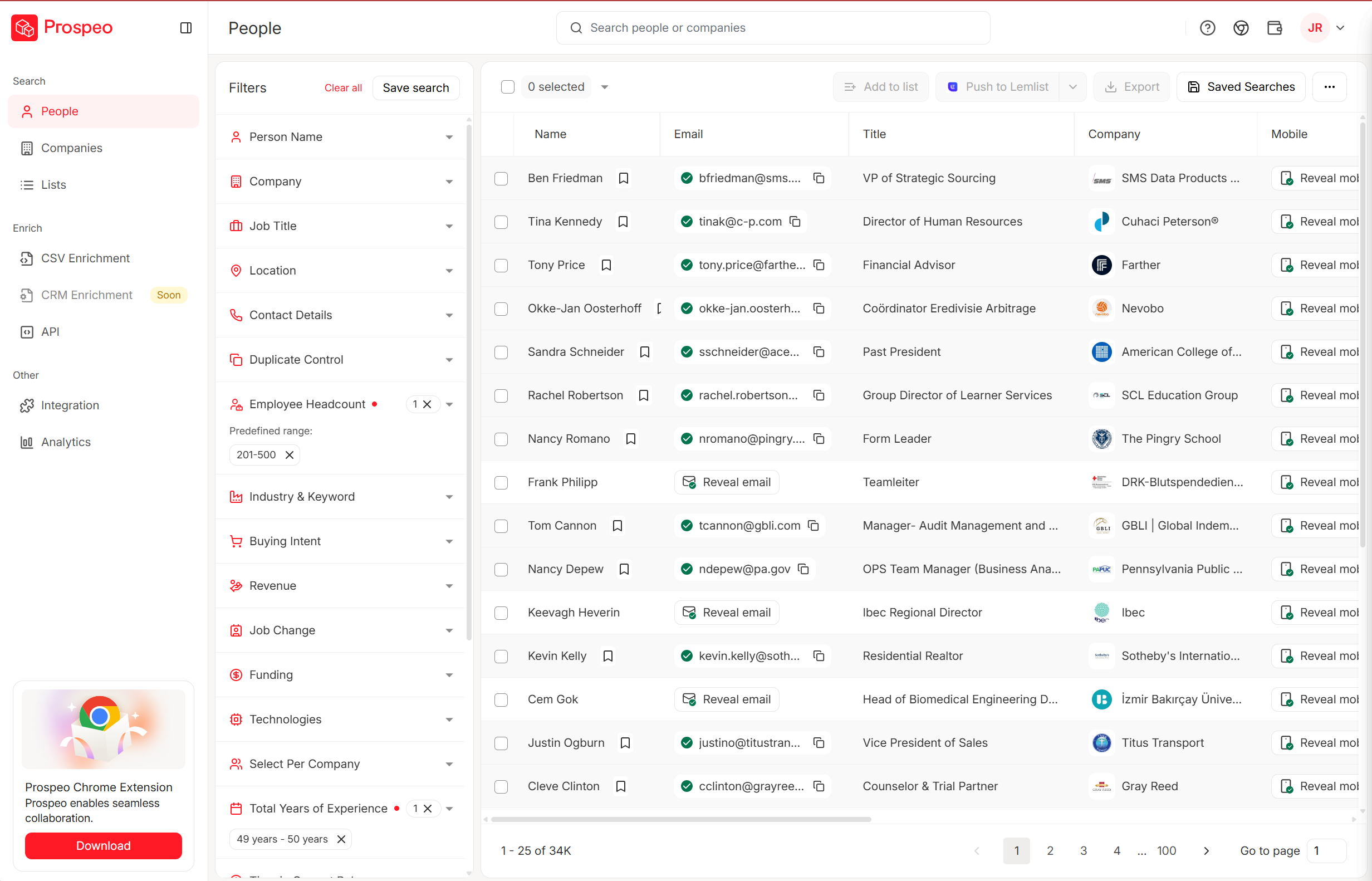
GreyScout cut bounce rates from 38% to under 4% and grew pipeline 140%. Stack Optimize built to $1M ARR with under 3% bounce across every client. The difference wasn't their copy or cadence - it was verified data refreshed every 7 days at $0.01 per email. Your software sales stack starts here.
Bad data is the most expensive mistake in your entire sales motion.
Mistakes That Kill Software Deals
Lead with discovery. Ask about the prospect's pain, timeline, and decision process before you ever open a slide deck. Build data-backed proposals with ROI models. Use a mutual action plan - 3-5 concrete steps both sides agree to. One Head of Sales reported that replacing urgency-based CTAs with tailored value maps increased their win rate by 20% over two quarters.
Here's what to avoid: getting "feature happy." A practitioner on r/sales described losing a major deal by drowning the prospect in technical specs while ignoring the stakeholder's emotional buying motives. Nobody buys software because of a feature matrix. They buy because they believe it'll solve a problem they're tired of dealing with. Fake scarcity and aggressive urgency tactics push deals into "no decision" faster than anything else - and once a deal lands there, it's nearly impossible to resurrect.
Your Minimum Sales Stack
Your minimum viable stack is three things: a CRM, a prospecting tool with verified data, and a sequencing platform. Everything else is optimization. Skip the $50K/year "all-in-one" platforms until you're past $5M ARR.
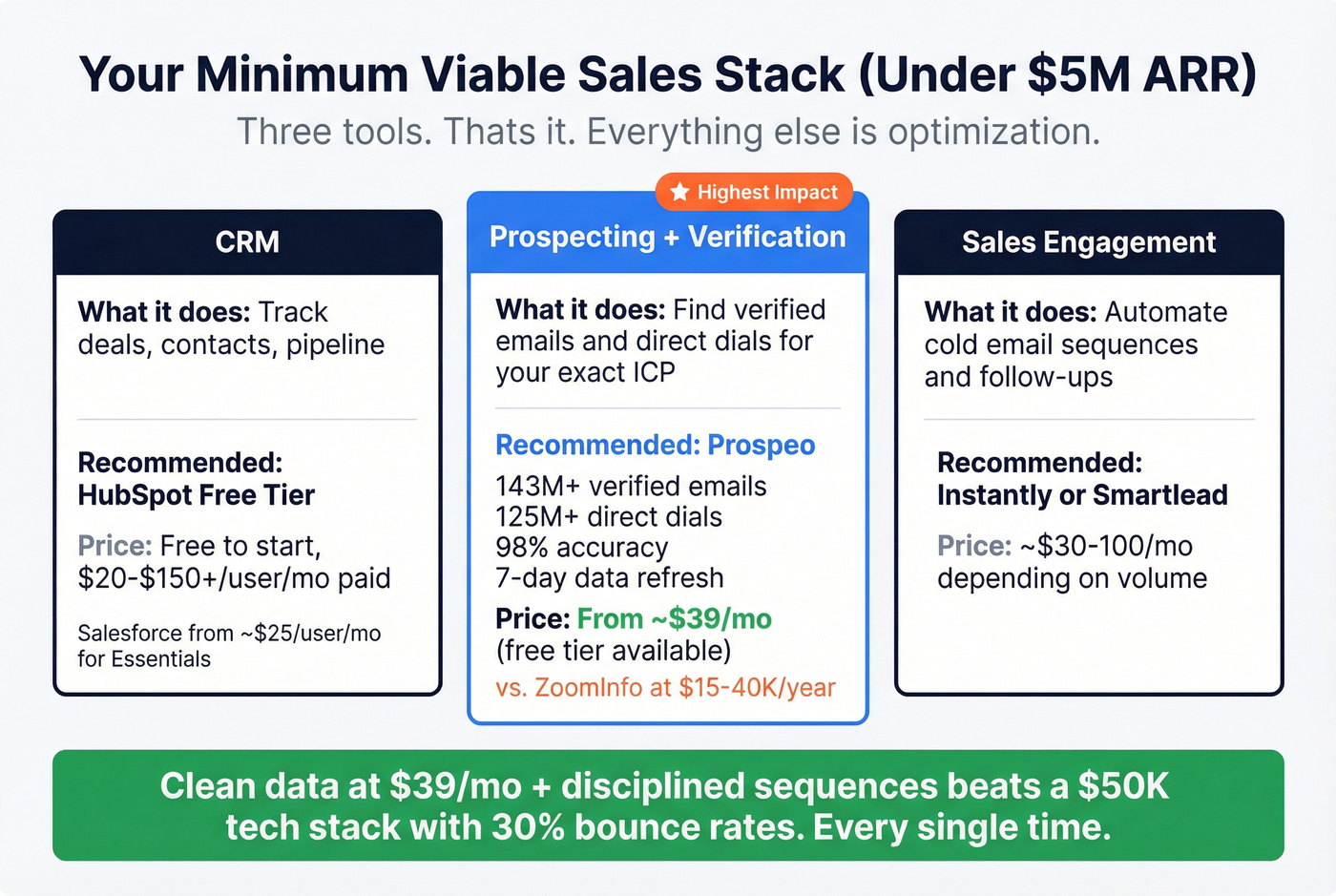
- CRM: HubSpot's free tier gets you started. Paid plans run ~$20-$150+/user/mo depending on tier. Salesforce starts around ~$25/user/mo for Essentials. (If you’re still evaluating, see examples of a CRM.)
- Prospecting + verification: Prospeo - 143M+ verified emails, 125M+ direct dials, 98% accuracy. Free tier available, paid from ~$39/mo. Compare that to ZoomInfo at $15-40K/year. (More options: data enrichment services and sales prospecting databases.)
- Sales engagement: Instantly or Smartlead for cold email sequencing, ~$30-100/mo depending on volume. If you need structure, start with a B2B cold email sequence and keep an eye on email deliverability.
If your average deal is under $10K annually, you almost certainly don't need ZoomInfo-level spend. A team with clean data at $39/mo and disciplined sequences will outperform a team with a $50K tech stack and a 30% bounce rate every single time.
FAQ
What's the fastest way to shorten a SaaS sales cycle?
Match your sales motion to your ACV. Deals under $5K should be self-serve or product-led; enterprise deals need discovery-first demos and mutual action plans. Across all deal sizes, faster follow-up on inbound requests - under five minutes - is the single highest-leverage fix most teams ignore.
How many cold emails should I send per day?
Cap at 30-40 sends per inbox per day across multiple domains. Three domains with 5 inboxes each is a proven setup. A well-targeted campaign to 50 intent-matched contacts outperforms 500 generic emails because deliverability and reply rates stay high.
What's the #1 mistake that prevents teams from growing software revenue?
Bad data. Teams invest in sequencing tools, hire more reps, and build elaborate cadences, then wonder why nothing converts. A 30%+ bounce rate destroys domain reputation and poisons every campaign downstream. Fix the data first - everything else compounds from there.
How do I improve software sales without hiring more reps?
Focus on conversion efficiency rather than headcount. Benchmark each funnel stage, fix onboarding to reduce churn, and switch from volume-based outbound to signal-led selling. Teams that clean up their contact data and tighten targeting consistently see 20-40% more pipeline from the same number of reps.
Does product-led growth replace a sales team?
Not usually. Most SaaS companies above $5K ACV use a hybrid model - PLG for self-serve adoption and a sales team for expansion and enterprise deals. PQLs convert 5-10x faster than MQLs, so PLG makes your sales team more efficient rather than replacing them.