

How to Lower Cost Per Lead Without Sacrificing Quality
A marketing team ran two campaigns last quarter. Test A generated 100 leads at $4.50 each - $450 total spend, $13.5k in revenue. Test B generated 15 leads at $30 each - same $450 spend, $32k in revenue. The expensive leads produced 2.4x the revenue.
That's the CPL trap most teams fall into, and understanding how to lower cost per lead starts with recognizing it. The problem's getting worse: CPC increased for 87% of industries in the past year alone.
What You Need (Quick Version)
- Audit your search terms and add dozens of negative keywords this week. One HVAC company dropped CPL from $180 to $105 in three weeks doing exactly this.
- Compare your CPL across channels. Cold email ($225) and multi-channel prospecting ($188) cost far less than PPC ($463). Most teams over-index on paid search.
- Stop optimizing for CPL. Start measuring cost per qualified lead. A $30 lead that closes beats ten $3 leads that don't.
Calculate Your True CPL First
Most teams divide ad spend by leads and call it a day. That's not your real CPL. True CPL includes ad spend, software subscriptions, agency fees, and in-house labor - everything that touches lead generation. Any serious cost reduction effort starts here, with an honest accounting of total spend.
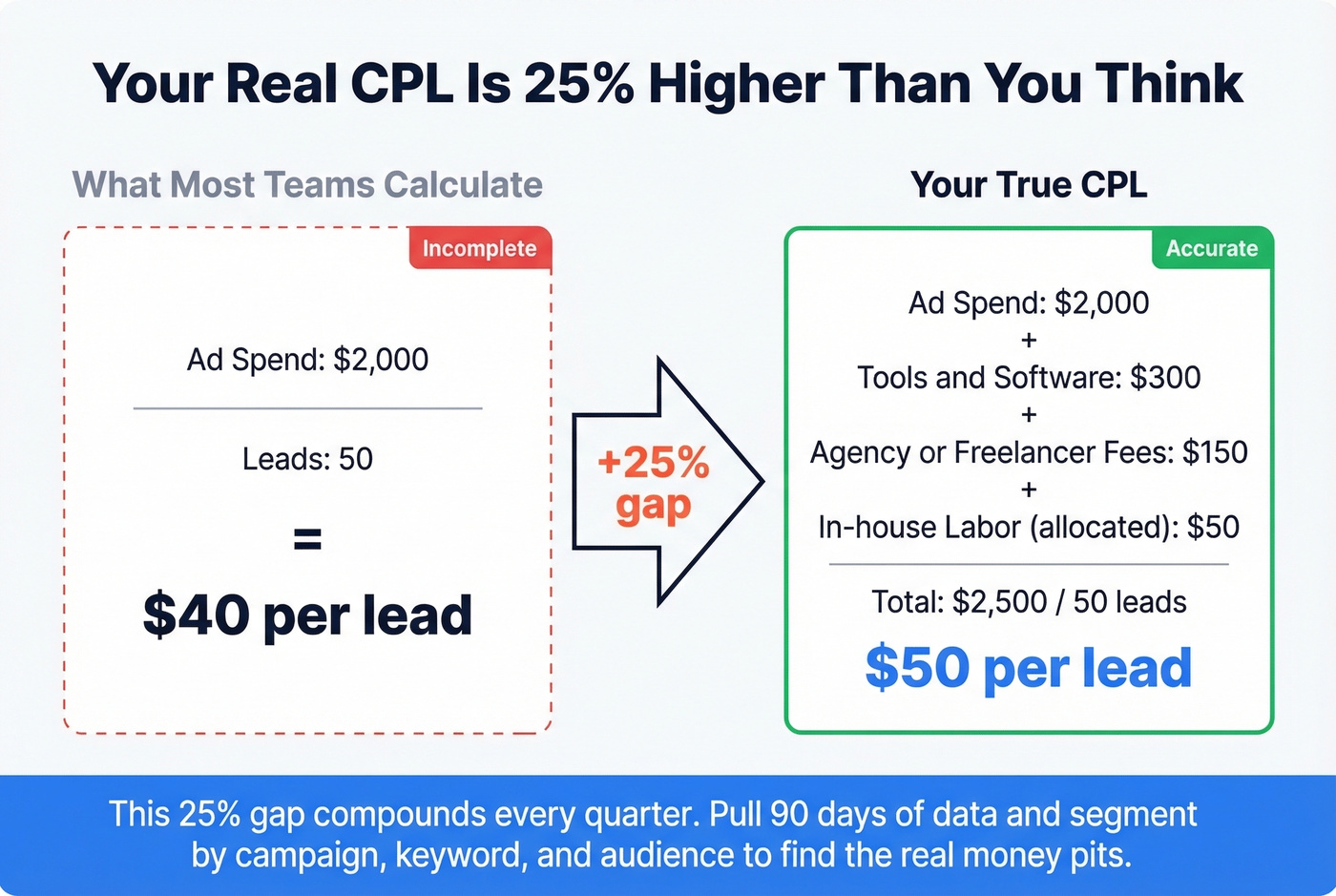
Here's what that looks like: $2,000 in ads + $500 in tools = $2,500 / 50 leads = $50 per lead, not the $40 you'd get from ad spend alone. That 25% gap compounds across quarters. Pull the last 90 days and segment CPL by campaign, keyword, and audience. You'll find money pits - campaigns that look efficient on the surface but bleed budget when you account for the full stack.
If you're not already tracking it, set up a simple lead generation workflow so every cost input is captured consistently.
Know Your Benchmarks
Before you optimize, know what "good" looks like. These numbers come from First Page Sage's 2026 report:
| Industry | Paid CPL | Organic CPL | Blended |
|---|---|---|---|
| eCommerce | $98 | $83 | $91 |
| HVAC | $115 | $69 | $92 |
| B2B SaaS | $310 | $164 | $237 |
| Legal Services | $784 | $516 | $649 |
| Financial | $761 | $555 | $653 |
| Higher Ed | $1,261 | $705 | $982 |
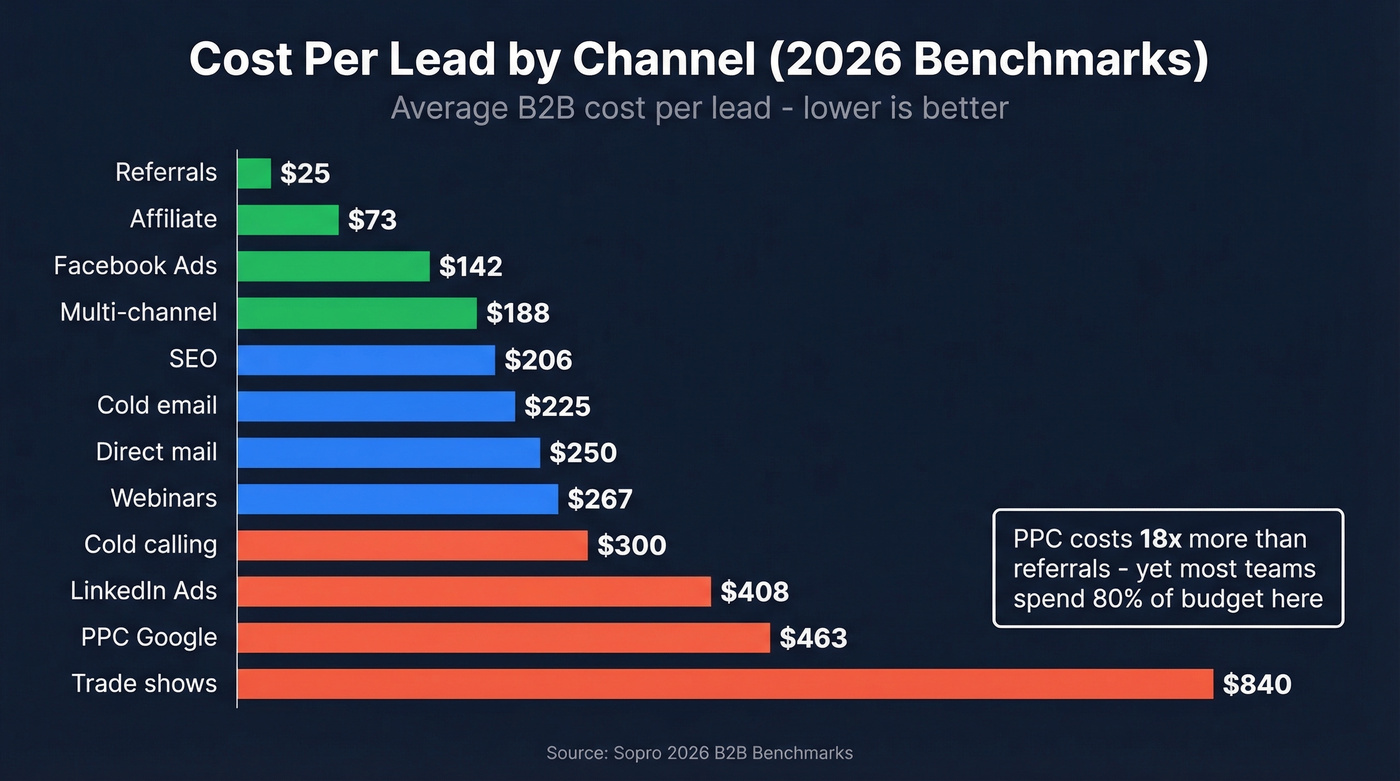
And here's CPL by channel, per Sopro's benchmarks:
| Channel | Avg CPL |
|---|---|
| Referrals | $25 |
| Affiliate | $73 |
| Facebook Ads | $142 |
| Multi-channel | $188 |
| SEO | $206 |
| Cold email | $225 |
| Direct mail | $250 |
| Webinars | $267 |
| Cold calling | $300 |
| LinkedIn Ads | $408 |
| PPC (Google) | $463 |
| Trade shows | $840 |
The increases are concentrated in paid search. If you're only running Google Ads, you're absorbing all the inflation while cheaper channels sit untouched. Teams in fintech or financial services - where blended CPL already exceeds $650 - feel this pressure most acutely, but even B2B SaaS teams at $237 blended have room to shift budget toward lower-cost channels and see immediate results.
To pressure-test your channel mix, compare against broader lead generation metrics (not just CPL).

Shifting budget from $463 PPC leads to outbound only works if your contact data is clean. Prospeo's 98% email accuracy and 7-day data refresh keep bounce rates under 4% - so every dollar you move into cold email actually converts instead of torching your domain.
Cut your outbound CPL to ~$0.01 per verified contact.
Cut Wasted Ad Spend
Google's broader matching has gotten aggressive. PPC practitioners on r/PPC report CPL jumping 30-50% over the last 6-8 months with identical campaigns. The culprit: ads showing on informational queries like "how to fix a leak" - $40-$80 clicks from people who'll never buy.
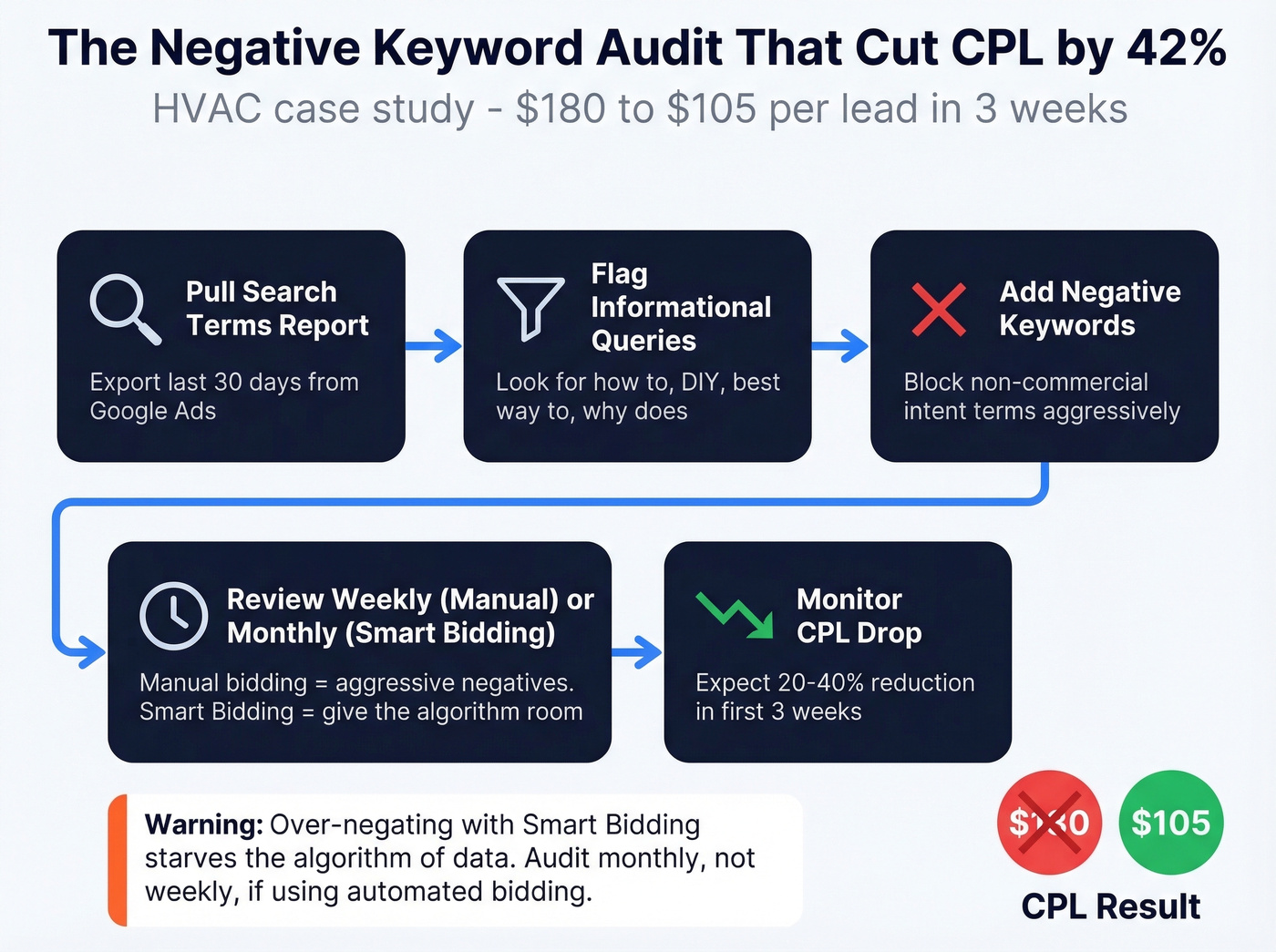
We've seen teams cut CPL 20-40% by maintaining a negative keyword list and auditing search terms weekly. One HVAC company spending $15k/month cut CPL from $180 to $105 in about three weeks by adding hundreds of aggressive negative keywords ("how to," "why does," "best way to," "DIY"). That's a 42% reduction from search term hygiene alone.
There's a catch, though. If you're running Smart Bidding, overusing negatives can backfire. As Andrew Lolk puts it: "Smart Bidding needs data to learn, and by being overly aggressive with negatives, you're starving the system." For automated bidding, audit monthly and let the algorithm breathe. For manual bidding, go aggressive and review search terms every week.
Fix Your Landing Pages
Doubling your conversion rate halves your CPL. No extra spend required.
This is the highest-return move most teams ignore, and it doesn't require a redesign. Removing unnecessary form fields can increase conversion rates 20-30%, which immediately brings CPL down. Message match matters just as much: if your ad says "Get a free HVAC quote," the landing page better not open with "Welcome to our company." Test on mobile first - if a landing page takes more than 3 seconds to load, you lose leads before they even see the offer.
If you want to tie landing page changes to revenue, map them to your B2B sales funnel stages.
Add Lower-CPL Channels
Here's the thing: if your average deal size is under $10k, you probably don't need Google Ads at all. Multi-channel prospecting runs $188 per lead versus $463 for PPC. Even cold email alone at $225 is half the cost. The consensus on r/b2bmarketing is that cold email sits in a sweet spot between cold calls and paid ads - cheaper than ads, less intrusive than calls, and scalable with the right infrastructure.
If you're building outbound from scratch, start with proven sales prospecting techniques and a clear ideal customer profile.
Let's run the math. At 15-18 emails per inbox per day, 50 inboxes send about 24,000 emails per month. At a 3% reply rate, that's 720 replies. If 15-20% qualify, you're looking at 100+ serious conversations monthly. Total cost for a 1,000-contact campaign run in-house: roughly $2,200.
In our experience, the biggest CPL leak in outbound isn't send volume - it's bad contact data. Bounced emails don't just waste infrastructure; they damage your domain reputation, which tanks deliverability on every future campaign. That's a hidden CPL multiplier most teams don't account for. Prospeo verifies emails in real time with 98% accuracy at about $0.01 per contact, and Stack Optimize kept client deliverability at 94%+ with bounce rates under 3% and zero domain flags across all clients using it. Clean data is the foundation that makes outbound CPL math actually work.
To keep deliverability stable as you scale, monitor your email bounce rate and follow an email deliverability guide.

Bad data is a hidden CPL multiplier - bounced emails burn domain reputation and inflate every future campaign's cost. Prospeo's 5-step verification and proprietary email infrastructure give you 98% accuracy across 300M+ profiles, so your cost per qualified lead drops instead of compounding.
Stop subsidizing bad data. Verify before you send.
Measure CPQL, Not CPL
42% of B2B companies cite lead quality as their top marketing challenge - yet most still optimize for raw CPL. That's backwards.
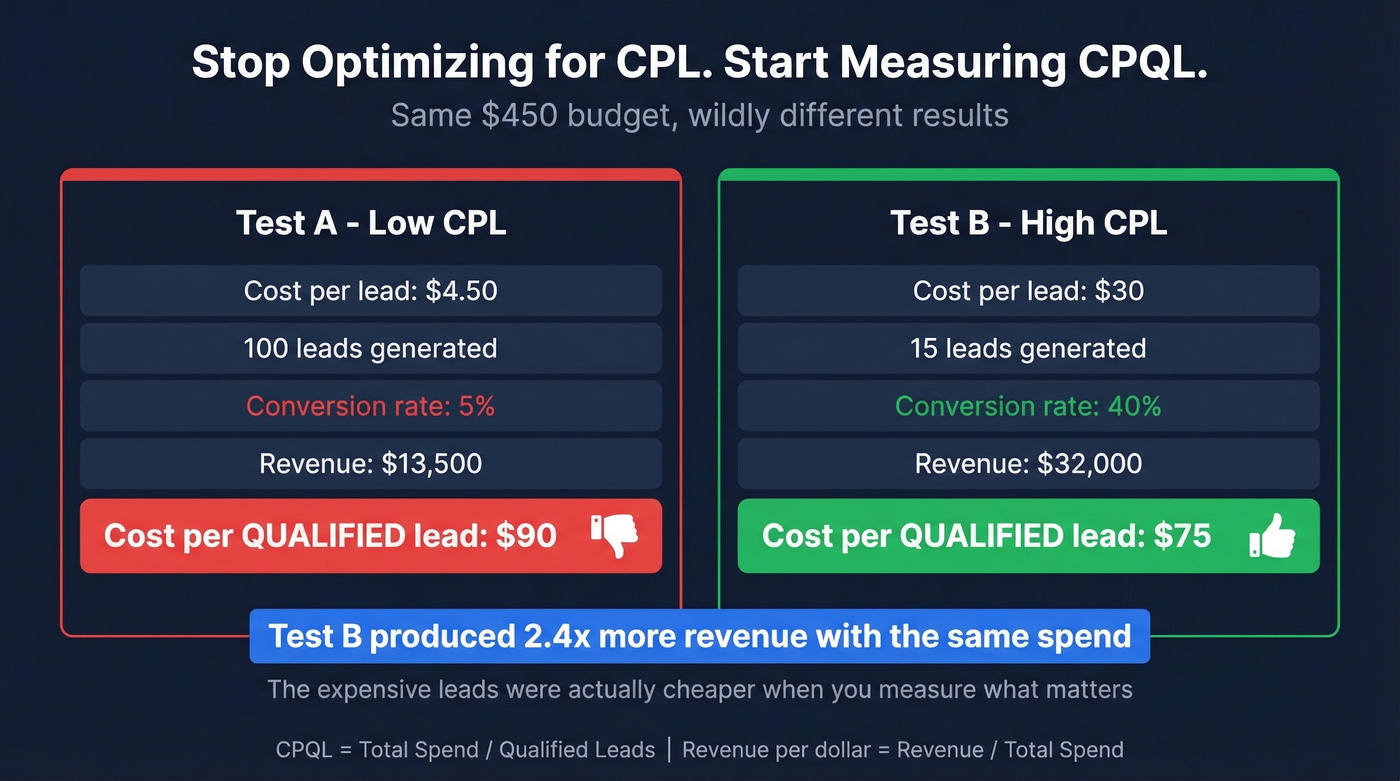
Here's the framework that actually matters. If your average deal is $15,000 and your close rate is 20%, each qualified lead is worth $3,000 in expected revenue. At 50% gross margin, that's $1,500 in gross profit value per qualified lead. You can afford to pay $150-$300 per qualified lead and still get a 5-10x return.
Remember those two tests from the intro? Test A's $4.50 CPL looked great on a dashboard. Test B's $30 CPL looked expensive. But Test B converted at 40% versus 5%, generating $32k in revenue versus $13.5k. Stop trying to minimize your CPL number. Start trying to lower your cost per qualified lead.
This is where targeting precision matters more than volume. Prospeo's 30+ search filters - including buyer intent signals across 15,000 topics, technographics, and headcount growth - let you build lists matching your ICP before spending a dollar on outreach. Fewer wasted touches, lower CPQL.
FAQ
What's a good cost per lead in B2B?
B2B SaaS averages $237 blended, financial services runs $653, and eCommerce sits around $91 per First Page Sage's 2026 benchmarks. More important than the absolute number: compare your CPL to your deal value. A $500 lead on a $50k deal is cheap.
What's the difference between CPL and CPQL?
CPL counts every lead regardless of quality. CPQL counts only leads meeting your qualification criteria - budget, authority, need, timeline. A low CPL with a 2% qualification rate is more expensive than a high CPL with a 40% qualification rate. CPQL is the metric that correlates with revenue.
Can cold email really reduce lead costs?
Yes. Cold email averages $225 per lead versus $463 for PPC. The catch: your contact data must be clean. Bounced emails waste infrastructure and damage domain reputation, so verifying addresses before you send keeps your effective outbound CPL low and your sender reputation intact.
What's the fastest way to cut CPL on Google Ads?
Add negative keywords aggressively. One HVAC company cut CPL from $180 to $105 in three weeks by blocking informational queries ("how to," "DIY," "best way to"). Pair that with landing page optimization - removing extra form fields alone can lift conversion rates 20-30%, cutting CPL proportionally.