

How to Make a Sales Pitch That Actually Converts
79% of buyers say most sales presentations are ineffective. That's nearly four out of five prospects mentally checking out while you talk. Meanwhile, reps spend only 28% of their time actually selling - the rest goes to admin, internal meetings, and CRM hygiene.
If you're figuring out how to make a sales pitch that earns attention, holds it, and converts, this guide breaks it down with real call data. Not vibes.
The Short Version
- Use a framework. Teams with a formal sales methodology see 27% higher win rates. Problem, Solution, Impact, CTA - that's the simplest version that works everywhere.
- Research before you pitch. If you're pitching the wrong person or your email bounces, you aren't "losing deals." You're wasting touches.
- Stop memorizing scripts, start memorizing questions. SPIN Selling's questioning approach - built from 35,000 sales calls - lifts close rates by 20%.
What Makes a Sales Pitch Work
Most pitch advice boils down to "know your audience" and "tell a story." True, but useless unless you can execute it under pressure.
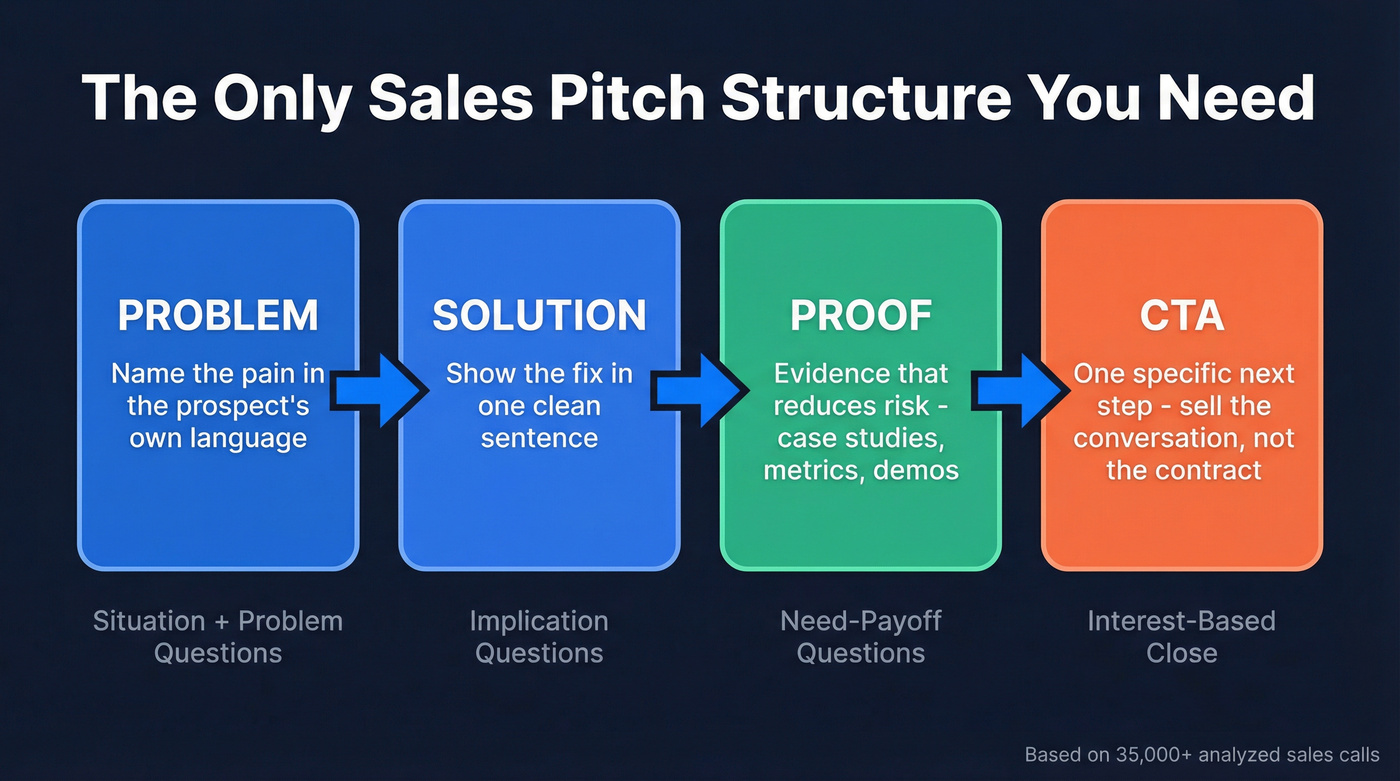
The structure that holds up across cold calls, emails, and decks is Problem, Solution, Proof, CTA:
- Problem: name the pain in the prospect's language
- Solution: show the fix in one clean sentence
- Proof: evidence that reduces risk
- CTA: one specific next step
SPIN Selling fits neatly inside this. Situation and Problem questions surface the pain, Implication makes it costly to ignore, and Need-payoff gets the buyer to say the value out loud.
One more methodology worth stealing from: The Challenger Sale. In a study of 6,000+ reps, 54% of top performers in complex sales were "Challengers" - they teach, tailor, and take control of the conversation. Translation: don't just ask questions. Bring a point of view. This is one of the most effective pitching techniques for sales that involve multiple stakeholders and long buying cycles.
Here's the thing: if your pitch can't be explained in 20 seconds, it's not "strategic" - it's bloated. Complexity doesn't impress buyers. Clarity does.
Building Your Pitch Step by Step
Research Your Prospect First
A good pitch starts before you write a single line. You need one credible trigger and one plausible problem: a new hire, a tool they use, a funding round, a shift in headcount, a compliance deadline - anything that proves you're not blasting the same message to 200 people.
Prospeo makes this fast. You can build targeted lists using 30+ filters including intent signals across 15,000 topics, technographics, job changes, headcount growth, and funding stage. Emails are verified at 98% accuracy on a 7-day refresh cycle, so your pitch actually reaches a human instead of bouncing and torching your domain reputation.

Craft a Hook That Earns 10 More Seconds
Your opener has one job: buy time.
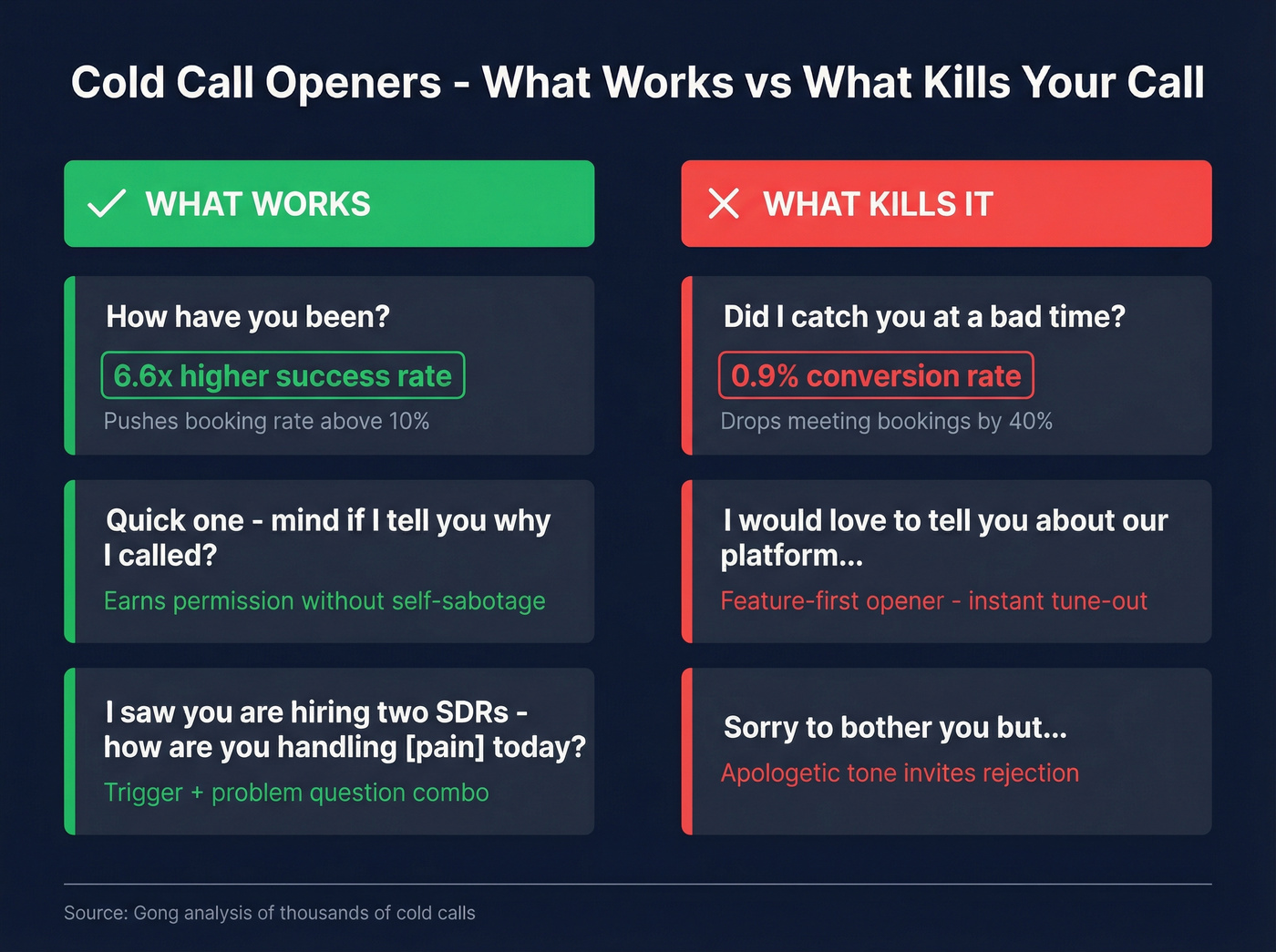
Gong data shows a simple line like "How have you been?" drives a 6.6x higher success rate than baseline, pushing meeting-booking success above 10%. It works because it sounds like a normal human, not a script.
What doesn't work: "Did I catch you at a bad time?" It converts at 0.9% and drops meeting bookings by 40%. Kill that line permanently.
A strong hook has three parts:
- Permission without self-sabotage: "Quick one - mind if I tell you why I called?"
- Trigger: "I saw you're hiring two SDRs" or "noticed you're rolling out [tool]"
- Problem question: "How are you handling [pain] today?"
Present the Solution Through Their Problem
The number-one pitch-killer is leading with features. Buyers don't buy features; they buy the future state.
Instead of: "We have AI-powered analytics."
Say: "Finance teams close the books faster because exceptions get flagged automatically."
Tailor the same product to the stakeholder. A CFO cares about risk, cost, and time-to-value. A CTO cares about integration, security, and maintenance burden. A marketing leader cares about pipeline quality, speed, and attribution confidence. If you're presenting the same deck to every buyer, you're not being "consistent" - you're being lazy.
Prove It With Evidence
Stories are remembered 22x more than facts alone, but your proof still needs teeth. The best proof is specific and low-drama:
"We helped a team like yours reduce [metric] by [number] in [timeframe]."
If you don't have a case study, use a short customer quote, a before/after metric, a live demo of one workflow, or a teardown of what's broken today. Screenshots beat adjectives every time.
Dollar Shave Club didn't win with a feature checklist. Scrub Daddy didn't win with a spreadsheet. They won because the value was obvious in seconds.
Close With a Specific Ask
A pitch that "ends" is a pitch that dies. Close with one clear next step that matches where the buyer is mentally.
The best-performing CTA is usually an interest CTA - you're selling the conversation, not the calendar invite:
"Worth a quick conversation to see if this applies to your team?"
Don't wait for objections like they're a pop quiz. Bring the two most common ones up yourself: "You might already have something for this - if so, I'll be brief." Or: "If timing's the issue, we can park it; I just want to see if it's relevant."
One more counterintuitive stat: using ROI language in cold emails decreases success by 15%. Early-stage prospects don't want a spreadsheet. They want to feel understood.
Sales Pitch Templates by Channel
Cold Call Script
Cold calls that work are longer: 5:50 on average vs 2:45 for the ones that fail. And despite what people say on podcasts, cold calling isn't dead - 49% of buyers prefer to be contacted via cold call.
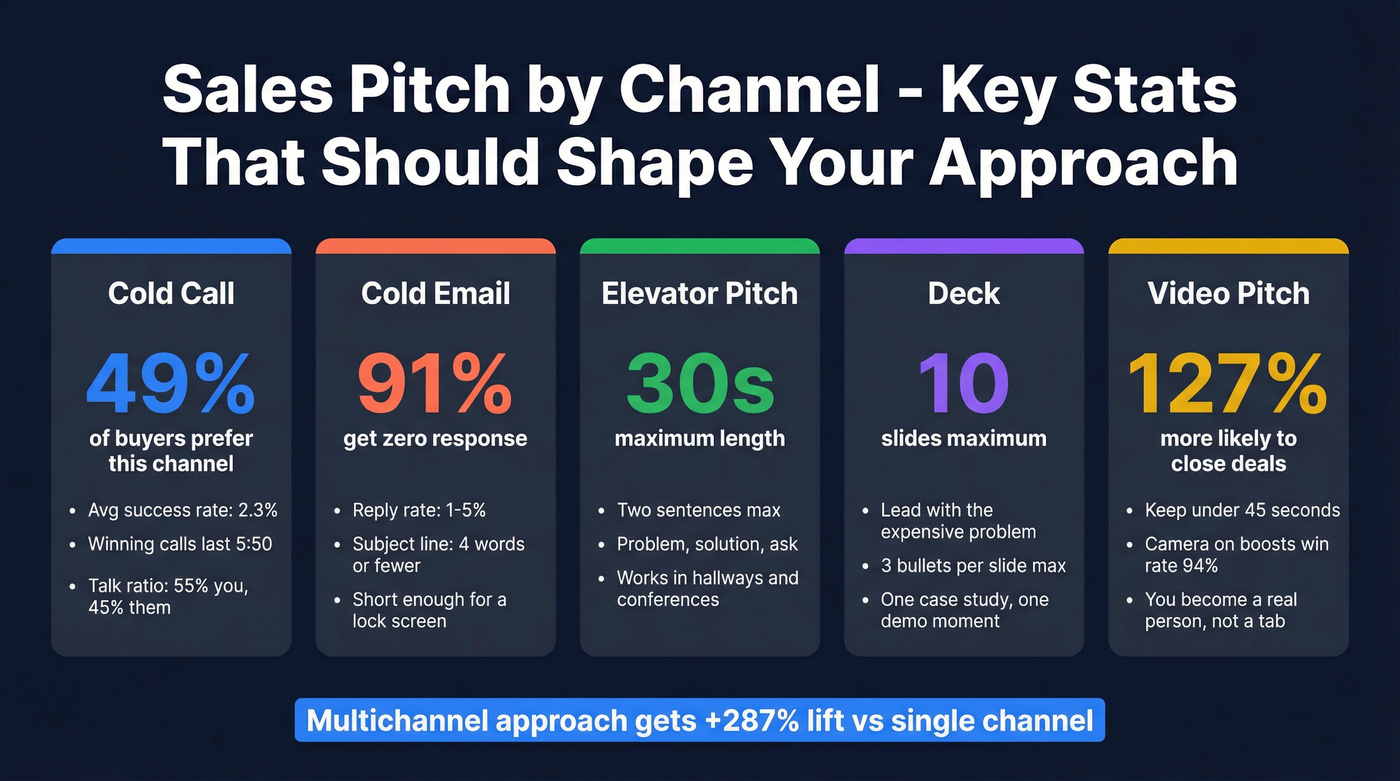
On cold calls, the talk ratio flips: aim for 55% talk, 45% listen. You're not running discovery; you're earning the right to a real conversation.
Try this:
"Hey [Name] - [You] at [Company]. Quick one: I'm calling because [trigger]. Curious - how are you handling [problem] today? The reason I ask is we help [peer group] [outcome] without [common headache]. If it's relevant, open to a quick chat this week?"
Weak openers invite rejection. Apologetic permission lines like "bad time?" get brushed off fast. Delivering a pitch on a cold call means sounding like a peer, not a telemarketer.
Cold Email
91% of cold emails get zero response. Reply rates sit at 1-5%, so your email needs to be short enough to read on a lock screen.
Subject line guidance: keep it four words or fewer, lowercase, and plain. "quick question on onboarding" beats "Revolutionize Your Sales Pipeline..." every time. (If you want more options, steal from these email subject line examples.)
Subject: quick question on [topic] Body: "[First name] - saw [trigger]. Teams like yours often run into [problem]. We helped [similar company/type] get [proof]. Worth a quick chat?"
Elevator Pitch
Under 30 seconds. Two sentences max.
Fill-in-the-blank version that works in any hallway or conference:
"We help [target audience] [solve specific problem] by [mechanism]. We're seeing this come up because [trigger/proof]. Worth exploring?"
That's it. Problem, solution, ask - done. When you need to deliver a pitch at a conference, this format keeps you from rambling past the point of interest. If you want more variations, here are sample elevator pitches you can customize.
Presentation / Deck
A deck is a visual argument, not a brochure.
Lead with the problem and make it feel expensive. Show the "new way" - your point of view. Prove it with one case study and one demo moment. End with a single CTA. The Crunchbase heuristic still holds: 10 slides, 3 bullets per slide max.
Decks worth studying: Zuora's subscription economy narrative and Reddit's ad sales deck, both outcome-heavy rather than feature-heavy. For AI-generated slides, practitioners tend to like Alai for design speed, Gamma for shareable docs, and Plus AI if your team lives in Google Slides.
Video Pitch
Deals are 127% more likely to close when video is used at any point in the sales cycle, and win rates jump 94% when sellers keep their camera on. Video works because it removes ambiguity: you become a real person, not another tab.
Keep it under 45 seconds. One sentence on why you're reaching out, one on the problem you see, one on proof, and one question about the next step.

A perfect sales pitch means nothing if it lands in the wrong inbox - or bounces entirely. Prospeo gives you 30+ filters including intent data, technographics, and funding stage so every pitch hits a real buyer with a real problem. 98% email accuracy, refreshed every 7 days.
Stop pitching into the void. Start reaching verified decision-makers.
Benchmarks - What Good Looks Like
| Metric | Benchmark | Source |
|---|---|---|
| Buyer cold call preference | 49% prefer cold calls | Cognism |
| Cold call success | 2.3% avg | Cognism |
| Cold email reply | 1-5% | Martal |
| Multichannel lift | +287% vs single channel | Martal |
| Talk-to-listen (discovery) | 43% / 57% | Gong |
| Successful call length | 5:50 vs 2:45 | Focus Digital |
| 30-min meeting show rate | +12% vs 60-min | Gong (30K calls) |
| Touches to close | 5+ (80% of deals) | Martal |
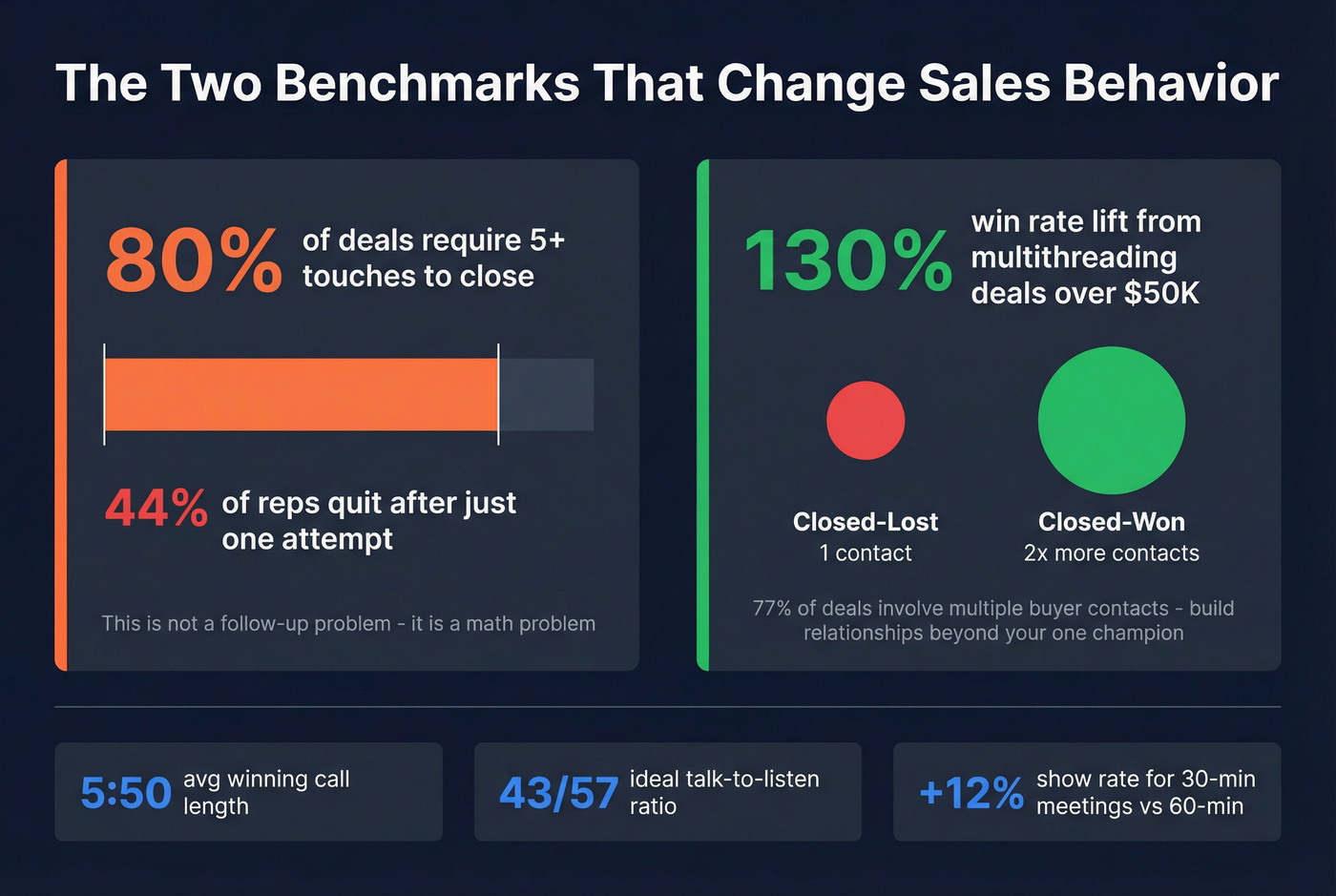
Two benchmarks matter more than the rest because they change behavior.
First: 80% of deals take 5+ touches, but 44% of reps quit after one. That's not a "follow-up problem." It's a math problem. (If you need copy you can actually send, use these sales follow-up templates.)
Second: multithreading. An analysis of millions of opportunities found 77% of deals involve multiple contacts, and closed-won deals include 2x as many buyer contacts as closed-lost. For deals above $50K, multithreading can lift win rates by 130%. In our experience, the fastest way to lose a winnable deal is to build the whole case with one champion and ignore everyone else who can veto it.
One more nuance on talk ratios: the 43/57 split is useful, but the real separator is consistency. Low performers swing their talk time by roughly 10% between won and lost calls; top performers stay steady. You don't need a new personality every time a deal gets tense.
AI Tools to Sharpen Your Pitch
Frequent AI users generate 77% more revenue across 7.1 million opportunities analyzed in Gong's 2026 insights. Used well, AI doesn't replace selling - it removes the busywork that blocks it.
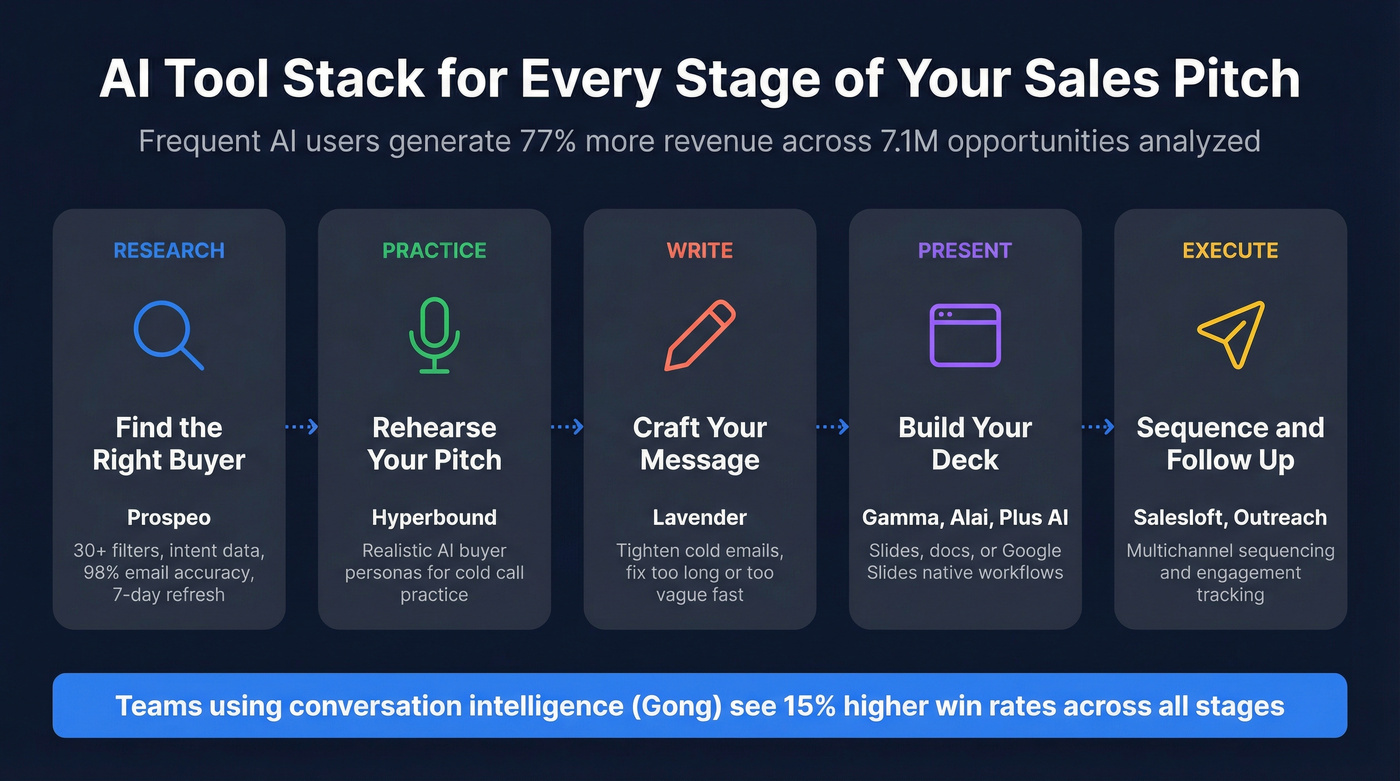
- Coaching and practice: Hyperbound for rehearsing cold calls against realistic buyer personas.
- Conversation intelligence: Gong for reviewing calls at scale and copying what top reps do. Teams using conversation intelligence see 15% higher win rates.
- Email writing: Lavender for tightening cold emails and fixing "too long / too vague" fast. (More tactics: AI for Sales Emails.)
- Presentations: Alai, Gamma, and Plus AI depending on whether you need slides, docs, or Google Slides-native workflows.
- Engagement: Salesloft or Outreach for sequencing and multichannel follow-up. (If you're building a stack, start with these SDR tools.)
- Lead intelligence: Prospeo for verified emails and mobile numbers so your pitch actually lands. We've tested every "perfect pitch" trick in the world - none of it matters if your data is stale and your emails bounce. (If deliverability is the bottleneck, fix it with an email deliverability guide.)
Mistakes That Kill Your Pitch
1. Opening with "Did I catch you at a bad time?" Converts at 0.9%. Drops meeting bookings by 40%. You're handing them the exit.
2. Pitching before you understand the problem. If you're two minutes into a call and already sharing a deck, you're not selling - you're broadcasting. The buyer can feel it.
3. Using pressure tactics. Bryan Vasquez at LinkBuilder.io replaced urgency-based CTAs with data-backed proposals and tailored value maps and saw a 20% higher win rate over two quarters. Fake scarcity doesn't work in B2B. Trust does.
4. Treating objections like interruptions. The best reps "marinate" in objections. They ask one more question, label the concern, and make the buyer feel smart for raising it.
5. Pitching into bad data. Look, if your bounce rate is in the 35-40% range, you're burning domain reputation and wasting hours crafting messages nobody receives. Snyk's team of 50 AEs cut their bounce rate from 35-40% down to under 5% and saw AE-sourced pipeline jump 180% after fixing their data layer. (If you want the benchmarks and fixes, start with email bounce rate.)
Tips That Actually Separate Quota-Hitters
- Personalize every touch. Even one line of research - a recent post, a job listing, a product launch - signals that you did the work. Buyers reward effort. (More ideas: sales prospecting techniques.)
- Match your energy to the channel. A cold call needs warmth and pace. An email needs brevity. A deck needs narrative structure. The same message delivered the wrong way falls flat.
- Rehearse the transitions, not just the lines. The moments between your hook, your proof, and your ask are where most pitches lose momentum. We've found that recording practice runs and listening back - even once - catches problems you'd never notice in real time.
- Debrief every pitch. Review calls, study emails that got replies, and figure out what actually moved the deal forward. Not what felt good in the moment.
Let's be honest: most reps skip all four of these because they feel like overhead. They're not. They're the difference between "almost" and "closed."
FAQ
How long should a sales pitch be?
Successful cold calls average 5:50, unsuccessful ones 2:45. An analysis of 30,000 first calls found no correlation between first-call length and getting a second meeting - book 30-minute meetings instead. Prospects are 12% more likely to show up for a 30-minute slot than a 60-minute one.
What's the best way to start a pitch?
"How have you been?" drives a 6.6x higher success rate than baseline and pushes meeting booking above 10%. Never open with "Did I catch you at a bad time?" - it drops booking rates by 40% and converts at just 0.9%.
Do sales methodologies actually improve results?
Yes. Organizations with a formalized methodology see 27% higher win rates and 21% higher quota attainment. SPIN's questioning strategy increases close rates by 20% based on 35,000 calls. In complex deals, Challenger-style reps dominate - they teach, tailor, and take control.
What tools help you build a better sales pitch?
Use conversation intelligence to hear what works, an email coach to tighten copy, and a practice tool to rehearse. For outbound, verified contact data matters more than any template - if your emails bounce, the best pitch in the world is just a file on your desktop.
How do I personalize a pitch at scale?
Start with a research layer that surfaces triggers automatically - funding rounds, job changes, tech stack shifts. Filter by intent signals and firmographic data so you can write a relevant opener in seconds rather than minutes. Skip this step and you're back to spray-and-pray, which the consensus on r/sales will tell you stopped working years ago.
The article says 91% of cold emails get zero response. Bad data makes that worse - bounced emails torch your domain and kill future campaigns. Prospeo's 5-step verification and 7-day refresh cycle keep your sender reputation clean so your pitch actually gets read. Starting at $0.01 per email.
Protect your domain reputation and land every pitch in a real inbox.