

How to Market SaaS Software: The Benchmark-Driven Guide for 2026
Your CEO just asked why you're spending $15K/month on marketing and pipeline hasn't moved. Here's the uncomfortable truth: you're probably running campaigns across eight channels with zero clarity on what's working. Stop trying to do 12 things. Pick three channels, fund them properly, and measure what matters.
The Quick Version
- Pick your GTM motion first - PLG, sales-led, or hybrid - based on your average deal size. Everything else flows from this.
- Focus on 3 channels max for 6 months. Not 12. Three.
- Budget roughly 8% of ARR on marketing - that's the median across 1,000+ private SaaS companies.
- The lowest-CAC channels: organic content, partnerships, and referrals.
- Bad data kills outbound ROI - verify emails before every campaign.
Why SaaS Product Marketing Is Different
You're not optimizing for a single purchase. You're optimizing for a relationship that compounds or churns every month, and that changes everything about how you allocate budget, measure success, and sequence your campaigns.
Deals under $5K ACV close in roughly 40 days; push above $100K and you're looking at 170 days. Deals under $20K ACV require 31 touchpoints to close - above $60K, that jumps to 75. Acquiring a new customer costs 5-25x more than keeping one. And activation is brutally hard: Amplitude's benchmark data shows that for half of all products, over 98% of new users go inactive within two weeks.
If your marketing stops at "get the signup," you're losing almost everyone.
Pick Your GTM Motion First
Your GTM motion determines your budget split, channel mix, and hiring plan. Get this wrong and every downstream decision inherits the mistake.
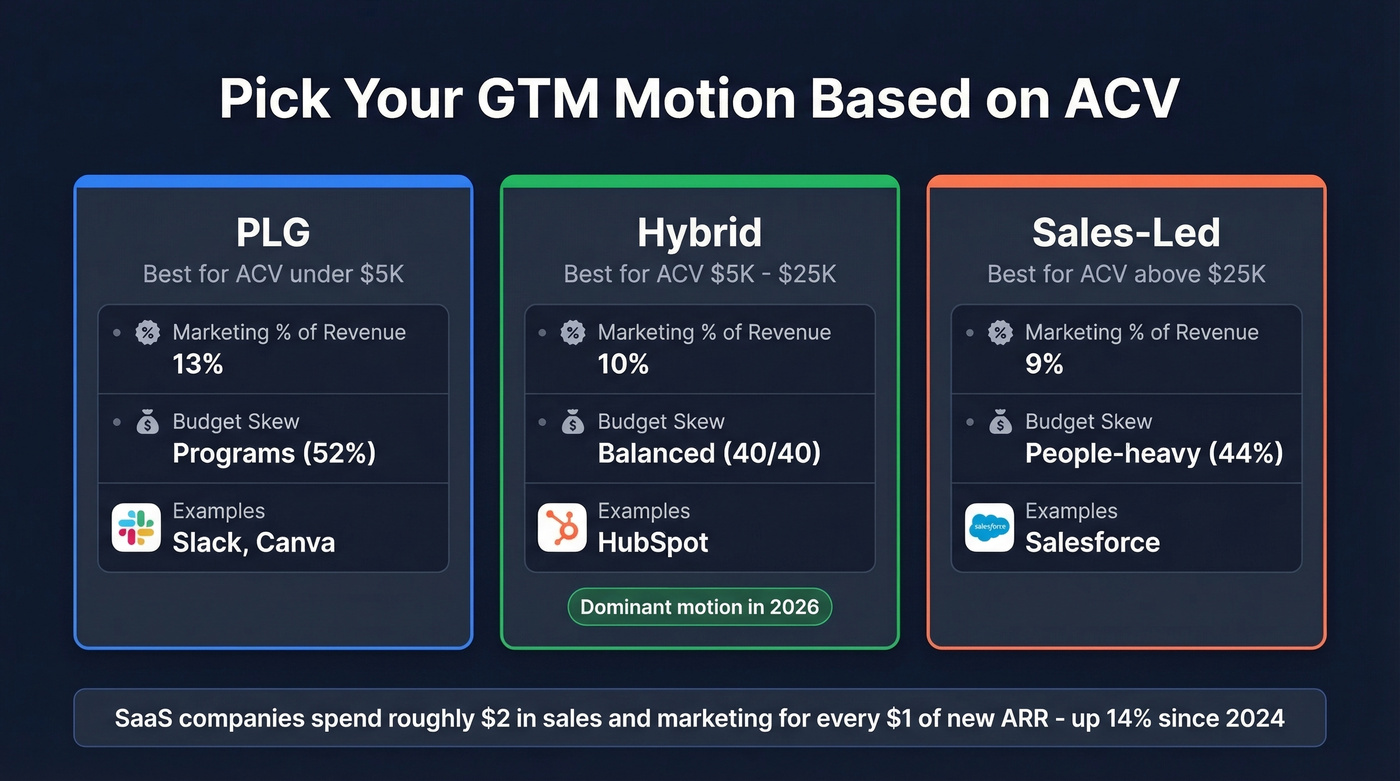
| PLG | Hybrid | Sales-Led | |
|---|---|---|---|
| Best for ACV | <$5K | $5K-$25K | >$25K |
| Marketing % of rev | 13% | 10% | 9% |
| Budget skew | Programs (52%) | ~40% each (people/programs) | People-heavy (~44%) |
| Example | Slack, Canva | HubSpot | Salesforce |
Hybrid is the dominant motion in 2026: PLG for acquisition, sales for expansion when usage signals appear. One stat that should frame your planning - SaaS companies spend roughly $2 in sales and marketing for every $1 of new ARR, up 14% since 2024. Efficiency isn't optional anymore.
Here's the thing: if your ACV sits below $10K, you almost certainly don't need a sales-led motion. Most teams at that price point burn money on SDRs when a well-built product-led funnel would outperform at a fraction of the cost. We've watched teams waste entire quarters learning this the hard way.

Your GTM motion only works if reps reach real buyers. Prospeo's 300M+ profiles with 30+ filters - intent data, technographics, headcount growth - let you build hyper-targeted lists that match your ICP. 98% email accuracy on a 7-day refresh cycle means your outbound actually compounds instead of burning domains.
Stop funding campaigns built on stale data. Fix the foundation first.
7 Strategies to Market SaaS Software in 2026
1. Product-Led Content
Generic listicles are dead - the consensus on r/SaaS is consistent on this point. What converts is use-case content with screenshots, workflows, and product data baked in. BOLT ON Technology drove a 272% increase in inbound demos after switching to this approach.
Content returns roughly $3 for every $1 invested, and 66% of buyers prefer watching a video to reading about a product. So embed demos, not paragraphs. Expect 3-6 months before you see pipeline impact - that's normal, not a sign it isn't working.
If you need a tighter definition of what "content that compounds" looks like, start with B2B content marketing fundamentals and build from there.
2. AI Visibility (GEO)
Showing up in ChatGPT and Perplexity answers is the new demand generation battleground, and most SaaS teams are ignoring it entirely.
Three things that work right now: structure content with clear entity definitions so AI can parse your expertise, write concise "answer-ready" paragraphs under 50 words for key queries, and monitor whether your brand appears in AI-generated responses using tools like Otterly.ai. Reddit threads on r/SEO are already treating GEO like early-days search optimization. First-mover advantage is real here, and the window won't stay open forever.
3. Partnerships and Co-Marketing
Partnerships close faster than cold outbound and often come in at lower CAC than paid ads. Referral CAC averages ~$150 vs >$2,000 for LinkedIn Ads. Integration partners, marketplace listings, and co-marketing campaigns consistently deliver the cheapest pipeline in the stack.
If you're not actively building an integration ecosystem, you're leaving money on the table.
4. Paid Acquisition
Google Ads CPC runs $2-$20 for B2B SaaS keywords. Use paid as a testing lab, not your growth engine - validate positioning, identify high-intent keywords, test landing pages - then shift budget to channels that compound. Most teams over-invest here because it feels like progress. It isn't. It's data collection.
5. Email and Lifecycle
For companies above $50M ARR, 60% of new revenue comes from existing customers. Onboarding sequences, feature adoption nudges, and expansion triggers are the highest-ROI marketing you can do.
We've seen teams obsess over top-of-funnel while ignoring the customers already paying them. Retention is 5-25x cheaper than acquisition. Act like it.
If churn is creeping up, do a proper churn analysis before you add more acquisition spend.
6. Community
"Niche Slack communities are gold" - that's the recurring sentiment across r/SaaS and r/startups. Gong built a community that turns users into advocates and supports pipeline. The catch? Community takes 6-12 months to build and doesn't scale linearly. Start before you need it.
7. Outbound With Verified Data
Outbound fails when data is bad. A 10% bounce rate doesn't just waste sends - it damages your sender reputation and hurts deliverability for every future campaign. Many teams hemorrhage money buying $15-40K/year enterprise data contracts, blasting unverified lists, and wondering why reply rates sit in the basement.
This is where data quality becomes a marketing problem, not just a sales ops problem. Stack Optimize built from $0 to $1M ARR by running outbound through Prospeo's 5-step verification on a 7-day refresh cycle - client deliverability stayed above 94%, bounce rates under 3%, zero domain flags. At ~$0.01 per email with a free tier of 75 verified emails/month, self-serve data tools keep outbound CAC dramatically lower than legacy enterprise contracts.
If you're scaling outbound, pair verification with an email deliverability guide and a plan to improve sender reputation.
Skip these entirely: gated whitepapers behind long forms (buyers hate them and your MQL numbers are lying to you), buying third-party lead lists, and chasing MQL volume over pipeline quality.

The article math is clear: SaaS companies spend $2 for every $1 of new ARR. Every bounced email inflates that ratio. Stack Optimize hit $1M ARR with sub-3% bounce rates using Prospeo's 5-step verification - no enterprise contract, no sales call, starting at $0.01 per verified email.
Cut your outbound CAC by 90% compared to legacy data vendors.
How Much to Spend
The SaaS Capital annual survey puts median marketing spend at 8% of ARR. For a $3M ARR company, that's $240K/year - roughly $20K/month.
If you want to pressure-test your spend against unit economics, start with a clean definition of cost to acquire customer and track it by channel.
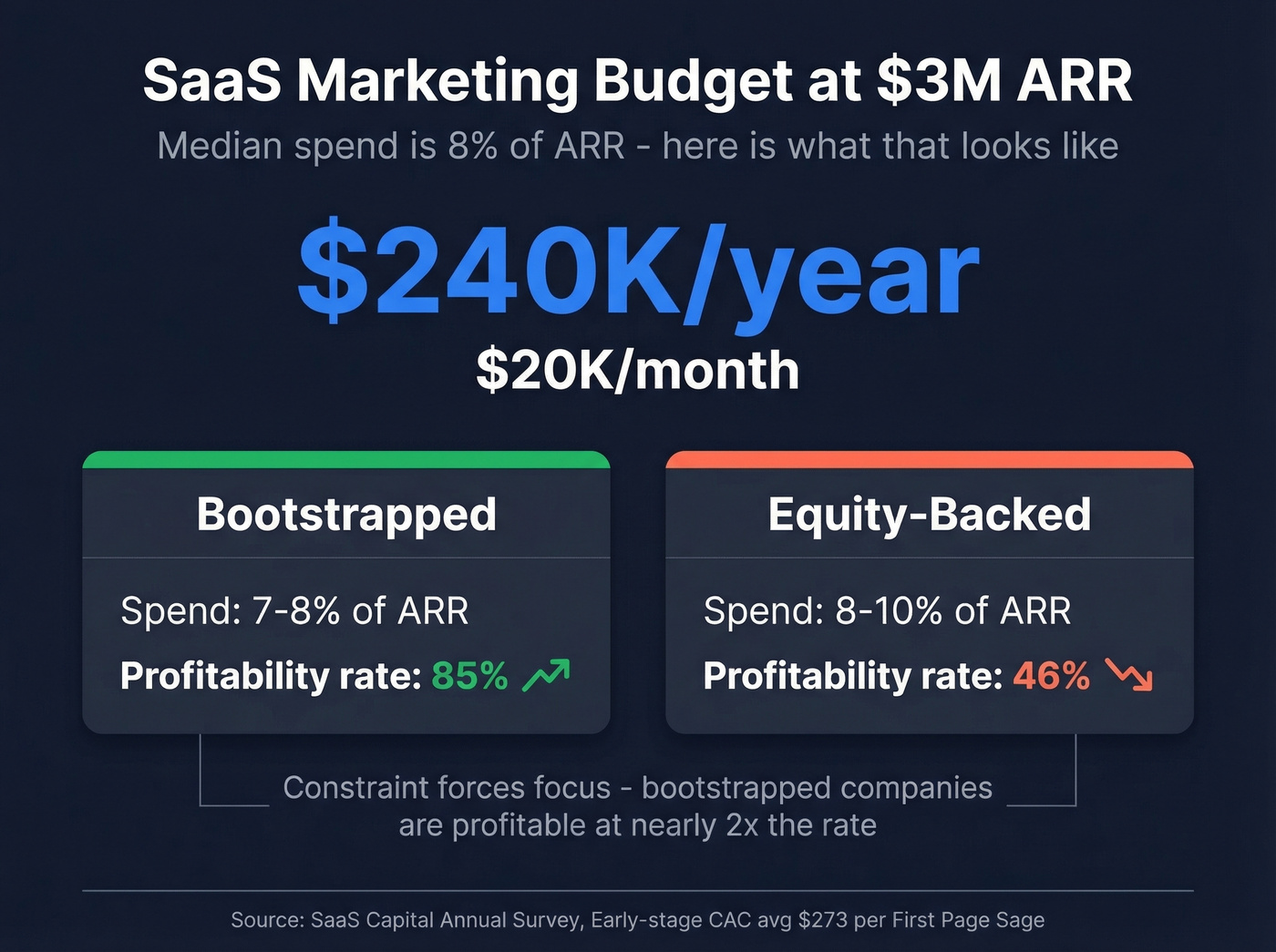
| Metric | Bootstrapped | Equity-Backed |
|---|---|---|
| Total spend (% of ARR) | 95% | 107% |
| Marketing (% of ARR) | ~7-8% | ~8-10% |
| Profitability rate | 85% | 46% |
Bootstrapped companies spend less and are profitable at nearly twice the rate. Constraint forces focus. Early-stage B2B SaaS CAC averages $273 per First Page Sage's data, which is achievable if you're disciplined about channel selection and don't spread budget across every shiny platform that launches a self-serve ad product.
Benchmarks That Matter
Median SaaS revenue growth hit 26% in 2026 - down from 47% in 2024. Growth is harder. The median CAC payback across SaaS sits at 15-18 months. The targets below are what top performers hit.
If you're trying to diagnose where the leak is, map your funnel metrics end-to-end and compare stage conversion rates.
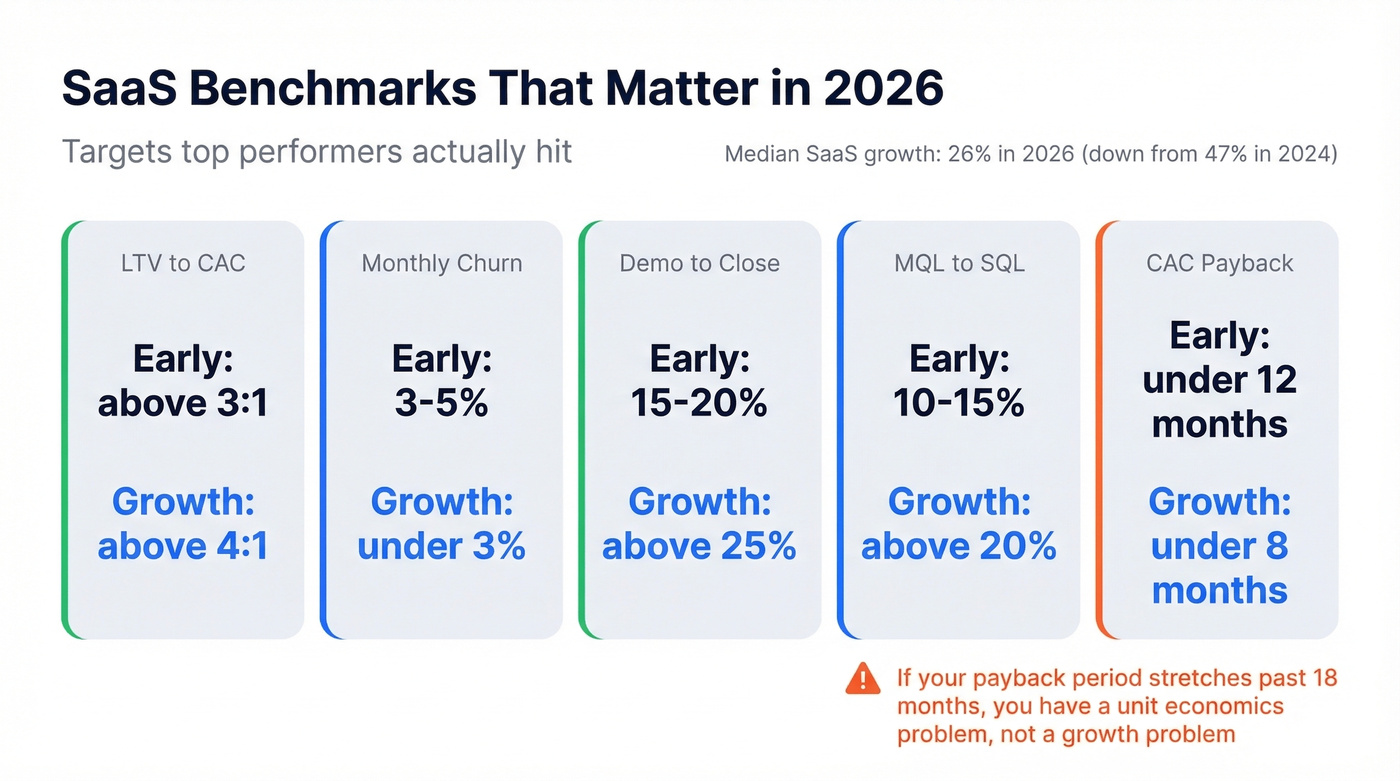
| Metric | Early Stage | Growth Stage |
|---|---|---|
| LTV:CAC | >3:1 | >4:1 |
| Monthly churn | 3-5% | <3% |
| Demo-to-close | 15-20% | >25% |
| MQL-to-SQL | 10-15% | >20% |
| CAC payback | <12 months | <8 months |
CAC payback is the metric that separates sustainable SaaS from companies burning runway. Let's be honest - if your payback period stretches past 18 months, you don't have a growth problem. You have a unit economics problem. Fix that before you scale anything.
If your pipeline still isn't moving, audit sales pipeline challenges before you add more channels.
FAQ
What's the best marketing channel for early-stage SaaS?
Organic content, partnerships, and referrals deliver the lowest CAC. Referral CAC averages ~$150 compared to >$2,000 for LinkedIn Ads. Start with one high-intent channel, prove ROI over 3-6 months, then expand.
How long does SaaS content marketing take to show results?
Expect 3-6 months before content drives meaningful pipeline. SEO delivers 748% ROI for B2B long-term, but compounding requires patience. Use paid ads to validate messaging in parallel while your content engine builds.
How do you keep outbound CAC low?
Use self-serve data tools with real-time verification instead of enterprise contracts. The difference between 3% and 10% bounce rates is the difference between a healthy domain and a blacklisted one. Weekly data refresh cycles and 98% email accuracy keep cost per meeting booked low and your sender reputation intact.
What budget should a $3M ARR SaaS company allocate to marketing?
The median is 8% of ARR - roughly $240K/year or $20K/month. Bootstrapped companies trend toward 7-8% and stay profitable at nearly twice the rate of equity-backed peers. Spend less, but spend it on fewer channels with real measurement.
Does AI visibility matter for SaaS go-to-market in 2026?
Yes - appearing in ChatGPT and Perplexity answers is becoming a meaningful demand channel. Structure content with clear entity definitions, write concise answer-ready paragraphs, and monitor brand mentions in AI responses. Early movers are capturing share before the playbook commoditizes.