

How to Measure Purchase Intent: The Operational Playbook
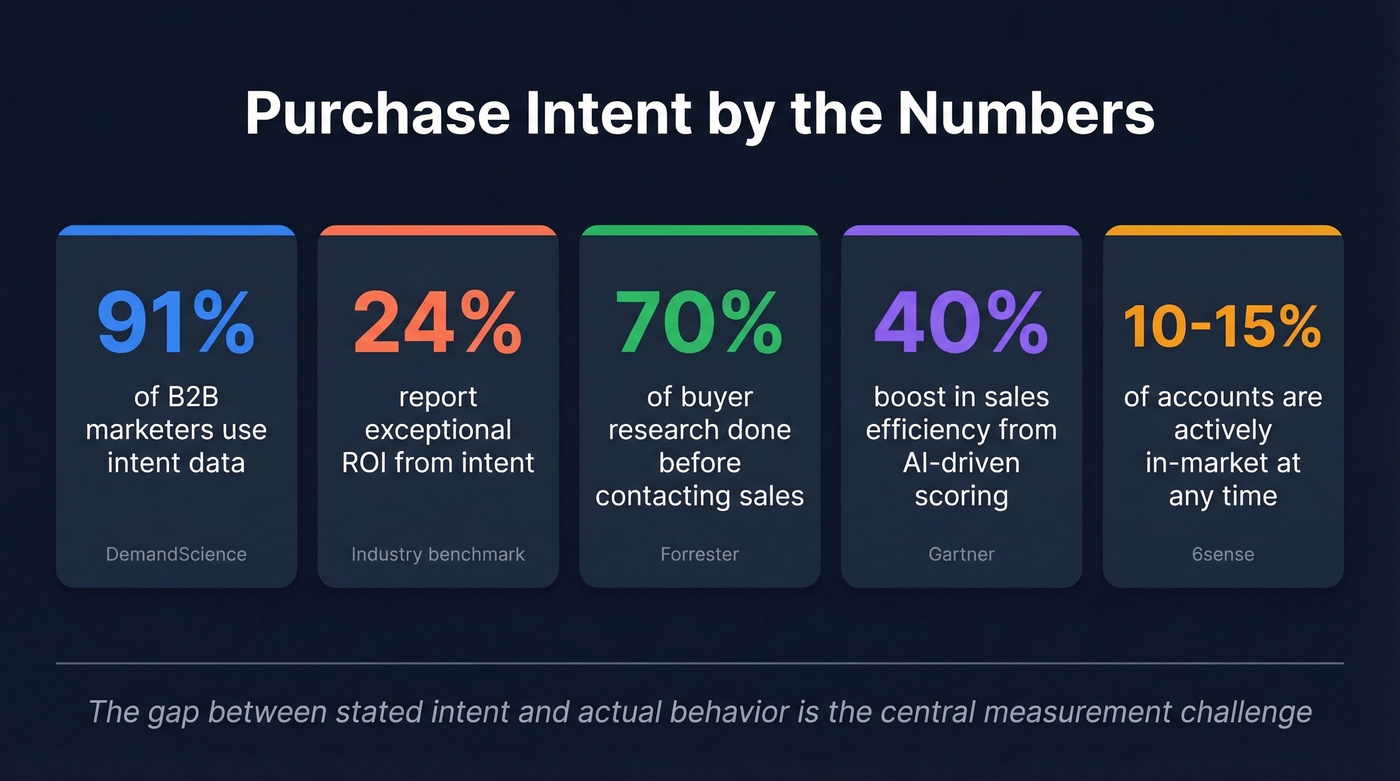
72% of respondents in a pre-launch survey said they'd buy. 8% actually did. That gap between what people say and what they do is the central problem when you try to measure purchase intent. 91% of B2B marketers now use intent data, but only 24% report exceptional ROI. The issue isn't that intent data doesn't work. It's that most teams measure it badly, act on it slowly, or trust signals that were never reliable in the first place.
The Short Version
- Layer your methods. Combine behavioral signals like page visits, demo requests, and content downloads with survey data. Neither alone is reliable enough to bet pipeline on.
- Build a point-based scoring model (template below) and refresh it quarterly. Businesses that update lead scoring quarterly see a 35% boost in conversion rates.
- Verify before you act. Intent signals are only as good as the contact data underneath them. Stale records mean your "high-intent" outreach hits dead ends.
What Is Purchase Intent?
Purchase intent is the measured likelihood that a person or account will buy a specific product or service within a defined timeframe. It's the bridge between "interested" and "revenue."
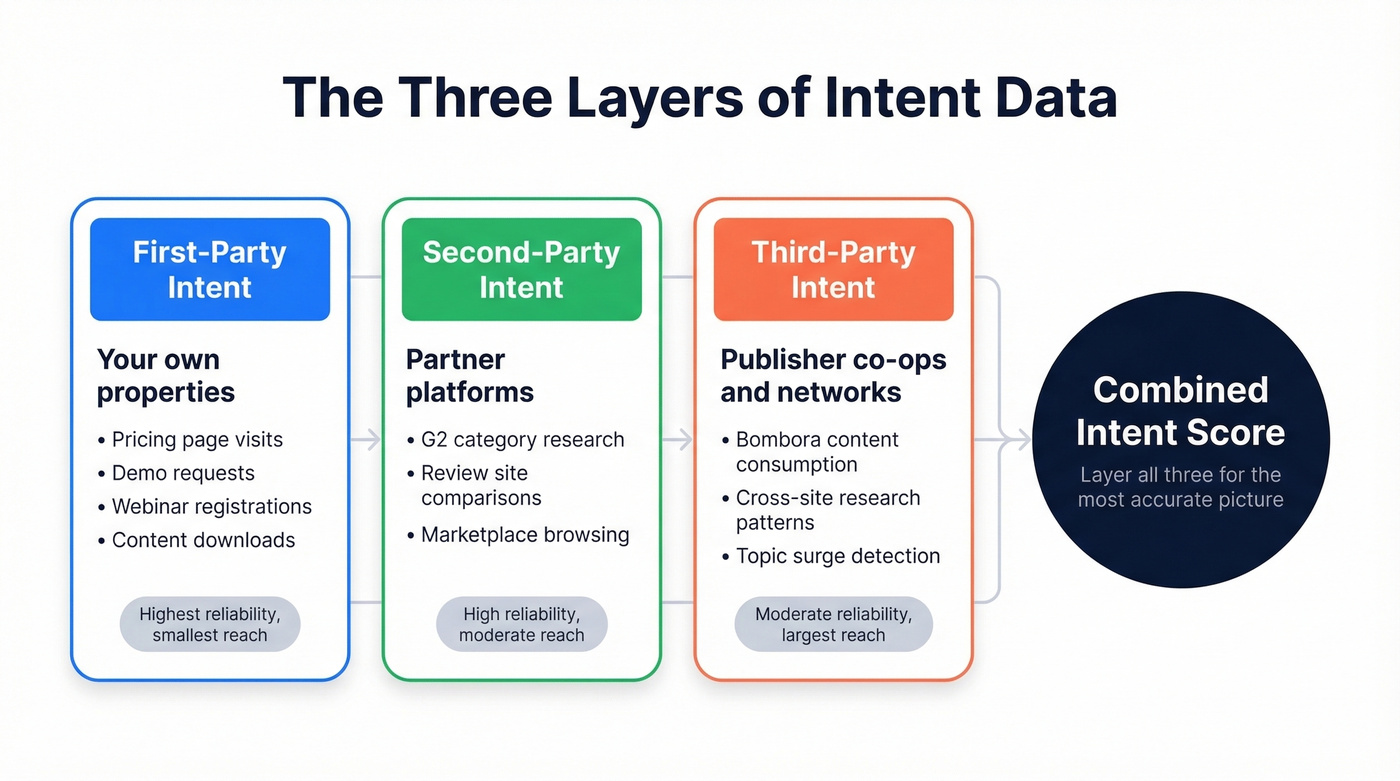
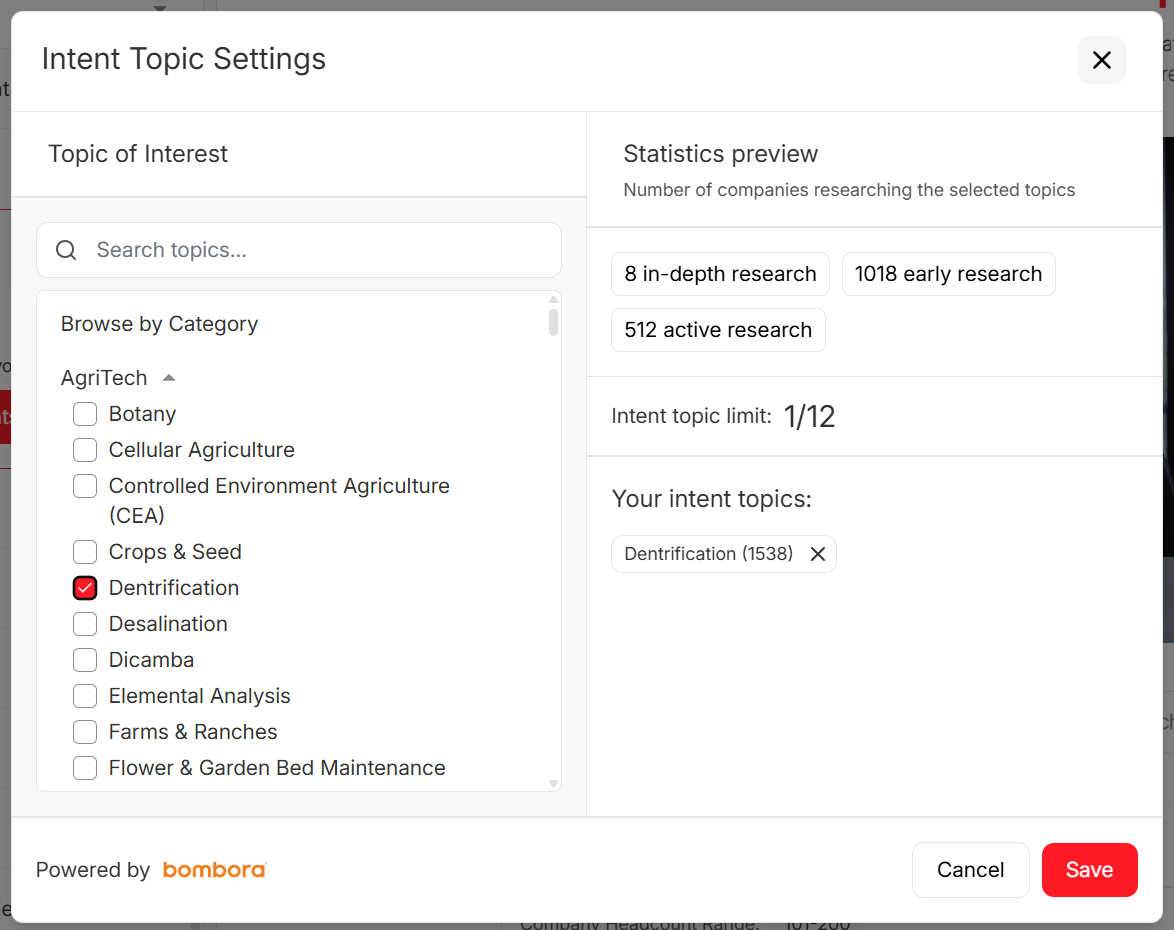
Three types of intent data work best together. First-party intent comes from your own properties - pricing page visits, demo requests, webinar registrations. Second-party intent comes from partner platforms like G2 where prospects are actively comparing solutions. Third-party intent comes from publisher co-ops and content networks like Bombora and Intentsify that track research behavior across thousands of websites.
Here's what makes measurement harder now than five years ago. A Greenbook analysis found that buyers are actively resisting impulse purchases, using budgeting apps, and revisiting saved recommendations before committing. They're growing hostile to algorithm-driven shopping, describing it as "invasive" and "generic." Traditional intent signals - ad clicks, page views, even cart additions - are less predictive when buyers deliberately slow down their own purchase process.
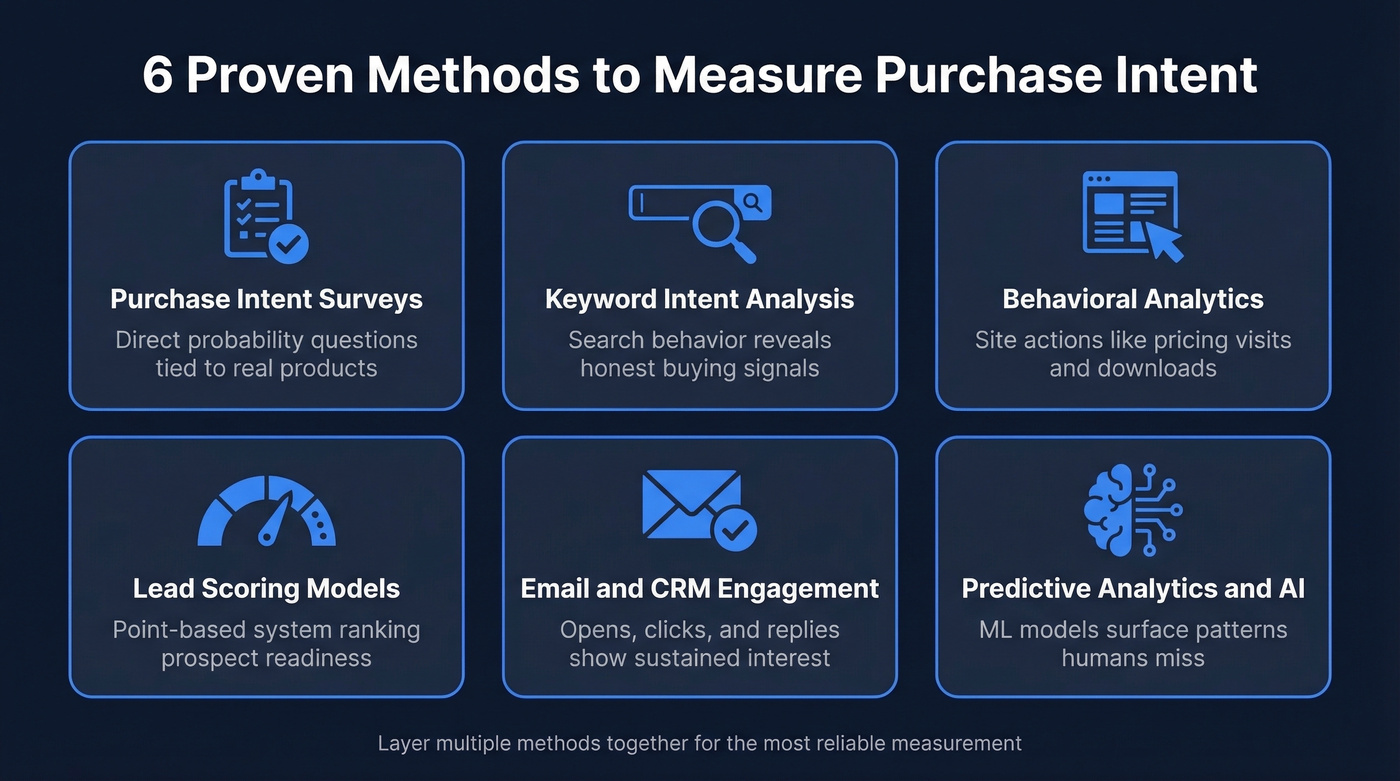
Six Proven Methods to Gauge Buying Intent
Purchase Intent Surveys
Surveys remain the most direct way to gauge buying intent, but the format matters enormously. A Juster-style probability question - where respondents rate their likelihood of purchasing on a 0-to-10 scale - forces people to think in probabilities rather than vague agreement levels. Multi-item Likert approaches still work if the questions are specific and time-bound, like "I intend to buy this product within the next 90 days," but generic templates produce generic answers.
Watch your wording. The difference between "How much did you enjoy using our new mobile app?" and "How would you describe your experience using our new mobile app?" is the difference between leading and neutral. That distinction matters more than most teams realize.
The biggest trap is hypothetical bias. The consensus on r/AskResearch and similar threads is blunt: measuring intent toward "hypothetical items rather than a specific item" produces responses that "have little to do with reality." Always tie survey questions to a concrete product, price point, and timeframe.
Keyword Intent Analysis
Search behavior is one of the most honest intent signals available - people don't lie to Google. Categorize keywords by funnel stage and prioritize high-intent modifiers: "buy," "pricing," "demo," "discount," "vs," and "[product] alternative." These signal active evaluation, not casual browsing.
Tools like Google Keyword Planner and Ahrefs let you map keyword clusters to buying stages. A prospect searching "what is CRM software" is early-stage. A prospect searching "HubSpot vs Salesforce pricing 2026" is close to a decision. Build content and ad targeting around these clusters, and you've got a passive intent measurement system running around the clock.
Behavioral Analytics
What people do on your site tells you more than what they say in a survey. The metrics that matter most: pricing page visits (especially repeat visits), time on product pages, content downloads, and cart or checkout activity. B2B buyers complete 70% of their research before engaging sales, so by the time they're deep in your site, they're already well into the decision.
Google Analytics pathing is the starting point. Track the sequences that lead to conversions - if pricing page, then case study, then demo request is your highest-converting path, you know exactly which behavioral signals to weight in your scoring model.
Lead Scoring and Buyer Intent Scores
This gets its own full section below. The quick version: assign numeric values to actions based on how strongly they correlate with closed deals, then combine them into a buyer intent score for each prospect or account. High-intent signals include repeated pricing page visits, demo requests, and competitor comparison research on review sites. Low-intent signals include social media clicks and single blog reads.
Engagement isn't buying. Don't confuse the two.
Email and CRM Engagement
Contacts who consistently open emails and click through demonstrate sustained interest. Those who open but never click are curious, not committed. Send more direct purchase offers - pricing, case studies, limited-time trials - to high-engagement segments, and keep nurturing the rest.
77% of B2B buyers won't talk to a salesperson until they've done their own research. Your email sequences are part of that research. Track which content drives replies and meetings, not just opens.
Predictive Analytics and AI
Machine learning models analyze your CRM history - every touchpoint, every conversion, every lost deal - and surface patterns humans miss. A VP who downloads a pricing guide, visits the integrations page twice, and works at a company that just raised a Series B? The model catches that combination faster than any rep could.
Salesforce Einstein refreshes its predictive scores every 10 days. MadKudu and HubSpot's predictive scoring offer similar capabilities at different price points. Gartner data shows AI-driven scoring yields a 40% boost in sales efficiency. We've seen that play out firsthand - teams that move from manual scoring to ML-based models see faster pipeline velocity within the first quarter.

Intent signals are worthless if they point to stale contacts. Prospeo tracks 15,000 buyer intent topics via Bombora and pairs them with 143M+ verified emails refreshed every 7 days - not the 6-week industry average. Your high-intent leads actually get reached.
Turn intent scores into booked meetings, not bounced emails.
Building an Intent Scoring Model
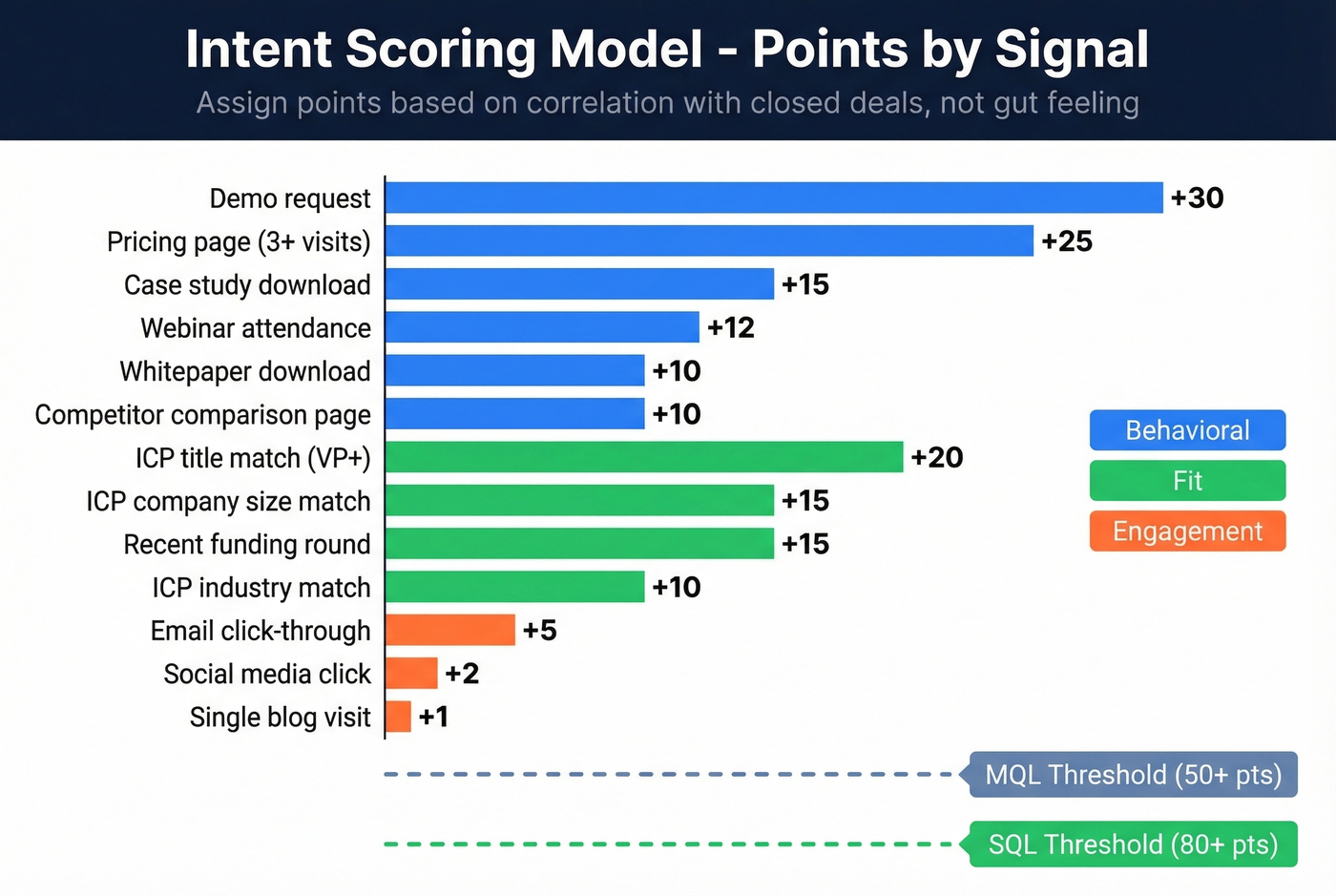
A scoring model turns qualitative signals into a number your team can act on. Companies that align sales and marketing on lead scoring see 208% higher revenue growth from priority leads. Here's a rubric we've used as a starting point:
| Signal | Points | Category |
|---|---|---|
| Demo request | +30 | Behavioral |
| Pricing page (3+ visits) | +25 | Behavioral |
| Case study download | +15 | Behavioral |
| Webinar attendance | +12 | Behavioral |
| Whitepaper download | +10 | Behavioral |
| Competitor comparison page | +10 | Behavioral |
| Email click-through | +5 | Engagement |
| Social media click | +2 | Engagement |
| Single blog visit | +1 | Engagement |
| ICP title match (VP+) | +20 | Fit |
| ICP company size match | +15 | Fit |
| ICP industry match | +10 | Fit |
| Recent funding round | +15 | Fit |
Set your thresholds based on historical conversion data. A common starting point: 50+ points = MQL, 80+ points = SQL. But these aren't universal - calibrate against your actual close rates and adjust quarterly.
Why does the funding round signal deserve +15 points? Companies that recently raised funding are 2.5x more likely to buy new solutions. That single data point is one of the strongest fit indicators you can track.
The model above is a template. Your version should weight signals based on what actually predicts closed deals in your pipeline, not what feels important in a planning meeting. And your scoring model is only as good as the data feeding it - if contact records are stale with wrong titles, old emails, and departed employees, you're scoring ghosts. Enrich CRM records before scoring them with a proper CRM data enrichment workflow. Prospeo's enrichment API returns 50+ data points per contact at a 92% match rate, including job changes and company growth signals that directly affect fit scores.
Intent Data Tools and Pricing
The intent data market hit $4.49B in 2026 and is projected to reach $20.89B by 2035 at a 16.6% CAGR. The Forrester Wave Leaders include Intentsify, 6sense, Bombora, Informa TechTarget, and Demandbase. But "leader" doesn't mean "right for your team."
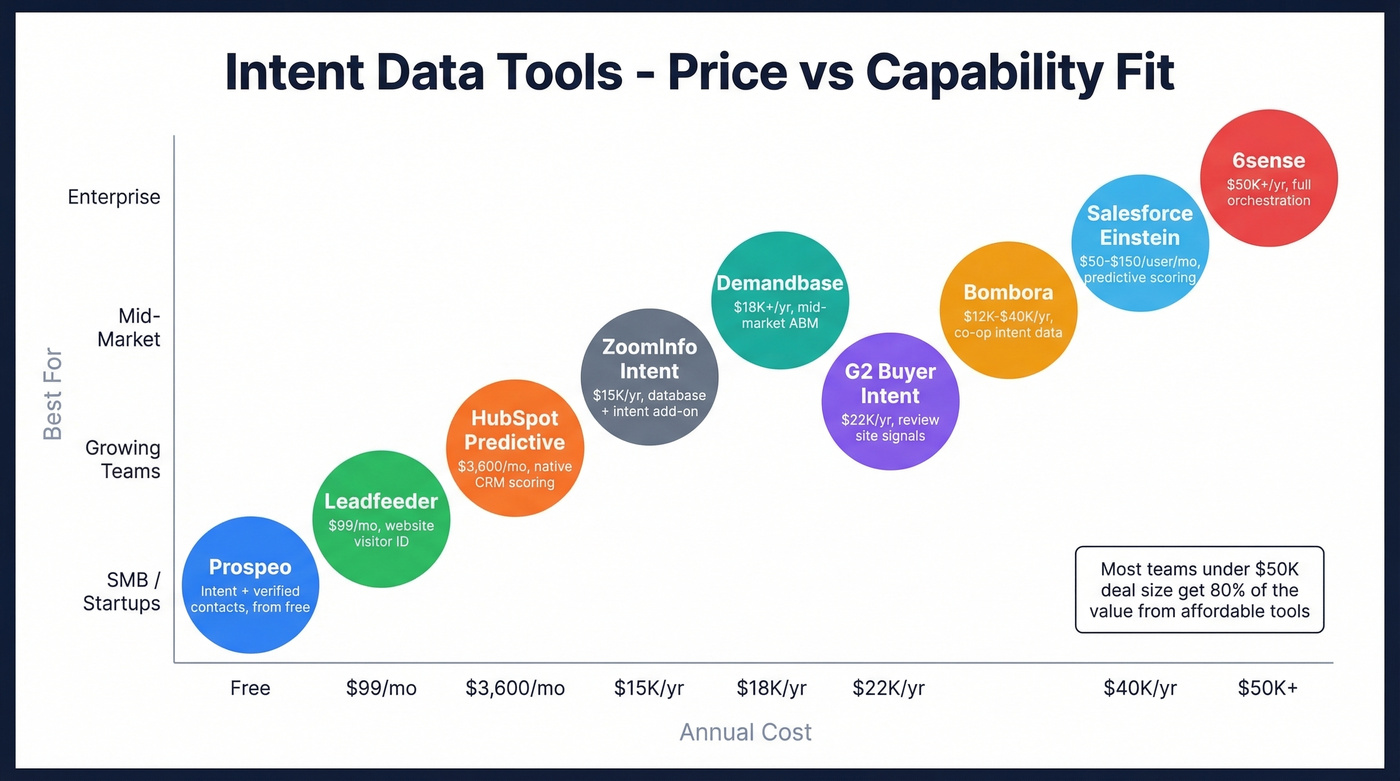
| Tool | What It Does | Starting Price | Best For |
|---|---|---|---|
| Prospeo | Intent + verified contacts | Free; ~$0.01/email | Acting on intent immediately |
| Bombora | Third-party co-op intent | $12K-$40K/yr | Enterprise intent sourcing |
| 6sense | Account intent + orchestration | $50K+/yr | Large revenue teams |
| Demandbase | ABM + intent | $18K+/yr | Mid-market ABM programs |
| ZoomInfo (intent add-on) | Database + intent | ~$15K/yr | Existing ZoomInfo customers |
| G2 Buyer Intent | Second-party review signals | $22K/yr | Software companies |
| Leadfeeder | Website visitor ID | $99/mo | SMBs tracking site visitors |
| HubSpot (predictive) | Native CRM scoring | ~$3,600/mo (Enterprise) | HubSpot-native teams |
| Salesforce Einstein | Predictive lead scoring | ~$50-$150/user/mo add-on | Salesforce-native teams |
Bombora's co-op spans 5,000+ B2B websites tracking 12,000+ intent topics, with 70% of the dataset exclusive to their network. Intent is flagged when a company's content consumption rises above its historical baseline - not just when someone visits a page, but when the pattern changes.
One market shift worth tracking: HubSpot absorbed Clearbit into Breeze Intelligence and ended free standalone Clearbit access. If you were using Clearbit for enrichment outside HubSpot, you need a new source - start with these data enrichment services.
A 6sense study of 4,000+ buyers found that 94% of buying groups have already ranked their preferred vendors before talking to sales. They consume an average of 13 content pieces, overwhelmingly anonymously. The same research revealed that only 10-15% of accounts in a given market are actively in-market at any time - which makes knowing how many accounts are in-market essential for realistic pipeline planning (see accounts in-market intent data).
Let's be honest: most teams with deal sizes under $50K don't need a $50K+ intent platform. Combine your first-party behavioral data with a tool that gives you verified contacts and basic intent signals, and you'll cover 80% of what the enterprise platforms offer at a fraction of the cost. The remaining 20% is orchestration and analytics you can build incrementally.
Your scoring model says a VP visited pricing three times and downloaded a case study. Now what? Prospeo gives you their verified email (98% accuracy) and direct mobile (125M+ numbers, 30% pickup rate) so you can act on that score in minutes, not days.
Stop measuring intent you can't act on. Get the contact data to close it.
Five Pitfalls That Corrupt Intent Data
1. Hypothetical optimism. People overstate their likelihood of buying. It's not dishonesty - it's human psychology. Stated intent consistently overpredicts actual purchase behavior by 50-80% depending on the category. Validate survey intent with behavioral data. If someone says they'll buy but never visits your pricing page, weight the behavior.
2. Contextual blind spots. A competitor launches a price cut. The economy shifts. A seasonal trend inflates your numbers. Intent data captured in isolation misses these forces. Control for external variables by tracking intent alongside market conditions, competitive moves, and seasonality patterns.
3. Missing emotional drivers. Purchase decisions involve habits, heuristics, and subconscious preferences that no survey or click-tracking captures. Supplement quantitative intent data with qualitative research - customer interviews, win/loss analysis, and post-purchase surveys that ask why, not just whether.
4. Survey fatigue. Long surveys produce garbage data. Non-representative samples produce misleading data. Keep surveys under 5 minutes, use screening questions to ensure you're reaching actual buyers, and rotate question formats to keep responses honest.
5. Single-snapshot measurement. Measuring intent once is like checking the weather once and planning your whole year around it. Buying journeys are multi-touch and nonlinear. Implement longitudinal tracking and continuous scoring that adapts as prospects move through their decision process.
Benchmarks - What Good Looks Like
Without benchmarks, your intent scores are just numbers.
| Intent Level | Score Range | What It Means |
|---|---|---|
| Strong demand | >70% | Ready to buy - route to sales |
| Healthy interest | 50-70% | Active evaluation - nurture aggressively |
| Weak intent | <50% | Early stage - educate, don't sell |
The general target is above 60%. Anything below 50% needs nurturing, not a sales call. Accounts that cross the 70% threshold show strong demand - these are the ones your sales team should prioritize for immediate outreach.
For downstream conversion benchmarks, Ruler Analytics analyzed over 100M data points across 14 industries and found an average qualified lead conversion rate of 2.9%. Form conversion averaged 1.7%, phone calls 1.2%. If your intent-driven campaigns convert above 3%, you're outperforming most of the market. And 67% of customers prefer self-service over speaking to a representative, which means your intent measurement needs to capture digital behavior, not just hand-raiser forms.
If you're running intent-based outreach and your qualified lead rate sits below 2%, the problem probably isn't your intent model. It's your contact data, your messaging, or your ICP definition. Fix those first with a tighter ideal client profile and better prospect data accuracy.
FAQ
Which survey scale best predicts actual purchases?
A Juster-style 0-10 probability scale outperforms standard Likert agree/disagree formats for stated intent. For B2B, combine it with behavioral data - surveys alone overpredict actual purchases by 50-80% depending on the category.
How often should I update my scoring model?
Quarterly at minimum. Teams that recalibrate quarterly see a 35% conversion boost. Markets shift, buyer behavior evolves, and last year's model misfires on this year's pipeline.
Can I track buying intent without expensive tools?
Yes. Google Analytics behavioral data, CRM engagement metrics, and well-designed surveys cost nothing and cover the fundamentals. For intent data layered with verified contacts, Prospeo offers a free tier with 75 emails per month - enough to test intent-driven outreach before committing budget.
What's a strong conversion benchmark for intent campaigns?
Above 3% qualified lead conversion rate puts you ahead of the 2.9% cross-industry average. Top-performing intent programs hit 5-8% by combining behavioral scoring with verified contact data and tight ICP targeting.
The through-line on measuring purchase intent is simple: layer your methods, score continuously, and verify your data before you act on it. The teams that treat intent measurement as an ongoing system - not a one-time project - are the ones that actually close the gap between "interested" and "revenue."