

How to Pitch a Product: The Practitioner's Playbook
84% of reps missed quota last year. And 96% of buyers research your product before they'll even take a call. If you're figuring out how to pitch a product in 2026, the old playbook is dead. Your pitch isn't - but the way most people deliver it is. Your words matter less than who hears them, when they hear them, and whether you've earned the right to say anything at all.
The Short Version
- Use the 5-part framework - Hook, Problem, Solution, Proof, CTA - for any pitch format, from a 30-second elevator ride to a 20-minute investor deck.
- Your pitch is only as good as your targeting. The most brilliant script fails if it reaches the wrong person or bounces off a dead inbox.
- Templates die when everyone copies them. Use frameworks you can adapt, not scripts you recite verbatim.
What Is a Product Pitch?
A product pitch is a focused argument for why a specific product solves a specific problem for a specific audience. It's narrower than a general sales pitch, which might cover your company story, multiple offerings, or a long-term relationship play. Every product pitch is a sales pitch. Not every sales pitch is a product pitch.
The other critical distinction: who you're pitching to. Customer pitches and investor pitches share DNA but serve completely different goals, and understanding that difference changes everything from your tone to your CTA.
| Customer Pitch | Investor Pitch | |
|---|---|---|
| Goal | Solve their problem | Prove a financial bet |
| Tone | Benefit-driven, human | Data-backed, strategic |
| Key Content | Use cases, outcomes | Market size, traction |
| CTA | Demo, trial, next call | Meeting, term sheet |
| Success Metric | Deal closed | Funding secured |
The 5-Part Pitch Framework
This is the skeleton that works across every format - cold call, cold email, investor deck, product demo. Memorize the structure, not the words.
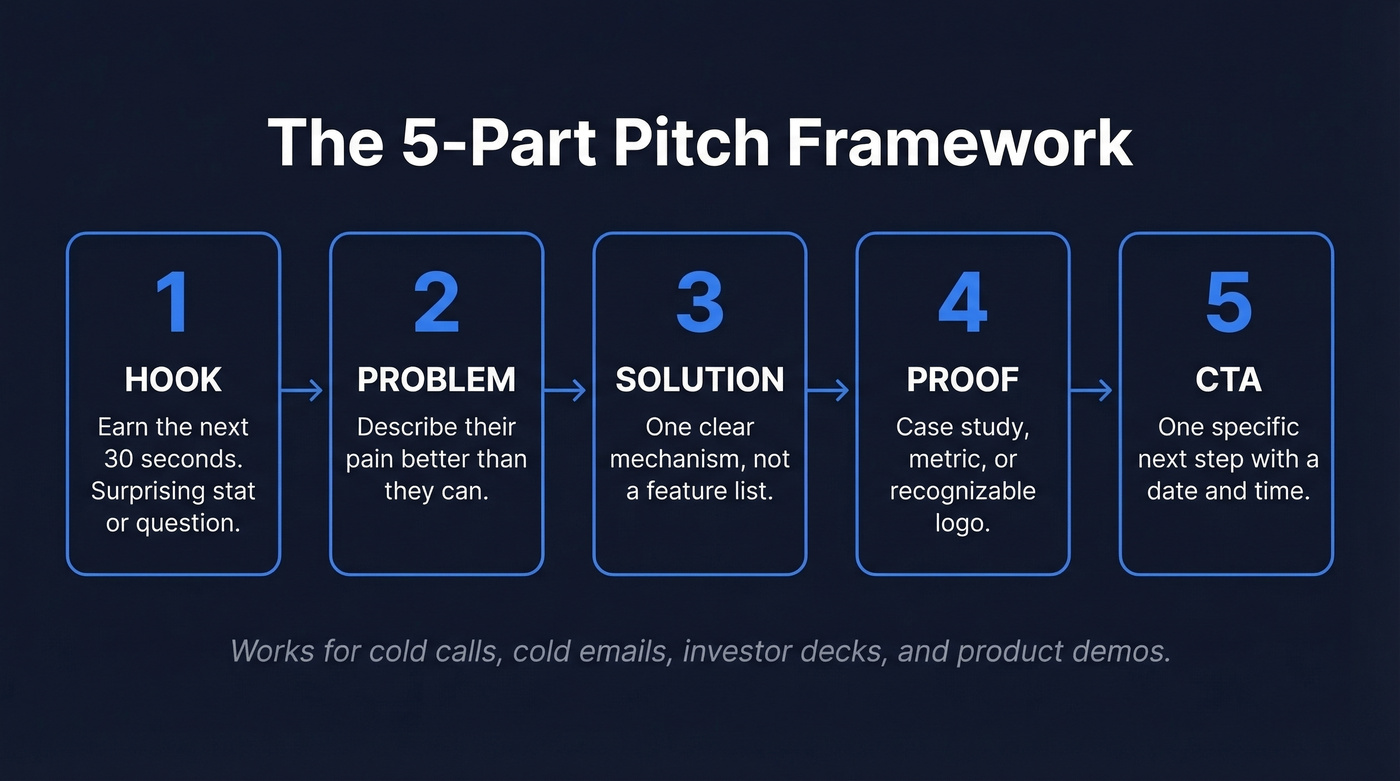
- Hook - Earn the next 30 seconds. A surprising stat, a provocative question, or a scene the listener recognizes. You have seconds, not minutes, before attention drifts, so don't waste them on your company name.
- Problem - Articulate the pain better than they can. If the prospect thinks "that's exactly my situation," you've won the right to keep talking. Stories beat data here - stories are 22x more memorable than facts alone, per Stanford research from Dr. Jennifer Aaker.
- Solution - Show how you fix the problem. Not a feature list. One clear mechanism that connects their pain to your product.
- Proof - Remove doubt. A case study, a metric, a recognizable logo. "We helped [company like yours] achieve [specific result] in [timeframe]." One detailed result beats a wall of logos every time.
- CTA - One clear next step. Not "let me know if you're interested." Instead: "Can we do 15 minutes Thursday to walk through how this works for your team?"
If you've used PAS or AIDA), you'll recognize the bones. This framework just makes the proof and CTA explicit, which is where most pitches fall apart.

You just built the perfect pitch - Hook, Problem, Solution, Proof, CTA. Now imagine it bouncing off a dead inbox or reaching an intern instead of the VP. 84% of reps missed quota last year, and bad targeting is the silent killer. Prospeo's 300M+ verified profiles with 30+ filters let you find the exact decision-maker who needs to hear your pitch, with 98% email accuracy so your words actually land.
Stop perfecting pitches that reach the wrong person.
How to Pitch a Product to Customers
The 30-Second Elevator Pitch
An elevator pitch runs 30-45 seconds, roughly 75-100 words. That's it. You don't have time to explain your tech stack or your founding story. You have time for one clear idea.
Use the 3 C's: Clear, Concise, Compelling. Here's a fill-in-the-blank template built on the framework above:
"You know how [target audience] struggles with [specific problem]? Most [current solutions] [why they fall short]. We built [product name] to [one-sentence mechanism]. [Company/team like theirs] used it to [specific result]. Would it make sense to show you how it works in [timeframe]?"
Aim for 75-100 words with blanks filled. You've got room for one more sentence of proof or context. Resist the urge to cram in more - the goal is to earn a longer conversation, not close the deal on the spot.
For more examples you can adapt, see elevator pitch variations by role and industry.
Cold Call Script (With Teardown)
Let's tear apart a real cold call script from a cybersecurity seller on Reddit, then rebuild it.
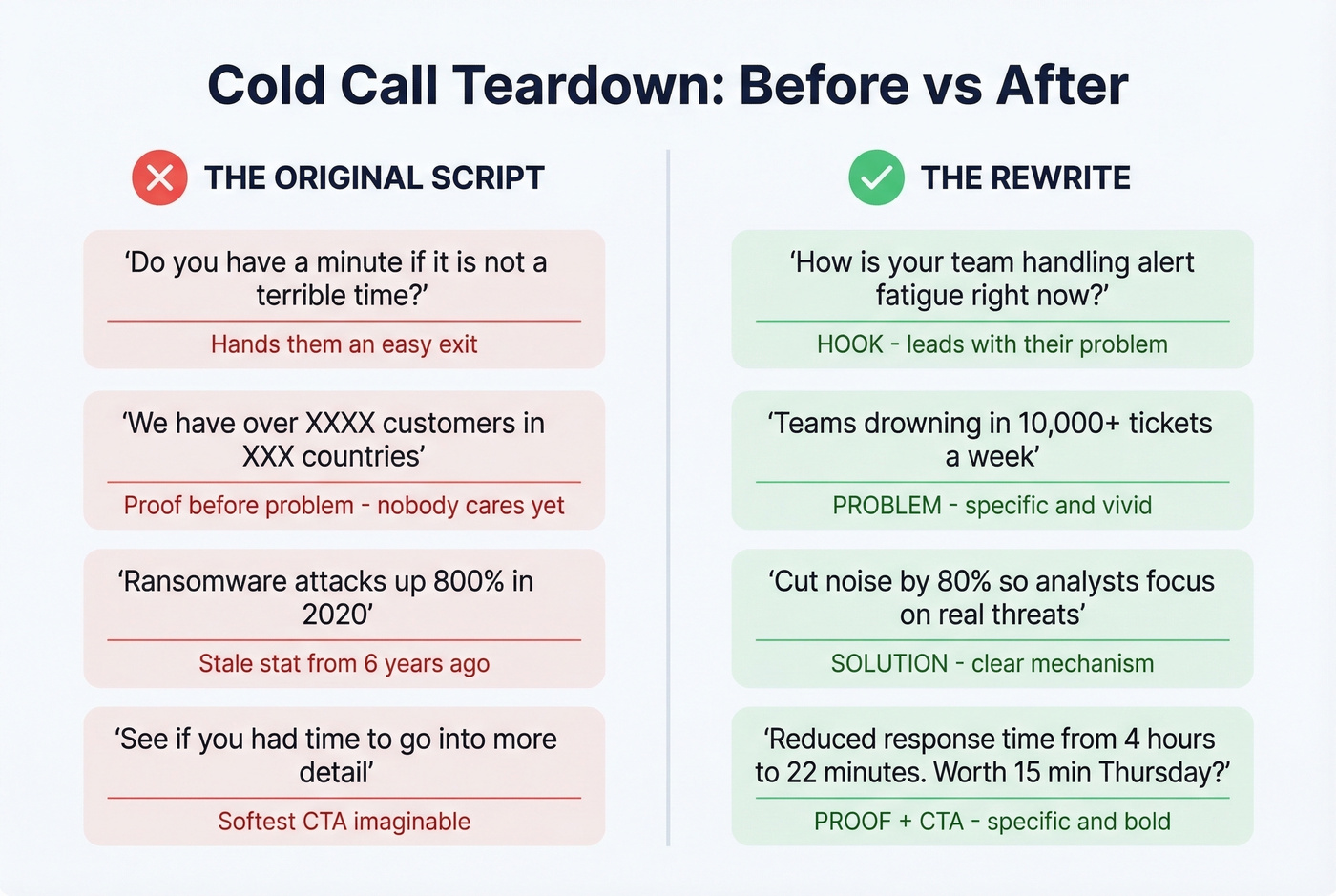
The original script:
"Hi [Name], this is [Rep] from [Company]. Do you have a minute to explain the reason of the call if it's not a terrible time? We have over XXXX customers in over XXX countries. We're seeing security environments that are far too noisy... lots of different tickets. With ransomware attacks being up by 800% in 2020, I wanted to see if you had a bit of time to go into a bit more detail...?"
Here's what's wrong, line by line:
- "Do you have a minute...if it's not a terrible time?" - Permission-based openers hand the prospect an easy exit. They don't know you yet. Why would they give you permission?
- "We have over XXXX customers in over XXX countries." - Nobody cares about your customer count in the first 10 seconds. That's proof, and proof comes after the problem.
- "Ransomware attacks being up by 800% in 2020." - A stat from six years ago. In 2026, this signals you're reading from a stale script.
- "See if you had a bit of time to go into a bit more detail." - The softest CTA imaginable. What are you actually asking for?
The rewrite:
"Hi [Name], this is [Rep] from [Company]. Quick question - how's your team handling alert fatigue right now? [Pause.] We work with security teams drowning in 10,000+ tickets a week and missing the ones that actually matter. We built [product] to cut noise by 80% so your analysts focus on real threats. [Company similar to theirs] reduced mean-time-to-respond from 4 hours to 22 minutes. Worth 15 minutes Thursday to see if we can do the same for you?"
The difference: the rewrite leads with their problem, not your company. It follows Hook, Problem, Solution, Proof, CTA. And it asks for something specific.
If you want a full system (not just a script), build it into a repeatable cold calling workflow.
In our experience, the reps who close consistently aren't better pitchers - they're better at diagnosing the problem in the first ten seconds. 87% of businesses expect reps to act as trusted advisors, not product pushers. Your cold call should sound like a peer flagging a problem, not a vendor reading a brochure.
Cold Email Pitch
Here's the thing: 69% of senders report year-over-year performance declines thanks to spam filtering and AI content fatigue. The consensus on r/coldemail is blunt - once a template gets shared widely, it stops working. That overused "Hey [Name], noticed you [generic observation]..." opener? Dead on arrival.
So don't copy templates. Use a framework:
- Make it about them. First sentence references their world, not yours.
- One clear idea. Not three value props. One.
- Easy to say yes to. "15 minutes Tuesday?" beats "Would love to explore potential alignment."
Keep it under 200 words. A structure that works:
Subject: [Specific result] for [their company/role]
Body: [One sentence about their situation - specific enough to prove you did homework.] [One sentence about the problem you solve.] [One proof point - metric or logo.] [One-line CTA with a specific time.]
If you want more structure (and what to avoid), use this AI cold email outreach playbook.
The Follow-Up Sequence
Buyers use roughly 10 interaction channels on average, and you don't know which one they prefer. Most reps send one email, get no reply, and move on. That's leaving money on the table. It takes an average of 5 touches to engage a prospect and 9 touches for executives.
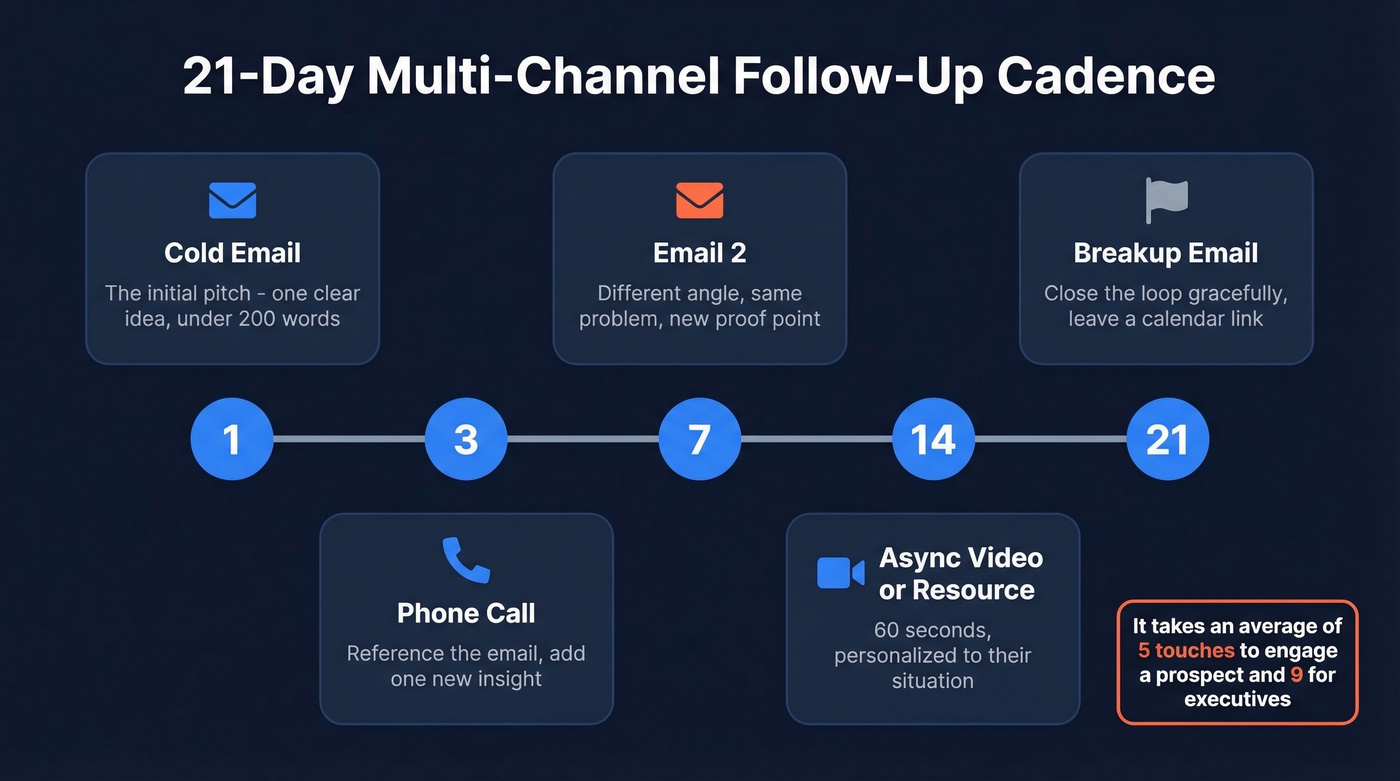
Here's a multi-channel cadence that actually works:
- Day 1: Cold email (the pitch above)
- Day 3: Phone call - reference the email, add one new insight
- Day 7: Second email - different angle, same problem, new proof point
- Day 14: Async video (60 seconds, personalized) or a relevant resource share
- Day 21: Breakup email - "Looks like timing isn't right. I'll close the loop - but if [problem] comes back up, here's my calendar link."
The follow-up isn't an afterthought. The follow-up IS the pitch. Your first email is just the opening act. Mix channels - email, phone, video - because the reps who show up in multiple places are the ones who get remembered.
If you need copy you can plug in fast, start with these follow-up templates.
How to Pitch a Product to Investors
Over 1,000 pitch decks get created every day. Only about 1% secure funding. The odds are terrible, but the pattern is clear: decks that win follow a structure investors already expect, then surprise them with the story inside it.
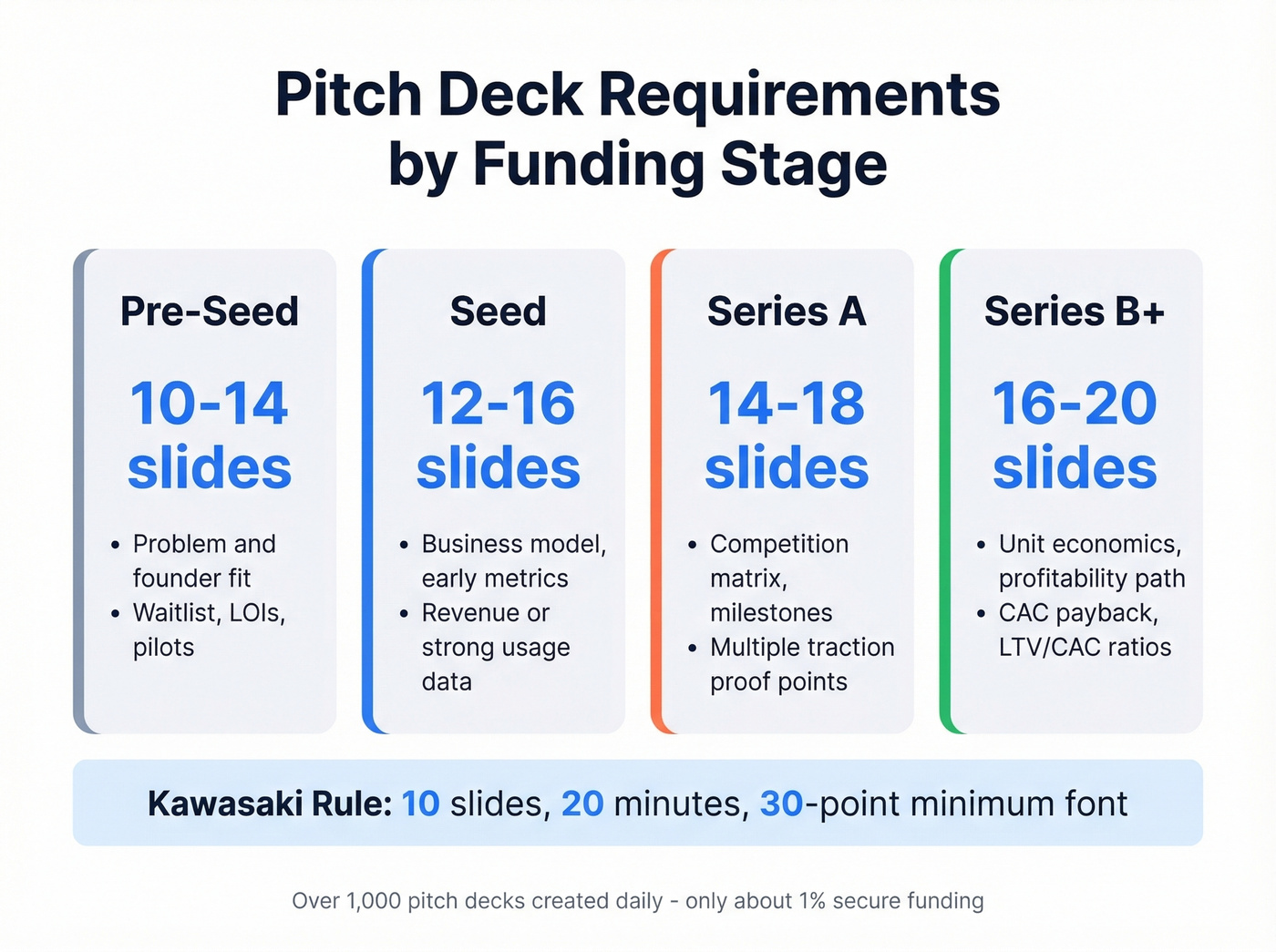
Guy Kawasaki's 10/20/30 rule still holds: 10 slides, 20 minutes, 30-point minimum font. But the real slide count varies by stage:
| Stage | Slides | Must-Include | Traction Expected |
|---|---|---|---|
| Pre-seed | 10-14 | Problem, founder fit | Waitlist, LOIs, pilots |
| Seed | 12-16 | Business model, early metrics | Revenue or strong usage |
| Series A | 14-18 | Competition matrix, milestones | Multiple traction slides |
| Series B+ | 16-20 | Unit economics, profitability path | CAC payback, LTV/CAC |
Most pitch guides are written by marketers, not people who've sat through investor meetings. The framework that works across all stages is Understanding, Interest, Belief. Your opening slides build understanding of the problem and market. The middle slides generate interest in your solution and traction. The closing slides create belief that your team can execute and the return is real. Investors expect a 10x return within 3-5 years - your deck needs to make that math feel plausible, not aspirational.
If you're building the narrative arc, borrow proven sales deck storytelling patterns and adapt them to investor expectations.
Synthesia raised $4M with a tight seed deck that led with the AI video market's explosive growth before ever showing the product. Datawisp closed a $3.6M seed round after a deck redesign focused on clear storytelling. The lesson is always the same: narrative first, product second.
Presentation Mistakes That Kill Deals
Leading with tech instead of the outcome.
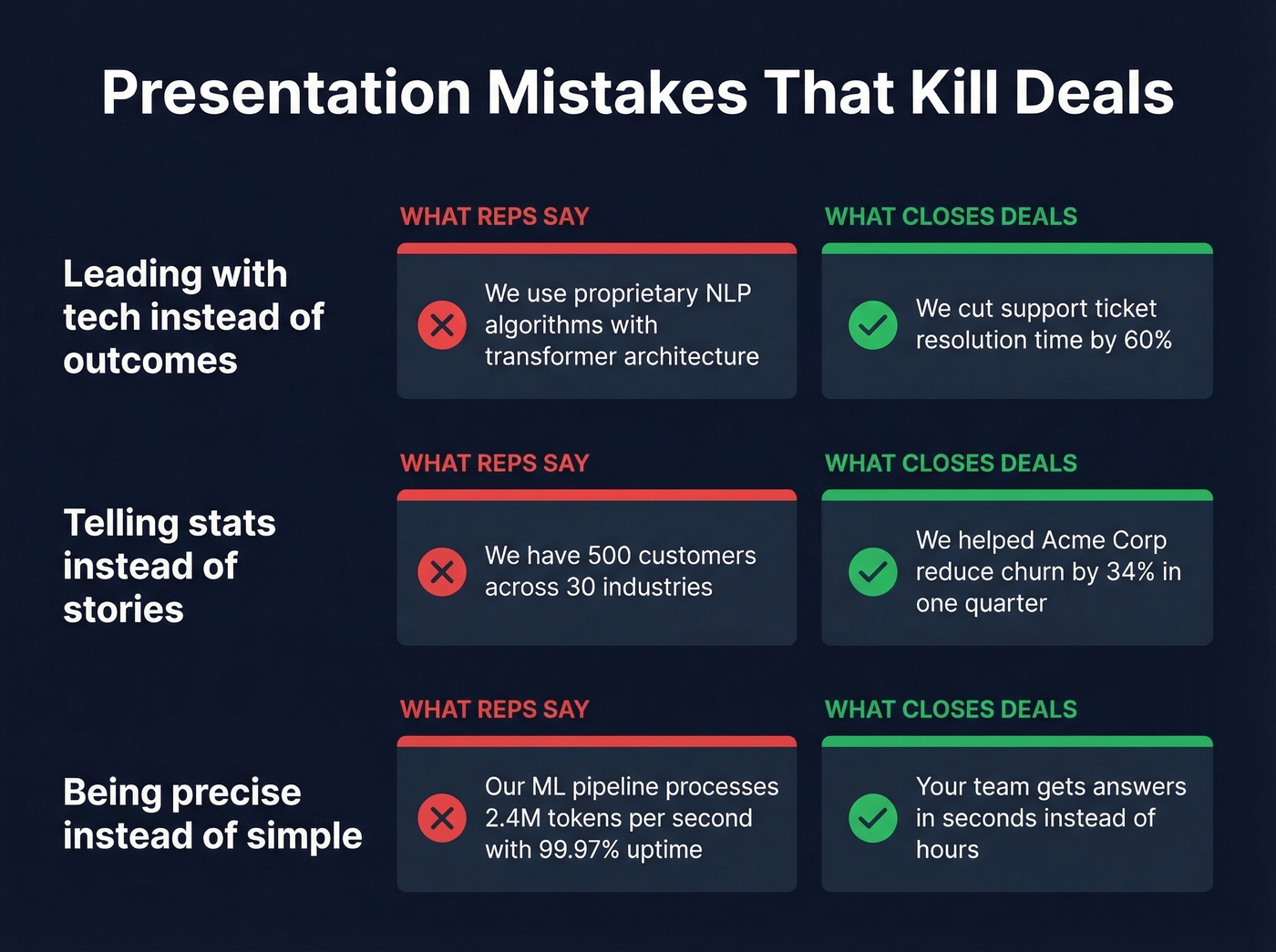
Bad: "We use proprietary NLP algorithms with transformer architecture."
Good: "We cut support ticket resolution time by 60%."
Technology is a tool. Investors and customers buy outcomes. If your prospect needs to Google a term to understand your pitch, you've already lost them.
Telling stats instead of stories.
A thousand customers is just a number. A single story is traction. One detailed case study of how you changed a customer's business beats a slide full of logos every time. When you say "We helped Acme Corp reduce churn by 34% in one quarter," the listener immediately pictures their own churn number. When you say "We have 500 customers," they picture nothing.
Being precise instead of simple.
Technical founders write decks like academic papers. Your deck's job isn't to close the deal - it's to get the next meeting. Simplify ruthlessly. If a slide needs a footnote, rewrite the slide.
No narrative thread.
If someone can't retell your pitch in two sentences after hearing it, you don't have a narrative. You have a feature list.
Bad: "We offer AI-powered analytics, custom dashboards, real-time alerts, and integrations with 50+ tools."
Good: "Companies are drowning in data but starving for answers. We turn raw metrics into the three decisions that matter most each morning."
The first version is a feature dump. The second has conflict, a villain (data overload), and a resolution. Build your pitch like a story - problem exists, current solutions fail, your product is the resolution.
Making the audience connect the dots.
Every slide, every email, every call should have a clear headline that states the argument. Don't make prospects do the work themselves - they won't.
Bad slide headline: "Q3 Performance Metrics"
Good slide headline: "Revenue grew 40% in Q3 - here's why it accelerates"
Give them the conclusion first, then back it up.
The Pitch Starts Before the Pitch
Stop perfecting your pitch. Start perfecting your targeting.
In 2026, 80% of B2B interactions happen in digital channels. 71% of buyers prefer independent research over talking to a rep. A full 33% want a completely seller-free experience - and that number jumps to 44% among millennial buyers. Buyers spend just 17% of their buying time meeting suppliers. The rest is independent research and internal alignment. By the time someone takes your call or opens your email, they've already formed an opinion.
Your pitch doesn't exist in a vacuum. It exists in the context of who you're reaching and whether they actually have the problem you solve.
Here's my hot take: if your deal sizes clear $5K, the ROI on better data dwarfs the ROI on a better subject line. Every hour you spend wordsmithing a pitch that lands in the wrong inbox is an hour wasted. Fix the list first. Then fix the words.
If you don't have a tight ideal customer profile, your pitch will always feel "off" to the buyer.

The best pitch in the world, sent to the wrong person, is just noise.
If you're cleaning up targeting inputs, start with firmographic filters and layer in intent based segmentation to prioritize accounts that are actually in-market.
Your cold call script is dialed in. Your email follows the framework. But 69% of senders report declining performance because they're sending to stale data. Prospeo refreshes every record on a 7-day cycle - not the 6-week industry average - so the contact info behind your pitch is as sharp as the pitch itself. At $0.01 per verified email, bad data is no longer an excuse for a great pitch that goes nowhere.
Great pitches deserve fresh, verified data behind them.
FAQ
How long should a product pitch be?
An elevator pitch runs 30-45 seconds (75-100 words). A cold email stays under 200 words. An investor presentation tops out at 20 minutes following Kawasaki's 10/20/30 rule. Match the length to the channel - shorter is almost always better because you're earning the next conversation, not closing the deal.
What's the difference between a product pitch and a sales pitch?
A product pitch focuses on one specific product's value for one specific problem. A sales pitch is broader - it can include company positioning, multiple offerings, or relationship-building across a longer cycle. Every product pitch is a sales pitch, but not every sales pitch is a product pitch.
How do you pitch a product with no traction?
Lead with the problem's severity, not your solution's track record. Use pilot results, waitlist numbers, or founder credibility as proxy traction. Pre-seed investor decks emphasize problem insight and founder-market fit over metrics. A compelling "why now" narrative can outweigh a revenue chart.
How many follow-ups should you send after a pitch?
At least five - executives often require nine touches before engaging. Most reps give up after two, which means persistence alone puts you ahead of the majority. Mix channels (email, phone, video) because the follow-up sequence is where deals actually close.
What tools help you reach the right prospects?
B2B data platforms like Prospeo let you filter by buyer intent, job changes, and technographics so your pitch reaches decision-makers who are actively in-market. Verified emails with 98% accuracy mean your message lands instead of bouncing. The difference between a 35% bounce rate and a sub-3% bounce rate is the difference between a pitch that gets heard and one that never arrives.