

How to Professionally Follow Up on an Unanswered Email Without Being Annoying
You sent a perfectly good email. Three days pass. Nothing. Now you're second-guessing whether following up will make you look desperate.
It won't. Not following up is the actual mistake.
Here's the thing most follow-up guides won't tell you: you probably don't have a follow-up problem. You have a first-email problem. If your original message was clear, concise, and sent to a valid address, one follow-up is usually all it takes. But if that address was wrong - or your message landed in spam - no amount of clever copy will save you.
The Quick Version
Wait 3 business days, then reply in the original thread with one new piece of value and one clear ask. Use a specific subject line - personalized lines get 46% opens vs. 35% for generic ones across a 5.5M email dataset. And verify the address first, because roughly 17% of cold emails never reach the inbox at all.
That's it. The rest of this article is the "why" and the "how" behind those three steps.
You're Not Being Annoying - You're Being Professional
42% of all campaign replies come from follow-up steps. Nearly half. Yet 48% of reps never send a second message. That's not politeness. It's self-sabotage.
People are busy, inboxes are brutal, and your email got buried between a Slack notification and a calendar invite. Silence is the default. Your job is to break through it - politely, with something worth reading.
Why Emails Go Unanswered
Most people assume silence means "not interested." Often it just means "never saw it."
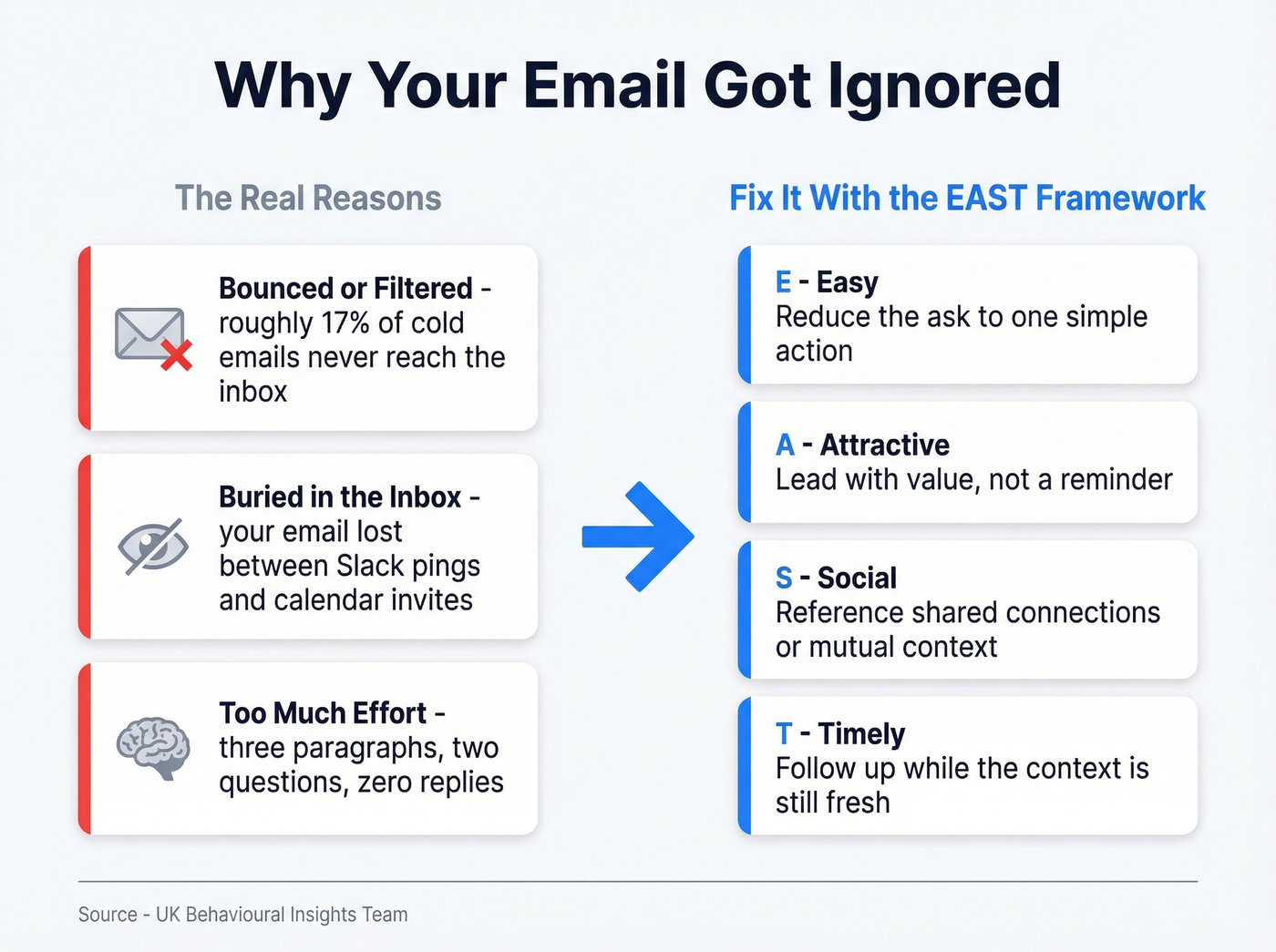
About 17% of cold emails bounce or get filtered before anyone sees them. That's your Step Zero before any follow-up: confirm the address is valid. Prospeo's email finder runs a 5-step verification process with 98% accuracy, and the free tier covers 75 emails per month. If your email bounced, you're following up on a ghost.

Don't trust open tracking either. Apple Mail Privacy Protection inflates open rates with phantom opens, so a "read" receipt means nothing in 2026.
Even when emails land, they still get ignored. The UK Behavioural Insights Team's EAST framework explains why: Easy - reduce the ask. Attractive - lead with value. Social - reference shared connections. Timely - follow up while context is fresh. If your original email required someone to read three paragraphs, parse two questions, and make a decision, they did none of those things. They skimmed, got distracted, and moved on.
The Follow-Up Framework
A single follow-up lifts reply rates by 65.8%. We've tested this cadence across hundreds of campaigns, and it holds:
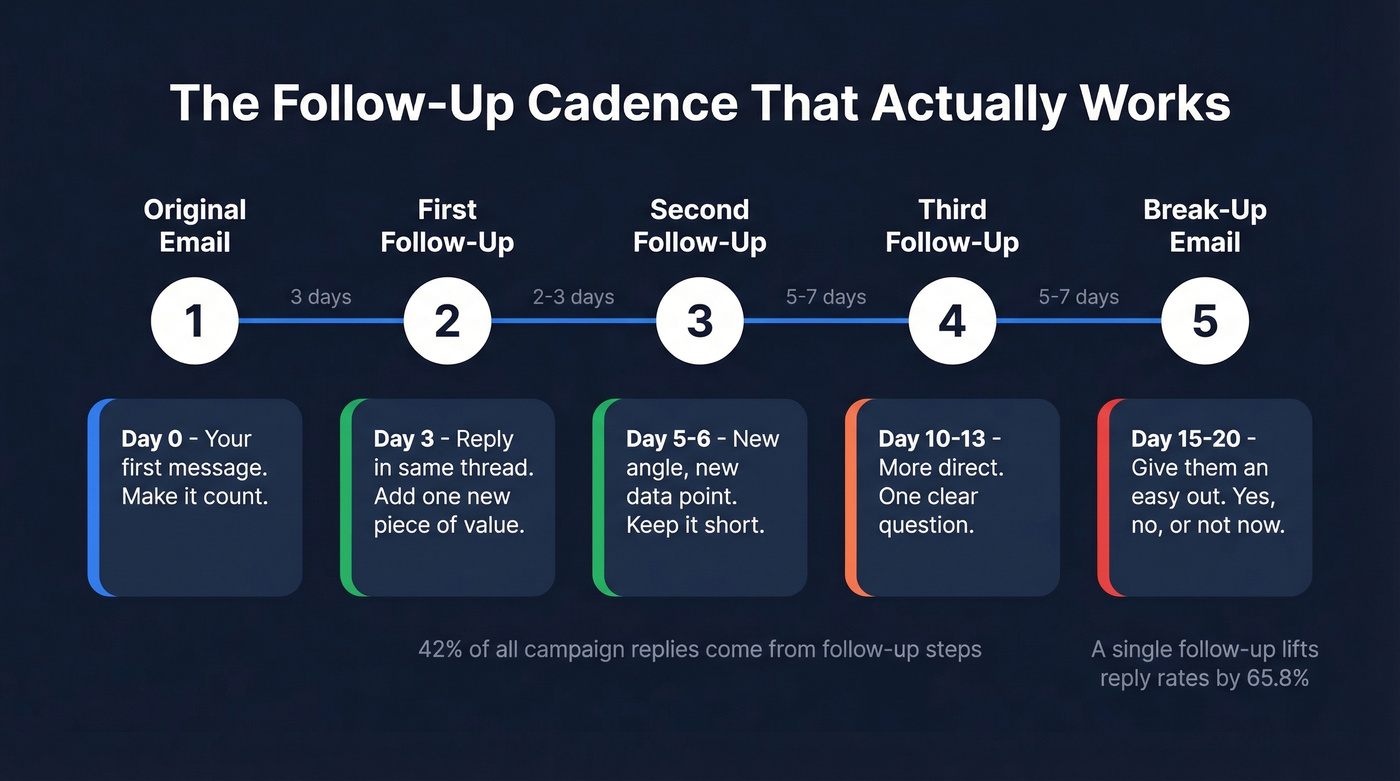
- First follow-up - 3 business days. Reply in the same thread.
- Second follow-up - 2-3 days later. Add new value.
- Third follow-up - 5-7 days later. Shorter, more direct.
- Break-up email - After 3-5 total touches. Give them an easy out.
Early spacing stays tight to keep context fresh. Later touches stretch so you don't crowd the inbox. For most professional contexts, stop after 3-5 touches. Cold outreach can push to 5-8 - 80% of sales require 5+ touches before a prospect responds.
One rule above all: every follow-up must add something new. A bare "just checking in" is dead weight. New data point, new case study, new angle on their problem - pick one.
If you want more ready-to-send options, start with these sales follow-up templates.

Your follow-up won't work if it never reaches the inbox. 17% of cold emails bounce before anyone sees them. Prospeo's email finder runs 5-step verification with 98% accuracy - so you know the address is real before you craft that perfect second touch. 75 free lookups per month, no card required.
Stop following up on ghost addresses. Verify first, then send.
Templates by Scenario
Most follow-up guides only cover sales. That's useless if you're chasing a coworker for a deliverable or waiting to hear back from a recruiter. Let's break this down by the situations that actually come up in professional life.
Sales Prospect
Hi [Name], I came across [specific case study] that's relevant to what we discussed. [Similar company] saw [specific result]. Worth a 15-minute call this week?
Lead with new value, not a reminder. One CTA, one question, one easy action. (If you're building a full sequence, see B2B cold email sequence best practices.)
Client Who's Gone Quiet
The key here is I-language. "I want to make sure I'm not holding things up" beats "you haven't responded." Offering multiple-choice options makes it easy to reply with a single letter:
Hi [Name], I want to make sure I'm not holding things up on my end. Would it help to (a) hop on a quick call, (b) get a revised timeline, or (c) pause until [specific date]?
Coworker or Internal Stakeholder
This is where the "default action" tactic shines. As one popular Workplace StackExchange thread puts it, the "unless I hear otherwise, I'll assume..." approach is powerful - but carries political risk if misused. Use it when you genuinely need to move forward:
Hi [Name], I need the [deliverable] by [date] to keep [project] on track. If I don't hear back by Friday, I'll proceed with Option A.
After two unanswered emails, switch to IM or walk over. Seriously. Don't send a third email to someone who sits 20 feet away.
Job Application
Send a thank-you within 24 hours of the interview. A status check at 5-7 business days is appropriate. Stop after 2-3 total follow-ups - recruiters operate on their own timeline, and pushing harder won't speed things up.
Hi [Name], thanks again for the conversation on [date]. I'm still very interested in the [role] and wanted to check on timing for next steps.
Vendor or Partner
Hi [Name], following up on the [proposal] we discussed on [date]. I'd like to finalize by [deadline]. Would a quick call be easier than email? I'm open [two specific times].
Offering a call as an alternative channel often breaks the logjam. Some people just hate email threads.
Subject Lines and Sign-Offs
That 5.5M email analysis from Yesware found personalized subject lines hit ~46% open rates and 7% reply rates, versus ~35% opens and 3% replies for generic lines. That's a massive gap from a single variable.
If you need inspiration, borrow from these email subject line examples.
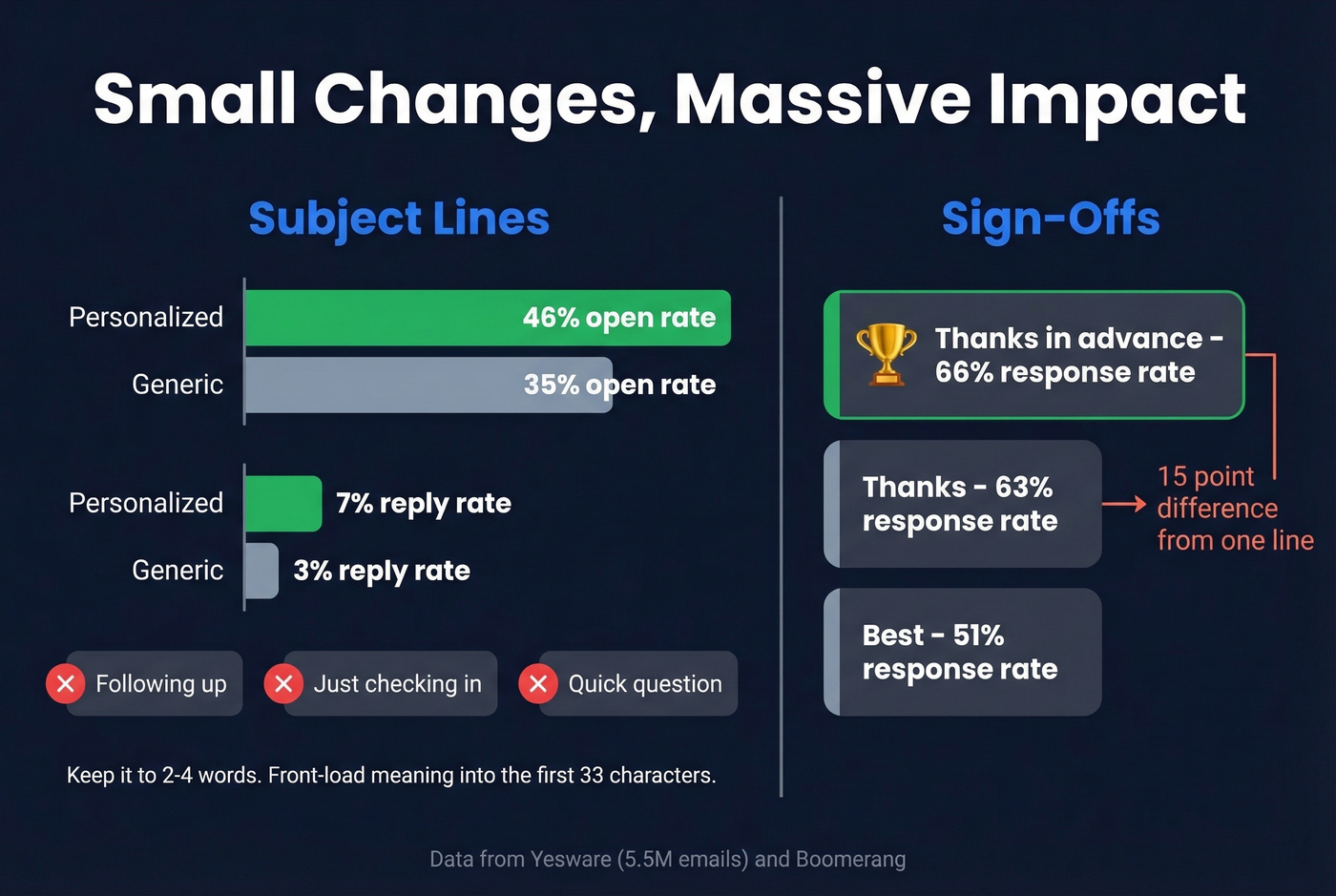
Keep subject lines to 2-4 words. Front-load meaning into the first 33 characters - that's all most mobile clients display. Retire "Following up," "Just checking in," and "Quick question." They signal you have nothing new to say.
If you catch yourself writing "just checking in," use these alternatives for how to say just checking in professionally.
Your sign-off matters too. Boomerang's analysis found "Thanks in advance" hits a 66% response rate - 15 points higher than "Best." It's a small change that creates a subtle obligation to act.
Mistakes That Kill Your Follow-Up
We've seen all of these tank otherwise solid campaigns:
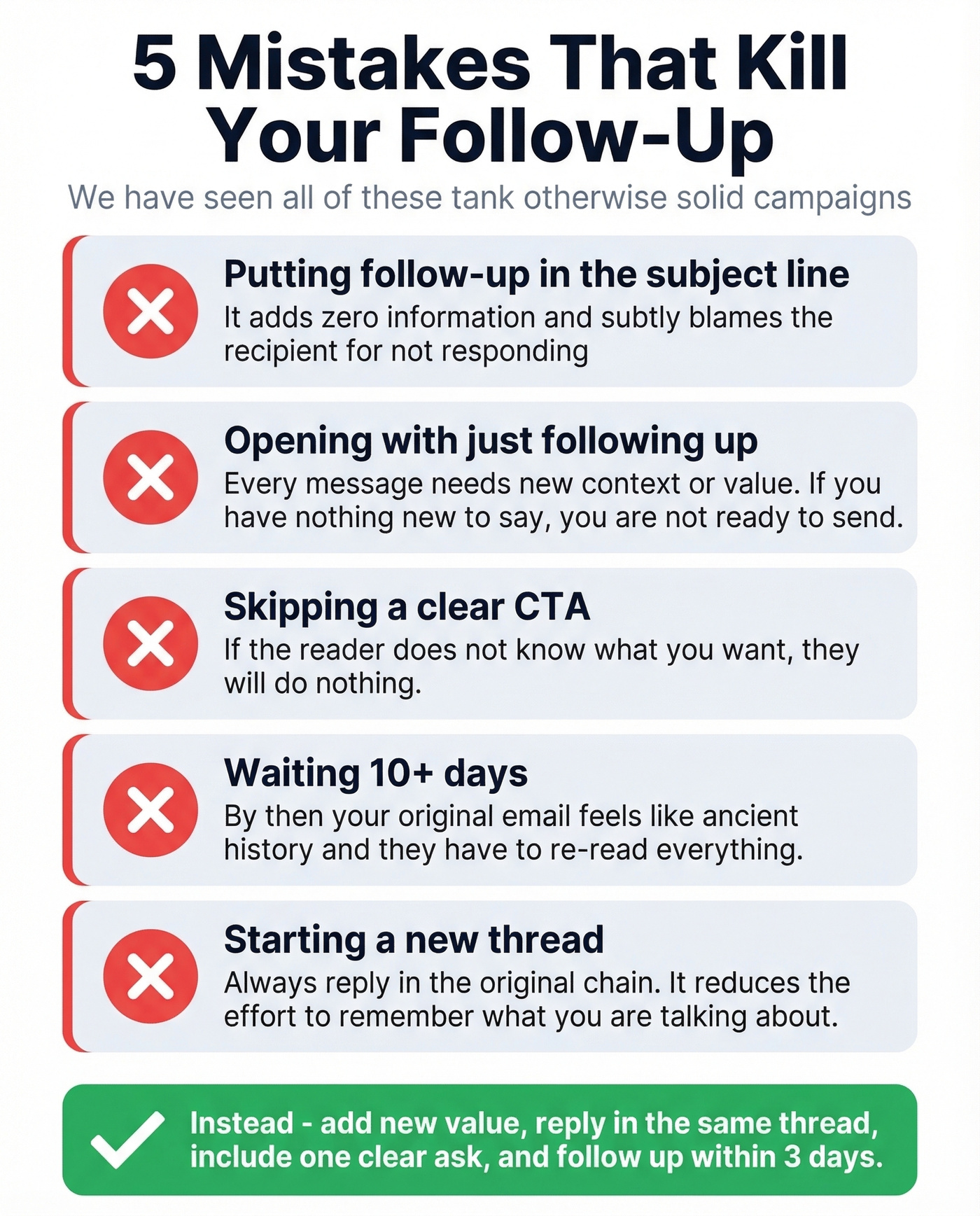
- Putting "follow-up" in the subject line. It adds zero information and subtly blames the recipient for not responding.
- Opening with "just following up" and nothing else. Every message needs new context or value. If you have nothing new to say, you're not ready to send.
- Skipping a clear CTA. If the reader doesn't know what you want, they'll do nothing. (Here are practical rules for an email call to action.)
- Waiting 10+ days. By then your original email feels like ancient history and the recipient has to re-read the entire thread to remember who you are.
- Starting a new thread. Always reply in the original chain. It reduces the effort to remember what you're talking about.
When to Switch Channels
Email isn't always the right medium. After 2 unanswered emails, move to IM or chat. After 2-3, pick up the phone.
If all digital channels fail, try an in-person conversation or reach out to an alternate contact on the same team. In our experience, the break-up email often generates replies because it gives people a clean "yes/no/not now" decision - the simplicity is what makes it work.
If you're tracking performance, compare your results to current follow-up email reply rate benchmarks.
Look, knowing how to professionally follow up on an unanswered email is half the battle. The other half is making sure your message actually lands in the inbox. Bad data silently kills more campaigns than bad copy ever will, and we've watched teams waste weeks of follow-up effort on addresses that were dead from the start.
If deliverability is the real issue, start with an email deliverability guide and then tighten list quality by learning how to check if an email exists.
The best follow-up in the world can't save a bad email address. Prospeo gives you 143M+ verified emails refreshed every 7 days - not the stale data that's been sitting in your CRM for months. At $0.01 per email, fixing your deliverability costs less than the deal you're losing to silence.
Your prospect isn't ignoring you. Your email just never arrived.
FAQ
How long should I wait before following up on an email?
Three business days is the standard for most professional contexts. For urgent internal requests, 24-48 hours is fine. Job applications deserve 5-7 business days after an interview before a polite status check.
How many follow-ups is too many?
For warm contacts, 2-3 messages is the ceiling before switching channels. For cold outreach, send 4-5 touches before a break-up email. A coworker doesn't need a 7-email sequence - after two unanswered messages, walk over or send a chat message.
What if my emails aren't reaching the inbox at all?
About 17% of cold emails bounce or get filtered before anyone sees them. Verify addresses before sending, and use tools like Mail Tester to flag domain reputation issues on your sending side. If your bounce rate is above 5%, your list quality is the problem, not your copy.