

How to Send a Final Follow-Up Email That Actually Gets a Reply
You sent a proposal two weeks ago. The prospect seemed excited on the demo call. Then - nothing. Three follow-ups, zero replies.
Here's the thing: 44% of salespeople give up after just one follow-up, and 80% of sales require 5-12 attempts before a deal closes. That last email you're dreading? It might be the one that works.
Knowing how to send a final follow-up email is the difference between abandoned pipeline and closed revenue. And please stop calling it a "breakup email." You're not dating your prospect. The cringe factor of that language is exactly why so many salespeople avoid sending the closing message - and leave money on the table.
What You Need (Quick Version)
- Send your final follow-up after 5+ attempts spread over 2-3 weeks. High-growth organizations average 16 touchpoints per prospect, so five is conservative, not aggressive.
- Use a short subject line. In a large cold-email dataset, 2-4 word subject lines hit a 46% open rate.
- Give the recipient an easy out. "Permission to close" language triggers loss aversion and actually increases replies.
- If you're getting zero replies across your entire sequence, the problem is probably bad data, not bad messaging. Verify your contact list before giving up.
When to Send Your Final Follow-Up
Send too early and you look impatient. Wait too long and the prospect forgets who you are. Space your touches 3-4 days apart - anything under 48 hours feels desperate, and gaps longer than five days lose context. If you want a deeper cadence breakdown, see When Should You Follow Up on an Email?.
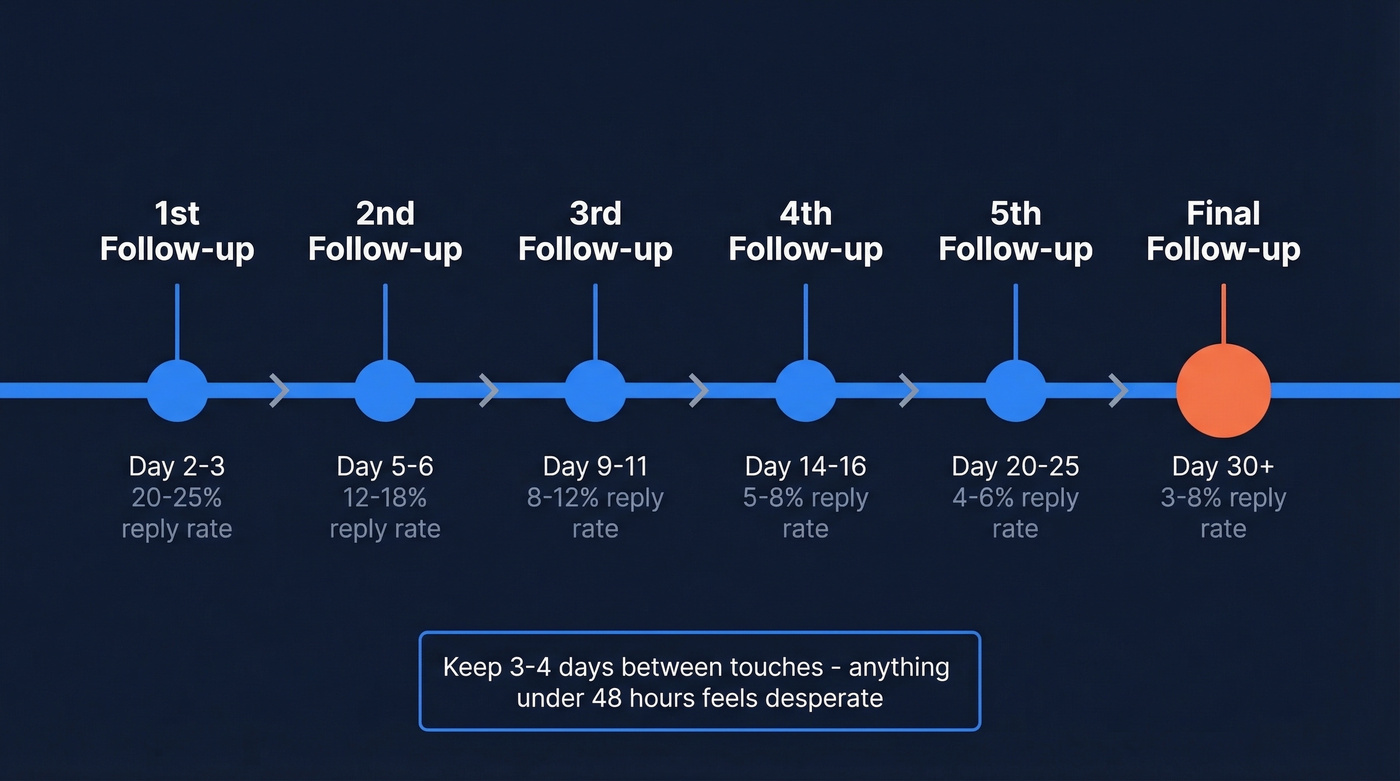
| Follow-Up Stage | Timing | Expected Response Rate |
|---|---|---|
| 1st follow-up | Day 2-3 | 20-25% |
| 2nd follow-up | Day 5-6 | 12-18% |
| 3rd follow-up | Day 9-11 | 8-12% |
| 4th follow-up | Day 14-16 | 5-8% |
| 5th follow-up | Day 20-25 | 4-6% |
| Final follow-up | Day 30+ | 3-8% |
That 3-8% on the final email doesn't sound like much. But it's free pipeline you'd otherwise abandon entirely. If you're tracking performance, compare against follow-up reply rate benchmarks.
Why the Last Follow-Up Before Closing Works
Two psychological forces do the heavy lifting here. Loss aversion: when you signal you're walking away, the prospect suddenly feels the potential loss of whatever value you offered. Autonomy restoration: by giving them permission to say no, you remove the pressure that was keeping them silent in the first place.
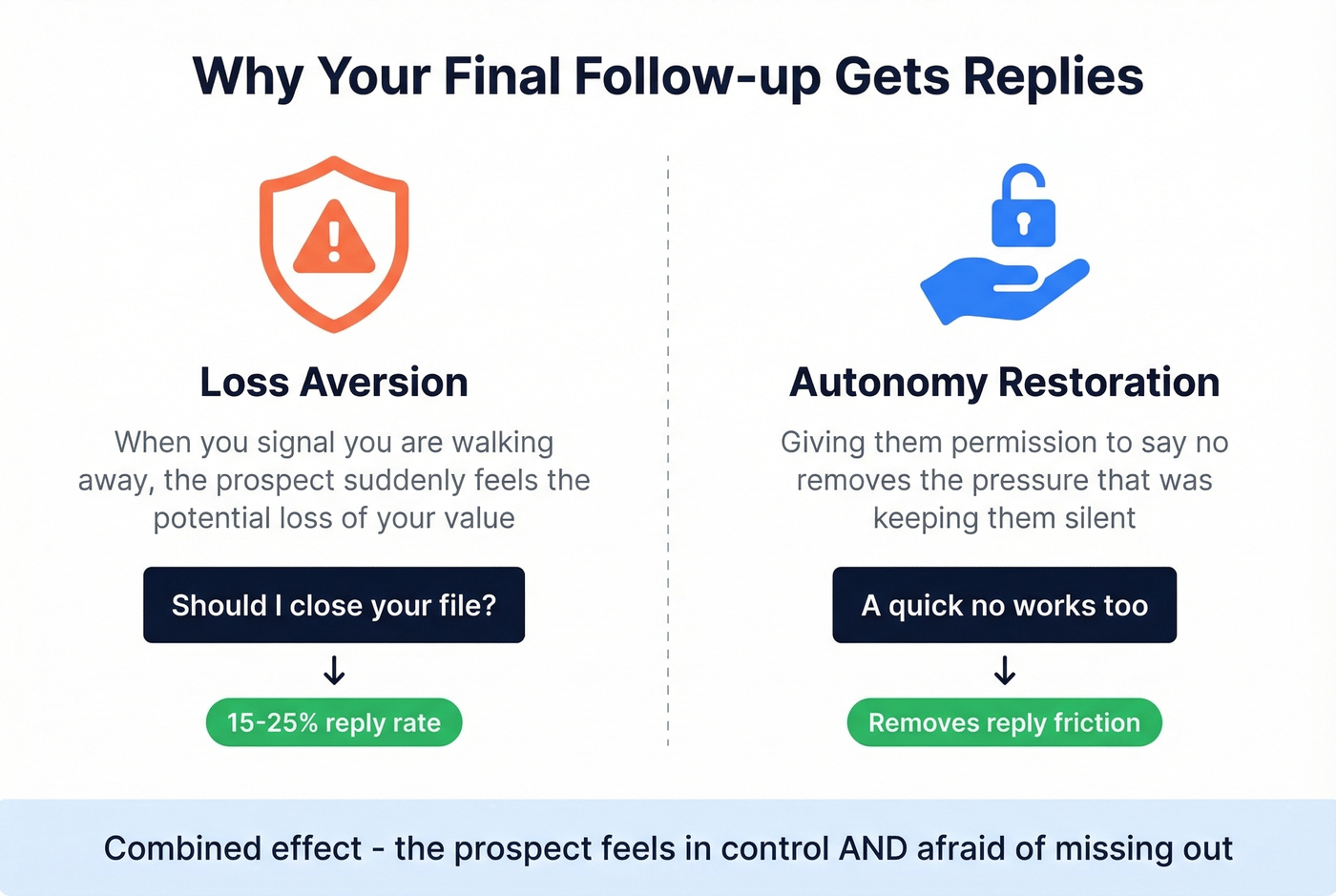
Some benchmarks cite response rates as high as 76% for final emails. We've seen more like 15-25% in real campaigns, but the directional truth holds - a well-written closing email pulls replies that mid-sequence nudges miss. The whole "breakup email" framing is cringey. Call it what it is: a final follow-up that closes the loop and hands the prospect control. (If you want more patterns, borrow from these sales follow-up templates.)

If your entire follow-up sequence is getting zero replies, the problem isn't your copy - it's bad data. 35% bounce rates destroy your domain reputation before your final email ever arrives. Prospeo's 5-step verification delivers 98% email accuracy, so every follow-up hits a real inbox.
Stop crafting the perfect closing email for an address that doesn't exist.
Templates That Work
Sales - "Permission to Close"
Use this when a prospect went quiet after a demo or proposal. The "close your file" framing works because it's specific, final, and hands control back to the recipient.
Subject: Should I close your file?
Hi [Name],
I've reached out a few times about [specific topic]. I don't want to be a nuisance, so I'll assume the timing isn't right.
Should I close your file for now, or is there still interest on your end? Either way, no hard feelings.
Best, [Your name]
Sales - "No Interest?"
A more direct pattern for when the prospect never engaged at all - no replies, no opens, nothing. The binary question makes replying easier than ignoring.
Subject: Not interested?
Hi [Name],
I haven't heard back, so I'll keep this short: are you still interested in [solving X problem], or should I stop reaching out?
A quick "no" works too - I'd rather know than guess.
[Your name]
Job Application - Graceful Exit
The interview went great. They said they'd get back to you "by end of week." That was 10 days ago. Send this 5-7 business days after your last contact.
Subject: Following up on [Role]
Hi [Name],
I wanted to check in one last time about the [Role] position. I'm still very interested, but I understand if the team has moved in a different direction.
If there's any update, I'd love to hear it. If not, thanks for the opportunity - I genuinely enjoyed our conversation.
Best, [Your name]
Invoice / Payment Reminder
Keep the tone firm but professional, and always reference the specific amount and date. Don't be too polite here. You did the work. Be direct.
Subject: Invoice #[Number] - final reminder
Hi [Name],
This is a final reminder that invoice #[Number] for $[Amount], originally due on [Date], remains unpaid. Please process payment at your earliest convenience.
If there's an issue with the invoice, let me know and I'll sort it out immediately.
Thanks, [Your name]
Networking / Partnership
When a potential partner has gone quiet, preserve the relationship while closing the loop.
Subject: Last note, [Name]
Hi [Name],
I've reached out a couple of times about [collaboration/topic]. Totally understand if priorities have shifted - it happens.
I'll leave the ball in your court. If the timing works down the road, I'm easy to find.
Cheers, [Your name]
Subject Lines That Get Opens
A Belkins analysis of 5.5M cold emails found that personalized subject lines hit a 46% open rate and 7% reply rate. The sweet spot is 2-4 words - open rates drop after seven words. Question-format subject lines also performed strongly in the same dataset, and 33% of recipients decide to open based on the subject line alone. One counterintuitive finding: emails with no subject line at all outperformed many subject lines by 8%. Numbers in subject lines, meanwhile, dropped opens to 27%. For more ideas, swipe from these email subject line examples.
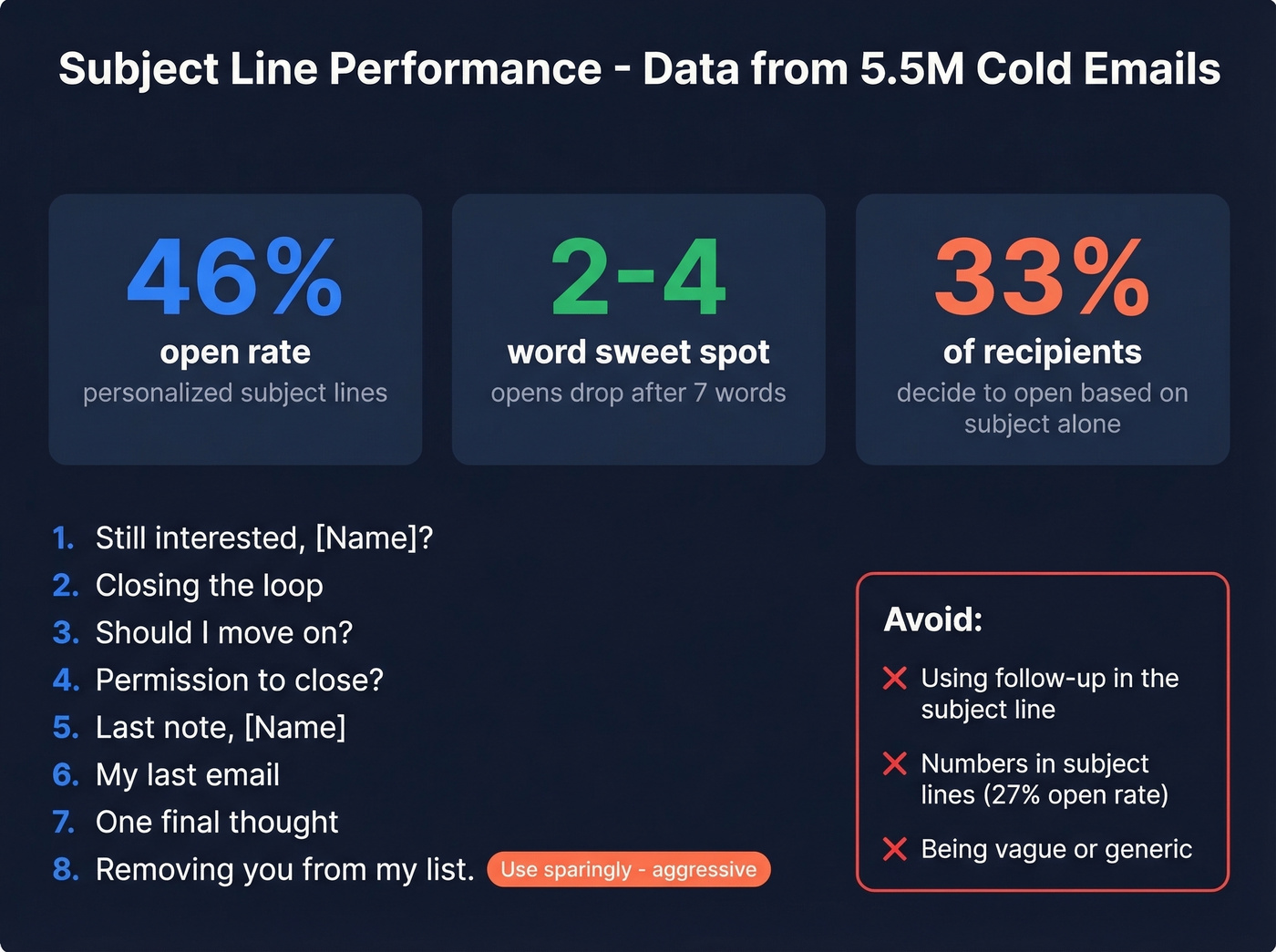
Final follow-up subject lines that work:
- Still interested, [Name]?
- Closing the loop
- Should I move on?
- Permission to close?
- Last note, [Name]
- My last email
- One final thought
- Removing you from my list
That last one is aggressive - use it sparingly. But it gets attention because it triggers loss aversion hard.
Mistakes That Kill Your Final Email
Don't use "follow-up" in the subject line. It adds zero value and feels like a guilt trip. Use a question or finality signal instead. If you're building a full sequence, follow a proven B2B cold email sequence structure.
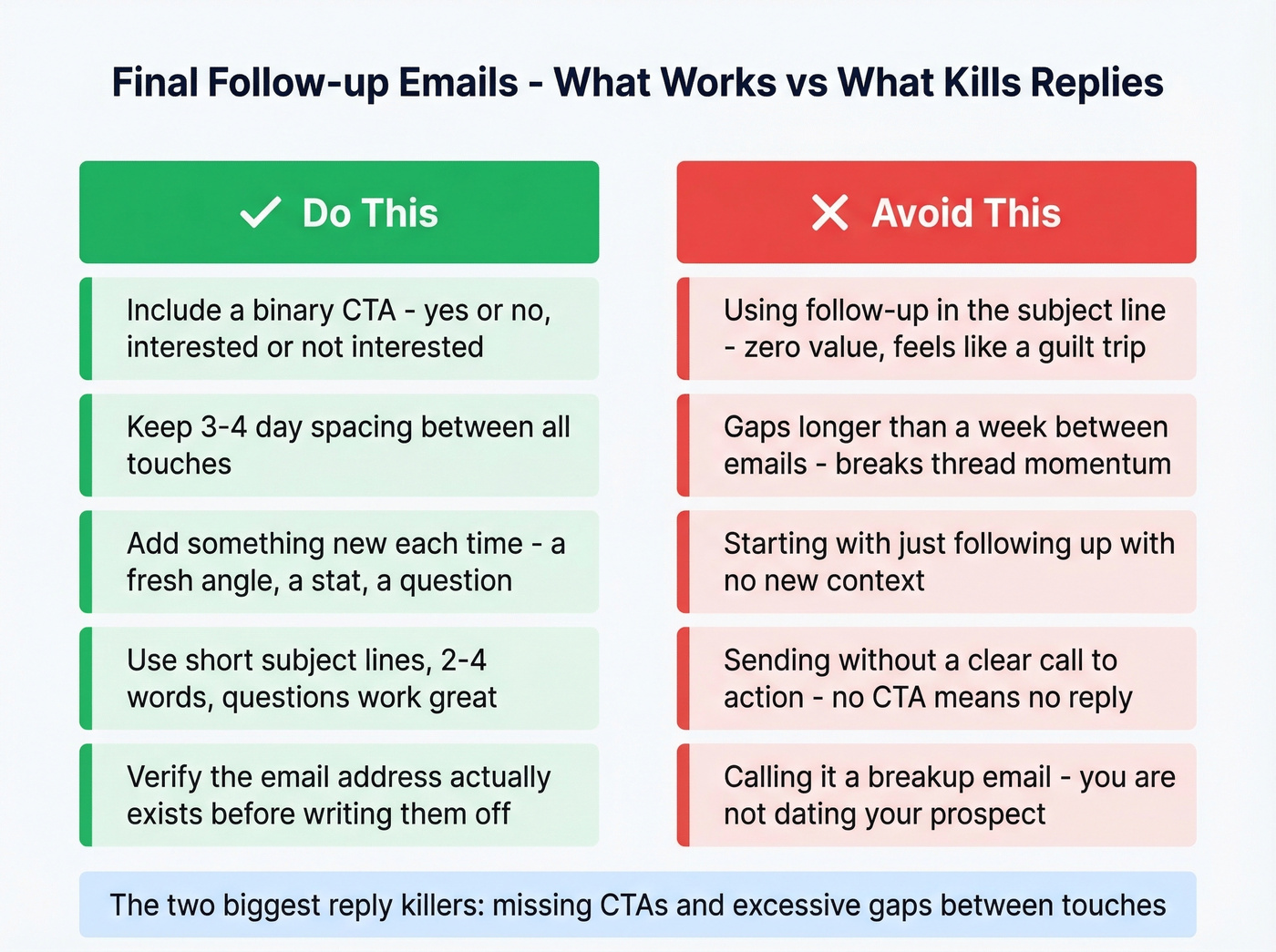
Don't start with "just following up" without new context. Every touch should add something new - a fresh angle, a relevant stat, a direct question. A naked bump is lazy and prospects can tell. If you need alternatives, use these ways to say just checking in professionally.
We've tested dozens of final email variations, and the two biggest killers are missing CTAs and excessive gaps between touches. Always include a binary ask - yes/no, interested/not interested - so replying takes five seconds. Keep 3-4 day spacing. Gaps longer than a week break the thread's momentum and force the prospect to re-read everything, which they won't do. (More on this in our guide to email call to action.)
After You Hit Send
Clean your pipeline first. If you don't hear back within a week, mark the contact as lost or move them to a nurture track. Sales reps already spend only 30% of their time actually selling - don't waste it managing stale deals that distort your forecast. If you want to operationalize this, track pipeline health consistently.
Set a 90-day re-engagement reminder. A prospect who ghosted you in Q1 might have budget in Q3, and a simple check-in keeps the door open without being annoying.
Third - and this is the one most people miss - check whether the email actually arrived. Before you write off a prospect, verify the email address is valid. We've run audits on "dead" pipelines and found that roughly 15-20% of "no reply" prospects never got the email in the first place. Prospeo catches invalid addresses with 98% accuracy using real-time verification, and the free tier gives you 75 verifications per month. That's enough to audit your stale pipeline and know that silence means "not interested," not "never received." If you're diagnosing deliverability, start with email bounce rate and work backward.
Let's be honest: most "dead" pipeline isn't dead. It's poorly verified.

You just spent 30 days nurturing a prospect through five follow-ups. Don't let that effort die on a bounced email or outdated contact. Prospeo refreshes 300M+ profiles every 7 days - not every 6 weeks like other providers - so your final follow-up reaches the right person at the right address.
Clean your list before you send that last email. 75 free verifications to start.
FAQ
How many follow-ups should I send before the final one?
Four to five follow-ups over 2-3 weeks is the standard cadence. 80% of sales require 5-12 total touches to close. If you've sent fewer than four emails, it's too early for a final message - you're leaving responses on the table.
What if they open my emails but never reply?
Opens without replies usually signal interest without urgency. Include a binary CTA - "yes or no" - to force a decision. One caveat: Apple Mail Privacy Protection inflates open rates significantly, so don't over-index on opens alone. Reply rate is the metric that matters.
How do I know my emails are actually reaching the prospect?
Use an email verification tool before launching your sequence. If your bounce rate exceeds 4%, your data quality is the bottleneck, not your messaging. Fix the inputs before you rewrite the copy.