

How to Send a Gentle Follow-Up Email That Actually Gets a Reply
You wrote a thoughtful email. You waited. Nothing came back. Now you're staring at your inbox wondering if following up makes you annoying.
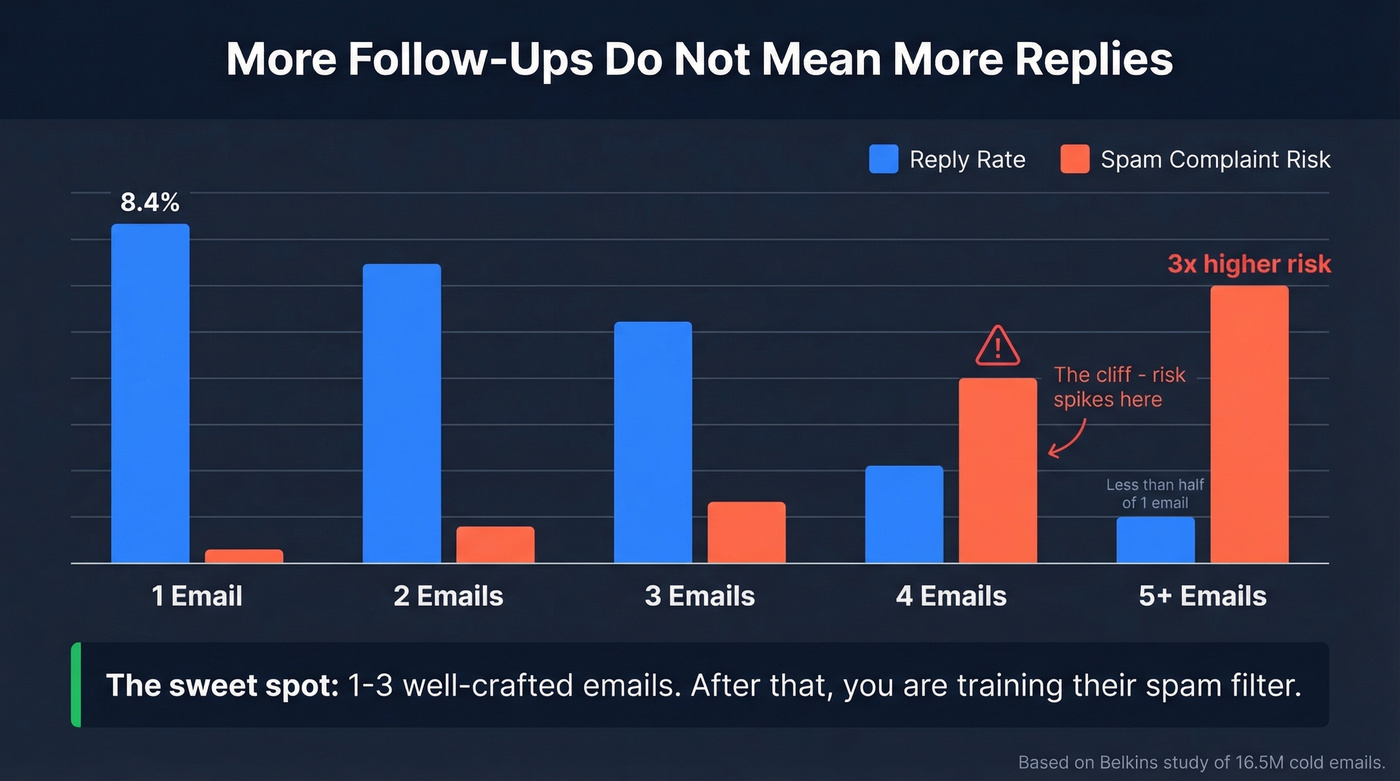
It doesn't. Knowing how to send a gentle follow-up email is statistically smart, not pushy. A Belkins study of 16.5 million cold emails found the highest reply rate - 8.4% - comes from a single well-crafted message, not a barrage of "just checking in" nudges. As one poster on r/socialskills put it: "I don't want them to feel guilty or pressured." You won't. Here's how to follow up without crossing that line.
The One Rule for Every Follow-Up
The biggest mistake people make? Bumping with no new information. "Just checking in" and "wanted to make sure you saw this" add zero value. They're easy to ignore because there's nothing new to respond to.
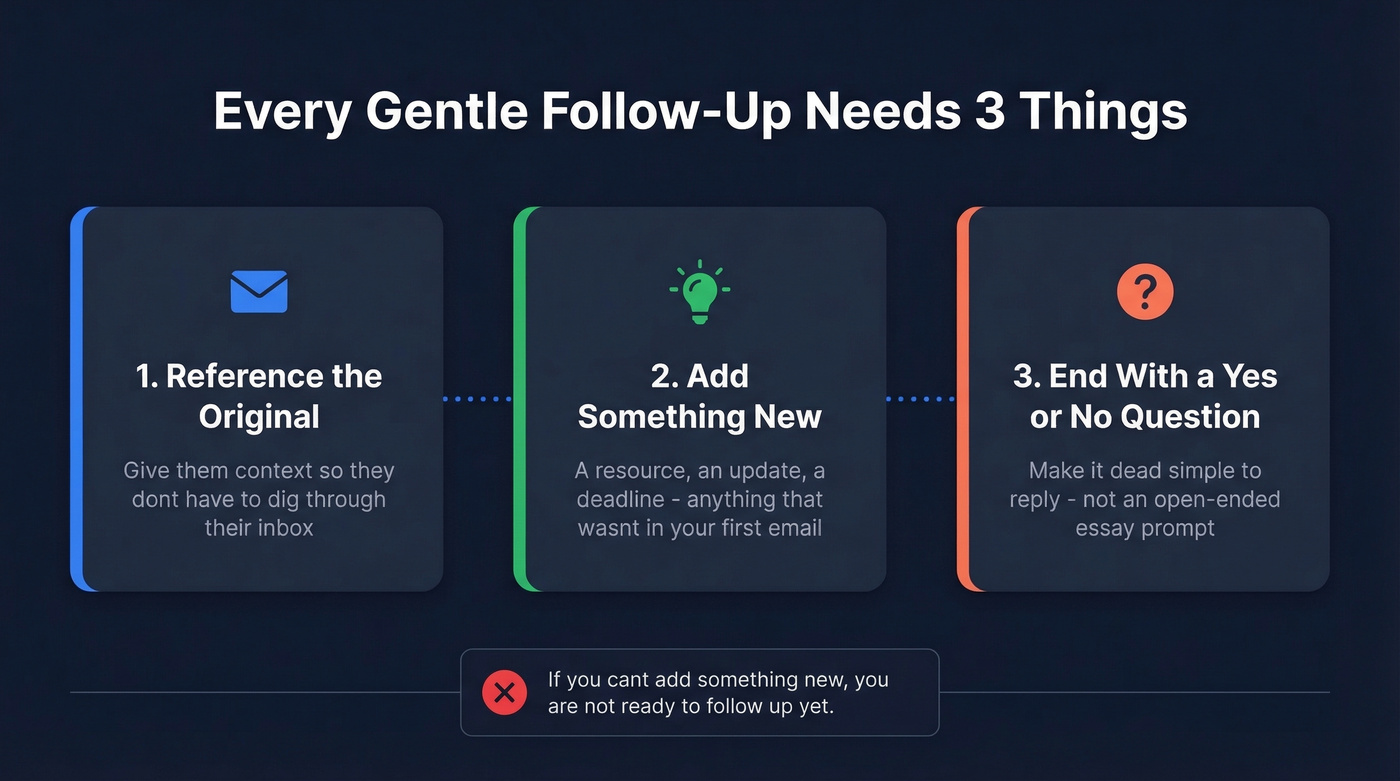
A follow-up works because it moves your request back to the top of someone's mental to-do list. But it only works if you give them a reason to act. Every polite follow-up needs three things:
- Reference the original email so they have context
- Add one new piece of information - a resource, an update, a deadline
- End with a yes/no question instead of an open-ended ask
If you can't think of something new to add, you're not ready to follow up yet. And always send your follow-up as a reply in the original thread. It looks like a real conversation, not a mass blast.
If you’re unsure about cadence, when to follow up on an email is a helpful baseline.
When to Send Your Follow-Up
Too early feels aggressive. Too late and your email is buried under dozens of newer messages.
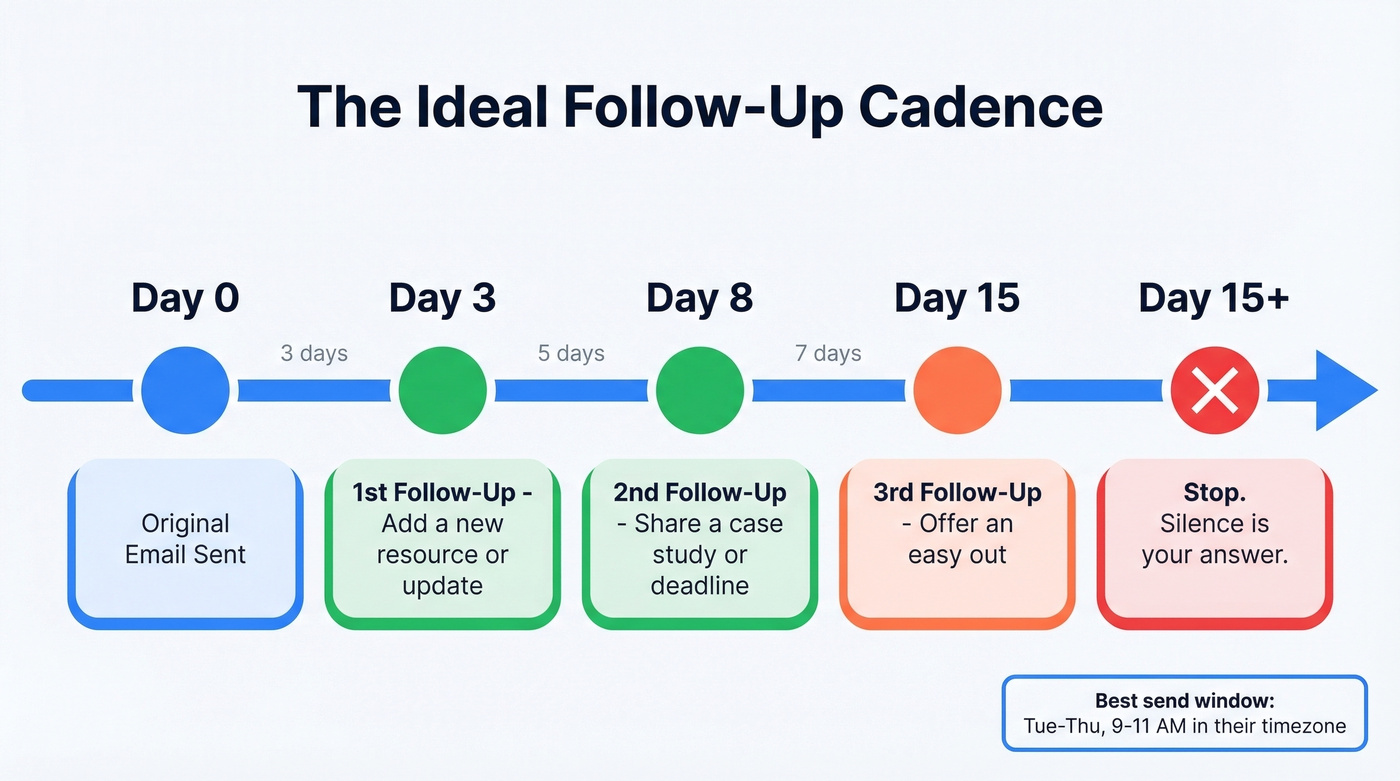
| Situation | Wait time | Best window |
|---|---|---|
| General request | 3-5 business days | Tue-Thu, 9-11 AM |
| Post-interview | 24-48 hours | Next business morning |
| Job application | 1-2 weeks | Mid-week |
| Proposal/quote | 1-2 weeks | Tue-Thu, 9-11 AM |
Tuesday through Thursday, 9-11 AM is a solid default window - always send in the recipient's timezone. If you're planning multiple follow-ups, space them progressively: 3 days after the first, 5 days after the second, 7 days after the third. Don't wait longer than 10 days for any single gap; by then your original message is ancient history.
If you’re building a repeatable outreach system, sequence management helps you keep timing consistent without spamming.
6 Friendly Follow-Up Email Templates
No-Response General Request
Subject: Quick question about [topic]
Hi [Name], I sent a note last [day] about [specific topic]. I've since found [new resource/update] that might be relevant. Would it help if I sent that over, or is this not a priority right now?
This works because it gives them an easy out ("not a priority right now") while offering something new. People respond to low-pressure questions.
For more options, see these sales follow-up templates and cold email follow-up templates.
Post-Meeting Recap
Subject: Next steps from [day]'s call
Hi [Name], thanks again for [specific thing discussed]. I pulled together [deliverable/resource] based on what you mentioned about [their challenge]. I'm finalizing my calendar for next week - does Thursday or Friday work to pick this back up?
If your goal is to book time, use proven email wording to schedule a meeting.
Job Application Follow-Up
Subject: Following up - [Role Title] application
Hi [Name], I applied for the [Role] position on [date] and wanted to reiterate my interest. I noticed your team recently [specific company news], which aligns with my experience in [relevant skill]. Is there anything else I can provide to support my application?
Referencing specific company news proves you're paying attention, not blasting every recruiter on the planet.
Proposal or Quote Follow-Up
Subject: Any questions on the [project] proposal?
Hi [Name], I wanted to check if you had a chance to review the proposal I sent on [date]. I've added a [case study/updated timeline/revised pricing] that addresses [specific concern from earlier conversation]. Would a 15-minute call this week help move things forward - yes or no?
Overdue Payment Reminder
Subject: Invoice #[number] - quick reminder
Hi [Name], friendly note that invoice #[number] from [date] is now [X days] past due. I've reattached it for convenience. Could you confirm it's in the queue, or let me know if there's an issue I can help resolve?
Internal Colleague Nudge
Hey [Name], I'm finalizing [project/report] for [deadline] and still need your section on [specific item]. I've drafted a placeholder based on our last conversation - want me to send it for you to edit, or would you prefer to start fresh? Either way works.

A perfect follow-up means nothing if it hits an invalid inbox. Prospeo verifies every email through a 5-step process - 98% accuracy, catch-all handling, spam-trap removal. Stop wondering if your message bounced. Know it landed.
Send follow-ups that arrive. Verify emails at $0.01 each.
Subject Lines That Get Opened
47% of recipients decide whether to open based on the subject line alone, and 69% mark emails as spam based on nothing else. We've tested dozens of approaches across our own outreach, and the data backs up what feels intuitive:
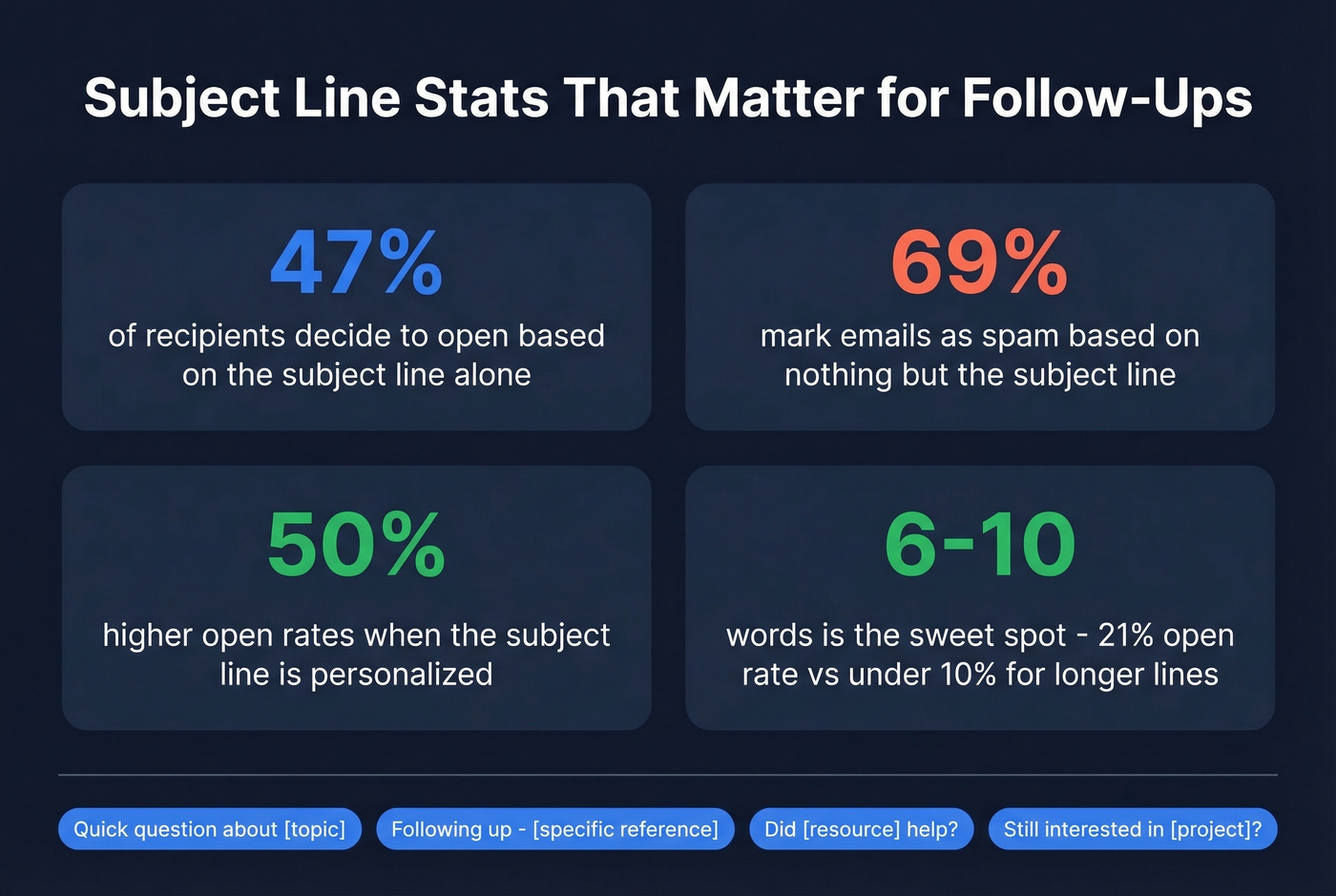
6-10 words hit a 21% open rate - longer subject lines perform at less than half that. Personalized subject lines get 50% higher open rates. Questions boost opens by 21%, and numbers can increase them up to 113%. Keep it under 45 characters so the full line displays on mobile.
Gentle subject lines that work: "Quick question about [topic]," "Following up - [specific reference]," "Did [resource] help?," "Still interested in [project]?"
If you want more swipeable ideas, browse these email subject line examples and subject lines that get opened.
Phrases That Backfire
| Don't say | Why it fails | Say instead |
|---|---|---|
| "Just following up" | Adds zero value | "I have an update on..." |
| "Kindly" | Reads as condescending | Drop it entirely |
| "Per my last email" | Passive-aggressive | "As we discussed" |
| "Bumping this" | Lazy, no new info | Add a new reason to reply |
| "Circling back" | Corporate filler | "Checking in with [update]" |
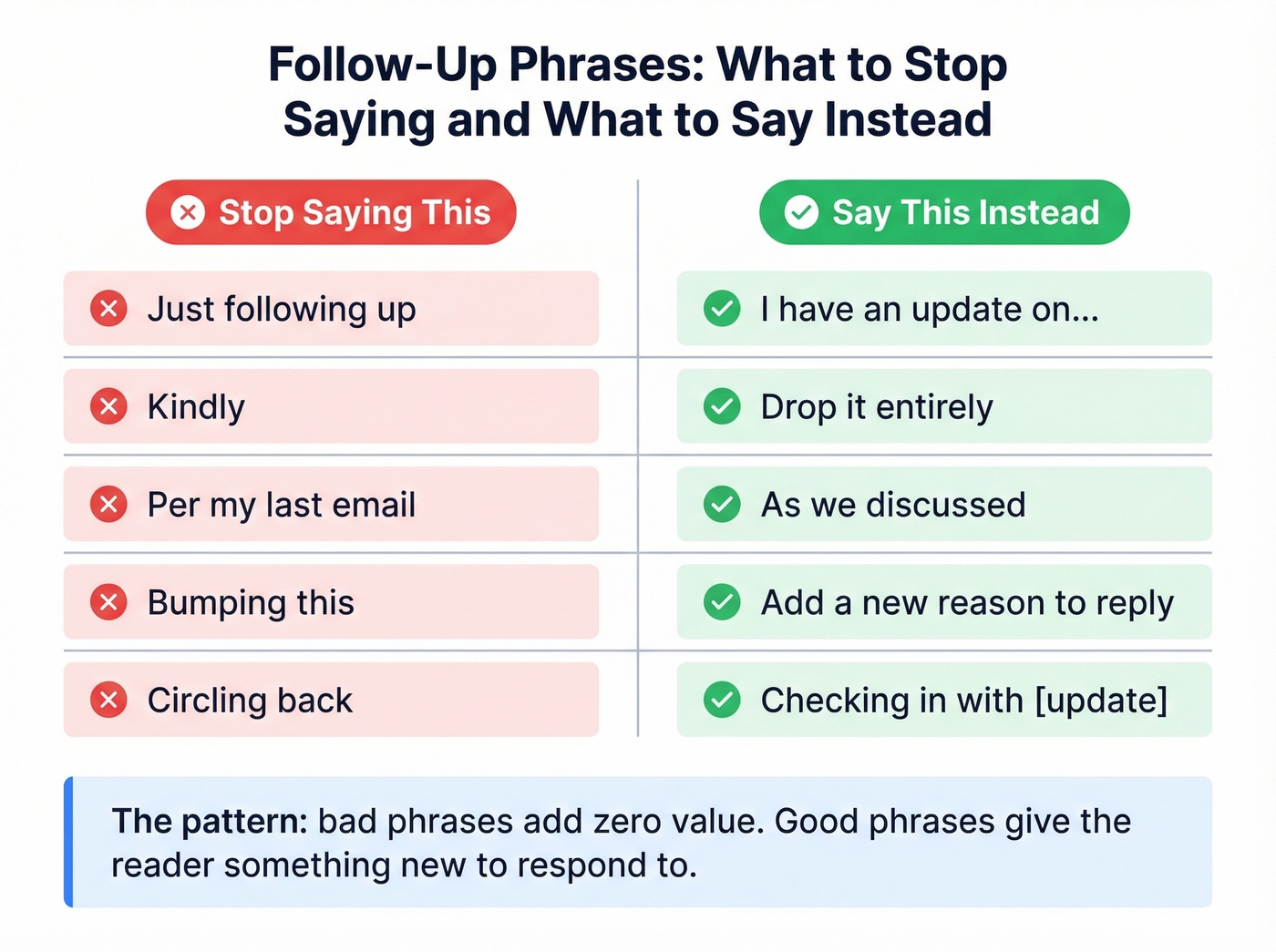
That r/etiquette thread is a good example of a common reaction: "kindly" is the word people think sounds polite but triggers the opposite vibe, especially in cross-cultural communication. And "just checking in" is easy to ignore because it doesn't give the reader anything new to respond to. When you're gently following up, the goal is to sound human and helpful - not robotic and formulaic.
If you catch yourself writing “just checking in,” here are better ways: how to say just checking in professionally.
When to Stop
Here's the thing: persistence has a cliff. Belkins' data shows that once you hit 4+ emails in a sequence, risk spikes - the 4th follow-up more than triples spam-complaint risk, and going from 1 email to 5+ cuts reply rate by more than half. After 2-3 attempts with no response, stop. You're not persistent at that point. You're training their spam filter.
Don't follow up if you've already received a clear answer (even if it wasn't the one you wanted), the promised timeframe hasn't passed yet, or you've sent multiple messages to total silence. Silence after three touches is its own answer.
If email isn't working at all, a brief message on another channel can sometimes break through where email can't.
Let's be honest about something most follow-up guides skip: the quality of your message matters far more than the quantity. One thoughtful email with a new reason to reply beats three hollow "just bumping this" nudges every single time.
Make Sure It Actually Arrives
There's a problem most people miss entirely. Your original email may have bounced and you don't know it. You're crafting the perfect gentle follow-up to an address that doesn't exist anymore. I've seen people agonize over wording for an email that was never going to land.
Google enforces a 0.3% spam complaint threshold - sending to bad addresses accelerates that. Before you follow up, verify the email address is still valid. Prospeo checks professional emails in real time with 98% accuracy, and the free tier covers 75 verifications per month with no credit card required. It takes seconds and eliminates the most frustrating scenario: a perfectly written follow-up that never arrives.
If you want the deeper mechanics, start with an email deliverability guide and these email reputation tools.

When three emails get no reply, the problem might not be your copy - it might be the address. Prospeo refreshes 300M+ contacts every 7 days, so you're never following up to a dead inbox. Find verified emails and direct dials in one click.
Get the right contact data before you write another follow-up.
FAQ
How do I write a gentle follow-up email?
Reference your original message so the recipient has context, add one new piece of value - an update, a resource, or a relevant deadline - and close with a simple yes/no question. This three-part structure keeps the tone warm and makes responding easy without creating pressure.
How long should I wait before following up?
Three to five business days for most situations. After a job interview, send within 24-48 hours while the conversation is fresh. After submitting a proposal or job application, wait 1-2 weeks - recruiting and procurement cycles need that runway.
How many follow-ups is too many?
Two to three maximum. A study of 16.5 million emails found that the 5th email in a sequence more than triples spam-complaint risk while cutting reply rates by over half. If three well-crafted attempts get silence, take the hint and move on.
How do I know my follow-up email actually reached them?
You don't - unless you verify the address first. An email verification tool confirms whether an address is valid before you hit send. If the address is invalid or outdated, no follow-up template in the world will help.