

How to Write a Referral Email That Actually Gets a Response
One of the best referral request emails we've ever seen was four sentences long. It named a shared connection, specified the exact role, made a direct ask, and attached a resume with the job link. No preamble, no forced coffee chat, no "I'd love to pick your brain." The recipient called it the best referral request she'd ever received because it was fast to forward and required zero follow-up work.
That's the whole secret of how to write a referral email: be precise, make it easy to say yes, and include everything the recipient needs. 80% of buyers prefer email contact, so getting this right matters whether you're referring a colleague for a job, asking a stranger for a referral, or emailing customers about a referral program. We've reviewed referral emails across job, customer, and B2B contexts, and the formula never changes.
The Three Rules Every Referral Email Follows
- Precise ask. Name the role, the company, or the program. "I was wondering if you might know anyone" is a dead end.
- Context. Why you, why them, why now. One sentence is enough.
- Everything they need to act. Resume, job link, referral code, CTA button - remove every possible follow-up question.
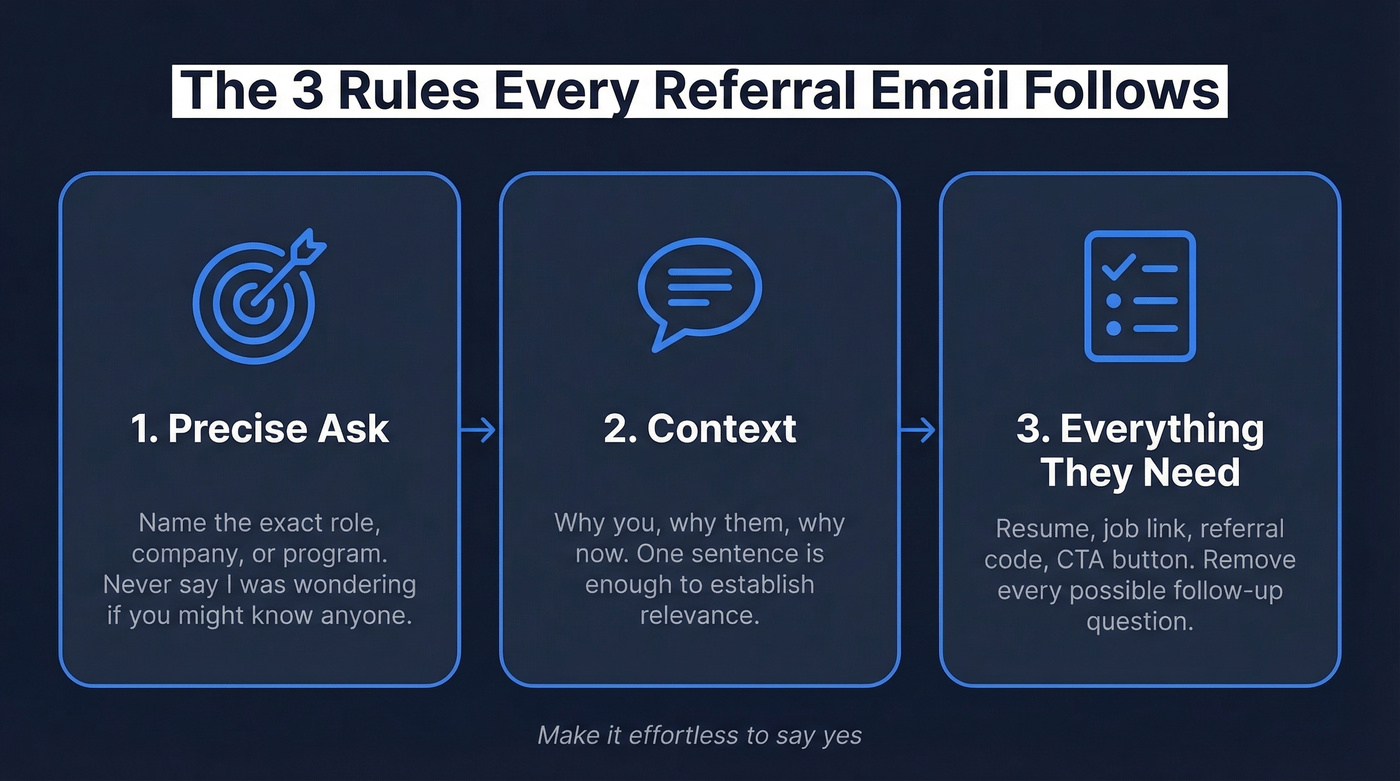
There are two broad categories: job referral emails and customer referral emails. This guide covers both with templates you can copy today.
Job vs. Customer Referrals
Job referral emails are personal. You're either vouching for someone's skills to a hiring manager or asking someone to put their reputation on the line for you. The stakes are real - developers regularly point out that referring a stranger risks their own credibility if the person doesn't perform.
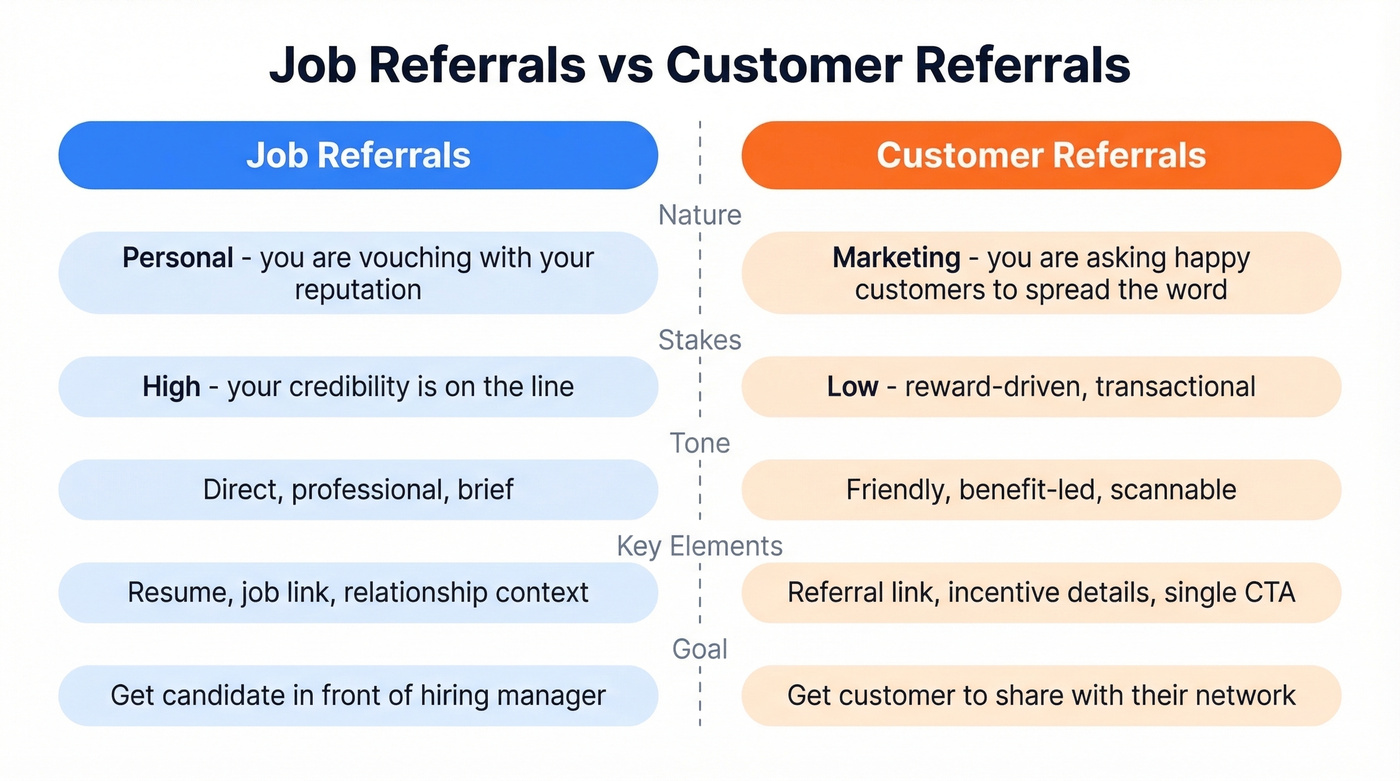
Customer referral emails are marketing. You're asking happy customers to spread the word, usually in exchange for a reward. The mechanics differ - referral links, incentive structures, automated triggers - but the core principle is identical: make it effortless to say yes.
Writing a Job Referral Email
Referring Someone You Know
When you're referring someone you personally know, your email needs five elements: a clear ask, context about your relationship with the candidate, why they're qualified, an attached resume, and the exact role with a link. Mention why the timing matters - the role just opened, they just finished a relevant project, the team is scaling. Skip any of these and you're creating work for the recipient.
Subject: Referral for [Role] - [Candidate Name]
Hi [Hiring Manager / HR Contact],
I'd like to refer [Candidate Name] for the [Role] position ([link to job posting]). We worked together at [Company] for [X years], where they [one concrete accomplishment relevant to the role].
I've attached their resume. Happy to share more context if helpful.
Best, [Your Name]
Under 80 words. The hiring manager can forward it to the team in seconds.
Asking for a Referral
Here's the thing: the instinct is to build rapport first - "Let's grab coffee!" - but the best cold referral requests respect the recipient's time by being direct. Knowing how to ask for a referral comes down to specificity and ease.
For a friend or former colleague:
Subject: Quick ask - referral for [Role] at [Company]?
Hey [Name],
I saw [Company] is hiring for [Role] and it's a strong fit for my background in [named skill]. Would you be open to passing my resume to the hiring team?
I've attached my resume and the job link is here: [URL]. Totally understand if it's not a good time - appreciate you either way.
Thanks, [Your Name]
For a stranger or loose connection, you need to establish context fast:
Subject: [Shared Connection/Context] - referral for [Role]?
Hi [Name],
We both [attended X bootcamp / are in Y community / worked at Z company]. I'm reaching out because [Company] is hiring for [Role], and I'd love a referral if you're comfortable with it.
I've attached my resume and here's the job link: [URL]. Happy to answer any questions about my background first.
Best, [Your Name]
Etiquette when requesting referrals: Name the exact role - not "any openings." Always attach your resume and the job link; making the recipient search for these is a dealbreaker. If time allows, engage with their content first - comment on a post or react to an article. It turns a cold ask into a warm one. And don't force a coffee chat as a prerequisite. If someone wants to chat first, they'll suggest it.
Internal Referral to HR
If your company has a formal referral program, the email to HR is even simpler:
Subject: Employee Referral - [Candidate Name] for [Role]
Hi [HR Contact],
I'd like to submit a referral for [Candidate Name] for the [Role] position (Req #[number]). We [relationship context - e.g., "worked together at my previous company for three years"].
Their resume is attached. Let me know if you need anything else.
Thanks, [Your Name]
HR processes dozens of these. Brevity is a courtesy.
Customer Referral Email Templates
The A.I.R. Framework
Customer referral emails follow a different playbook. We use the A.I.R. framework to break it into three layers:
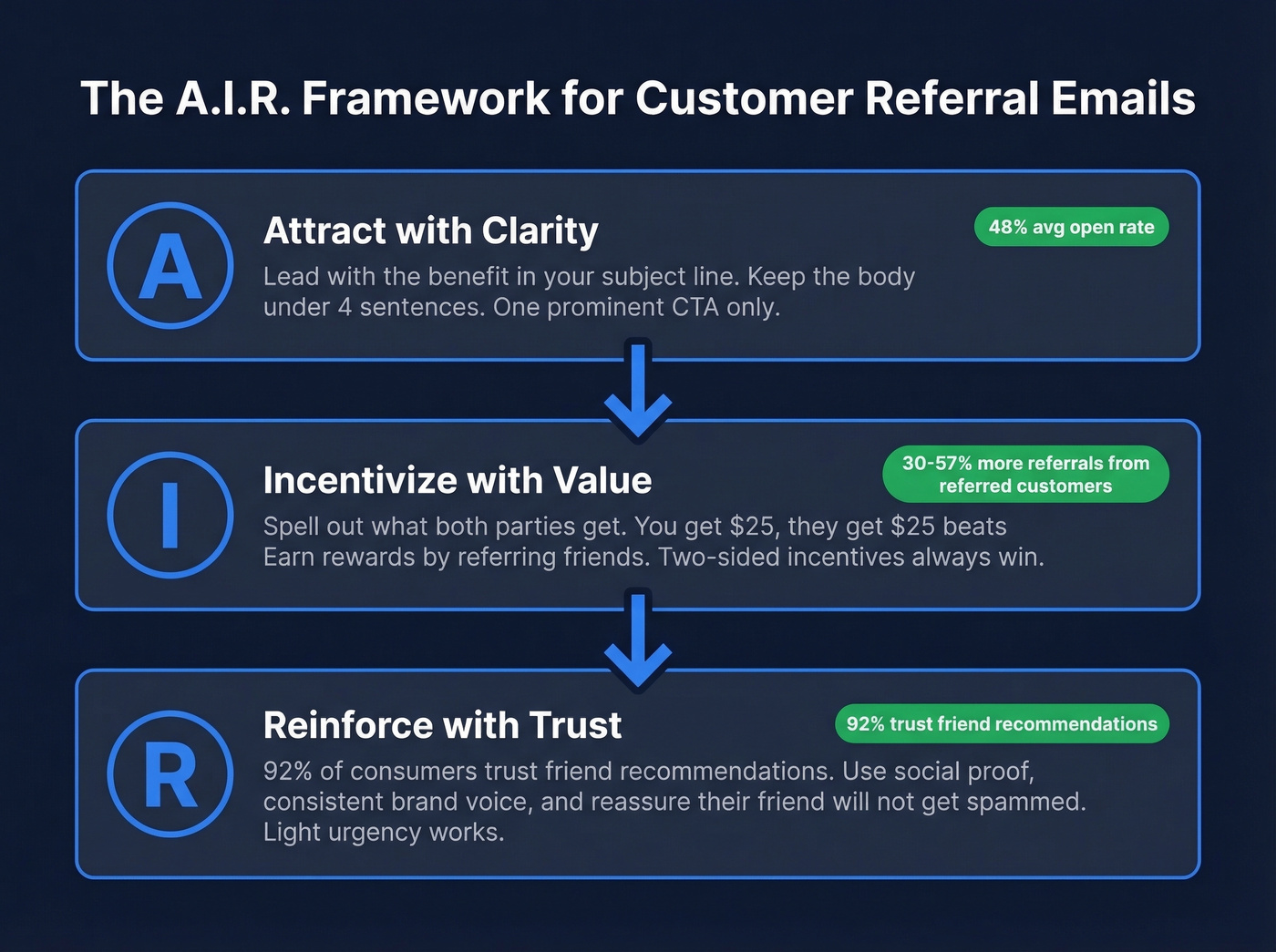
Attract with clarity. Your subject line should lead with the benefit, not the ask. The headline should be scannable. The body stays under four sentences. One prominent CTA. Referral emails average a 48% open rate, so a clear subject line is doing real work here. If you want more options, borrow from these subject line patterns.
Incentivize with value. Spell out what both parties get. "You get $25, they get $25" is more compelling than "Earn rewards by referring friends." Two-sided incentives consistently outperform one-sided ones, and referred customers generate 30-57% more referrals than non-referred ones, creating a compounding loop.
Reinforce with trust. Use consistent brand voice, add a line of social proof, and reassure the recipient that their friend won't get spammed. 92% of consumers trust recommendations from friends and family over other forms of advertising - your job is to make it easy for that trust to flow through. Light urgency works - "limited time" or "first 100 referrals" - but don't overdo it.
Post-Purchase Referral Template
Subject: Loving [Product]? Share the love - you both get $20
Hey [First Name],
Thanks for your recent order! If you know someone who'd love [Product], share your unique link below. They'll get $20 off their first purchase, and you'll get $20 in store credit.
[Share My Link]
That's it - one click, and you're both rewarded.
Single CTA. Clear give/get.
VIP Customer Referral Template
Subject: Exclusive for you - double referral rewards this week
Hi [First Name],
You've been with us since [month/year], and we wanted to say thanks with something special. This week only, your referral reward is doubled: you get $50 in credit for every friend who signs up, and they get $30 off.
[Refer a Friend Now]
This offer is limited to our top customers and expires [date].
The exclusivity framing matters. When customers feel the offer isn't available to everyone, they're more motivated to share it.

A great referral email needs the right recipient. Prospeo gives you 98% accurate emails for hiring managers, decision-makers, and warm connections - so your referral lands in the inbox that matters.
Stop guessing email addresses. Verify them before you hit send.
B2B Sales Referral Emails
B2B referrals work differently than job or consumer referrals. You're typically asking a happy client to introduce you to someone in their network, or using a networking contact for a warm intro. These templates also work for partner and vendor referrals. The key principle: mention the referrer's name near the top of the email. Personalized subject lines get 10-15% more responses.
Look - if you're closing deals under $10k, you usually don't need a complex referral sequence. Start with one well-written request to a happy customer, then follow up once or twice if needed. Save the heavier cadences for enterprise deals where the intro carries real weight. If you're building a repeatable outbound motion, these sales prospecting techniques help.
For a satisfied client:
Subject: Quick favor - know anyone dealing with [problem you solve]?
Hi [Client Name],
Glad to hear [concrete positive result - e.g., "the new pipeline numbers are tracking ahead"]. I'm looking to work with more companies like yours. Do you know anyone in your network who's dealing with [named pain point]?
Happy to make it easy - just forward this email or connect us, and I'll take it from there.
For a networking contact making an introduction:
Subject: [Referrer Name] suggested I reach out
Hi [Name],
[Referrer Name] mentioned you're [concrete context - e.g., "scaling your outbound team"]. We helped [Referrer's Company] [named result], and they thought we might be able to help you too.
Would a 15-minute call next week make sense?
Before sending that intro email, make sure you have the right address. Prospeo's Chrome extension finds and verifies emails from any website in one click, so you're not guessing at addresses. If you need more options, compare free lead generation tools and email search tools.
Subject Lines That Work
55% of emails are read on mobile, so your subject line needs to be scannable on a small screen. Keep it under 50 characters when possible.
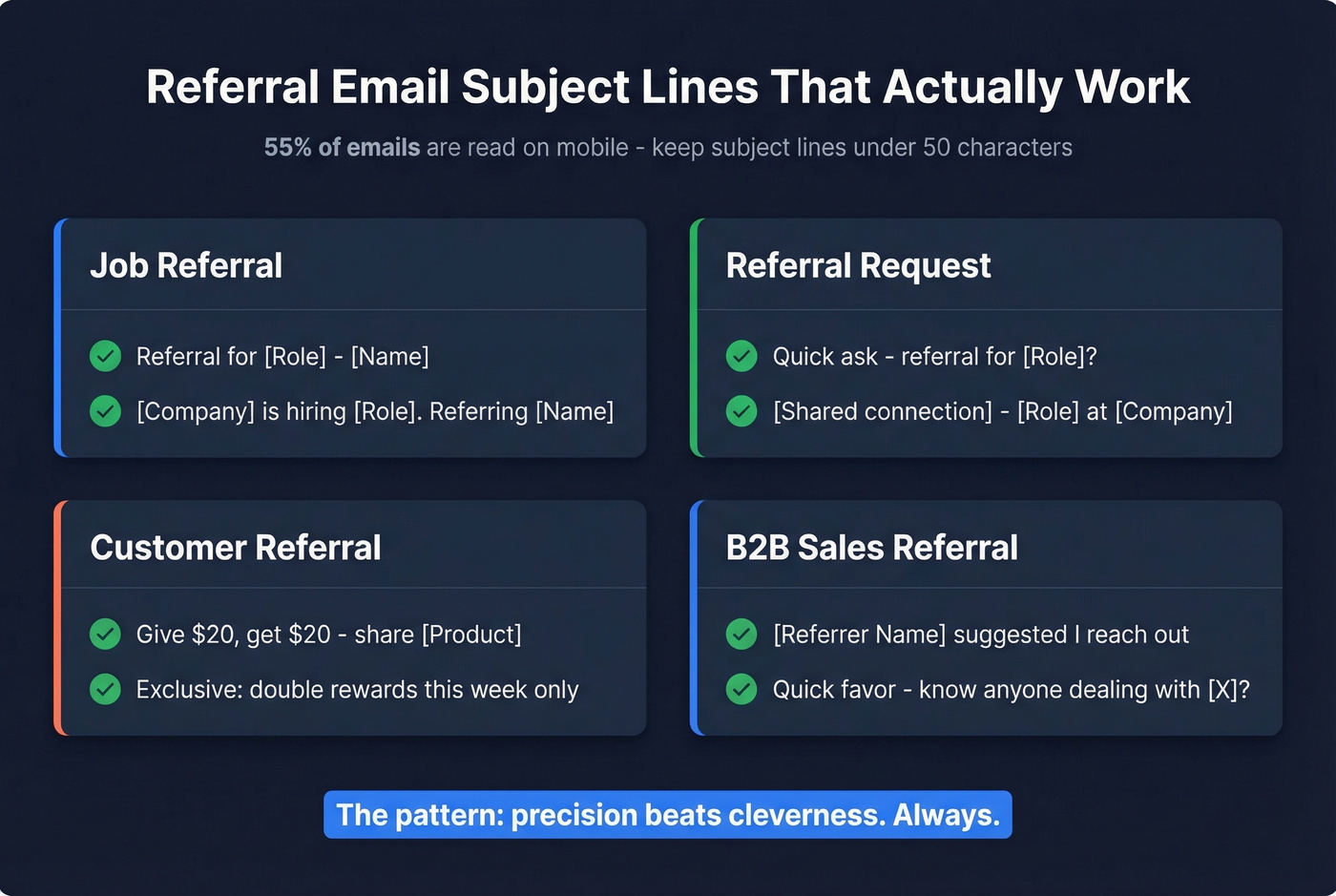
| Type | Subject Line Examples |
|---|---|
| Job referral | "Referral for [Role] - [Name]" |
| Job referral | "[Company] is hiring [Role]. Referring [Name]" |
| Referral request | "Quick ask - referral for [Role]?" |
| Referral request | "[Shared connection] - [Role] at [Company]" |
| Customer referral | "Give $20, get $20 - share [Product]" |
| Customer referral | "Exclusive: double rewards this week only" |
| B2B sales referral | "[Referrer Name] suggested I reach out" |
| B2B sales referral | "Quick favor - know anyone dealing with [X]?" |
The pattern across all of these: precision beats cleverness. "[Referrer Name] suggested I reach out" will always outperform "A quick question for you." For more tested variations, see these cold email subject line examples.
Follow-Up When You Don't Hear Back
Most referral emails die in silence - not because the recipient said no, but because they got busy. 4-7 step sequences generate 3x the reply rate of 1-3 step sequences. You don't need seven follow-ups for a referral ask, but you absolutely need more than one. If you want plug-and-play options, use these sales follow-up templates.
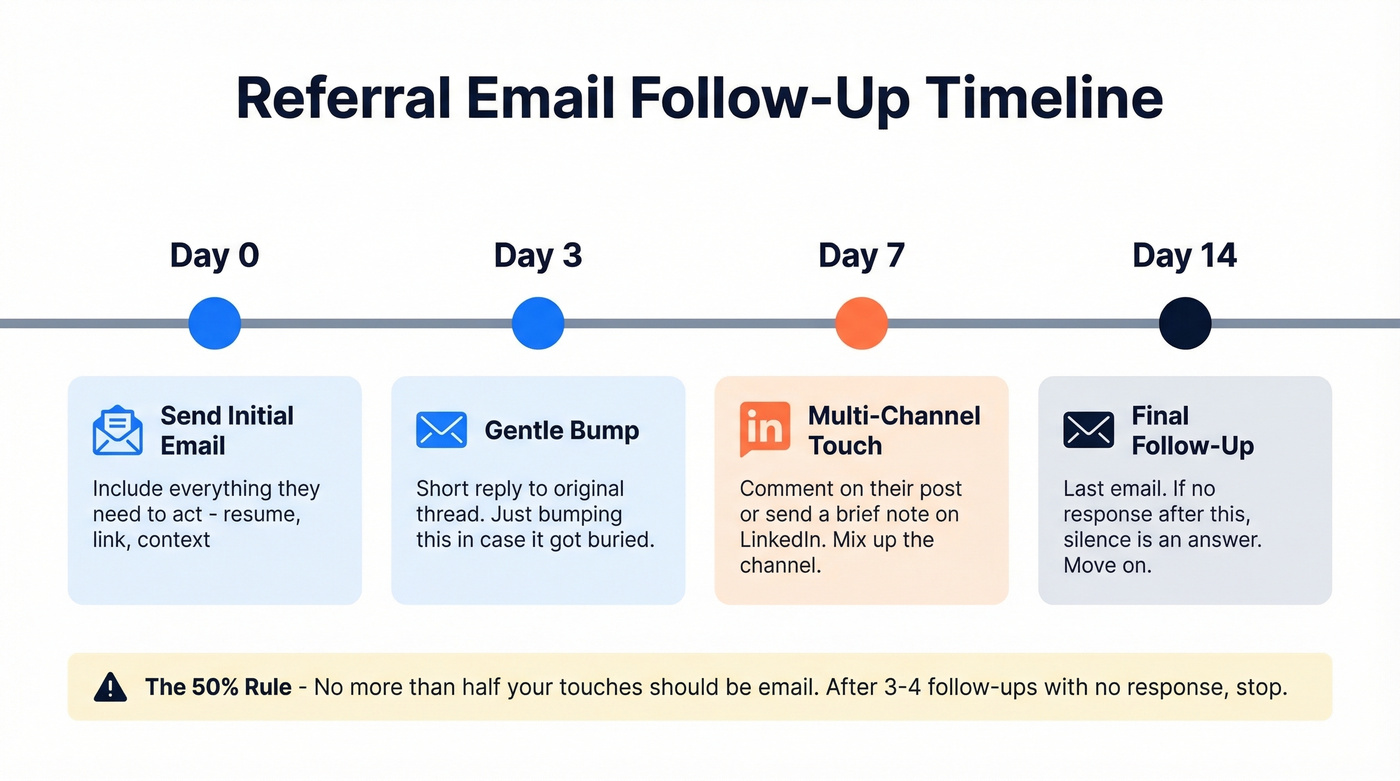
| Day | Action | Channel |
|---|---|---|
| Day 0 | Send initial referral email | |
| Day 3 | Gentle bump | |
| Day 7 | Engage with their content or send a brief note | Social / email |
| Day 14 | Final follow-up |
The 50% rule applies: no more than half your touches should be email. Mix in a comment on their post or a brief message on another channel. After 3-4 follow-ups with no response, stop. Silence is an answer.
Day 3 follow-up template:
Subject: Re: [Original subject line]
Hi [Name],
Just bumping this in case it got buried. Totally understand if the timing isn't right - let me know either way and I'll take it from here.
[Your Name]
In our experience, the best results come when follow-ups land Tuesday through Thursday, 9-11 AM in the recipient's timezone. Keep each one shorter than the last. (More on timing: best time to send cold emails.)
Mistakes That Kill Responses
Being too vague. "Do you know anyone who might be hiring?" gives the recipient nothing to work with. Name the company, the role, and why you're a fit.
Writing too long. Job referral emails should be under 150 words. Writing at a simpler reading level can yield a 36% better response rate. Draft on your phone - if it feels long on a small screen, it is.
Not including the resume or job link. This is the single most frustrating mistake we see. It creates extra work and gets referral requests ignored. Attach everything.
Burying the ask. Your request should be in the first three sentences, not the last paragraph. People skim.
Using a generic subject line. "Quick question" or "Reaching out" tells the recipient nothing. Use the role name, the referrer's name, or the incentive.
Not following up. One email isn't a strategy. If you're stuck on wording, these cold email follow-up templates help.
Sending to an unverified email address. None of this matters if your email bounces. For B2B sales referrals especially, a bounced email doesn't just waste your time - it damages your sender reputation. Verify addresses before you send. If deliverability is a priority, start with this email deliverability guide and learn how to improve sender reputation.
Whether you're asking for a job referral or running a customer referral program, the hardest part is finding the right person to email. Prospeo's 300M+ profiles with 30+ filters let you pinpoint exactly who to reach - by company, role, department, even tech stack.
Every referral email starts with knowing who to send it to.
FAQ
How long should a referral email be?
Job referral emails should stay under 150 words - shorter is almost always better. Customer referral program emails can be slightly longer, but keep the body to 3-4 short sentences max. Emails written at a simpler reading level get 36% more responses, so cut the jargon and write like you're texting a colleague.
Should I offer an incentive in a referral email?
For customer referral emails, yes - two-sided incentives where both the referrer and their friend benefit consistently outperform one-sided rewards. For job referrals, the incentive is usually the company's referral bonus, not something you offer personally. Don't try to pay someone to refer you for a job. It's awkward and unnecessary.
When's the best time to send a referral email?
Tuesday through Thursday, 9-11 AM in the recipient's timezone. For customer referral emails, the best trigger is right after a positive experience - post-purchase, after a support resolution, or following a high NPS score. Timing the ask to a moment of satisfaction dramatically increases conversion.
How do I ask a stranger for a referral without being awkward?
Be direct, name a shared connection or context, specify the exact role, and attach everything they need - resume plus job link. Don't force a coffee chat. The best etiquette is to respect the recipient's time by making it possible to act in under 60 seconds. If you can, engage with their content a day or two before reaching out. It turns a cold ask into a warm one.
What free tools help verify emails before sending?
Prospeo offers a free tier with 75 email verifications per month at 98% accuracy - enough for most individual referral outreach. Hunter provides 25 free searches monthly but caps enrichment. For B2B referral campaigns at scale, a Chrome extension that finds and verifies addresses from any website in one click saves hours of manual work.