

HubSpot vs SalesLoft: The Comparison HubSpot Won't Write
Your VP of Sales wants "one platform" by next quarter. You open HubSpot's comparison page, then you realize it doesn't actually tell you what Salesloft costs in the real world. That's the whole problem with HubSpot vs Salesloft: one side posts list pricing, the other makes you sit through a discovery call before you even know what you're comparing.
Let's break it down like a RevOps team would: what each tool is built for, what you'll pay in 2026, what users complain about, and the one thing neither product fixes (but both will happily let you fail at).
30-second verdict
| Scenario | Pick |
|---|---|
| Already on HubSpot CRM, under ~25 reps | HubSpot Sales Hub |
| Salesforce-first, dedicated SDR team | Salesloft |
| Comparing Salesforce engagement layers | Also look at Outreach |
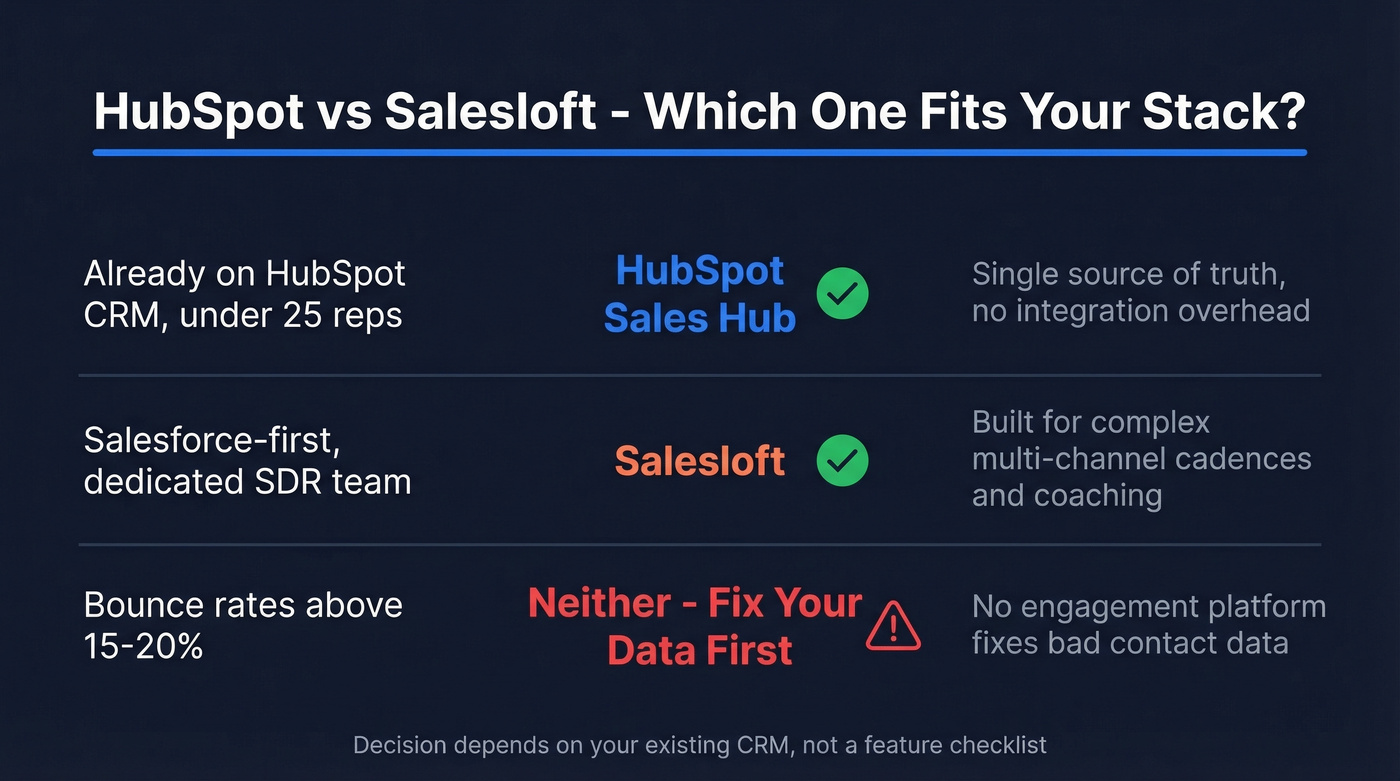
Pick HubSpot if you want CRM + sales engagement in one place and you're already living in HubSpot. Pick Salesloft if you're on Salesforce and your SDR motion depends on complex, multi-channel cadences plus coaching.
Skip both if your real issue is 15-20% bounce rates. No engagement platform fixes bad contact data - start with email bounce rate fundamentals.
Core differences that actually matter
HubSpot is CRM-first. Sequences, calling, deal management, reporting, and automation all sit inside the same system of record, which makes adoption easier and admin work lighter. Since acquiring Clearbit, HubSpot's direction has been pretty clear: pull more data and prospecting workflows into the CRM so teams don't need a separate "engagement layer" to get basic outbound done.
Salesloft is an engagement layer designed to sit on top of Salesforce, not replace it. The Salesforce integration isn't a nice-to-have; it's the product. When Salesloft works well, reps live in Salesloft for daily execution while Salesforce stays clean for pipeline, forecasting, and governance. When it doesn't, you get duplicate fields, weird activity logging, and the classic "why is this contact in one system but not the other?" argument between Sales Ops and RevOps.
Here's the thing: this comparison is getting less dramatic every year. HubSpot keeps adding engagement depth. Salesloft keeps adding intelligence and workflow features that feel closer to CRM territory. So the decision usually comes down to your existing stack and your tolerance for integration overhead, not a checklist of features.
If you're also evaluating Outreach, treat it as "Salesloft-class" for Salesforce-first orgs. Pricing is typically negotiated and often lands in the ~$100-150/user/month range depending on seats, term length, and what you bundle, and the feature overlap is big enough that procurement and vendor relationships end up deciding more than product screenshots. (If you want a rollout plan, see implementing a sales engagement platform.)
Pricing breakdown for 2026 (what teams really pay)
HubSpot publishes pricing. Salesloft doesn't. That alone changes the buying experience: HubSpot is easy to model in a spreadsheet, while Salesloft is a negotiation with a moving target (seats, add-ons, services, and term length all matter). If you need a framework for negotiating, use an anchor in negotiation approach.
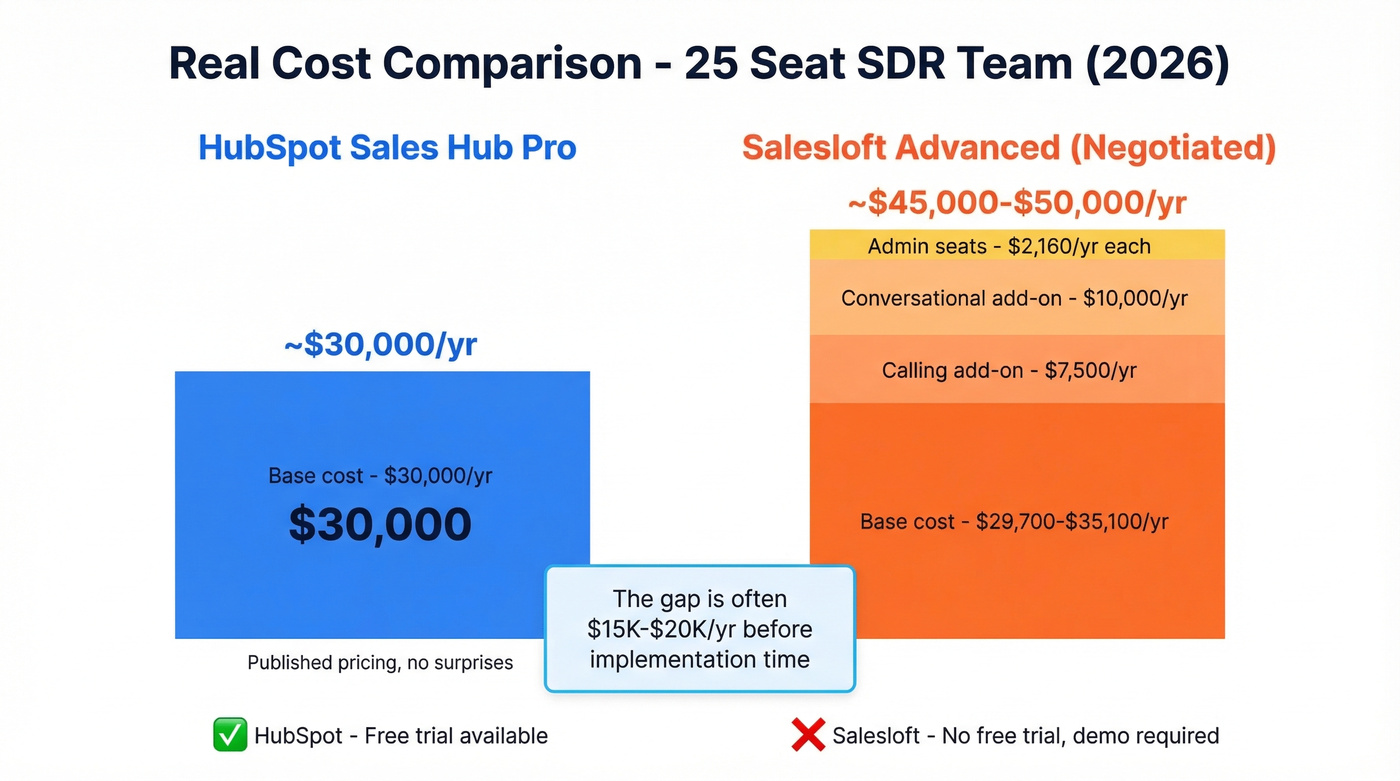
Below is a practical budget view for a 25-person SDR team using typical market benchmarks (including Vendr marketplace ranges for negotiated Salesloft pricing).
| HubSpot Sales Hub Professional | Salesloft Advanced (negotiated) | |
|---|---|---|
| List price | ~$90-100/user/mo | ~$180/user/mo |
| Typical discount | Published pricing | ~35-45% off with annual upfront |
| Base cost (25 users) | ~$30,000/yr | ~$29,700-$35,100/yr |
| Calling add-on | Available depending on setup/tier | +~$7,500/yr (common add-on) |
| Chatbot / conversational | Usually via HubSpot marketing tooling | +~$10,000/yr (common add-on) |
| Admin seats | N/A | Often priced like rep seats (~$2,160/yr each) |
| Estimated total | ~ $30,000/yr | ~ $45,000-$50,000/yr |
| Free trial | Yes | No (demo required) |
| Minimum seats | 1 | Commonly 3+ |
Payment terms matter more than most teams expect. We've seen Salesloft discounts swing hard based on whether you pay annual upfront, whether you bundle add-ons, and whether you're willing to sign multi-year. And yes, it's frustrating: two companies with the same seat count can end up paying very different numbers because one negotiated like a procurement team and the other negotiated like a sales manager in a hurry.
One more line item people forget: training. Budget roughly $300-500 per user per year for certification or enablement if you're serious about rolling it out, because "we'll just figure it out" turns into a messy quarter when managers start asking why activity is up but meetings aren't. (If you're building ramp plans, a 30-60-90 day plan for sales reps helps.)
For HubSpot Sales Hub, the common benchmark ranges in 2026 look like this: Starter around $15/user/month, Professional around $90-100/user/month, and Enterprise around $150/user/month. If you're comparing a 25-seat team, the gap between "HubSpot Pro only" and "Salesloft + add-ons + admin seats" often ends up in the $15k-20k/year range, and that's before you count implementation time.
For official pricing pages, start here:
- HubSpot Sales Hub pricing: https://www.hubspot.com/pricing/sales
- Salesloft (request pricing): https://salesloft.com/

You just read that neither HubSpot nor Salesloft fixes 15-20% bounce rates. Prospeo does. With 98% email accuracy, a 7-day data refresh cycle, and native integrations for both HubSpot and Salesloft, your sequences finally hit real inboxes instead of bouncing into the void.
Stop paying for engagement tools that engage no one. Fix the data first.
AI features: where each one is strongest
Salesloft shipped major AI updates in 2025, and HubSpot kept expanding Breeze AI through 2026. Both are real products now, not just marketing copy, but they help in different parts of the workflow.
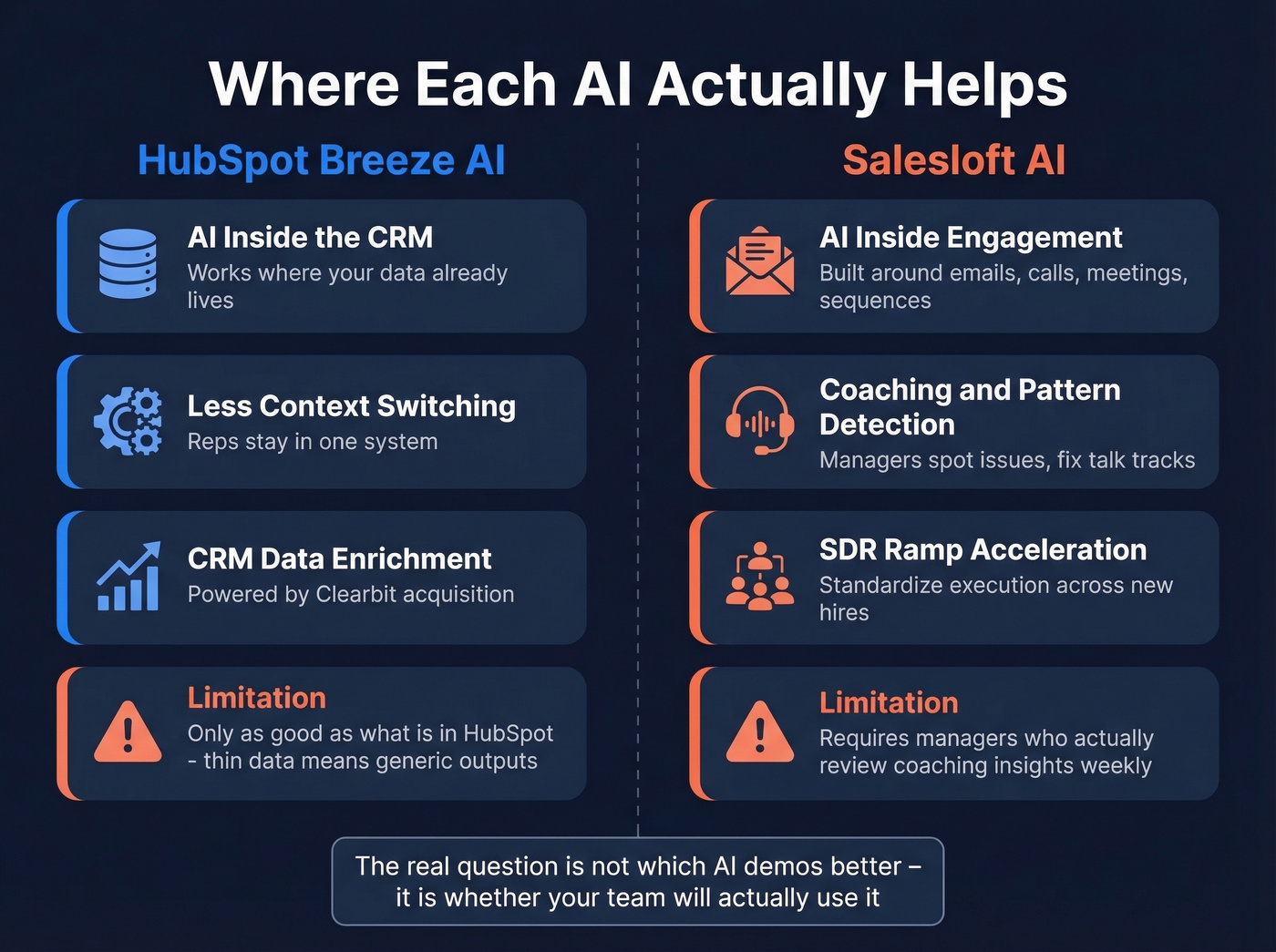
HubSpot's strength is "AI inside the CRM." Breeze features work where your data already lives, so reps don't have to context-switch as much and admins don't have to stitch together yet another system. The tradeoff is simple: HubSpot's AI is only as good as what's in HubSpot. If your CRM data is thin, stale, or inconsistent, the outputs get generic fast. (This is where data enrichment services can matter more than another AI feature.)
Salesloft's strength is "AI inside engagement." The 2025-era agent and coaching direction is built around what reps actually do all day: emails, calls, meetings, and sequences. If you're running a coaching-heavy SDR org, that matters because the tool isn't just helping you write messages; it's helping managers spot patterns, fix talk tracks, and standardize execution across a team that ramps new hires constantly.
If your leadership team is buying AI because it sounds good in a board update, don't overthink this section. Both will demo well. The better question is whether your managers will actually use coaching insights weekly, and whether your reps will follow recommended actions instead of doing what they always do.
For product details, these are the best starting points:
- HubSpot Breeze overview: https://www.hubspot.com/products/artificial-intelligence
- Salesloft product overview: https://salesloft.com/product/
What users actually say (and what they complain about)
Public review data is close enough that you can't "win" this decision on star ratings alone. On G2, HubSpot Sales Hub sits around 4.4/5 with a much larger review base, while Salesloft is around 4.5/5 with fewer reviews. Software Advice shows a similar pattern, with HubSpot slightly ahead on average rating and Salesloft still strong.
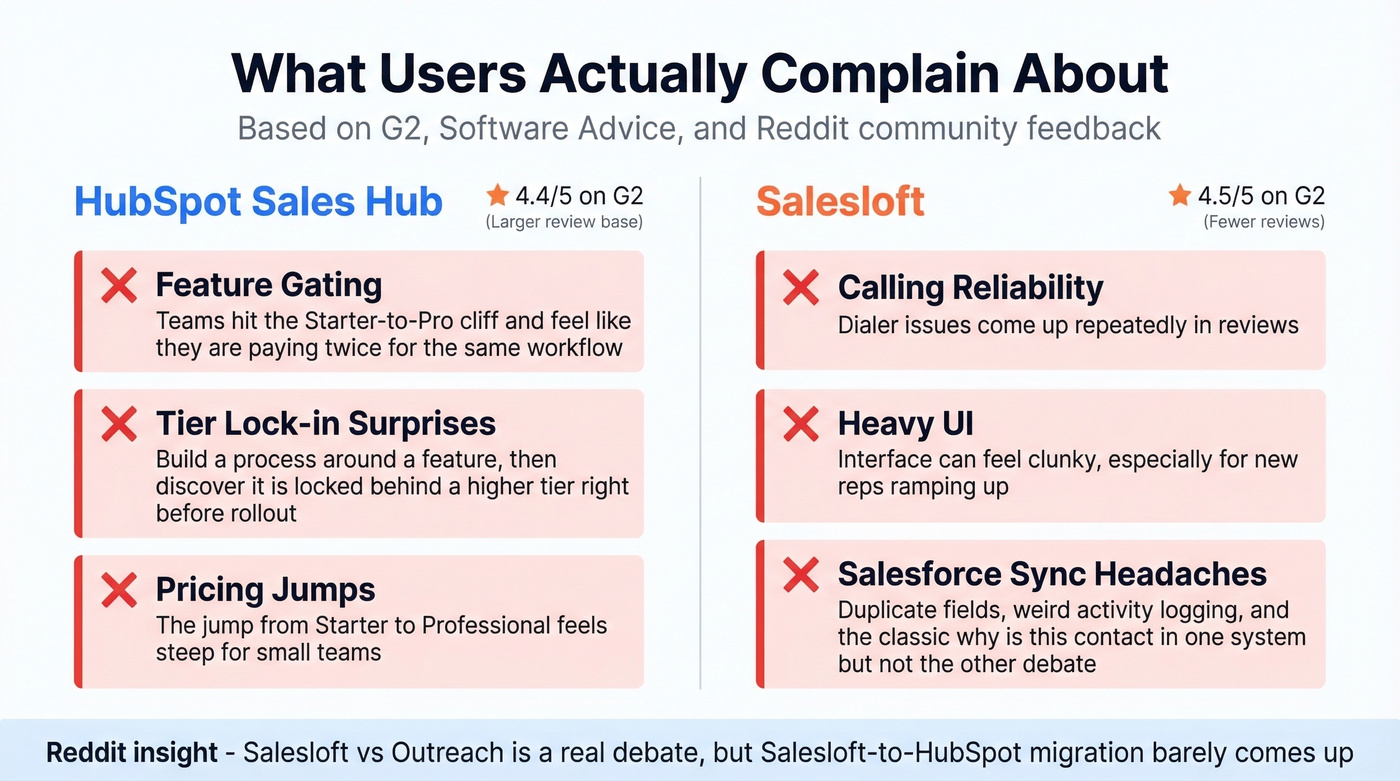
The difference shows up in the complaints.
Salesloft criticism tends to cluster around calling reliability, a UI that can feel heavy, and integration quirks. If you're Salesforce-first, you should assume you'll spend real RevOps time on field mapping, activity logging rules, and ongoing hygiene. That's not a "maybe." It's the cost of running an engagement layer on top of a CRM.
HubSpot criticism is more blunt: feature gating. Teams love how fast they can get started, then they hit the Starter-to-Professional cliff and feel like they're paying twice for the same workflow. If you've ever watched a team build a process around a feature, then realize it's locked behind a higher tier right before rollout, you know why this annoys people so much.
A quick community gut-check: Reddit threads in r/sales and r/salesops tend to treat Salesloft vs Outreach as a real debate, but "Salesloft to HubSpot migration" barely comes up. That doesn't prove it's a bad move; it just tells you it's not a common one, so you'll have fewer playbooks to copy.
The data problem neither solves (and it bites teams every week)
Neither HubSpot nor Salesloft is an email verification tool. They'll both let you import 10,000 contacts, launch sequences, and learn the hard way that 15-20% of your list is junk. Then your domain reputation takes the hit, deliverability drops, and suddenly the team thinks "outbound doesn't work anymore." (If you want the full playbook, read our email deliverability guide.)
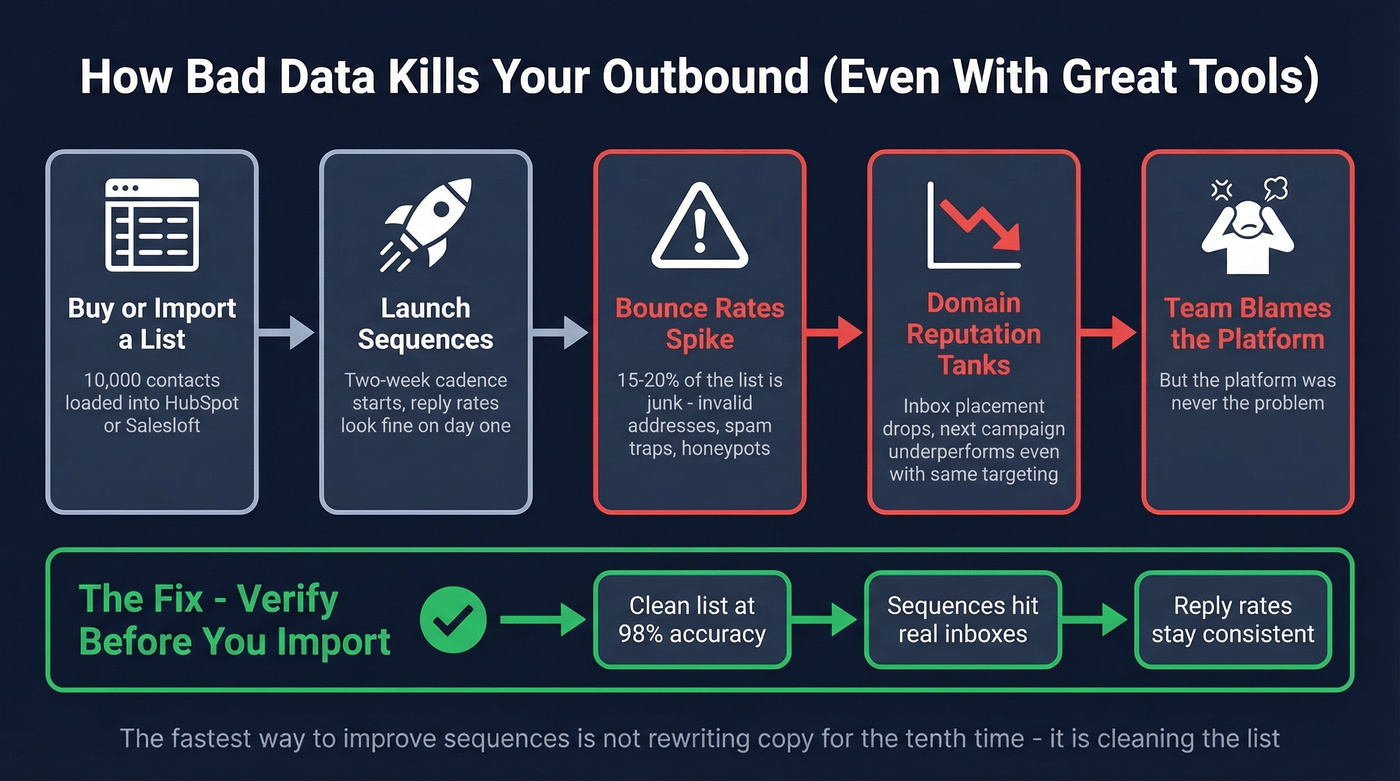
It does work. Your data just doesn't.

This is where tools like Prospeo fit naturally. Prospeo verifies emails at 98% accuracy with a 5-step verification process and a 7-day refresh cycle, so you catch invalid addresses, spam traps, and honeypots before they torch your sender reputation. In our experience, the fastest way to "improve sequences" isn't rewriting copy for the tenth time; it's cleaning the list so your best messages actually land. (Related: spam trap removal.)
A concrete scenario we see a lot: a team buys a list, imports it, and runs a two-week sequence. Reply rates look fine on day one, then bounce rates spike, inbox placement drops, and the next campaign underperforms even with the same targeting. They blame the platform. The platform wasn't the issue.
If you're building outbound at any scale, verifying before you import is non-negotiable.
Final verdict
Already on HubSpot CRM? Stay on HubSpot Sales Hub Professional. You'll save money, you'll avoid integration overhead, and you'll get a single source of truth that marketing and sales can actually share without constant reconciliation.
Salesforce-first with dedicated SDRs? Salesloft is the better fit, but negotiate like you mean it and budget for add-ons. That $45k-50k/year total for a 25-seat team is common once you include the extras, and you don't want to be surprised after you've already committed.
Everyone (no exceptions): fix your data before you scale sequences. It's painfully easy to waste thousands in tooling and rep time while your deliverability quietly collapses in the background.
You're budgeting $30K-$50K/year for HubSpot or Salesloft. Don't let bad contact data waste that investment. Prospeo enriches your CRM with 50+ data points per contact at $0.01/email - so every sequence, cadence, and call connects to a verified buyer.
Feed your engagement platform data it can actually work with.
FAQ
Can you use HubSpot and SalesLoft together?
Yes. Salesloft can integrate with HubSpot, and teams commonly use it when HubSpot is the CRM but they want a dedicated engagement layer. Plan for 2-4 hours of field mapping and testing up front, then ongoing ownership (usually one RevOps person) to keep sync rules clean as your lifecycle stages, fields, and routing logic evolve.
Does SalesLoft offer a free trial?
No. Salesloft is typically demo-first, with pricing shared during the sales process, and minimum seat commitments are common. HubSpot has a free tier and time-limited trials on paid hubs, which makes it easier to test with a small group before rolling out.
Is HubSpot or SalesLoft better for small teams?
HubSpot. Published pricing, no minimum seats, and a smoother setup path make it the practical choice under ~10 reps. Salesloft can work for small teams, but the minimums and the admin overhead usually don't pencil out unless you're already deep in Salesforce and running a very structured SDR motion.
What's the best way to clean contact data for either platform?
Verify before you import. Prospeo's bulk email verification runs at 98% accuracy and refreshes data every 7 days, which helps you remove invalid addresses, spam traps, and catch-all risks before they hurt deliverability. At roughly $0.01 per lead, verifying 10,000 contacts costs about $100, which is cheaper than the damage a high-bounce campaign does to your domain and your team's confidence.