

HubSpot vs Zoho CRM: The Comparison Your CFO Would Actually Write
You just got the HubSpot renewal quote. $6,500 a month - up from $4,000 - and the CFO wants to know why you're paying for marketing contacts nobody emails. Meanwhile, someone on the team forwarded a Zoho link showing $14/user/month and asked, "Why aren't we using this?"
If you're weighing HubSpot vs Zoho CRM, stop comparing feature checklists. Compare what happens in year two, when the contract renews and the data's gone stale.
30-Second Verdict
Pick HubSpot if you've got budget, prioritize UX, and run marketing-led growth. It's the CRM your reps will actually use without a training session.
Pick Zoho if you're cost-conscious, willing to invest in setup, and need deep customization. It'll do everything you need at a fraction of the price - if you're patient enough to configure it.
Skip both if your real problem is data quality. Bad contact data tanks any CRM. Verify emails and phones before importing a single record. A CRM full of bounced emails and disconnected numbers isn't a pipeline - it's a graveyard.
On G2, HubSpot holds a 4.4/5 from 13,564 reviews while Zoho sits at 4.1/5 from 2,884. Zoho serves 250K+ businesses. Those numbers tell you something about adoption, but nothing about total cost of ownership.
HubSpot vs Zoho CRM at a Glance
| HubSpot | Zoho CRM | Winner | |
|---|---|---|---|
| G2 Rating | 4.4/5 (13,564) | 4.1/5 (2,884) | HubSpot |
| Free Plan | Free plan available | Free for 3 users | Zoho |
| Paid Starting Price | ~$9/user/mo (annual) | $14/user/mo (annual) | Zoho |
| AI Engine | Breeze | Zia | Zoho (deeper predictions) |
| Integrations | 2,000+ | 500+ | HubSpot (breadth) |
| Best For | Marketing-led teams | Budget-conscious orgs | - |
Pricing - The Real Numbers
Tier-by-Tier Breakdown
HubSpot's pricing is bundled, not per-seat in the traditional sense. Zapier's hands-on comparison breaks it down: Starter runs $20/month for 2 users ($10 per additional), Professional jumps to $500/month for 5 users ($100 per additional), and Enterprise hits $1,500/month for 10 users ($150 per additional).
Zoho's math is simpler. Per user, per month, billed annually: Standard at $14, Professional at $23, Enterprise at $40, Ultimate at $52.
Annualized TCO for 5, 10, and 25 Users
This is the table your CFO actually wants to see.
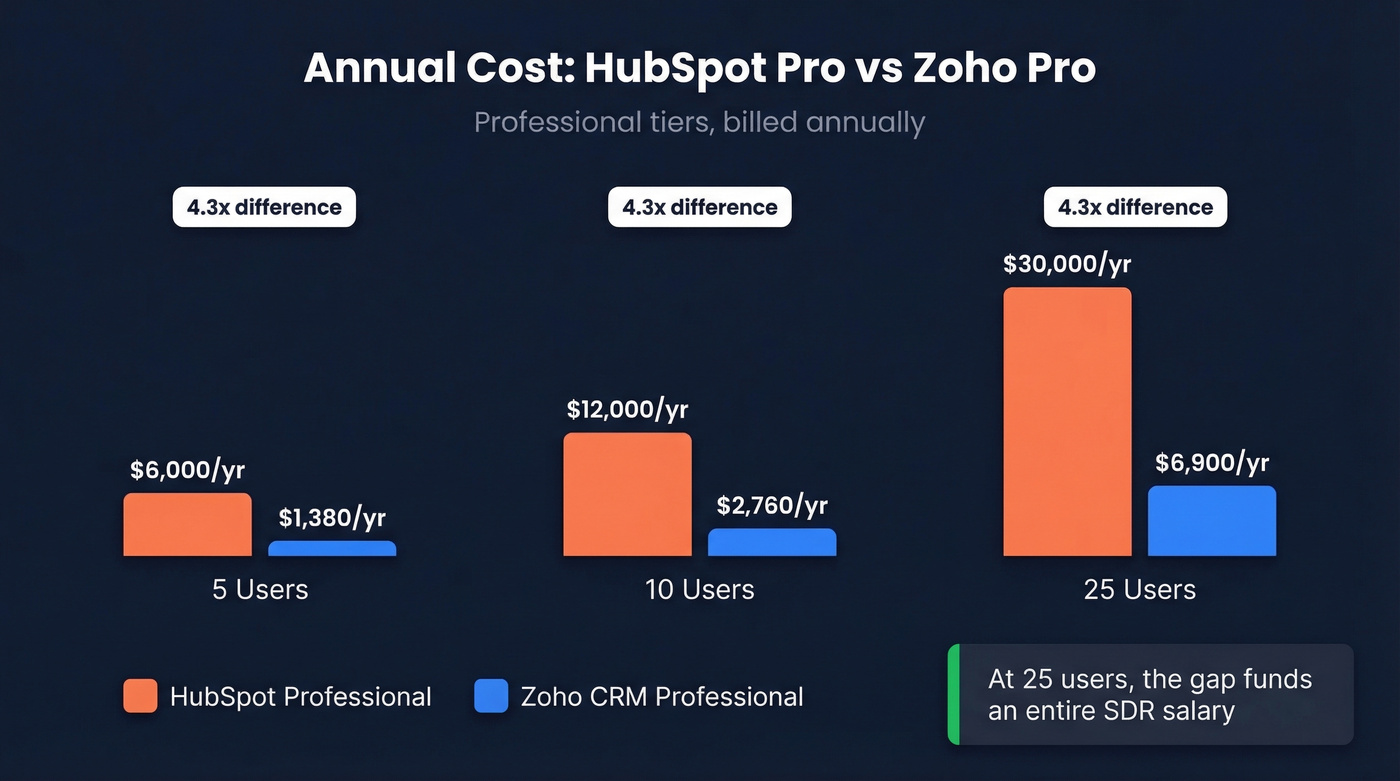
| Team Size | HubSpot Pro/yr | Zoho Pro/yr (annual billing) | Difference |
|---|---|---|---|
| 5 users | $6,000 | $1,380 | 4.3x |
| 10 users | $12,000 | $2,760 | 4.3x |
| 25 users | $30,000 | $6,900 | 4.3x |
HubSpot Professional: $500/mo includes 5 users, plus $100/mo per additional user. Zoho Professional on annual billing: $23/user/mo.
At 10 users on Professional tiers, HubSpot costs over four times more than Zoho. For a Series A company burning through runway, that gap funds an entire SDR.
Here's the thing: if your average deal size sits below five figures, you probably don't need HubSpot-level tooling. Zoho at $23/user/month gets you most of what you need. Spend the savings on headcount or better data.
Hidden Costs Nobody Mentions
HubSpot's credit system is the cost lever most teams don't see coming. Many Breeze AI features consume HubSpot Credits - you get 500/month on Starter, 3,000 on Professional, 5,000 on Enterprise. Credits don't roll over. When they're gone, credit-gated features pause until the monthly reset.
If you're trying to keep your pipeline clean, budget for data enrichment and verification alongside the CRM license.
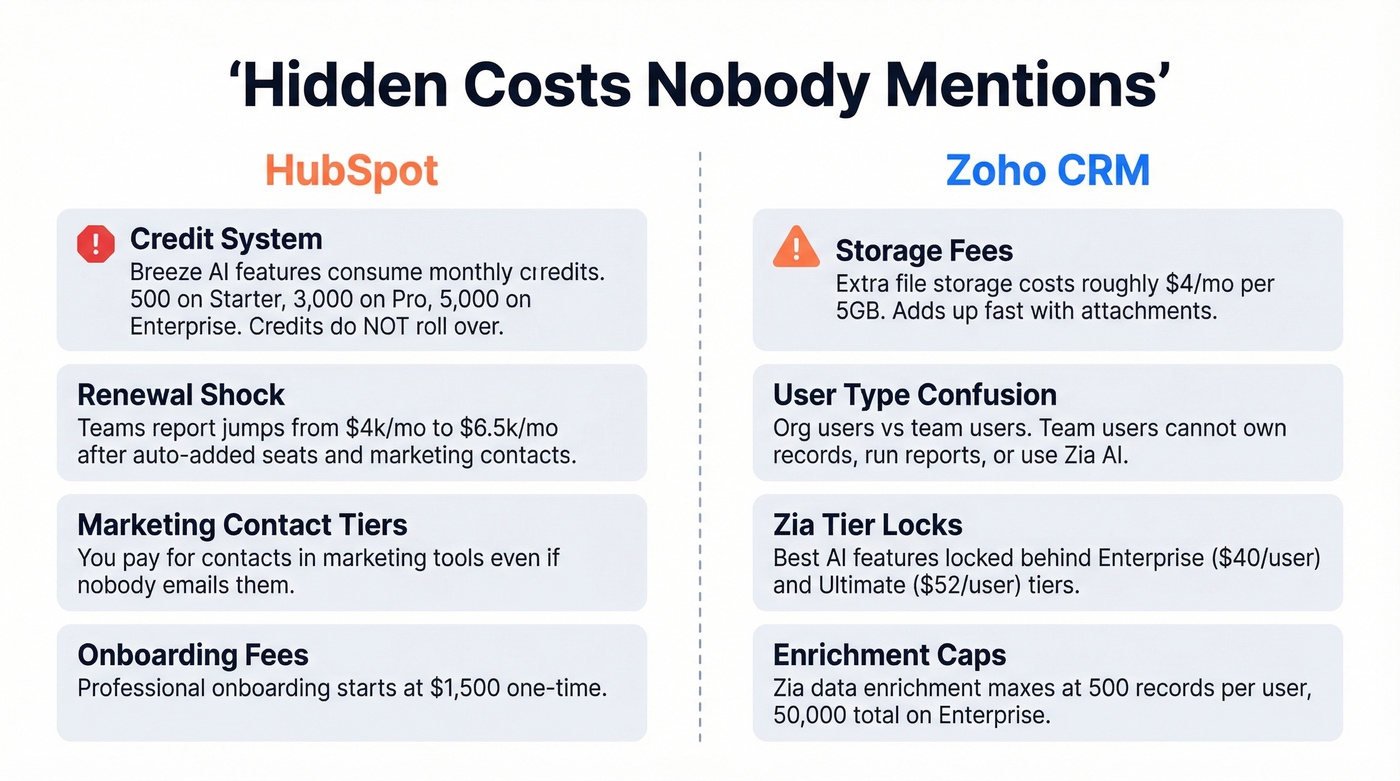
Heavy users burn through credits fast. The renewal shock is real, too. One Reddit post describes a jump from ~$4k/month to $6.5k/month after HubSpot added seats and marketing contacts the team didn't even use. Auto-renewal locked them in.
Zoho's hidden costs are subtler. Additional file storage runs ₹275/month per 5GB - manageable until you're storing attachments at scale. Zoho also has two user types many teams miss: org users (full CRM users) and team users (partial-access users for non-sales teams like legal or finance). Team users can view and add notes, tags, and attachments in up to 10 org modules, but they can't own records, access reports, manage automation, or use Zia AI.
Ease of Use and Onboarding
HubSpot wins this one, and it's not close.
G2's ease-of-use score gives HubSpot an 8.7 versus Zoho's 8.3. Ease of setup: 8.3 versus 8.0. Ease of admin: 8.6 versus 8.0. Quality of support: 8.6 versus 7.6. That support gap matters when you're stuck at 11 PM trying to fix a broken workflow before a Monday morning pipeline review.
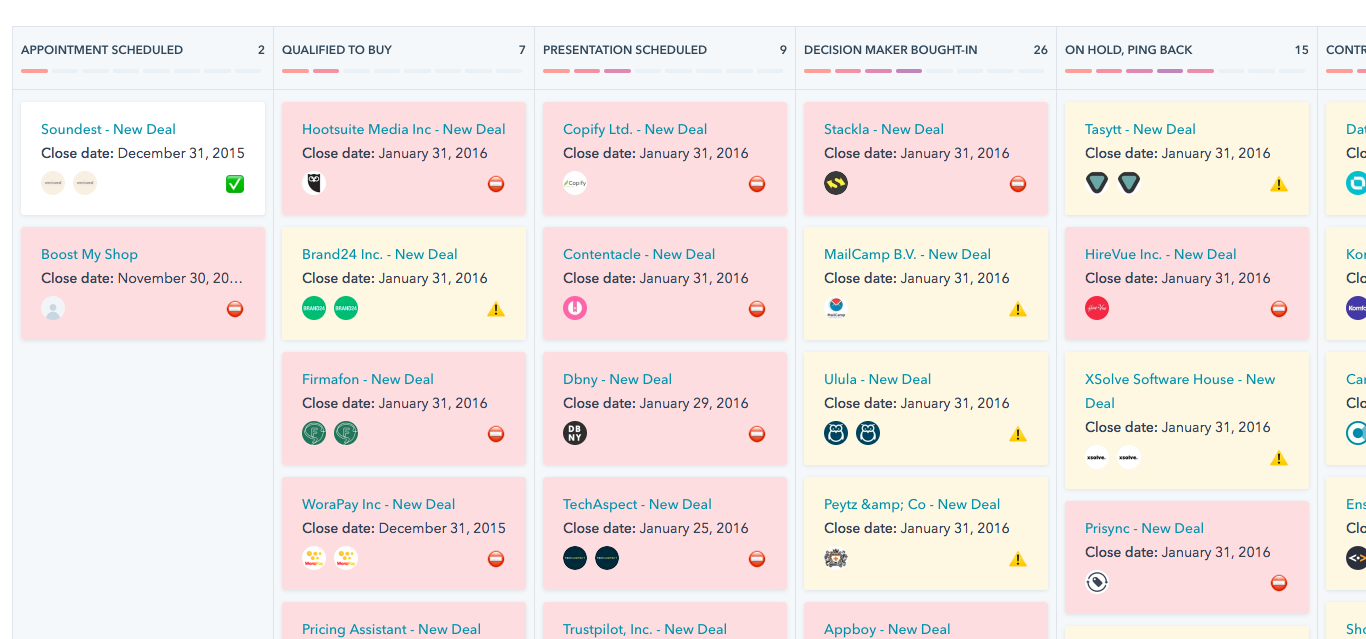
Zapier's review calls HubSpot "vastly more user-friendly," and we've seen the same pattern across dozens of implementations. HubSpot's interface is intuitive enough that most reps figure it out within a day. Zoho can bury critical features in Setup/settings, and it takes longer to learn where everything lives.
Zoho's UX issues compound over time. One Reddit user running a sub-10-person team reported burning 15 hours a month fighting slow reports, glitchy custom fields, and a mobile app that lagged on basic searches. That's nearly two full workdays lost to the tool that's supposed to save time. TechRadar found Zoho's mobile app full-featured with offline sync, so individual experiences vary - but the risk of configuration headaches is real.
If onboarding is a priority, a tighter 30-60-90 day plan for reps can reduce the "new CRM" productivity dip.

Choosing between HubSpot and Zoho won't matter if your CRM is full of bounced emails and dead phone numbers. Prospeo verifies every record through a 5-step process - 98% email accuracy, 125M+ verified mobiles, refreshed every 7 days. Import clean data into whichever CRM you pick.
Stop debating CRMs. Fix the data going into them first.
AI Features - Breeze vs Zia
What HubSpot Breeze Does
Breeze is HubSpot's AI layer, split into three components. Breeze Copilot handles drafting emails, social posts, and blog content. Breeze Intelligence powers enrichment, predictive scoring, and forecasting. Breeze Agents run autonomous tasks like content creation and customer support triage. HubSpot also supports lead score decay - scores decrease over time without engagement, keeping your pipeline honest.
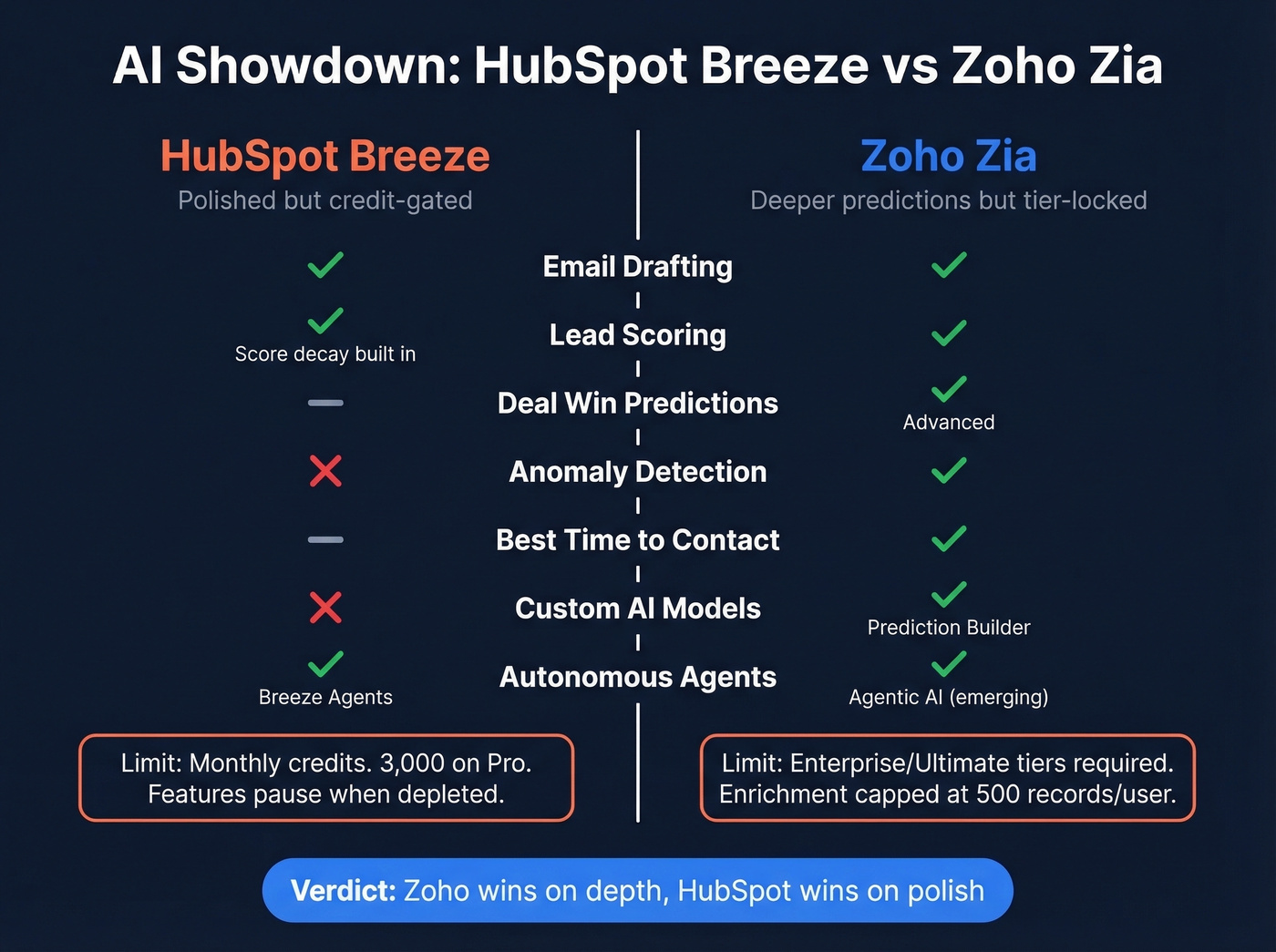
It's polished. It's also credit-gated. Many AI actions eat into your monthly allotment, and once you're out, credit-gated features pause until credits reset. We've watched teams hit the ceiling mid-month when enrichment just stops working - no warning, no graceful degradation.

What Zoho Zia Does
Zia goes deeper on predictive capabilities: deal-win predictions, anomaly detection, churn forecasting, Best Time to Contact recommendations, and a no-code Prediction Builder for creating custom AI models. The catch is that Zia's best features are locked behind Enterprise and Ultimate tiers. Zia Data Enrichment caps at 500 records per user with a 50,000-record maximum even on Enterprise.
Zoho is pushing Zia toward an "agentic AI" model that can autonomously identify at-risk renewals and draft recovery emails.
Neither CRM gives you "free AI." HubSpot gates it behind credits. Zoho gates it behind tiers. Budget accordingly.
Integrations and Ecosystem
HubSpot's Marketplace runs 2,000+ integrations. Most major SaaS tools have a HubSpot connector, which matters for marketing-led teams running complex stacks where your MAP, ad platforms, and analytics tools all need to plug in natively.
Zoho takes a different approach: 500+ third-party integrations plus a large native Zoho ecosystem including Books, Projects, and Desk. Go all-in on Zoho and you get a tightly integrated suite at a fraction of the cost. If you don't, you'll lean on Zapier to bridge the gaps - which works, but adds another line item and another point of failure. For developer teams, Zoho offers a more open platform with REST APIs, custom widgets, and serverless functions; HubSpot's API is solid but more opinionated in structure.
If you're stitching tools together, it's worth mapping the full workflow end-to-end (including connect outreach tool to CRM) before you commit.
Migration - What Actually Happens
If you're moving between these two platforms, Caldere's migration playbook lays out the sequence that preserves data integrity: Accounts, then Contacts, then Deals, then Activities, then Notes, then Attachments, then Campaigns. Follow that order or you'll break object relationships. The hardest part isn't exporting CSVs - it's preserving the connections between records.
This is also where sales operations metrics get distorted if you import messy history without a plan.
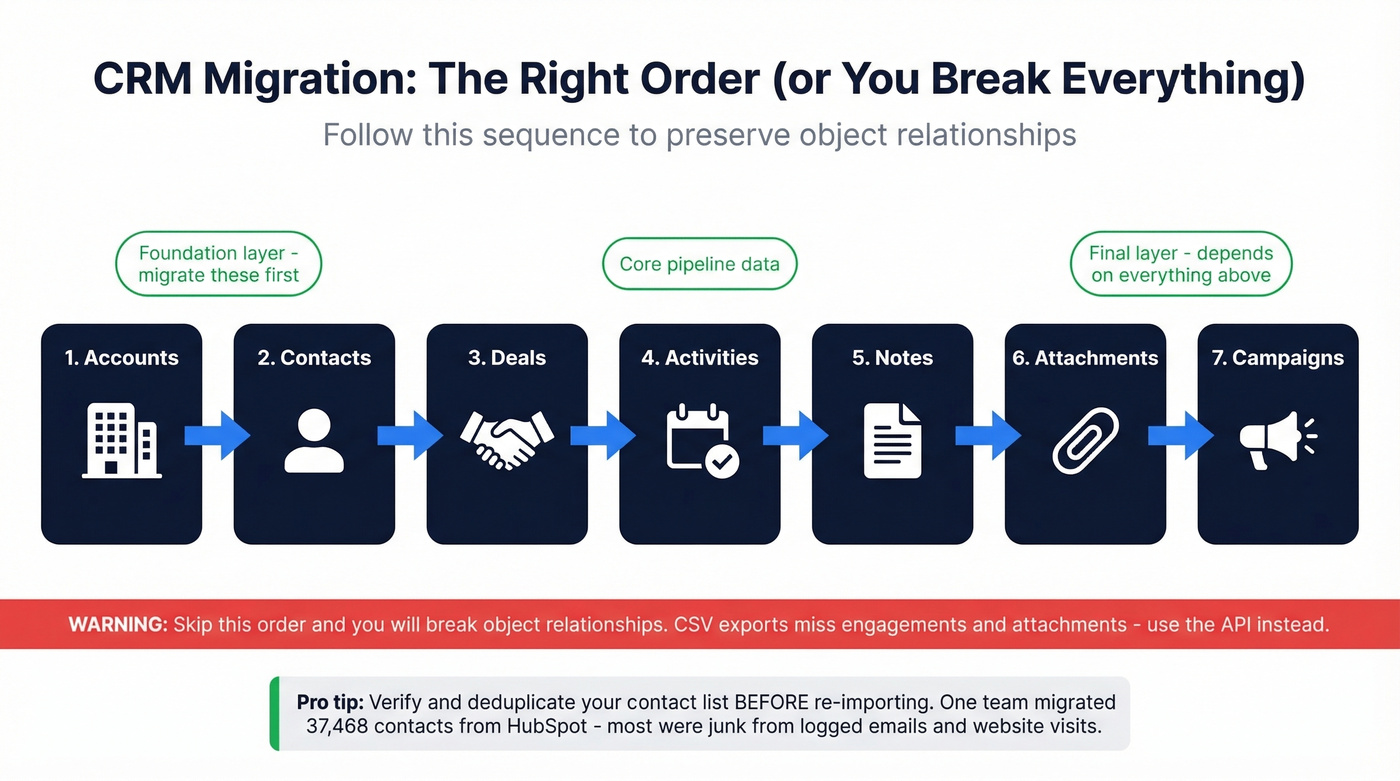
HubSpot's marketing-first architecture means CRM data is entangled with workflows, campaigns, and engagement logs. CSV exports won't preserve engagements and attachments the way an API export can. You need the API for those.
The Data Bloat Trap
One Reddit migration story captures the problem perfectly: a 3-person company migrated from HubSpot to Zoho and ended up with 9,000 Accounts and 37,468 Contacts. HubSpot had been logging every email, website visit, and meeting as a lead. We've run migrations between both platforms and the bloat problem is universal - teams spend days nuking records just to get back to a usable state.
The lesson: don't migrate everything. Verify your contact list before re-importing. Strip out bounced emails, disconnected numbers, and duplicate records. A clean migration beats a complete one every time.
If you're seeing high bounce rates post-migration, start with email bounce rate diagnostics before blaming the CRM.

Who Should Pick What
Series A startup, 8 reps, marketing-led: HubSpot Professional. The UX advantage means faster onboarding, and the integration ecosystem supports the complex marketing stack you're building. Budget roughly $9,600/year on HubSpot Professional for 8 users ($500/mo base plus 3 extra users at $100/mo each).
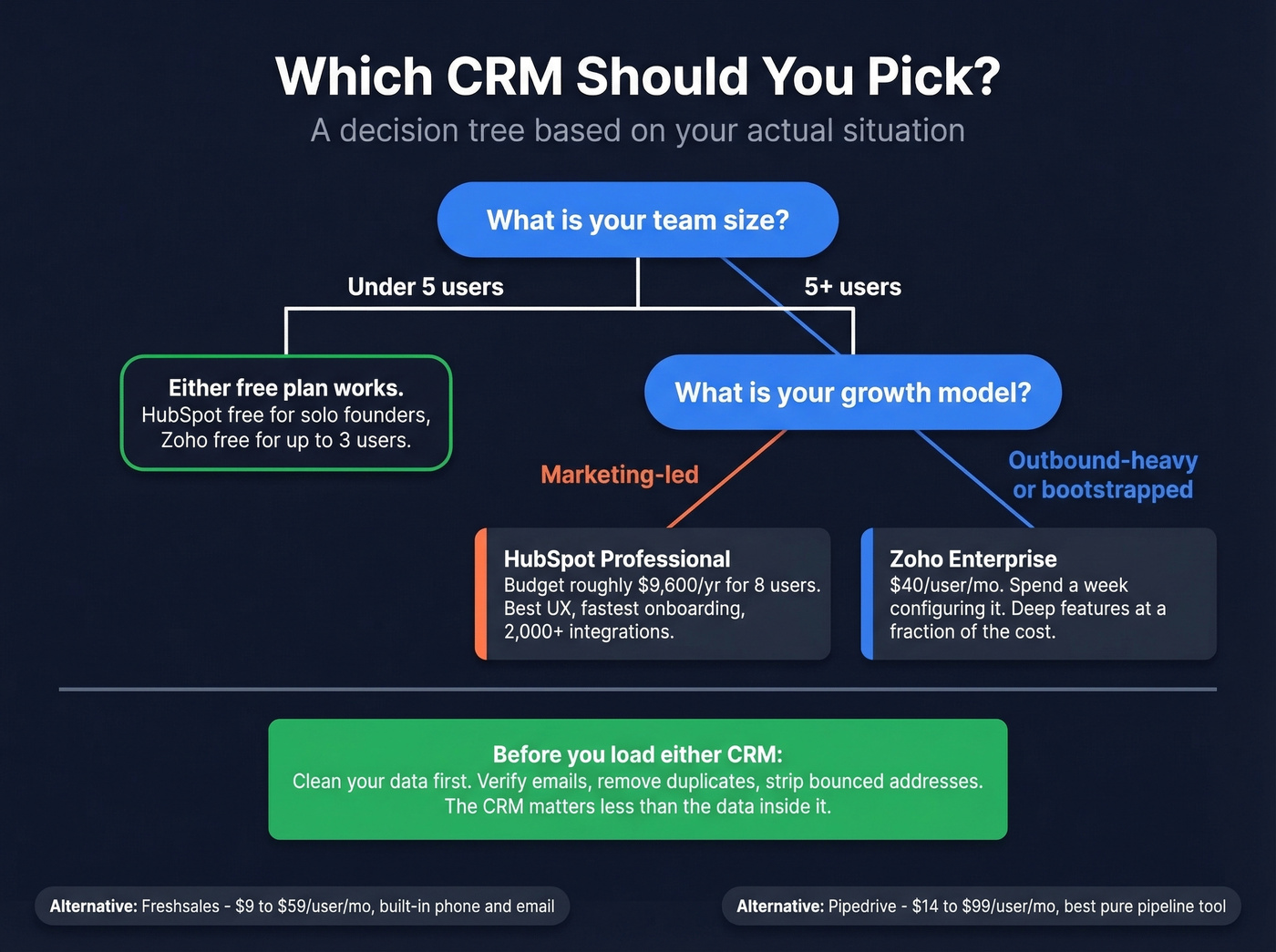
Bootstrapped SaaS, 15 users, outbound-heavy: Zoho Enterprise. You'll spend a week configuring it, but at $40/user/month you're keeping software spend under control while still getting a deep feature set.
Teams under 5 needing basic pipeline tracking: Either free plan works. Zoho's free plan covers 3 users. If you're a solo founder, HubSpot's free CRM is the faster start.
Data quality before loading either CRM: Run your list through Prospeo first. At $0.01 per email with a free tier of 75 verified emails, you'll catch bounced addresses and duplicates before they pollute your pipeline metrics. The CRM you pick matters less than the data you put in it.
Want neither? Freshsales ($9-$59/user/month) offers a clean middle ground with built-in phone and email. Pipedrive ($14-$99/user/month) is the best pure pipeline tool for teams that don't need marketing automation.
If you're still evaluating options, it helps to look at a few examples of a CRM side-by-side before you lock in.
HubSpot's Breeze enrichment burns credits and stops mid-month. Zoho's Zia caps at 500 records per user. Prospeo enriches your CRM with 50+ data points per contact at a 92% match rate - no credit gates, no tier locks, starting at $0.01 per email.
Enrich your entire pipeline for less than one HubSpot credit overage.
FAQ
Is HubSpot's free CRM really free?
Yes, but it's capped on automation, reporting, and custom properties - and some assets carry HubSpot branding. Zoho's free plan covers 3 users with basic lead and contact management. Jumping to HubSpot Professional for workflow automation costs $500/month, a steep leap from free-tier pricing.
Can I migrate from HubSpot to Zoho without losing data?
Yes, but expect pain. Export via API (not just CSV) to preserve object relationships between accounts, contacts, and deals. Follow the Accounts-first, Contacts-second, Deals-third import order and verify your data before importing to avoid the bloat problem described above.
Which CRM has better AI in 2026?
HubSpot Breeze is more polished but credit-gated - heavy users hit the ceiling mid-month. Zoho Zia goes deeper with predictive scoring, anomaly detection, and a no-code Prediction Builder, but the best features require Enterprise+ tiers ($40/user/mo). For most teams, Zia delivers more analytical depth per dollar.
What's the cheapest CRM for a 10-person sales team?
Zoho Professional at ~$2,760/year versus HubSpot Professional at ~$12,000/year. That's roughly a 4.3x difference before factoring in HubSpot credit overages and add-on costs. Freshsales and Pipedrive fall between the two on price.