

Human Verified Contact Data: What It Really Means (and Whether You Need It)
You bought a "human-verified" list last quarter and your bounce rate is still 12%. The vendor swore every record was checked by a real person. So what happened?
The answer isn't about verification method. It's about how fast data rots after someone confirms it - and that's the part most vendors skip over.
The Short Version
A human-verified record means a real person checked it, but it's a snapshot, not a guarantee. Data decays roughly 22.5% per year regardless of how it was verified. SalesIntel's human-verified data typically costs $18K-$48K/year. For most teams, technology-driven verification with a weekly refresh cycle delivers equal or better real-world accuracy.
Refresh cadence matters more than verification method. A record verified last week beats a hand-checked record from three months ago. Every time.
What the Term Actually Means
The label gets thrown around loosely. Human verified contact data means an actual researcher - not a bot, not an algorithm - manually confirmed that a person works at a specific company, holds a specific title, and can be reached at a specific email or phone number. SalesIntel, the most prominent player here, runs a three-tier accuracy model: human-verified records at ~95% accuracy, email-verified at ~90%, and machine-verified at ~60%.
That tiered approach is honest, and it's worth understanding. The ~95% figure applies only to the human-verified tier - not the entire database. Most vendors who slap "human-verified" on their marketing don't make that distinction.
Here's what's also true: no credible independent study has compared human-verified B2B contacts against automated verification on the same dataset. The accuracy claims are all self-reported. Every single one.
The Cost of Bad Data
Bad contact data isn't just annoying - it's expensive at scale. Poor data quality costs US businesses an estimated [$3.1 trillion annually]. Sales reps waste 27.3% of their time, roughly 546 hours per year, chasing leads built on bad information.
The cold email math is unforgiving. Average bounce rates for cold outreach run 7-8%, compared to under 2% for verified, opt-in lists. B2B email campaigns show a 98.16% delivery rate but only 84.3% inbox placement. That 14-point gap is where your pipeline disappears. Whether you rely on manually checked records or automated systems, stale records are the root cause.

Your human-verified list decays 2.1% every month. By the time that 90-day refresh hits, nearly 7% of your records are already stale. Prospeo's 5-step automated verification refreshes 300M+ profiles every 7 days - delivering 98% email accuracy at ~$0.01/email instead of $18K+/year.
Freshness beats hand-checking. Prove it with your own list.
Why Verified Data Still Goes Stale
Verification is a moment in time. The second a researcher clicks "confirmed," the clock starts ticking. B2B contact data decays at roughly 22.5% per year - about 2.1% per month. ZeroBounce's analysis of 11 billion emails verified in 2025 confirmed at least 23% annual list degradation.
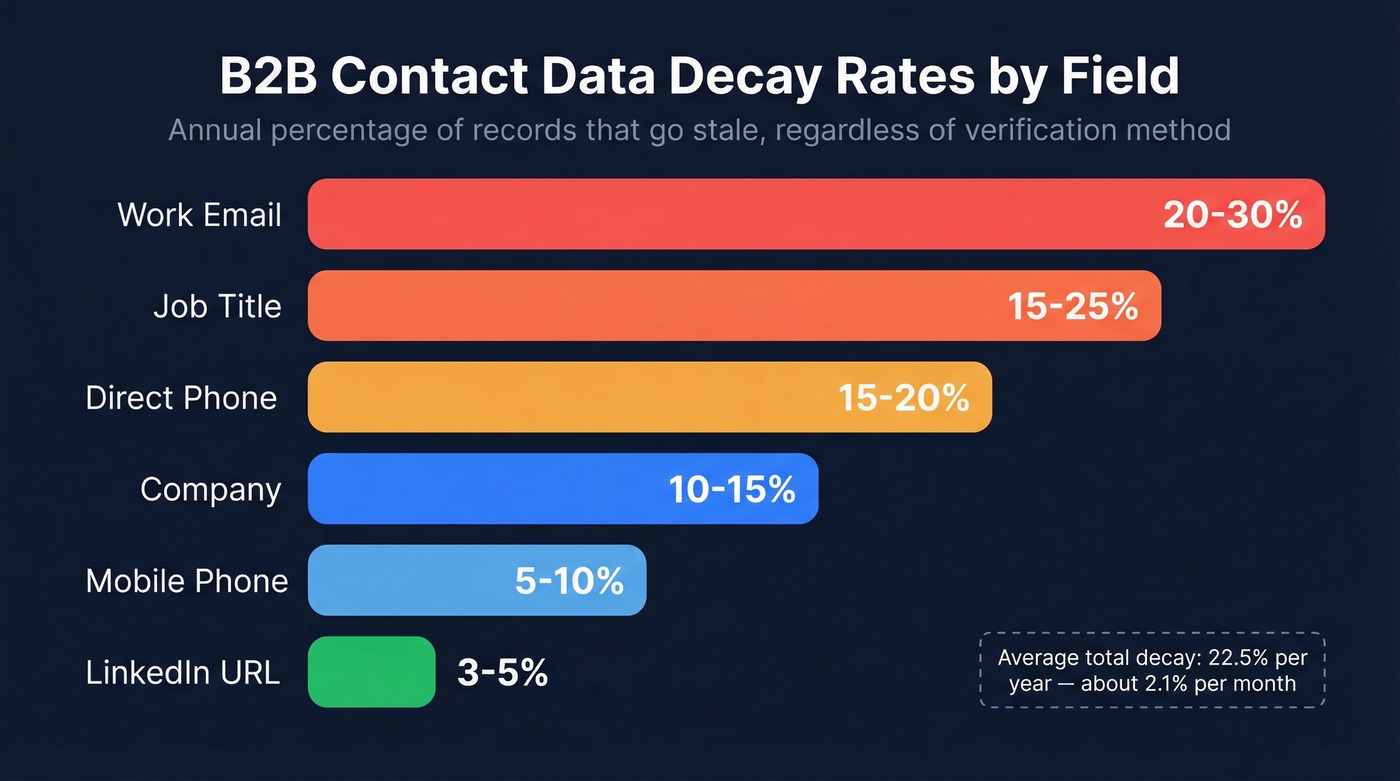
Not all fields decay equally:
| Field | Annual Decay Rate |
|---|---|
| Work email | 20-30% |
| Job title | 15-25% |
| Direct phone | 15-20% |
| Company | 10-15% |
| Mobile phone | 5-10% |
| LinkedIn URL | 3-5% |
There's also the catch-all domain blind spot. Over 9% of emails in ZeroBounce's dataset were catch-all addresses - domains that accept any email sent to them, making it impossible to confirm whether a specific address is real without actually sending to it. Even hand-checked B2B contacts can't escape this limitation.

Human vs. Automated Verification
Human verification is more thorough per-record. A trained researcher can cross-reference a contact's title, company, and email against multiple sources. SalesIntel refreshes its records on a quarterly 90-day cadence. The tradeoff: it's slow, expensive, and still subject to the same decay curve. A record verified by a human in January is just as stale by July as one verified by software.
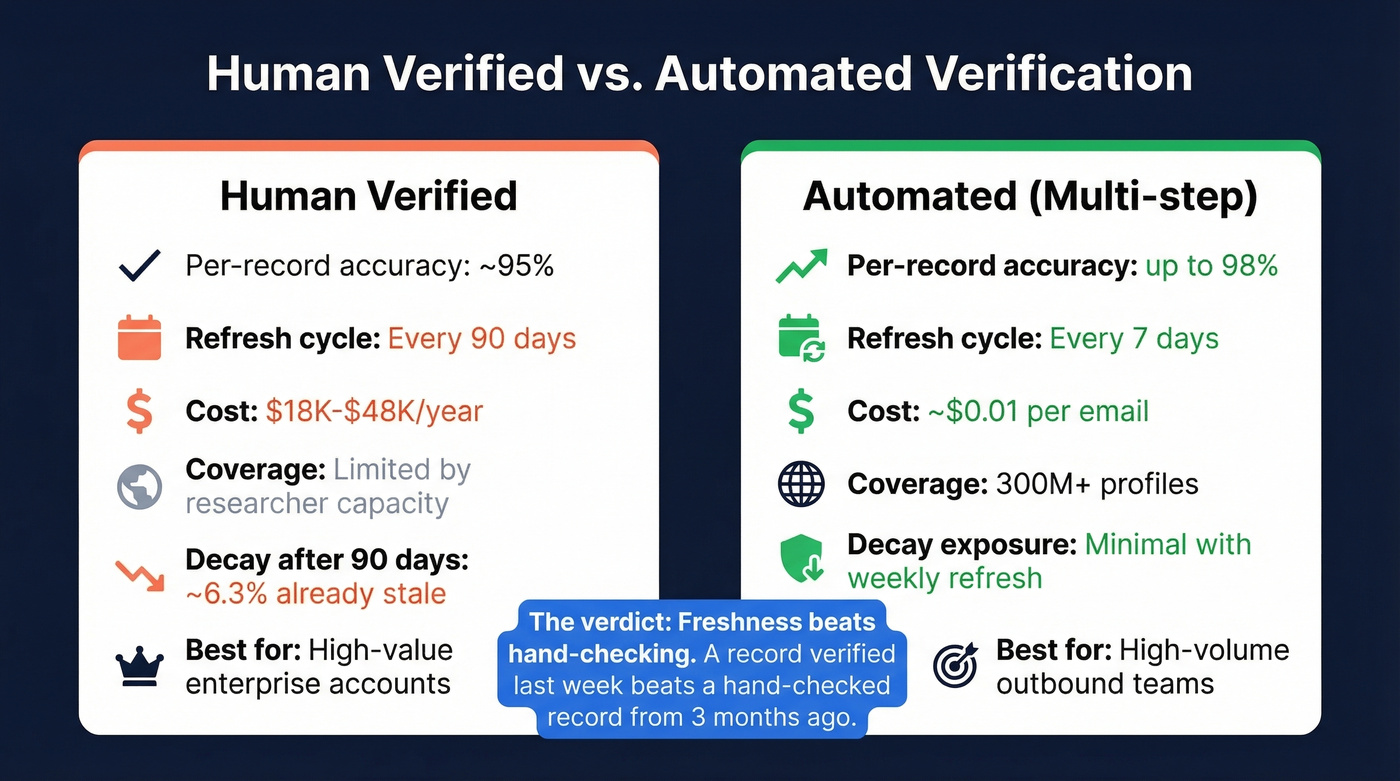
Automated verification trades per-record depth for speed and coverage. Platforms with the largest databases report 15-30% bounce rates - proof that size alone doesn't equal quality. But automated systems that combine multi-step verification with frequent refresh cycles can match or beat the accuracy of manually verified records in practice. The consensus on r/sales threads tends to agree: freshness trumps method.
Some teams use a hybrid approach - automated collection with human QA on high-value accounts - but this only works if the underlying data is fresh. The most common complaint you'll see in reviews of human-verified providers isn't accuracy at the point of verification. It's outdated records showing up months later, plus inconsistent phone number quality.
Let's be honest about what we've seen in our own testing: refresh cadence is the single biggest predictor of deliverability. A hand-checked record from six months ago performs worse than an automatically verified record from last week. Prospeo's 5-step verification process covers 300M+ profiles with catch-all handling, spam-trap removal, and honeypot filtering - refreshed every 7 days, not every 90.
The result is 98% email accuracy. When Meritt switched to Prospeo, their bounce rate dropped from 35% to under 4%. That's not a marginal improvement; it's a category shift.
What It Costs in 2026
The premium for human verification is significant:
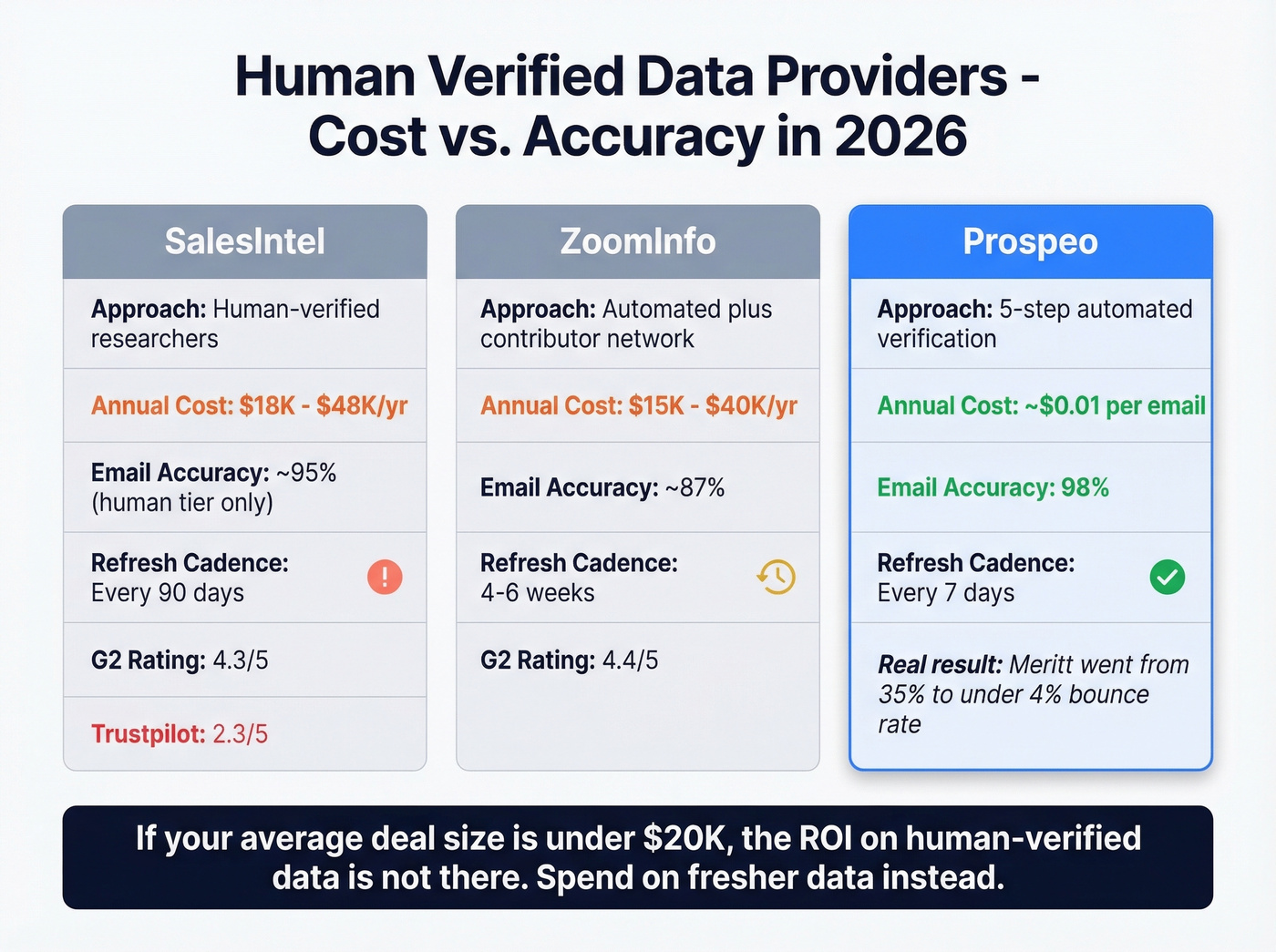
| Provider | Approach | Annual Cost | Accuracy | Refresh Cadence |
|---|---|---|---|---|
| SalesIntel | Human-verified | $18K-$48K/yr | ~95% (human tier) | 90 days |
| ZoomInfo | Automated + contributors | $15K-$40K/yr | ~87% email | 4-6 weeks |
| Prospeo | 5-step automated | ~$0.01/email | 98% email | 7 days |
SalesIntel carries a 4.3/5 on G2 across 538 reviews, with praise for CRM integrations. But their Trustpilot score sits at 2.3/5, with complaints about phone number accuracy and pricing opacity. Team plans start at $18K/year for 3 users and 30K credits.
Here's the thing: if your average deal size is under $15K, you almost certainly don't need human verified contact data. The math just doesn't work. You're paying $18K+ per year for a marginal accuracy edge that evaporates within one quarterly refresh cycle. Spend that budget on fresher automated data and better sequences instead (see B2B sales best practices and pipeline generation ideas).
Skip human-verified providers entirely if you're running high-volume outbound with deal sizes under $20K. The ROI isn't there.
Meritt's bounce rate dropped from 35% to under 4% after switching to Prospeo - no human verification needed. When your data refreshes weekly instead of quarterly, accuracy isn't a snapshot. It's a constant.
Stop overpaying for data that's already decaying. Start free today.
How to Evaluate Any Verification Approach
Before you sign anything, run through these five criteria.
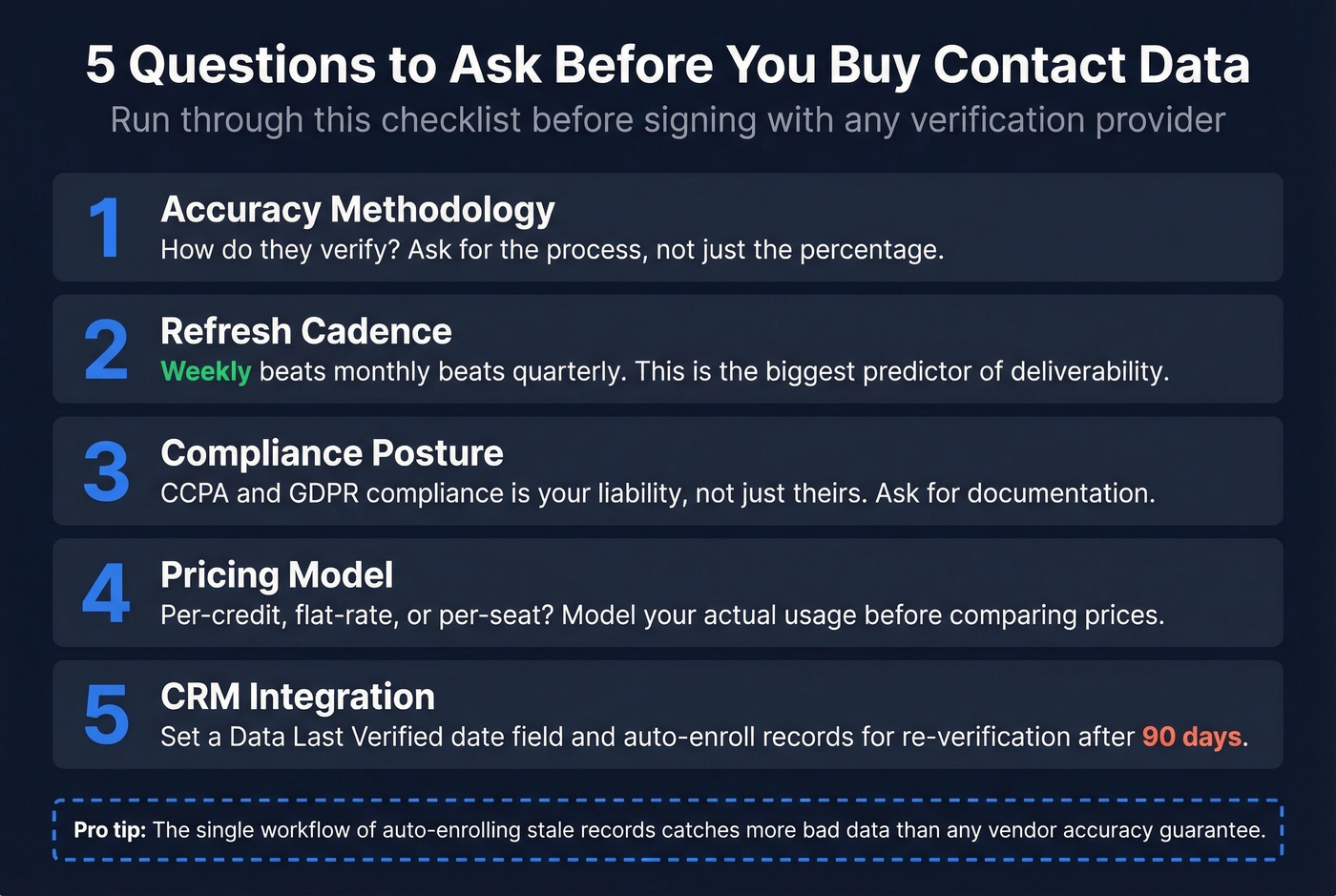
Accuracy methodology. Ask how they verify, not just what percentage they claim. "95% accurate" means nothing without knowing the process behind it. Manually verified records should come with documentation of the researcher's workflow, not just a label. If you're comparing vendors, start with a ranked list of the best B2B database options.
Refresh cadence. Weekly beats monthly beats quarterly. In our testing, the refresh cycle is the single biggest factor in real-world deliverability - more predictive than verification method, database size, or any other variable we've measured. If you're troubleshooting bounces, use a bounce rate checklist and pair it with an email verifier before you scale.
Compliance posture. CCPA's updated regulations took effect January 1, 2026, with risk-assessment duties now active. GDPR enforcement continues to tighten. Your data provider's compliance isn't optional - it's your liability (see B2B compliance and GDPR compliant database).
Pricing model. Per-credit, flat-rate, and per-seat models produce wildly different costs at scale. Model your actual usage before comparing sticker prices. A $15K/year flat rate sounds cheaper than per-credit pricing until you realize you're only using 40% of your allocation. If you want flexibility, compare pay-as-you-go options.
CRM integration. If verified data doesn't flow cleanly into HubSpot or Salesforce, your team won't use it. Set a "Data last verified on" date property in your CRM and auto-enroll records for re-verification after 90 days - this single workflow catches more stale data than any vendor's accuracy guarantee. If you're building this out, CRM automation software can help.
FAQ
Is human verified contact data more accurate than automated verification?
Per-record, human verification can be more thorough - SalesIntel reports ~95% accuracy for its human-verified tier. But no independent study has compared both methods on the same B2B dataset. Automated verification with a weekly refresh cycle often delivers better real-world accuracy because records stay current rather than aging 90 days between checks.
How often does B2B contact data go stale?
About 22.5% per year - roughly 2.1% per month. Work emails decay fastest at 20-30% annually, followed by job titles at 15-25%. This decay rate applies equally to human-verified and automated records, which is why refresh cadence matters more than verification method.
What's a cost-effective alternative to human-verified data providers?
Platforms with automated multi-step verification and weekly refresh cycles. Prospeo delivers 98% email accuracy at ~$0.01/email with a 7-day refresh - compared to $18K+/year for quarterly human re-verification. For teams with deal sizes under $20K, that combination of freshness and cost typically outperforms premium human-verified providers.