

Hunter Email Finder: Honest Review & Guide for 2026
Hunter email finder was the tool everyone recommended. Back in 2017-2018, it had the cleanest interface, the simplest domain lookups, and a free plan generous enough to make it the default for anyone doing cold outreach. Six million users and a Chrome extension with 600,000+ installs later, Hunter's still running on that reputation. But the email finder market has moved fast, and Hunter's web-scraping model hasn't kept pace with platforms built on larger, fresher databases. The result: a tool that's still good for light use and increasingly painful at scale.
Here's what Hunter actually delivers in 2026, where the cracks show, and what's worth switching to.
Quick Take
Use Hunter if you're a freelancer or solo operator doing fewer than 50 lookups a month. The free plan handles that fine, the Chrome extension is polished, and you don't need to think about credits.
How Hunter.io Works
Hunter's core data model is web scraping. It crawls publicly available web pages - company sites, directories, press releases - and indexes the email addresses it finds. That's fundamentally different from platforms maintaining proprietary databases of verified contacts. The upside is transparency: Hunter shows you the source URL where it found each email, so you can verify the context yourself.
The platform has three main lookup tools. Domain Search takes a company domain and returns every email address Hunter has indexed for that organization. Email Finder takes a person's name plus their company domain and guesses the most likely email format. Author Finder extracts the email of whoever wrote a specific article or blog post. Beyond these, Hunter offers Discover and Signals features - AI-powered company searches and proactive suggestions that help you identify target accounts before you start pulling emails.

Verification runs on a three-tier system: Valid (safe to send), Invalid (will bounce), and Accept-all (the domain accepts everything, so Hunter can't confirm - it gives you a confidence score instead). Each verification costs 0.5 credits, which matters when you're doing the math on your plan. If you're comparing tools, it's worth understanding how email verification pricing and accuracy typically work across providers.
The Chrome extension is well-built. Those 600,000+ users and the 4.7 rating from 12,000+ reviews are earned. It lets you pull emails while browsing company websites without switching tabs. Bulk modes exist for Domain Search, Email Finder, and verification, though operational limits apply: 10,000 bulk verifications and roughly 500 Google Sheets actions per run. One important caveat - Hunter won't scrape social media profiles and removed its integration with professional networks years ago due to legal pressure, which limits coverage for companies that don't publish employee emails on their public-facing pages.
Credit where it's due: Hunter has been investing in its data pipeline. Between January and October 2024, the platform grew its indexed profiles by 211%, with plans for another 50-100% expansion including 60% more profiles with job titles. That's real progress. But expanding a web-scraping index doesn't fix the structural problem: if a company doesn't publish employee emails on public pages, more crawling won't surface them. The model itself is the bottleneck. (If you're evaluating this approach, see our breakdown of web scraping lead generation.)
Pricing Breakdown
Here's the breakdown from Hunter's pricing page:
| Plan | Monthly | Annual (per mo) | Credits/mo | Starting Price |
|---|---|---|---|---|
| Free | $0 | $0 | 50 | $0 |
| Starter | $49 | $34 | 2,000 | $34/mo annual |
| Growth | $149 | $104 | 10,000 | $104/mo annual |
| Scale | $299 | $209 | 25,000 | $209/mo annual |
| Enterprise | Custom | Custom | Custom | Custom |
Annual billing saves 30%, which is meaningful at the Growth and Scale tiers. Additional email accounts run +$10/mo each. Outreach recipients scale from 500 on Free to 15,000 on Scale, and email accounts from 1 to 20.
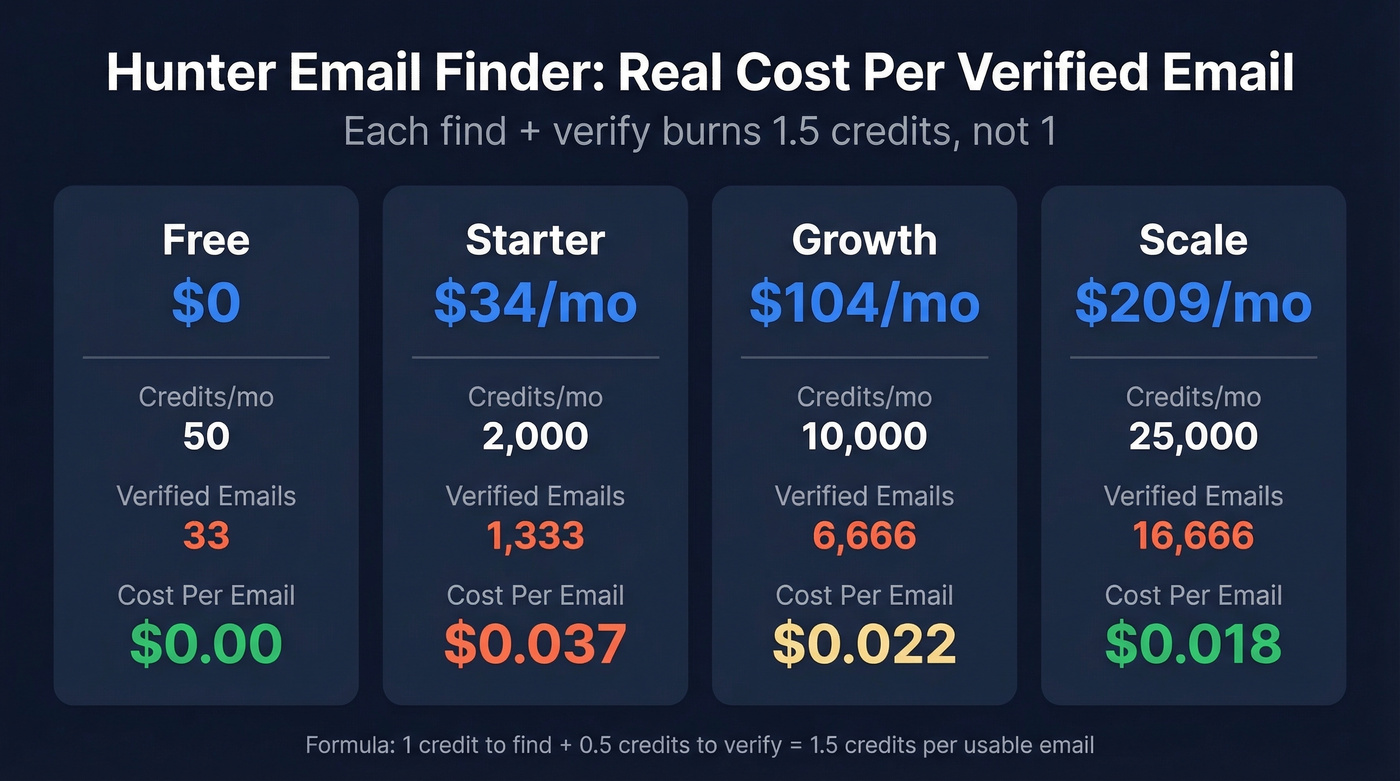
Now the credit wall. A search costs 1 credit. Verification costs 0.5 credits. So finding and verifying a single email burns 1.5 credits. On the Starter plan, that's roughly 1,333 verified emails per month - not 2,000. Your cost per verified email on Starter works out to about $0.037. Growth drops to ~$0.022, and Scale to ~$0.018.
Domain Search is more efficient - finding up to ten emails from a single domain costs just one credit. But if you're prospecting across hundreds of companies, which most outbound teams are, you're still burning credits fast. We've seen SDR teams exhaust a Starter plan's credits in the first week of a new campaign, then sit idle or buy bulk add-ons at $6,500 for 1,000 search credits plus 200,000 verification credits. If you're building a modern outbound stack, compare this against other SDR tools and how they meter usage.
What Users Actually Say
Hunter holds a 4.4/5 on G2 from 634 reviews, with 69% five-star and 22% four-star ratings. Capterra has it at 4.6/5. Solid numbers.
What people like: Ease of use comes up constantly. The interface is clean, the workflow is intuitive, and verification helps reduce bounce rates. For simple domain lookups, it's hard to beat the speed - a quick search returns results in seconds with source links attached.
What people complain about: Credits. The credit system is the number-one frustration across G2 reviews. Users describe it as limiting at scale and expensive once you outgrow the free tier. Data depth for smaller companies is another recurring theme - Hunter's web-scraping model means if a company doesn't publish employee emails publicly, you get nothing or generic addresses like info@ and support@. A February 2026 G2 review captures the tension well: the reviewer praised Hunter's simplicity and verification reliability, then flagged the credit system and occasional outdated emails as dealbreakers.
Here's the thing - the consensus on r/sales and outbound communities is pretty consistent: Hunter is great for getting started, but most teams outgrow it. Apollo and Snov.io are two of the most common alternatives people recommend, mainly because they want broader coverage outside the "emails published on public pages" universe. If you want a broader shortlist, see our ranked guide to Hunter alternatives.

Burning 1.5 credits per verified email adds up fast. Prospeo delivers 98% accurate emails at $0.01 each from a 300M+ profile database refreshed every 7 days - not scraped from cached web pages.
Stop paying more for stale, scraped emails. Switch to verified data.
Where Hunter Falls Short
The limitations matter more as your usage scales. Four issues bite hardest.
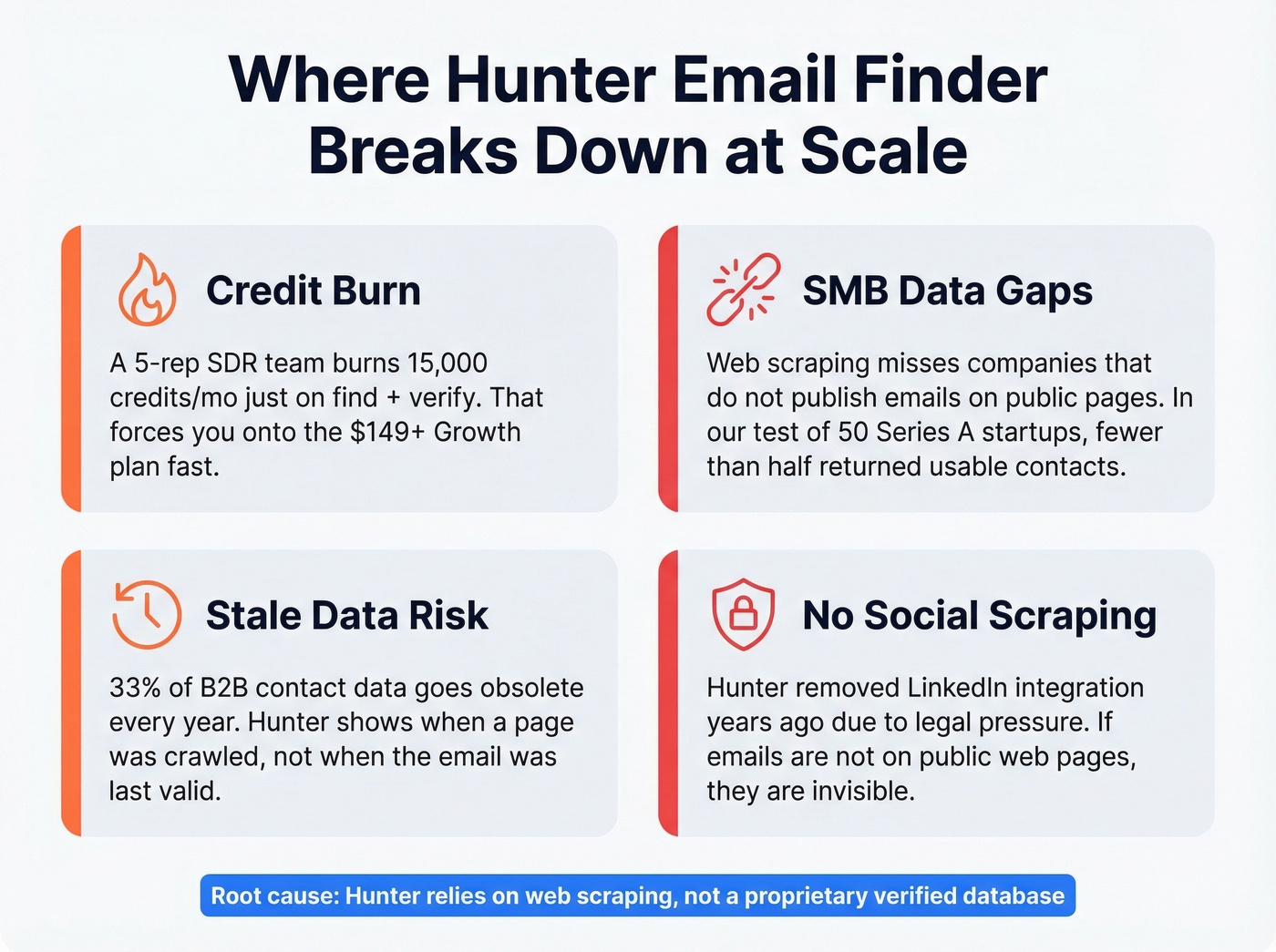
Credit burn at scale. Picture an SDR team of five reps, each prospecting 100 contacts per day. That's 750 credits daily for search plus verify - 15,000 credits per month. You're already on the Growth plan at $149/mo, and you'll likely need Scale. This is why teams start looking at outbound lead generation tools that price by usable leads, not just lookups.
Data gaps for SMBs. Hunter's web-scraping model has a structural blind spot: companies that don't publish employee emails on public web pages simply don't appear. This hits hardest when you're targeting SMBs and mid-market companies, where you often get generic addresses instead of decision-maker emails. We ran a test targeting 50 Series A startups last quarter and Hunter returned usable contacts for fewer than half. If this is your ICP, you’ll usually need stronger data enrichment services to fill in missing contacts.
Stale data risk. About 33% of B2B contact data becomes obsolete every year due to job changes, company moves, and domain switches. Hunter's data reflects when a page was last crawled, not when the email was last valid. If someone left their company six months ago but the old "About Us" page is still cached, Hunter will serve you that dead address.
No social scraping, and GDPR gray areas. Hunter won't scrape social media profiles, and because it scrapes public web pages rather than using consent-based data collection, European prospects can raise GDPR compliance questions. If compliance is a concern, it’s also worth reading our guide on is it illegal to buy email lists.
Best Alternatives to Hunter
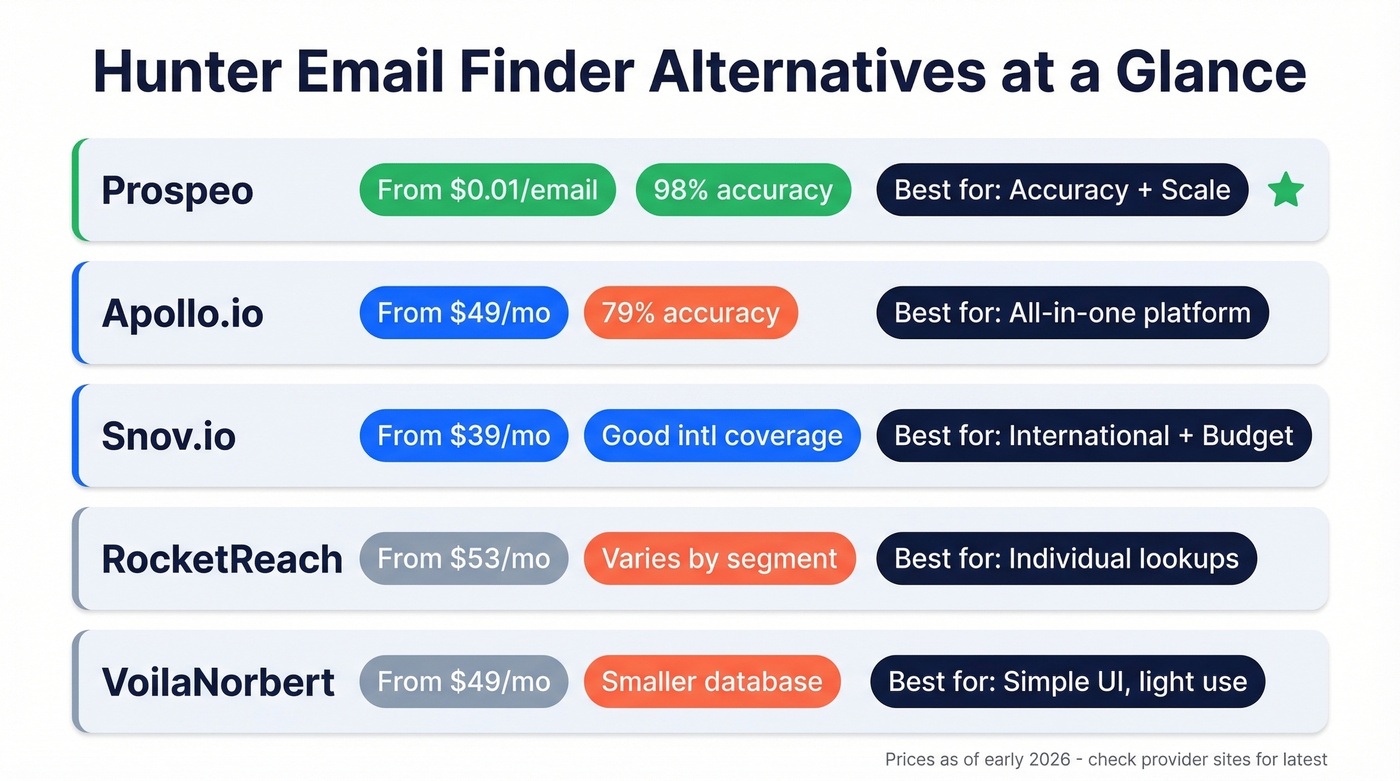
| Tool | Starting Price | Best For |
|---|---|---|
| Prospeo | Free / ~$0.01/email | Accuracy + scale |
| Apollo.io | Free / ~$49/mo | All-in-one + sequences |
| Snov.io | Free / $39/mo | International + budget |
| RocketReach | $53/mo | Individual lookups |
| VoilaNorbert | $49/mo | Simple UI, light use |
Prospeo
Use this if you need verified emails and mobiles at scale without the credit anxiety. Skip this if you want built-in email sequencing - pair Prospeo with Smartlead, Instantly, or Lemlist for that. If you’re building lists in a workflow tool, our guide to Clay list building can help.
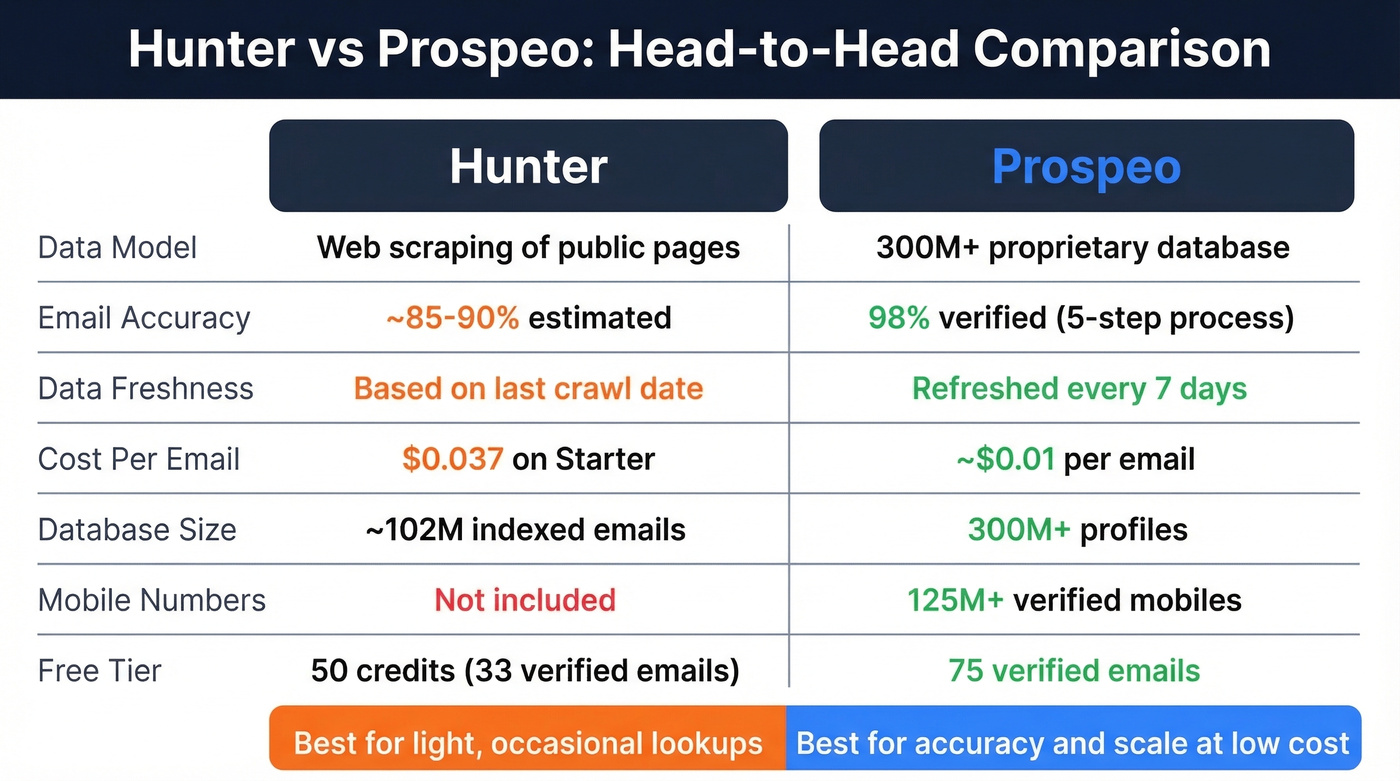
Prospeo's database covers 300M+ professional profiles, roughly 3x Hunter's ~102M indexed emails. Email accuracy runs 98% through a proprietary 5-step verification process with catch-all handling, spam-trap removal, and honeypot filtering. The 7-day data refresh cycle is the real differentiator: while Hunter serves you whatever it last crawled, Prospeo keeps records current on a weekly cadence - the industry average is six weeks.
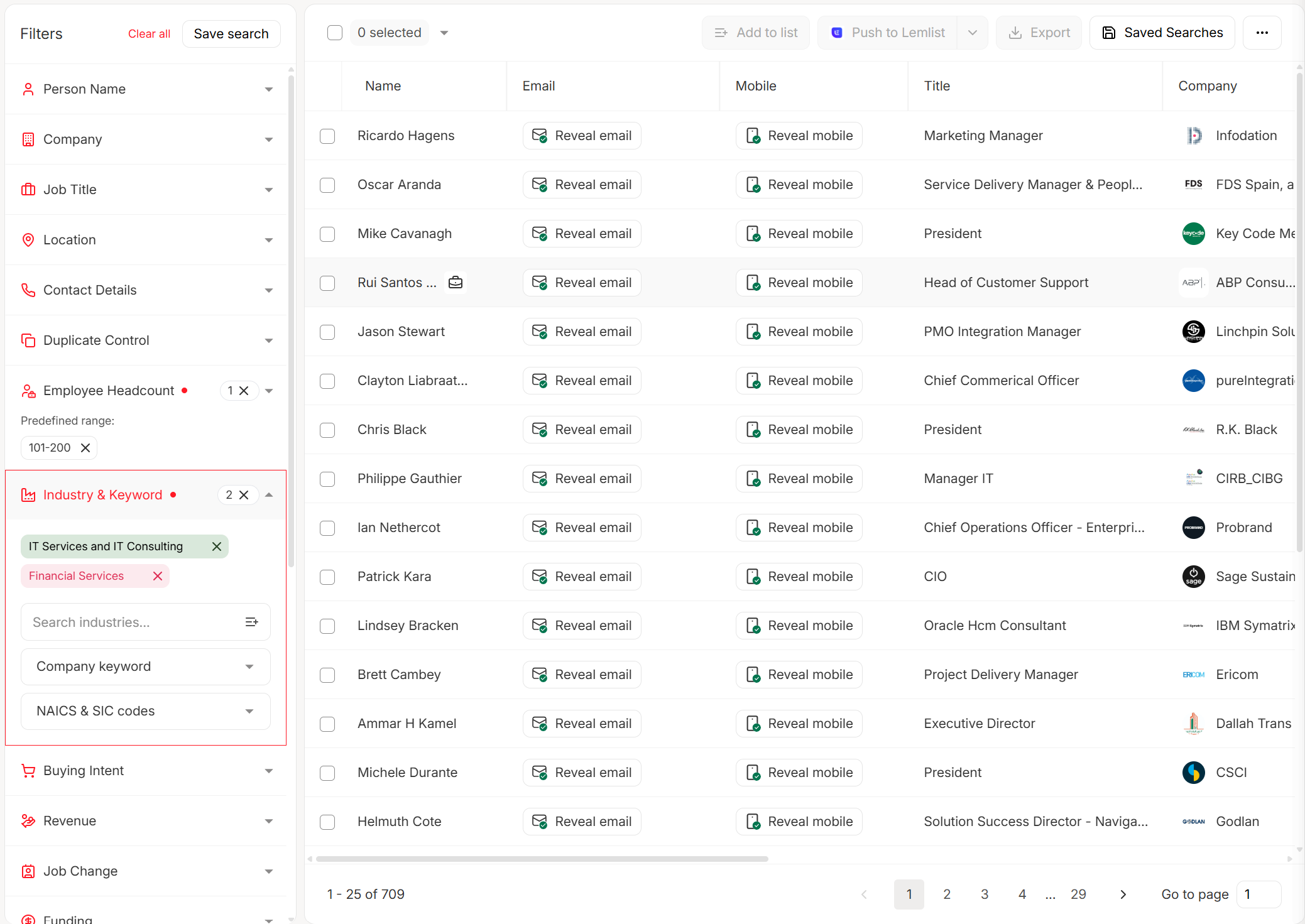
At roughly $0.01 per email, you're looking at about 70% cheaper than Hunter's Starter plan per verified email. The free tier gives you 75 emails per month, compared to Hunter's ~33 find-and-verify lookups. Prospeo also includes 125M+ verified mobile numbers with a 30% pickup rate, which matters if direct dials are part of your outbound motion. Real results back this up: Meritt tripled their pipeline from $100K to $300K/week after switching, with bounce rates dropping from 35% to under 4%. (If bounces are a recurring issue, see our guide to email bounce rate.)
Apollo.io
Apollo is the obvious pick if you want prospecting and outreach in one platform. Its large contact database comes with built-in email sequencing, task management, and a CRM-lite layer that reduces tool sprawl. The free tier is generous, and paid plans start around $49/mo.
A Sparkle.io test comparing 527 leads from each platform reported a 51.6% open rate for Apollo versus Hunter's 18.4% - a dramatic gap suggesting Apollo's data is meaningfully fresher. The tradeoff: Apollo's email accuracy sits around 79%, well below what you'd get from a verification-first platform. The platform's complexity also means a longer ramp-up for new teams. If your average deal size is small and you just need emails, Apollo is overkill.
Snov.io
Snov.io earns its spot for teams prospecting outside North America. Plans start at $39/mo with a free tier available, and it bundles email warm-up and drip campaigns into the platform. For teams targeting European or APAC markets where Hunter's web-scraping model has thinner coverage, Snov.io tends to surface more results. The price-to-feature ratio is competitive for smaller teams that don't need the deepest database.
RocketReach and VoilaNorbert
RocketReach starts at $53/mo and works well for individual lookups - searching by name and company to find direct contact info. Less suited for bulk outbound workflows where credit efficiency matters, and accuracy varies by segment and geography.
VoilaNorbert starts at $49/mo with a clean, no-nonsense interface that gets out of your way. The database is smaller than the larger players, which limits it for high-volume prospecting, but it's a solid lightweight option for occasional lookups when you don't want to learn a complex platform.
Hunter vs Prospeo: The Numbers
| Feature | Hunter | Prospeo |
|---|---|---|
| Database size | ~102M emails indexed | 300M+ profiles |
| Email accuracy | Not published | 98% |
| Data refresh | Crawl-dependent | 7 days |
| Mobile numbers | - | 125M+ |
| Cost/verified email | ~$0.037 (Starter) | ~$0.01 |
| Chrome extension | 600K+ users | 40K+ users |
| Free tier | 50 credits/mo | 75 emails/mo |
Hunter has brand recognition and a massive extension install base - 600K+ users is impressive, and the 4.7 rating is earned. But on the metrics that actually drive outbound results - database size, data freshness, verified mobiles, and cost per email - the gap is wide. If you’re comparing vendors more broadly, start with our roundup of email search tools.
Let's be honest: Hunter was the best email finder in 2018. In 2026, it's the tool people recommend because they haven't tested anything else recently. The web-scraping model that made it innovative a decade ago is now a structural ceiling. Most teams paying for Hunter's Growth plan would get better results spending less on a verification-first platform.
Hunter's web-scraping model misses companies that don't publish emails publicly. Prospeo's proprietary email-finding infrastructure covers 143M+ verified emails across 300M+ profiles - including the SMBs and startups Hunter can't reach.
Close the data gaps that cost your team meetings every week.
Verdict: Is Hunter Worth It in 2026?
Three scenarios, three answers.
Occasional free lookups: Hunter's free plan is perfectly fine. Fifty credits per month handles light research, and the Chrome extension is best-in-class for quick domain searches. No reason to switch.
Scaling outbound with a team: Switch. You'll get 3x the database, fresher data, verified mobiles, and roughly 70% lower cost per email. The switch pays for itself in the first month. If you want to tighten the rest of your motion too, use these sales prospecting techniques to improve list quality and reply rates.
Want an all-in-one with sequences: Apollo bundles database and outreach in a single platform, which reduces tool sprawl if that's a priority. Just know you're trading email accuracy for convenience.
Hunter's coasting on brand recognition while competitors have lapped it on database size, accuracy, and pricing. If you're still using it out of habit, run a side-by-side test with any of the alternatives above. The results will speak for themselves.
FAQ
Is Hunter email finder free?
Yes - Hunter's free plan gives you 50 credits per month, enough for roughly 33 find-and-verify lookups. No credit card required. Paid plans start at $34/month billed annually. Prospeo's free tier offers 75 verified emails per month, which is more usable volume for teams running real campaigns.
How accurate is Hunter's email verification?
Hunter doesn't publish an accuracy percentage. Its verification flags emails as Valid, Invalid, or Accept-all with a confidence score. G2 reviewers praise verification reliability but note occasional stale results, especially for smaller companies without public-facing email directories.
What's the best Hunter alternative for outbound teams?
Prospeo is the strongest pick for teams prioritizing accuracy and cost - 300M+ profiles, 98% verified email accuracy, and 125M+ mobile numbers at ~$0.01/email. Apollo.io is better if you need built-in sequencing. Snov.io works well for international prospecting on a budget.
Does Hunter find phone numbers?
No. Hunter is built around email finding, verification, and outreach sequences - not phone data. If direct dials are core to your outbound motion, you'll need a mobile-first provider or a platform that includes verified mobile numbers natively.
Does Hunter have a Chrome extension?
Yes - Hunter's Chrome extension has 600,000+ users and a 4.7 rating from 12,000+ reviews. It finds emails while you browse company websites and is one of Hunter's strongest features. It's often the first touchpoint before users explore the full web app.