

Why "I Would Like to Follow Up on My Previous Email" Fails - and What to Say Instead
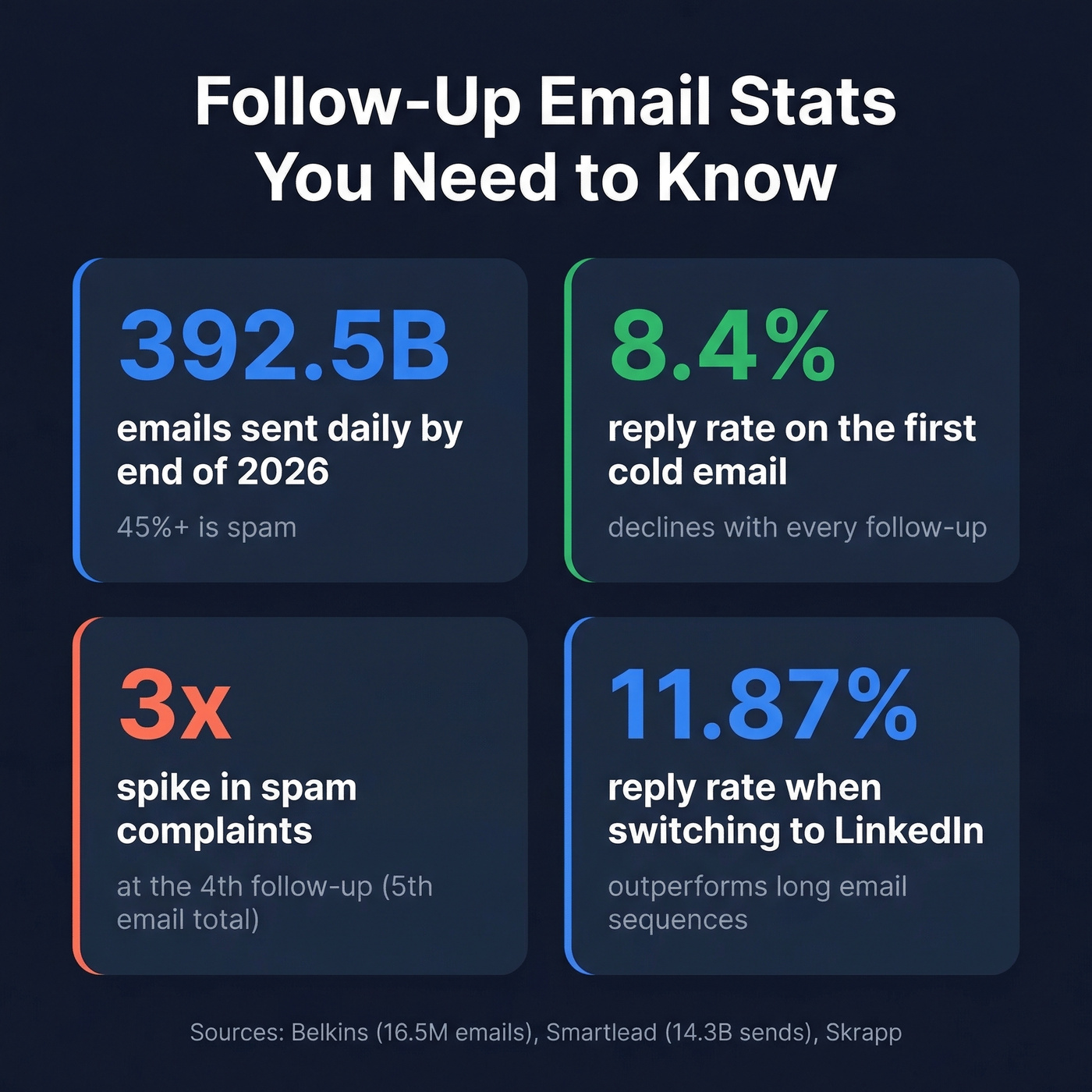
You typed it, stared at it, and felt something was off. That instinct is correct. "I would like to follow up on my previous email" is nine words that announce you're following up without giving anyone a reason to respond. With 392.5 billion emails sent daily by the end of 2026 and over 45% of that traffic being spam, your follow-up needs to earn attention, not just request it.
The phrase fails for three reasons. It's self-referential - it talks about your action instead of their need. It doesn't restate the original ask, forcing the recipient to dig through their inbox. And it adds zero new information. That's not a follow-up. That's a notification.
The best follow-up is one you never have to send. But when you do need one - and you will - here's how to make it count.
What to Say Instead
Three principles before we get into specific phrases:
Restate and ask. Remind them what you need, add something new, close with a specific question. Don't make them do archaeology in their inbox.
Three follow-ups is the ceiling. A 16.5-million cold email analysis from Belkins found that the 4th follow-up (the 5th email total) is where unsubscribe and spam complaints more than triple. After three, you're hurting yourself.
Every follow-up must add new value. A data point, a simplified ask, a deadline. "Just bumping this" isn't value - it's noise. (If you need more ready-to-send options, see our sales follow-up templates.)
Better Follow-Up Phrases by Tone
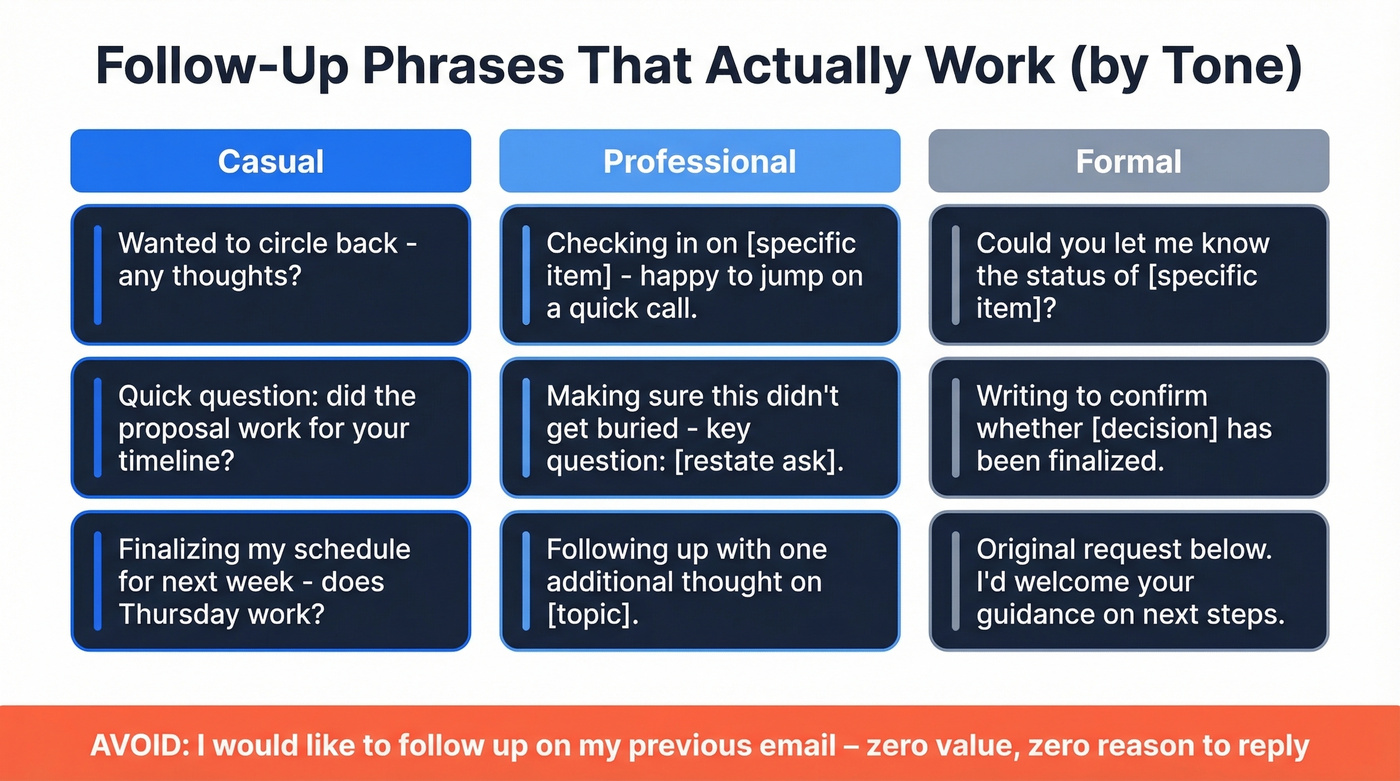
The right phrase depends on who you're writing to. Variations like "I'd like to follow up on my previous email" or "I would like to follow up my previous email" are just as stale as the original - they all center your action instead of the recipient's need. Here are alternatives organized by register so you can match tone to relationship.
| Phrase | Tone | Best For |
|---|---|---|
| "Wanted to circle back - any thoughts?" | Casual | Colleagues, warm contacts |
| "Quick question: did the proposal work for your timeline?" | Casual | Sales follow-ups |
| "Finalizing my schedule for next week - does Thursday work?" | Casual | Meeting coordination |
| "Checking in on [specific item] - happy to jump on a quick call." | Professional | Clients, prospects |
| "Making sure this didn't get buried - key question: [restate ask]." | Professional | Internal requests |
| "Following up with one additional thought on [topic]." | Professional | Networking, proposals |
| "Could you let me know the status of [specific item]?" | Formal | Executive communication |
| "Writing to confirm whether [decision/action] has been finalized." | Formal | Legal, procurement, HR |
| "Original request below. I'd welcome your guidance on next steps." | Formal | Senior stakeholders |
A note on "kindly": in American or British business English, "kindly follow up" or "kindly revert" can sound condescending, especially in reminder contexts. The r/etiquette thread on this topic highlights this concern. "Please" is the safer swap, but overusing it rings hollow too - pair it with a specific ask to keep it genuine.
The r/sales community nails the underlying principle in one line: give a logistical reason to reply. "I'm finalizing my schedule for next week" works because it creates a real deadline, not an artificial one.
Phrases That Sound Passive-Aggressive
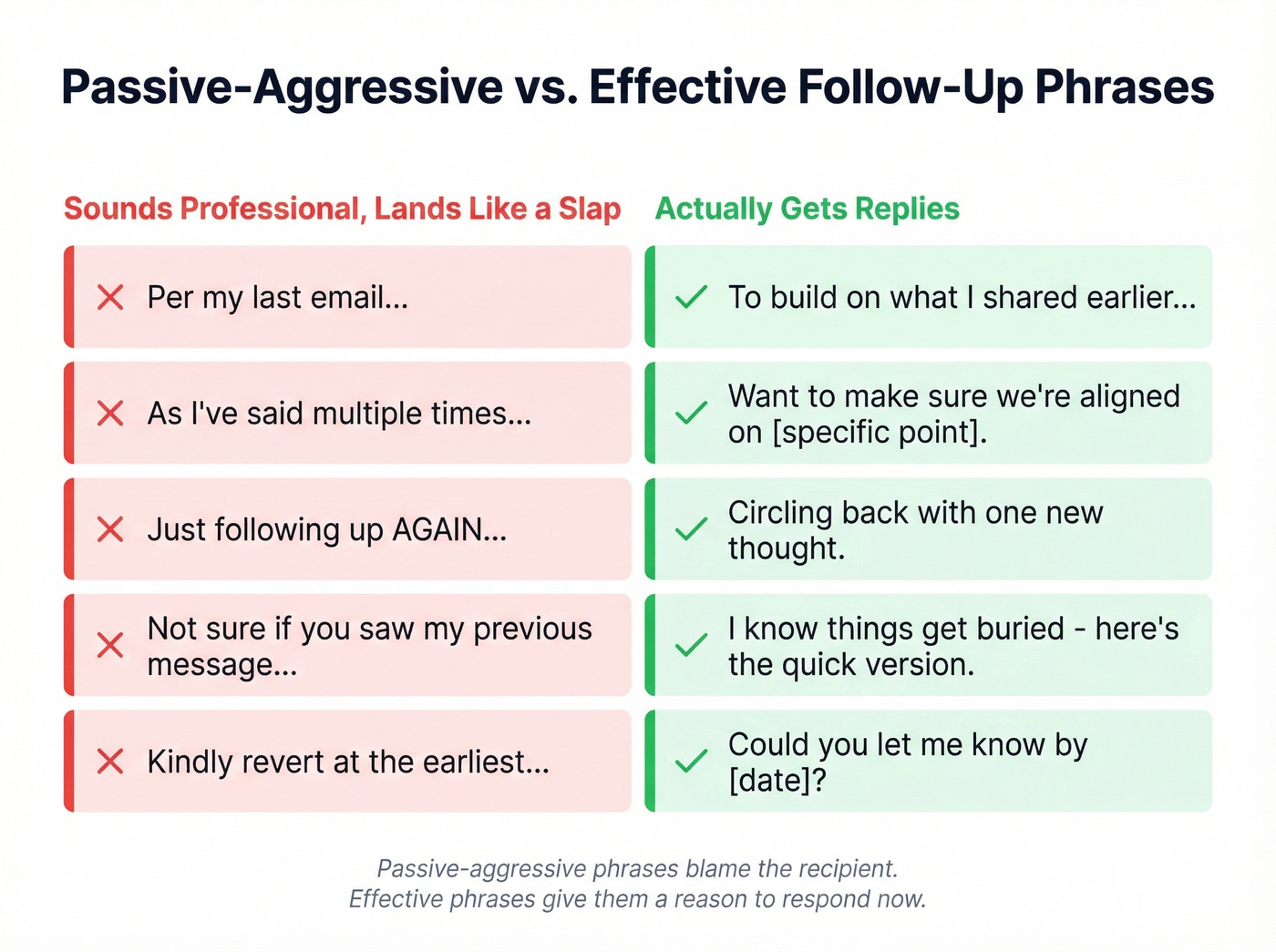
Some phrases feel professional in your head but land like a slap in someone's inbox. Whether you write "I would like to follow up on the email below" or "not sure if you saw my previous message," the subtext is the same: why haven't you replied?
| Don't Say This | Say This Instead |
|---|---|
| "Per my last email..." | "To build on what I shared earlier..." |
| "As I've said multiple times..." | "Want to make sure we're aligned on [specific point]." |
| "Just following up AGAIN..." | "Circling back with one new thought." |
| "Not sure if you saw my previous message..." | "I know things get buried - here's the quick version." |
| "Kindly revert at the earliest..." | "Could you let me know by [date]?" |
Passive-aggressive phrases blame the recipient for not responding. Effective phrases give them a reason to respond now. As Rebecca Zucker wrote in HBR, following up is standard professional communication - but tone determines whether it strengthens or damages the relationship.

The best follow-up is one you never have to send. When your first email reaches a verified inbox, replies come faster. Prospeo's 98% email accuracy and 7-day data refresh mean fewer bounces, fewer follow-ups, and more conversations from email one.
Reach the right inbox the first time - no follow-up needed.
Follow-Up Email Templates by Scenario
Every template below follows one structure: restate context, add value, close with a specific ask. Keep them to 3-5 sentences. We've tested dozens of variations across our own outbound - these are the patterns that consistently get replies. (For more variations, compare these with our cold email follow-up templates.)
Job Application
Subject: Following up on [Role Title] - [Your Name]
Hi [Name], I applied for the [Role Title] on [date] and wanted to check on timing. I'm excited about [specific company detail] and happy to provide anything else you need. What does the timeline look like?
Send 7-10 business days after application. Thank-you notes go out within 24 hours of an interview.
Sales / Proposal
Subject: Quick thought on [their company]'s [challenge]
Hi [Name], since we spoke, I pulled a case study from a similar company that cut [metric] by [X%]. Worth a 15-minute call this week to walk through the numbers?
This works because it adds a new asset instead of restating the pitch. Each follow-up should address a different potential objection - cost, timing, trust, or relevance. Send 3-5 business days after the proposal if you haven't heard back.
Internal Request - Before and After
Before: "Hi [Name], just following up on my previous email about the Q3 report. Let me know your thoughts."
After: "Hi [Name], circling back on the Q3 report I sent Tuesday. I need your sign-off by Friday to keep the launch on track. If there's a blocker, let me know and I'll adjust."
The rewrite names the deliverable, sets a deadline, and offers an escape hatch. Send within 24-48 hours.
Networking
Subject: [Shared context] - let's stay connected
Hi [Name], great meeting you at [event]. Your work on [specific thing] caught my attention - I'd love to stay in touch. Open to a quick virtual coffee this month?
Send within 48 hours. The longer you wait, the less they remember you.
Invoice / Payment
Subject: Invoice #[number] - payment due [date]
Hi [Name], writing about Invoice #[number] for $[amount], due on [date]. Attached again for convenience. Could you confirm when payment will be processed?
Send immediately after the due date. Always re-attach the invoice.
When the Follow-Up Comes From a Team
Sometimes the follow-up comes from a shared inbox or a team account. "We would like to follow up on our previous email" is the default - and it's just as weak as the singular version. Try this instead: "Our team sent over the proposal last Tuesday. We'd love to finalize details this week - does anything need adjusting on your end?" Same rules apply: restate context, add value, close with a specific ask.
Breakup / Final Follow-Up
Here's the thing - this template consistently gets the highest reply rate of any follow-up we've seen, because it gives people permission to say no.
Subject: Should I close this out?
Hi [Name], I've reached out a couple of times about [topic] and haven't heard back - totally understand if priorities shifted. If this isn't relevant, let me know and I'll close it out. No hard feelings.
Send after 2-3 unanswered follow-ups. The data shows diminishing returns after the second follow-up, and unsubscribe/spam complaints jump hard at the 4th follow-up. This is your exit ramp.
When to Send Your Follow-Up
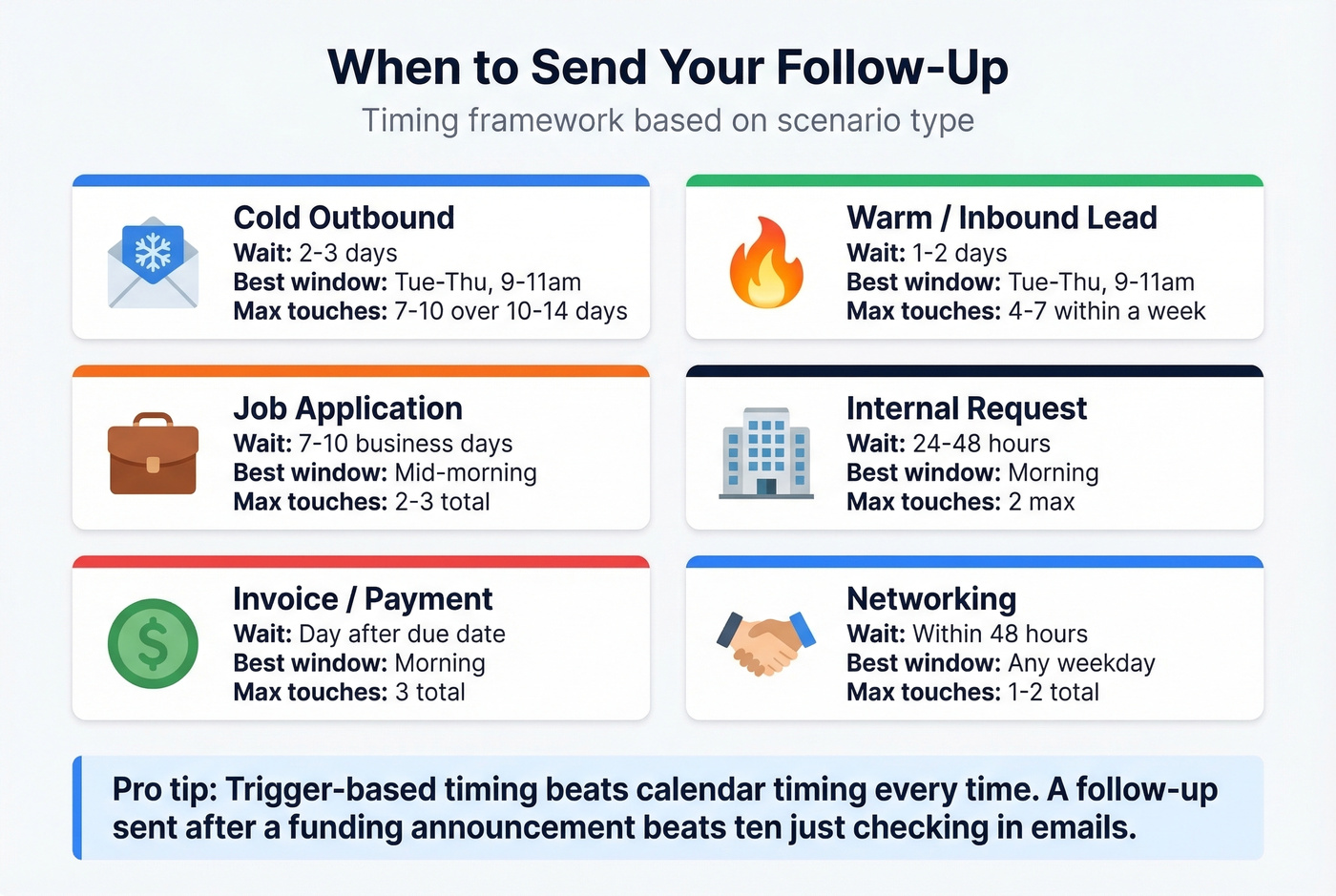
Timing matters more than most people think. Here's a framework based on Sybill's cadence research and standard professional norms. (If you want a deeper breakdown, see when should I follow up on an email.)
| Scenario | Wait Time | Best Window | Max Touches |
|---|---|---|---|
| Cold outbound | 2-3 days | Tue-Thu, 9-11am | 7-10 over 10-14 days |
| Warm / inbound lead | 1-2 days | Tue-Thu, 9-11am | 4-7 within a week |
| Job application | 7-10 biz days | Mid-morning | 2-3 total |
| Internal request | 24-48 hours | Morning | 2 max |
| Invoice / payment | Day after due | Morning | 3 total |
| Networking | Within 48 hours | Any weekday | 1-2 total |
Trigger-based timing beats calendar timing every single time. A follow-up sent the day after a prospect's company announces a funding round is worth ten "just checking in" emails sent on arbitrary Tuesdays. Watch for job changes, product launches, and regulatory shifts - then follow up with context. If your average deal size is modest, this kind of signal-based outreach matters more than any template. (This is also where identifying buying signals pays off.)
Thread or new email? Reply in the same thread. Gmail and Outlook keep the context visible, so the recipient doesn't have to hunt for your original message. Start a new thread only if you're changing the subject entirely or if the original thread is more than two weeks old.
The Data on Follow-Up Effectiveness
Belkins analyzed 16.5 million cold emails across 93 business domains covering all of 2024. The findings are clear: 8.4% reply rate on the first email, declining with each subsequent follow-up, and unsubscribe/spam complaints more than tripling at the 4th follow-up.
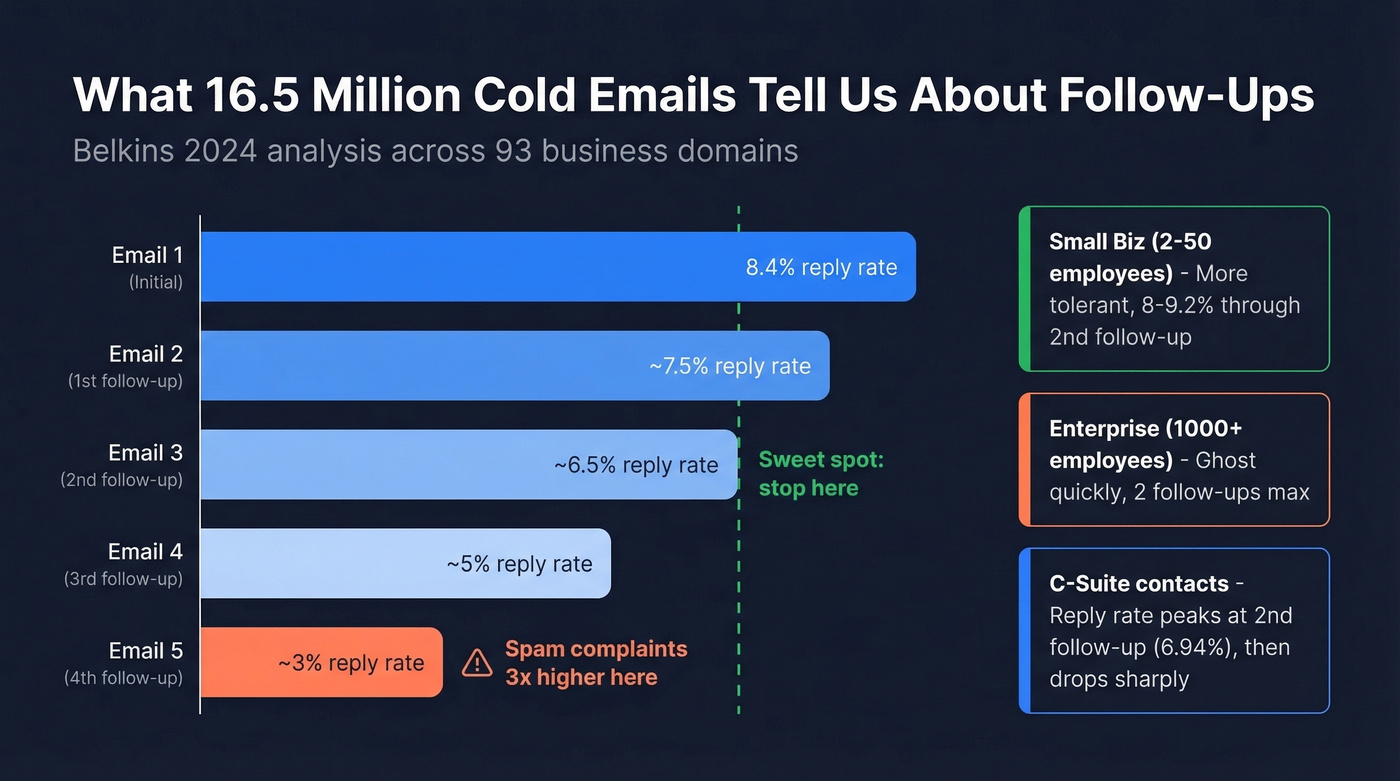
Company size changes the math. Small businesses (2-50 employees) are more tolerant - reply rates stay in the 8%-9.2% range through the second follow-up. Enterprises with 1,000+ employees ghost quickly and punish persistence. If you're emailing a Fortune 500 VP, two follow-ups is your limit.
Founders and C-suite contacts show an interesting pattern: reply rates actually increase slightly through the second follow-up (from 6.64% to 6.94%), then drop sharply. Two follow-ups is the sweet spot for senior decision-makers. No more.
For broader benchmarks, Smartlead's aggregated data across 14.3 billion sends shows roughly 42% open rates, 3% reply rates, and 1% meeting conversion. One caveat: Apple's Mail Privacy Protection inflates open rates, so focus on replies and meetings as your real metrics. And when email threads stall entirely, switching channels helps - a message on a professional network paired with a profile visit pulls an 11.87% reply rate, outperforming long email sequences. (If you're optimizing the whole motion, start with B2B cold email sequence fundamentals.)
Mistakes That Kill Your Follow-Up
Bumping with no new value. "Just making sure you saw this" adds nothing. Every follow-up needs a new angle - a case study, a simplified ask, a deadline. (More examples: how to say just checking in professionally.)
Using "follow-up" in the subject line. It signals "this isn't new information." Preview the new value instead. (If you need inspiration, pull from these email subject line examples.)
No clear CTA. "Let me know your thoughts" isn't a call to action. "Does 2pm Thursday work?" is. Give them something to say yes or no to. (More on structuring asks: email call to action.)
Wrong timing. Same day feels desperate. Two weeks later, they've forgotten the context. Match your cadence to the scenario table above.
Sending to a dead inbox. The average cold email bounce rate is roughly 7.5% - about 1 in 13 follow-ups never reaches a human. Verifying addresses before you send protects deliverability and saves touches. Prospeo checks emails in real time with 98% accuracy on a 7-day refresh cycle, and the free tier gives you 75 verifications per month, so there's no reason to skip this step. (If you're troubleshooting deliverability, start with email bounce rate basics.)
You're perfecting your follow-up phrasing - but none of it matters if the email bounces. Teams using Prospeo cut bounce rates from 35%+ to under 4% and book 26% more meetings. 143M+ verified emails at $0.01 each, no contracts.
Fix the data before you fix the copy.
FAQ
How long should I wait before following up?
Match timing to the scenario: thank-you notes within 24 hours, proposals 3-5 business days, job applications 7-10 business days, invoices the day after the due date. When you're unsure, three business days is the safe default.
Is "I would like to follow up with you regarding" too formal?
For executive, legal, or procurement contexts it's fine. For a colleague or warm prospect it's unnecessarily stiff - swap in something like "Circling back on [topic]" instead. The tone table above helps you match register to recipient.
Is it rude to follow up twice?
No. Two well-timed follow-ups are standard professional communication. The 16.5-million-email study shows reply rates hold through the second follow-up, and complaints don't spike until the 4th follow-up. Two is safe; three is the ceiling.
Should I reply in the same thread or start a new email?
Reply in the same thread. It keeps context visible so the recipient doesn't have to hunt for your original message. Start a new thread only if the subject has changed or the original is more than two weeks old.
What if I never get a response?
After 2-3 unanswered follow-ups, switch channels - call or reach out on a professional network. Continuing to email the same address risks your sender reputation. It's also worth confirming the address is valid before you waste another touch, since roughly 7.5% of B2B emails bounce on average.