

Stop Building Personas. Start Mapping ICP Pain Points.
Every marketing team has one: the beautifully designed ICP deck sitting in a shared drive, collecting dust. It lists company size, industry, maybe a cartoon avatar named "Marketing Mary" who "values efficiency." Nobody opens it. And 68% of B2B buyers say brands all sound the same - which is exactly what happens when your ICP work stops at firmographics instead of the pain points that actually drive buying decisions. 38% of SaaS founders waste ad spend targeting surface traits. The pretty PPT deck isn't just useless - it's expensive.
What Are ICP Pain Points?
Pain points aren't features your product solves. They're the resistance blocking your buyer's progress toward a goal they already care about.
Through a Jobs-to-Be-Done lens: your customer has a "job" - grow pipeline, reduce churn, hit compliance - and pain points are what's standing in the way. User needs = goals + pain points. The goal is where they want to go. The pain point is what's stopping them.
Firmographics tell you who the company is. Pain points tell you why they'd buy. If your ideal customer profile only describes the first half, your outreach sounds like every other vendor in the inbox.
The 5 Categories of B2B Pain Points
Most teams lump all buyer frustrations into one vague bucket. That's a mistake. We use this five-category taxonomy internally, and it forces the kind of specificity that generic frameworks never produce:
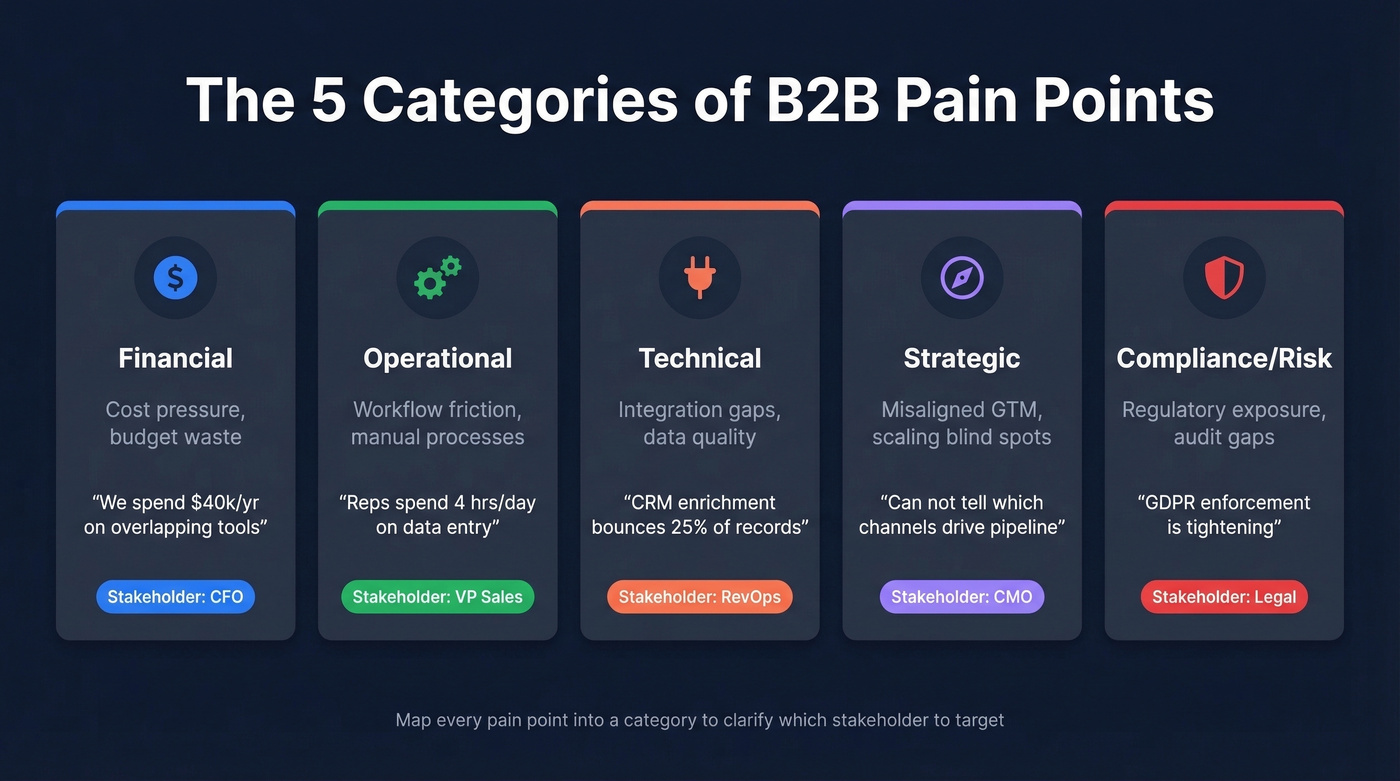
| Category | What It Means | Example |
|---|---|---|
| Financial | Cost pressure, budget waste | CFO: "$40k/yr on overlapping tools" |
| Operational | Workflow friction, manual processes | VP Sales: "Reps spend 4 hrs/day on data entry" |
| Technical | Integration gaps, data quality | RevOps: "CRM enrichment bounces 25% of records" |
| Strategic | Misaligned GTM, scaling blind spots | CMO: "Can't tell which channels drive pipeline" |
| Compliance/Risk | Regulatory exposure, audit readiness | Legal: "GDPR enforcement is tightening" |
Map every pain point you discover into one of these categories. It immediately clarifies which stakeholder your messaging should target - and who needs to be in the buying committee conversation.
How to Discover Buyer Pain Points
Discovery isn't a brainstorm in a conference room. It's a research process.
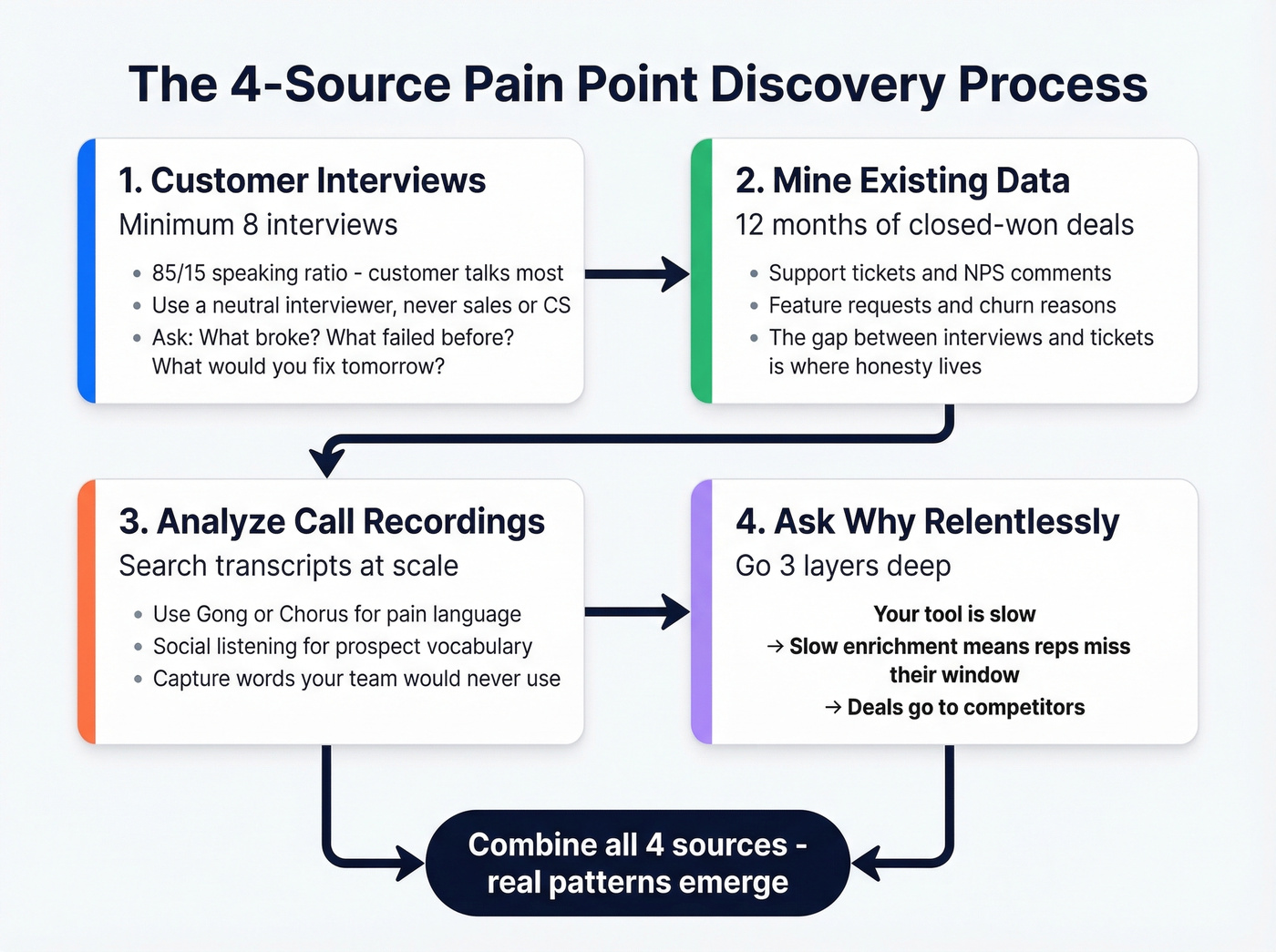
1. Customer interviews. Aim for a minimum of eight - that's where patterns start repeating. Use a neutral interviewer, never sales or CS, because they'll unconsciously steer the conversation. Target an 85/15 speaking ratio: the customer talks 85% of the time. Three questions that consistently unlock real pain: "Walk me through the last time this process broke down." "What did you try before us, and why did it fail?" "If you could fix one thing tomorrow, what would it be?"
2. Mine existing data. Pull 12 months of closed-won deals. Look at support tickets, NPS comments, feature requests. What patterns emerge? We've found that the gap between what customers say in interviews and what they actually do in support tickets is where the most honest pain points live.
3. Analyze call recordings. Search transcripts in Gong or Chorus for pain-related language at scale. Social listening tools like Brand24 surface how prospects describe problems in the wild - often in language your marketing team would never use on its own.
4. Ask "why" relentlessly. "Your tool is slow" isn't a pain point. "Slow enrichment means reps miss their window and deals go to competitors" - that's three layers deeper, and that's where the real messaging lives.
No single source gives you the full picture. Combine all four and the real patterns emerge.

Discovering ICP pain points is half the battle. The other half is reaching decision-makers with verified data. Prospeo's 300M+ profiles with 30+ filters - including buyer intent, technographics, and job changes - let you target prospects by the exact pain triggers you've mapped.
Turn your pain-point research into pipeline that actually converts.
How to Prioritize What You Find
You'll uncover more pain points than you can act on. Here's the thing: that's normal, and it's where most teams stall.
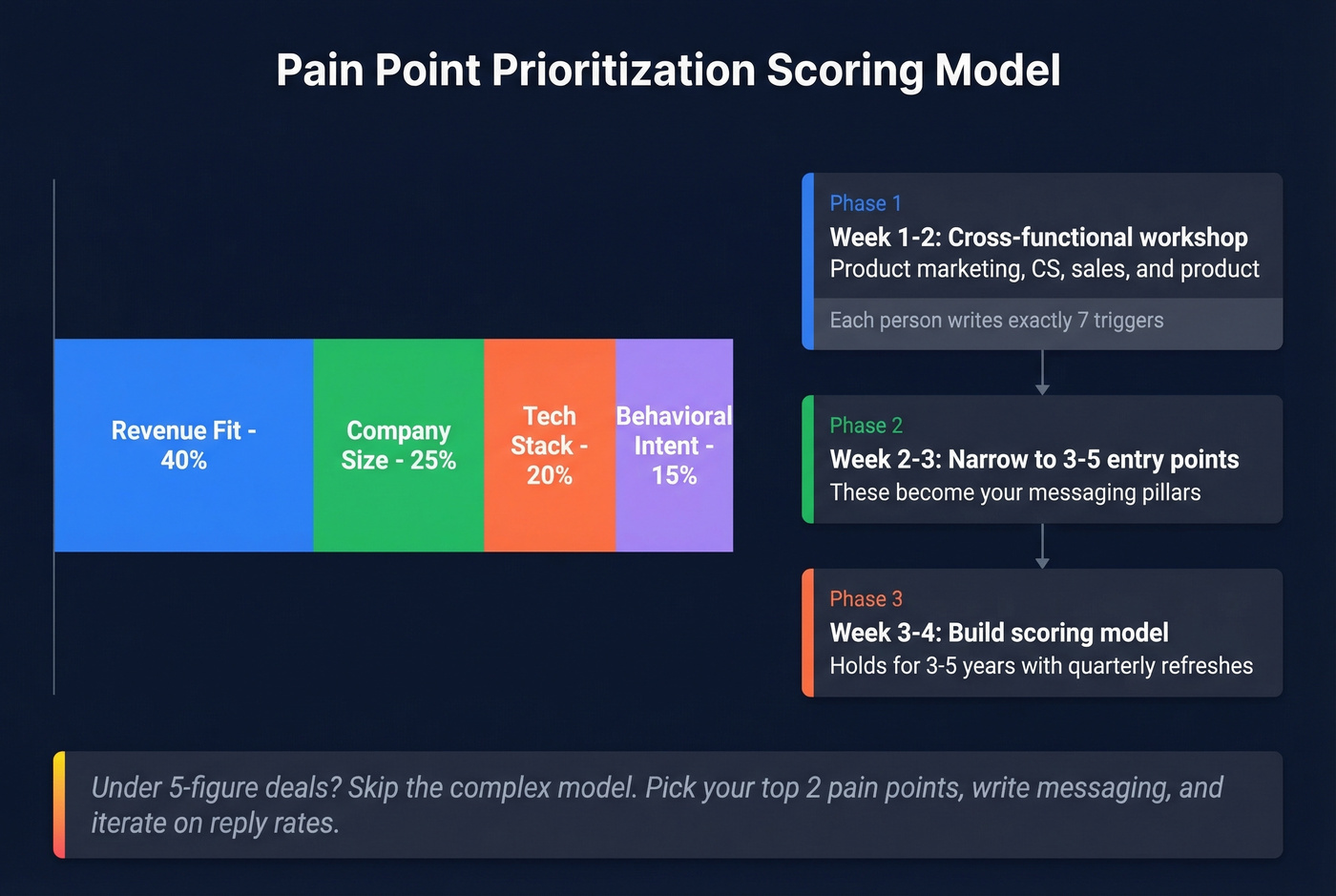
Run a cross-functional workshop with product marketing, CS, sales, and product. Have each person write down exactly seven triggers - the moments when a prospect feels acute pain your solution addresses. Narrow to three to five entry points the whole group agrees on. These become your messaging pillars.
Layer in a scoring model: Revenue Fit (40%), Company Size (25%), Tech Stack (20%), Behavioral Intent (15%). A well-built entry-point strategy holds for three to five years, with quarterly tactical refreshes. Expect the initial build to take two to four weeks. If you want a starting point, use an ICP template with a scoring rubric.
If your average deal size is under five figures, you probably don't need a complex scoring model. Pick your top two pain points, write messaging for them, and iterate based on reply rates. Overengineering the framework is its own form of procrastination - and we've watched teams spend six weeks on a scoring matrix they could've replaced with a spreadsheet and 20 cold emails.
Applying Pain Points Across Your GTM
Cold Email
Pain-point-first emails outperform product-pitch emails by a wide margin. Subject lines with pain-point language lift open rates by 29%, and pain-point openers generate 47% higher response rates. The format working right now: 40-60 words, a specific trigger tied to the prospect's role, and a soft CTA like "Worth a conversation?" If you need inspiration, pull from these email subject line examples.
A CFO opener references rising cost of capital and margin pressure. An HR leader opener calls out 60+ day onboarding cycles. Generic "I noticed your company is growing" doesn't cut it - and your prospects can smell it from the subject line.
Landing Pages
Pain-point-led headlines increase conversions by 40% compared to benefit-led alternatives. Structure each section around a specific pain: describe the problem, reinforce with data or a customer quote, then present your solution. Don't lead with what you built. Lead with what's broken. To keep the funnel measurable, align this with your funnel metrics.
Content Strategy
Blog posts, webinars, and guides should map directly to your top three to five pain points. If "data quality killing deliverability" is a core pain for your ICP, that's a content pillar - not a one-off blog post. Build a cluster around it. (If deliverability is a recurring pain, start with an email deliverability guide.)
Of course, pain-point messaging only works if it reaches the right inbox. One of our customers, Meritt, was running sharp outbound copy but watching 35% of it bounce. After switching to Prospeo for verified contact data, their bounce rate dropped to under 4% and pipeline tripled from $100K to $300K per week. The best message in the world is worthless if it never lands.

Pain-point messaging lifts response rates 47% - but only if it lands. Meritt ran sharp copy on bad data and watched 35% bounce. After switching to Prospeo's 98% accurate emails, bounce dropped to under 4% and pipeline tripled. Your ICP work deserves data that delivers.
Stop letting bounced emails waste your best messaging.
Signs Your Pain Points Are Wrong
Your metrics will tell you before your team does:
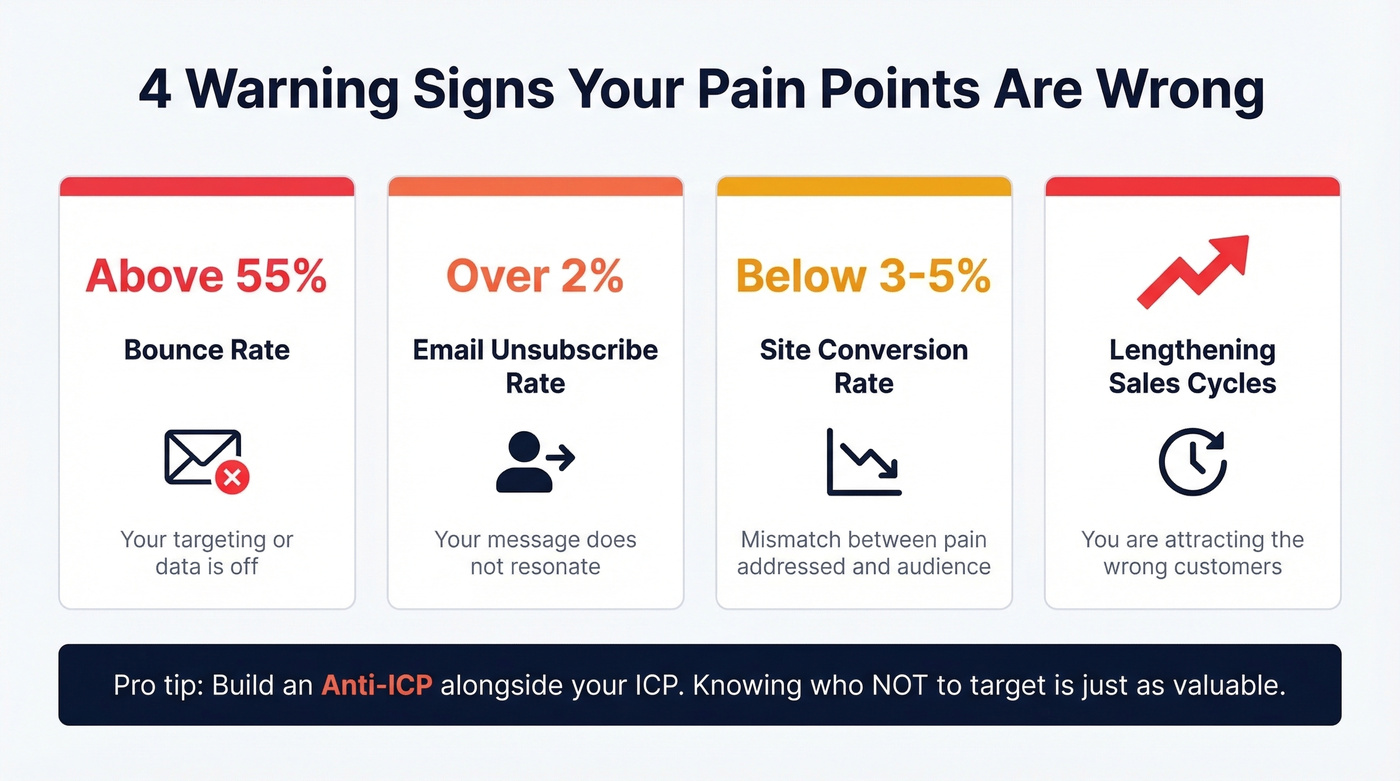
- Bounce rate above 55% - your targeting or data is off (use these email bounce rate benchmarks to sanity-check)
- Email unsubscribe rate over 2% - your message doesn't resonate
- Site conversion below 3-5% - mismatch between pain addressed and audience arriving
- Lengthening sales cycles - you're attracting the wrong customers
Build an Anti-ICP alongside your ICP. Knowing who not to target is just as valuable. Skip this step and you'll spend months optimizing messaging for an audience that was never going to buy.
Common Mistakes
Fairytale personas built without customer input. If nobody on the team has talked to eight real customers in the last quarter, your pain points are fiction. The consensus on r/b2bmarketing is blunt: most ICP decks are "pretty PPT decks with persona stereotypes that get put into some shared area never to be looked at again." Schedule the interviews before the next workshop.
Demographic-only ICPs that describe 40,000 companies and nobody. "Mid-market SaaS in North America" isn't an ICP - it's a TAM slide. Layer in pain points, buying triggers, and tech stack signals to make it actionable. If you need a framework for sizing, start with TAM, SAM, SOM.
One-and-done exercises with no refresh. Markets shift. Pain points evolve. Run quarterly reviews using CRM conversion data and fresh interviews. The pain point that drove 40% of your pipeline last year might be table stakes by now.
FAQ
What's the difference between ICP pain points and buyer persona pain points?
ICP pain points are company-level patterns that make a business a good fit - think budget constraints, tech-stack gaps, or compliance exposure shared across the org. Persona pain points are role-specific frustrations, like a VP Sales hating manual data entry. Map both, but start at the ICP level to define which companies to target, then layer persona-level pain on top for messaging.
How many customer interviews do I need?
Eight is the minimum for reliable patterns - themes start repeating around interview six to eight. Use a neutral interviewer and an 85/15 speaking ratio. Triangulate with CRM data and support tickets to validate what you hear.
How often should I refresh my ICP pain points?
Quarterly, using closed-won and closed-lost CRM data plus two to three fresh customer interviews. Markets move fast. A pain point that drove pipeline six months ago may already be solved by a competitor or baked into buyer expectations. Quarterly refreshes keep your messaging aligned with what buyers actually feel today.