

How to Identify Pain Points That Actually Matter
Your SDR team sends 2,000 emails. 400 bounce. The domain takes a reputation hit, and suddenly even the good emails land in spam. Nobody flags "bad contact data" as a pain point - they blame the copy, the timing, the ICP. That's the thing about identifying pain points: the ones costing you the most money are usually the ones nobody's named yet.
70% of shopping carts get abandoned before checkout, according to Baymard Institute research. 42% of startups fail not because the product was bad, but because the team never found the real friction. Pain points aren't abstract CX jargon. They're the specific moments where customers hit a wall, lose trust, and walk away.
Every unidentified source of friction is revenue leaking out of your funnel. The gap between teams that grow and teams that plateau comes down to how systematically they surface these problems - and whether they fix what's actually behind them.
What You Need (Quick Version)
Short on time? Do these three things:
- Build a SPIN-based discovery script and train your team to probe implications, not just surface problems (pair it with a solid discovery script).
- Mine competitor 1-2 star reviews weekly on G2, Capterra, and Trustpilot for unfiltered pain language.
- Pick one behavioral analytics tool - Mixpanel or Amplitude - and watch where users drop off.
If you only do one thing, stop accepting surface-level answers in discovery calls. Probe implications and cost of inaction. The rest of this guide gives you the frameworks, scripts, and tools to do it right.
The Four Types of Pain Points
Not all customer friction looks the same, and the fix for each is different.
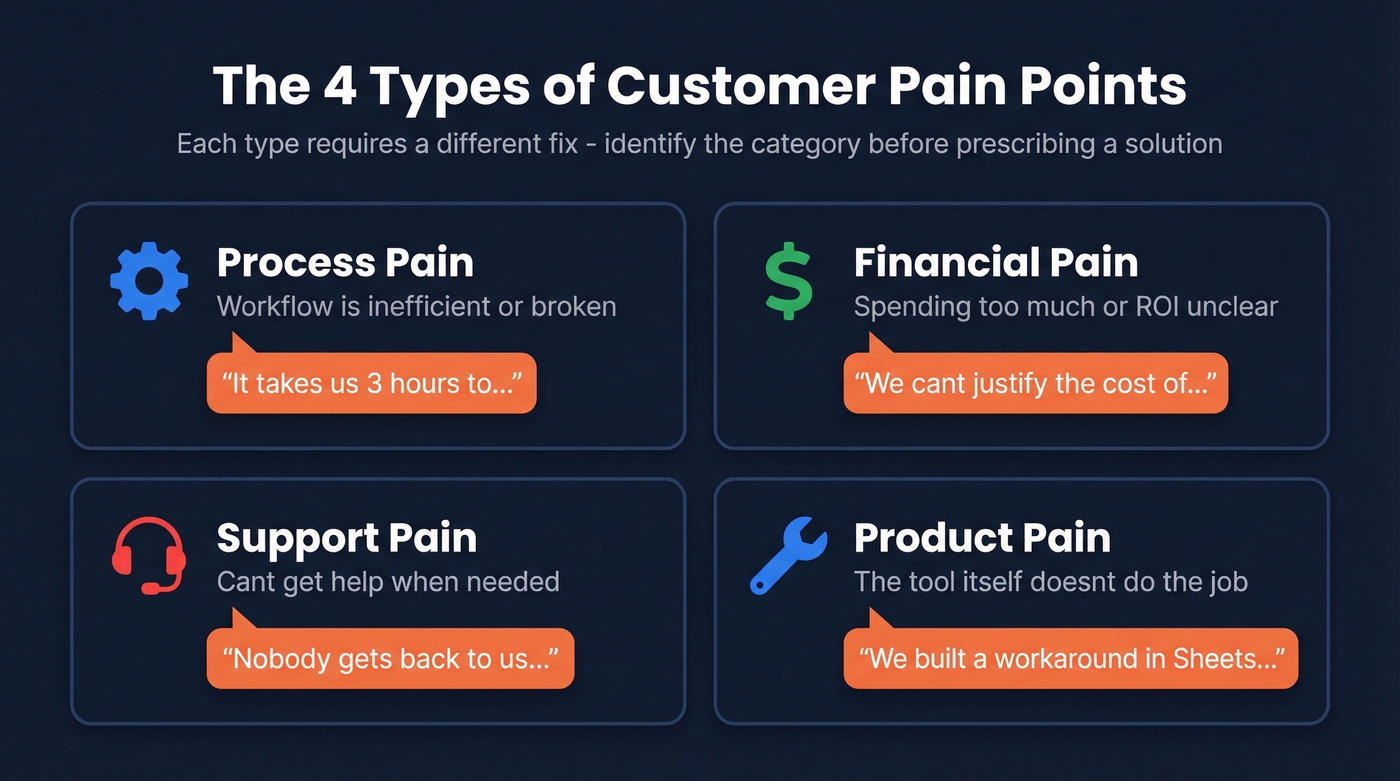
| Type | Definition | Real Example | Signal to Watch |
|---|---|---|---|
| Process | Workflow is inefficient or broken | Manual data entry between CRM and sequencer | "It takes us 3 hours to..." |
| Financial | Spending too much or ROI unclear | Paying $40K/yr for a data tool reps barely use | "We can't justify the cost of..." |
| Support | Can't get help when needed | 48-hour response times on critical issues | "Nobody gets back to us..." |
| Product | The tool itself doesn't do the job | CRM doesn't track multi-threaded deals | "We built a workaround in Sheets..." |
Support pain points are especially dangerous because they compound. 83% of customers expect to interact with someone immediately when they reach out. When that expectation isn't met, the frustration bleeds into how they perceive the product itself - even if the product is fine.
Three Levels of Depth
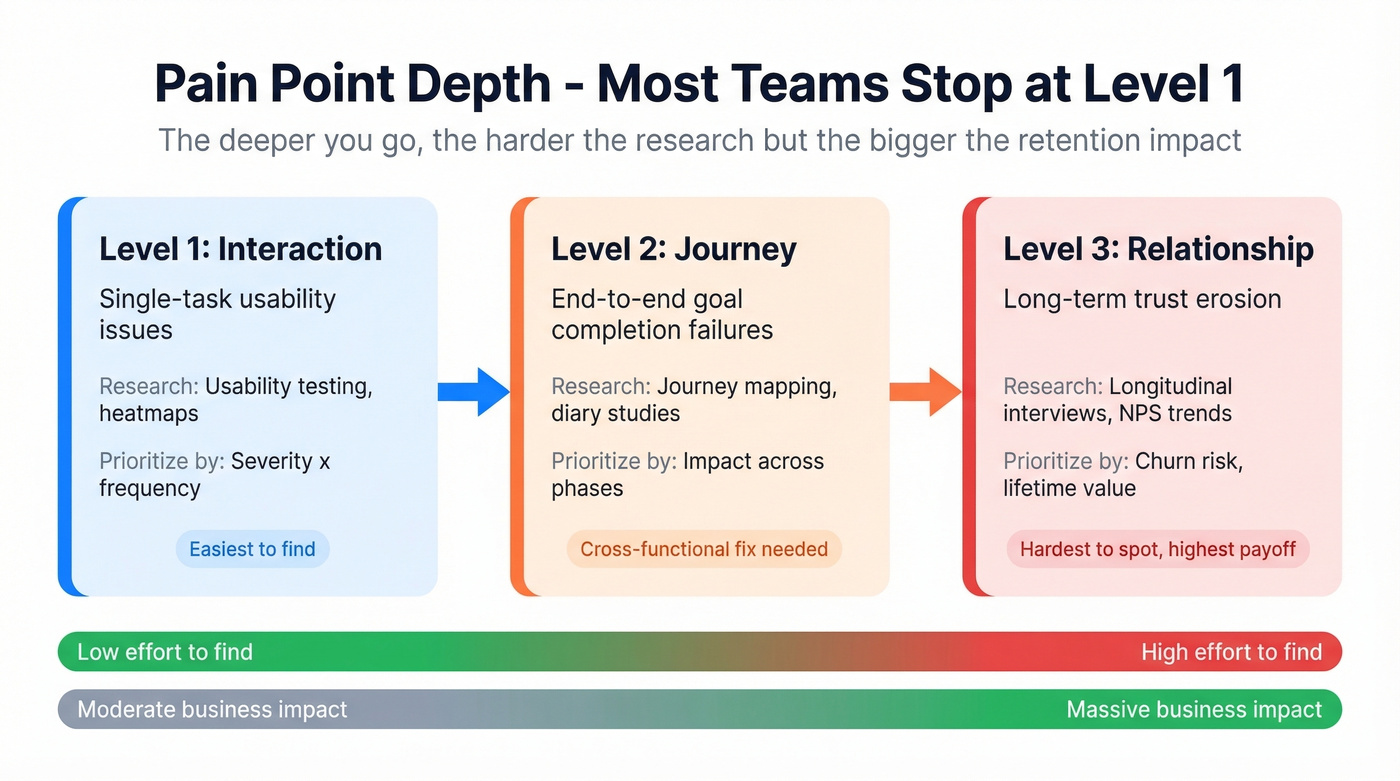
The Nielsen Norman Group developed a three-level model that we've found more useful than most frameworks, because it forces you to think about depth, not just category.
| Level | What It Is | Research Method | Prioritize By |
|---|---|---|---|
| Interaction | Single-task usability issues | Usability testing, heatmaps | Severity x frequency |
| Journey | End-to-end goal completion failures | Journey mapping, diary studies | Impact across phases |
| Relationship | Long-term trust erosion | Longitudinal interviews, NPS trends | Churn risk, lifetime value |
Most teams only address interaction-level issues. They fix a confusing button label or streamline a checkout flow and call it done. That's necessary but insufficient - journey-level problems, like a prospect who gets great demos but terrible onboarding, require cross-functional fixes that no single team owns.
Relationship-level friction is the hardest to spot. It silently drives churn over months, almost invisible unless you're deliberately looking. The research methods get heavier as you go deeper: usability testing catches interaction issues in an afternoon, but relationship-level problems need diary studies, longitudinal interviews, and real patience. The payoff scales accordingly, though. Fixing a relationship-level issue can move retention numbers that no amount of UI polish will touch (and it shows up fast in a good churn analysis).
Identifying Pain Points Across Every Channel
Customer Feedback and Surveys
Customer Effort Score - "How easy was it to [complete this task]?" on a 1-5 scale - is one of the most actionable metrics for finding friction. It forces you to measure effort at a specific moment in the journey, not in the abstract.
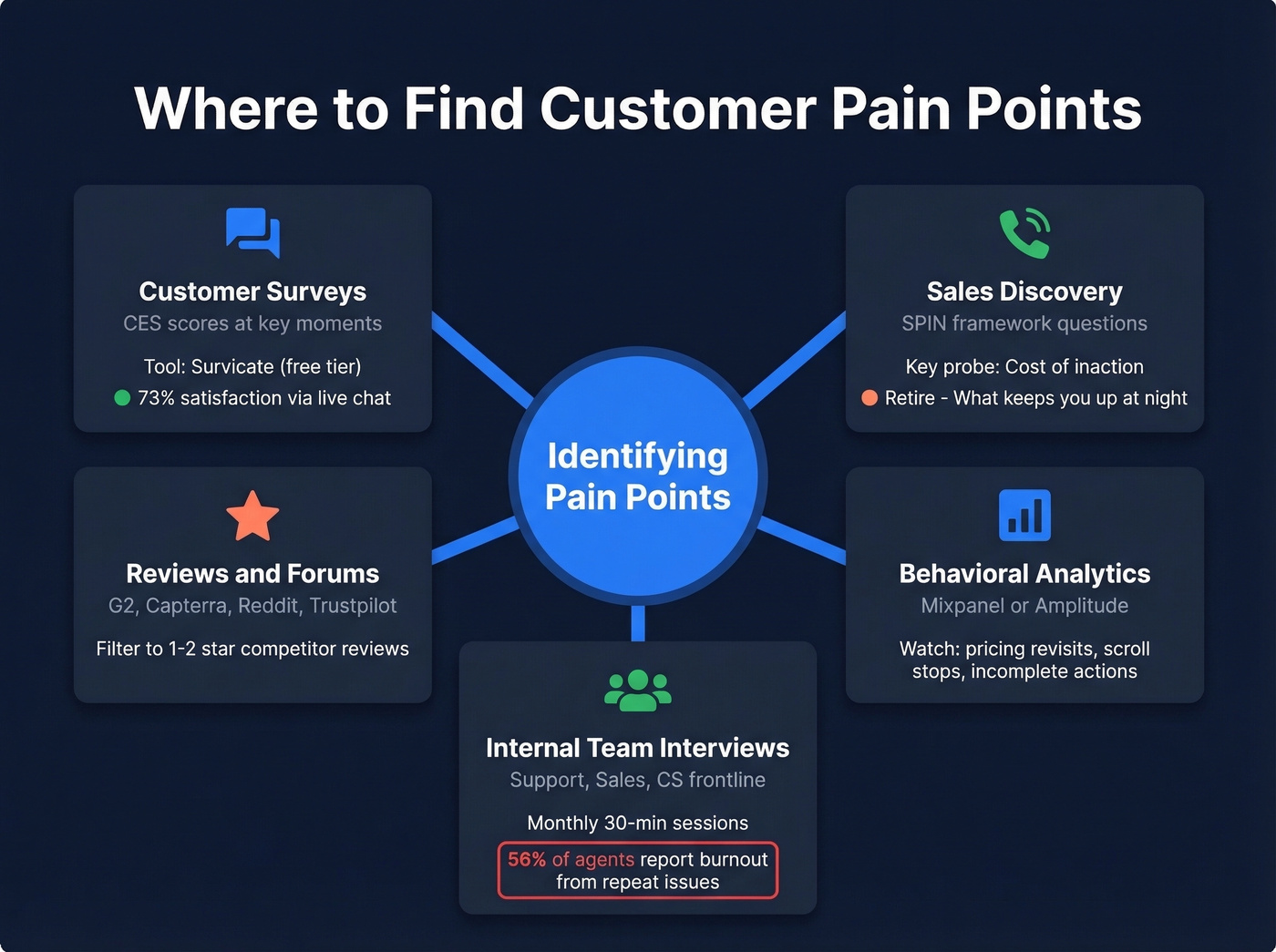
Survicate offers a free tier with 25 responses per month, enough for early-stage teams to start collecting CES data. The key is asking at the right moment: immediately after a support interaction, after onboarding, after first value delivery. Don't batch surveys quarterly. You'll get vague, averaged-out answers that help nobody.
One stat that should change how you think about channels: live chat satisfaction runs 73% vs. 51% for email. If you're only collecting feedback via email surveys, you're hearing from the least satisfied channel and missing real-time signals entirely.
Sales Discovery Conversations
The SPIN framework, developed by Neil Rackham, structures discovery around Situation, Problem, Implication, and Need-Payoff. It's decades old and still one of the best approaches for uncovering customer friction in a live conversation (use these discovery questions to sharpen it).
Questions that work:
- Situation: "Walk me through your current process for [X]."
- Problem: "Where do things break down most often?"
- Implication: "What happens if nothing changes in the next 6 months?"
- Need-Payoff: "How valuable would it be to solve [problem]?"
Questions to retire:
- "What keeps you up at night?" - It's a cliche, and prospects give cliche answers.
- Leading with budget or decision-maker questions before you've earned the right.
- Anything that lets the prospect say "We're fine" and move on.
Here's the thing: the cost-of-inaction question is the single most powerful probe in the sequence. It forces the prospect to articulate consequences they haven't quantified before. We've watched reps transform their close rates just by adding this one question consistently.
Mining Reviews, Forums, and Support Tickets
This is where you find customer frustrations in their own language - unfiltered, unprompted, and brutally honest.
G2 and Capterra are the obvious starting points. Filter to 1-2 star reviews of your competitors and read the "What do you dislike?" field like it's a product roadmap. Trustpilot and Amazon work for B2C or product-led companies. Reddit - especially r/sales and r/startups - gives you candid frustrations that people won't share on a recorded call. The consensus on r/sales is that most outbound teams blame messaging when the real problem is data quality, and that tracks with what we've seen too.
Your own support tickets deserve a monthly review. If the same issue appears dozens of times, that's not a bug report - it's a recurring problem worth solving at the root.
The biggest mistake in pain-point research is doing it from your office chair. Reading your own product docs and brainstorming what customers might struggle with is a recipe for confirmation bias. Go where customers complain when they think nobody from your company is listening.
Behavioral Data and Analytics
What people do matters more than what they say. Behavioral analytics tools like Mixpanel and Amplitude let you watch for micro-signals that reveal friction:
- Pricing page revisits - someone who visits your pricing page multiple times in a week has a financial concern. They want to buy but can't justify the cost internally.
- Scroll-stops - if a large share of users stop scrolling at the same point on a landing page, something above that fold is confusing or unconvincing.
- Repeated incomplete actions - a user who starts the export flow three times but never finishes has a process issue you need to investigate.
These signals are unbiased. Nobody performs for a behavioral analytics tool. The data just shows you where friction lives (and it’s easier to operationalize when you track funnel metrics consistently).
Internal Team Interviews
Your support, sales, and CS teams are sitting on a mountain of customer insight they've never been asked to synthesize. 56% of service agents report burnout, and a big driver is handling the same preventable issues on repeat. Those repeated issues are your most urgent problems to solve.
Run a monthly 30-minute session with frontline teams. Two questions: "What's the most common complaint this month?" and "What do customers expect that we don't deliver?" That's it. You don't need a formal program to start.

The article nails it: teams blame copy and timing when the real pain point is bad contact data. 400 bounced emails out of 2,000 isn't a messaging problem - it's a data problem. Prospeo's 98% email accuracy and 7-day refresh cycle eliminate the hidden friction that tanks your domain reputation and kills pipeline.
Stop diagnosing the wrong pain point. Start with data you can trust.
How to Prioritize What You Find
Identifying pain points is the easy part. Prioritizing them is where most teams stall.
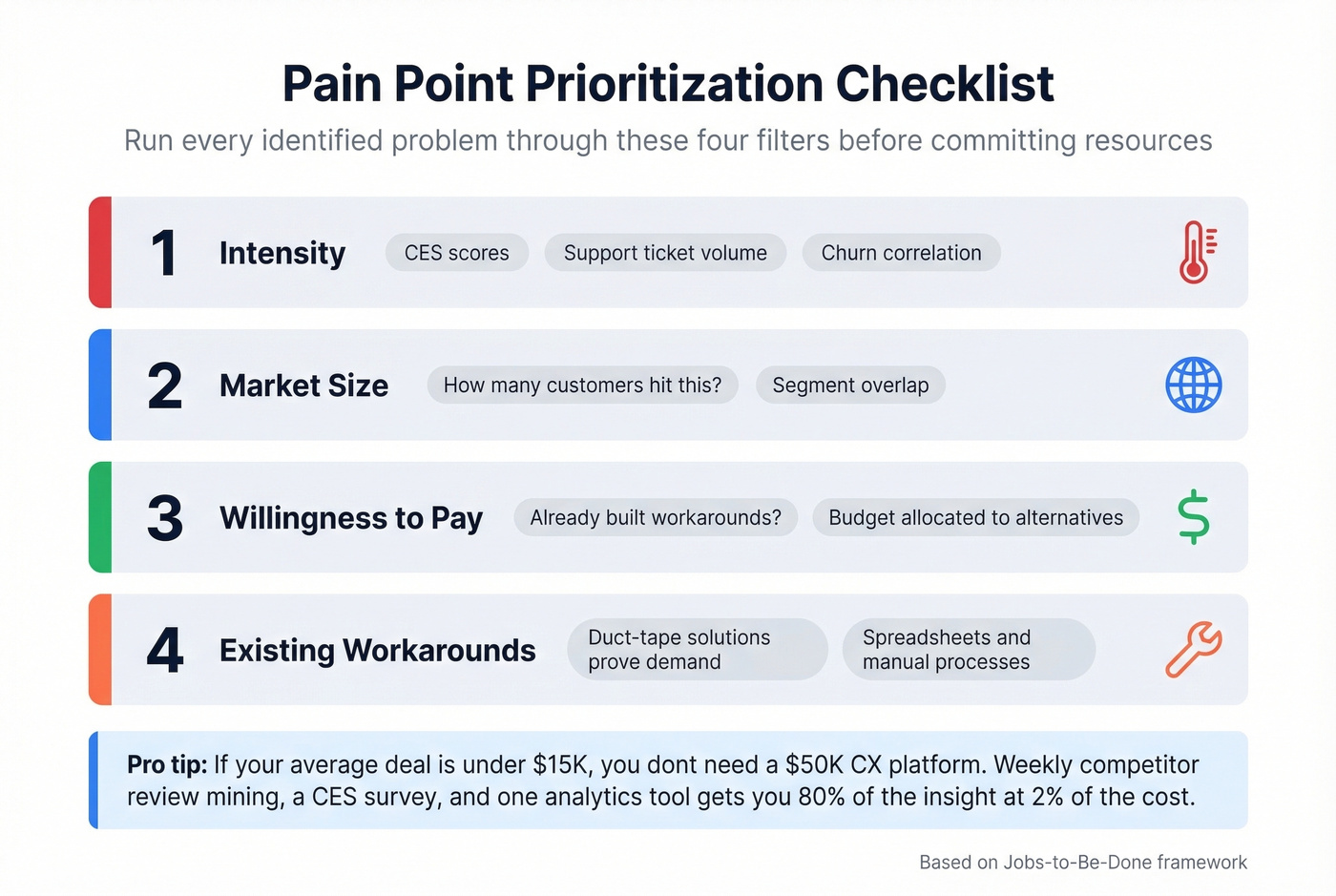
The Jobs-to-Be-Done framework gives you the right lens: friction only matters in the context of a job the customer is trying to get done. Run every problem through this validation checklist:
- Intensity - CES scores, support ticket volume, churn correlation
- Market size - how many customers or prospects experience this?
- Willingness to pay - if they've already built workarounds, the answer is yes
- Existing workarounds - workarounds prove demand; if customers are duct-taping solutions together, the need is real
Don't just fix the surface complaint. Ask what job the customer is trying to complete. Superhuman used this thinking with their "very disappointed" PMF metric, setting a 40% threshold before scaling. That's prioritization with teeth.
Let's be honest: if your average deal size is under $15K, you probably don't need a $50K enterprise CX platform to find friction. A weekly review of competitor G2 reviews, a CES survey, and one behavioral analytics tool will get you 80% of the insight at 2% of the cost. The teams we've watched grow fastest treat pain-point research as a weekly habit, not a quarterly project (especially when they’re already tracking sales pipeline challenges and fixing the root causes).
Five Mistakes That Derail the Research
Office-chair research. Brainstorming problems in a conference room without talking to customers. Get into the review sites and forums.
Solution-first bias. Starting with "we built this feature, now let's find the problem it solves." Pain points come first; solutions follow.
Accepting surface answers. When a prospect says "we're mostly happy," most reps move on. "Mostly happy" means there's a gap - find it.
Ignoring competitor reviews. Your competitors' 1-star reviews are a free roadmap to unmet needs. Read them weekly. Skip this if you're already doing win/loss analysis with real rigor, but most teams aren't.
Skipping validation. A problem mentioned by one customer is an anecdote. A problem confirmed across 20 conversations, 50 support tickets, and behavioral data is a priority.
Real-World Case Studies
Airbnb - Trust as the Core Friction
Airbnb's early growth stalled because guests didn't trust listings with amateur photos. The underlying issue wasn't "bad photos" - it was uncertainty about what they'd actually get. Airbnb sent professional photographers to hosts, and those listings earned 2-3x more bookings. The insight was about trust, not photography.
Drift - Behavioral Signals for Churn
Drift discovered that customers who stopped engaging with certain features were churning at predictable rates. They segmented users by behavioral intent signals and intervened early, cutting churn 18% in under a quarter. No customer ever said "I'm about to churn because I stopped using feature X." The friction was invisible until they looked at the data.
Bad B2B Data - The Invisible Pipeline Killer
Here's a problem we see constantly in outbound teams: bad contact data. A team sends 2,000 cold emails. 400 bounce. The ESP flags the domain. Deliverability tanks across the board, and the team blames the copy, the subject lines, the ICP. Nobody thinks to audit the data (start by monitoring your email bounce rate and fixing the upstream source).
One sales team - Meritt - saw bounce rates drop from 35% to under 4% and pipeline triple from $100K to $300K/week after switching to Prospeo for verified contact data. Bad data is one of those issues that's invisible until you fix it, and then you can't believe you lived with it.
Tools for the Job
Most guides skip tooling and pricing. Here's what each option actually costs:
| Category | Tool | Starting Price | Best For |
|---|---|---|---|
| VoC / Feedback | Survicate | Free (25/mo); $49/mo | Quick surveys |
| VoC / Feedback | Zonka Feedback | $33-$166/mo | Multi-channel |
| VoC / Feedback | AskNicely | $449/mo | Serious VoC programs |
| VoC / Feedback | Nicereply | $59-$239/mo | Support CSAT |
| Product Analytics | Mixpanel | Free; ~$20/mo paid | Event tracking |
| Product Analytics | Amplitude | Free; custom paid | Analytics at scale |
| Enterprise CX | Medallia | ~$50K+/yr | Omnichannel CX |
| Enterprise CX | Qualtrics | ~$30K+/yr | Survey + analytics |
| Enterprise CX | SentiSum | $3,000/mo | AI ticket analysis |
| B2B Data Quality | Prospeo | Free (75 emails/mo) | Verified emails + mobiles |
For most teams, the right starting stack is Survicate plus Mixpanel or Amplitude. That covers both stated and behavioral signals without a massive budget commitment. If bad contact data is dragging down your outbound - and it's more common than most people admit - a tool like Prospeo eliminates it at the source with 98% email accuracy and a 7-day data refresh cycle (and it pairs well with a broader email deliverability guide if you’re cleaning up reputation).

You just read about financial pain points - paying $40K/year for a data tool reps barely use. Prospeo delivers 300M+ verified profiles at $0.01 per email, with no contracts and no sales calls. Teams book 26% more meetings than with ZoomInfo at 90% lower cost.
Solve your biggest financial pain point in under two minutes.
FAQ
What's the Difference Between a Pain Point and a Complaint?
A complaint is a single expression of frustration. A pain point is the recurring underlying problem that generates complaints. If five customers complain about different things during onboarding, the real issue is a confusing onboarding process - the complaints are symptoms. Focus on patterns across 20+ data points, not individual incidents.
How Many Pain Points Should a Team Focus On?
Three to five, maximum. Rank by which ones block the highest-value jobs your customers are trying to complete. Spreading resources across 15 problems means none get fixed properly. Pick the ones with the highest intensity and market size from your validation checklist, then go deep.
How Do You Identify Pain Points in B2B Sales?
Use a SPIN-based discovery script and record calls for pattern analysis - the cost-of-inaction question alone surfaces problems prospects haven't quantified. Layer in Mixpanel or Amplitude to track where prospects drop off in your funnel. For ensuring outreach actually reaches decision-makers, verify emails and phone numbers in real time before sending - bad contact data is one of the most common and invisible friction points in B2B pipelines.
Can You Identify Pain Points Without Talking to Customers?
Partially. Competitor review mining, behavioral analytics, and support ticket analysis all surface real friction without direct interviews. But relying solely on indirect methods risks confirmation bias. The strongest pain-point research combines at least two indirect channels with five to ten live discovery conversations for validation.